Feeling uncertain about what to expect in your upcoming interview? We’ve got you covered! This blog highlights the most important Costume Design for Historical Productions interview questions and provides actionable advice to help you stand out as the ideal candidate. Let’s pave the way for your success.
Questions Asked in Costume Design for Historical Productions Interview
Q 1. Describe your experience researching historical clothing for a specific period.
Researching historical clothing is like being a detective, piecing together clues from various sources to create a complete picture. For example, when working on a production set in 18th-century France, my research would begin with primary sources: paintings, engravings, and surviving garments in museum collections. I would meticulously study the silhouettes, fabric choices, and construction techniques evident in these sources. Then I would delve into secondary sources like academic books, journal articles, and period pattern books to gain a deeper understanding of the social and cultural context surrounding the clothing. This helps me understand not just what people wore, but *why* they wore it, providing crucial insight into class distinctions, regional variations, and evolving styles.
For instance, in studying the French court of Louis XV, I would examine portraits of the aristocracy to understand the opulent fabrics and elaborate embellishments favored by the elite, contrasting this with the simpler, more functional clothing depicted in paintings of the peasantry. This comparative analysis ensures historical accuracy while providing creative license within the established parameters of the period.
Q 2. Explain your process for creating accurate historical patterns.
Creating accurate historical patterns demands a combination of technical skill and historical understanding. I begin by studying surviving garments or detailed illustrations, carefully measuring key features like sleeve width, skirt circumference, and garment length. Then, I draft a modern-day block pattern (a basic pattern for a specific body type) which I manipulate to reflect the historical garment’s distinctive shape. This often involves complex adjustments. For example, a 15th-century gown would necessitate creating a completely different pattern compared to a 1920s flapper dress.
I usually work with both flat and draped patterns. Flat pattern making involves creating a 2D pattern from measurements and drawings, while draped pattern making involves manipulating fabric directly on a dress form to shape the garment. The method depends on the complexity of the garment. Often, a combination of both is necessary. Once drafted, the pattern is tested, adjusted, and refined through multiple muslin mock-ups before finally being cut in the chosen fabric. This iterative process is critical in ensuring both historical accuracy and a well-fitting final product.
Q 3. How do you adapt historical designs to fit modern body types?
Adapting historical designs to modern body types requires a delicate balance between authenticity and wearability. Modern body shapes differ significantly from those depicted in historical sources. To address this, I modify the patterns while retaining the garment’s essential character. This might involve subtly adjusting the seams, adding darts or gores to create a better fit, or modifying the proportions of certain elements. For instance, a tightly fitted Elizabethan ruff might be slightly loosened to improve comfort without compromising the overall historical style.
The key is to make these changes as discreetly as possible, avoiding overt alterations that would disrupt the overall silhouette or aesthetic. I often use modern undergarments or construction techniques to improve fit and comfort, but I carefully select these elements to ensure they remain unseen and do not detract from the historical accuracy of the outer garment. It’s a balancing act, but with careful planning and execution, we can create costumes that are both historically informed and wearable for the actors.
Q 4. What are your preferred methods for sourcing authentic or replica fabrics?
Sourcing authentic or replica fabrics is paramount for achieving historical accuracy. I prioritize sourcing from reputable dealers specializing in historical textiles. For authentic fabrics, this could involve working with antique dealers or museums to acquire existing material. However, this is often expensive and supply is limited. Therefore, I often rely on mills that produce high-quality replicas of historical fabrics, using traditional techniques and materials.
When choosing replica fabrics, I carefully research the period’s fiber content (e.g., linen, wool, silk) and weave structures. I work closely with the mill to ensure the color and texture match the historical prototypes as closely as possible. I always request fabric swatches and conduct dye tests to guarantee color consistency and avoid issues such as color bleeding or uneven dyeing. Documentation of the fabric’s origins and composition is crucial for preserving the historical integrity of the costume.
Q 5. Describe your experience with different historical textile techniques (e.g., embroidery, weaving).
My experience with historical textile techniques is extensive. I’m proficient in many different techniques, including embroidery, weaving, and various forms of surface ornamentation. For example, in recreating a medieval tunic, I would incorporate techniques like hand-stitching and decorative embroidery that were common in that era. Understanding these techniques is crucial in creating authentic-looking costumes. For a 17th-century gown, I might employ needle lace or even goldwork embroidery to capture the opulent details that distinguished the era. Each period presents unique challenges and rewards.
I often consult with textile specialists or artisans experienced in historical techniques. This collaborative approach ensures historical accuracy and often provides unique insights into the finer points of construction and decoration. Sometimes I even incorporate these specialists directly into my production process, depending on the budget and time constraints. This enhances authenticity and allows me to access expert knowledge unavailable elsewhere.
Q 6. How do you manage a costume budget effectively?
Managing a costume budget requires careful planning and meticulous record-keeping. I start by creating a detailed budget breakdown that includes fabric costs, labor costs (including my own time), trim costs, and any other associated expenses. Early on, I collaborate with the production team to establish a realistic budget that takes into account the number of costumes, the complexity of each design, and the overall scope of the production.
To control costs, I explore creative alternatives: using less expensive fabrics where possible, prioritizing readily available materials, and utilizing cost-effective construction methods. I leverage my knowledge of fabrics and techniques to maximize cost-effectiveness without sacrificing historical accuracy or aesthetic appeal. Negotiating with suppliers and artisans to secure favorable pricing is a crucial part of budget management. Regular monitoring of expenses throughout the production process helps me identify potential overruns early and implement corrective measures.
Q 7. Explain your problem-solving approach when faced with fabric shortages or inconsistencies.
Fabric shortages or inconsistencies are common challenges in historical costume design. My problem-solving approach involves a combination of creativity, resourcefulness, and historical knowledge. If a specific fabric is unavailable, I thoroughly research alternative fabrics with similar properties (texture, drape, color) which are historically plausible. I might even adjust the design to accommodate the available fabrics, ensuring that the changes remain within the historical context of the design.
For example, if a specific shade of blue is unavailable for an 18th-century gown, I might substitute it with a closely related shade, documenting the change for reference. If a fabric’s color proves inconsistent, I might work with a textile specialist to dye the fabric to ensure consistency. Sometimes, I might resort to combining different fabrics strategically to minimize the impact of inconsistencies. Documentation of each problem-solving step is crucial for maintain accuracy and preserving the integrity of the costume.
Q 8. How do you collaborate effectively with other departments (e.g., Set Design, Actors)?
Collaboration is the cornerstone of successful historical productions. For instance, on a recent project depicting Victorian England, I began by meeting with the Set Designer to discuss the overall aesthetic – the color palettes, textures, and architectural details of the sets. This informed my costume choices; if the sets were predominantly warm, earthy tones, I leaned toward similar hues in the costumes to maintain visual harmony. Early discussions with the actors are crucial too. I need to understand their characters’ physicality – are they flamboyant or reserved? – as this impacts the silhouette, fabric choice, and overall feel of their costumes. Regular meetings throughout the production process, reviewing sketches, fabric swatches, and even early costume fittings, ensure everyone is on the same page and that the costumes complement the sets and performances seamlessly.
- Example: A scene set in a grand ballroom required lavish gowns. My initial sketches were shown to the Set Designer, who then confirmed the richness of the background would support the opulence of the costumes, avoiding a clash of visual elements.
- Example: Discussions with actors helped us decide on practical yet historically accurate footwear. While high-heeled boots might be historically accurate, an actor might find them impractical for long scenes requiring movement. We found a compromise of lower heels that were still period-appropriate.
Q 9. Describe your experience with different costume construction methods.
My experience encompasses a wide range of costume construction methods, from traditional hand-sewing techniques to modern pattern-making and machine sewing. For example, I’ve worked extensively with period-accurate techniques like hand-stitching tailored garments, using period-appropriate seams like French seams and felled seams for durability. I’m also proficient in using modern tools like computer-aided design (CAD) for pattern creation, which allows for intricate details and precise fitting. Knowing when to employ each method is critical. A delicate 18th-century gown necessitates hand-sewing for the finer details, whereas a sturdy medieval tunic might benefit from machine sewing for efficiency, while still maintaining historical integrity in the design and construction.
- Example: For a recent production set in the 16th century, I utilized hand-sewing for the elaborate embroidery on a noblewoman’s bodice, while employing machine stitching for the lining and undergarments to ensure structural integrity and save time.
- Example: Modern pattern-making software allowed me to create perfectly fitting doublet jackets for the male leads, ensuring accurate historical proportions and a flawless silhouette on the actors.
Q 10. How do you ensure the historical accuracy of costume details?
Historical accuracy is paramount. My process begins with extensive research using primary sources such as paintings, sketches, diaries, and surviving garments whenever possible. Museums and historical societies are invaluable resources, allowing detailed study of surviving examples. I cross-reference this information with scholarly articles and books on the period to ensure the details are accurate and consistent. For example, fabric choices, embellishments, and even the buttons used are carefully considered in relation to the specific time period and social class depicted.
- Example: When designing costumes for a 1780s French Revolution drama, I meticulously researched the types of fabrics (silk, linen, cotton) used by the different social classes, ensuring the characters’ attire reflects their socio-economic standing. The way the fabric was draped also reflected their class.
- Example: The size and placement of lace details on a woman’s gown in the 19th century could vary based on the region and the specific fashion trends. I verified these minute details to ensure regional and temporal accuracy.
Q 11. Explain your process for aging and distressing costumes.
Aging and distressing costumes requires a delicate touch to achieve a believable effect. It’s not about making them look ruined but rather worn and lived-in. My methods involve a variety of techniques that create different levels of wear. For example, I might use tea or coffee dyes to create a faded look, or carefully apply paint to simulate dirt and grime. Fabric manipulation is key; I might strategically fray edges or create wrinkles to suggest usage and time’s passage. Sanding techniques, careful scorching with a candle flame or iron (with extreme caution!), and even strategically placing small tears can all contribute to a more authentic appearance.
- Example: To age a medieval tunic, I used tea dyeing to create faded colors and then strategically rubbed the fabric to create a worn texture around the elbows and knees, suggesting years of wear.
- Example: For a character who’s spent years outdoors, I might create subtle dirt patches using watered-down paints, ensuring they appear natural and realistic rather than simply muddy.
Q 12. How do you maintain the integrity of historical costumes during a production?
Maintaining the integrity of historical costumes during a production is critical. I begin by creating detailed care instructions for each garment. This includes appropriate cleaning methods, storage instructions, and handling protocols. The costumes are stored in protective bags or garment bags, and ideally, we have a designated costume assistant to oversee the care, dressing, and undressing of the actors. Regular inspections are also crucial for identifying any damage early. Minor repairs are carried out immediately and more significant repairs are handled by the costume crew to prevent further damage.
- Example: Each garment has a tag with specific washing or dry-cleaning instructions, and recommendations on how to handle delicate lace or embroidery.
- Example: During a performance run, a designated costume assistant is responsible for inspecting each costume before and after every performance and reporting any damage immediately.
Q 13. Describe your experience with managing a costume crew.
Managing a costume crew involves excellent communication and delegation. I start by clearly outlining roles and responsibilities. I create a detailed schedule with clear timelines and deadlines, which allows for efficient workflow. Regular team meetings keep everyone updated on progress, address challenges, and ensure everyone is comfortable with their tasks. Open communication is vital; I encourage the team to raise concerns or suggest improvements. Creating a supportive and collaborative atmosphere is crucial to ensure the crew is both efficient and maintains morale throughout a potentially stressful production.
- Example: I use project management software to assign tasks to different team members and track progress, ensuring everyone is accountable and deadlines are met.
- Example: Regular team meetings provide opportunities to address any challenges, share best practices, and discuss any creative solutions required during the process.
Q 14. How do you handle costume fittings and alterations?
Costume fittings are an iterative process. I typically schedule several fittings for each actor. The first fitting is often a muslin fitting where the basic shape and fit of the costume are checked. Subsequent fittings incorporate the final fabrics and details. Alterations are handled swiftly and efficiently. I work closely with the actors to ensure the costumes are comfortable and allow for ease of movement. Detailed notes are kept for each fitting, detailing any necessary adjustments to ensure the final product fits perfectly and enhances the performance.
- Example: During a muslin fitting, we might need to adjust the sleeve length or the bodice fit to ensure the garment allows for comfortable movement during scenes requiring physical activity.
- Example: In a final fitting, we will address minor issues like hemming, adjusting seams, or adding any finishing touches to the costume.
Q 15. What software or tools are you proficient in (e.g., CAD, Illustrator)?
My proficiency in software extends to a range of tools crucial for costume design in historical productions. I’m highly skilled in Adobe Illustrator, which I use extensively for creating detailed sketches, developing color palettes, and producing technical drawings for pattern-making. I also utilize Vectorworks for CAD drafting, particularly helpful in designing complex garments and creating accurate scale models for fitting and construction. Additionally, I’m familiar with Photoshop for image manipulation, such as aging fabrics or altering textures digitally to achieve specific historical effects, and utilize CLO3D for 3D garment modeling and pattern creation, which allows for virtual fitting and minimizes material waste.
Career Expert Tips:
- Ace those interviews! Prepare effectively by reviewing the Top 50 Most Common Interview Questions on ResumeGemini.
- Navigate your job search with confidence! Explore a wide range of Career Tips on ResumeGemini. Learn about common challenges and recommendations to overcome them.
- Craft the perfect resume! Master the Art of Resume Writing with ResumeGemini’s guide. Showcase your unique qualifications and achievements effectively.
- Don’t miss out on holiday savings! Build your dream resume with ResumeGemini’s ATS optimized templates.
Q 16. How do you address potential challenges regarding the availability of specific historical materials?
The unavailability of specific historical materials presents a constant challenge in historical costume design. My approach is multifaceted. Firstly, thorough research is paramount – identifying substitute materials with similar textures, weights, and drape. For example, if genuine 18th-century silk is unavailable, I might explore high-quality silk dupioni or even a carefully chosen linen blend that achieves a similar visual effect. Secondly, I engage in creative problem-solving, perhaps employing innovative dyeing techniques or adapting existing fabrics to closely mimic the original material. Thirdly, I will often collaborate with textile specialists or artisans who can produce bespoke fabrics based on my specifications from historical samples. Finally, for exceptionally rare or delicate materials, replication using high-quality photography and digital textile printing can provide a viable solution.
Q 17. Describe your experience working with delicate or fragile historical garments.
Working with delicate or fragile historical garments requires meticulous care and precision. I’ve had the privilege of working with garments dating back to the Victorian era, and the approach involves several key steps. Firstly, a comprehensive condition assessment is carried out, often with the assistance of a textile conservator. This allows us to understand the garment’s fragility and identify areas of potential weakness. Next, handling procedures are established to minimize stress on the fabric, involving specialized gloves and supports. During any fitting or examination, the garment is treated with utmost care, often supported on a specialized mannequin or form. Finally, any needed repairs or stabilization are carried out by qualified conservators, ensuring the preservation of the historical artifact while allowing for safe viewing or limited display.
Q 18. How do you ensure that costumes are comfortable and practical for actors to wear?
Balancing historical accuracy with actor comfort and practicality is crucial. I start by carefully considering the garment’s design, ensuring that its construction allows for ease of movement and avoids restricting the actor’s performance. For example, I might incorporate hidden zippers or strategically placed fastenings instead of historically accurate but impractical lacing. I also collaborate closely with the actors during fittings, allowing them to voice their concerns and make adjustments to ensure comfort and facilitate quick changes. The use of modern, lightweight undergarments can also dramatically improve comfort without significantly compromising the outward appearance. Finally, I may employ breathable fabrics and consider the climate and physical demands of the scenes, particularly for long-duration or physically active performances.
Q 19. How do you approach the design of costumes for different social classes within a historical period?
Costumes serve as powerful visual indicators of social class in historical periods. I translate this into design choices by considering fabric quality, color, embellishment, and silhouette. For example, in a Regency-era production, members of the aristocracy might wear luxurious silks and velvets in rich jewel tones, intricately embellished with lace and embroidery, with garments following the fashionable silhouette of the period. In contrast, the costumes of the working class would be designed using coarser fabrics like linen or wool in muted earth tones, with simpler cuts and minimal ornamentation. The overall effect creates a clear visual hierarchy reflecting the social strata of the time, adding depth and authenticity to the production.
Q 20. What is your process for choosing colors and patterns appropriate for a given era?
Color and pattern choices are critical for historical accuracy. My process begins with extensive research into period-specific palettes and patterns. I consult historical paintings, textiles, and written documents to understand prevalent color combinations and stylistic choices for a given era. For instance, the rich, deep hues of the late medieval period would differ significantly from the pastel shades popular in the Rococo era. Furthermore, I consider the symbolism associated with certain colors in a particular culture and time period. This research informs my choices, ensuring that costumes are not only visually accurate but also reflect the cultural and social context of the story.
Q 21. Describe your approach to creating unique and memorable costumes for characters.
Creating memorable costumes involves a blend of research, artistic interpretation, and collaboration. I begin by analyzing the character’s personality, backstory, and role within the narrative. For example, a villainous character might be clad in dark, brooding colors, with sharp lines and unconventional elements to reflect their menacing nature, while a protagonist might be dressed in brighter, more optimistic colors and softer lines. I also incorporate subtle details that hint at the character’s personality or inner conflicts, perhaps through specific embroidery, jewelry, or accessories. Ultimately, I aim for a design that not only reflects the period accurately but also adds a unique visual language to the character, making them instantly recognizable and memorable to the audience.
Q 22. How do you address the ethical considerations of using historical artifacts in a production?
The ethical use of historical artifacts in a production is paramount. It’s not just about aesthetics; it’s about respecting the past and preserving cultural heritage. My approach involves a multi-step process. First, I thoroughly research the provenance of any potential artifact. This means understanding its origin, age, condition, and any previous exhibitions or uses. Second, I assess the necessity of using the actual artifact versus a high-quality replica. Often, a replica is a safer and more responsible choice, minimizing risk of damage. If an original piece is deemed absolutely essential for artistic reasons, I insist on stringent conservation measures, including appropriate handling, display cases, and environmental controls, collaborating closely with museum curators and conservators. For example, on a recent project involving 18th-century textiles, we meticulously documented each item, used archival-quality display methods, and obtained necessary permits and insurance to mitigate any risks. Transparency and collaboration with relevant institutions are key to ethical sourcing and usage.
Q 23. Explain your experience in creating historically accurate hairstyles and makeup.
Creating historically accurate hairstyles and makeup demands extensive research and understanding of the era’s beauty standards and available materials. I begin by studying period paintings, photographs, and written accounts of fashion. I then consult with historical hairdressers and makeup artists, if possible, or delve into period manuals and guides. For example, working on a Tudor-era production involved learning about the use of elaborate headdresses, veils, and the precise techniques for creating the iconic ‘French’ or ‘heart’ shaped hairline. For makeup, I focus on the limited color palettes available during the era, employing natural pigments and understanding the cultural significance of certain makeup styles. For instance, the use of Venetian ceruse in the 16th century was common but extremely harmful; we opted for safer alternatives while visually retaining its effect. The outcome is never a mere imitation but a thoughtful interpretation, aiming for both accuracy and a safe and comfortable experience for the actors.
Q 24. How do you ensure the safety of the actors while wearing historically accurate costumes?
Actor safety is my utmost priority. While striving for historical accuracy, I avoid compromising safety. This means careful consideration of fabric choices—avoiding materials that are flammable or easily snagged. I ensure that costumes fit comfortably and allow for freedom of movement, especially for fight scenes or physically demanding sequences. For example, I replaced heavy, restrictive 19th-century corsets with lighter, customized undergarments that provided the visual silhouette without restricting breathing or movement. I also work closely with the director and stunt coordinator to assess potential hazards and modify costumes accordingly, perhaps reinforcing seams or using protective underlayers in areas prone to friction or impact. Regular fittings and rehearsals allow for adjustments to guarantee comfort and safety throughout the production.
Q 25. Describe your understanding of historical silhouette and its importance in costume design.
Historical silhouette refers to the overall shape and outline of the body as defined by clothing. Understanding the silhouette is fundamental, acting as a foundation for the entire costume design. It dictates the proportions, volume, and structure of the garments. Each era has distinct silhouettes, reflecting social norms, technological advancements, and cultural preferences. For example, the voluminous skirts and tightly laced bodices of the Elizabethan era contrast sharply with the slimmer, more streamlined silhouette of the 1920s. Mastering these silhouettes is crucial for achieving historical authenticity. By paying close attention to the silhouette, I can help to immediately convey the time period to the audience and establish a strong visual foundation for the character’s presentation.
Q 26. How do you approach the design of costumes that accurately reflect the social and cultural context of the time period?
Costumes are not just garments; they are powerful tools that communicate social status, occupation, and cultural beliefs. To accurately reflect the socio-cultural context, I conduct thorough research on social hierarchies, class distinctions, religious practices, and prevalent fashion trends. For instance, when designing costumes for a medieval production, I would differentiate the clothing of a peasant from that of a noblewoman through fabrics, embellishments, and overall construction. The choice of colours and patterns also holds significance. Certain colours might have denoted religious affiliation or social standing. Detailed research ensures that the costumes serve not only as aesthetically pleasing garments but also as meaningful visual narratives, conveying the characters’ place within the specific historical society.
Q 27. What are your preferred methods for documenting your costume design process?
My preferred methods for documenting the costume design process are multifaceted, combining both traditional and digital tools. I begin with extensive sketching and mood boards, creating visual representations of the costumes, and documenting color palettes, fabrics, and design inspiration. Then I use digital tools to create detailed technical drawings, including measurements, pattern specifications, and material details. This ensures clarity for the construction team. I photograph samples of fabrics and trimmings, and maintain a detailed log of every alteration and decision made throughout the process. Digital tools such as Adobe Photoshop and Illustrator are essential for creating presentations for producers and directors. Finally, detailed photographic documentation of the finished costumes ensures a complete record of the production’s visual aesthetic.
Q 28. Describe your experience working on a production with specific historical requirements (e.g., specific events, battles).
Working on a production with specific historical requirements, such as depicting a particular battle or event, presents unique challenges and opportunities. For example, my work on a production portraying the Battle of Agincourt required meticulous research into the military uniforms and weaponry of the time. This involved studying contemporary illustrations, archaeological findings, and historical texts. The accuracy of the armor, weaponry, and troop uniforms needed to be precise, not just visually, but in terms of how the clothing functioned in a combat setting. It involved consultation with military historians and armor specialists to ensure the correct weight, fit, and construction of the costumes. This painstaking research process, combined with the practical needs of the actors’ mobility and safety, ultimately created costumes that were both historically accurate and suitable for the dynamic demands of the battle scenes.
Key Topics to Learn for Costume Design for Historical Productions Interview
- Research & Historical Accuracy: Understanding the nuances of historical periods, fashion trends, social classes, and cultural influences on clothing. This includes sourcing reliable research materials and effectively interpreting them.
- Fabric Selection & Sourcing: Knowledge of various fabrics, their properties (drape, texture, durability), and appropriate sourcing for historically accurate reproductions or stylistic interpretations. Consider budget limitations and ethical sourcing.
- Pattern Making & Drape: Demonstrating an understanding of historical pattern-making techniques and the ability to adapt modern methods to achieve period-specific silhouettes. Highlight expertise in draping techniques for unique garments.
- Construction Techniques: Familiarity with historical sewing techniques, embellishment methods (embroidery, lacemaking, etc.), and the tools used in each era. Be prepared to discuss your proficiency and adaptability.
- Color Theory & Palette Development: Ability to create historically informed color palettes, understanding the availability and use of dyes in different periods. Showcase your understanding of color symbolism and its impact on storytelling.
- Budgeting & Resource Management: Demonstrating skills in creating realistic budgets, sourcing materials cost-effectively, and managing resources efficiently within project constraints.
- Collaboration & Communication: Highlighting experience in collaborating with directors, actors, other designers, and technicians. Emphasize effective communication and problem-solving skills in a collaborative environment.
- Problem-Solving & Adaptability: Be prepared to discuss how you approach challenges like sourcing difficult-to-find materials, adapting designs to accommodate actor limitations, or working with unexpected budget cuts.
Next Steps
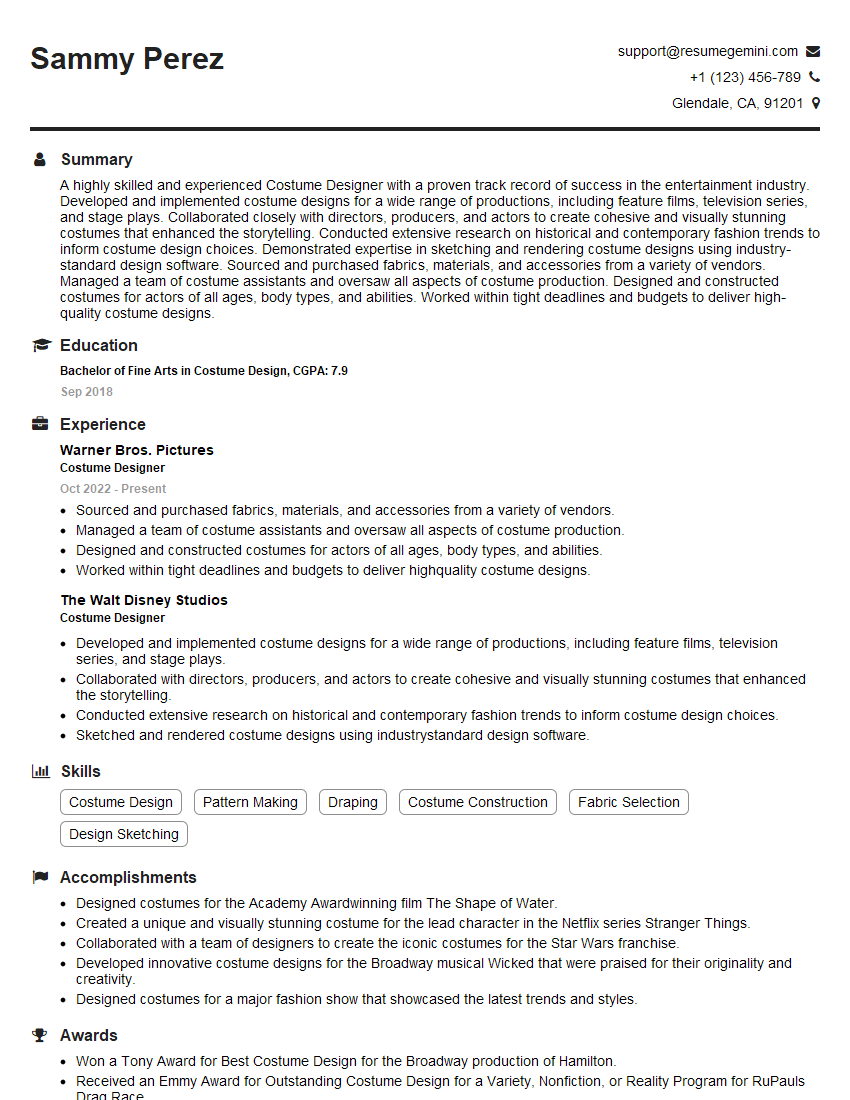
Mastering Costume Design for Historical Productions opens doors to exciting and fulfilling careers in theatre, film, television, and museums. A strong resume is crucial for showcasing your skills and experience to potential employers. Creating an ATS-friendly resume is essential to ensure your application gets noticed. ResumeGemini is a trusted resource for building professional and effective resumes that highlight your unique qualifications. Examples of resumes tailored to Costume Design for Historical Productions are available to help you create a compelling application.




Explore more articles
Users Rating of Our Blogs
Share Your Experience
We value your feedback! Please rate our content and share your thoughts (optional).
What Readers Say About Our Blog
I Redesigned Spongebob Squarepants and his main characters of my artwork.
https://www.deviantart.com/reimaginesponge/art/Redesigned-Spongebob-characters-1223583608
IT gave me an insight and words to use and be able to think of examples
Hi, I’m Jay, we have a few potential clients that are interested in your services, thought you might be a good fit. I’d love to talk about the details, when do you have time to talk?
Best,
Jay
Founder | CEO