Cracking a skill-specific interview, like one for Lock Picking, requires understanding the nuances of the role. In this blog, we present the questions you’re most likely to encounter, along with insights into how to answer them effectively. Let’s ensure you’re ready to make a strong impression.
Questions Asked in Lock Picking Interview
Q 1. Explain the difference between a pin tumbler lock and a wafer lock.
Pin tumbler locks and wafer locks are both common types of mechanical locks, but they differ significantly in their internal mechanisms. Think of it like comparing a complex clock to a simpler, more basic mechanism. A pin tumbler lock uses a series of pins that must be aligned precisely to allow the lock to open. These pins are divided into two parts: driver pins and key pins. The key lifts the pins to the correct height, aligning them within the lock’s cylinder, allowing the core to rotate and the lock to open. A wafer lock, on the other hand, uses thinner, flat wafers instead of pins. These wafers have a notch cut into them and align only when the correct key is inserted. The key shapes the wafers in a specific order which allows the lock to open.
In essence, pin tumbler locks are more complex, offering higher security due to their multiple interacting components, while wafer locks are simpler, offering less resistance to picking or bumping.
Q 2. Describe the process of picking a pin tumbler lock.
Picking a pin tumbler lock involves manipulating the internal pins to mimic the action of the correct key. It’s a delicate process requiring patience and precision. Imagine each pin as a tiny puzzle piece that needs to be set perfectly in place. The process typically involves using tools like tension wrenches and picks. The tension wrench applies slight torque to the lock cylinder, while the pick is used to carefully lift each pin to the shear line (the point where the pin is correctly aligned). Once all pins are set, the cylinder will rotate, and the lock will open.
The process often involves feeling the ‘set’ of each pin – a slight click or resistance indicating it’s in the correct position. It’s a tactile process requiring a keen sense of touch and feel.
Q 3. What are the different types of lock picking tools and their applications?
Lock picking tools are specialized instruments designed for precise manipulation of lock mechanisms. Some common tools include:
- Tension Wrenches: These apply torque to the cylinder, allowing the pins to be manipulated.
- Picks: These are used to lift and set the pins. Different picks have various shapes and sizes for different lock types and complexities.
- Rakes: These are used for a faster, less precise method of picking (raking), though less reliable.
- Hooks: Specialized picks designed to snag and manipulate specific pins.
- Dimple Picks: Designed for dimple locks, which have a significantly different mechanism.
The application of each tool depends entirely on the type of lock and the picker’s preferred method. For example, a hook might be ideal for a specific pin that’s proving difficult to set with a standard pick. Professional lock pick sets often include a variety of tools to cover a range of lock types and picking techniques.
Q 4. How do you identify a lock’s vulnerability?
Identifying a lock’s vulnerability involves a combination of visual inspection and understanding of lock mechanics. Look for signs of wear and tear, such as loose parts, damaged casing, or obvious signs of tampering. The type of lock itself is a factor – wafer locks, for example, are generally more vulnerable than high-quality pin tumbler locks. The material of the lock is also a factor; cheap materials are more likely to be weaker and easier to pick.
Understanding the lock’s manufacturer and model can provide clues to its inherent security features or known vulnerabilities. While some locks might appear outwardly secure, subtle manufacturing flaws or design weaknesses could make them susceptible to specific picking techniques.
Q 5. What safety precautions should be taken while lock picking?
Safety is paramount when lock picking. Never attempt to pick locks without the owner’s explicit permission. Picking locks illegally is a crime. Always practice in a controlled environment, away from sensitive areas and potential hazards. Be mindful of sharp tools and take precautions to avoid injury. It’s important to understand that lock picking requires a fine motor skills and dexterity; repetitive use can cause strain.
It’s crucial to respect the legal implications and ethical considerations. Even for educational purposes, ensure you’re complying with all applicable laws and regulations. Focus on ethical considerations and legal implications, before even starting to practice.
Q 6. Explain the concept of ‘raking’ in lock picking.
Raking is a less precise lock picking technique compared to single pin picking. It involves using a rake pick—a tool with multiple teeth—to simultaneously attempt to set all the pins at once. It’s like shaking a set of keys in a lock with the hope that the right one aligns and the lock opens. This method is often faster but less reliable than single pin picking, and its success rate depends heavily on the lock’s design and the skill of the picker.
Raking can be effective on older or cheaper locks, which may have weaker or less precise tolerances. However, it’s less effective on modern, high-security locks. Think of it as a shortcut; sometimes it works, sometimes it doesn’t.
Q 7. Describe the process of ‘single pin picking’.
Single pin picking is a methodical and precise technique where each pin is manipulated individually. It’s much slower but considerably more reliable than raking. Imagine carefully placing each piece in a complex puzzle one by one, feeling each component and meticulously placing it into the right place. Using a pick, the picker feels each pin individually, carefully lifting and setting it until a distinct ‘click’ is heard, indicating it’s at the shear line. This process is repeated for every pin until all are set.
This technique requires a great deal of patience and practice to develop the necessary tactile sensitivity. It’s the preferred method for professional locksmiths and security experts because of its higher success rate and control.
Q 8. What are the ethical considerations of lock picking?
The ethics of lock picking are complex and hinge on intent and legality. It’s crucial to distinguish between ethical lock picking, such as for educational purposes, security consulting, or locksmithing, and unethical lock picking, such as for illegal entry or theft. Ethical lock picking involves respecting property rights and only engaging in activities with explicit consent. For instance, a security consultant might pick locks to assess a client’s security vulnerabilities, providing a report to help improve their system, but would never use this knowledge for personal gain. Conversely, picking locks without permission to gain unauthorized access is a serious breach of ethics and the law.
- Consent: Always obtain explicit permission before picking any lock.
- Purpose: The purpose of the lock picking must be ethical and legal.
- Respect for Property: Never damage property or leave locks in an insecure state.
Q 9. How do you handle a lock that is unusually difficult to pick?
Encountering a particularly difficult lock requires patience, methodical approach, and a comprehensive understanding of lock mechanisms. My first step would involve careful observation – assessing the type of lock, its wear, and any potential manufacturing flaws. I’d then systematically try different picking techniques, beginning with the simplest and gradually progressing to more complex methods. If the pins are particularly stubborn, I might use specialized tools like a tension wrench with a finer tip for more precise manipulation. If the lock has security pins, I’d carefully study their behavior and adjust my picking technique accordingly. Sometimes, understanding the lock’s internal workings is essential – sometimes even a slight variation in the way the lock’s components interact can significantly impact the picking process. In extreme cases, after exhausting all reasonable attempts, it might be necessary to consider destructive entry, but this should always be the last resort.
For example, I once encountered a high-security Abloy lock. Its unique pin tumbler mechanism with rotating discs was particularly challenging. I had to meticulously study the lock’s behavior under tension, understanding how the discs interact with the pins to achieve a proper alignment. Only after hours of careful manipulation and adjustments could I successfully pick it.
Q 10. What are the common causes of lock failure?
Lock failure can stem from various causes, broadly categorized into mechanical and environmental factors. Mechanical failures often arise from wear and tear, poor manufacturing, or forced entry attempts. Environmental factors like corrosion, extreme temperatures, and exposure to chemicals can also significantly compromise a lock’s integrity. Here’s a detailed breakdown:
- Mechanical wear: Over time, constant use leads to wear on the pins, springs, and other internal components, causing them to malfunction.
- Manufacturing defects: Locks with poor manufacturing quality often exhibit weaknesses that make them vulnerable to picking or manipulation.
- Forced entry: Unsuccessful attempts at breaking into a lock can cause damage, weakening the entire mechanism and potentially leading to failure.
- Corrosion: Exposure to moisture or chemicals can corrode internal parts, jamming the lock and rendering it inoperable.
- Extreme temperatures: Extreme heat or cold can affect the material properties of the lock components, causing warping, expansion, or contraction, leading to malfunctions.
Q 11. How do you maintain and care for lock picking tools?
Proper care is vital for maintaining the longevity and effectiveness of lock picking tools. Regular cleaning and lubrication are key. After each use, I meticulously clean my tools with a soft cloth and a suitable cleaning solvent to remove any debris or residue. A light application of a suitable lubricant, such as a high-quality lock picking lubricant, helps ensure smooth operation and prevents wear and tear. It’s crucial to store the tools in a protective case to avoid damage or loss. Sharpening tools like picks might also be needed periodically, but this must be done carefully using appropriate tools and techniques to prevent damage to the delicate tips.
For example, regularly cleaning my tension wrenches prevents debris from interfering with the smooth application of tension, and lubricating my picks reduces friction, making them more effective and preventing damage to the delicate tips during use.
Q 12. Describe your experience with various lock mechanisms.
My experience encompasses a broad range of lock mechanisms, including pin tumbler locks (the most common type), wafer locks, disc detainer locks, lever locks, and various high-security locks. I’ve worked with different variations within each category, including those with anti-picking features like serrated pins, mushroom pins, and spool pins. Each mechanism presents unique challenges and demands a specific approach. Understanding the internal workings of each is crucial, as it dictates the appropriate picking techniques. For example, the picking technique for a simple pin tumbler lock differs considerably from that of a complex dimple lock or an Abloy disc tumbler lock. My experience allows me to quickly identify the type of lock and select the appropriate tools and technique for successful picking.
Working with high-security locks has been particularly rewarding, requiring both advanced technical skills and a deep understanding of the security principles involved. Successfully picking these locks requires a deep understanding of how the internal components interact. A specific example is the challenge posed by Medeco locks, known for their high security features. Picking these locks requires a deep understanding of the warding system and the correct manipulation of the pins.
Q 13. What are the legal implications of lock picking?
The legal implications of lock picking are significant and vary widely depending on jurisdiction and intent. In most places, possessing lock picking tools is legal, but using them to unlawfully enter a premises, or to commit a crime like theft or vandalism is a serious offense, punishable by fines or imprisonment. The key distinction lies in intent. Legitimate uses, such as by locksmiths or security professionals with proper authorization, are lawful. However, unauthorized use, even if no crime is ultimately committed, can still result in legal repercussions. For example, attempting to pick a lock on a building you don’t have permission to enter is illegal, irrespective of your success.
It’s vital to always be aware of the local laws concerning lock picking and to ensure all activities are conducted within the bounds of the law and with appropriate authorization.
Q 14. How do you assess the security of a lock system?
Assessing the security of a lock system requires a holistic approach, evaluating several factors beyond just the locks themselves. I begin by identifying the types of locks used, their quality, and the presence of any anti-picking features. I then consider the overall security of the building or premises, looking at factors like window security, door frames, and the overall design. Weak points in the system, such as easily accessible windows or poorly installed locks, can significantly reduce the overall security, even if the locks themselves are high-quality. I also assess the surrounding environment, considering potential vulnerabilities. Finally, I’d evaluate the access control measures in place, such as security cameras, alarm systems, and access control systems. A robust security system requires a multi-layered approach, relying on a combination of physical and electronic measures.
For example, a building might have high-security locks on its doors, but if the windows are easily accessible, the overall security is weakened. A thorough security assessment considers all aspects, aiming to identify and mitigate all potential weaknesses.
Q 15. Explain the concept of bump keys and their use.
Bump keys are specially designed keys that utilize a specific profile to manipulate pin tumblers in a lock. Instead of precisely aligning each pin to the shear line like a regular key, a bump key uses its shape to simultaneously lift all pins slightly above the shear line. A sharp impact, typically a light tap, then forces the pins into the correct position, allowing the lock to open. Think of it like using a hammer to gently nudge multiple pins at once, rather than precisely setting each one individually.
They’re primarily used by locksmiths for gaining entry to locks in emergency situations or for testing lock security. However, it’s crucial to understand that their use is ethically restricted to authorized personnel. Unauthorized use constitutes illegal activity.
How it works: The bump key’s unique profile is slightly wider at the shoulder than a normal key. This wider shoulder creates a uniform force on all pins, allowing the impact to force them up and over the shear line.
Career Expert Tips:
- Ace those interviews! Prepare effectively by reviewing the Top 50 Most Common Interview Questions on ResumeGemini.
- Navigate your job search with confidence! Explore a wide range of Career Tips on ResumeGemini. Learn about common challenges and recommendations to overcome them.
- Craft the perfect resume! Master the Art of Resume Writing with ResumeGemini’s guide. Showcase your unique qualifications and achievements effectively.
- Don’t miss out on holiday savings! Build your dream resume with ResumeGemini’s ATS optimized templates.
Q 16. How do you determine the best approach to opening a specific type of lock?
Determining the best approach to opening a lock depends heavily on its type and condition. I start by visually inspecting the lock – identifying the brand, mechanism type (pin tumbler, wafer, disc detainer, etc.), and any visible damage or tampering. This initial assessment guides my next steps.
- Pin Tumbler Locks: These are the most common. I might use tension wrenches and picks, employing various techniques depending on the specific pin stack configuration (e.g., single pin picking, raking, or even a bump key if appropriate).
- Wafer Locks: Simpler than pin tumbler locks, they are often opened using a slim jim or similar tool.
- Disc Detainer Locks: These require specialized tools and techniques, often involving manipulating a series of rotating discs.
- Lever Locks: Usually found in older structures, these are opened by aligning levers in the correct position.
Beyond the type, the lock’s condition plays a role. A damaged or worn lock might require a different approach than a new one. For example, a binding lock could necessitate lubrication or careful manipulation to avoid causing further damage.
Q 17. What are some common lock picking myths?
Many myths surround lock picking, often perpetuated in fiction. One common misconception is that only skilled individuals can pick locks. While expertise improves speed and efficiency, basic lock picking techniques are readily learned with practice. Another is that a lock picker needs to be incredibly quiet. The reality is that most lock picking produces audible clicks and sounds, though experienced pickers minimize these noises.
Another dangerous misconception is that all locks are easily picked. This is completely false. High-security locks present significant challenges, and their design actively resists various picking techniques. Finally, the idea that lock picking is an easy way to break into buildings is inaccurate; successful lock picking requires specialized tools, knowledge, and patience, making it considerably more difficult than often portrayed.
Q 18. How do you deal with a lock that is damaged or compromised?
Dealing with a damaged or compromised lock requires a cautious approach. My first step is to assess the extent of the damage. Minor damage, like scratches, might not affect functionality. However, significant damage, such as broken components or significant wear, usually indicates the need for lock replacement.
If the lock is still operational but compromised (e.g., signs of tampering), I would recommend replacing it to ensure security. Attempting to repair a severely damaged lock often leads to further problems and compromises security. In cases where the lock is jammed or broken beyond repair, I’d use specialized tools to carefully remove the damaged lock and prepare the door for a new lock installation.
Q 19. Describe your experience with different types of keys.
My experience encompasses a wide range of keys, from simple flat keys to complex high-security keys. I’m familiar with:
- Pin tumbler keys: The most prevalent type, with various bitting patterns that determine their function.
- Wafer keys: Simpler in design than pin tumbler keys, used in lower-security locks.
- Lever keys: Employed in older lever-style locks, which operate on a different principle than pin tumbler locks.
- Tubular keys: Often found in vending machines and some automotive applications, with multiple pins arranged in a cylinder.
- High-security keys: Featuring intricate designs and increased resistance to picking, like dimple keys or Abloy keys.
This diverse experience provides a comprehensive understanding of key design and their interaction with various locking mechanisms.
Q 20. Explain your understanding of key control systems.
Key control systems are crucial for maintaining security and accountability. These systems manage the creation, distribution, and control of keys, minimizing unauthorized access. Examples range from simple key registers (a log of who possesses which keys) to more advanced electronic systems that track key usage and permissions.
Understanding key control is paramount for preventing unauthorized access and ensuring proper accountability. Well-implemented key control systems enhance security and reduce the risk of lost or stolen keys being used maliciously. They are critical in scenarios such as large office buildings, industrial facilities, or government agencies.
Q 21. What are your troubleshooting skills when dealing with lock problems?
Troubleshooting lock problems begins with careful observation and a systematic approach. I’d start by identifying the specific problem: is the lock jammed, sticking, not turning, or exhibiting other issues? I’d then analyze the cause: is it a mechanical problem, a key issue, or a problem with the lock’s installation?
For mechanical issues, I might use tools like lubricants, tension wrenches, or specialized picks to address binding or internal obstructions. If a key is damaged or broken, I’d try to extract the broken fragment while minimizing damage to the lock. Finally, if the problem stems from faulty installation, adjusting the alignment or replacing damaged components is often the solution. The approach depends entirely on the nature and extent of the issue, necessitating a careful and systematic diagnosis.
Q 22. How do you stay updated on the latest lock picking techniques and technology?
Staying current in the dynamic field of lock picking requires a multi-pronged approach. It’s not just about physical skill; it’s about understanding the ever-evolving technology of locks themselves. I maintain my expertise through several key methods:
- Active Participation in the Community: I regularly attend lockpicking conferences and workshops, where experts share their latest discoveries and techniques. These events often feature hands-on sessions with new lock types and security mechanisms.
- Online Forums and Publications: I actively engage with online communities dedicated to locksmithing and security. These forums often host discussions on new lock designs, vulnerabilities, and innovative picking methods. I also subscribe to relevant industry publications and journals.
- Continuous Hands-On Practice: Theory is only half the battle. I dedicate significant time to practicing on a wide variety of locks, from common pin tumbler locks to more complex high-security mechanisms. This allows me to test and refine my techniques, and to build muscle memory.
- Dissecting and Studying Locks: I frequently acquire and disassemble various locks to understand their internal workings. This allows me to grasp the mechanical principles at play and predict potential weaknesses.
This combination of active learning, community involvement, and hands-on practice ensures I remain at the forefront of lock picking techniques and technology.
Q 23. Describe a situation where you had to overcome a challenging lock picking scenario.
One particularly challenging scenario involved a high-security Medeco Biaxial lock on a vault door. The complexity stemmed from the Biaxial pin tumblers, which require precise manipulation in two axes simultaneously. Standard raking techniques were ineffective, and traditional picks struggled to engage the pins properly.
My approach involved a methodical combination of techniques. I started by carefully studying the lock’s profile and pin-stacking behavior using a tension wrench and a variety of picks. I gradually shifted to using a specialized diamond pick, which allowed for finer control of each pin’s movement. It took several hours of focused work, employing techniques like the ‘snake’ method and the ‘single pin picking’ method, to manipulate each pin into the correct position without disturbing the others.
The key to success was patience and precision. Instead of rushing, I focused on feeling the individual pin feedback and adjusting my technique accordingly. Understanding the specific challenges posed by the Biaxial mechanism was crucial for choosing the right tools and strategies. Ultimately, I successfully opened the lock, demonstrating the importance of adaptability and a deep understanding of lock mechanics in overcoming difficult challenges.
Q 24. How do you document your lock picking procedures?
Thorough documentation is critical for both ethical and practical reasons. My documentation process follows a standardized format:
- Lock Identification: I begin by meticulously documenting the lock’s manufacturer, model number, and any unique features. Photos and detailed sketches are crucial.
- Tool Selection: I record the specific tools used, including their type and any modifications.
- Picking Methodology: A step-by-step account of the process is critical. This includes descriptions of the techniques used, the order in which pins were manipulated, and any challenges encountered.
- Visual Aids: Photographs and videos throughout the process provide valuable visual documentation. This is particularly useful when working on complex mechanisms or when teaching others.
- Time Tracking: Recording the time spent on each step aids in identifying areas for improvement and helps in estimating future tasks.
This comprehensive documentation serves as a valuable learning resource, allowing me to review and refine my techniques, share my knowledge with others, and provide a detailed record of my work for legal or professional purposes.
Q 25. What are some common mistakes to avoid when picking locks?
Many common mistakes stem from a lack of patience, precision, and understanding of lock mechanics. Here are a few key errors to avoid:
- Applying Excessive Tension: Too much tension on the wrench can bind the pins and damage the lock, making it even harder to open.
- Rushing the Process: Lock picking demands patience. Attempting to force the pins can lead to errors and damage.
- Ignoring Pin Feedback: Ignoring the subtle feedback from the pins is a critical error. Each pin provides valuable information about its position and the necessary manipulation required.
- Using Incorrect Tools: Selecting inappropriate tools for the type of lock can significantly impede progress.
- Improper Tool Handling: Using picks incorrectly, applying uneven pressure or excessive force, can damage the lock mechanism.
Avoiding these errors requires a combination of careful observation, practice, and a deep understanding of lock mechanics.
Q 26. How would you explain lock picking to someone with no prior knowledge?
Imagine a lock as a series of small obstacles (pins) blocking a gate (the bolt). Lock picking is the art of carefully manipulating these obstacles, one by one, to allow the gate to open without damaging it. We use specialized tools to gently lift each pin to the correct height, aligning them in a specific order that allows the bolt to move.
It’s like solving a very intricate puzzle, requiring patience, precision, and a keen understanding of the lock’s internal mechanisms. It’s not about brute force; it’s about finesse and carefully understanding how the lock works.
Q 27. Describe the different types of lock manipulation techniques.
Lock manipulation encompasses a range of techniques, each with its own nuances:
- Raking: A quick, sweeping motion of the pick across the pins, attempting to set all pins simultaneously. This is a faster but less precise method.
- Single Pin Picking (SPP): A more precise technique that involves setting each pin individually, using feel and feedback from the lock to guide the process. This is more time-consuming but more effective on complex locks.
- Jiggling: A variation of raking that employs a gentle back and forth motion to set the pins.
- Hooking: Using specially shaped picks to lift and set pins in a precise way. This is especially useful for complex or warped keyways.
- Impressioning: Creating a key from the impression left on a lock by a previous key. This requires high skill and often involves using specialized impressioning tools.
- Picking with the keyway: Manipulating the pins using a pick that fits the keyway perfectly. It usually involves applying tension to the lock cylinder and finding the pins by manipulating them in sequence.
- Bumping: Using a specific tool to strike the pins, causing them to set as the cylinder is turned. Not a precise method but quick and efficient, mostly used on less sophisticated locks.
The choice of technique depends on the type of lock and the skill of the picker.
Q 28. What are the advantages and disadvantages of different lock picking tools?
Various lock picking tools each have advantages and disadvantages:
- Standard Picks (Hook, Rake, Diamond): These are versatile and relatively inexpensive but require skill and practice.
- Tension Wrenches: Essential for applying the correct amount of tension to the lock cylinder. Different types provide varying levels of control and grip.
- Specialized Picks: Picks designed for specific lock types or techniques (e.g., Bogota picks for dimple locks). These are more effective for specific locks, but less versatile.
- Electric Picks: These automate the picking process, but they can be expensive, less subtle, and easily detected.
The best tool depends on the lock being picked and the skill of the user. A skilled picker can effectively use basic tools on various locks, while specialized tools provide an advantage in more challenging scenarios.
Key Topics to Learn for Lock Picking Interview
- Lock Anatomy and Mechanisms: Understanding the internal workings of various lock types (pin tumbler, wafer, disc detainer, etc.) is fundamental. This includes knowing the components and how they interact.
- Tension and Picking Techniques: Mastering the application of tension and the manipulation of pins is crucial. Practical experience with different tension wrenches and picks is essential.
- Security Principles and Vulnerabilities: Analyze common lock vulnerabilities and understand how security measures, such as bump keys or picking-resistant locks, impact picking techniques.
- Ethical Considerations and Legal Implications: A thorough understanding of the legal and ethical ramifications of lock picking, especially in professional contexts, is vital. This includes knowing where and when lock picking is permissible.
- Troubleshooting and Problem-Solving: Interviewers may assess your ability to diagnose and overcome challenges encountered during the picking process. Practice identifying and resolving issues independently.
- Specialized Lock Picking Techniques: Explore advanced techniques like raking, single-pin picking, and impressioning to demonstrate a comprehensive understanding of the field.
- Lock Picking Tools and Their Application: Familiarize yourself with the various tools used in lock picking, their specific functions, and appropriate selection for different lock types.
Next Steps
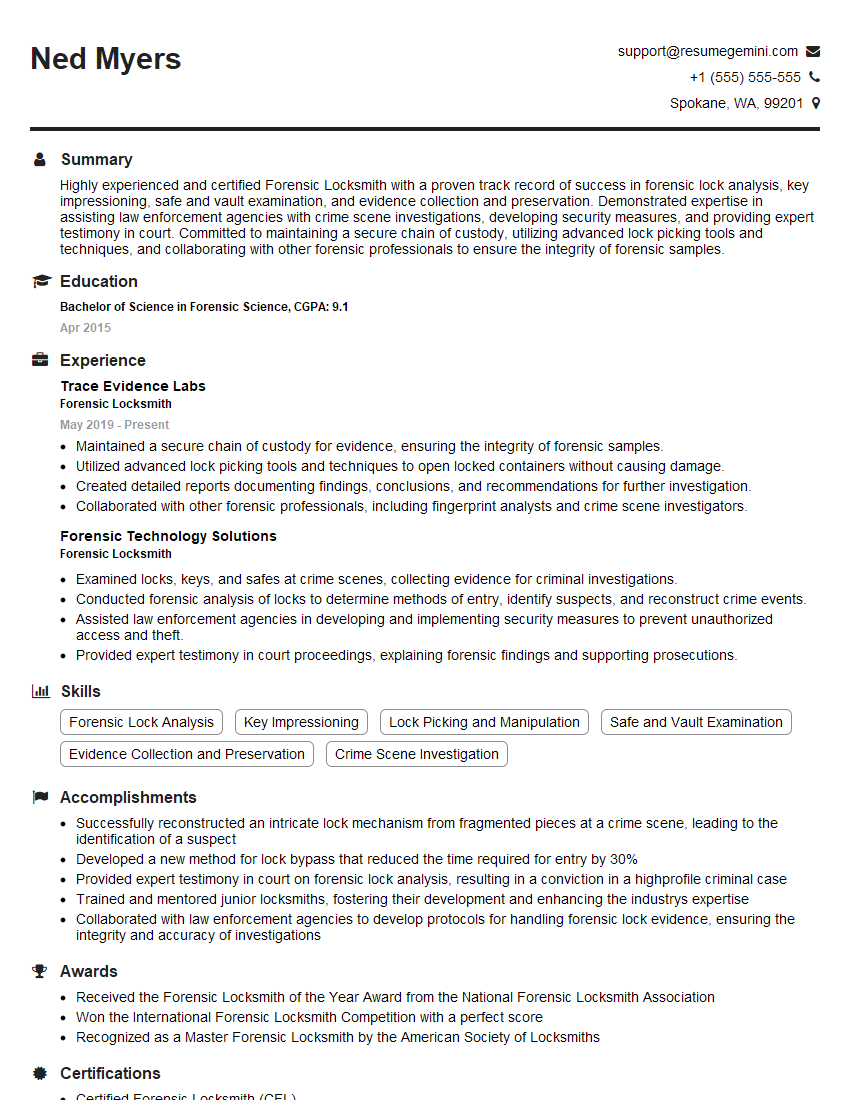
Mastering lock picking opens doors to exciting career opportunities in security, law enforcement, and specialized locksmithing. To maximize your job prospects, crafting a compelling and ATS-friendly resume is critical. ResumeGemini can significantly enhance your resume-building experience by providing the tools and resources to create a professional document that highlights your skills and experience effectively. We offer examples of resumes tailored specifically to the lock picking profession to help you get started. Invest in your future; build the best possible representation of your capabilities.



Explore more articles
Users Rating of Our Blogs
Share Your Experience
We value your feedback! Please rate our content and share your thoughts (optional).
What Readers Say About Our Blog
I Redesigned Spongebob Squarepants and his main characters of my artwork.
https://www.deviantart.com/reimaginesponge/art/Redesigned-Spongebob-characters-1223583608
IT gave me an insight and words to use and be able to think of examples
Hi, I’m Jay, we have a few potential clients that are interested in your services, thought you might be a good fit. I’d love to talk about the details, when do you have time to talk?
Best,
Jay
Founder | CEO