Cracking a skill-specific interview, like one for Advanced Threading and Pattern Development, requires understanding the nuances of the role. In this blog, we present the questions you’re most likely to encounter, along with insights into how to answer them effectively. Let’s ensure you’re ready to make a strong impression.
Questions Asked in Advanced Threading and Pattern Development Interview
Q 1. Explain the difference between flat pattern making and draping.
Flat pattern making and draping are two distinct methods for creating garment patterns. Flat pattern making involves creating a pattern on a two-dimensional surface, typically paper, using measurements and calculations. Draping, on the other hand, involves manipulating fabric directly on a dress form to create a three-dimensional pattern. Think of flat pattern making as drawing a blueprint, while draping is more like sculpting the garment.
Flat Pattern Making: This method is precise and repeatable, making it ideal for mass production. It relies on a set of standard measurements and calculations to create the pattern pieces. Changes and adjustments are made directly to the flat pattern.
Draping: This method is more intuitive and allows for greater design flexibility. It’s frequently used for creating unique or avant-garde designs, where the drape and flow of the fabric are crucial. Draping often leads to more organic and less structured shapes. The pattern is created by cutting the draped fabric and then transferring the shape to paper.
In practice, many designers use a combination of both techniques. They might drape a basic bodice shape and then use flat pattern making techniques to refine the details and create the sleeves and other components.
Q 2. Describe your experience with various pattern-making software (e.g., Gerber, Lectra).
I have extensive experience with various pattern-making software packages, including Gerber Accumark and Lectra Modaris. My proficiency in these programs extends beyond basic pattern creation; I’m adept at using their advanced features for grading, marker making, and 3D visualization. For instance, I’ve used Gerber Accumark to create highly efficient marker layouts, minimizing fabric waste and maximizing production efficiency. With Lectra Modaris, I’ve extensively explored its 3D simulation capabilities to predict garment drape and identify potential fit issues before the first sample is sewn. This preemptive approach saves significant time and resources.
Beyond these two, I am familiar with other CAD systems such as Optitex and TukaTech, and can quickly adapt to new software as needed. My experience encompasses the entire pattern-making workflow within these systems, from initial design conception to final production patterns.
Q 3. How do you handle grading patterns for different sizes?
Grading patterns for different sizes is a crucial step in garment production. It involves systematically adjusting the pattern pieces to accommodate a range of body measurements. I typically use a combination of automated grading within CAD software like Gerber or Lectra and manual adjustments based on my knowledge of fit and body proportions. Automated grading often provides a good starting point, but manual refinement is necessary to account for subtle variations in fit across different size ranges.
My process involves establishing a detailed grading chart, specifying the exact increase or decrease in measurements for each size. I carefully consider factors like ease, which is the extra fabric added for comfort and movement, ensuring it’s adjusted proportionately with each size. I’m always watchful for areas that require particular attention, such as the neckline, armholes, and waistline, to ensure that the graded patterns maintain the original design’s integrity and fit consistency across all sizes. Regular checks and fit tests are vital to verify the accuracy of the grading process.
Q 4. Explain your process for creating a sloper.
A sloper, or basic block, is a foundation pattern that serves as the starting point for creating various garment styles. Creating a precise sloper is paramount because all subsequent patterns are derived from it. My process begins with taking accurate body measurements. I then use these measurements along with my understanding of body proportions to create a basic pattern on paper using standard pattern-making techniques. I don’t rely solely on formulaic approaches. I frequently use a combination of flat pattern making and draping techniques to achieve the best fit.
The initial sloper is tested and refined through multiple muslin mock-ups. I meticulously assess the fit, making adjustments to ensure a smooth, comfortable, and well-proportioned shape. This iterative process involves detailed adjustments to areas such as the shoulder, neckline, armhole, and bustline, and continues until the sloper perfectly matches the body form. This results in a truly customized and perfectly fitting foundation pattern that enables me to develop more accurate and consistent designs in the future.
Q 5. How do you address fit issues during the pattern making process?
Addressing fit issues is a fundamental part of pattern making. I employ a systematic approach, starting with a thorough analysis of the muslin fit. I look at areas like ease, shoulder slope, bust point placement, and overall silhouette. Identifying the specific areas needing adjustment guides my next steps. A pulling or bagging at the neckline might indicate a need for adjustment to the shoulder slope, while a tight armhole might suggest reducing the armhole depth. My experience enables me to visually assess the fit issues and connect them to the pattern areas needing correction.
I meticulously document all changes made, creating notes that are directly transferable to the paper pattern. This documentation becomes a valuable resource for future projects and facilitates efficient pattern revision. This systematic approach reduces time and material waste, improving my efficiency and the overall quality of the final garment.
Q 6. Describe your experience with different types of fabrics and how that impacts pattern making.
Fabric choice significantly impacts pattern making. Different fabrics have varying drapability, stretch, and weight, all affecting how a pattern will behave on the garment. For instance, a lightweight, drapey fabric like silk will require a different pattern design and construction approach compared to a heavier, structured fabric like denim. The design, the choice of pattern pieces, and the techniques used in construction must all be appropriate to the fabric being used.
My experience encompasses a wide range of fabrics, from delicate silks and chiffons to robust wovens and knits. This knowledge informs my pattern design decisions, enabling me to create patterns that will complement the fabric’s inherent qualities. I’m able to anticipate how the fabric will drape and behave during construction and incorporate those considerations into the pattern design itself. My understanding of fabric properties allows me to make informed decisions on seam allowances, construction methods, and even the type of interfacing to use for a given garment.
Q 7. Explain your understanding of seam allowances and their importance.
Seam allowances are the extra fabric added to each pattern piece before sewing. They are crucial for several reasons. First, they provide the necessary fabric to create a finished seam. Second, they contribute to ease and comfort and allow for minor variations during garment construction. Third, they are essential for clean, well-finished seams, crucial for both aesthetics and durability. Selecting the appropriate seam allowance depends on the fabric, the garment style, and the desired finish.
Standard seam allowances are typically 5/8 inch (1.5 cm) for most garments, but can vary. Narrower seam allowances might be used for delicate fabrics to minimize bulk, while wider allowances may be necessary for heavier fabrics or for specific construction techniques. Incorrect seam allowances can result in ill-fitting, poorly finished garments, which directly impacts the quality and professional look of the project. Therefore, it’s critical to know the appropriate seam allowance for each pattern piece and fabric used. My experience enables me to choose the most suitable seam allowances for any project.
Q 8. How do you ensure accuracy in your pattern making?
Accuracy in pattern making is paramount. It’s the foundation of a well-fitting and aesthetically pleasing garment. I achieve this through a multi-pronged approach, starting with meticulous measurements. I always take multiple measurements, comparing them to ensure consistency. Then, I use these measurements to create a base block, a foundational pattern piece that forms the basis of all subsequent designs. This base block is carefully checked and adjusted until it fits perfectly on my chosen model or sloper. I also employ precision cutting techniques, using sharp shears and cutting mats to ensure clean, accurate lines. Finally, I always test my patterns by creating a muslin (a test garment made from inexpensive fabric) before cutting into my final fabric. This allows me to identify and correct any fitting issues before committing to the final garment. Think of it like building a house; a solid foundation (accurate measurements and base block) ensures a structurally sound and beautiful final product.
Q 9. Describe your experience with digital pattern making techniques.
Digital pattern making has revolutionized the industry, offering incredible efficiency and precision. I’m proficient in several CAD (Computer-Aided Design) software packages, including [mention specific software, e.g., Adobe Illustrator, Lectra Modaris]. These tools allow me to create patterns quickly and accurately, adjusting grading (sizing) and making modifications with ease. For instance, I can easily manipulate grading rules to create a range of sizes without redrawing the entire pattern. I also utilize digital pattern making for complex pattern manipulations like creating princess seams or intricate draping effects. The software allows for precise control over seam allowances and grading, minimizing errors and saving considerable time compared to traditional methods. Digital platforms also facilitate efficient collaboration and sharing of patterns. I can easily send patterns to manufacturers or collaborators, ensuring everyone works from the same accurate blueprint.
Q 10. How do you incorporate design details into your patterns?
Incorporating design details seamlessly requires careful planning and execution. I start by sketching the design, paying close attention to the drape and flow of the fabric. Then, I translate those sketches onto the pattern, making modifications to the base block. For example, to add a yoke, I would create a separate yoke pattern piece and adjust the bodice pattern accordingly, ensuring a smooth transition between the two. Similarly, adding pockets, pleats, or gathers involves careful planning and precise placement on the pattern pieces. Using notches and markings on the pattern ensures that the design details are accurately placed during construction. I often use draping techniques, particularly for more complex designs, to physically manipulate fabric on a dress form to achieve the desired shape before translating it into a pattern. This process ensures the design’s integrity and drape are preserved.
Q 11. Explain your understanding of different types of darts and their use.
Darts are essential shaping tools in pattern making, used to create curves and shape garments to the body. There are several types, each serving a specific purpose.
- Bust darts: Shape the bust area, providing a fitted silhouette.
- Waist darts: Provide shaping at the waistline, creating a defined waist curve.
- Shoulder darts: Shape the shoulder area, creating a more natural shoulder line.
- Hip darts: Shape the hip area for a more fitted look, often used in skirts or trousers.
- French darts: Multiple, small darts that combine to achieve the same shaping as a larger dart, providing a softer, less pronounced curve.
Q 12. How do you handle complex design details during pattern making?
Handling complex design details often involves a combination of techniques. For instance, incorporating intricate embroidery or applique requires planning for extra fabric to accommodate the embellishments. The pattern needs to be drafted with appropriate seam allowances and the placement of the embroidery precisely marked on the pattern pieces. Similarly, creating asymmetrical designs or complex draping effects often involves creating separate pattern pieces for each section and carefully manipulating the fabric to ensure proper fit and drape. I often utilize prototyping, creating a muslin or sample garment to test the fit and drape of complex details before final construction. This iterative process allows for adjustments and refinement, ensuring the final garment meets the design specifications.
Q 13. Describe your experience with marker making and fabric planning.
Marker making is the process of arranging pattern pieces efficiently on fabric to minimize waste. My experience includes both manual and computer-aided marker making. Computer-aided marker making software significantly optimizes fabric usage, resulting in cost savings. Fabric planning involves understanding the fabric’s drape, grain, and width to determine the most efficient layout of pattern pieces. For example, using the fabric’s lengthwise grain for garments requiring a good drape (like a dress) maximizes the drape quality and minimizes distortion. I consider factors such as fabric width, pattern piece size, and the total yardage needed when planning fabric. Accurate marker making and fabric planning are essential for cost control and waste reduction in larger-scale production. For smaller projects, I will often draw the markers by hand, paying careful attention to efficient layout to minimize waste and material costs.
Q 14. How do you manage time effectively when working on multiple patterns simultaneously?
Managing multiple patterns simultaneously requires excellent organizational skills and a clear workflow. I typically use project management tools, such as [mention tools, e.g., Trello, Asana], to track progress and deadlines. I prioritize tasks based on urgency and complexity, focusing on completing the most critical steps for each project first. I break down large projects into smaller, manageable tasks, making progress more visible and less overwhelming. Time blocking is another effective strategy—allocating specific time slots for working on individual patterns. This method prevents me from getting bogged down in one project while neglecting others. Regularly reviewing my schedule ensures I stay on track and address any potential delays proactively. Just like a conductor of an orchestra, I manage the different parts simultaneously to ensure a harmonious outcome.
Q 15. Explain your approach to problem-solving when faced with a difficult pattern.
Tackling a complex pattern begins with a systematic approach. I first thoroughly analyze the design, breaking it down into its fundamental components – darts, seams, ease, and any unique construction details. I then create a simplified base pattern, perhaps using a sloper (a basic, foundational pattern) as a starting point. This allows me to test individual elements before combining them. For example, if the design features a complex sleeve, I’ll create and fit the sleeve separately before integrating it into the bodice. I use digital tools like CAD software to draft and manipulate the pattern, which allows for easier adjustments and iterations. Next, I create a prototype, testing the fit and making adjustments based on the prototype’s performance. This iterative process continues until the pattern achieves the desired fit and aesthetic. Imagine building a house – you wouldn’t build the entire structure at once without testing foundations or walls; similarly, I build up the pattern piece by piece, constantly evaluating and refining.
For especially challenging elements, such as asymmetrical designs or intricate draping, I might create multiple mockups using inexpensive muslin fabric before moving to the final fabric. This helps to visualize and solve problems early on, saving time and material costs. Documentation is key. I meticulously track all my adjustments and revisions, creating a detailed history of the pattern’s development for future use and reference.
Career Expert Tips:
- Ace those interviews! Prepare effectively by reviewing the Top 50 Most Common Interview Questions on ResumeGemini.
- Navigate your job search with confidence! Explore a wide range of Career Tips on ResumeGemini. Learn about common challenges and recommendations to overcome them.
- Craft the perfect resume! Master the Art of Resume Writing with ResumeGemini’s guide. Showcase your unique qualifications and achievements effectively.
- Don’t miss out on holiday savings! Build your dream resume with ResumeGemini’s ATS optimized templates.
Q 16. How do you stay updated with the latest trends and technologies in pattern making?
Staying current in pattern making requires a multifaceted approach. I actively participate in industry conferences and workshops, attending seminars led by renowned pattern makers and designers. This allows for hands-on learning and networking with peers. Reading industry publications – both print and digital – is vital. These magazines and online resources often showcase cutting-edge techniques and technologies. I also follow influential designers and pattern makers on social media platforms and subscribe to relevant newsletters. Additionally, I explore online learning platforms that offer courses in advanced pattern making techniques, CAD software proficiency, and new material technologies. Experimentation is crucial; I often try out new fabrics and techniques in personal projects to broaden my skillset and discover new possibilities.
Q 17. Describe your experience working with different types of pattern materials.
My experience spans a wide range of pattern materials, each presenting unique challenges and advantages. I’m proficient in working with woven fabrics such as cotton, silk, linen, and wool, understanding their drape, stretch, and grain. With woven fabrics, precision cutting and careful seam allowances are crucial. Knit fabrics, including jersey and rib knits, require a different approach due to their elasticity. Understanding how knit fabrics stretch and recover during wear is critical to ensuring a good fit. I’ve also worked extensively with non-woven interfacings, which add structure and support to garments. Selecting the right interfacing for a given fabric and design is key to achieving the desired shape and drape. Finally, my experience extends to leather and other specialty materials; each requires specialized techniques and tools. For example, leather’s thickness and lack of give demand precise cutting and different stitching methods. The choice of material dictates the pattern adjustments needed to accommodate its unique properties.
Q 18. How do you ensure consistent quality in your patterns?
Maintaining consistent quality in pattern making relies on several key strategies. First, using accurate measurements and consistent grading techniques is essential. Grading is the process of scaling a pattern to different sizes. I employ precise measuring tools and adhere to strict grading rules to ensure accuracy across all sizes. Second, meticulous record-keeping is vital. I maintain a detailed log of all pattern adjustments, noting any changes made during prototyping and testing. This allows for reproducibility and ensures that any future production runs maintain consistency. Third, diligent quality control checks are performed at every stage – from initial drafting to the final prototype. This includes scrutinizing the pattern pieces for accuracy, checking seam allowances, and carefully assessing the fit on a fit model. Regular calibration and maintenance of my tools are essential; this ensures accuracy and precision in cutting and construction. Consistent attention to detail is paramount, and it’s something I instill in any team members I supervise.
Q 19. Explain your understanding of industrial sewing machinery and its relation to pattern making.
A strong understanding of industrial sewing machinery is crucial for effective pattern making. The capabilities and limitations of different sewing machines directly impact the design and construction of a garment. For example, the stitch type, stitch length, and needle size can affect the finished garment’s appearance and durability. Understanding these limitations allows me to design patterns that are feasible to produce efficiently. Knowledge of industrial sewing machines extends beyond simple operation; it includes the ability to identify potential issues during production and troubleshoot problems proactively. This might involve understanding stitch tension issues, feed dog adjustments, or appropriate needle types for different fabrics. Pattern making is not just about the design; it’s also about understanding the practical production process and ensuring the pattern is compatible with available machinery and manufacturing techniques. I can also consider the efficiency of production by designing patterns that minimize waste and maximize the use of fabric.
Q 20. Describe your experience with fit models and how you use them in pattern development.
Fit models are indispensable in pattern development. They are individuals whose body measurements and proportions closely match the target demographic for the garment. I use fit models to test the fit of prototypes, identifying areas needing adjustment. The process starts with taking precise body measurements of the fit model. These measurements guide the initial pattern adjustments. Then, the prototype is sewn and fitted on the model. I carefully observe the fit, noting any areas of tightness, looseness, or distortion. This might involve using marking tools to identify areas requiring alteration. Based on this observation, I make necessary adjustments to the pattern, create a new prototype, and repeat the process until the desired fit is achieved. Using a fit model significantly reduces the need for extensive alterations on the final garment and ensures a better fit for the target customer. Without a fit model, the pattern fitting process becomes much more complex and less accurate.
Q 21. How do you communicate technical specifications effectively to other team members?
Effective communication is vital in pattern making, especially when working with a team. I use clear and concise language, avoiding technical jargon whenever possible. When jargon is necessary, I provide clear definitions. I utilize both verbal and visual communication methods. I explain technical specifications using clear diagrams and sketches – often annotated with precise measurements and construction details. I also utilize digital tools, such as CAD software, to share detailed pattern specifications, including grading rules and construction notes, with the team. Furthermore, I create comprehensive technical packages that include all necessary information for production, ensuring everyone understands the pattern specifications and construction process. These packages might include detailed pattern pieces, grading specifications, bill of materials, sewing instructions, and quality control checklists. Open communication and regular team meetings are essential to ensure everyone is on the same page and potential issues are addressed promptly.
Q 22. Explain your understanding of tolerance in pattern making.
Tolerance in pattern making refers to the acceptable range of variation in measurements during the creation and production of garments. It’s essentially the wiggle room built into a pattern to account for the realities of fabric manipulation, seam allowance, and variations in individual body measurements. Think of it like this: a perfectly drafted pattern might be mathematically precise, but real-world fabric has give, stretch, and drape. Tolerance helps bridge the gap between the ideal and the practical.
For example, a 1cm tolerance on a sleeve width means that the final sleeve width can be anywhere between 1cm smaller or 1cm larger than the specified measurement in the pattern, and still be considered acceptable. This is crucial because fabrics can shrink or stretch during washing, and slight variations in cutting can also occur. Without tolerance, achieving a consistent fit across multiple garments would be nearly impossible.
Managing tolerance involves carefully considering the type of fabric being used (stretchy fabrics need a wider tolerance), the garment style (a tailored jacket requires tighter tolerance than a flowing dress), and the level of precision required. Experienced pattern makers develop an intuitive sense of appropriate tolerances through practice and experience.
Q 23. How do you create and manage pattern libraries?
Creating and managing a pattern library is a cornerstone of efficient and professional pattern making. My approach involves a digital and physical system for optimal organization and retrieval. Digitally, I utilize a well-organized file system, often categorized by garment type, size range, and design details (e.g., ‘Dresses/Summer/Maxi/FloralPrint_SizeRange8-16’). This allows for easy searching and retrieval.
Furthermore, I utilize software like Adobe Illustrator or dedicated CAD programs for pattern design and storage, enabling effortless scaling, manipulation, and version control. Crucially, each pattern file is clearly labeled with relevant metadata including date created, fabric type recommendations, and any pertinent notes.
Physically, I maintain a well-organized archive of hard copies of key patterns, particularly those that have been proven successful and are likely to be reused. This provides a backup and allows for quick visual reference. Each hard copy pattern is clearly labeled and stored in appropriate folders. Regular auditing ensures the library remains current and relevant, with outdated patterns archived or removed.
Q 24. Describe your experience with advanced stitching techniques and their application in garments.
My experience encompasses a wide range of advanced stitching techniques. I’m proficient in techniques such as French seams (for clean, professional finishes, especially in high-end garments), Hong Kong seams (a beautiful finish for curved edges), bound buttonholes (for durability and a sophisticated look), and decorative stitching methods like topstitching, quilting, and embroidery.
The application of these techniques depends heavily on the garment. For instance, French seams are ideal for lingerie or delicate blouses where seam allowance shouldn’t be visible, while Hong Kong seams are perfect for outerwear or garments requiring a strong and elegant finish. Bound buttonholes are essential for high-quality jackets and coats. Decorative stitching can add significant aesthetic value, from subtle topstitching to elaborate embroidery.
I understand how these techniques impact pattern construction; for instance, French seams require smaller seam allowances, whereas bound buttonholes necessitate specific placement markings on the pattern. My expertise enables me to seamlessly integrate these techniques into the pattern design process, ensuring a harmonious blend of aesthetics and functionality.
Q 25. How do you troubleshoot pattern issues and adapt designs during production?
Troubleshooting pattern issues during production requires a systematic approach. I begin by identifying the problem – is it a fit issue (too tight, too loose), a construction issue (seam slippage), or a design flaw? Then, I analyze the root cause. This might involve checking the original measurements, inspecting the fabric for irregularities, or reviewing the stitching process.
For fit issues, I might make adjustments to the pattern, such as widening the shoulder seams or taking in the waist. I’d utilize a combination of grading techniques and fitting adjustments on a muslin prototype to test these changes before implementing them on the final fabric.
Construction issues often point towards problems with the stitching or fabric handling, requiring adjustments to the sewing instructions or better quality control during production. Design flaws, on the other hand, may require a more substantial redesign, possibly involving reevaluating the drape, construction, or overall aesthetic of the garment. This process always involves clear communication with the production team to ensure all changes are implemented consistently.
Q 26. Explain your understanding of different types of closures and their impact on pattern making.
Different types of closures significantly impact pattern making. The choice of closure dictates seam placement, allowance for overlap or gaps, and even the overall silhouette of the garment.
- Zippers: Require a specific seam allowance and often necessitate a zipper placket which needs to be incorporated into the pattern.
- Buttons and buttonholes: Demand accurate placement markings on the pattern for both the buttonholes and the corresponding button positions. The buttonhole placement affects the overall fit and the ease of fastening.
- Hooks and eyes: Require less space than zippers but still need careful placement on the pattern to ensure a secure closure. The pattern must accommodate the overlap needed for the hooks and eyes.
- Velcro: Relatively straightforward in terms of pattern adjustments, but the fabric choice and adhesive nature of Velcro needs to be factored into the design.
- Ties and belts: Often require loops or belt carriers that must be included in the pattern, along with appropriate allowances for tie lengths or belt widths.
Understanding the mechanical properties of each closure type and its influence on fit and construction is paramount to successfully incorporating it into a pattern.
Q 27. How do you handle alterations to existing patterns?
Handling alterations to existing patterns depends on the nature and extent of the change. Minor alterations, such as adjusting sleeve length or waist size, can often be done directly on the pattern pieces using grading techniques. This involves smoothly adjusting the pattern lines to accommodate the new measurements.
More significant changes might require redrawing specific pattern pieces or even creating entirely new pieces. For instance, converting a V-neck to a scoop neck might require altering the neckline curve and redrawing that section. I would use my knowledge of pattern design principles, including ease allowances, grainlines, and balance, to ensure the integrity of the design is maintained after the alteration.
Regardless of the alteration’s size, thorough documentation is crucial. I would make detailed notes about the changes made, including any adjustments to seam allowances or other construction details. This prevents confusion later and ensures that future replications of the altered pattern are accurate.
Q 28. Describe your experience with different types of pattern drafting methods.
My experience spans several pattern drafting methods, each with its strengths and weaknesses. These include:
- Draping: A hands-on approach where fabric is draped on a dress form to create a three-dimensional mockup, then translated to a two-dimensional pattern. Ideal for complex designs or creating unique silhouettes but requires significant skill and experience.
- Flat pattern drafting: A more technical method relying on mathematical calculations and measurements taken from a sloper (a basic pattern block). It provides precision and consistency, particularly for mass production, but might not be as suitable for highly stylized or experimental designs.
- Block drafting: Uses fundamental pattern blocks – the sloper – as a base to which modifications are added to create various styles. Offers a balance between precision and design flexibility.
- Computer-aided design (CAD): Utilizes specialized software to create and manipulate patterns digitally. Offers efficiency, accuracy, and the ability to easily scale and modify patterns, but requires expertise in the software itself.
My proficiency in these different methods allows me to choose the most appropriate approach depending on the design complexity, production volume, and available resources. I find it is often beneficial to combine methods, for instance, using draping to explore design ideas and then refining the design through flat pattern techniques.
Key Topics to Learn for Advanced Threading and Pattern Development Interview
- Advanced Pattern Construction Techniques: Understanding and applying advanced techniques like draping, sloper creation, and pattern grading for various body types and garment styles.
- Computer-Aided Design (CAD) for Pattern Making: Proficiency in using industry-standard CAD software for pattern design, manipulation, and grading, including knowledge of its limitations and troubleshooting.
- Fabric Selection and its Impact on Pattern Design: Deep understanding of different fabric properties (drape, stretch, weight) and how they influence pattern design and construction choices. Practical application includes choosing appropriate patterns based on fabric characteristics.
- Advanced Sewing Techniques and Thread Management: Mastering specialized sewing techniques for complex garment construction, including efficient thread management and minimizing seam puckering.
- Pattern Alterations and Fit Adjustments: Demonstrating expertise in making accurate and effective alterations to existing patterns to achieve optimal fit on various body types. This includes understanding different fitting issues and their solutions.
- Understanding Industrial Sewing Processes: Familiarity with industrial sewing equipment and mass production techniques related to pattern implementation, including knowledge of production timelines and constraints.
- Problem-Solving and Critical Thinking: Ability to diagnose and solve pattern-related issues during the design, construction, and production phases. This includes using analytical skills to assess and improve designs and manufacturing processes.
Next Steps
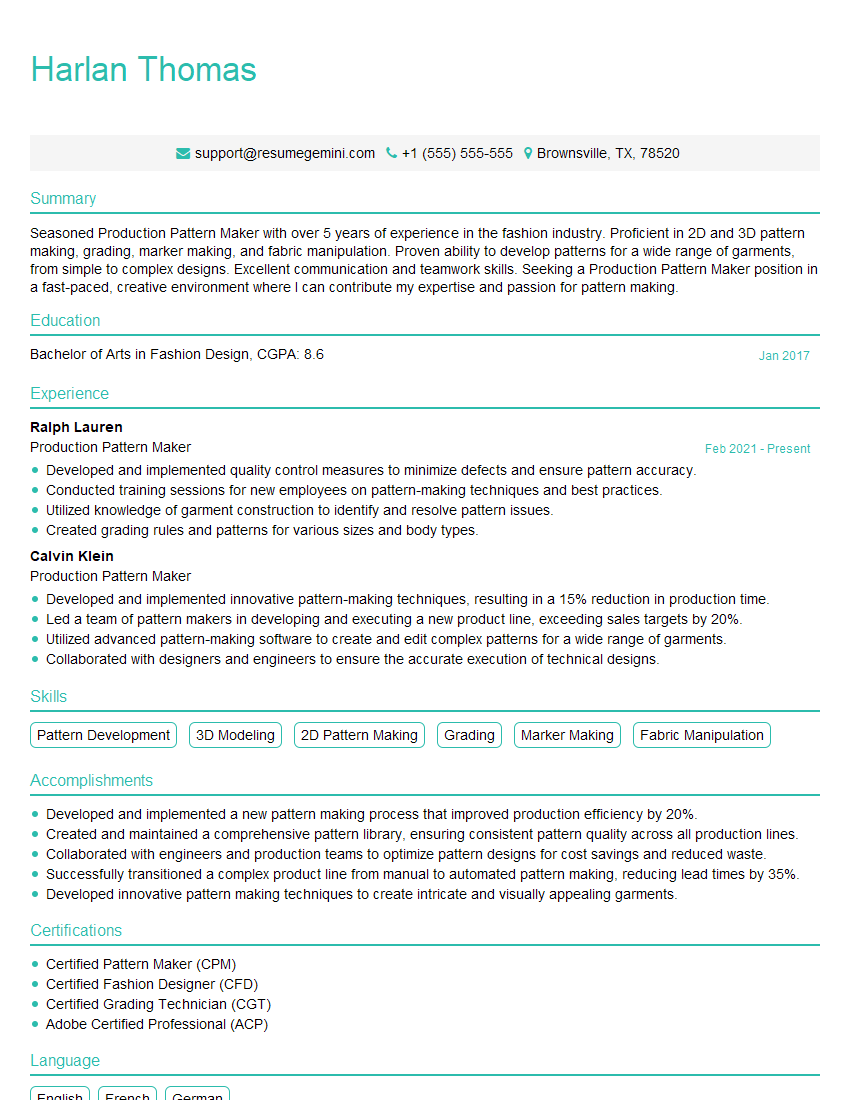
Mastering Advanced Threading and Pattern Development opens doors to exciting opportunities in the fashion and apparel industry, offering higher earning potential and increased career satisfaction. To maximize your chances of landing your dream role, creating a compelling and ATS-friendly resume is crucial. This ensures your skills and experience are effectively communicated to potential employers. We highly recommend leveraging ResumeGemini to build a professional and impactful resume tailored to showcase your expertise in Advanced Threading and Pattern Development. ResumeGemini provides you with the tools and resources to create a standout resume, and we offer examples of resumes tailored to this specific field. Take the next step and invest in your career success.
Explore more articles
Users Rating of Our Blogs
Share Your Experience
We value your feedback! Please rate our content and share your thoughts (optional).
What Readers Say About Our Blog
Really detailed insights and content, thank you for writing this detailed article.
IT gave me an insight and words to use and be able to think of examples