Unlock your full potential by mastering the most common Drilling Wellbore Cementing interview questions. This blog offers a deep dive into the critical topics, ensuring you’re not only prepared to answer but to excel. With these insights, you’ll approach your interview with clarity and confidence.
Questions Asked in Drilling Wellbore Cementing Interview
Q 1. Explain the primary functions of wellbore cementing.
Wellbore cementing serves several crucial functions in the oil and gas industry. Its primary purpose is to create a robust, impermeable barrier between different formations within a wellbore. This barrier ensures:
- Zone Isolation: Preventing the mixing of fluids from different geological formations (e.g., preventing oil and gas from entering freshwater aquifers or vice versa).
- Pressure Control: Maintaining wellbore pressure integrity and preventing uncontrolled fluid flow, which is crucial for safety and efficient operation.
- Structural Support: Providing support to the wellbore casing, preventing casing collapse under high pressures or in unstable formations.
- Corrosion Protection: Protecting the casing from corrosion by isolating it from corrosive fluids.
Think of it like building a strong, waterproof wall within the Earth – crucial for both environmental protection and operational success.
Q 2. Describe different types of cement slurries used in wellbore cementing.
Various cement slurries are used, each tailored to specific well conditions. The choice depends on factors like temperature, pressure, and the characteristics of the formation. Common types include:
- Portland Cement: The most common type, offering a good balance of properties. Different classes (like API Class A, B, C, H) offer variations in strength and setting time.
- Grouts: Used for smaller scale operations or where high strength isn’t as critical, offering better flow properties in narrow spaces.
- Special Cements: These are designed to handle extreme conditions. Examples include high-temperature cements (HTHC) for deep wells and lightweight cements for shallower wells where minimizing compressive load is critical.
- Pozzolanic Cements: These cements reduce permeability, improve strength, and reduce heat generation. They are often used in high-temperature wells.
Selecting the right type is a critical design step, dictated by well-specific conditions. For instance, a high-temperature well needs a cement that can withstand the heat without losing its integrity.
Q 3. What are the key properties of a good cement slurry?
A good cement slurry needs a combination of properties to ensure successful cementing. These include:
- Early Strength Development: Rapid initial strength helps prevent fluid channeling during the initial setting period.
- High Compressive Strength: Essential for long-term wellbore integrity and pressure containment.
- Low Permeability: Minimizes fluid flow through the cemented annulus.
- Good Rheology: Ensures proper placement and distribution of the cement slurry within the annulus.
- Compatibility with Casing and Formation: Prevents chemical reactions that could weaken the cement or casing.
- Stable Properties Under Downhole Conditions: Maintaining its properties even at high temperatures and pressures is critical.
Think of it like building a brick wall – you need strong bricks (high strength), a good mortar (low permeability), and proper construction techniques (good rheology) to make a durable structure that lasts.
Q 4. Explain the importance of rheological properties in cement slurry design.
Rheological properties, such as viscosity, yield point, and gel strength, are crucial because they determine how the cement slurry flows and sets.
- Viscosity: Affects how easily the slurry flows through the casing and annulus. Too low, and it flows too quickly, potentially leading to poor placement. Too high, and it may not reach the bottom of the well.
- Yield Point: The minimum shear stress required for the slurry to flow. A higher yield point helps prevent settling of the heavier components (like cement particles).
- Gel Strength: The ability of the slurry to retain its shape, preventing settling and helping to create a uniform cement sheath.
Proper rheology ensures the cement is distributed evenly, filling the annular space completely, preventing channels that could compromise the integrity of the cement sheath. Imagine trying to pour concrete – if it’s too watery, it will settle unevenly; if it’s too thick, it won’t flow into all the corners.
Q 5. How do you control the setting time of cement?
Cement setting time is controlled primarily through the use of retarders and accelerators.
- Retarders: These chemicals slow down the setting process, providing more time for the cement to be placed and achieve complete displacement of drilling mud. They are especially useful in deep wells or when long pumping times are expected.
- Accelerators: These chemicals speed up the setting process, which can be beneficial in shallow wells or when rapid strength development is needed. However, they can also reduce the working time available.
The choice and amount of these additives depend on various factors like temperature, pressure, cement type, and desired setting time. Careful selection and accurate measurement are vital for successful cementing operations.
Q 6. Describe the different stages of a typical wellbore cementing operation.
A typical wellbore cementing operation involves several key stages:
- Pre-Job Planning and Design: Involves selecting the right cement slurry, calculating cement quantities, and planning the operational sequence.
- Displacement of Drilling Mud: Removing the drilling mud from the annulus to ensure that the cement slurry can fully contact the casing and formation.
- Cementing: Pumping the cement slurry into the annulus, ensuring complete filling and avoiding any voids.
- Displacing the Cement Slurry: Pumping a fluid (typically water or a special spacer fluid) to displace the cement slurry and create a clean zone above the cement.
- Post-Job Evaluation: Monitoring the cementing process and assessing its success through various logging tools (such as cement bond logs) to check for integrity.
Each stage requires meticulous attention to detail and adherence to best practices to ensure successful cementation. Careful planning and precise execution are critical to achieving the desired results.
Q 7. What are the potential challenges encountered during wellbore cementing?
Wellbore cementing can present various challenges, including:
- Formation Fractures: Cement may leak into the formation through existing fractures, reducing the effectiveness of the cement sheath.
- Channel Formation: Uneven cement placement leading to voids or channels that compromise wellbore integrity.
- Cement Settling: Heavy components settling in the slurry can lead to uneven distribution and weak areas within the cement sheath.
- Excessive Heat Generation: In deep wells, the heat generated during cement hydration can negatively impact cement properties.
- Fluid Loss: Cement fluid might be absorbed by the surrounding formations, leading to a weak cement sheath.
- Equipment Malfunction: Failure of pumps, valves or other equipment during cementing can seriously compromise the operation.
Addressing these challenges requires careful planning, advanced cement designs, effective quality control, and contingency planning to mitigate potential problems and ensure successful cementing operations. Each challenge might necessitate unique solutions; for example, special cement additives can minimize fluid loss in permeable formations.
Q 8. How do you prevent channeling and fluid loss during cementing?
Preventing channeling and fluid loss during cementing is crucial for ensuring a robust and reliable wellbore seal. Channeling, the formation of preferential flow paths for the cement slurry, weakens the seal and compromises zonal isolation. Fluid loss, on the other hand, reduces the volume of cement available to fill the annulus, leading to incomplete coverage and potential for leaks. We combat these issues through a multi-pronged approach:
Proper slurry design: Using the correct cement type, water-to-cement ratio, and additives optimizes the slurry’s rheological properties (flow behavior). A properly designed slurry will have sufficient viscosity to resist channeling and minimize fluid loss. For instance, high-yield-point cement is preferred in deviated wells to better resist flow.
Effective placement techniques: Techniques like using multiple stages of cementing, optimizing the pumping rate, and employing centralizers ensure uniform distribution of the slurry. Centralizers, as we’ll discuss later, prevent the cement from settling only on one side of the casing.
Use of fluid-loss control agents: Adding specialized materials like cellulose or polymers to the cement slurry reduces the permeability of the formation, thereby minimizing fluid loss into the porous rock. The selection of the appropriate additive will depend on the nature of the formation.
Careful wellbore preparation: Ensuring the wellbore is clean and free from debris before cementing prevents the formation of channels or obstructions. This might include running a wiper plug to remove any drilling mud.
Think of it like building a wall: if you have uneven mortar (cement slurry) and gaps, it will be weak. Proper slurry design and placement are like using the correct type of mortar and applying it evenly to create a strong, leak-proof wall.
Q 9. Explain the importance of zonal isolation in wellbore cementing.
Zonal isolation is paramount in wellbore cementing. It refers to the ability to create impermeable barriers between different geological formations or zones within the wellbore. This is essential for several reasons:
Preventing fluid migration: Zonal isolation prevents the movement of fluids (oil, gas, water) between different formations, thus avoiding cross-contamination and environmental hazards. For instance, preventing gas migration from a high-pressure reservoir into a shallower aquifer can prevent dangerous situations and environmental disasters.
Ensuring wellbore stability: The cement seal provides support to the wellbore, preventing formation collapse or swelling. This is crucial in areas with unstable geological formations.
Enhancing production efficiency: Proper zonal isolation ensures that only the desired zone is produced, maximizing well productivity. This is vital when multiple producing horizons exist within the same wellbore.
Protecting groundwater resources: A well-cemented wellbore prevents the leakage of drilling fluids or produced fluids into freshwater aquifers, safeguarding this vital resource.
Imagine a layered cake: each layer needs to be perfectly separated to prevent them from mixing. Zonal isolation is analogous to ensuring that each layer (geological formation) remains distinct and prevents the mixing of different ingredients (fluids).
Q 10. How do you assess the quality of a cement job?
Assessing the quality of a cement job is critical for ensuring well integrity and safety. We use a variety of methods, often in combination:
Cement bond logs: These measure the acoustic impedance between the casing and the formation, indicating the presence and quality of the cement bond. A strong bond shows as a high amplitude signal.
Variable density logs: These logs measure the density of the cement, helping to determine whether the annulus is fully filled and the cement is of the appropriate density.
Pressure tests: These tests, such as formation integrity tests (FITs), verify the integrity of the cement seal by pressurizing the wellbore and monitoring for pressure changes indicating leaks.
Cement samples: Collecting and analyzing cement samples during and after the cementing operation allows us to check the quality of the cement itself, its setting time, and its compressive strength.
Temperature surveys: By monitoring changes in temperature within the wellbore, we can sometimes infer the quality and consistency of the cement. Exothermic reactions during setting can generate heat, which a temperature survey will detect.
These tests are essential for confirming that the cement job met its design parameters and provides the necessary well integrity. Think of it like a doctor performing a checkup after an operation; several tests help to validate success.
Q 11. Describe different cementing techniques (e.g., single-stage, two-stage, plug and perf).
Different cementing techniques are selected based on well design, formation properties, and operational objectives:
Single-stage cementing: The simplest technique where a single batch of cement slurry is pumped to fill the entire annulus. Suitable for relatively straightforward wells.
Two-stage cementing: This technique involves pumping two separate cement slurries. A lead slurry is pumped first to displace the drilling mud and establish a seal, followed by a main slurry to fill the annulus. This is common in deeper wells to improve displacement efficiency.
Plug and perf cementing: A cement plug is placed in the annulus, followed by perforating the casing. This technique is used for selective cementing, allowing cement placement only in specific zones. This is very common in stimulated reservoirs.
The choice of technique depends on the specific needs of the well. Single-stage is efficient for simple applications but might be insufficient for complex wells. Two-stage improves displacement and zonal isolation while plug and perf is ideal for targeted cementing, showcasing the versatility needed to suit individual well requirements.
Q 12. What are the environmental considerations in wellbore cementing?
Environmental considerations in wellbore cementing are crucial. The main concerns revolve around:
Minimizing waste: Cement slurry is a significant waste product. Careful planning and optimized techniques help minimize the volume of waste generated. Recycled materials are also increasingly being explored.
Preventing fluid contamination: Leaks of cement or drilling fluids can contaminate groundwater resources or surface water. Proper cementing practices and regular monitoring are crucial to prevent this.
Reducing greenhouse gas emissions: The cement manufacturing process is energy-intensive and produces greenhouse gases. Using low-carbon cement and optimizing cementing operations can mitigate these emissions.
Protecting sensitive ecosystems: Cementing operations need to consider the impact on nearby ecosystems, especially in environmentally sensitive areas. Best practices include environmental impact assessments and mitigation measures.
Responsible cementing demands a holistic approach to minimize environmental impact throughout the lifecycle, from cement production to well completion and beyond.
Q 13. Explain the role of centralizers in cementing operations.
Centralizers are essential components in cementing operations. They are mechanical devices attached to the casing string that maintain a consistent distance between the casing and the wellbore wall during cement placement.
Their main function is to:
Prevent eccentricity: Without centralizers, the casing might settle to one side of the wellbore, resulting in uneven cement distribution and potential channeling. This uneven distribution weakens the seal.
Enhance zonal isolation: By maintaining even spacing, centralizers improve the uniformity of the cement sheath, resulting in a stronger and more reliable seal across the entire annulus.
Improve displacement efficiency: Centralizers help in the proper displacement of drilling mud by preventing it from becoming trapped behind the casing.
Imagine you’re painting a wall; a roller helps achieve even coverage. Centralizers play a similar role, ensuring that the cement slurry coats the wellbore uniformly, avoiding the formation of gaps or weak spots. Proper spacing and selection of centralizers are crucial to ensure a quality cement job.
Q 14. How do you deal with a stuck pipe during cementing?
A stuck pipe during cementing is a serious event that can result in significant delays and costs. The first step is to thoroughly diagnose the cause. This often involves analyzing well logs and pressure readings. Possible causes include:
Differential sticking: The pipe may be stuck due to pressure differentials between the formations.
Mechanical sticking: The pipe may be mechanically wedged against the wellbore.
Cement bridging: The cement may have set prematurely, bridging the annulus and trapping the pipe.
Once the cause is identified, we employ various techniques to free the pipe, depending on the nature of the problem. These may include:
Circulation: Attempting to circulate drilling mud to dislodge the pipe.
Weighting up and down: Applying weight or pulling back on the pipe to break the bond.
Mechanical jarring: Using specialized tools that impart sharp impacts to jar the pipe loose.
Chemical treatments: Employing specialized chemicals to break down the cement or dissolve the formation.
Cutting the pipe: As a last resort, the stuck pipe might need to be cut and retrieved, but this is expensive and time-consuming.
Dealing with a stuck pipe requires careful assessment, decisive action, and sometimes the use of sophisticated equipment and techniques. Prevention is key, and careful planning and execution of the cementing operation drastically reduce the risk of this scenario.
Q 15. What is the significance of pressure monitoring during cementing?
Pressure monitoring during cementing is absolutely critical for ensuring a successful operation and the long-term integrity of the well. It allows us to understand the pressure dynamics within the wellbore and annulus, providing real-time feedback on the cement slurry placement and the effectiveness of the displacement process. Think of it like monitoring the blood pressure of a patient during a complex surgery – any deviation requires immediate attention.
Specifically, pressure monitoring helps us:
- Verify proper cement placement: Pressure increases indicate the cement is displacing drilling mud effectively. Sudden pressure drops might signal problems like channeling or insufficient cement volume.
- Detect and mitigate potential problems: Unusual pressure fluctuations can alert us to issues like formation fracturing, casing leaks, or stuck pipe. Early detection allows for corrective action, preventing costly wellbore damage or even catastrophic failure.
- Optimize cementing parameters: Pressure data helps us fine-tune the cement slurry properties (viscosity, density) and pumping rates for optimal placement in complex well geometries.
- Ensure zonal isolation: We can use pressure data to confirm that the cement has successfully isolated different zones in the wellbore, preventing fluid communication between them, which is crucial for reservoir management and safety.
For instance, a sudden pressure spike during a cement job might indicate that the formation pressure is being exceeded, risking fracturing the formation, which will severely compromise well integrity.
Career Expert Tips:
- Ace those interviews! Prepare effectively by reviewing the Top 50 Most Common Interview Questions on ResumeGemini.
- Navigate your job search with confidence! Explore a wide range of Career Tips on ResumeGemini. Learn about common challenges and recommendations to overcome them.
- Craft the perfect resume! Master the Art of Resume Writing with ResumeGemini’s guide. Showcase your unique qualifications and achievements effectively.
- Don’t miss out on holiday savings! Build your dream resume with ResumeGemini’s ATS optimized templates.
Q 16. Explain the concept of compressive strength in cement.
Compressive strength in cement refers to its ability to resist being crushed or compressed. It’s a crucial indicator of the cement’s overall strength and durability, directly impacting the well’s longevity and safety. Imagine a strong column supporting a heavy building; the column needs sufficient compressive strength to prevent collapse. Similarly, cement needs high compressive strength to withstand the enormous pressure in the wellbore.
Several factors influence compressive strength, including:
- Cement type: Different cement types (Portland, Class G, Class H, etc.) possess varying compressive strengths.
- Water-cement ratio: A lower water-cement ratio generally leads to higher strength, but excessive reduction can hinder workability.
- Curing time and temperature: Longer curing times and higher temperatures accelerate cement hydration, enhancing strength.
- Additives: Certain additives can either enhance or reduce compressive strength, depending on their function.
We measure compressive strength using specialized testing procedures in a laboratory. A low compressive strength indicates a potential for wellbore failure, leading to significant safety and economic consequences.
Q 17. Describe different types of cementing equipment.
Cementing operations utilize a variety of sophisticated equipment, each playing a crucial role in the process. Here are some key components:
- Cementing units: These are the heart of the operation, responsible for mixing, storing, and pumping the cement slurry. They include high-pressure pumps, blenders, and sophisticated control systems. Think of them as the ‘kitchen’ where the cement ‘recipe’ is prepared and served.
- Mixing hoppers and blenders: These ensure the proper mixing of cement powder, water, and additives, creating a homogenous slurry with the desired rheological properties. The consistency needs to be just right – neither too thick nor too thin for optimal placement.
- High-pressure pumps: These deliver the cement slurry to the wellbore at precisely controlled pressures and flow rates, ensuring that the slurry reaches its intended destination effectively.
- Centralizers and spacers: These devices help ensure uniform cement placement around the casing, preventing channels and ensuring proper zonal isolation. They maintain the casing’s central position during the cementing process.
- Pressure and flow rate monitoring equipment: Crucial for real-time monitoring and control of the cementing process. These tools provide immediate feedback on the success of the operation.
- Surface and downhole tools: These tools are used to manage the flow of fluids and the placement of the cement, preventing unwanted fluid flow between zones.
The specific equipment used depends on the well’s characteristics, the type of cement, and the operational requirements.
Q 18. What are the safety precautions associated with wellbore cementing?
Wellbore cementing is inherently hazardous, requiring stringent safety protocols. Key precautions include:
- H2S detection and monitoring: Hydrogen sulfide (H2S) is a highly toxic gas that can be released during cementing. Continuous monitoring and appropriate respiratory protection are essential.
- Pressure control: Maintaining proper pressure control during the entire process is paramount to prevent formation fracturing or casing failures. Overpressure is a significant safety risk.
- Emergency shut-down systems: These systems are crucial for rapidly halting the operation in case of emergencies. Regular testing and maintenance are vital.
- Personal Protective Equipment (PPE): All personnel involved must wear appropriate PPE, including safety glasses, gloves, and protective clothing, to minimize exposure to chemicals and potential hazards.
- Proper training and competency: All personnel must be thoroughly trained and competent in wellbore cementing procedures and safety protocols. Regular training refreshes and enhances these skills.
- Risk assessment and hazard identification: Conducting thorough risk assessments before and during the operation identifies potential hazards and allows for mitigation strategies to be implemented.
Failure to adhere to these safety precautions can lead to serious injuries, environmental damage, and significant financial losses.
Q 19. How do you interpret cement bond logs?
Cement bond logs provide a crucial evaluation of the cement bond quality behind the casing. The log measures the acoustic impedance contrast between the casing, cement, and formation. Imagine trying to see how well paint adheres to a wall – the log provides a similar assessment for cement.
Interpretation involves looking for several key indicators:
- High amplitude signals: These indicate a good bond between the cement and the formation, a desirable outcome.
- Low amplitude signals: These suggest a poor cement bond, potentially leaving gaps or channels, which is a major concern. Further investigation would be required.
- Microannuli: These are small gaps between the cement and the formation, which are often difficult to detect, but can lead to wellbore problems in the long run.
- Cement top and bottom: The log precisely identifies where the cement starts and ends, providing information about the cement placement process.
A thorough analysis of the cement bond log, in conjunction with other wellbore data, helps evaluate the overall integrity of the cement sheath. A poor cement bond can lead to formation damage, fluid migration, and overall well failure. If we see low amplitude signals, it suggests channels have formed and the well may require remedial action.
Q 20. How do you troubleshoot common cementing problems?
Troubleshooting cementing problems requires systematic investigation, using all available data. Here’s a structured approach:
- Gather data: Collect all relevant information, including pressure charts, mud logs, cementing parameters, and cement bond logs.
- Identify the problem: Analyze the data to pinpoint the specific issue (e.g., channeling, poor cement placement, inadequate zonal isolation).
- Analyze the root cause: Determine the underlying reason for the problem (e.g., improper slurry design, equipment malfunction, unforeseen formation conditions).
- Develop a solution: Based on the root cause analysis, propose a suitable remedial action (e.g., squeeze cementing, milling, or re-cementing).
- Implement the solution: Execute the chosen remedial action, following all necessary safety precautions.
- Verify the solution: After the remedial action, run additional logging tools to confirm the effectiveness of the solution.
For example, if a cement bond log shows significant channeling, we might suspect insufficient slurry volume or poor mud displacement. This could then lead us to recommend a squeeze cementing procedure to fill the channels and ensure proper zonal isolation.
Q 21. What is the importance of proper fluid displacement during cementing?
Proper fluid displacement is absolutely vital for successful wellbore cementing. It ensures that the cement slurry displaces the drilling mud effectively, preventing contamination and ensuring a strong, continuous cement sheath. Think of it like painting a wall – you wouldn’t want the old paint to mix with the new one. Similarly, the mud needs to be thoroughly removed to allow for a clean interface with the cement.
Inadequate displacement can lead to several problems:
- Channeling: Incomplete mud displacement creates channels where the cement doesn’t reach, weakening the cement sheath and compromising zonal isolation.
- Cement contamination: Mixing mud with cement reduces the cement’s strength and overall performance. It’s like mixing water with oil; they don’t mix well and create a weak bond.
- Poor bond: The cement might not properly adhere to the casing or formation, leading to a weak bond and potential for wellbore failure.
Effective displacement relies on several factors, including:
- Proper fluid rheology: The properties of both the drilling mud and cement slurry must be carefully considered.
- Displacement techniques: Various displacement techniques, like piston displacement or spacer techniques, help ensure efficient removal of drilling mud.
- Monitoring tools: Pressure and temperature sensors provide real-time feedback on the displacement process.
Careful planning and execution of the displacement process is key to achieving a successful cement job.
Q 22. Explain the effect of temperature and pressure on cement properties.
Temperature and pressure significantly impact cement properties throughout its lifecycle, from mixing to long-term performance. High temperatures accelerate hydration, leading to faster setting times and potentially increased early strength but can also cause excessive heat generation, potentially damaging the wellbore. Conversely, low temperatures slow hydration, delaying strength development. Pressure affects the cement’s density and viscosity. High pressure can compact the cement, improving its strength, while low pressure might lead to a less dense and weaker cement.
For instance, in deepwater wells with high bottomhole temperatures and pressures, we must select cement systems specifically designed to withstand these conditions. These often incorporate specialized additives to control setting time and ensure the cement achieves adequate strength under extreme conditions. Conversely, in shallow, cooler wells, we can use standard cement systems with a focus on optimizing cost-effectiveness.
Understanding this interplay is crucial for selecting the right cement type and additives to ensure the well’s integrity. Failure to account for temperature and pressure variations can lead to poor cement quality, compromising the well’s structural integrity and potentially causing leaks or other issues.
Q 23. Describe the role of additives in cement slurries.
Additives play a critical role in tailoring cement slurry properties to specific well conditions. They modify various aspects, including rheology (flowability), setting time, density, and compressive strength.
- Retarders: Slow down the setting time, allowing for better placement in deeper or more complex wells.
- Accelerators: Speed up setting time, beneficial in shallow wells or when rapid strength gain is needed.
- Fluid Loss Control Agents: Reduce the amount of water lost from the cement slurry into the formation, preventing weakening of the cement sheath.
- Density Control Agents: Adjust the density of the cement slurry to match the formation’s pore pressure, preventing formation fluid invasion.
- Expanders: Increase the cement’s volume after setting, creating a thicker cement sheath and improving zonal isolation.
Imagine trying to pour concrete in a narrow, tall mold. A retarder would be like adding a slow-release agent, allowing time to properly fill the mold before the concrete hardens. An accelerator would be like adding a quick-setting additive if you needed the concrete to set rapidly.
The selection of additives is crucial and depends on the specific well conditions and requirements. The wrong choice can lead to failed cement jobs, compromising well integrity.
Q 24. How do you calculate the required volume of cement slurry?
Calculating the required volume of cement slurry involves a step-by-step process. First, we accurately measure the annular volume of the wellbore – the space between the casing and the well’s walls. This calculation considers the length of the cementing interval and the different casing sizes involved. We typically use specialized software programs with wellbore geometry data to accomplish this. The second step accounts for the slurry yield, considering both water and cement powder used in the mixture, this varies depending on the cement type and additives. Finally, a safety factor (usually 5-10%) is added to account for potential losses and ensure sufficient cement to fill the entire annulus.
For example, let’s assume the annular volume is 100 cubic meters, and the cement slurry yield is 1.5 cubic meters of slurry per cubic meter of powder. Thus, we will need 100m³/1.5m³/m³ = 66.67 cubic meters of cement powder. Adding a 10% safety factor brings the total required cement powder to roughly 73.3 cubic meters. This process ensures a sufficient volume of cement is available for a complete and successful well cementing operation.
Q 25. What are the regulatory requirements for wellbore cementing?
Regulatory requirements for wellbore cementing are stringent and vary depending on location and well type. Generally, they aim to ensure well integrity and environmental protection. Key aspects include:
- Cementing procedures and quality control: Detailed documentation of all stages, including mixing, placement, and monitoring. Regular inspections and tests of the cement are vital.
- Environmental regulations: Minimizing the risk of cement spills and contamination, particularly in sensitive ecosystems.
- Well control and safety: Procedures for preventing wellbore kicks (sudden influx of formation fluids) during and after cementing.
- Zonal isolation: Ensuring proper isolation of different geological formations, preventing fluid migration or wellbore instability.
Regulatory bodies, such as the U.S. Bureau of Ocean Energy Management (BOEM) for offshore operations or national oil and gas regulatory agencies, typically set specific requirements based on the well’s location, depth, and operational hazards. Non-compliance can lead to significant penalties and operational disruption.
Q 26. Explain the difference between primary and secondary cementing.
Primary cementing is the initial cementing operation after setting casing, aiming to create a primary cement sheath that isolates different formations and provides pressure containment. It’s the crucial first step in protecting the wellbore and subsurface environments. Secondary cementing is a subsequent cementing job, usually performed after encountering problems like a failed primary cement job, or to isolate specific zones within the wellbore. It’s often employed to rectify issues or improve zonal isolation in areas where primary cementing proved insufficient.
Think of it like building a house: primary cementing is like laying the foundation – absolutely essential for the structural integrity. Secondary cementing is like repairing a section of the foundation that’s cracked or weak after the house is partially built. Both are vital but serve different purposes within the overall well integrity strategy.
Q 27. Describe your experience with different types of well completions and their cementing requirements.
My experience encompasses various well completions, each demanding a tailored cementing strategy. I’ve worked on:
- Conventional Completions: These typically involve a single string of casing cemented to isolate different formations. The main focus is ensuring a strong, continuous cement sheath to prevent fluid migration. The challenges often lie in managing the effects of temperature and pressure changes on cement properties.
- Multi-Stage Fracturing Completions: These wells require carefully designed cementing strategies to isolate specific zones for individual fracturing stages. This involves using specialized cement systems and techniques to achieve zonal isolation and avoid compromising the fracturing intervals.
- Horizontal Wells: Cementing horizontal wells presents unique challenges because of the extended reach and the potential for cement channeling or uneven placement. Specialized pumping techniques and rheological control are necessary.
- Underbalanced Cementing: This approach requires precise control of slurry density and rheology to prevent formation fluids from entering the wellbore during cement placement.
Each of these completions has its unique cementing requirements that demand an understanding of the reservoir and wellbore characteristics, plus the ability to select and implement the right cement system and placement techniques. I’ve always prioritized meticulous planning and execution to achieve the highest standards of wellbore integrity.
Q 28. How do you ensure the integrity of the cemented wellbore?
Ensuring cemented wellbore integrity involves a multifaceted approach, beginning with careful planning and selection of appropriate cement systems and additives. Throughout the cementing operation, close monitoring of pressure, temperature, and cement slurry properties is vital. After cementing, thorough evaluation of the cement job is critical. This often involves logging tools that assess the cement bond quality, such as cement bond logs and acoustic logs. These logs identify any voids, channels, or weak zones in the cement sheath.
In cases of insufficient cement bonding, remedial actions might be required, such as squeeze cementing to fill identified voids or re-cementing sections with poor bond quality. Regular monitoring of well pressure and production data after completion can also indicate potential issues with cement integrity. A thorough approach to planning, execution, and post-cementing evaluation ensures long-term wellbore integrity and reduces the risk of costly and environmentally damaging failures.
Key Topics to Learn for Drilling Wellbore Cementing Interview
- Cement Slurry Design: Understanding the properties of different cement types, additives, and their impact on rheology, setting time, and compressive strength. Consider practical applications like selecting the optimal cement system for varying well conditions (temperature, pressure, depth).
- Cementing Operations: Familiarize yourself with the different cementing techniques (e.g., primary cementing, squeeze cementing, remedial cementing), equipment used (cementing units, pumps, centralizers), and the procedures involved. Analyze potential challenges and problem-solving approaches during each stage of the operation.
- Wellbore Integrity: Master the crucial role of cement in achieving and maintaining wellbore integrity. Explore how proper cementing prevents formation damage, fluid migration (e.g., annulus leakage, gas channeling), and ensures zonal isolation.
- Cement Evaluation and Quality Control: Learn about various methods used to evaluate the quality of cement placement (e.g., cement bond logs, pressure tests, acoustic imaging). Understand the importance of quality control measures and how to identify and address potential issues.
- Health, Safety, and Environmental (HSE) Considerations: Discuss the safety protocols and environmental regulations related to cementing operations. This includes understanding the handling of hazardous materials and minimizing environmental impact.
- Troubleshooting and Problem Solving: Prepare to discuss common cementing challenges (e.g., channeling, poor zonal isolation, fluid losses) and the strategies for identifying and resolving them. This includes understanding the impact of various factors on cementing success and the decision-making processes involved.
- Advanced Cementing Techniques: Research specialized cementing techniques such as expandable tubulars, lightweight cement slurries, and techniques for challenging well conditions (e.g., high-temperature, high-pressure wells).
Next Steps
Mastering Drilling Wellbore Cementing significantly enhances your career prospects in the oil and gas industry, opening doors to specialized roles and higher earning potential. A well-crafted resume is crucial for showcasing your expertise and securing interviews. Building an ATS-friendly resume is essential to get past Applicant Tracking Systems and into the hands of hiring managers. ResumeGemini is a trusted resource that can help you create a professional and effective resume. They provide examples of resumes tailored to Drilling Wellbore Cementing to guide you in crafting your own compelling application.

Project Engineer Resume Sample

Reservoir Engineer Resume Sample

Field Engineer Resume Sample

Operations Engineer Resume Sample

Production Engineer Resume Sample

Completion Engineer Resume Sample
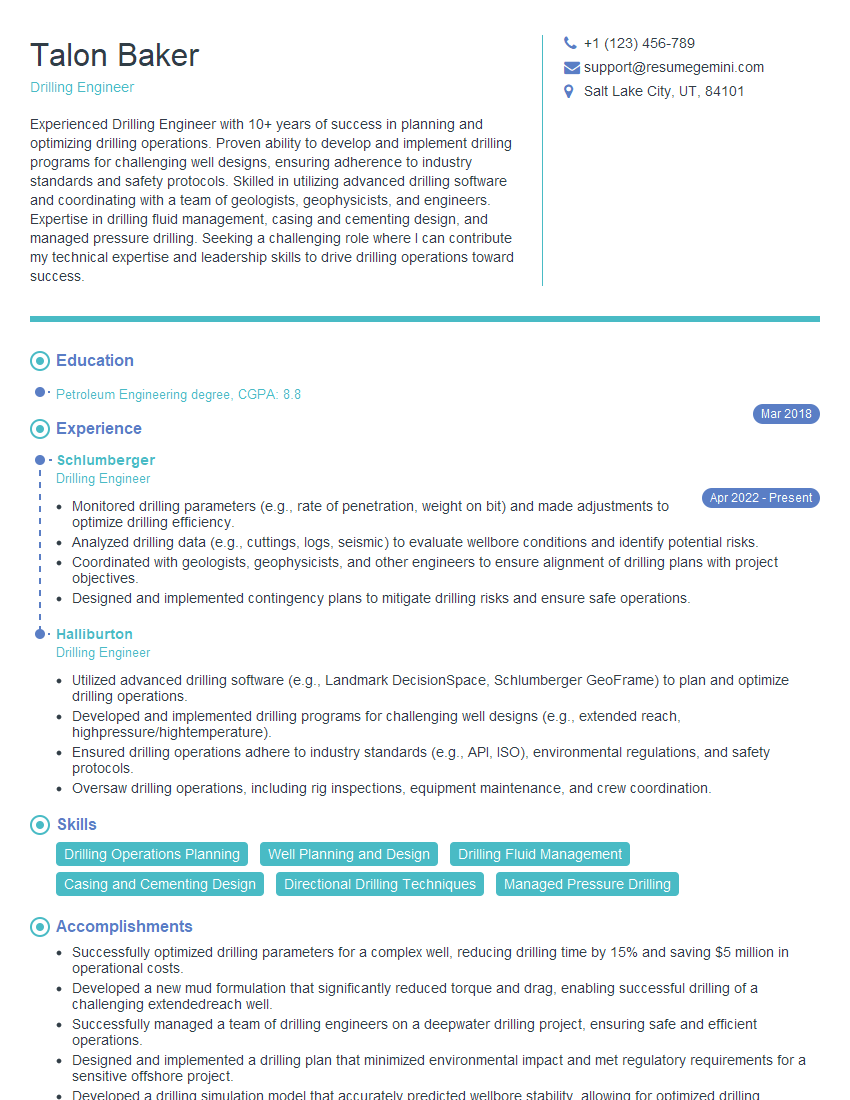
Drilling Engineer Resume Sample

Mud Engineer Resume Sample

Petroleum Engineer Resume Sample
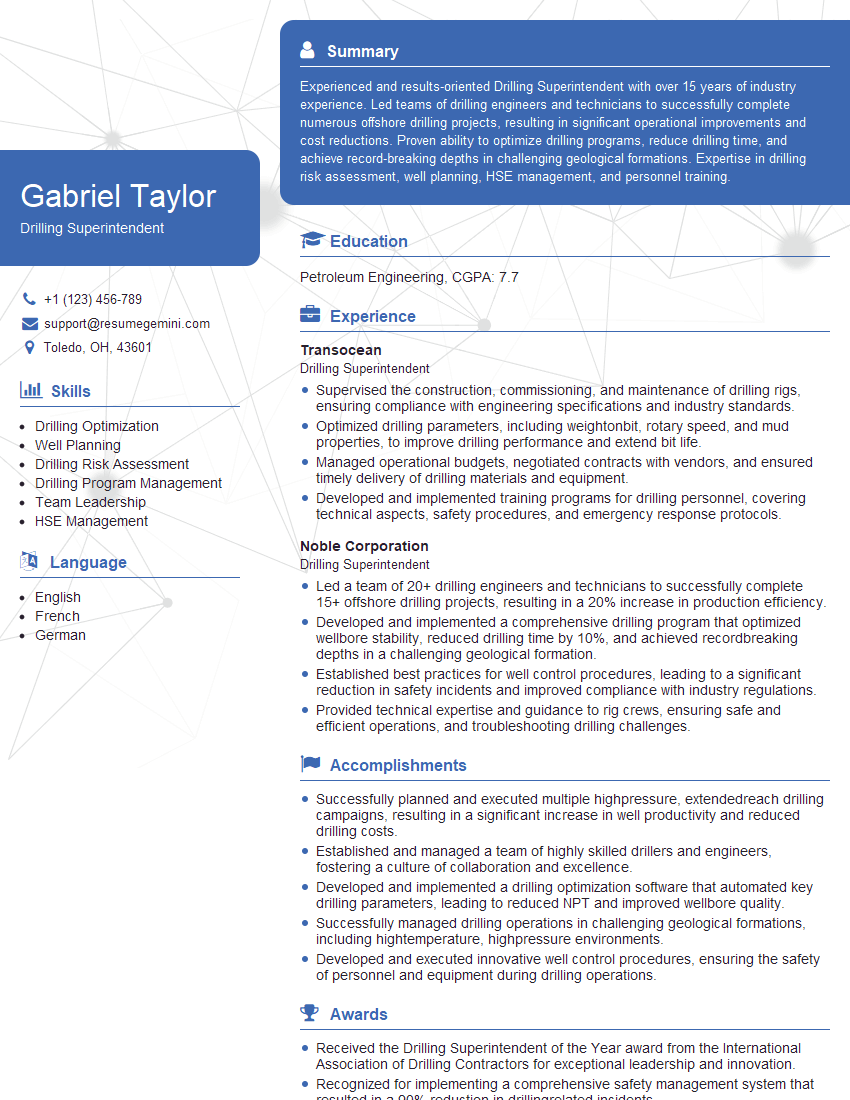
Drilling Superintendent Resume Sample

Directional Driller Resume Sample
Explore more articles
Users Rating of Our Blogs
Share Your Experience
We value your feedback! Please rate our content and share your thoughts (optional).
What Readers Say About Our Blog
I Redesigned Spongebob Squarepants and his main characters of my artwork.
https://www.deviantart.com/reimaginesponge/art/Redesigned-Spongebob-characters-1223583608
IT gave me an insight and words to use and be able to think of examples
Hi, I’m Jay, we have a few potential clients that are interested in your services, thought you might be a good fit. I’d love to talk about the details, when do you have time to talk?
Best,
Jay
Founder | CEO