Cracking a skill-specific interview, like one for ASE Brake Repair Certification, requires understanding the nuances of the role. In this blog, we present the questions you’re most likely to encounter, along with insights into how to answer them effectively. Let’s ensure you’re ready to make a strong impression.
Questions Asked in ASE Brake Repair Certification Interview
Q 1. Explain the principles of hydraulic brake systems.
Hydraulic brake systems rely on Pascal’s principle: pressure applied to a confined fluid is transmitted equally in all directions. In a car, this means pressing the brake pedal generates pressure in the master cylinder, a sealed container filled with brake fluid. This pressure is then transmitted through brake lines to the wheel cylinders (drum brakes) or calipers (disc brakes). The increased pressure forces pistons to push brake pads against the rotors (disc) or brake shoes against the drums (drum), slowing or stopping the vehicle.
Think of it like squeezing a toothpaste tube: the pressure you apply at one end forces the toothpaste out the other end, albeit much more controlled in a brake system. The incompressibility of the brake fluid is crucial; it transmits the force directly without significant loss, ensuring effective braking.
A crucial component is the brake fluid itself; it needs to be compatible with the system’s materials and possess the right viscosity to ensure efficient pressure transfer. Different fluids are specified for different systems and temperature ranges. Air in the brake lines is a serious problem as it’s compressible, reducing braking effectiveness significantly.
Q 2. Describe different types of brake systems (disc, drum, ABS).
There are several types of braking systems:
- Disc Brakes: These use calipers that squeeze brake pads against a rotating disc attached to the wheel. Disc brakes offer superior braking performance, especially at high speeds and in wet conditions, because of better heat dissipation. They are prevalent in modern vehicles, often found on all four wheels.
- Drum Brakes: These utilize shoes that expand outwards against a rotating drum attached to the wheel. Drum brakes are generally less expensive but less effective than disc brakes, particularly in wet conditions, as they are more prone to fading. They’re still sometimes used on the rear wheels of less expensive vehicles.
- Anti-lock Braking System (ABS): ABS is an electronic system that prevents wheel lock-up during hard braking. It uses sensors to detect wheel speed and adjusts brake pressure individually at each wheel to maintain traction and allow for steering control during emergency stops. This is vital for preventing skidding and maintaining control of the vehicle.
Many modern vehicles use a combination of disc brakes (front) and drum brakes (rear), while increasingly, all four wheels utilize disc brakes, often integrated with an ABS system for optimal safety.
Q 3. How do you diagnose a brake fluid leak?
Diagnosing a brake fluid leak requires a systematic approach:
- Visual Inspection: Carefully examine brake lines, hoses, calipers, wheel cylinders, and the master cylinder for any signs of leakage – wet spots, stains, or dripping fluid. Pay close attention to areas where components connect, as these are common leak points.
- Brake Fluid Level Check: Regularly check the brake fluid reservoir level. A consistently low level despite not recently changing pads or having other service is a strong indicator of a leak.
- Pressure Test (if equipped): A pressure tester can pinpoint leaks within the system more precisely. It applies pressure to the brake system and identifies pressure drops, indicating the leak location.
- Road Test: Observe for any unusual brake pedal feel, such as sponginess or a low pedal. This might indicate air in the system due to a leak.
Brake fluid is corrosive, so a leak needs prompt attention to prevent damage to components and to ensure safe braking. The color of the fluid (typically brownish) will also help identify the leak.
Q 4. What are the common causes of brake squeal?
Brake squeal is a common annoyance, stemming from several causes:
- Worn Brake Pads: Thin or worn brake pads can vibrate against the rotor, causing high-frequency squeals. The metal wear indicators on pads often produce a scraping sound that serves as a warning.
- Glazed Brake Pads: Overheating can glaze brake pads, making them hard and less effective at gripping the rotor, leading to squealing.
- Contaminated Rotors: Dirt, grease, or other contaminants on the rotor surfaces can interfere with proper pad contact, leading to noise.
- Loose or Damaged Components: Loose caliper pins, worn caliper slides, or other loose hardware can cause vibration and squealing.
- Pad Material Composition: Certain brake pad formulations may be more prone to squealing due to their material properties.
Addressing brake squeal requires careful inspection to determine the root cause. Often, replacing brake pads and cleaning rotors will resolve the issue.
Q 5. How do you inspect brake pads and rotors for wear?
Inspecting brake pads and rotors for wear involves several steps:
- Visual Inspection: Check brake pad thickness. A general rule is pads that are less than 1/4 inch thick may be getting near the end of their service life (manufacturers specify minimum thickness, refer to this information). Look for uneven wear patterns or any signs of damage, cracking, or excessive glazing. Inspect rotors for scoring, grooves, cracks, or excessive wear (thinning).
- Measurement: Use a caliper to accurately measure the pad thickness. This should be compared against the manufacturer’s specifications or the minimum thickness that assures the wear indicator doesn’t contact the rotor. Also, measure rotor thickness using a caliper, comparing to the minimum spec.
- Rotor Runout: Check for excessive runout (wobble) in the rotors using a dial indicator. This can be caused by uneven wear or damage and will likely lead to brake pulsation or vibration.
Proper inspection is vital to prevent costly and dangerous brake failures. Always replace pads and rotors in pairs on each axle to maintain balance and braking performance.
Q 6. Explain the process of bleeding brake lines.
Bleeding brake lines removes air from the hydraulic system. Air in the lines is highly compressible, leading to a spongy brake pedal and reduced braking power. The process involves:
- Gather Tools: You’ll need a brake bleeder wrench, a clear hose to collect fluid, a container for used fluid, and a helper to pump the brake pedal.
- Locate Bleeder Valves: Identify the bleeder valves, usually located on the calipers or wheel cylinders. It’s typically recommended to start with the furthest bleeder valve from the master cylinder.
- Attach Hose: Attach the clear hose to the bleeder valve, leading it into the fluid container.
- Open Bleeder Valve: Have your assistant gently pump the brake pedal several times. Open the bleeder valve slowly, allowing trapped air to escape along with some fresh fluid. Make sure fluid continuously flows through the hose to ensure that the air is fully purged.
- Close Bleeder Valve: Close the bleeder valve before your helper releases the brake pedal to prevent the return of air to the system.
- Repeat: Repeat steps 3-5 until the fluid coming out of the hose is clear and free of bubbles.
- Repeat for All Wheels: Repeat the bleeding process for each wheel, typically moving from the furthest wheel to the closest.
- Check Brake Fluid Level: After bleeding the system, check and top up the brake fluid reservoir as needed.
Remember to always work with clean brake fluid and in well-ventilated areas, as brake fluid can be dangerous and irritating.
Q 7. Describe the function of the Anti-lock Braking System (ABS).
The Anti-lock Braking System (ABS) is a safety feature that prevents wheel lock-up during hard braking. When wheels lock, the vehicle loses steering control and skids. ABS uses wheel speed sensors to detect when a wheel is about to lock up. If a wheel is nearing lock-up, the system rapidly reduces brake pressure to that individual wheel, allowing it to regain traction. This process of pulsing pressure is what causes the characteristic pulsing sensation in the brake pedal during an ABS engagement.
Imagine trying to stop quickly on ice: without ABS, your wheels would likely lock, sending you into a skid. With ABS, your wheels maintain traction allowing you to maintain some steering control while significantly reducing braking distance.
The ABS module is the ‘brain’ of the system, constantly monitoring wheel speed and adjusting brake pressure accordingly. It’s a crucial safety component in modern vehicles.
Q 8. How do you diagnose ABS system malfunctions?
Diagnosing ABS (Anti-lock Braking System) malfunctions requires a systematic approach combining diagnostic tools and a thorough understanding of the system’s components. First, you’ll need a scan tool capable of reading ABS codes. This tool will provide diagnostic trouble codes (DTCs) indicating the specific malfunction. For instance, a code might point to a faulty wheel speed sensor, a problem with the ABS control module, or a low hydraulic pressure issue.
Once you have the DTCs, you’ll need to visually inspect the relevant components. This includes checking wiring harnesses for damage, ensuring proper sensor connections, and examining the hydraulic components for leaks or damage. You might use a multimeter to test sensor voltage and resistance. For example, a faulty wheel speed sensor will often show an open or short circuit. The ABS system’s hydraulic components, including the hydraulic control unit and pumps should be inspected for leaks, damage, or proper functionality. A thorough road test, if safe and allowed, may be necessary to replicate the reported issue. Ultimately, accurate diagnosis depends on your ability to correctly interpret the DTCs, conduct a thorough visual inspection, and perform appropriate electrical tests.
Q 9. What are the safety precautions when working on brake systems?
Safety is paramount when working on brake systems. Always start by securing the vehicle using wheel chocks and the parking brake. Never work under a vehicle supported only by a jack; use jack stands for proper support. Wear safety glasses to protect your eyes from potential debris or fluid splashes. Brake fluid is corrosive, so wear gloves and avoid skin contact. Proper ventilation is important as brake cleaning solvents and brake fluid fumes can be harmful. When working with compressed air, wear appropriate hearing protection. Remember, even seemingly minor brake issues can have severe consequences; taking necessary precautions is non-negotiable.
Before starting any repair, make sure you have the correct tools and parts on hand and always follow the manufacturer’s specifications and recommendations for service. Properly dispose of used brake fluid according to local regulations. A clean and organized workspace makes for a much safer and more efficient repair.
Q 10. Explain the importance of proper torque specifications when working on brakes.
Proper torque specifications are critical for brake system safety and performance. Over-tightening can strip threads, crack components, or distort the brake system’s geometry. Under-tightening can lead to loose connections and potential failure, resulting in brake fade or complete failure. Always use a torque wrench calibrated to the manufacturer’s specifications for each component. These specifications vary depending on the vehicle make, model, and specific brake component. For example, lug nuts require a very specific torque setting to ensure the wheel is securely fastened. Using the wrong torque wrench, or not using one at all, can have serious repercussions that could potentially endanger the driver and other people on the road.
The torque values are typically found in repair manuals or service information provided by the vehicle manufacturer. Incorrect torque can lead to premature wear or even catastrophic brake failure, so paying attention to detail is paramount.
Q 11. How do you inspect brake lines and hoses for damage?
Inspecting brake lines and hoses involves a thorough visual examination for signs of damage such as leaks, bulges, corrosion, kinks, or abrasions. Start by carefully checking the entire length of each line and hose, paying close attention to areas where the lines connect to components, as these joints are especially vulnerable. Look for rust, cracks, or evidence of rubbing against other parts. Any signs of damage, no matter how small, must be addressed. A small leak can quickly escalate into a complete brake failure.
You can use a pressure tester to verify the integrity of the lines and hoses under pressure. This is important to discover leaks that may not be immediately visible. If you find any damage, replace the affected line or hose with an equivalent part designed for automotive brake systems. Never attempt to repair damaged lines or hoses; they must be replaced.
Q 12. What are the common causes of brake pulsation?
Brake pulsation, that rhythmic vibration felt in the brake pedal when braking, usually indicates problems in the braking system’s components. Common causes include warped rotors, which is the most common culprit, uneven pad wear, sticking caliper pistons, or a problem with the ABS system. Warped rotors cause a pulsating feeling when braking and are usually caused by overheating, so the rotors might need resurfacing or replacing.
Uneven pad wear might indicate a problem with the caliper assembly or the guiding pins, causing the brakes to be applied unevenly. Sticking caliper pistons can prevent the pads from fully retracting, leading to uneven braking and pulsation. The ABS system’s sensors and control module should also be examined, because a fault in those components can also result in brake pulsation.
Q 13. How do you diagnose a faulty brake master cylinder?
Diagnosing a faulty brake master cylinder involves several steps. First, carefully inspect the master cylinder for any external leaks. Look for brake fluid stains or wetness around the cylinder. Then, check the brake fluid level in the reservoir; low fluid often indicates an internal leak within the master cylinder. You can also use a pressure tester to check for internal leaks. If there’s a problem the pressure will fall. A visual inspection might also reveal external damage or corrosion. A faulty master cylinder can lead to a complete brake failure.
The next step is to verify whether the brake pedal feels spongy or goes to the floor. This is a crucial indicator of a problem in the master cylinder or associated systems, it is important to immediately inspect the system if this happens. If a leak or internal failure is suspected, the master cylinder will require replacement.
Q 14. Describe the function of a brake booster.
The brake booster is a vacuum-powered assist device that makes it easier to stop the vehicle. It reduces the force needed to push the brake pedal. It increases the efficiency of the braking system, especially at lower engine speeds. It works by using engine vacuum to amplify the force applied to the master cylinder, hence reducing driver effort.
In simple terms, imagine trying to lift a heavy weight: you can do it yourself, but it’s much easier with the help of a lever. The brake booster is like that lever, using engine vacuum to amplify your foot’s force on the brake pedal. A malfunctioning brake booster will require more effort to stop the vehicle and may be diagnosed by a lack of assistance when applying the brakes.
Q 15. How do you inspect and replace brake calipers?
Inspecting and replacing brake calipers is a crucial part of maintaining safe braking performance. Before you begin, always ensure the vehicle is safely secured and the parking brake is engaged. The inspection involves visually checking the caliper for damage like cracks, corrosion, or leaks. You’ll also check the caliper piston for smoothness and ease of movement, ensuring it’s not sticking. A sticking caliper can lead to uneven brake pad wear and rotor damage. If the caliper is damaged or the piston is seized, replacement is necessary.
Replacement Procedure:
- Disconnect the brake line: Carefully remove the brake line from the caliper using a wrench and a proper container to catch any fluid spillage.
- Remove the caliper mounting bolts: These bolts typically secure the caliper to the caliper bracket. Be mindful of the potential for fluid leakage.
- Remove the caliper: Once the bolts are removed, carefully slide the caliper off the rotor.
- Compress the caliper piston: Using a specialized tool (to avoid damaging the piston), compress the piston to allow the new brake pads to fit.
- Install the new caliper: Carefully position the new caliper onto the bracket and securely tighten the mounting bolts to the manufacturer’s specifications. Ensure proper alignment.
- Reconnect the brake line: Carefully reconnect the brake line, ensuring a tight and leak-free connection. Bleed the brake system after reconnecting the brake line to remove any air bubbles.
- Inspect and replace brake pads: Replace brake pads if they are worn below the minimum thickness or show signs of damage.
Example: I once worked on a vehicle where one caliper was completely seized due to corrosion. This led to severe brake pad wear on one side and considerable rotor damage. Replacing the caliper restored proper braking function.
Career Expert Tips:
- Ace those interviews! Prepare effectively by reviewing the Top 50 Most Common Interview Questions on ResumeGemini.
- Navigate your job search with confidence! Explore a wide range of Career Tips on ResumeGemini. Learn about common challenges and recommendations to overcome them.
- Craft the perfect resume! Master the Art of Resume Writing with ResumeGemini’s guide. Showcase your unique qualifications and achievements effectively.
- Don’t miss out on holiday savings! Build your dream resume with ResumeGemini’s ATS optimized templates.
Q 16. Explain the procedure for replacing brake pads and rotors.
Replacing brake pads and rotors is a common maintenance procedure. Always ensure the vehicle is properly secured and the wheels are removed before starting. The old brake pads should be thoroughly inspected for wear; if the wear indicators are visible, replacement is necessary. Similarly, rotors should be checked for scoring, cracking, or excessive wear. If the minimum thickness is breached, the rotors need replacement.
Procedure:
- Remove the caliper: Carefully remove the brake caliper as described in the previous answer.
- Remove the brake pads: Remove the old brake pads; they typically slide out after removing the caliper.
- Remove the rotors: Depending on the vehicle, rotors can be removed with simple removal using a wheel puller or the use of the wheel lug nuts.
- Install the new rotors: Install the new rotors ensuring they are correctly seated and secured.
- Install the new brake pads: Install the new brake pads, ensuring they are properly seated and aligned within the caliper.
- Install the caliper: Carefully reinstall the caliper and properly torque the bolts to the specifications.
- Verify caliper piston compression: ensure piston compresses correctly and pads are properly contacting rotor.
- Bleed the brakes: After reinstalling the caliper and pads, bleed the brakes to remove any air that may have entered the system.
Important Note: Always use the appropriate tools for the job to avoid damaging components and maintain safety. Torque values should be strictly followed as stated in vehicle service manual.
Q 17. What are the different types of brake fluid and their properties?
Brake fluid is crucial for transferring hydraulic pressure from the master cylinder to the wheels. Several types exist, primarily categorized by their DOT (Department of Transportation) classification. The most common are DOT 3, DOT 4, and DOT 5.1. DOT 3 is a glycol-ether based fluid, DOT 4 is a higher boiling point glycol-based fluid, and DOT 5.1 is also a glycol-based fluid. DOT 5 is silicone-based and is NOT interchangeable with the other types.
- DOT 3: Generally used in older vehicles and offers decent performance but lower boiling point.
- DOT 4: A more common choice in modern vehicles, providing better performance at higher temperatures compared to DOT 3.
- DOT 5.1: offers even better heat resistance and high boiling point, best for high-performance braking systems. Should not be mixed with DOT 3 or DOT 4.
- DOT 5: Silicone-based and incompatible with other DOT fluids. It doesn’t absorb water as readily as glycol-based fluids, but it also has a lower boiling point and can cause issues with some brake system components.
Selecting the correct brake fluid is essential for optimal braking performance and safety. Always refer to your vehicle’s owner’s manual to determine the correct type.
Q 18. How do you properly dispose of used brake fluid?
Used brake fluid is hazardous waste and must be disposed of properly. Never pour it down the drain or onto the ground. Most auto parts stores and some municipalities offer used brake fluid recycling programs. They often have designated containers for collecting used fluids. Alternatively, you can contact a hazardous waste disposal facility in your area for appropriate guidance and disposal methods. Always follow local regulations and guidelines for safe disposal of hazardous materials.
Example: Many auto parts stores accept used brake fluid in exchange for a discount on new fluid, further incentivizing responsible disposal.
Q 19. Describe the components of a wheel cylinder.
A wheel cylinder is a crucial component in drum brake systems. It converts hydraulic pressure into mechanical force to apply the brake shoes to the drum. Key components include:
- Cylinder body: The housing that holds the internal components.
- Piston cups: Seals that prevent brake fluid leakage and create a tight seal.
- Piston(s): These reciprocate to apply force to the brake shoes.
- Brake shoes: The friction material that contacts the brake drum.
- Wheel cylinder springs: These return the pistons and brake shoes to their released position.
- Bleeder screw: Allows for bleeding air from the brake line after servicing or repair.
The wheel cylinder’s intricate design ensures effective braking by transferring hydraulic pressure to the mechanical force needed to stop the vehicle.
Q 20. How do you test a wheel cylinder for leaks?
Testing a wheel cylinder for leaks involves a visual inspection and a pressure test. Visually inspect the wheel cylinder for any signs of fluid leakage around the piston seals or bleeder screw. Then, for a more thorough test, use a pressure gauge and adapter to pressurize the wheel cylinder. If the pressure drops noticeably over time or fluid is observed leaking, the wheel cylinder needs to be replaced.
Example: I once found a pinhole leak in a wheel cylinder during a visual inspection; the leak was barely visible but it caused a considerable loss of pressure over time and the eventual need to replace the cylinder.
Q 21. What are the symptoms of a failing wheel bearing?
Failing wheel bearings can manifest in several ways. Common symptoms include:
- Noise: A growling, rumbling, or humming sound, often increasing with vehicle speed. This is usually the most noticeable sign.
- Vibration: A noticeable vibration in the steering wheel or brake pedal, particularly when braking.
- Roughness: The wheel may feel rough or sticky when rotating.
- Loose wheel: An unusual amount of play in the wheel during movement which shows a significantly worn bearing.
- Uneven tire wear: Although less common, excessive play in a wheel bearing may result in unusual tire wear patterns.
If any of these symptoms are present, it’s crucial to inspect the wheel bearings promptly. Ignoring a failing wheel bearing can lead to complete failure, potentially causing a loss of vehicle control.
Q 22. How do you diagnose and repair a parking brake issue?
Diagnosing and repairing a parking brake issue starts with a thorough inspection. First, check the parking brake lever or pedal for proper engagement and release. Then, examine the parking brake cables for fraying, corrosion, or binding. Inspect the brake shoes or pads for wear and tear; significantly worn components need replacement. Next, verify the proper adjustment of the brake shoes or calipers. If the brakes are still ineffective after this, check for mechanical issues like seized calipers or damaged components within the parking brake mechanism itself. For drum brakes, this might involve inspecting the wheel cylinders and return springs. For disc brakes, examine the caliper pistons for free movement. Finally, a test drive is essential to confirm the repair’s success. If the parking brake still doesn’t hold the vehicle securely on a slight incline, further investigation is needed, possibly involving a professional diagnostic scan.
Example: Imagine a customer complaining their parking brake is ineffective. Your inspection reveals severely worn brake shoes. Replacing the shoes and adjusting the mechanism resolves the problem.
Q 23. Explain the principles of brake proportioning valves.
Brake proportioning valves are crucial for ensuring safe and effective braking, especially in vehicles with different braking characteristics on the front and rear axles. Their primary function is to regulate the hydraulic pressure applied to the front and rear brakes. They prevent rear-wheel lockup under heavy braking, a situation that can cause a loss of control. The valve works by sensing the pressure difference between the front and rear brakes and diverting fluid to equalize the braking force. This is particularly important in vehicles with a higher proportion of braking power on the front, such as those with a front-engine, front-wheel-drive configuration. Essentially, they maintain optimal balance between front and rear braking to improve stability and prevent skids.
Example: A vehicle with worn rear brakes might exhibit a tendency to lock up the rear wheels during hard braking. A properly functioning proportioning valve would compensate for this by reducing pressure to the rear brakes, thereby restoring balance and preventing skidding.
Q 24. How do you perform a brake system pressure test?
A brake system pressure test is performed using a pressure gauge connected to the brake system. The test measures the hydraulic pressure within the system. It helps identify leaks, problems with the master cylinder, or issues with the power brake booster if equipped. The procedure generally involves disconnecting a brake line at a suitable point (often at a wheel cylinder or caliper) and attaching the pressure gauge. The brake pedal is then pumped several times to build up pressure within the system. The gauge reading is observed for any leaks or significant pressure drops. A comparison of pressure readings against manufacturer specifications is crucial for accurate diagnosis. A low or rapidly dropping pressure indicates a leak or internal system failure. Always follow manufacturer’s procedures and safety precautions; brake fluid is corrosive and under pressure.
Example: During a pressure test, if the gauge shows a significant pressure drop after pumping, it strongly suggests a leak in the brake lines, wheel cylinder, or caliper.
Q 25. Describe different types of brake adjusters.
Brake adjusters are mechanisms that maintain the correct clearance between the brake shoes or pads and the brake drum or rotor. There are several types:
- Star wheel adjusters: Commonly found in drum brakes, they use a rotating star wheel to move the brake shoes closer to the drum.
- Automatic adjusters: These adjust the brake shoes automatically each time the brakes are released. They utilize the movement of components to self-adjust the brake shoes.
- Screw adjusters: These use a threaded screw mechanism to adjust the brake pads’ position. They require manual adjustment.
Example: A vehicle with excessively worn brake shoes might have a malfunctioning automatic adjuster. Manual adjustment (if possible on this type of system) might be necessary, or the adjuster itself might need replacement.
Q 26. What is the procedure for replacing a brake hose?
Replacing a brake hose requires careful attention to detail and safety. First, the vehicle must be secured using jack stands. The old brake hose is carefully disconnected from the caliper and brake line using the appropriate wrenches and tools. Brake fluid will likely spill; have absorbent material ready. Next, the new hose is installed, ensuring a tight and secure connection. A visual inspection is needed to detect any signs of damage or leaks. A pressure test is then crucial to ensure the hose is properly installed and there are no leaks. All connections must be tightened to the manufacturer’s specified torque. Finally, the system is bled to remove any air bubbles trapped within the lines.
Example: After replacing a brake hose, failure to bleed the system properly could result in spongy brake feel or reduced braking effectiveness.
Q 27. How do you identify and interpret brake system diagnostic trouble codes (DTCs)?
Modern vehicles often have sophisticated onboard diagnostic systems (OBD-II) that can store diagnostic trouble codes (DTCs) related to the brake system. These codes provide valuable information about potential issues. A scan tool is used to retrieve the DTCs. Each code has a specific meaning indicating a particular problem within the braking system, such as a faulty wheel speed sensor, ABS module malfunction, or low brake fluid level. The interpretation involves consulting a repair manual or online database specific to the vehicle’s make and model to understand the implications of the retrieved codes. This is crucial for accurately diagnosing brake system problems.
Example: A DTC of C1234 might indicate a fault in the anti-lock braking system (ABS) module. Further diagnosis may then be required to determine the exact cause of the module failure.
Q 28. Explain the importance of regular brake system maintenance.
Regular brake system maintenance is paramount for safety and longevity. It helps to prevent catastrophic brake failure and prolong the lifespan of brake components. This includes:
- Regular inspection: Visually checking brake pads, rotors, and lines for wear and tear.
- Fluid change: Brake fluid absorbs moisture over time, reducing its effectiveness and causing corrosion. Timely fluid changes are essential.
- Adjustments: Regularly checking and adjusting brake components as needed to maintain optimal braking performance.
Example: Neglecting brake fluid changes can lead to the corrosion of brake lines and calipers, potentially resulting in brake failure. This highlights the importance of regular maintenance.
Key Topics to Learn for ASE Brake Repair Certification Interview
- Hydraulic System Fundamentals: Understanding brake fluid properties, pressure distribution, and master cylinder operation. Practical application: Diagnosing and repairing brake fluid leaks.
- Brake System Components: Detailed knowledge of calipers, rotors, drums, pads, shoes, and wheel cylinders. Practical application: Identifying worn components and performing accurate measurements.
- Anti-lock Braking Systems (ABS): Understanding ABS functionality, sensor operation, and diagnostic procedures. Practical application: Troubleshooting ABS warning lights and performing system tests.
- Electronic Brake Control Systems (EBC): Familiarity with electronic stability control (ESC), traction control, and other advanced brake systems. Practical application: Explaining the interaction of these systems with other vehicle components.
- Brake System Diagnostics: Mastering diagnostic techniques, including visual inspection, pressure testing, and using diagnostic scanners. Practical application: Accurately diagnosing brake system malfunctions.
- Wheel Alignment and Suspension: Understanding the relationship between wheel alignment, suspension components, and brake performance. Practical application: Explaining how misalignment can affect brake wear and handling.
- Safety Procedures and Regulations: Adherence to safety protocols during brake repair and maintenance. Practical application: Describing safe practices for handling brake components and fluids.
- Troubleshooting and Repair Techniques: Developing effective problem-solving strategies for common brake issues. Practical application: Explaining your approach to diagnosing and repairing a specific brake problem.
Next Steps
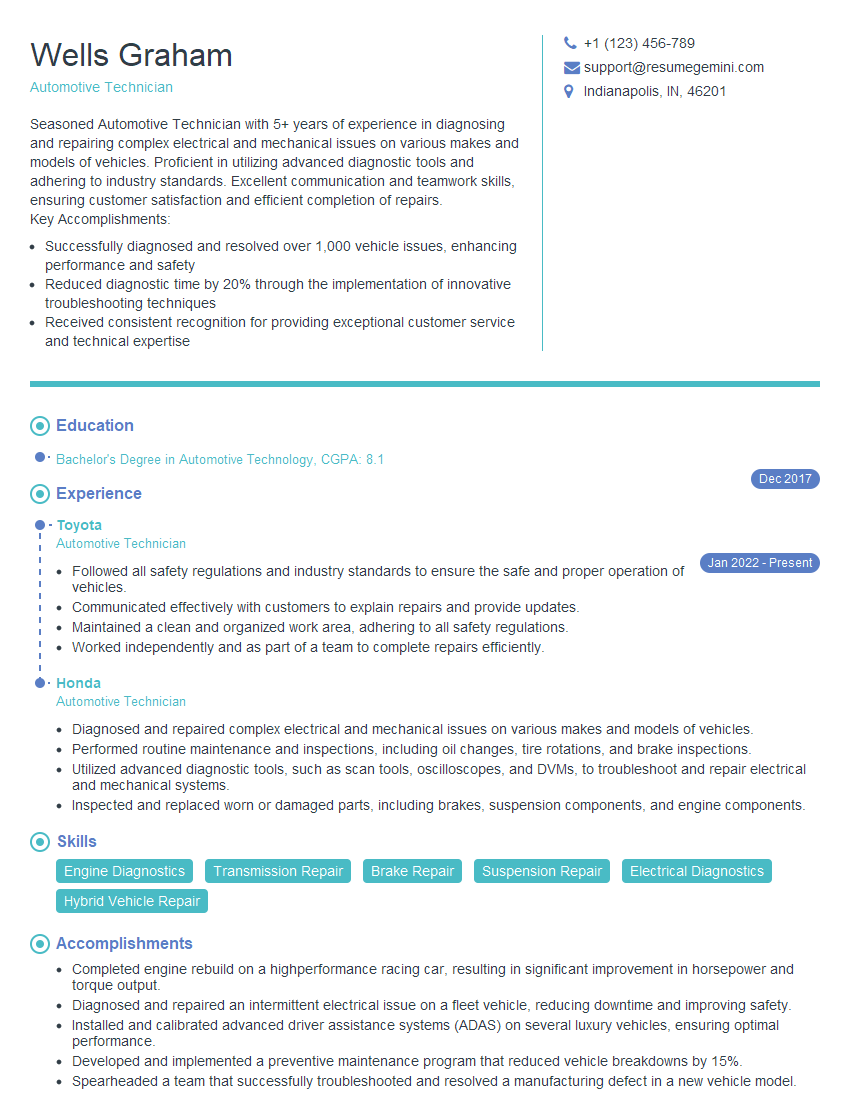
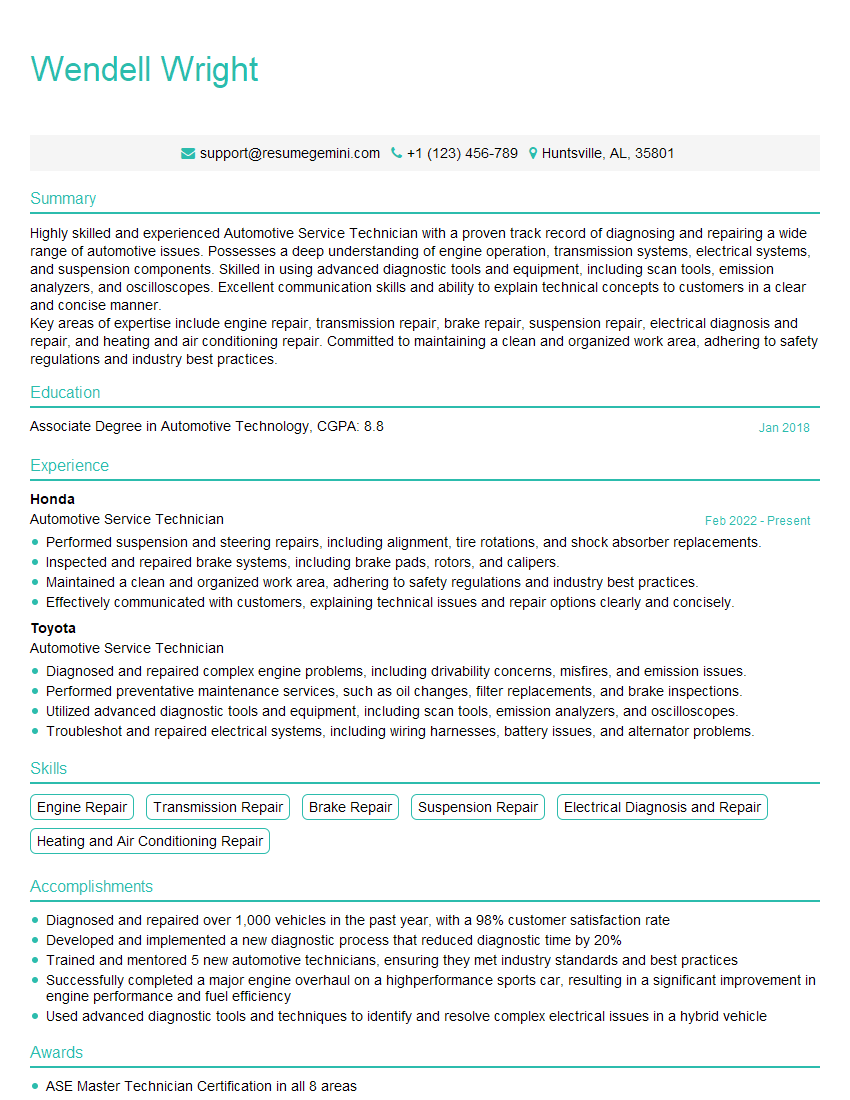
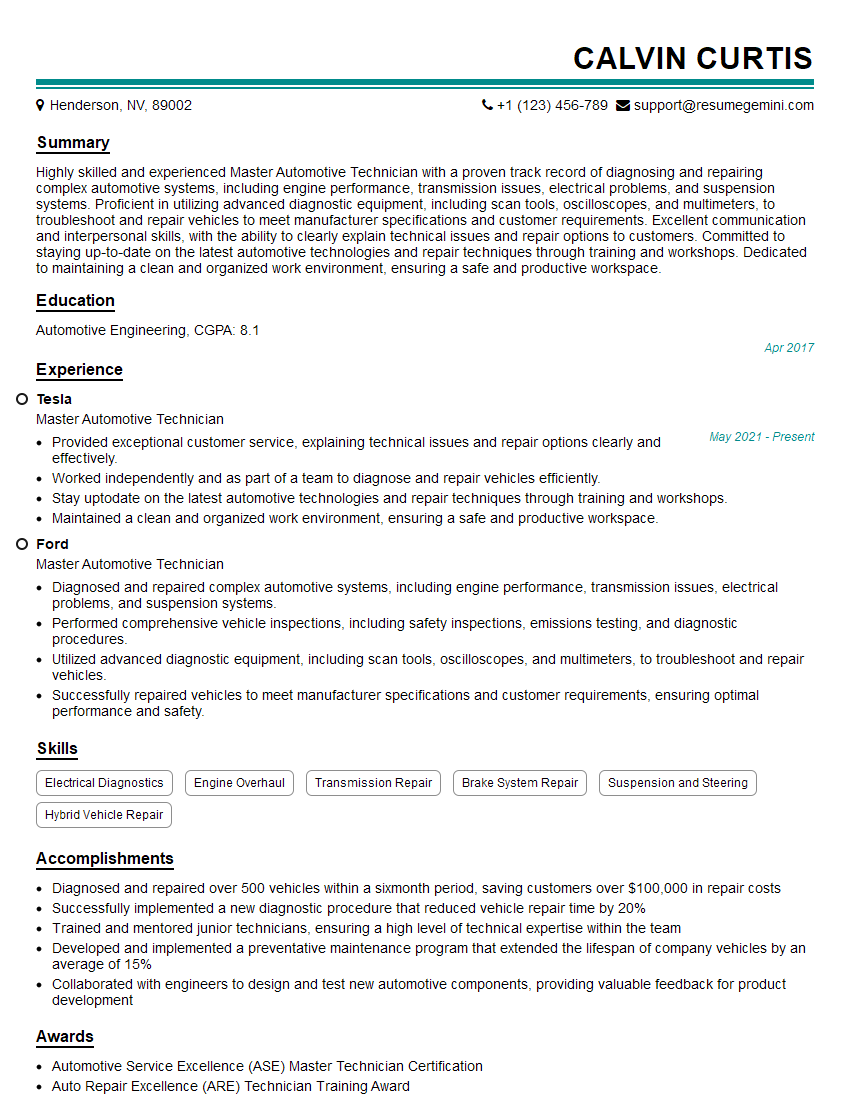
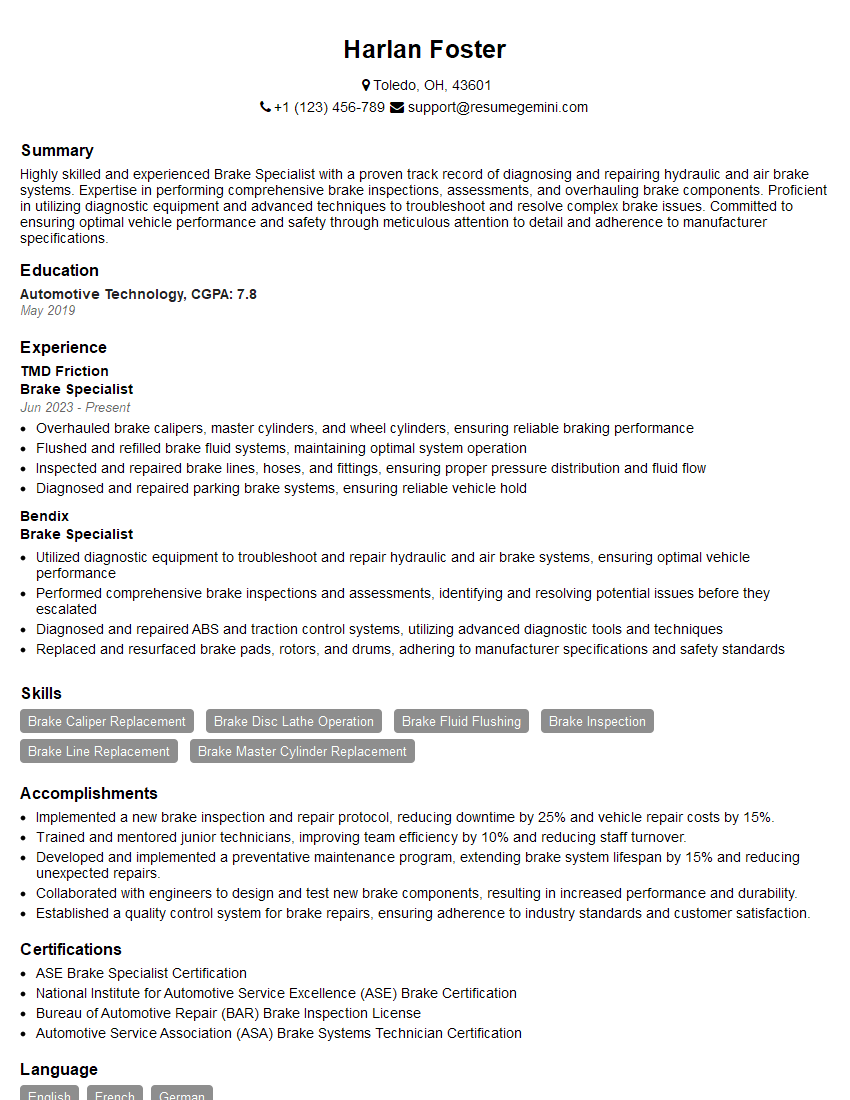
Mastering ASE Brake Repair Certification significantly enhances your career prospects, opening doors to higher-paying positions and increased responsibility within the automotive industry. To maximize your job search success, create a compelling and ATS-friendly resume that highlights your skills and experience. ResumeGemini is a trusted resource that can help you build a professional resume that makes a lasting impression on potential employers. Examples of resumes tailored to ASE Brake Repair Certification are available to help you get started.
Explore more articles
Users Rating of Our Blogs
Share Your Experience
We value your feedback! Please rate our content and share your thoughts (optional).
What Readers Say About Our Blog
I Redesigned Spongebob Squarepants and his main characters of my artwork.
https://www.deviantart.com/reimaginesponge/art/Redesigned-Spongebob-characters-1223583608
IT gave me an insight and words to use and be able to think of examples
Hi, I’m Jay, we have a few potential clients that are interested in your services, thought you might be a good fit. I’d love to talk about the details, when do you have time to talk?
Best,
Jay
Founder | CEO