Cracking a skill-specific interview, like one for Rail Traffic Control Systems, requires understanding the nuances of the role. In this blog, we present the questions you’re most likely to encounter, along with insights into how to answer them effectively. Let’s ensure you’re ready to make a strong impression.
Questions Asked in Rail Traffic Control Systems Interview
Q 1. Explain the different types of railway signaling systems.
Railway signaling systems are the backbone of safe and efficient train operations. They communicate instructions to trains, ensuring they maintain safe distances and follow designated routes. Different systems exist, categorized primarily by their technology and level of automation.
- Absolute Block Signaling: This is a traditional system where a section of track (a block) can only hold one train at a time. Signals are used to indicate whether a block is occupied or clear. Think of it like a series of traffic lights on a railway. Each block is protected, preventing collisions.
- Automatic Block Signaling (ABS): An advancement over absolute block, ABS automatically detects train occupancy within a block, simplifying signal operations. It reduces the need for manual signal manipulation at signal boxes.
- Automatic Train Control (ATC): ATC systems go beyond simply indicating occupancy. They actively control train speed, ensuring that it never exceeds a safe speed for the prevailing track conditions and signals. This increases safety and efficiency.
- Moving Block Signaling (MBS): The most advanced system, MBS allows for closer spacing of trains as it dynamically adjusts block boundaries based on the actual positions of trains. It uses sophisticated communication and train tracking technology to optimize track usage. This is like having a dynamic traffic management system adjusting the ‘blocks’ based on real-time conditions.
- Centralized Traffic Control (CTC): This isn’t a signaling system itself, but rather a system that centrally manages and controls a large network of signals and tracks. A single operator can oversee and adjust the entire system from a central location.
The choice of signaling system depends on factors like track density, train frequency, terrain, and budget. Older lines might use simpler systems like absolute block, while modern high-speed lines typically employ ATC or MBS for increased capacity and safety.
Q 2. Describe the process of train scheduling and dispatching.
Train scheduling and dispatching involve planning and executing train movements across a railway network to optimize efficiency and punctuality while ensuring safety. It’s a complex process involving several steps.
- Timetabling: This is the initial planning phase where trains’ departure and arrival times at various stations are determined. Factors considered include track capacity, passenger demand, maintenance schedules, and operational constraints.
- Train Path Allocation: Once the timetable is finalized, train paths (the specific route a train will take) are assigned. This process ensures that trains don’t conflict with each other on the same track segment.
- Dispatching: This is the real-time control of train movements. Dispatchers monitor train locations, speeds, and any delays. They adjust train paths, speeds, and timings as needed to resolve conflicts or optimize the schedule. They often communicate directly with train drivers through communication systems.
- Real-time Monitoring: Modern systems provide real-time tracking of trains allowing dispatchers to make informed decisions and intervene promptly in case of unforeseen circumstances like delays or emergencies.
The entire process relies heavily on sophisticated software and communication systems. Any deviation from the schedule is carefully managed to minimize disruption to the overall railway operation. For example, a delayed train might be given priority on certain sections to catch up, while other trains might be held momentarily.
Q 3. What are the key safety features of modern rail traffic control systems?
Modern rail traffic control systems incorporate numerous safety features to prevent accidents and maximize operational security. Key features include:
- Redundancy: Critical systems have backups in case of component failure. This ensures continued operation even if one part malfunctions.
- Automatic Train Protection (ATP): ATP systems continuously monitor train speed and position, automatically applying brakes if the train exceeds safe limits or enters a prohibited section of track. (This will be explained in more detail in a later answer).
- Fail-safe Design: Systems are designed to fail in a safe manner. For instance, if a signal fails, it will automatically default to a stop indication.
- Track Circuit Monitoring: Circuits embedded in the tracks detect the presence or absence of trains, providing occupancy information to the signaling system.
- Interlocking Systems: These prevent conflicting movements. For example, they prevent signals from showing a green light while another train is in the same block. They lock the opposing signal system
- Signalling System Monitoring and Diagnostics: Real-time monitoring and diagnostics allow for early fault detection and prevent failures from escalating into major incidents.
- Human Machine Interfaces (HMI): Intuitive interfaces allow signal engineers and dispatchers to efficiently monitor the system and react swiftly to incidents.
These safety features work together to create a robust and reliable system aimed at preventing accidents and ensuring safe train operations.
Q 4. How do Automatic Train Protection (ATP) systems work?
Automatic Train Protection (ATP) systems are crucial safety devices that enhance railway safety significantly. They use various technologies to monitor train speed and location, automatically intervening to prevent accidents if necessary.
Here’s how they work:
- Train Position Detection: ATP systems use various methods to determine the train’s location on the track, such as track circuits, balises (transponders embedded in the track), or GPS.
- Speed Monitoring: Sensors on board the train continuously monitor its speed.
- Data Comparison: The train’s speed and position are compared against permitted values stored in the ATP system’s database, which are based on the current signals and track conditions (curves, gradients etc.).
- Intervention: If the train exceeds the permitted speed or enters a prohibited area, the ATP system automatically initiates one or more of the following actions:
- Warning Signal: An audible and visual warning alerts the driver.
- Speed Reduction: The ATP system automatically reduces train speed.
- Emergency Braking: In severe situations, the ATP system automatically applies the emergency brakes to bring the train to a halt.
Different ATP systems exist, each using varying technologies and levels of sophistication. However, the underlying principle remains the same: preventing train overspeeding and unauthorized entry into restricted zones. Think of ATP as a safety net, always monitoring the train’s behavior and intervening if necessary.
Q 5. Explain the role of communication systems in rail traffic control.
Communication systems are the nervous system of modern rail traffic control, enabling seamless data exchange between various components and personnel. Effective communication is vital for efficient and safe operation.
- Train-to-Ground Communication: This allows for real-time data transmission between trains and the control center. Information such as train location, speed, and status is exchanged, enabling accurate monitoring and dispatching.
- Ground-to-Ground Communication: This involves communication between different signaling components, control centers, and maintenance personnel. It facilitates coordinated control of the entire railway network and efficient response to incidents.
- Driver-to-Dispatcher Communication: This allows dispatchers to communicate with train drivers, providing updates, instructions, or alerts. This direct communication is essential for managing delays, emergencies, or unexpected situations.
- Data Transmission: Communication networks carry vast amounts of data regarding train schedules, track occupancy, signal status, and other crucial information. This allows for automated decision-making and improved system efficiency.
Different communication technologies are used, ranging from traditional radio systems to modern digital networks employing Ethernet, fibre optics, or cellular technologies. Reliable communication is essential for preventing accidents, optimizing train schedules, and responding effectively to unforeseen circumstances.
Q 6. Describe the process of fault detection and diagnosis in a rail signaling system.
Fault detection and diagnosis in a rail signaling system is crucial for maintaining safety and operational reliability. It involves a combination of automated monitoring and human expertise.
- Real-time Monitoring: The signaling system continuously monitors its own components for anomalies. Sensors, track circuits, and other elements send data to a central monitoring system. Deviations from expected values trigger alerts.
- Automated Diagnostics: Sophisticated software analyzes the data from the monitoring system, identifying the probable cause of a fault. This automated diagnostics reduces the time needed to pinpoint the problem.
- Remote Diagnostics: In some cases, the system can be remotely accessed for fault identification and resolution, reducing the need for on-site intervention.
- On-site Inspection: If automated diagnostics can’t pinpoint the issue, on-site engineers will be dispatched to inspect the problematic area of the signaling system. This could involve checking wiring, inspecting equipment, or testing components.
- Data Logging: The system records details of all events, including faults. This historical data is valuable for identifying recurring problems, improving system design, and preventing future failures.
The entire process relies heavily on skilled engineers and technicians. Rapid and accurate fault detection and diagnosis minimizes disruptions and safeguards the safety of train operations. The aim is to minimize downtime and quickly resolve issues to prevent potential delays or accidents.
Q 7. What are the common causes of signaling failures and how are they addressed?
Signaling failures can stem from various causes, impacting the safety and efficiency of railway operations.
- Equipment Malfunctions: Ageing equipment, wear and tear, or manufacturing defects can cause failures in signals, points, track circuits, or other components.
- Environmental Factors: Extreme weather conditions (e.g., heavy rain, snow, or extreme temperatures) can damage equipment or affect its performance.
- Power Supply Issues: Failures in the power supply can shut down parts or all of the signaling system, halting train operations.
- Human Error: Incorrect configuration or maintenance of the system by personnel can lead to errors. This is usually minimized by proper training and strict operating procedures.
- Cybersecurity Threats: Modern systems are increasingly vulnerable to cyberattacks, potentially disrupting operations or causing safety hazards.
Addressing these issues requires a multi-pronged approach:
- Regular Maintenance: Preventive maintenance is crucial to identify and fix minor problems before they escalate into major failures.
- Equipment Upgrades: Replacing ageing equipment with more modern, reliable components enhances system resilience.
- Redundancy and Fail-safe Design: Incorporating backup systems and fail-safe mechanisms ensures continued operation even during failures.
- Robust Cybersecurity Measures: Implementing strong cybersecurity practices mitigates the risk of cyberattacks.
- Staff Training: Thorough training for staff involved in maintenance and operation is essential to minimize human error.
A proactive approach to maintenance and system design is crucial to minimizing signaling failures and maximizing the safety and reliability of railway operations.
Q 8. Explain the concept of interlocking in rail signaling.
Interlocking is the heart of railway safety, ensuring that conflicting movements of trains are prevented. Imagine a complex set of switches and signals – interlocking prevents the simultaneous activation of signals or routes that would lead to a collision. It’s a system of mechanical or electronic devices that logically links the different components of a railway signaling system. For example, if a signal is set to allow a train to proceed onto a section of track, the interlocking system will automatically prevent conflicting signals from being set on that same section. This prevents trains from colliding head-on or entering occupied tracks. Modern interlocking systems use computer-based logic to manage these complex interactions, but the core principle remains the same: to ensure safe and conflict-free train movements.
A simple example would be a single track with a crossover. Interlocking would ensure that the points (switches) are correctly set before a signal is allowed to show a proceed aspect for either direction. If the points are incorrectly set, the signal remains at danger, preventing any train movement that could cause a derailment.
Q 9. How do different signaling systems interact with each other?
Different signaling systems interact through interfaces and protocols, often requiring gateways or translation layers. Imagine a situation where an older system (e.g., relay-based) meets a newer, computer-based system (e.g., ETCS). These systems don’t directly ‘speak’ the same language. Therefore, specialized interfaces convert the signaling data between different formats and protocols, ensuring seamless operation and safety. These interfaces might involve data communication protocols like TCP/IP for more modern systems or specialized signaling protocols designed for specific applications. For example, a level crossing safety system interacts with the main line signaling system to ensure signals are appropriately set to stop trains at the crossing while it’s activated, preventing collisions between trains and road vehicles. The interaction ensures safety, coordination, and efficiency across the different technologies.
Q 10. What are the safety regulations and standards relevant to rail traffic control?
Safety regulations and standards for rail traffic control are stringent and vary slightly by country but share common goals. Key elements often include:
- Compliance with national and international standards: Standards like EN 50128 (for software development) and IEC 61508 (for functional safety) are widely followed. These standards define processes, techniques, and verification methods to guarantee the safety of the systems.
- Regular inspections and maintenance: Rigorous testing and maintenance are crucial to prevent system failures. This involves inspections of both hardware (track circuits, signals, points) and software components.
- Failure mode and effect analysis (FMEA): This proactive method aims to identify potential hazards and implement mitigating measures.
- Safety certification: Systems undergo rigorous certification processes to ensure compliance with safety standards before deployment.
- Emergency response plans: Procedures for handling failures and emergencies, including fail-safe mechanisms, are crucial components of the overall safety management.
Non-compliance can lead to severe penalties, operational disruptions, and, most importantly, accidents. The focus is always on preventing accidents, protecting personnel, and ensuring the reliability of the system.
Q 11. Describe your experience with SCADA systems in a rail environment.
My experience with SCADA (Supervisory Control and Data Acquisition) systems in a rail environment involved overseeing the implementation and maintenance of a system monitoring various aspects of a large railway network. This included real-time monitoring of train positions, speed, and status, as well as the status of signaling equipment. We used the SCADA system to remotely control switches and signals, although this was always within a carefully designed safety framework, with several layers of safety interlocks. The system utilized advanced features like geographical information system (GIS) integration for visualization of the network and alarm management for rapid response to operational issues. Troubleshooting involved analyzing data logs, investigating alarm events, and coordinating maintenance activities. I also worked on integrating the SCADA system with other systems, ensuring seamless data exchange and improved overall situational awareness. The key focus was ensuring real-time visibility and control while maintaining the highest safety standards.
Q 12. How do you ensure the integrity and reliability of rail traffic control systems?
Ensuring the integrity and reliability of rail traffic control systems requires a multi-faceted approach.
- Redundancy: Implementing redundant components and systems (e.g., backup power supplies, duplicate communication channels) is vital to mitigate failures. If one system fails, a backup system automatically takes over.
- Regular testing and maintenance: A planned maintenance program with rigorous testing and inspections ensures that equipment and software are functioning as expected. This should include both preventative and corrective maintenance.
- Data validation and error detection: Sophisticated mechanisms should be in place to detect and handle errors in data transmission and processing, ensuring data integrity.
- Security: Protecting the system from cyber threats is also crucial. This involves implementing robust cybersecurity measures, access control, and intrusion detection systems.
- Continuous monitoring: Real-time monitoring of the system’s performance, using tools such as SCADA systems, helps in quickly identifying and addressing any anomalies or potential issues.
These measures create a layered approach to safety, increasing reliability and mitigating risks to achieve a dependable rail traffic management system.
Q 13. Explain the different types of track circuits and their applications.
Track circuits are essential for detecting the presence and location of trains on the track. Different types cater to various needs:
- DC Track Circuits: These are the most common type, using a low-voltage DC current to power the track. The presence of a train creates a short circuit, indicating train occupancy. They’re simple, reliable and cost-effective, but can be susceptible to stray currents. They are used extensively on many railway lines globally.
- AC Track Circuits: These use an AC current, offering better performance in environments with stray DC currents. They’re generally more robust to electrical interference. AC track circuits can also transmit additional data over the track circuit itself, although this is less common.
- High-frequency Track Circuits: Used in complex situations like multiple tracks, they use higher-frequency signals to improve performance and reduce susceptibility to interference.
- Balise circuits: These do not rely on the track for their function, instead relying on a series of discrete trackside transponders (balises). They provide highly precise information about location and other data for trainborne systems such as ETCS.
The choice of track circuit depends on factors like track layout, traffic density, and the presence of stray currents. For instance, high-frequency circuits are often found in high-density urban areas due to their ability to accurately detect trains in closely spaced tracks.
Q 14. What is your understanding of ETCS (European Train Control System)?
ETCS (European Train Control System) is a modern, train-borne signaling system designed to enhance railway safety and capacity. Unlike conventional ground-based signaling, ETCS relies on digital communication between the train and the trackside infrastructure. This communication provides the train with continuous information about speed restrictions, signals, and other relevant data. ETCS levels vary in complexity and functionality. Level 1 utilizes existing national signaling systems and adds safety enhancements. Levels 2 and 3 are entirely based on radio communication and provide enhanced safety and capacity through moving block signaling. It’s a sophisticated system offering improvements like:
- Increased capacity: More efficient use of track capacity due to the precise positioning and control.
- Improved safety: Automatic train protection features eliminate potential human error.
- Interoperability: Trains equipped with ETCS can operate across different countries.
While ETCS adoption is increasing, it’s a significant investment, requiring significant upgrades to infrastructure and trains. However, the long-term safety and efficiency gains are substantial, making it a cornerstone of modern railway signaling.
Q 15. How do you manage conflicting train movements in a busy railway network?
Managing conflicting train movements in a busy railway network is a complex task that relies on sophisticated scheduling and signaling systems. Think of it like air traffic control, but on the ground. The core principle is to ensure that trains never occupy the same track segment simultaneously, preventing collisions. This is achieved through a combination of technologies and strategies:
Centralized Traffic Control (CTC): A CTC system allows a single operator to monitor and control the movement of trains across a large network. The operator uses a visual representation of the track layout to direct train movements, ensuring that trains maintain safe distances and don’t conflict.
Automatic Train Protection (ATP): ATP systems constantly monitor train speed and location, automatically applying the brakes if a train exceeds its permitted speed or approaches a signal improperly. This provides an extra layer of safety, even if human error occurs.
Signaling Systems: These systems use signals (lights and track circuits) to communicate to train drivers the authorized speed and route. Interlocking systems ensure that signals cannot be set to conflicting states, preventing multiple trains from entering a single section of track.
Train Scheduling and Planning: Careful planning of train schedules is essential. Sophisticated algorithms are used to optimize train movements, minimizing delays and conflicts while ensuring safety. This planning takes into account factors such as track capacity, maintenance schedules, and expected passenger demand. This is often simulated before implementation to test the robustness of the plan.
For example, in a scenario where two trains are approaching the same station, the CTC operator would use the system to route one train to a siding or hold it in a safe location until the other train has passed. This process ensures safety and minimizes disruption to the network.
Career Expert Tips:
- Ace those interviews! Prepare effectively by reviewing the Top 50 Most Common Interview Questions on ResumeGemini.
- Navigate your job search with confidence! Explore a wide range of Career Tips on ResumeGemini. Learn about common challenges and recommendations to overcome them.
- Craft the perfect resume! Master the Art of Resume Writing with ResumeGemini’s guide. Showcase your unique qualifications and achievements effectively.
- Don’t miss out on holiday savings! Build your dream resume with ResumeGemini’s ATS optimized templates.
Q 16. Describe your experience with troubleshooting rail signaling system failures.
Troubleshooting rail signaling system failures requires a systematic and methodical approach. I’ve encountered various issues, ranging from simple component failures (like a faulty light bulb) to complex software glitches. My approach involves:
Identify the symptom: First, pinpoint the exact nature of the failure. Is a signal displaying incorrectly? Is a track circuit failing to detect a train? Is there a complete system outage?
Gather information: Collect relevant data. This could include logs from the signaling system, witness statements from train drivers or maintenance staff, and any available diagnostic information.
Isolate the cause: Systematically investigate potential causes, using schematics and technical documentation. This often involves checking wiring, inspecting components, and running diagnostic tests. Tools like specialized signal testers and software diagnostics are used in this phase.
Repair or replace: Once the cause is identified, repair or replace the faulty component. This might involve replacing a faulty relay, repairing a broken wire, or updating software.
Test and verify: After the repair, thoroughly test the system to ensure it is functioning correctly and that the issue is resolved. This often involves running simulations and performing on-site testing.
One memorable instance involved a seemingly random signal failure that turned out to be caused by a faulty ground connection, affecting multiple signals. The issue was initially hard to pinpoint, but with a combination of systematic testing and detailed schematics, the faulty ground was identified and repaired efficiently. This highlighted the importance of thorough investigation and a comprehensive understanding of the system’s architecture.
Q 17. Explain the role of human factors in rail traffic control.
Human factors are paramount in rail traffic control. The system’s effectiveness and safety ultimately depend on the competence and vigilance of the people operating and maintaining it. Key aspects include:
Operator Training and Competency: Thorough training is crucial to ensure operators understand the system’s complexities, procedures, and emergency response protocols. Regular refresher training and simulation exercises are essential to maintain competency and awareness of potential hazards.
Workforce Management: Managing operator workload and fatigue is critical. Long shifts, insufficient rest periods, and excessive stress can significantly impact performance and increase the risk of errors. Effective scheduling and support mechanisms are key to maintaining operator alertness and efficiency.
Human-Machine Interface (HMI) Design: The design of the control interface significantly impacts operator performance. A well-designed HMI should be intuitive, easy to understand, and provide clear, concise information, reducing operator workload and error rates.
Safety Culture: A strong safety culture within the organization is paramount. This includes reporting systems for near misses and incidents, thorough investigations into accidents, and a commitment to continuous improvement.
For example, a poorly designed HMI that presents confusing or incomplete information can lead to operator errors, with potentially catastrophic consequences. Therefore, creating and maintaining a supportive culture that prioritizes safe operations is critical.
Q 18. What are the implications of cyber threats to rail traffic control systems?
Cyber threats pose significant implications for rail traffic control systems. These systems are increasingly reliant on networked technologies, making them vulnerable to various cyberattacks. The potential consequences range from minor service disruptions to catastrophic failures with potentially devastating results.
Data breaches: Compromised systems could leak sensitive operational data, leading to reputational damage and financial losses.
System disruptions: Cyberattacks could disrupt signaling systems, causing delays, derailments, or complete system outages.
Malicious control: In a worst-case scenario, attackers could gain control of the system, potentially causing trains to derail or collide.
Sabotage: Attackers could manipulate data to cause trains to malfunction or derail, leading to substantial damage and loss of life.
Mitigating these risks requires a multi-layered approach involving robust cybersecurity measures, including network segmentation, intrusion detection systems, regular security audits, employee training on cybersecurity threats, and implementation of fail-safe mechanisms. Regular penetration testing can uncover weaknesses in the system and ensure that vulnerabilities are addressed proactively.
Q 19. How do you maintain compliance with safety regulations and industry standards?
Maintaining compliance with safety regulations and industry standards is paramount in rail traffic control. We adhere to a rigorous framework that involves:
Regular inspections and audits: Systems undergo regular inspections to verify their compliance with relevant regulations and standards, such as those set by the relevant national safety authority. This ensures that all components are operating within specification.
Documentation and record-keeping: Meticulous record-keeping is essential, including maintenance logs, inspection reports, and incident reports. This ensures traceability and aids in identifying potential issues.
Staff training and certification: All personnel involved in rail traffic control must undergo thorough training and certification, demonstrating their competence to operate and maintain the systems safely.
Emergency response planning: Comprehensive emergency response plans are in place, covering a wide range of scenarios. Regular drills and simulations ensure staff are prepared to respond effectively in case of emergencies.
Staying updated on industry standards: Continuous monitoring of changes in industry standards and best practices ensures that the system remains compliant and up-to-date with the latest safety recommendations.
Non-compliance can lead to severe penalties, including hefty fines and operational restrictions, highlighting the critical nature of maintaining regulatory compliance.
Q 20. Describe your experience with rail signaling system maintenance and upgrades.
My experience with rail signaling system maintenance and upgrades is extensive. It involves a combination of preventative maintenance, corrective maintenance, and planned upgrades. Preventative maintenance aims to prevent failures before they occur. This includes regular inspections, cleaning, testing, and component replacements.
Corrective maintenance addresses issues that have already arisen, using the troubleshooting techniques I described earlier. Planned upgrades involve replacing outdated systems with newer, more efficient technology. This often requires careful planning and coordination to minimize disruption to rail services. This may involve replacing obsolete relay-based systems with modern solid-state systems or implementing advanced features like ATP or ETCS (European Train Control System). Upgrades often involve extensive testing and validation to ensure the seamless integration of the new system into the existing infrastructure.
For example, one project involved upgrading an aging electromechanical interlocking system to a modern computer-based system. The process included detailed planning, meticulous testing, staged cutovers, and comprehensive staff training to ensure a smooth transition and minimal disruption to train operations.
Q 21. Explain the process of commissioning a new rail signaling system.
Commissioning a new rail signaling system is a multi-stage process that requires meticulous planning and execution. The process typically involves:
Design and engineering: This phase involves detailed design, including system architecture, component selection, and integration with existing systems.
Installation: The signaling equipment is installed according to the design specifications. This requires careful coordination and adherence to strict safety protocols.
Testing: A rigorous testing phase follows, encompassing individual component testing, subsystem testing, and integrated system testing. This ensures that all components are functioning correctly and that the system meets its performance requirements. This testing may involve simulations and real-world tests.
Integration: The new signaling system is integrated with other railway systems, such as train control systems and communication networks.
Commissioning and handover: Once testing is complete, the system is formally commissioned and handed over to the railway operator.
Training: Comprehensive training is provided to railway staff on the operation and maintenance of the new system.
Throughout the entire process, stringent safety standards and regulatory requirements must be adhered to. Thorough documentation is crucial, and any deviations from the design specifications must be carefully managed and approved. The goal is a reliable and safe system that meets the operational needs of the railway and meets all relevant safety and regulatory standards.
Q 22. How do you ensure the seamless integration of new systems with existing infrastructure?
Seamless integration of new rail traffic control systems with existing infrastructure is crucial for avoiding disruptions and ensuring safety. It requires a phased approach, meticulous planning, and rigorous testing. We begin with a comprehensive assessment of the existing system, identifying its limitations and potential compatibility issues with the new technology. This involves detailed documentation review, on-site inspections, and data analysis.
Next, we develop a detailed integration plan. This outlines the migration strategy, including data migration processes, interface specifications, and system testing protocols. We prioritize minimizing downtime; this often involves parallel operation of the old and new systems for a period before complete cutover.
Thorough testing is paramount. We conduct various tests, ranging from unit testing of individual components to system integration testing and user acceptance testing (UAT). UAT involves simulating real-world scenarios to verify that the integrated system meets operational requirements and user expectations. Post-implementation monitoring is also essential to identify and address any unexpected issues.
For example, in a recent project involving the upgrade of a legacy signaling system, we implemented a phased rollout, starting with a less critical section of the railway line. This allowed us to test and refine the integration process before deploying it across the entire network, significantly reducing the risk of widespread disruption.
Q 23. What are the key performance indicators (KPIs) for rail traffic control systems?
Key Performance Indicators (KPIs) for rail traffic control systems are critical for assessing their efficiency, safety, and overall performance. These KPIs can be categorized into safety, operational efficiency, and system reliability metrics.
- Safety KPIs: These focus on preventing accidents and incidents. Examples include the number of near misses, the rate of signal failures leading to delays, and the frequency of unauthorized train movements.
- Operational Efficiency KPIs: These measure the effectiveness of the system in managing train movements. Examples include average train speed, punctuality rates, and the number of delays caused by signaling system failures.
- System Reliability KPIs: These indicate the robustness and dependability of the system. Examples include mean time between failures (MTBF), mean time to repair (MTTR), and system availability.
Regular monitoring of these KPIs, combined with trend analysis, enables proactive identification of potential issues and allows for timely intervention, ensuring optimal system performance and a safe railway operation.
Q 24. Describe your experience with using diagnostic tools for rail signaling systems.
My experience with diagnostic tools for rail signaling systems is extensive. I’m proficient in using a variety of hardware and software tools for troubleshooting and maintenance. These tools range from handheld diagnostic devices to sophisticated computerized systems that provide real-time data monitoring and analysis.
For instance, I’ve utilized specialized software that can interface with the signaling system’s central control unit to diagnose faults, analyze logs, and identify the root cause of problems. This software often includes features like circuit simulation and fault injection capabilities for testing and verification purposes. Additionally, we employ hardware tools such as oscilloscopes and current clamps to measure voltage, current, and other electrical parameters, helping us isolate faulty components.
A recent example involves using a network analyzer to troubleshoot communication problems between different signaling components. By analyzing network traffic patterns, we were able to pinpoint a faulty communication link, significantly reducing downtime and preventing potential safety hazards.
Q 25. How do you manage risk and prioritize safety in rail traffic control operations?
Risk management and safety are paramount in rail traffic control. We employ a multi-layered approach incorporating hazard identification, risk assessment, and mitigation strategies. This starts with a thorough hazard and operability study (HAZOP) to identify potential hazards throughout the system lifecycle.
We use risk matrices to assess the likelihood and severity of each identified hazard. Based on the risk assessment, we develop mitigation strategies, which can include implementing safety systems (like automatic train protection systems – ATP), modifying operational procedures, or investing in improved technology.
Regular safety audits and inspections are conducted to ensure the effectiveness of the safety measures. Furthermore, a strong safety culture within the organization is essential, promoting proactive reporting of near misses and encouraging continuous improvement initiatives. For example, implementing a robust system for reporting and investigating incidents helps us learn from past experiences and prevent similar events from occurring in the future.
Q 26. Explain your understanding of the different levels of railway automation.
Railway automation levels are generally categorized according to the degree of automation involved in train operations. The most common classification uses grades from GOA (Grade of Automation) 0 to 4.
- GOA 0: Unattended operation. The train driver is fully responsible for all aspects of train control.
- GOA 1: The train automatically monitors the speed of the train, and an audible warning is given to the driver if the speed limit is exceeded.
- GOA 2: The train automatically maintains the speed and distance from preceding trains. However, the driver is still required to monitor the train and take over in case of emergencies or specific situations.
- GOA 3: Automatic train operation without continuous driver intervention is possible except during starting, stopping, and changes in line. The driver monitors the system and is responsible for safety.
- GOA 4: Fully automated operation without any driver intervention is possible, with the driver only required in case of emergencies.
Each level represents an increasing degree of automation and control, leading to improved safety, efficiency, and capacity.
Q 27. How do you stay updated with the latest advancements in rail traffic control technology?
Staying updated on advancements in rail traffic control technology is vital for maintaining professional competency. I actively participate in industry conferences, workshops, and seminars, regularly attending events like the InnoTrans trade fair in Berlin. I also subscribe to relevant industry publications and journals, such as the Railway Gazette International and follow key organizations like the ERA (European Union Agency for Railways).
Moreover, I actively engage in online learning platforms and professional development courses focused on new technologies like digital signaling, AI-driven predictive maintenance, and cybersecurity in railway systems. Networking with colleagues and experts in the field through professional organizations helps share best practices and remain abreast of the latest developments.
Q 28. Describe a challenging situation you faced in rail traffic control and how you resolved it.
One particularly challenging situation involved a major signaling system failure during peak hours. The failure resulted in widespread delays and disruption to train services, affecting thousands of commuters. Initial diagnostics pointed to a hardware fault within the central control unit, but the specific cause remained elusive.
My approach involved assembling a team of experts from different disciplines, including hardware engineers, software specialists, and operational staff. We utilized a combination of diagnostic tools, including network analyzers and data loggers, to collect detailed information about the failure. We implemented a systematic troubleshooting process, systematically eliminating potential causes until we isolated the problem to a specific power supply module within the central control unit.
While replacing the faulty module was relatively straightforward, the real challenge was restoring normal operations as quickly and safely as possible. We devised a phased restoration plan, prioritizing critical train routes and gradually bringing other lines back online. This involved close collaboration with operational staff to coordinate train movements and minimize further disruptions. We successfully restored full service within 6 hours, mitigating the impact of the failure and preventing further escalation. Following the incident, we conducted a thorough post-incident analysis to identify improvements and preventative measures to reduce the likelihood of similar failures in the future.
Key Topics to Learn for Rail Traffic Control Systems Interview
- Signaling Systems: Understand the different types of signaling systems (e.g., absolute block, automatic block, centralized traffic control) and their operational principles. Consider the practical implications of failures within these systems.
- Track Circuits and their Function: Explore the role of track circuits in detecting train occupancy and ensuring safe train spacing. Be prepared to discuss troubleshooting scenarios involving track circuit failures.
- Interlocking Systems: Learn the fundamentals of interlocking systems and their critical role in preventing conflicting train movements. Discuss practical applications and potential points of failure.
- Communication Systems: Understand the various communication systems used in rail traffic control (e.g., radio, telephone, data networks) and their importance in efficient and safe operations. Think about how disruptions impact overall control.
- Safety Regulations and Procedures: Familiarize yourself with relevant safety regulations and operational procedures. Be able to discuss how these procedures contribute to accident prevention and mitigation.
- Human-Machine Interface (HMI): Understand the design and operation of the HMI used in rail traffic control centers. Consider the importance of user-friendliness and error prevention in the design of these interfaces.
- Troubleshooting and Problem Solving: Develop your ability to approach complex problems methodically, using your knowledge of the system to identify and solve issues efficiently and safely.
- Data Analysis and Reporting: Understand how data from the rail traffic control system is used for analysis, performance monitoring, and reporting to improve efficiency and safety.
Next Steps
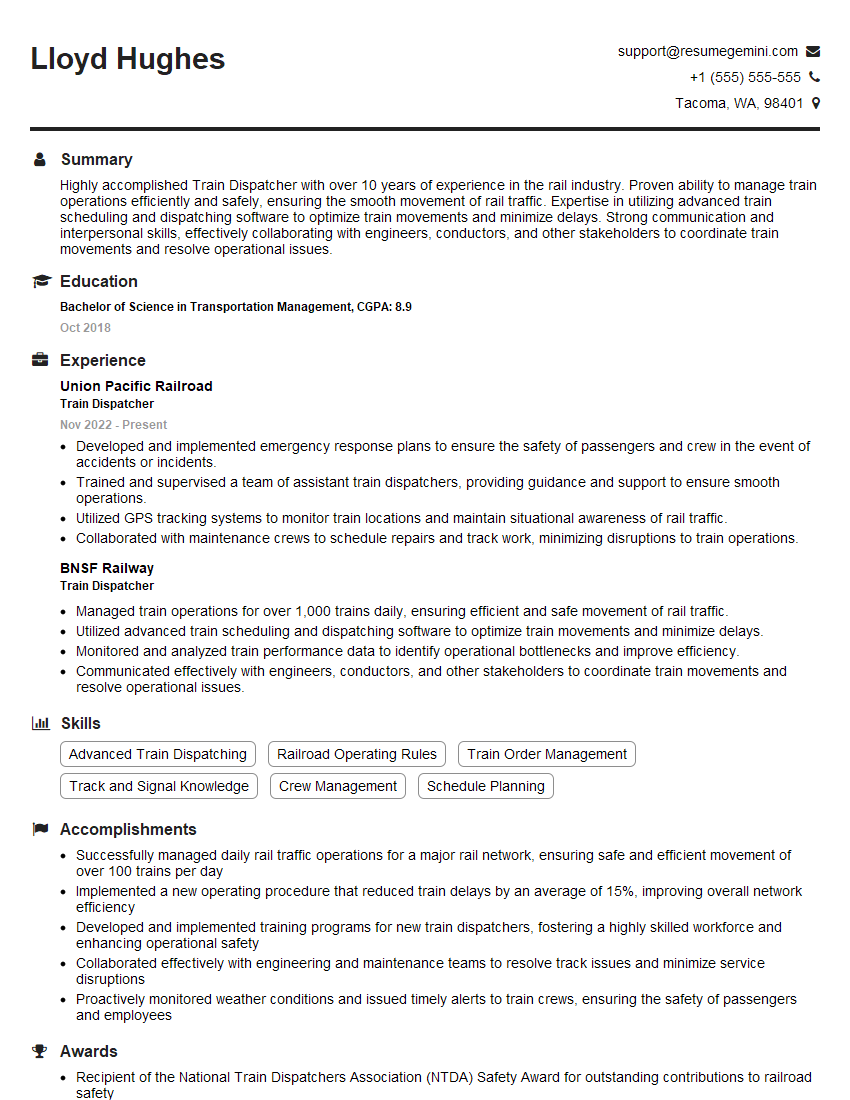
Mastering Rail Traffic Control Systems opens doors to exciting and rewarding careers in a crucial industry. Demonstrating your expertise through a well-crafted resume is paramount to securing your desired position. An ATS-friendly resume ensures your qualifications are effectively communicated to hiring managers. To create a professional and impactful resume that showcases your skills and experience in Rail Traffic Control Systems, we encourage you to use ResumeGemini. ResumeGemini provides tools and resources to build a superior resume, and examples of resumes tailored to Rail Traffic Control Systems are available to guide you.

Explore more articles
Users Rating of Our Blogs
Share Your Experience
We value your feedback! Please rate our content and share your thoughts (optional).
What Readers Say About Our Blog
I Redesigned Spongebob Squarepants and his main characters of my artwork.
https://www.deviantart.com/reimaginesponge/art/Redesigned-Spongebob-characters-1223583608
IT gave me an insight and words to use and be able to think of examples
Hi, I’m Jay, we have a few potential clients that are interested in your services, thought you might be a good fit. I’d love to talk about the details, when do you have time to talk?
Best,
Jay
Founder | CEO