Every successful interview starts with knowing what to expect. In this blog, we’ll take you through the top Geophysical Surveying interview questions, breaking them down with expert tips to help you deliver impactful answers. Step into your next interview fully prepared and ready to succeed.
Questions Asked in Geophysical Surveying Interview
Q 1. Explain the difference between reflection and refraction seismic methods.
Both reflection and refraction seismic methods utilize seismic waves to image subsurface structures, but they differ in how they interpret the wave’s behavior. Reflection seismology focuses on the reflected waves that bounce back from subsurface interfaces (boundaries between layers with different acoustic properties). Think of it like shining a flashlight at a mirror; the light reflects back, giving you information about the mirror’s location and surface. Refraction seismology, conversely, analyzes the refracted waves that bend as they pass through different layers with varying seismic velocities. Imagine a straw in a glass of water; the light bends as it passes from air to water, revealing information about the water’s density.
Reflection Seismology: Primarily used for imaging subsurface structures at depth. The strong reflections provide high-resolution images of geological features like faults and reservoirs. Data is typically processed to create a seismic section, a visual representation of the subsurface reflectors.
Refraction Seismology: More suitable for determining the shallow subsurface velocity structure, often used for engineering site investigations or shallow groundwater exploration. It determines layer velocities by analyzing the arrival times of the refracted waves. It can provide information about the depth to the refracting interfaces.
In essence, reflection methods emphasize the reflected energy for imaging, while refraction methods use the refracted energy to determine layer velocities and depths.
Q 2. Describe the principle of gravity surveying and its applications.
Gravity surveying measures variations in the Earth’s gravitational field caused by differences in subsurface density. Denser rocks exert a stronger gravitational pull than less dense rocks. By measuring these subtle variations, we can infer the presence and distribution of subsurface masses. It’s like having a very sensitive scale that measures the ‘weight’ of the subsurface.
Principle: Gravity meters (gravimeters) measure the acceleration due to gravity at various locations. These measurements are then corrected for various factors (latitude, elevation, Earth tides) to obtain the Bouguer anomaly, which represents the gravitational effect of subsurface density variations. Positive anomalies suggest dense subsurface features (e.g., ore bodies, salt domes), while negative anomalies indicate less dense features (e.g., sedimentary basins).
Applications:
- Mineral Exploration: Detecting dense ore bodies.
- Petroleum Exploration: Mapping subsurface structures and identifying potential hydrocarbon reservoirs.
- Geotechnical Engineering: Assessing subsurface conditions for construction projects.
- Groundwater Exploration: Mapping aquifers and identifying potential contaminant plumes.
Q 3. What are the common sources of noise in geophysical data acquisition?
Geophysical data acquisition is susceptible to various noise sources, which can significantly compromise the quality of the data and subsequent interpretations. These sources can be broadly classified as environmental, instrumental, and cultural.
Environmental Noise:
- Seismic Noise: Wind, rain, traffic, and even waves can generate vibrations that interfere with seismic data acquisition. Imagine trying to hear a quiet whisper amidst a noisy crowd.
- Magnetic Noise: Variations in the Earth’s magnetic field due to solar flares or nearby power lines can affect magnetic surveys.
- Electromagnetic Noise: Radio waves, power lines, and industrial equipment generate electromagnetic fields that can corrupt electromagnetic data.
Instrumental Noise:
- Electronic Noise: Malfunctioning instruments or faulty wiring can introduce noise into the data.
- Mechanical Noise: Vibrations within the instruments themselves can contaminate the measurements.
Cultural Noise:
- Human Activity: Construction, traffic, and industrial processes can generate noise that interferes with various geophysical methods.
Minimizing these noise sources through careful survey design, instrument calibration, and data processing techniques is crucial for obtaining reliable geophysical data.
Q 4. How do you handle outliers in geophysical datasets?
Outliers, data points significantly deviating from the general trend, can be a major issue in geophysical datasets. These often arise from measurement errors, noise, or genuine but unexpected geological phenomena. Handling them requires a cautious and context-aware approach.
Methods for Handling Outliers:
- Visual Inspection: Plotting the data is the first step. Obvious outliers are often identifiable visually.
- Statistical Methods: Techniques like the boxplot or standard deviation can identify values exceeding a certain threshold. Points outside a certain number of standard deviations from the mean can be flagged as potential outliers.
- Robust Statistics: Methods like median filtering or using robust regression techniques are less sensitive to outliers than traditional methods.
- Data Transformation: Transforming the data (e.g., using logarithms) can sometimes reduce the influence of outliers.
- Investigation: If possible, investigate the cause of suspected outliers. It might be a genuine geological feature or an error that can be corrected.
- Removal or Weighting: Outliers can be removed from the dataset or assigned lower weights during data processing, but this should only be done after careful consideration and ideally with supporting evidence.
The best approach depends on the nature of the data and the specific context. Blindly removing outliers can lead to loss of valuable information, so a thorough analysis is essential.
Q 5. Explain the concept of seismic velocity and its importance.
Seismic velocity is the speed at which seismic waves propagate through a medium. It’s a crucial parameter in seismic interpretation because it’s directly related to the physical properties of the rocks (density, elasticity, and porosity). Imagine sound traveling through different materials—it travels faster through steel than air.
Importance:
- Depth Determination: Knowing the seismic velocity is essential for accurately converting travel times (the time it takes for seismic waves to travel to a reflector and back) into depths.
- Lithological Identification: Seismic velocity varies significantly between different rock types. Changes in velocity can help to identify different geological formations.
- Reservoir Characterization: In petroleum exploration, seismic velocity is used to estimate reservoir properties, such as porosity and fluid saturation.
- Seismic Imaging: Accurate velocity models are critical for correcting distortions in seismic images and obtaining a clear picture of subsurface structures.
Seismic velocity determination is achieved through various methods, including well logs, refraction surveys, and velocity analysis of seismic reflection data.
Q 6. Describe different types of seismic waves and their properties.
Seismic waves are elastic waves that propagate through the Earth. They are generated by various sources such as earthquakes, explosions, or specialized seismic sources. Several types of seismic waves exist, each with unique properties:
Body Waves: These waves travel through the Earth’s interior.
- P-waves (Primary waves): These are compressional waves, meaning the particle motion is parallel to the direction of wave propagation. They are the fastest seismic waves and are the first to arrive at a seismometer. Think of pushing and pulling a slinky.
- S-waves (Secondary waves): These are shear waves, where the particle motion is perpendicular to the direction of wave propagation. They are slower than P-waves and cannot travel through liquids. Think of shaking a rope up and down.
Surface Waves: These waves propagate along the Earth’s surface.
- Rayleigh waves: These are retrograde elliptical waves, causing both vertical and horizontal particle motion. They are responsible for the rolling motion felt during an earthquake.
- Love waves: These are shear waves with horizontal particle motion. They are slower than Rayleigh waves and are confined to the Earth’s surface.
Understanding these wave types and their properties is crucial for seismic data interpretation and analysis.
Q 7. What are the advantages and disadvantages of different geophysical methods (e.g., seismic, gravity, magnetic)?
Different geophysical methods have their own strengths and weaknesses, making the choice of method dependent on the specific geological problem and the available resources. Here’s a comparison:
Seismic Methods:
- Advantages: High resolution, capable of imaging deep subsurface structures, provides information on layer boundaries and velocities.
- Disadvantages: Expensive, requires specialized equipment and expertise, can be sensitive to noise, data processing is complex.
Gravity Methods:
- Advantages: Relatively inexpensive and quick to perform, can cover large areas, useful for detecting large-scale density variations.
- Disadvantages: Low resolution, ambiguous interpretations (multiple density models can fit the same data), sensitive to terrain effects.
Magnetic Methods:
- Advantages: Relatively inexpensive and quick, useful for detecting magnetic minerals (e.g., iron ore), can cover large areas.
- Disadvantages: Low resolution, ambiguous interpretations (similar to gravity), affected by external magnetic fields.
The best method often involves a combination of techniques (integrated geophysical surveys) to obtain a more complete and accurate picture of the subsurface.
Q 8. How do you interpret seismic sections?
Interpreting seismic sections involves deciphering the subsurface geological structures from the reflected seismic waves. Think of it like looking at an ultrasound image of the Earth. We analyze the waveforms – their amplitudes, arrival times, and continuity – to identify geological features such as faults, folds, and stratigraphic layers.
For example, a strong continuous reflection might indicate a major geological boundary like a limestone layer, while a chaotic pattern of reflections might suggest a faulted or fractured zone. We also look for subtle changes in reflection characteristics – a change in amplitude could indicate a change in rock properties, for example. The process combines pattern recognition, geological understanding, and often, the use of specialized software to enhance the image quality and highlight important features.
It’s an iterative process; initial interpretations are refined through further analysis, well data correlation, and potentially additional surveys. This iterative process helps to minimize uncertainty and improve the accuracy of the subsurface model.
Q 9. Explain the process of geophysical data processing and interpretation.
Geophysical data processing and interpretation is a multi-stage workflow. It begins with the raw data acquired from various geophysical instruments (seismic, gravity, magnetic, etc.). This data is often noisy and needs significant processing to improve its signal-to-noise ratio and enhance the interpretable features.
- Data Acquisition: This involves collecting the raw geophysical data, employing appropriate instrument settings, and maintaining quality control procedures throughout the data collection process.
- Data Processing: This is where the magic happens. We apply various techniques, such as filtering (removing unwanted noise), gain control (normalizing amplitudes), and migration (positioning reflections to their correct subsurface locations) to enhance the data quality. For seismic data, this might include deconvolution, stacking, and velocity analysis. This stage is crucial for obtaining a clear and accurate image of the subsurface.
- Data Interpretation: This stage focuses on extracting geological information from the processed data. This involves analyzing reflection patterns, identifying horizons, mapping faults, and estimating geological properties. Software packages and modeling techniques aid in this interpretation, helping us build 3D models of the subsurface.
For example, in a seismic survey, the processing steps might involve removing surface waves, correcting for variations in the Earth’s velocity, and improving the resolution of the image. The interpretation then involves identifying key geological horizons and structures to build a subsurface model that is helpful for resource exploration or geotechnical studies.
Q 10. What software packages are you familiar with for geophysical data processing and analysis?
I’m proficient in several industry-standard software packages for geophysical data processing and analysis. These include:
- Seismic Unix (SU): A powerful and versatile open-source package, ideal for seismic processing and research.
- Petrel: A comprehensive reservoir characterization software used extensively for seismic interpretation and modeling.
- Kingdom: Another widely used interpretation platform with a strong suite of visualization and modeling tools.
- OpendTect: An open-source platform with advanced features for interpretation and visualization of seismic and other geophysical data.
- Geosoft Oasis Montaj: A powerful software for processing and interpreting potential field data (gravity and magnetics).
My experience with these packages covers a wide range of tasks, from basic data editing and processing to advanced interpretation and 3D modeling. The choice of software often depends on the specific project and data type.
Q 11. Describe your experience with different geophysical instruments and their operation.
My experience encompasses a range of geophysical instruments and their operation. This includes:
- Seismic reflection systems: I have worked with both land and marine seismic acquisition systems, from deploying geophones and sources to processing the acquired data and interpreting the results. This includes experience with various source types such as vibroseis and dynamite.
- Gravity and magnetic meters: I am familiar with operating both land and airborne gravity and magnetic instruments. This includes understanding the principles of operation, data acquisition procedures, and environmental considerations.
- Ground Penetrating Radar (GPR): I have experience operating GPR systems for shallow subsurface investigations, understanding the influence of antenna frequency on penetration depth and resolution.
- Electromagnetic (EM) instruments: I have hands-on experience with various EM methods (e.g., Time-Domain EM, Frequency-Domain EM) used for groundwater exploration and mineral exploration.
Beyond operating these instruments, I have a deep understanding of the principles behind their operation, data acquisition procedures, and the limitations of each technology.
Q 12. How do you ensure the quality control of geophysical data?
Quality control (QC) in geophysical data is crucial for reliable interpretations. It’s a continuous process starting from data acquisition and extending through to the final interpretation. We implement various checks at each stage:
- Instrument Calibration and Maintenance: Regular calibration and maintenance of all geophysical instruments ensure the accuracy and reliability of acquired data.
- Field QC: This involves monitoring data acquisition in real-time to identify any anomalies or problems. This may involve visual inspection of data, checking for instrument malfunctions, and addressing environmental factors.
- Data Processing QC: This includes evaluating the effectiveness of processing steps, checking for artifacts, and ensuring that the processing flow preserves the integrity of the data.
- Interpretation QC: This stage involves peer review and cross-validation of interpretations to ensure consistency and accuracy. This often includes comparing interpretations with existing geological knowledge and well data.
For example, a spike in the seismic data might indicate a temporary instrument malfunction, which needs to be identified and corrected, or excluded from the dataset. Regular QC checks are essential for producing high-quality and reliable results.
Q 13. How do you manage large geophysical datasets?
Managing large geophysical datasets requires a robust strategy. This involves efficient data storage, effective data management systems, and optimized processing workflows.
- Data Storage: We use high-capacity storage systems (e.g., network-attached storage (NAS) or cloud-based solutions) to store large volumes of data efficiently. Data is typically organized using a hierarchical structure that makes retrieval easy and efficient.
- Database Management: Relational databases or specialized geophysical data management systems help in organizing and indexing the data, facilitating searches and retrievals. This includes metadata management, ensuring data provenance and traceability.
- Parallel Processing: We employ parallel processing techniques and high-performance computing (HPC) clusters to process large datasets quickly and efficiently. This significantly reduces processing times.
- Data Compression and Visualization: Techniques like seismic trace compression help in minimizing the storage space required, and optimized visualization strategies make it easier to analyze large volumes of data.
A well-planned data management strategy is key for seamless workflows and minimizes risks related to data loss or corruption. This includes backing up data regularly and implementing data security measures.
Q 14. Explain the concept of depth conversion in seismic interpretation.
Depth conversion in seismic interpretation is the process of converting the two-way travel time of seismic reflections (recorded in milliseconds) into depth (in meters or feet). This is essential for building accurate subsurface geological models. Seismic data initially shows the travel time of the reflected waves, not the actual depth. To get the depth, we need to know the velocity of seismic waves in the subsurface.
The process usually involves:
- Velocity Analysis: Determining the velocity of seismic waves at different depths. This is often achieved through techniques like velocity analysis using moveout curves or through the use of well log data.
- Depth Conversion Algorithm: Applying a suitable depth conversion algorithm (e.g., Dix equation) that uses the velocity information to calculate the depth for each reflection.
- Depth Section: The final output is a depth section, which shows the subsurface geology in terms of depth rather than travel time. This allows for more accurate geological interpretations and modeling.
Imagine it like this: you’re measuring the time it takes for an echo to return. To calculate the distance to the object creating the echo, you need to know the speed of sound. Similarly, to convert seismic travel times to depths, we need to know the velocity of seismic waves in the rock layers.
Q 15. What are some common geological structures identified using geophysical methods?
Geophysical methods are incredibly powerful tools for identifying a wide range of geological structures. These methods indirectly reveal subsurface features by measuring physical properties like density, magnetic susceptibility, electrical conductivity, and seismic velocity. Some common geological structures identified include:
- Faults: These fractures in the Earth’s crust, often associated with displacement, show up as discontinuities in geophysical data. For example, a significant change in resistivity across a fault zone can be detected using electrical resistivity tomography (ERT).
- Folds: These bends in rock layers, caused by tectonic forces, create variations in subsurface properties, detectable through seismic reflection or gravity surveys. A synclinal fold, for example, might exhibit a characteristic pattern of higher density rocks at its core.
- Intrusive bodies (e.g., igneous dikes and sills): These bodies of magma that have solidified beneath the surface often possess different physical properties than the surrounding rock. Magnetic surveys are particularly effective at locating these features if they contain magnetic minerals.
- Unconformities: These represent gaps in the geological record, often marked by erosion or non-deposition. Seismic reflection profiles can clearly reveal angular unconformities, where older, tilted strata are overlain by younger, horizontal layers.
- Hydrocarbon reservoirs: Variations in porosity and permeability within sedimentary rocks, indicators of potential hydrocarbon reservoirs, can be detected using seismic reflection and electrical resistivity methods.
The specific geophysical method used depends heavily on the type of structure being sought and the subsurface conditions.
Career Expert Tips:
- Ace those interviews! Prepare effectively by reviewing the Top 50 Most Common Interview Questions on ResumeGemini.
- Navigate your job search with confidence! Explore a wide range of Career Tips on ResumeGemini. Learn about common challenges and recommendations to overcome them.
- Craft the perfect resume! Master the Art of Resume Writing with ResumeGemini’s guide. Showcase your unique qualifications and achievements effectively.
- Don’t miss out on holiday savings! Build your dream resume with ResumeGemini’s ATS optimized templates.
Q 16. Describe your experience in the field, including data acquisition and safety procedures.
My field experience spans over 10 years, encompassing various geophysical surveys including seismic reflection, refraction, gravity, magnetic, and electrical resistivity tomography (ERT). I’ve worked extensively on projects ranging from mineral exploration to environmental site characterization and geotechnical investigations.
Data acquisition involves careful planning, including site reconnaissance, instrument setup, and quality control procedures. For instance, in seismic surveys, geophone placement must be precise and the seismic source carefully controlled to ensure accurate data. For ERT surveys, electrode spacing must be carefully planned to optimize the subsurface resolution while ensuring safe operating procedures.
Safety is paramount in all fieldwork. We strictly adhere to company safety protocols and regulatory guidelines. This includes wearing appropriate personal protective equipment (PPE) like safety helmets, high-visibility clothing, and safety footwear. Before commencing any field operations, a thorough site-specific risk assessment is conducted, addressing potential hazards such as hazardous materials, uneven terrain, and equipment operation. Regular safety meetings and toolbox talks are conducted to ensure all crew members are well-informed and prepared.
Q 17. How do you integrate geophysical data with other geological data (e.g., well logs, geological maps)?
Integrating geophysical data with other geological information is crucial for creating a comprehensive subsurface model. This process involves a multi-step approach:
- Data compilation: Gathering all available data, including geophysical survey results (e.g., seismic sections, resistivity maps), well logs (lithology, porosity, permeability), geological maps, and borehole information.
- Data processing and interpretation: Processing geophysical data to enhance signal-to-noise ratio and create interpretable images. This step often involves advanced software and sophisticated algorithms. Well logs are also processed to provide consistent depth control and lithologic descriptions.
- Spatial correlation: Comparing the spatial distribution of geophysical anomalies with geological features mapped on the surface or from well logs. For example, low-resistivity zones in ERT data might be correlated with known clay layers from well logs.
- Geologic modeling: Creating a 3D subsurface model that integrates all data sources. This often involves using specialized software to build a coherent picture of the subsurface. This model should ideally be consistent with all the data inputs.
- Model validation: Testing the model’s accuracy against independent data sets or by comparing predicted values with actual observations. This step refines the model and improves its accuracy.
This integrated approach minimizes uncertainties and leads to more reliable interpretations.
Q 18. What are the limitations of geophysical methods?
Despite their power, geophysical methods have limitations. These limitations stem from the indirect nature of the measurements and the complex nature of the subsurface.
- Ambiguity of interpretation: Different geological structures can sometimes produce similar geophysical responses. This requires careful consideration of multiple data sets and geological context.
- Resolution limits: Geophysical methods have inherent limitations in their resolution, meaning that small or closely spaced features may not be clearly resolved. The resolution is dependent on the method used and the subsurface conditions.
- Depth of penetration: The depth to which geophysical methods can effectively probe varies depending on the method and the subsurface properties. Deep investigations often require specialized techniques.
- Influence of surface conditions: Weathering, topography, and near-surface variations can influence geophysical measurements and sometimes obscure deeper features.
- Assumption of homogeneity: Some geophysical methods make assumptions about subsurface homogeneity that may not always be valid in complex geological settings.
Careful planning, use of multiple methods, and integration with other data are essential to mitigate these limitations.
Q 19. How would you address a discrepancy between geophysical data and geological expectations?
Discrepancies between geophysical data and geological expectations are common and often signal an area requiring further investigation. Addressing this involves a systematic approach:
- Re-evaluate data quality: Verify the accuracy and reliability of both the geophysical data and the geological information. This might involve checking for errors in data acquisition, processing, or interpretation.
- Examine the assumptions: Review the assumptions made during data interpretation and compare them with the available geological knowledge. For instance, did we assume a uniform subsurface when that assumption is invalid?
- Consider alternative interpretations: Explore alternative interpretations of the geophysical data, considering the ambiguities inherent in geophysical methods. Could there be other geological features that create the observed geophysical signature?
- Gather additional data: If necessary, conduct further geophysical surveys or acquire additional geological data (e.g., more boreholes) to resolve the discrepancy. Perhaps a higher resolution survey or a different geophysical method is needed.
- Refine the geological model: Update the geological model to incorporate the new data and resolve the inconsistencies. The model should now align with both the geophysical and geological evidence.
This iterative process is crucial for developing a robust and reliable understanding of the subsurface.
Q 20. Describe your experience with different types of geological formations.
My experience encompasses a broad range of geological formations, including:
- Sedimentary rocks: I’ve worked on projects involving various sedimentary environments, from unconsolidated alluvial deposits to well-consolidated sandstones and shales. These projects often involve the identification of potential hydrocarbon reservoirs or groundwater aquifers.
- Igneous rocks: My experience includes surveys in areas with intrusive and extrusive igneous rocks. These projects frequently involve mineral exploration or geothermal resource assessment.
- Metamorphic rocks: I have conducted surveys in regions with metamorphic terrains, focusing on understanding the structural geology and identifying potential mineral deposits.
- Unconsolidated sediments: I have extensive experience using geophysical methods to characterize unconsolidated sediments for geotechnical investigations and environmental site assessments.
This diverse experience has provided me with a strong understanding of how geophysical methods respond to different geological settings and material properties.
Q 21. Explain your understanding of electromagnetic methods in geophysical surveying.
Electromagnetic (EM) methods are a crucial part of geophysical surveying, utilizing the principles of electromagnetism to investigate subsurface properties. These methods measure the electrical conductivity of the subsurface, which is sensitive to factors such as water content, mineral composition, and geological structures. Different EM methods exist, categorized broadly as either controlled-source or passive-source techniques.
Controlled-source EM (CSEM) methods involve transmitting an electromagnetic field into the ground using a controlled source (e.g., a loop of wire or a dipole) and measuring the resulting secondary electromagnetic field. Variations in conductivity are detected as variations in the measured field. CSEM methods are widely used in hydrocarbon exploration, where variations in conductivity can indicate the presence of hydrocarbon reservoirs.
Passive-source EM methods, such as magnetotellurics (MT), measure naturally occurring electromagnetic fields generated by atmospheric processes. These methods are particularly useful for investigating deeper subsurface structures than CSEM and often used in geothermal and mineral exploration. MT is particularly useful to determine deep crustal structures.
The choice of EM method depends on several factors, including the depth of investigation, the target properties, and the geological setting. Interpretation of EM data often involves sophisticated modeling and inversion techniques to derive a subsurface conductivity model.
Q 22. How do you interpret potential field data (gravity and magnetic)?
Interpreting potential field data, like gravity and magnetic data, involves identifying subsurface density and magnetic susceptibility variations. We’re essentially looking for anomalies – deviations from the expected, regional field – that indicate the presence of different geological materials.
The process typically begins with data reduction and processing to correct for instrumental drift, terrain effects, and latitude variations. Then, we apply various analytical techniques. These include:
- Filtering: Removing high-frequency noise using techniques like wavelet transforms to enhance the signal-to-noise ratio.
- Continuation: Upward or downward continuation of the data to enhance or suppress specific depth ranges of anomalies. This helps separate shallow and deeper sources.
- Derivative calculations: Calculating the first and second vertical derivatives to highlight edges and locate the center of anomalies. These derivatives emphasize the contrasts in the field.
- Analytical signal: Combining the amplitude and phase information of the data to enhance edges and define the boundaries of anomalies more precisely.
- Inversion modelling: Constructing 3D models of subsurface density or susceptibility distribution that best fit the observed data. This can be done using iterative algorithms, and the quality of the inversion greatly depends on the model parameterization, prior geological knowledge and the quality of the acquired data.
For example, a positive gravity anomaly might indicate a dense body like an ore deposit or igneous intrusion, while a negative anomaly might indicate a less dense body like a sedimentary basin. Similarly, a strong magnetic anomaly can indicate the presence of magnetic minerals like magnetite. The shape, amplitude and spatial extent of the anomaly help us constrain the size, depth, and geometry of the subsurface source. It’s crucial to integrate this data with geological knowledge and other geophysical surveys for accurate interpretation.
Q 23. What is your experience with 3D seismic data processing and interpretation?
My experience with 3D seismic data processing and interpretation is extensive. I’ve worked on numerous projects involving land and marine surveys, from initial data acquisition planning to the final interpretation of subsurface structures.
My processing experience includes:
- Pre-stack and post-stack processing: This involves various steps like noise attenuation (e.g., random noise reduction, multiple suppression), deconvolution, velocity analysis, migration (Kirchhoff, pre-stack depth migration, RTM), and amplitude balancing to optimize the seismic image quality and enhance resolution.
- Seismic attribute extraction and analysis: I’m proficient in extracting and interpreting various seismic attributes, including amplitude, frequency, instantaneous attributes (phase, frequency, amplitude), and coherence to delineate geological features like faults, channels, and stratigraphic horizons. I regularly use commercial software such as Petrel, Kingdom and SeisSpace for this process.
- Seismic modelling and forward modelling: I have a strong understanding of seismic modelling techniques and use them to calibrate interpretations and test geological models, ensuring the feasibility of interpretations.
In interpretation, I’m skilled at integrating seismic data with well logs, geological information, and other geophysical data to build accurate and reliable geological models. I’m comfortable using advanced interpretation techniques like horizon tracking, fault interpretation, and structural modeling to create 3D structural models. For example, on one project, we used 3D seismic data to identify a previously unknown fault system, ultimately leading to the discovery of a new hydrocarbon reservoir.
Q 24. Describe your understanding of seismic attribute analysis.
Seismic attribute analysis involves extracting quantitative measures from seismic data to enhance the interpretation of subsurface geology. These attributes describe various aspects of the seismic signal, providing additional information beyond simple amplitude variations.
There are numerous types of attributes, broadly categorized as:
- Geometric attributes: These describe the geometry of seismic reflections, including things like curvature, dip, azimuth, and coherence. Coherence, for instance, helps to identify discontinuities like faults or channels.
- Amplitude attributes: These focus on the amplitude of the seismic reflections, such as instantaneous amplitude, peak amplitude, and average amplitude. These attributes are useful for reservoir characterization, identifying fluid contacts, or identifying bright spots related to hydrocarbons.
- Frequency attributes: These relate to the frequency content of the seismic reflections, such as instantaneous frequency, dominant frequency, and spectral decomposition. Frequency attributes can be useful in differentiating lithologies or identifying changes in reservoir properties.
For instance, high coherence values indicate continuous reflections, often found in undisturbed sedimentary layers. Low coherence values, on the other hand, often indicate the presence of faults or fractures. By integrating multiple attributes, we can create a more comprehensive understanding of the subsurface geology, improve reservoir characterization and reduce the uncertainty in subsurface modelling.
Q 25. What are the environmental considerations in geophysical surveying?
Environmental considerations in geophysical surveying are paramount, and adhering to strict regulations is mandatory. Minimizing our impact on the environment is crucial, both during data acquisition and the post-survey phase.
Key considerations include:
- Land surveys: Avoiding sensitive habitats and minimizing ground disturbance. We use techniques like shallow trenching and minimal surface access when possible. Proper site restoration is critical after survey completion.
- Marine surveys: Preventing harm to marine life through careful vessel operation, adherence to noise regulations, and the use of appropriate marine mammal monitoring protocols. We utilize specialized equipment designed to minimize sound pollution in sensitive marine environments.
- Airborne surveys: Minimizing noise pollution and ensuring flight paths avoid sensitive areas or populations. We use environmentally sound aircraft with reduced noise emissions and operate within regulatory guidelines, obtaining the necessary permits to fly over environmentally sensitive areas.
- Waste management: Proper disposal of all survey materials and chemicals in accordance with environmental regulations.
- Permitting and approvals: Obtaining all necessary environmental permits before initiating any survey work. This process involves detailed environmental impact assessments.
Ultimately, responsible environmental stewardship is not just an ethical obligation but a legal requirement in most jurisdictions. Failure to comply can result in severe penalties and reputational damage. A comprehensive environmental management plan is a vital part of any successful geophysical survey project.
Q 26. Explain your experience with different types of geophysical surveys (e.g., land, marine, airborne).
My experience spans all major types of geophysical surveys: land, marine, and airborne.
Land Surveys: I’ve worked extensively with land-based techniques, including seismic reflection, refraction, gravity, and magnetic surveys. Experience ranges from small-scale site investigations to large-scale exploration projects. I’m familiar with various acquisition methods and instrumentation for different geological settings and objectives.
Marine Surveys: My experience includes marine seismic reflection surveys using both 2D and 3D techniques, as well as multibeam sonar bathymetry surveys for seabed mapping. I understand the challenges of working in a marine environment, including vessel operations, data acquisition in challenging weather conditions, and post-processing steps required to remove various noise sources inherent in marine data.
Airborne Surveys: I’ve participated in several airborne electromagnetic (AEM) and magnetic surveys. These surveys are particularly useful for covering large areas quickly and efficiently. I have hands-on experience in data acquisition planning, interpreting survey results using specialized processing software, and integrating the data with other geophysical information. The interpretation process often involves using advanced 3D modelling techniques.
My broad experience across these methodologies allows me to select the most appropriate surveying techniques for diverse geological and environmental conditions.
Q 27. How do you ensure the accuracy and reliability of geophysical data?
Ensuring the accuracy and reliability of geophysical data involves meticulous attention to detail at every stage, from planning and acquisition to processing and interpretation.
Key strategies include:
- Rigorous quality control (QC) procedures: Implementing checks at all stages to identify and correct errors or anomalies. This includes QC checks during data acquisition, processing, and interpretation. Examples include regular instrument calibration, repeated measurements, and comparison with independent datasets.
- Calibration and instrument testing: Ensuring all instruments are properly calibrated and regularly tested to maintain accuracy. We use certified standards and follow strict calibration procedures according to manufacturer specifications.
- Data processing and corrections: Applying various corrections during data processing to account for factors like instrument drift, terrain effects, and environmental noise. A rigorous approach involving various filtering techniques, and careful selection of processing parameters is crucial to enhance the signal-to-noise ratio.
- Appropriate data analysis techniques: Employing robust statistical analysis methods to identify potential errors or biases in the data and to quantify the uncertainties in the interpretations.
- Independent verification: Where possible, using multiple independent data sets or methodologies to cross-validate results and enhance confidence in the findings.
- Documentation: Maintaining comprehensive documentation of all aspects of the survey, including data acquisition parameters, processing steps, and interpretation results.
For example, in a seismic survey, we would use multiple geophones to obtain redundant measurements, which can then be used to improve the signal quality and reduce errors. Accurate positioning systems are vital to ensure the precise location of each measurement. The quality of the final product directly depends on a rigorous quality control throughout the project.
Q 28. Describe your project management experience in geophysical surveying.
My project management experience in geophysical surveying encompasses all aspects of project lifecycle, from initial planning to final reporting.
This includes:
- Project scoping and planning: Defining project objectives, identifying resources and timelines, and developing detailed work plans.
- Budget management: Developing and managing project budgets, ensuring efficient resource allocation and cost control.
- Team leadership and coordination: Leading and motivating multidisciplinary teams, including geophysicists, technicians, and support staff. Effective communication and collaboration are key elements to a successful project.
- Health and safety management: Implementing and enforcing strict health and safety protocols on all projects. This includes risk assessments, training and emergency response plans.
- Data management: Implementing efficient data management systems for data acquisition, processing, and archiving.
- Client liaison: Communicating effectively with clients, keeping them informed of progress, and addressing any concerns or issues promptly.
- Reporting: Preparing and presenting detailed project reports to clients, including interpretation of results and recommendations for future work.
I’m adept at using project management software and tools (e.g., MS Project) to track progress, manage resources, and communicate effectively within a team. A recent project involved coordinating a large-scale 3D seismic survey which required careful logistical planning, managing a large team, and working closely with external stakeholders. Successful completion of this complex project required a blend of technical knowledge and excellent project management skills.
Key Topics to Learn for Geophysical Surveying Interview
- Seismic Surveying: Understanding principles of seismic wave propagation, data acquisition techniques (reflection, refraction), processing and interpretation of seismic data for subsurface imaging. Practical applications include hydrocarbon exploration, geological mapping, and earthquake hazard assessment.
- Gravity and Magnetic Surveying: Grasping the theoretical basis of gravity and magnetic fields, data acquisition methods, and interpretation techniques for identifying subsurface density and magnetic susceptibility variations. Practical applications include mineral exploration, groundwater investigation, and mapping of geological structures.
- Electrical and Electromagnetic Surveying: Familiarizing yourself with various electrical and electromagnetic methods (resistivity, induced polarization, electromagnetic induction), their applications in groundwater exploration, environmental remediation, and mineral exploration. Understanding data interpretation and limitations of each method.
- Data Processing and Interpretation: Developing a strong understanding of geophysical data processing workflows, including noise reduction, filtering, and inversion techniques. Gain proficiency in interpreting processed data using appropriate software and visualizing subsurface models.
- Geophysical Instrumentation and Field Techniques: Become familiar with the various instruments used in geophysical surveying, their operational principles, and best practices for data acquisition in the field. Understand limitations and potential sources of error.
- Health and Safety: Demonstrate knowledge of relevant health and safety regulations and procedures related to geophysical field operations. This includes risk assessment and mitigation strategies.
- Report Writing and Presentation Skills: Practice communicating geophysical results effectively through clear and concise reports and presentations. This includes effectively visualizing data and drawing meaningful conclusions.
Next Steps
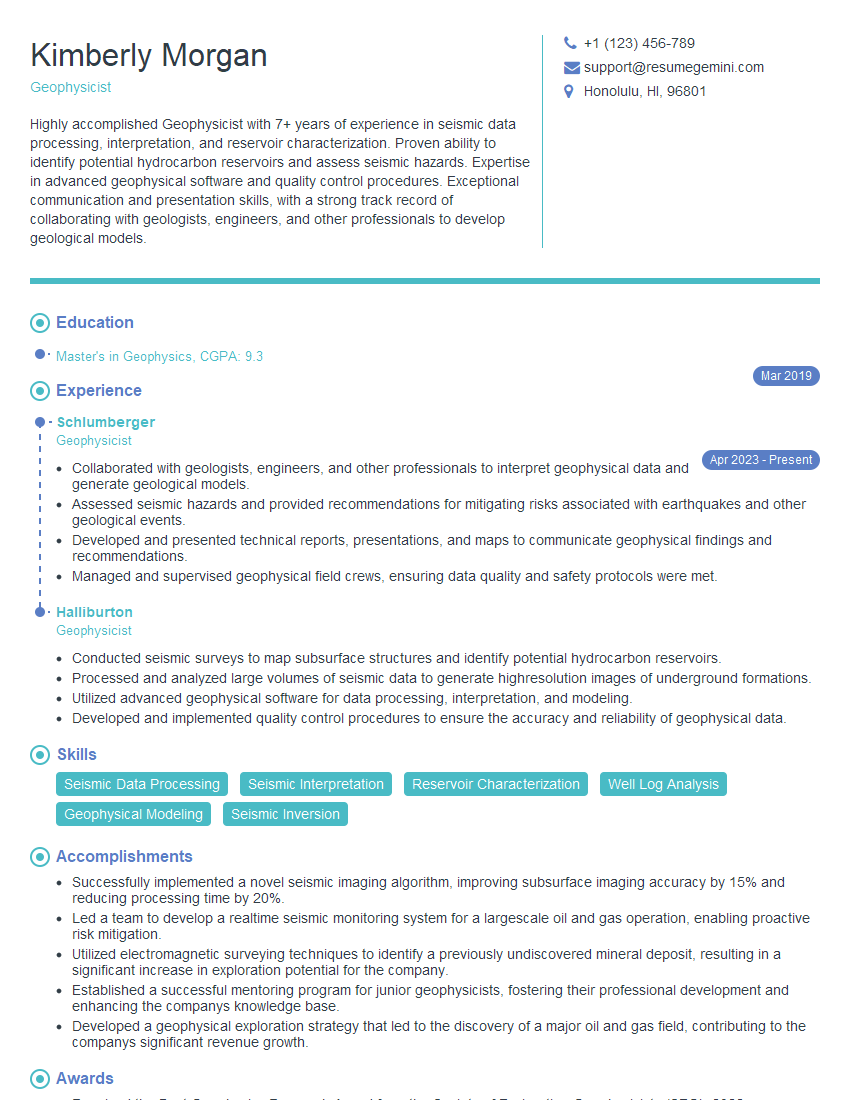
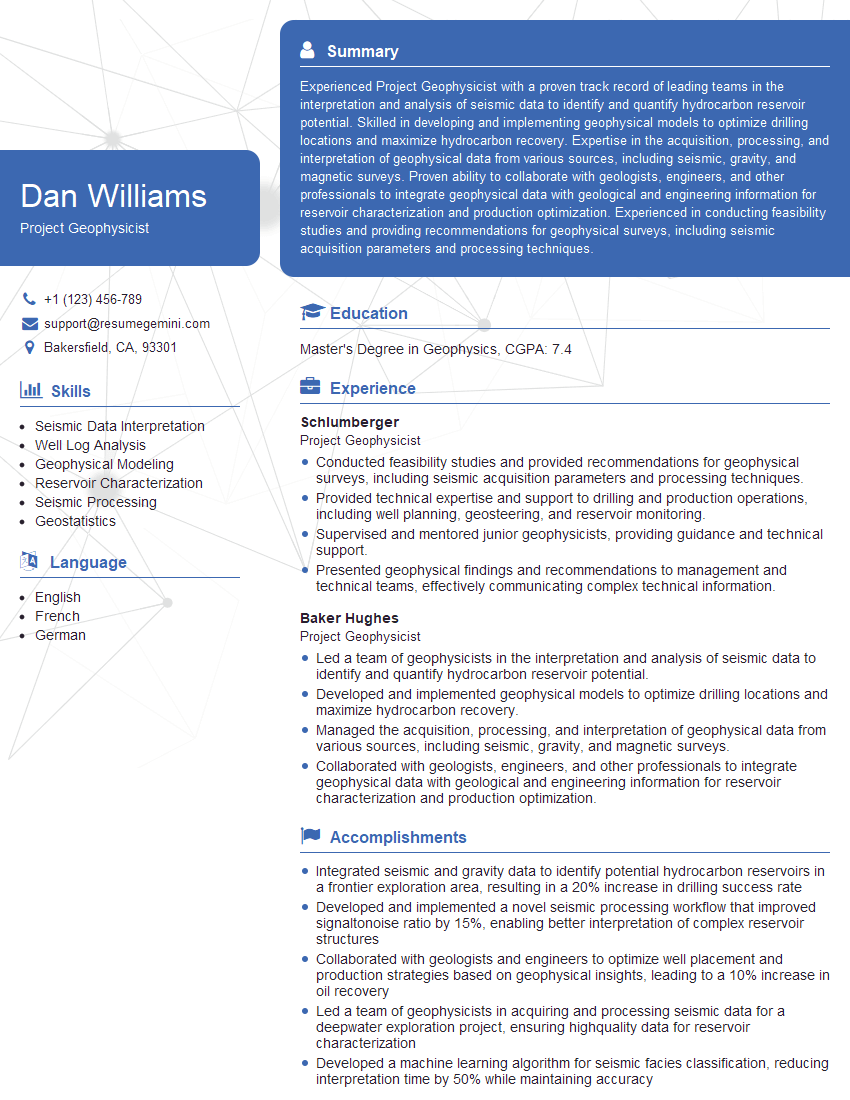
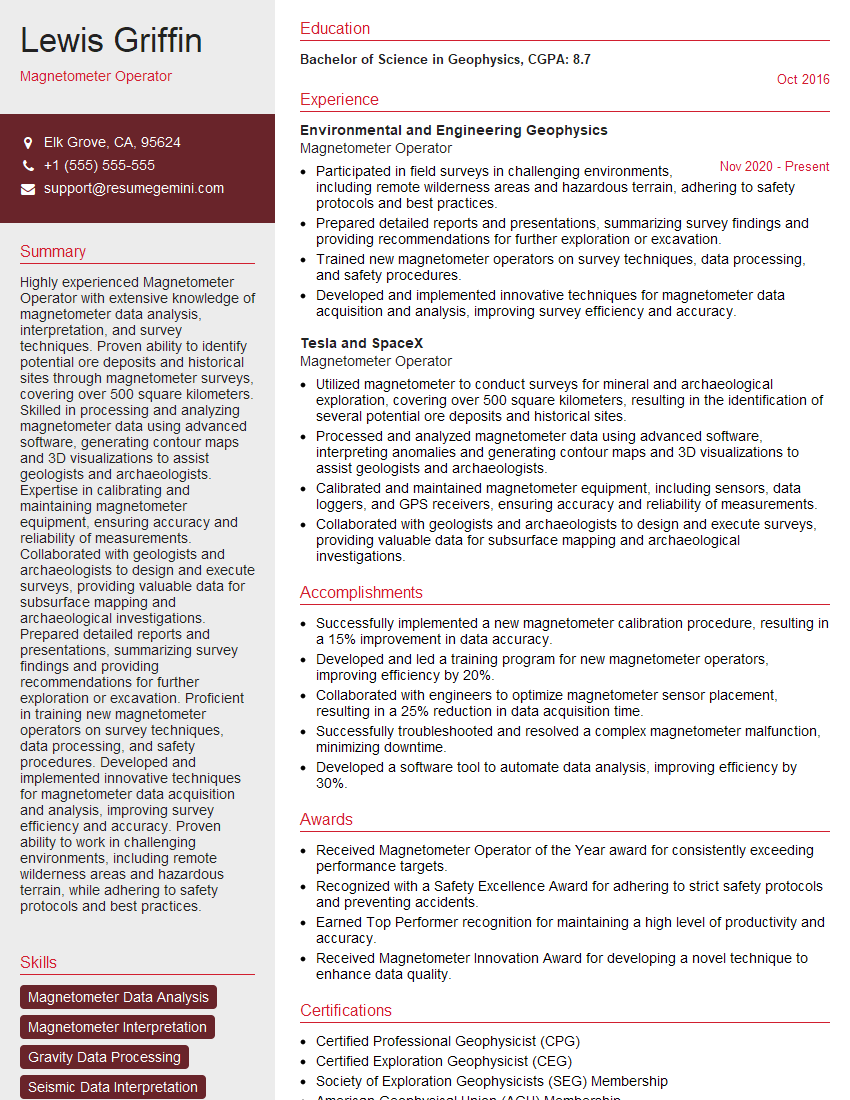
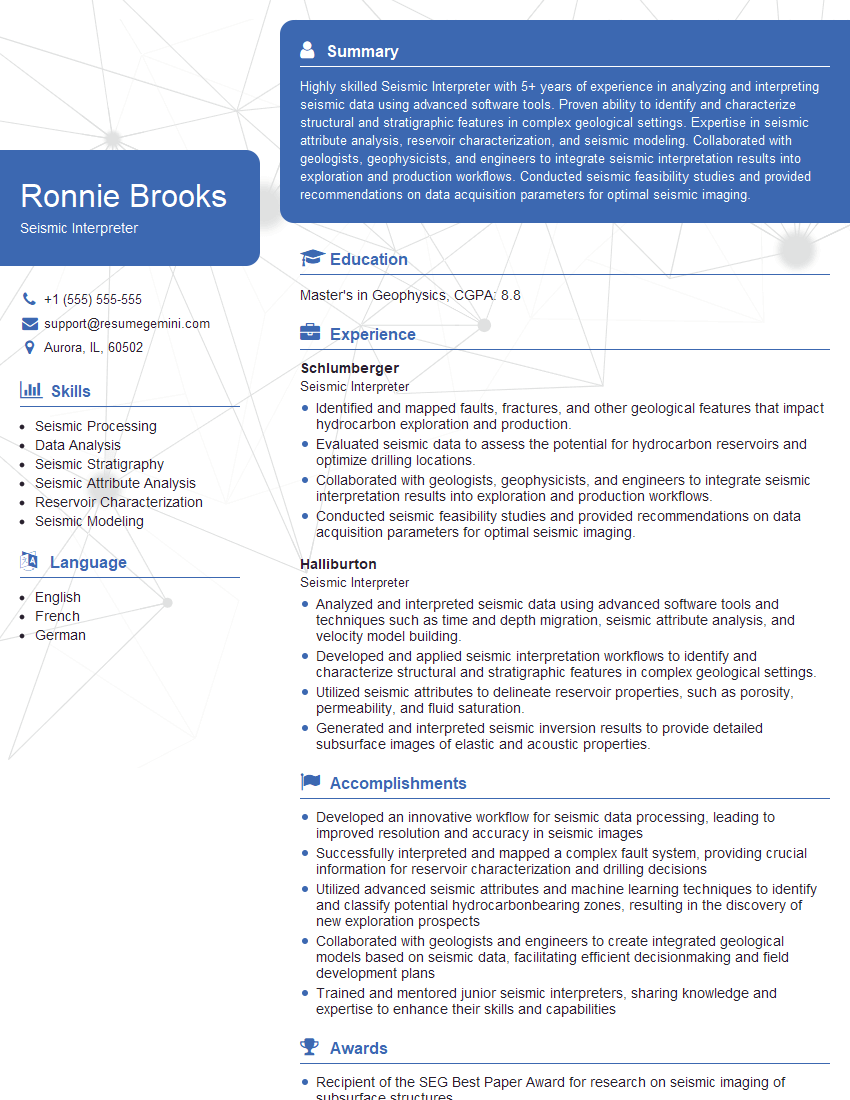
Mastering Geophysical Surveying opens doors to a rewarding career with diverse opportunities in the energy sector, environmental consulting, and geological research. To maximize your job prospects, creating an ATS-friendly resume is crucial. ResumeGemini is a trusted resource that can help you build a professional resume that stands out to recruiters. We provide examples of resumes tailored specifically to Geophysical Surveying to help guide you. Invest time in crafting a compelling resume – it’s your first impression on potential employers.
Explore more articles
Users Rating of Our Blogs
Share Your Experience
We value your feedback! Please rate our content and share your thoughts (optional).
What Readers Say About Our Blog
I Redesigned Spongebob Squarepants and his main characters of my artwork.
https://www.deviantart.com/reimaginesponge/art/Redesigned-Spongebob-characters-1223583608
IT gave me an insight and words to use and be able to think of examples
Hi, I’m Jay, we have a few potential clients that are interested in your services, thought you might be a good fit. I’d love to talk about the details, when do you have time to talk?
Best,
Jay
Founder | CEO