Cracking a skill-specific interview, like one for Elementary Education, requires understanding the nuances of the role. In this blog, we present the questions you’re most likely to encounter, along with insights into how to answer them effectively. Let’s ensure you’re ready to make a strong impression.
Questions Asked in Elementary Education Interview
Q 1. Describe your experience differentiating instruction to meet diverse learners’ needs in an elementary classroom.
Differentiated instruction is the art of tailoring teaching to meet the unique needs of each student. It’s about recognizing that a ‘one-size-fits-all’ approach doesn’t work in a diverse classroom. My experience involves employing a multi-pronged strategy that considers students’ learning styles, readiness levels, and interests.
- Readiness: I use pre-assessments (like quick quizzes or exit tickets) to gauge students’ prior knowledge. Based on the results, I might group students for targeted instruction, providing more support to those who need it and enrichment activities for advanced learners. For example, during a math lesson on fractions, students who mastered basic fractions might work on complex fraction operations, while others receive extra practice with simpler problems.
- Interests: I incorporate student choices whenever possible. In a writing unit, students might choose a topic that genuinely interests them, allowing them to express their creativity and engage more deeply with the material. For example, one student might choose to write a fictional story while another opts for a persuasive essay on a relevant social issue.
- Learning Styles: I cater to different learning styles by offering various instructional methods. Visual learners might benefit from diagrams and charts, while auditory learners might prefer discussions and lectures. Kinesthetic learners thrive on hands-on activities and group work. During a science lesson on the water cycle, I might use a visual model, a song, and a hands-on experiment to cater to all learning styles.
Regularly assessing and adjusting my approach based on student progress is crucial. It’s an ongoing process that requires flexibility and a deep understanding of each student’s strengths and weaknesses.
Q 2. Explain your approach to classroom management, including strategies for preventing and addressing disruptive behavior.
Classroom management is about creating a structured, positive, and engaging learning environment where students feel safe and respected. My approach is proactive, focusing on prevention rather than solely on reacting to disruptions. It rests on three pillars:
- Establishing Clear Expectations: From day one, I clearly communicate rules and procedures, involving students in the process whenever possible. This fosters a sense of ownership and responsibility. We co-create classroom rules, often displayed visually, making them easily accessible.
- Positive Reinforcement: I focus on praising positive behaviors and rewarding good work. This can involve verbal praise, small rewards, or highlighting student achievements publicly. A simple “I noticed you helped your classmate” can go a long way.
- Addressing Disruptive Behavior: When disruptive behavior occurs, I use a variety of strategies, starting with non-verbal cues or quiet redirection. If the behavior persists, I might have a private conversation with the student to understand the underlying cause. More serious issues might involve parent contact and collaboration with school counselors. I believe in restorative practices, focusing on repairing the harm caused by the disruption and teaching conflict resolution skills.
Building strong relationships with students is key. When students feel connected to their teacher and their peers, they are more likely to engage positively in the learning process.
Q 3. How do you assess student learning and use assessment data to inform your instruction?
Assessment is not just about grades; it’s about understanding student learning and using that information to improve instruction. I use a variety of assessment methods, both formative and summative, to gain a comprehensive picture of student progress.
- Formative Assessments: These ongoing assessments, like exit tickets, quick writes, observations, and class discussions, provide immediate feedback on student understanding. This allows me to adjust my instruction in real-time, addressing misconceptions and reinforcing key concepts. For example, if many students miss a question on a quick quiz, I know I need to revisit that topic.
- Summative Assessments: These are larger-scale assessments, like unit tests and projects, that evaluate student learning at the end of a unit or term. These provide a broader picture of student mastery. I use data from summative assessments to identify areas where students need additional support and adjust my future instruction.
Data analysis is crucial. I carefully review assessment data to identify patterns and trends in student learning. This information informs my instructional planning, helping me to differentiate instruction effectively and target specific learning needs. I also share this information with parents to create a collaborative learning environment.
Q 4. What methods do you use to foster a positive and inclusive learning environment?
Creating a positive and inclusive learning environment is paramount. I strive to build a classroom where every student feels respected, valued, and safe to take risks. My strategies include:
- Establishing a Culture of Respect: Clear expectations regarding respect for others, their ideas, and their differences are established early on. We actively discuss diversity and celebrate the unique contributions of each student.
- Collaborative Learning: I incorporate group work and peer learning activities frequently. This allows students to learn from each other, develop teamwork skills, and build positive relationships. I carefully structure group activities to ensure all students participate actively.
- Differentiated Instruction (as described previously): This is fundamental to creating an inclusive environment as it caters to the diverse needs and learning styles of each student.
- Positive Classroom Climate: I create a welcoming and supportive atmosphere through positive reinforcement, a sense of humor, and building genuine relationships with students. I create a classroom library with diverse books that reflect students’ backgrounds and interests.
Creating a sense of community is essential. Students should feel comfortable expressing themselves and seeking help when needed. A classroom library with diverse books representing different cultures and perspectives is key to creating an inclusive learning space.
Q 5. Describe your experience working with parents and guardians to support student learning.
Parent and guardian involvement is crucial for student success. I actively seek to build strong partnerships with families. My approach involves:
- Open Communication: I maintain regular communication with parents through newsletters, email updates, parent-teacher conferences, and informal chats. I share student progress, highlight successes, and address any concerns proactively.
- Collaboration: I view parents as partners in their child’s education. I actively seek their input on their child’s learning styles, preferences, and any challenges they might be facing at home. I encourage parents to be involved in classroom activities and events.
- Consistent Feedback: I provide regular and constructive feedback on student performance, focusing on both strengths and areas for improvement. This feedback is tailored to be understandable and actionable for parents. If a student is struggling, I work with parents to develop a support plan.
Building trust and rapport with parents is essential. When parents feel heard and valued, they are more likely to support their child’s education fully. Regular communication, transparency, and a collaborative approach foster strong home-school partnerships.
Q 6. How do you incorporate technology effectively into your elementary classroom?
Technology can significantly enhance learning when integrated effectively. I use technology to:
- Enhance Instruction: Interactive whiteboards, educational apps, and online resources provide engaging and interactive learning experiences. For example, I might use a virtual field trip to explore different ecosystems or utilize educational games to reinforce math concepts.
- Differentiate Instruction: Technology allows for personalized learning. Students can work at their own pace using online learning platforms, accessing tailored support or enrichment activities as needed. Learning management systems (LMS) are a powerful tool here.
- Promote Collaboration: Online collaborative tools allow students to work together on projects, share ideas, and provide peer feedback, even when they are not physically together. Tools like Google Docs and Slides support this effectively.
- Assess Learning: Online assessments offer efficient and effective ways to assess student understanding, providing immediate feedback and data analysis capabilities. I use a variety of platforms, choosing those that are appropriate to the subject and the age group.
It’s crucial to select age-appropriate and educational apps and to model responsible technology use. Balance is essential; technology should supplement, not replace, meaningful hands-on learning and social interaction.
Q 7. Explain your understanding of the Common Core State Standards or equivalent curriculum standards.
The Common Core State Standards (CCSS), or equivalent state standards, provide a framework for what students should know and be able to do at each grade level across various subjects. My understanding is that they are designed to ensure all students receive a high-quality education, preparing them for college and careers. They emphasize critical thinking, problem-solving, and communication skills.
I use the standards to guide my instructional planning, ensuring that my lessons align with the expected learning outcomes. I regularly review the standards to make sure my curriculum is comprehensive and addresses all key areas. The standards serve as a roadmap for creating engaging lessons and assessments that measure student mastery of the key concepts. This helps me to create a well-rounded curriculum that supports students’ academic growth.
Beyond the specific standards, the underlying philosophy of the CCSS – a focus on deeper understanding and application of knowledge – is critical to my teaching practice. It’s not just about rote memorization; it’s about fostering critical thinking and problem-solving skills.
Q 8. Describe your experience with IEP (Individualized Education Program) development and implementation.
Developing and implementing Individualized Education Programs (IEPs) is a cornerstone of inclusive education. It involves a collaborative process between educators, parents, specialists, and the student (when appropriate) to create a tailored learning plan for students with disabilities.
My experience includes participating in IEP meetings, contributing assessment data, crafting individualized goals, and monitoring student progress. For example, I worked with a student diagnosed with ADHD. We identified his challenges with sustained attention and impulsive behavior. His IEP included strategies like frequent breaks, a designated quiet workspace, and visual aids to support organization. We regularly monitored his progress using data from classroom observations, assignments, and standardized tests, adjusting interventions as needed. This involved frequent communication with parents and specialists, ensuring a unified approach to support his learning.
Successful IEP implementation relies on consistent monitoring, flexible adaptation, and strong communication. It’s not a static document, but a living plan that evolves with the student’s needs and progress.
Q 9. How do you plan and deliver engaging and effective lessons aligned with curriculum standards?
Effective lesson planning begins with aligning content to curriculum standards. I use a backward design approach, starting with the learning objectives, then selecting appropriate activities and assessments. Engaging lessons incorporate various teaching strategies to cater to diverse learning styles.
- Differentiation: I differentiate instruction by providing varied materials, activities, and levels of support to meet individual student needs. For instance, I might offer a simplified version of a reading passage for struggling readers while challenging advanced learners with higher-level comprehension questions.
- Active Learning: Instead of passive lecturing, I incorporate hands-on activities, group work, and technology integration. A recent project involved students creating podcasts to present their research on historical figures – a far more engaging approach than a traditional essay.
- Real-World Connections: I make learning relevant by connecting it to students’ lives and experiences. For example, when teaching fractions, we used pizza slices or sharing candy to illustrate concepts.
Regular formative assessments allow me to monitor student understanding and adjust my instruction accordingly. This continuous feedback loop ensures that lessons are effective and engaging, resulting in better student outcomes.
Q 10. How do you promote critical thinking and problem-solving skills in your students?
Cultivating critical thinking and problem-solving skills is crucial for preparing students for the future. I achieve this through:
- Open-ended questions: Instead of asking questions with simple yes/no answers, I encourage students to explore multiple perspectives and justify their reasoning.
- Inquiry-based learning: Students investigate questions, gather information, analyze data, and draw conclusions. For example, a science unit might involve designing and conducting experiments to test hypotheses.
- Debates and discussions: Engaging in respectful arguments strengthens reasoning, communication, and the ability to evaluate different perspectives.
- Problem-solving activities: I regularly incorporate activities that require students to analyze problems, develop solutions, and evaluate the effectiveness of their approaches. This could involve solving math word problems, designing a solution to a community issue, or working collaboratively on a complex engineering challenge.
Providing opportunities for students to reflect on their learning process and justify their decisions further enhances their critical thinking skills.
Q 11. What strategies do you use to support students who are struggling academically?
Supporting struggling learners requires a multi-faceted approach. I begin by identifying the root cause of their academic difficulties. This might involve reviewing their past performance, conducting informal assessments, and collaborating with parents and specialists.
- Targeted Interventions: Based on the identified needs, I implement targeted interventions, such as providing extra support during class, offering one-on-one tutoring, or using differentiated instruction to adjust the difficulty level of assignments.
- Technology Integration: I utilize educational software and apps to provide customized practice and feedback. Adaptive learning platforms can adjust the level of difficulty based on individual student performance.
- Differentiated Assignments: I create modified assignments that address the same learning objectives but offer varied levels of support or complexity.
- Positive Reinforcement: Focusing on students’ strengths and celebrating their progress, no matter how small, is essential to building confidence and motivation.
Regular communication with parents is vital to ensure a consistent and supportive learning environment at home and at school.
Q 12. How do you build relationships with your students and create a sense of community in your classroom?
Building positive relationships and fostering a sense of community in my classroom is paramount. I believe that students learn best in a supportive and inclusive environment where they feel safe, respected, and valued.
- Getting to Know Students: I take time at the beginning of the year to learn about each student’s interests, strengths, and challenges. This can involve informal conversations, surveys, and creative activities.
- Classroom Meetings: We have regular class meetings to discuss classroom issues, build consensus on rules, and resolve conflicts collaboratively. These meetings give students a voice and responsibility.
- Cooperative Learning Activities: Group work and collaborative projects allow students to interact positively, learn from each other, and build camaraderie.
- Positive Reinforcement: I create a positive and encouraging classroom environment by regularly praising students’ efforts, accomplishments, and positive behaviors.
- Creating a welcoming environment: I incorporate students’ artwork and projects into the classroom decoration, fostering a sense of ownership and belonging.
By creating a safe and supportive space, students feel comfortable taking risks, asking for help, and engaging in learning.
Q 13. Describe your experience with various teaching methodologies (e.g., project-based learning, inquiry-based learning).
I am proficient in using various teaching methodologies to cater to different learning styles and subject matter.
- Project-Based Learning (PBL): PBL involves engaging students in complex, real-world projects that require them to apply knowledge and skills. For instance, students might design and build a model of a sustainable community, applying their math, science, and social studies knowledge.
- Inquiry-Based Learning (IBL): IBL focuses on student-led investigations. Students develop questions, gather evidence, analyze data, and draw conclusions. This approach cultivates critical thinking and problem-solving skills. A recent example was students researching and presenting their findings on the impact of pollution on local ecosystems.
- Differentiated Instruction: This involves adjusting teaching methods to meet the diverse needs of learners. I use various instructional strategies, including visual aids, hands-on activities, and technology integration, to cater to diverse learning styles.
The choice of methodology depends on the learning objectives, the subject matter, and the needs of my students. Often, I integrate different approaches to create a dynamic and engaging learning experience.
Q 14. How do you address the social and emotional needs of your students?
Addressing the social and emotional needs of students is crucial for their academic success and overall well-being. I create a classroom environment where students feel safe, respected, and supported.
- Social-Emotional Learning (SEL) Curriculum: I incorporate explicit SEL instruction into my curriculum, teaching students skills such as self-awareness, self-management, social awareness, relationship skills, and responsible decision-making.
- Building Relationships: I invest time in building positive relationships with students, showing empathy, understanding, and providing consistent support.
- Classroom Community: I foster a sense of classroom community through cooperative learning activities, class meetings, and team-building exercises.
- Conflict Resolution: I teach students effective conflict resolution skills, encouraging them to communicate openly, respectfully, and collaboratively.
- Mental Health Awareness: I educate students about mental health and provide resources and support for those struggling with emotional challenges. I work closely with school counselors and other support staff to ensure students receive appropriate help.
By prioritizing social-emotional learning, I create a supportive classroom environment where students can thrive academically and emotionally.
Q 15. Describe your experience collaborating with other teachers and staff members.
Collaboration is the cornerstone of effective teaching. In my previous role, I actively participated in grade-level planning meetings, where we collaboratively designed unit plans, shared best practices, and addressed common student challenges. For example, we worked together to develop a cross-curricular project on the American Revolution, integrating history, language arts, and art. I also frequently co-taught lessons with colleagues, leveraging each other’s strengths to provide a richer learning experience for students. One instance involved co-teaching a science lesson on ecosystems, where my colleague, a science specialist, focused on the hands-on experiments while I focused on integrating literacy skills through journal writing and research. Beyond the classroom, I’ve collaborated with special education teachers, administrators, and support staff to create Individualized Education Programs (IEPs) and ensure that all students receive the support they need to thrive. This involved attending IEP meetings, actively participating in discussions, and ensuring the IEP goals were clearly defined and measurable.
Career Expert Tips:
- Ace those interviews! Prepare effectively by reviewing the Top 50 Most Common Interview Questions on ResumeGemini.
- Navigate your job search with confidence! Explore a wide range of Career Tips on ResumeGemini. Learn about common challenges and recommendations to overcome them.
- Craft the perfect resume! Master the Art of Resume Writing with ResumeGemini’s guide. Showcase your unique qualifications and achievements effectively.
- Don’t miss out on holiday savings! Build your dream resume with ResumeGemini’s ATS optimized templates.
Q 16. How do you maintain a safe and organized classroom environment?
Maintaining a safe and organized classroom is paramount to effective learning. My approach is multi-faceted and focuses on establishing clear routines and expectations from day one. This includes clearly defined classroom rules, displayed prominently, and consistently reinforced through positive reinforcement and gentle redirection. The physical space is organized logically, with designated areas for different activities (e.g., reading corner, group work tables, independent work spaces). Materials are readily accessible and stored in a way that promotes independence and minimizes disruptions. Safety protocols, such as emergency procedures, are practiced regularly and discussed openly with students. Furthermore, I build a positive classroom culture by fostering respect, empathy, and a sense of community among students. I create opportunities for students to contribute to the classroom environment, such as assigning classroom jobs, allowing students input on classroom rules, and actively promoting positive peer interactions. This proactive approach helps create a welcoming and productive learning environment for all.
Q 17. What professional development activities have you participated in recently?
I am committed to continuous professional development. Recently, I participated in a workshop on incorporating technology effectively into the elementary classroom. This workshop focused on using interactive whiteboards, educational apps, and online resources to enhance engagement and cater to diverse learning styles. I learned about specific apps like Quizizz and Kahoot!, which I now use frequently for formative assessment and review games. I also attended a professional development session on differentiated instruction, where we explored various strategies for adapting lesson plans to meet the individual needs of students. This included learning about flexible grouping, tiered assignments, and providing varied modes of assessment. These activities have significantly impacted my teaching practice, allowing me to create a more engaging and personalized learning experience for my students.
Q 18. How do you adapt your instruction to meet the needs of students with different learning styles?
Differentiated instruction is crucial to meeting the diverse learning needs of students. I use a variety of strategies to cater to different learning styles. For visual learners, I use diagrams, charts, and graphic organizers. For auditory learners, I incorporate discussions, lectures, and audiobooks. For kinesthetic learners, I incorporate hands-on activities, role-playing, and movement-based learning. For example, when teaching fractions, I might provide visual aids like fraction circles for some students, auditory explanations with real-world examples for others, and hands-on activities with manipulatives for kinesthetic learners. I also use flexible grouping strategies, allowing students to work independently, in pairs, or in small groups, based on their strengths and learning preferences. Furthermore, I provide varied modes of assessment, including written tests, oral presentations, projects, and performance tasks, to allow students to demonstrate their understanding in ways that best suit their abilities.
Q 19. How do you use formative assessment to monitor student progress and adjust your teaching accordingly?
Formative assessment is an ongoing process of monitoring student understanding. I utilize a variety of techniques, including exit tickets, quick writes, think-pair-share activities, and informal observations during lessons. For example, exit tickets, which are short questions students answer at the end of a lesson, provide immediate feedback on their grasp of key concepts. I use this information to adjust my teaching for the next lesson. If many students struggle with a particular concept, I might re-teach it using a different method or provide additional support. I also use quick writes, where students write briefly about a topic, to gauge their understanding and identify areas where they need further clarification. Observing students during group work or individual activities also allows me to informally assess their progress and address any misconceptions or challenges in real-time. By regularly employing these formative assessment methods, I can effectively monitor student progress and adapt my instruction to ensure all students are learning and succeeding.
Q 20. Describe your experience with integrating literacy and numeracy skills across the curriculum.
Integrating literacy and numeracy skills across the curriculum is essential for developing well-rounded students. I consistently incorporate reading, writing, and math skills into all subject areas. For instance, in a science unit on plants, students read texts about photosynthesis, write reports on their plant experiments, and graph their data. In a social studies unit on different cultures, students read stories from various countries, write comparative essays, and use maps and charts to understand geography. This integrated approach helps students see the connections between subjects and develop a deeper understanding of the material. It also makes learning more meaningful and engaging. For example, in a history lesson, students might create a timeline, requiring them to order events chronologically (numeracy) and then write a short summary for each event (literacy). This holistic approach is key in developing students’ critical thinking and problem-solving skills, equipping them for success in all areas of study.
Q 21. How do you create opportunities for students to engage in hands-on learning?
Hands-on learning is crucial for engagement and retention. I create many opportunities for students to actively participate in the learning process. This includes incorporating science experiments, art projects, building activities, and role-playing. For example, when studying the solar system, students might build models of planets using clay, demonstrating their understanding of size and distance. When learning about fractions, they might use manipulatives like fraction circles or build fraction towers. During a history lesson, they might participate in a historical reenactment or build a model of a historical landmark. These activities not only make learning fun but also allow students to explore concepts in a concrete and engaging way, fostering deeper understanding and retention. I also emphasize project-based learning where students apply their knowledge and skills to create real-world products or presentations, further promoting their engagement and understanding.
Q 22. What strategies do you use to promote creativity and innovation in your classroom?
Nurturing creativity and innovation in young learners requires a multifaceted approach. It’s not just about letting kids draw; it’s about fostering a culture of exploration, experimentation, and risk-taking.
Open-ended Projects: Instead of rigidly structured assignments, I incorporate open-ended projects that allow students to explore a topic in their own way. For instance, instead of a simple report on the rainforest, students might design a rainforest ecosystem diorama, compose a song about rainforest animals, or even create a rainforest-themed board game. This encourages divergent thinking and unique solutions.
Design Thinking Activities: I integrate design thinking principles, guiding students through the process of identifying a problem, brainstorming solutions, prototyping, testing, and iterating. This could be as simple as designing a better school lunchbox or as complex as creating a solution to a community problem.
Maker Space and STEM Integration: Providing access to a maker space with building materials, coding software, and various tools allows students to bring their ideas to life. Integrating STEM (Science, Technology, Engineering, and Mathematics) projects encourages experimentation and problem-solving in a creative context.
Encouraging Collaboration: Group projects and peer feedback sessions promote creative idea exchange and inspire students to build upon each other’s contributions. I ensure that students feel comfortable sharing their ideas, even if they’re unconventional.
Celebrating Failure as a Learning Opportunity: I create a classroom environment where mistakes are viewed as valuable learning experiences rather than setbacks. This encourages students to take risks and experiment without fear of judgment.
Q 23. How do you involve parents and the community in your classroom activities?
Parent and community involvement is crucial for creating a supportive learning environment. I actively seek ways to bridge the gap between the classroom and the broader community.
Regular Communication: I maintain open communication with parents through newsletters, emails, and parent-teacher conferences. I also use platforms like ClassDojo or Seesaw to share classroom updates and student work.
Parent Volunteers: I welcome parent volunteers to assist in the classroom, helping with activities, reading with students, or supporting classroom management. This fosters a sense of shared responsibility and allows parents to see the classroom environment firsthand.
Classroom Projects with Community Connections: We engage in community-based projects, such as organizing a school-wide recycling program, creating artwork for a local library, or partnering with a community garden. This allows students to apply their learning to real-world situations and fosters a sense of civic responsibility.
Parent Workshops and Events: I organize workshops for parents on topics relevant to education and child development, such as effective study habits or strategies for supporting their child’s learning at home. Family game nights or other events can also strengthen the school-home connection.
Community Partnerships: I collaborate with local businesses, organizations, or experts to provide enriching experiences for students, such as inviting a local artist to lead an art workshop or a scientist to conduct a science demonstration.
Q 24. Describe your experience with using data-driven decision making to improve student outcomes.
Data-driven decision making is essential for improving student outcomes. I regularly analyze assessment data to identify areas of strength and weakness in student learning and then adjust my instruction accordingly.
Formative Assessments: I use a variety of formative assessments, such as quizzes, exit tickets, and observation checklists, to monitor student progress throughout a unit of study. This allows me to identify misconceptions or areas where students need additional support in a timely manner.
Summative Assessments: Summative assessments, like unit tests and projects, provide a comprehensive overview of student learning at the end of a unit. Analysis of this data helps me determine the effectiveness of my instruction and identify areas for improvement in future teaching.
Data Analysis and Collaboration: I collaborate with other teachers and school administrators to analyze data and identify trends. This collaborative approach allows us to develop school-wide strategies to improve student achievement.
Differentiated Instruction: Based on the data analysis, I differentiate my instruction to meet the individual needs of my students. This might involve providing targeted interventions for students who are struggling or enrichment activities for students who are exceeding expectations.
Intervention Strategies: For students who are consistently below grade level, I utilize a variety of intervention strategies, such as small group instruction, individualized learning plans, and the use of technology to provide targeted support.
Q 25. How do you ensure that all students have access to high-quality instruction?
Ensuring all students have access to high-quality instruction requires a commitment to equity and inclusion. This involves understanding and addressing the unique needs of each learner.
Differentiated Instruction: As mentioned before, I differentiate my instruction to meet the diverse learning needs of my students. This includes varying the methods of instruction, the types of activities, and the levels of support provided.
Universal Design for Learning (UDL): I incorporate the principles of UDL into my teaching, providing multiple means of representation, action and expression, and engagement. This ensures that all students have access to the curriculum, regardless of their learning style or disability.
Collaborative Learning: Group work and peer tutoring provide opportunities for students to learn from each other. This approach fosters a sense of community and allows students with varying skills to support and learn from one another.
Individualized Learning Plans (ILPs): For students with Individualized Education Programs (IEPs) or 504 plans, I work closely with support staff to develop and implement ILPs that address their specific needs.
Resources and Technology: I ensure all students have access to the necessary resources and technology to support their learning. This may include assistive technology, specialized software, and access to online learning materials.
Q 26. Describe your experience with culturally responsive teaching.
Culturally responsive teaching is about creating a classroom environment that values and affirms the diverse backgrounds and experiences of all students. It’s about acknowledging that students don’t shed their identities at the classroom door.
Building Relationships: I prioritize building strong relationships with my students by learning about their cultures, interests, and backgrounds. This includes taking the time to get to know them as individuals and creating a safe and welcoming classroom environment.
Curriculum Integration: I integrate diverse perspectives and content into my curriculum, ensuring that students see themselves reflected in the materials they are learning. This might involve using diverse literature, incorporating diverse historical perspectives, and highlighting the contributions of people from different cultural backgrounds.
Learning Styles and Preferences: I recognize that students learn in different ways and adapt my instruction accordingly. This involves understanding the learning styles and preferences that are common in different cultures and tailoring my lessons to meet the needs of all students.
Family and Community Involvement: I actively seek to involve families and communities in my classroom by celebrating cultural events, inviting family members to share their stories, and partnering with community organizations to provide relevant learning experiences.
Language Support: For students who are English language learners (ELLs), I provide targeted language support, including bilingual materials, visual aids, and opportunities for collaborative language learning.
Q 27. How do you foster a growth mindset in your students?
Fostering a growth mindset is about teaching students that their intelligence and abilities are not fixed, but rather can be developed through effort and learning. It’s about shifting from a ‘fixed’ mindset (‘I’m just not good at math’) to a ‘growth’ mindset (‘I can get better at math if I practice’).
Positive Feedback: I focus on providing specific and positive feedback that emphasizes effort, perseverance, and strategies, rather than just grades or scores. For example, instead of saying “Good job!”, I might say, “I noticed you really persevered with that problem. I saw you tried several different strategies before you found the solution. That’s excellent problem-solving!”
Growth Mindset Language: I use language that promotes a growth mindset, such as “Yet” (e.g., “You haven’t mastered this concept yet, but with practice, you will.”) and highlighting effort and process over outcome.
Sharing Stories of Success Through Effort: I share stories of famous people who achieved success through hard work and perseverance, showing that intelligence and talent are not solely responsible for achievement.
Challenges and Mistakes as Opportunities: I encourage students to embrace challenges and view mistakes as opportunities for learning and growth. I model this myself by openly sharing my own learning process and mistakes.
Self-Reflection: I provide opportunities for students to reflect on their learning process, identifying areas of strength and growth. This could involve journaling, self-assessment activities, or goal setting exercises.
Q 28. What are your goals for professional growth as an elementary teacher?
My professional growth as an elementary teacher is an ongoing journey. I am committed to continually improving my skills and knowledge to better serve my students.
Continuing Education: I plan to pursue professional development opportunities, such as workshops, conferences, and online courses, to stay current with best practices in elementary education and explore new pedagogical approaches.
Mentorship and Collaboration: I actively seek out mentorship opportunities and collaborate with experienced educators to learn from their expertise and share my own knowledge.
Curriculum Development and Enhancement: I strive to continually enhance my curriculum, integrating new technologies and research-based strategies to make my lessons more engaging and effective.
Specialized Training: I am particularly interested in furthering my knowledge and skills in specific areas such as differentiated instruction, culturally responsive teaching, and utilizing technology in the classroom.
Action Research: I am keen to engage in action research to identify specific areas where I can improve my teaching practices and evaluate the effectiveness of new strategies.
Key Topics to Learn for Elementary Education Interview
- Child Development Theories: Understanding Piaget’s, Vygotsky’s, and Erikson’s theories and their implications for classroom management and curriculum design. Practical application: Explain how you would adapt your teaching methods based on a child’s developmental stage.
- Differentiated Instruction: Strategies for catering to diverse learners with varying needs and learning styles (e.g., gifted students, students with IEPs/504 plans). Practical application: Describe a time you successfully differentiated instruction to meet the needs of a specific student.
- Classroom Management Techniques: Positive behavior interventions and supports (PBIS), establishing clear expectations, and creating a positive learning environment. Practical application: Explain your approach to dealing with disruptive behavior in the classroom.
- Curriculum Development and Implementation: Understanding state standards, aligning curriculum with those standards, and utilizing various teaching methodologies (e.g., project-based learning, inquiry-based learning). Practical application: Describe your experience creating or adapting lesson plans to meet specific learning objectives.
- Assessment and Evaluation: Formative and summative assessment strategies, data-driven instruction, and utilizing assessment data to inform teaching practices. Practical application: Explain how you would use assessment data to adjust your teaching strategies.
- Technology Integration in Education: Using educational technology effectively to enhance teaching and learning. Practical application: Describe your experience using technology to support student learning.
- Collaboration and Communication: Working effectively with parents, colleagues, and administrators. Practical application: Describe a time you collaborated with others to improve student outcomes.
Next Steps
Mastering these key areas of Elementary Education will significantly boost your career prospects and allow you to make a real difference in the lives of your students. A strong resume is crucial for showcasing your skills and experience to potential employers. Creating an ATS-friendly resume is essential to get past applicant tracking systems and land interviews. To build a professional and impactful resume that highlights your qualifications, we recommend using ResumeGemini. ResumeGemini provides a user-friendly platform and offers examples of resumes tailored to Elementary Education, helping you create a document that stands out from the competition.
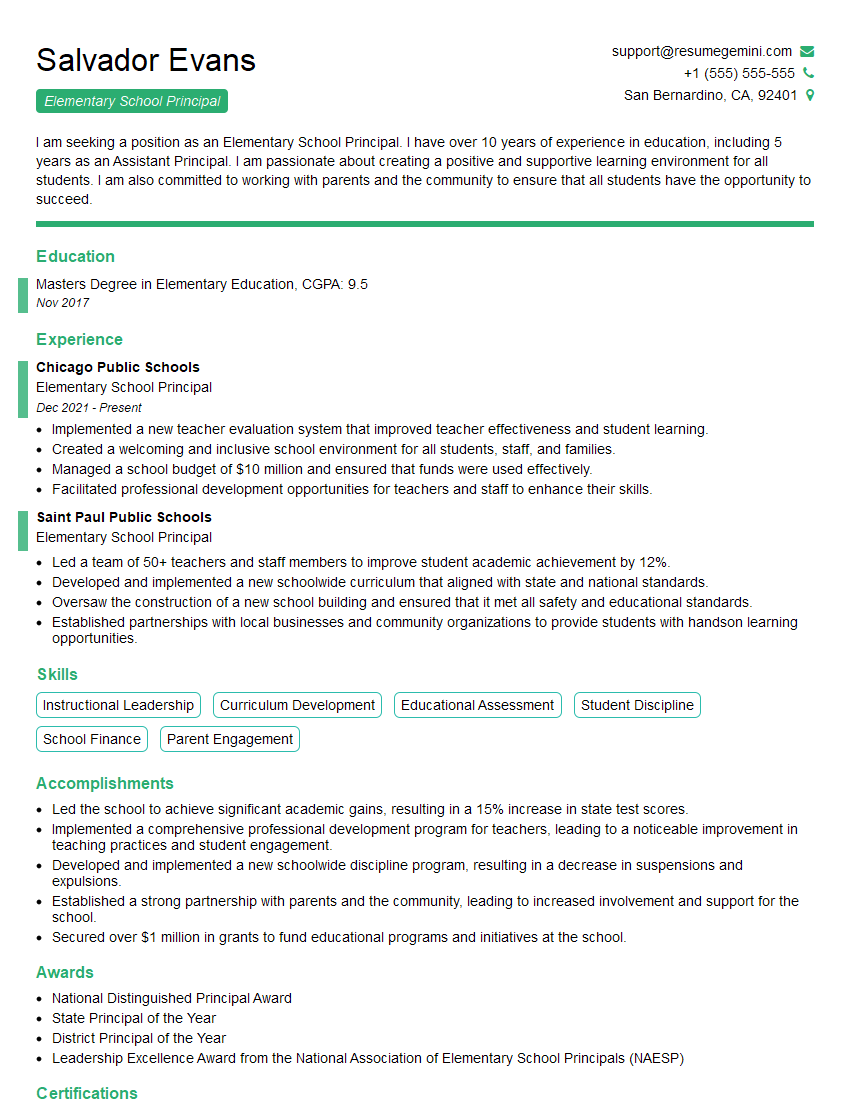
Elementary School Principal Resume Sample
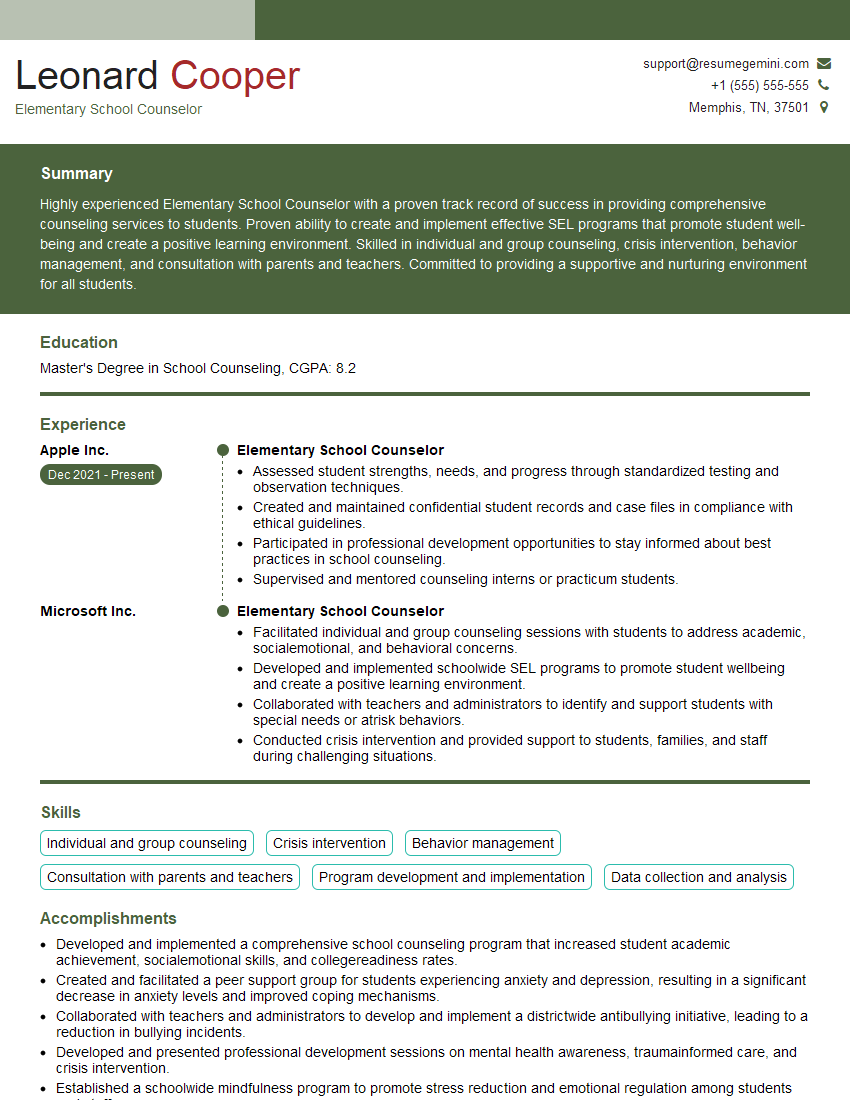
Elementary School Counselor Resume Sample
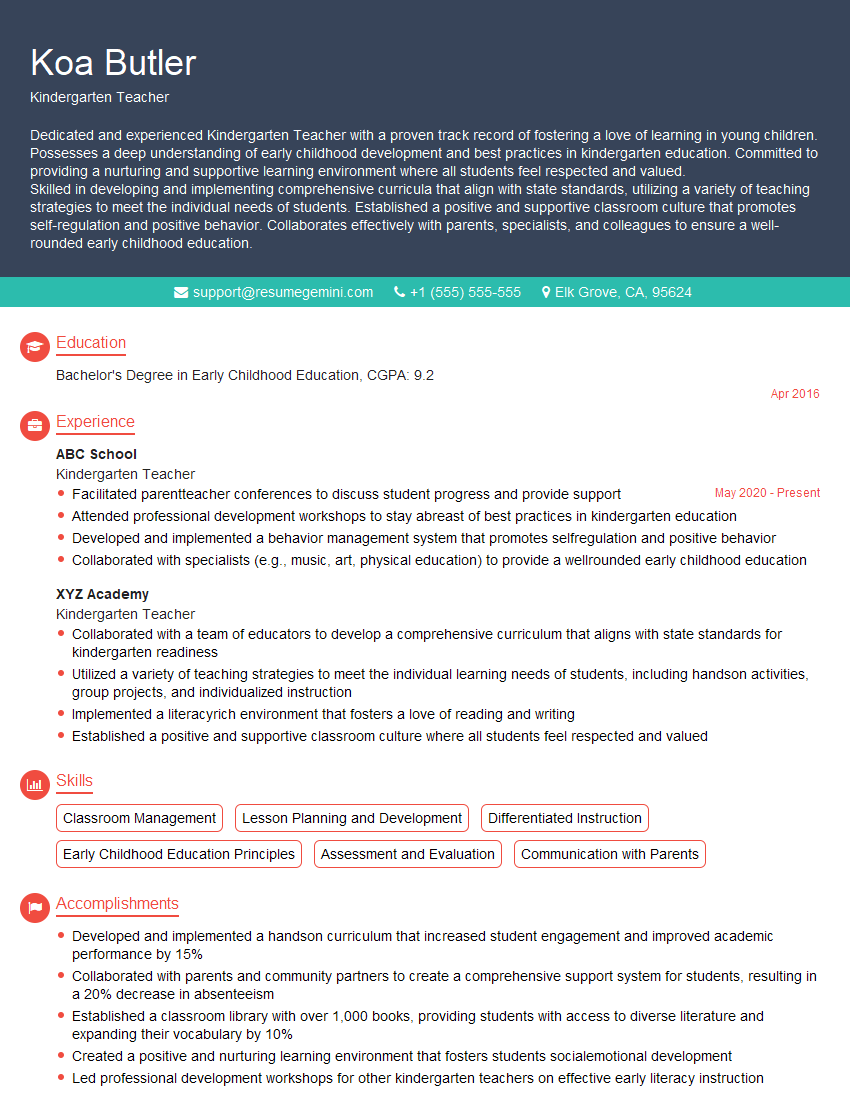
Kindergarten Teacher Resume Sample
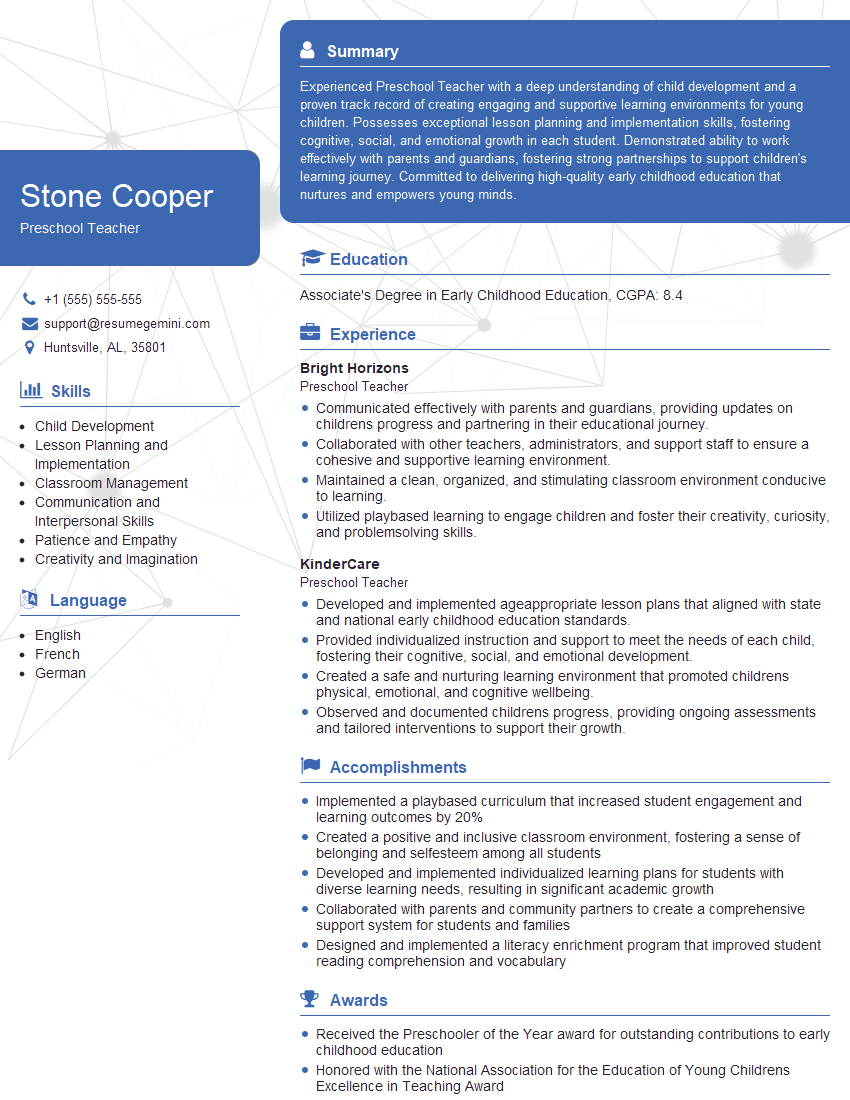
Preschool Teacher Resume Sample
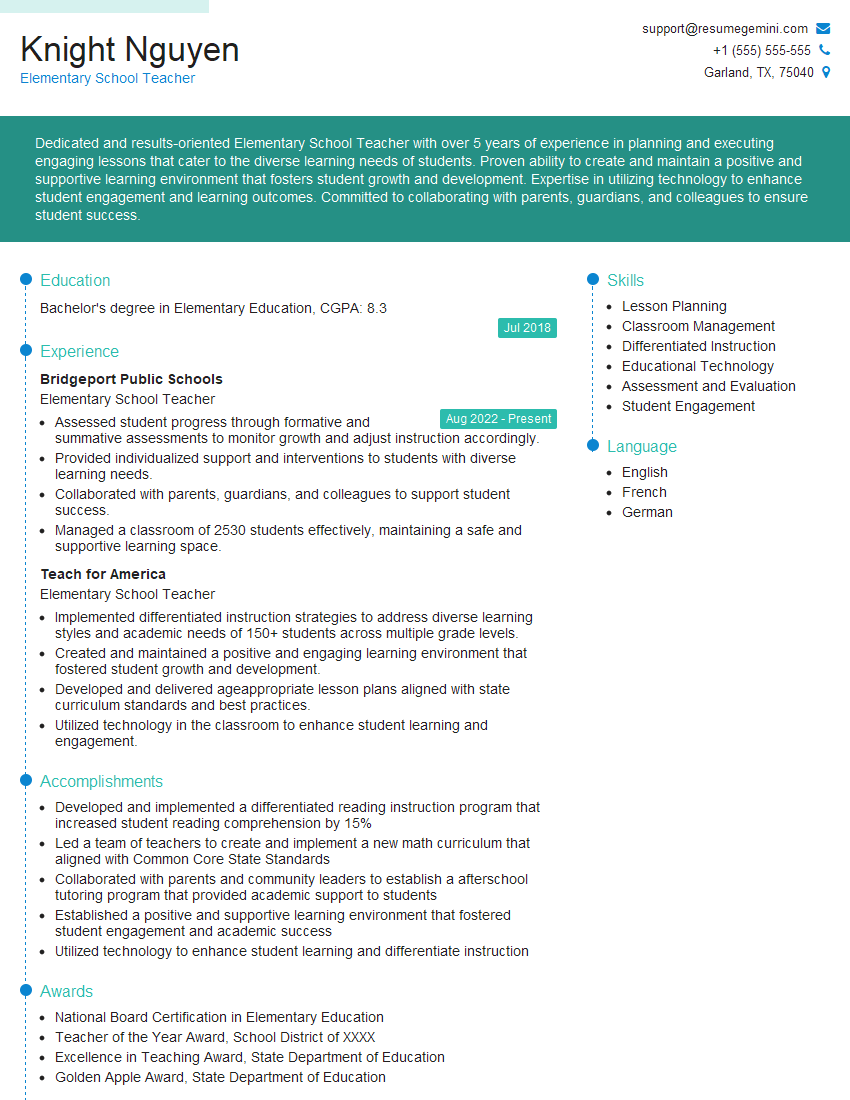
Elementary School Teacher Resume Sample
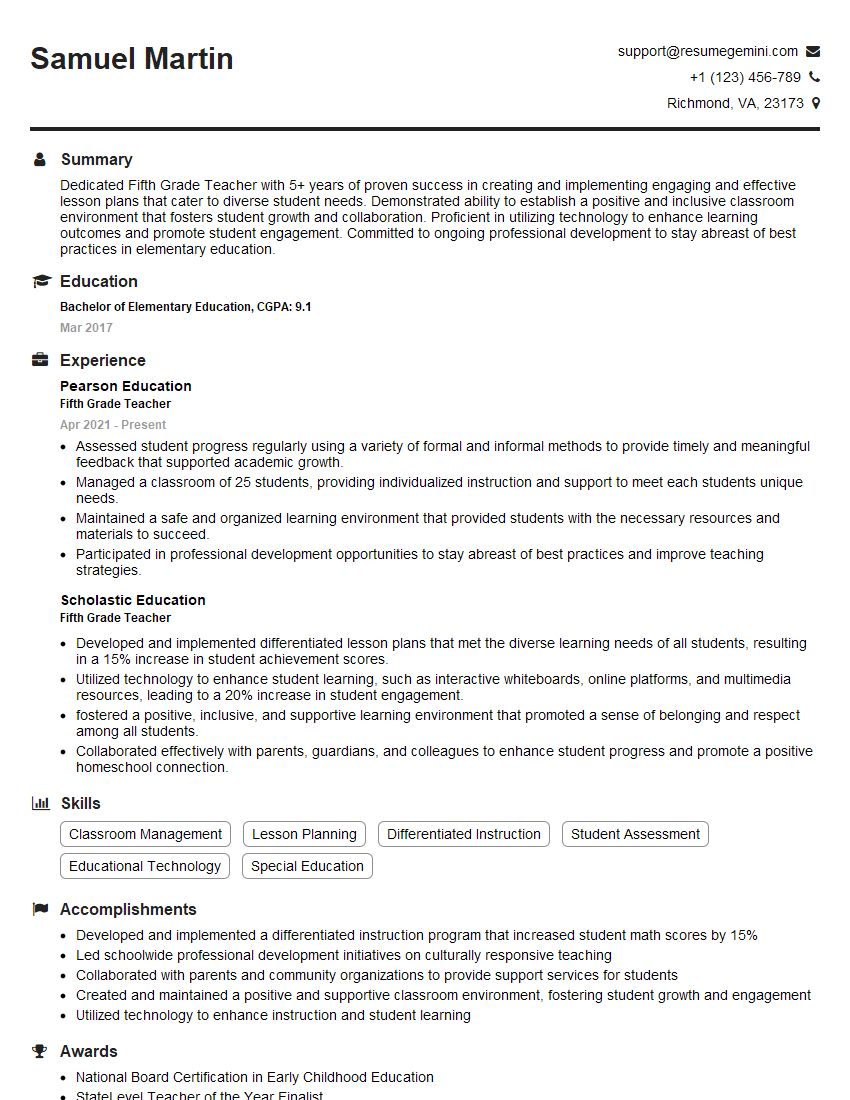
Fifth Grade Teacher Resume Sample
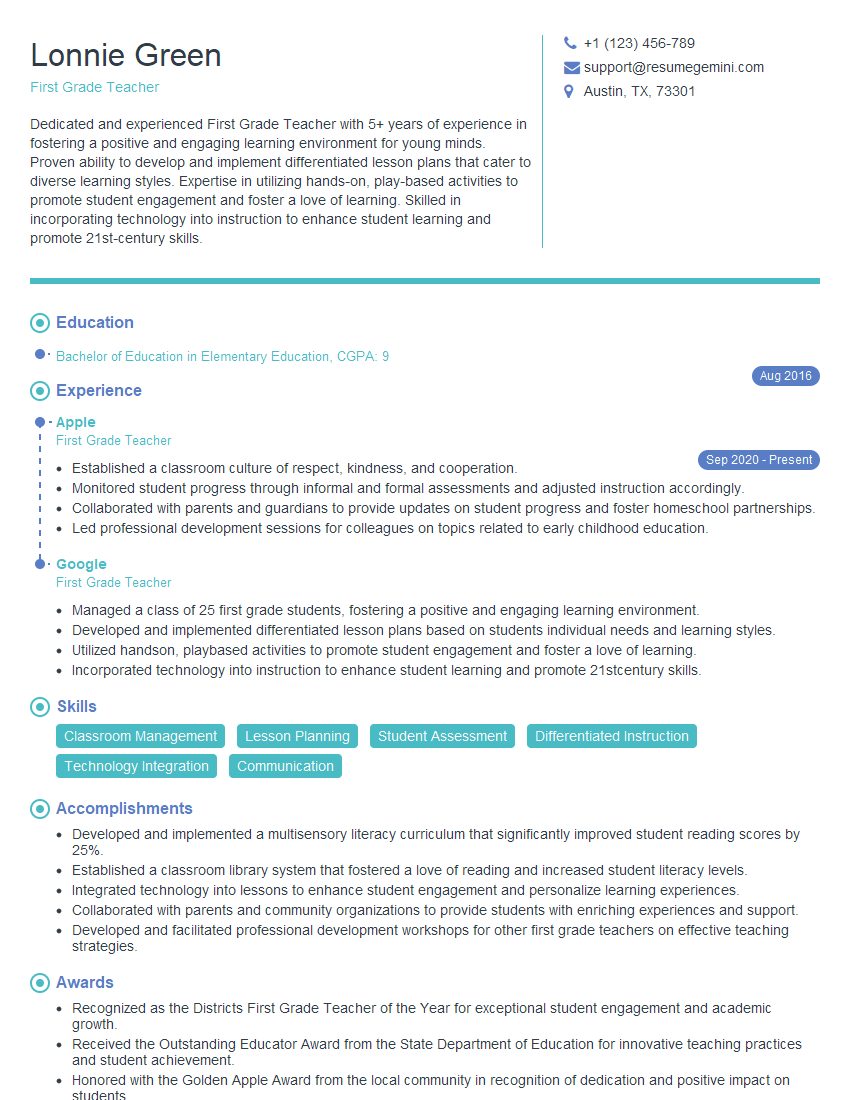
First Grade Teacher Resume Sample
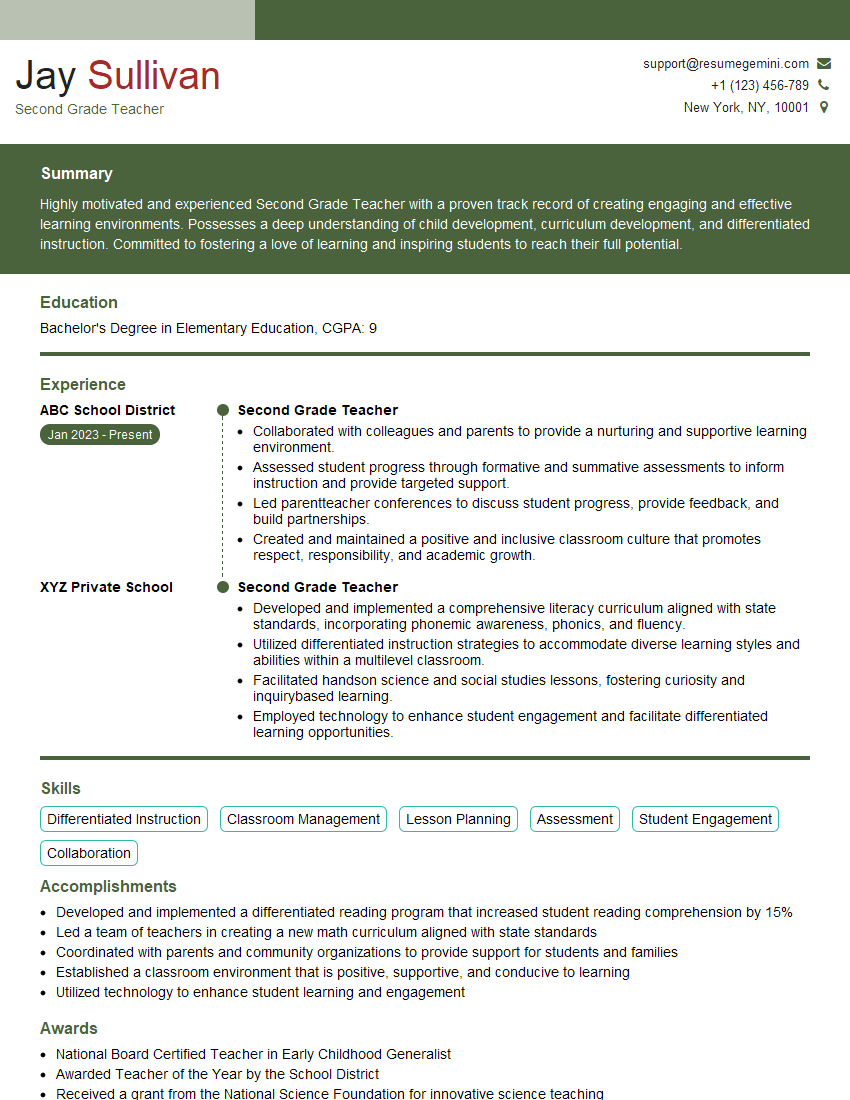
Second Grade Teacher Resume Sample
Explore more articles
Users Rating of Our Blogs
Share Your Experience
We value your feedback! Please rate our content and share your thoughts (optional).
What Readers Say About Our Blog
I Redesigned Spongebob Squarepants and his main characters of my artwork.
https://www.deviantart.com/reimaginesponge/art/Redesigned-Spongebob-characters-1223583608
IT gave me an insight and words to use and be able to think of examples
Hi, I’m Jay, we have a few potential clients that are interested in your services, thought you might be a good fit. I’d love to talk about the details, when do you have time to talk?
Best,
Jay
Founder | CEO