Interviews are more than just a Q&A session—they’re a chance to prove your worth. This blog dives into essential Use of Electronic Navigational Aids interview questions and expert tips to help you align your answers with what hiring managers are looking for. Start preparing to shine!
Questions Asked in Use of Electronic Navigational Aids Interview
Q 1. Explain the principles of Global Navigation Satellite Systems (GNSS).
Global Navigation Satellite Systems (GNSS), such as GPS, Galileo, and GLONASS, rely on a constellation of satellites orbiting the Earth. These satellites transmit precisely timed radio signals. A GNSS receiver, like the one in your smartphone or a marine GPS plotter, receives these signals from multiple satellites. By measuring the time it takes for the signals to reach the receiver, it can calculate the distance to each satellite. Using the known positions of the satellites (provided by the system’s ephemeris data), the receiver employs trilateration – using the distances as radii to draw spheres – to pinpoint its own three-dimensional location (latitude, longitude, and altitude).
Think of it like this: Imagine you’re standing at an unknown location. Three friends are at known locations and shout to you simultaneously. By measuring the time it takes for each shout to reach you, and knowing the speed of sound, you can estimate your distance from each friend. With three friends, you can pinpoint your position on a map.
Q 2. Describe the different types of GNSS errors and how to mitigate them.
GNSS accuracy can be affected by various errors. Atmospheric errors, caused by the ionosphere and troposphere delaying signals, are significant. Satellite clock errors, inconsistencies in the atomic clocks on board the satellites, are another source. Multipath errors occur when signals bounce off objects like buildings or water before reaching the receiver, resulting in inaccurate distance measurements. Finally, receiver noise and other electronic interference can introduce errors.
Mitigation techniques include using advanced signal processing techniques within the receiver to account for atmospheric delays. Precise satellite ephemeris data from correction services significantly improves accuracy. Careful antenna placement minimizes multipath. And selecting high-quality, well-maintained receivers minimizes receiver noise.
Q 3. How does differential GNSS (DGPS) improve accuracy?
Differential GNSS (DGPS) dramatically improves accuracy by correcting for systematic GNSS errors. A base station with a known, highly accurate position (often surveyed using precise techniques) receives the same GNSS signals as the user’s receiver. The base station compares its known position with the position calculated from the GNSS signals, identifying the errors. It then transmits these error corrections to the user’s receiver via radio or satellite link. The user’s receiver applies these corrections to its own GNSS position calculation, resulting in a much more accurate location.
Imagine two people measuring the height of a building. One has a perfectly calibrated measuring tape, while the other has a tape that’s slightly stretched. The person with the stretched tape consistently underestimates the height. DGPS acts like the person with the perfect tape, providing corrections to the other’s measurements.
Q 4. What are the limitations of GNSS?
Despite their advantages, GNSS has limitations. Signal blockage from structures, dense foliage, or even deep canyons can prevent satellites from being received, resulting in position loss. Atmospheric conditions like ionospheric storms can significantly affect accuracy. Satellite geometry (the relative positions of visible satellites) impacts accuracy; a poor geometry results in less precise calculations. Finally, intentional or unintentional jamming of GNSS signals can cause outages or inaccurate positioning.
Q 5. Explain the operation of an Electronic Chart Display and Information System (ECDIS).
An Electronic Chart Display and Information System (ECDIS) is an integrated navigation system that uses electronic charts (ENCs) instead of paper charts. It combines various navigational information sources such as GNSS, radar, and AIS (Automatic Identification System) to provide a comprehensive view of the vessel’s surroundings and its planned route. ECDIS provides safety-critical information like depth, hazards, and restricted areas, helping navigators make informed decisions.
ECDIS offers several key functionalities: route planning, voyage monitoring, alarm and warning systems, and integration with other navigation equipment. It displays navigational information graphically and numerically, providing a real-time understanding of the ship’s position and surroundings.
Q 6. Describe the different types of electronic charts used in ECDIS.
ECDIS utilizes Electronic Navigational Charts (ENCs), which are digital representations of paper charts, but with key differences. ENCs are produced according to international standards (S-57) and contain much more detailed information in a structured format. They include depth soundings, hazards to navigation, navigational warnings, and more. ENCs are updated regularly to reflect changes in the maritime environment.
Different types of ENCs might exist based on scale and intended use. For example, a harbor approach ENC will offer a much higher level of detail compared to a general ocean ENC.
Q 7. How do you ensure the accuracy and up-to-dateness of your charts on ECDIS?
Maintaining accurate and up-to-date charts on an ECDIS is crucial for safe navigation. The system should be linked to a chart management system that provides regular updates, including navigational warnings and corrections. The updates are often downloaded directly from service providers. It’s essential to verify the chart’s version number and the update date to ensure that it’s the latest version. Regular system checks, including self-tests and backups, should be performed. Additionally, a good understanding of the system’s limitations and the use of supplementary paper charts is important in situations with incomplete coverage or potential system failures. This layered approach ensures redundancy and reduces risks associated with reliance on a single system.
Q 8. What are the safety features and alarms incorporated in ECDIS?
ECDIS, or Electronic Chart Display and Information System, incorporates numerous safety features and alarms to prevent navigation errors and enhance situational awareness. These are crucial for safe passage, especially in challenging conditions.
- Anti-Grounding Alarm: This alerts the navigator if the planned route or the vessel’s current position gets dangerously close to shallow water or charted obstructions. Think of it as a sophisticated depth-sounding alarm, preventing accidental groundings.
- Proximity Alarm: Warns the navigator of approaching hazards like other vessels, navigational markers, or restricted areas. Imagine a virtual ‘buffer zone’ around your vessel, alerting you to potential collisions.
- Route Deviation Alarm: Sounds if the vessel deviates significantly from the planned route. This is particularly useful during autopilot operation or in reduced visibility. It ensures that the vessel stays on its intended course, avoiding unplanned entries into dangerous zones.
- Safety Contours: ECDIS can display safety contours around charted objects, providing visual cues of areas to avoid. This allows for proactive risk assessment and navigation planning.
- Chart Update Alerts: Informs the navigator of available chart updates, ensuring the system utilizes the most current navigational information. Outdated charts are a significant safety risk.
- System Failure Alarms: Alerts the crew to any malfunctions within the ECDIS itself, ensuring the prompt identification and response to system issues.
The specific alarms and their settings are customizable to the vessel’s operational requirements and preferences, allowing for tailored safety measures. Regular training and familiarization with these alarms are crucial for effective utilization and accident prevention.
Q 9. Explain the process of route planning using ECDIS.
Route planning with ECDIS is a streamlined process that leverages digital charts and advanced functionalities. It significantly enhances safety and efficiency compared to traditional paper chart methods.
- Define the Voyage: First, input the departure and destination points. ECDIS uses these coordinates to automatically generate a preliminary route.
- Select Route Options: ECDIS offers various route options, considering factors like shortest distance, fastest time, or avoidance of specific areas. You can modify the suggested route by adding waypoints, altering course lines, or adjusting parameters such as draft and speed.
- Check for Obstructions and Hazards: ECDIS overlays navigational information such as depth contours, traffic separation schemes, and other hazards on the chart. The system will highlight potential risks, allowing you to adjust the route accordingly. This avoids dangerous situations like running aground or colliding with other ships.
- Verify Route Parameters: Ensure the planned route complies with all relevant regulations and safety standards. Confirm that the vessel’s draft and other limitations are considered, ensuring the route’s feasibility.
- Review and Confirm: Before initiating the voyage, conduct a thorough review of the planned route, confirming all waypoints and parameters are accurate. This final check minimizes errors and ensures a smooth journey.
- Monitor and Adjust: During the voyage, continuously monitor the vessel’s position relative to the planned route, adjusting the route if necessary. ECDIS provides real-time updates, facilitating quick responses to changing circumstances.
ECDIS significantly improves route planning by providing a visual representation of the voyage, allowing for proactive hazard identification and avoidance, and reducing reliance on manual calculations. It’s a cornerstone of modern, safe navigation.
Q 10. How do you handle ECDIS malfunctions or failures?
ECDIS malfunctions are serious, demanding immediate and effective action. A well-defined contingency plan is essential.
- Identify the Malfunction: First, determine the nature of the failure – is it a total system failure, a partial failure, or a software glitch? Understanding the issue is the first step to solving it.
- Switch to Backup Systems: Most vessels have backup systems, including paper charts and other navigational aids. Transition swiftly to these, ensuring the continuity of navigation. Don’t panic; this is standard procedure.
- Attempt System Restart: If possible, attempt to restart the ECDIS. A simple reboot might resolve minor software glitches.
- Inform Authorities: Report the malfunction to relevant authorities, such as the coast guard or port control, especially if it affects your safe navigation.
- Implement Corrective Actions: If the malfunction persists, follow the ship’s established emergency procedures for navigation. The crew should be trained in handling such situations effectively.
- Log the Incident: Maintain a comprehensive log of the event, including the nature of the failure, the actions taken, and any impact on navigation. This documentation is crucial for future analysis and preventing similar incidents.
Regular maintenance and training are vital to minimizing the risk of malfunctions and maximizing the effectiveness of backup procedures. Preparedness is key to safely navigating ECDIS failures.
Q 11. Describe the different types of radar systems used in navigation.
Several radar systems are used in navigation, each with its unique capabilities and applications.
- X-band Radar: This is the most common type, operating at a frequency of around 9 GHz. It offers good target resolution and is effective in relatively short ranges, making it ideal for close-quarters navigation.
- S-band Radar: Operating at a lower frequency (around 3 GHz), S-band radar provides superior performance in heavy rain or sea clutter. The longer wavelengths penetrate these conditions better, revealing targets that might be obscured on X-band.
- AIS (Automatic Identification System) Radar Overlay: While not a radar system itself, AIS data can be overlaid on the radar display. This provides valuable information on the identity and movement of other vessels, enhancing collision avoidance capabilities.
- High-Definition Radar: These systems offer improved target detection and resolution compared to traditional X-band radars, using advanced signal processing techniques.
The choice of radar system depends on various factors, including the vessel’s size, operational environment, and budget. Many vessels utilize a combination of X-band and S-band radars for optimal performance in diverse conditions.
Q 12. Explain the principles of radar operation and signal interpretation.
Radar operates by transmitting electromagnetic pulses and receiving the echoes reflected from objects. The time it takes for the echo to return determines the range, while the strength of the echo indicates the target’s size and reflectivity.
Principle of Operation: A magnetron generates high-frequency pulses, which are transmitted through an antenna. When these pulses strike an object, a portion of the energy is reflected back to the receiver. The receiver processes these echoes, determining range, bearing, and relative motion.
Signal Interpretation: The radar display shows targets as blips or echoes. The size and intensity of these blips indicate the size and reflectivity of the object. The position of the blip on the screen shows the bearing and range. Relative motion is often displayed using a trail behind the target, showing the direction and speed. Experienced navigators can interpret these signals to identify targets such as vessels, landmasses, and weather formations.
Understanding radar operation requires recognizing that factors like sea clutter, rain, and interference can affect the clarity and accuracy of the returns. Proper interpretation necessitates experience and knowledge of these limitations.
Q 13. How do you interpret radar returns to avoid collisions?
Interpreting radar returns for collision avoidance involves careful observation and application of nautical rules.
- Identify Targets: Discriminate between actual targets and clutter. Distinguish between ships, land, and weather formations. This often requires experience and understanding of the radar’s capabilities.
- Assess Range and Bearing: Determine the range and bearing of each target. Consider both the target’s position and its rate of closure.
- Determine Relative Motion: Assess if the target is closing, crossing, or diverging from your course. A closing course is a potential collision risk. Observe the target’s trail to gauge its speed and direction.
- Predict CPA (Closest Point of Approach): Estimate the CPA, the point where the two vessels will be closest to each other. This helps anticipate a potential collision and take proactive measures.
- Take Action: Based on the risk assessment, take appropriate action. This might involve altering course, speed, or contacting the other vessel. Follow the rules of navigation to avoid collisions.
Regular radar training and experience are crucial for accurate interpretation and effective collision avoidance. The ability to predict target movement and understand its implications is a vital navigational skill.
Q 14. What are the limitations of radar?
While radar is a powerful navigational tool, it possesses limitations that must be considered:
- Range Limitation: Radar’s effective range is limited by the power of the transmitter and the size of the target. Small vessels might be undetectable at longer ranges.
- Clutter: Sea clutter (waves), rain, and snow can obscure targets, reducing the reliability of the radar image. This necessitates careful interpretation and might necessitate using alternative navigational tools.
- Blind Spots: Radar has blind spots, primarily directly behind the antenna. This area requires caution, as targets might be undetected.
- Target Identification: Radar alone cannot reliably identify targets. Visual confirmation is often needed, especially when determining the nature of the contacts. Radar provides range and bearing but often needs further interpretation to determine the identity.
- Signal Interference: Radar signals can be affected by electromagnetic interference from other sources, potentially causing inaccurate or misleading readings.
Understanding these limitations is crucial for safe navigation. Never rely solely on radar; always use it in conjunction with other navigational aids and visual observations.
Q 15. Explain the use of Automatic Identification System (AIS).
The Automatic Identification System (AIS) is a crucial electronic navigational aid that automatically transmits and receives data about a vessel’s identity, position, course, speed, and other relevant information. Think of it as a ship’s ‘electronic license plate’ and ‘digital broadcast’ combined. This data is broadcast to other vessels and shore-based stations within range, enhancing situational awareness and contributing significantly to collision avoidance.
AIS transponders on board vessels continuously transmit this information, allowing other vessels equipped with AIS receivers to view their location and movements on a chart plotter or electronic chart display and information system (ECDIS). This real-time tracking drastically improves safety, particularly in high-traffic areas such as ports or shipping lanes.
Career Expert Tips:
- Ace those interviews! Prepare effectively by reviewing the Top 50 Most Common Interview Questions on ResumeGemini.
- Navigate your job search with confidence! Explore a wide range of Career Tips on ResumeGemini. Learn about common challenges and recommendations to overcome them.
- Craft the perfect resume! Master the Art of Resume Writing with ResumeGemini’s guide. Showcase your unique qualifications and achievements effectively.
- Don’t miss out on holiday savings! Build your dream resume with ResumeGemini’s ATS optimized templates.
Q 16. How does AIS contribute to collision avoidance?
AIS plays a vital role in collision avoidance by providing mariners with early warning of nearby vessels. By seeing the position, course, and speed of other vessels on their ECDIS, mariners can assess potential collision risks and take appropriate evasive action. This is particularly helpful in situations with limited visibility, such as fog or darkness, where traditional visual observation might be insufficient. For example, imagine two vessels approaching each other at night – AIS allows each captain to see the other’s trajectory well in advance, allowing for timely adjustments to avoid a collision. This early warning significantly reduces the risk of accidents.
Q 17. Describe the different types of navigational warnings and how they are received.
Navigational warnings are crucial safety messages detailing hazards to navigation. These warnings can be categorized into several types, including:
- Notices to Mariners (NTMs): These provide information about changes to charts, aids to navigation, or other navigational hazards. They’re typically issued by national hydrographic offices.
- Urgent Marine Information Broadcasts: These are urgent warnings about immediate dangers such as severe weather, search and rescue operations, or major navigational obstructions.
- Safety Information Broadcasts: These convey less urgent but still important information, such as updated weather forecasts or port regulations.
Mariners receive these warnings through various channels, including:
- NAVTEX (Navigational Telex): A radio-based system providing broadcast messages.
- Inmarsat-C or other satellite communication systems:
- Digital broadcast systems:
- Websites and dedicated maritime information portals:
- VHF radio broadcasts:
Regularly checking these sources is vital for maintaining a safe and informed voyage.
Q 18. How do you prioritize navigational information from different sources?
Prioritizing navigational information requires a hierarchical approach, emphasizing reliability and recency. The general rule is to prioritize information based on its source’s authority and its relevance to the current situation.
- Official Charts and Publications: These are the primary source, meticulously surveyed and updated. Any discrepancies between other sources and these should be carefully investigated.
- Electronic Chart Display and Information Systems (ECDIS): ECDIS integrates official chart data with other navigational information, providing a centralized and dynamic view of the surroundings. ECDIS data is generally preferred over less authoritative sources, but still needs to be cross-referenced.
- AIS data: Useful for situational awareness of other vessels but should be treated cautiously as it relies on the proper functioning of other vessel’s AIS transponders.
- VHF radio broadcasts and NAVTEX: These provide real-time information about hazards, but can be prone to error or delay. Information needs to be verified when possible.
- Personal observations and estimations: These are the lowest priority, often used for cross referencing only.
In case of conflicting information, a cautious approach is crucial. Prioritize the most reliable and recent information available, and if in doubt, always err on the side of safety.
Q 19. Explain the use of gyrocompass and magnetic compass.
Both gyrocompasses and magnetic compasses are used for determining a vessel’s heading, but they operate on different principles.
A magnetic compass uses the Earth’s magnetic field to indicate magnetic north. It’s a relatively simple and reliable instrument but is susceptible to magnetic deviations caused by metallic objects on the vessel. Think of it as a simple needle following Earth’s magnetic lines.
A gyrocompass, on the other hand, uses a spinning gyroscope to find true north, independent of the Earth’s magnetic field. This makes it significantly more accurate than a magnetic compass, especially in high latitudes where magnetic variation is considerable and less susceptible to magnetic interference from the ship itself. It’s more complex and requires power to operate, but offers superior accuracy. Consider it a sophisticated, self-orienting top.
Q 20. Describe the sources of error in compass readings and how to correct them.
Compass readings can be affected by several sources of error:
- Deviation: Magnetic interference from the vessel’s own metal structures, equipment, or cargo affects the magnetic compass.
- Variation: The difference between magnetic north and true north varies geographically.
- Heaving error:** The rolling and pitching motion of a vessel can momentarily affect the reading of both magnetic and gyrocompasses.
- Gyrocompass errors:** While more accurate than a magnetic compass, gyrocompasses can suffer from errors due to various factors, including latitude error and installation inaccuracies.
Correction methods:
- Deviation correction: This involves using a deviation card or performing a deviation table calculation to compensate for the magnetic deviations caused by the vessel.
- Variation correction: This is done using navigational charts that provide variation information for specific locations. Applying the correction will transform the magnetic heading to true heading.
- Heaving error mitigation:** Use averaging techniques to reduce the effect of vessel motion on compass readings.
- Gyrocompass calibration and maintenance:** Regular calibration and maintenance help minimize errors, and any error messages provided by the device must be addressed.
Q 21. How do you determine your position using celestial navigation (if applicable)?
Celestial navigation involves using the positions of celestial bodies (sun, moon, stars) to determine a vessel’s latitude and longitude. It’s a less common method nowadays, but it remains a valuable skill in case of electronic equipment failure. The process involves several steps:
- Measuring the altitude of a celestial body: This is done using a sextant, which measures the angle between the horizon and the celestial body.
- Identifying the celestial body: Using a nautical almanac or ephemeris to identify the celestial body observed.
- Determining the Greenwich Hour Angle (GHA) and declination of the celestial body: The almanac provides this data based on time of observation.
- Calculating Local Hour Angle (LHA): The LHA is calculated from the GHA and the longitude of the observer (which we need to calculate).
- Solving the navigational triangle: This involves using spherical trigonometry or a navigational computer to calculate the latitude and longitude.
This calculation can be done manually using sight reduction tables or electronically with navigational software, yielding a position line from one celestial body. Taking simultaneous sights on at least two celestial bodies at different points in the sky allows a solution to find the intersection of position lines, thereby pinpointing the vessel’s location.
Q 22. Explain the process of taking and recording navigational observations.
Taking and recording navigational observations is a crucial process for determining a vessel’s position accurately. It involves using various navigational aids like GPS, celestial navigation, or radar to obtain position fixes, and then meticulously recording this information in the ship’s logbook or electronic navigation system.
The process typically follows these steps:
- Identify the navigational aid: Determine which aid you’ll be using (GPS, compass bearing to a landmark, etc.).
- Take the observation: This involves reading the data from the chosen aid – for example, noting GPS coordinates (latitude and longitude), or the bearing and distance to a landmark.
- Record the time: The time of the observation is crucial for plotting your position accurately, and any changes in your course or speed.
- Record the data: Note down all relevant information, including the type of aid used, the observed data (e.g., GPS coordinates, bearing, distance), and the time. This information might also include environmental factors (sea state, visibility), which could affect the accuracy of the observation.
- Plot the position (if necessary): Some methods require manual plotting on a chart, using protractors and dividers to pinpoint your location based on the observations.
Example: Let’s say I’m using a GPS receiver. I would record the time (14:30 UTC), the latitude (37°15’N), the longitude (26°12’E), and note that the GPS receiver was the source of the position fix. I’d then record this information in the navigation log, along with any other relevant details.
Q 23. Describe different methods for dead reckoning.
Dead reckoning (DR) is a method of estimating a vessel’s position by using its known course, speed, and starting position. While less precise than electronic position fixes, DR provides a continuous position estimate between fixes and serves as a valuable backup.
Different methods of dead reckoning exist:
- Manual Dead Reckoning: This traditional method uses a pencil, chart, parallel rules, and dividers. The navigator calculates the vessel’s progress based on course and speed over a period of time and plots it on the chart.
- Electronic Dead Reckoning (EDR): Modern vessels utilize electronic navigation systems with built-in EDR capabilities. These systems integrate data from various sources, including the gyrocompass, log, and even GPS (if available), to continuously calculate and display the vessel’s estimated position.
- Simple DR: This is a simplified version often used for short periods or when speed and course remain constant. It involves calculating the distance traveled based on speed and time and then adding this to the last known position.
Example: Imagine a ship traveling at 10 knots for 2 hours on a course of 090°. Using simple DR, the distance traveled would be 20 nautical miles (10 knots * 2 hours). This distance is then plotted on the chart from the last known position at a bearing of 090°.
Q 24. How do you handle emergency situations involving navigational equipment failure?
Navigational equipment failure is a serious concern. The response depends on the type of failure and the severity of the situation. A structured approach is vital:
- Immediate Actions: Assess the situation. Determine the extent of the failure and which systems are affected. If the failure is critical (e.g., complete GPS failure in low visibility), immediately alert the captain and follow the ship’s emergency procedures.
- Backup Systems: Utilize backup systems immediately. This might include switching to a secondary GPS receiver, using paper charts and traditional navigation methods (e.g., celestial navigation, dead reckoning, piloting), or contacting other vessels for position updates.
- Reduce Speed and Increase Vigilance: Reduce speed to allow for greater situational awareness and to improve the chances of avoiding collisions.
- Contact Relevant Authorities: Depending on the severity and location, contact coast guard or other maritime authorities for assistance.
- Troubleshooting and Repair (If Possible): Attempt to troubleshoot the problem and initiate repairs if the situation permits, following the relevant maintenance procedures.
- Log the Event: Record the full details of the failure, including the time, affected systems, actions taken, and outcomes, in the ship’s logbook.
Example: If the primary GPS receiver fails, I would immediately switch to a secondary GPS receiver (if available) and commence dead reckoning, referencing paper charts and any available visual aids such as landmarks. Then, I’d contact the bridge to report the issue, and we’d follow our established emergency procedures.
Q 25. What are the international regulations concerning the use of electronic navigational aids?
International regulations concerning the use of electronic navigational aids are primarily guided by the International Maritime Organization (IMO) and reflected in various conventions and guidelines. These regulations emphasize safety, standardization, and interoperability:
- SOLAS Convention (Safety of Life at Sea): This convention sets minimum standards for the safety of ships and their equipment, including navigational aids. It mandates certain types of electronic equipment based on ship type and operational area.
- IMO Performance Standards: The IMO sets performance standards for various electronic navigational equipment ensuring a minimum level of accuracy and reliability.
- International Regulations for Preventing Collisions at Sea (COLREGs): While not specifically about electronic navigational aids, COLREGs govern the safe navigation of vessels and dictate proper use of navigational lights and signals, which electronic aids can enhance.
- Use of Electronic Chart Display and Information Systems (ECDIS): IMO has specific guidelines for the use of ECDIS, including carriage requirements, data updates, and operational procedures.
These regulations aim to ensure consistent standards across the maritime industry, preventing confusion and enhancing overall safety at sea.
Q 26. Explain your understanding of the International Regulations for Preventing Collisions at Sea (COLREGs).
The International Regulations for Preventing Collisions at Sea (COLREGs) are a set of rules that govern the safe navigation of vessels to prevent collisions. Understanding and applying COLREGs is paramount for safe seamanship. They cover various aspects of navigation, including:
- Rules of the Road: Defining the right of way and responsibilities of vessels in different situations (e.g., crossing, overtaking).
- Lights and Shapes: Specifying the lights and shapes vessels must display at night and in reduced visibility to indicate their type and maneuverability.
- Sound Signals: Detailing the use of sound signals to warn other vessels of intentions or hazards.
- Visibility and Lookout: Emphasizing the importance of maintaining a proper lookout and taking actions to enhance visibility.
COLREGs provide a framework for safe navigation, but professional judgment and situational awareness are always necessary. Electronic navigational aids assist in complying with COLREGs by providing accurate information on vessel positions, courses, and speeds, enhancing situational awareness and facilitating decision-making to avoid potential collisions.
Example: If a vessel is overtaking another, COLREGs specify the actions that both vessels should take. The overtaking vessel needs to keep well clear of the overtaken vessel. Electronic navigational aids (such as AIS – Automatic Identification System) help determine the relative positions and speeds of both vessels, aiding in making safe and compliant maneuvers.
Q 27. Describe your experience with various navigational software and applications.
My experience encompasses a wide range of navigational software and applications. I’m proficient in using various Electronic Chart Display and Information Systems (ECDIS), including those from manufacturers like Furuno, Raymarine, and Simrad. I’m familiar with their functionalities, data management features, and safety protocols.
Beyond ECDIS, I have experience with:
- GPS Navigation Software: I’ve worked with various GPS software packages, both on integrated navigation systems and stand-alone applications, enabling me to plan routes, monitor position, and assess navigational risks.
- Voyage Planning Software: This includes software for creating detailed voyage plans, considering factors like weather, tides, and currents. These tools often integrate with ECDIS for optimal route optimization.
- AIS Software: I’m familiar with utilizing AIS data for tracking other vessels, assessing traffic density, and enhancing situational awareness.
I also have hands-on experience using various plotting software to create and maintain paper charts when necessary. Proficiency in this ensures that I can effectively transition to alternate means of navigation when electronic systems fail.
Q 28. How do you stay updated on changes and advancements in electronic navigational aids?
Staying updated on changes and advancements in electronic navigational aids is crucial for maintaining proficiency and ensuring safe navigation practices. I employ several methods:
- Professional Organizations: Active membership in organizations like the Institute of Navigation or equivalent bodies provides access to publications, conferences, and networking opportunities, allowing me to stay abreast of industry developments.
- Manufacturer Websites and Documentation: I regularly check the websites of major navigational equipment manufacturers for updates on their products, software releases, and any relevant safety notices.
- Industry Publications and Journals: I read industry journals and publications, attending workshops and seminars focused on navigation technology and safety.
- Regulatory Updates: I monitor updates from the IMO and other regulatory bodies on new standards and regulations related to electronic navigational aids and their use.
- Training Courses: I participate in regular training courses to ensure my skills and knowledge remain current and compliant with the latest technology and safety guidelines.
Continuous learning is not only essential for competence, it is crucial for safety at sea in a constantly evolving technological environment.
Key Topics to Learn for Use of Electronic Navigational Aids Interview
- GPS Fundamentals: Understanding GPS signals, satellite constellations, and error sources. Practical application: Analyzing GPS data to determine position accuracy and limitations.
- Chart Plotters & Navigation Software: Proficiency in using various chart plotter systems, including data entry, route planning, and waypoint management. Practical application: Demonstrating the ability to create and follow a safe and efficient route using electronic charts.
- Radar Systems: Understanding different radar types (X-band, S-band), interpreting radar returns, and using radar for collision avoidance. Practical application: Describing how to identify targets, measure range and bearing, and interpret weather information from radar data.
- AIS (Automatic Identification System): Knowledge of AIS principles, interpreting AIS data on a chart plotter, and understanding its role in collision avoidance. Practical application: Explaining how to use AIS to identify and track nearby vessels.
- ECDIS (Electronic Chart Display and Information System): Understanding ECDIS functionality, including chart updates, route planning, and safety features. Practical application: Demonstrating the ability to interpret ECDIS information and respond to navigational alerts.
- Integrated Navigation Systems: Understanding how different electronic navigational aids integrate and interact to provide a comprehensive navigational picture. Practical application: Describing the process of using multiple systems to confirm position and avoid hazards.
- Troubleshooting and Problem Solving: Diagnosing common electronic navigation system malfunctions and implementing effective solutions. Practical application: Describing a scenario where a navigational system malfunctioned and how you resolved the issue.
Next Steps
Mastering the use of electronic navigational aids is crucial for career advancement in the maritime and aviation industries, opening doors to more challenging and rewarding roles. A strong command of these technologies demonstrates competence and professionalism to potential employers. To maximize your job prospects, focus on building an ATS-friendly resume that clearly highlights your skills and experience. ResumeGemini is a trusted resource that can help you craft a compelling resume tailored to the specific requirements of the job market. Examples of resumes tailored to Use of Electronic Navigational Aids are available to help guide you through this process. Take the next step towards your ideal career today!
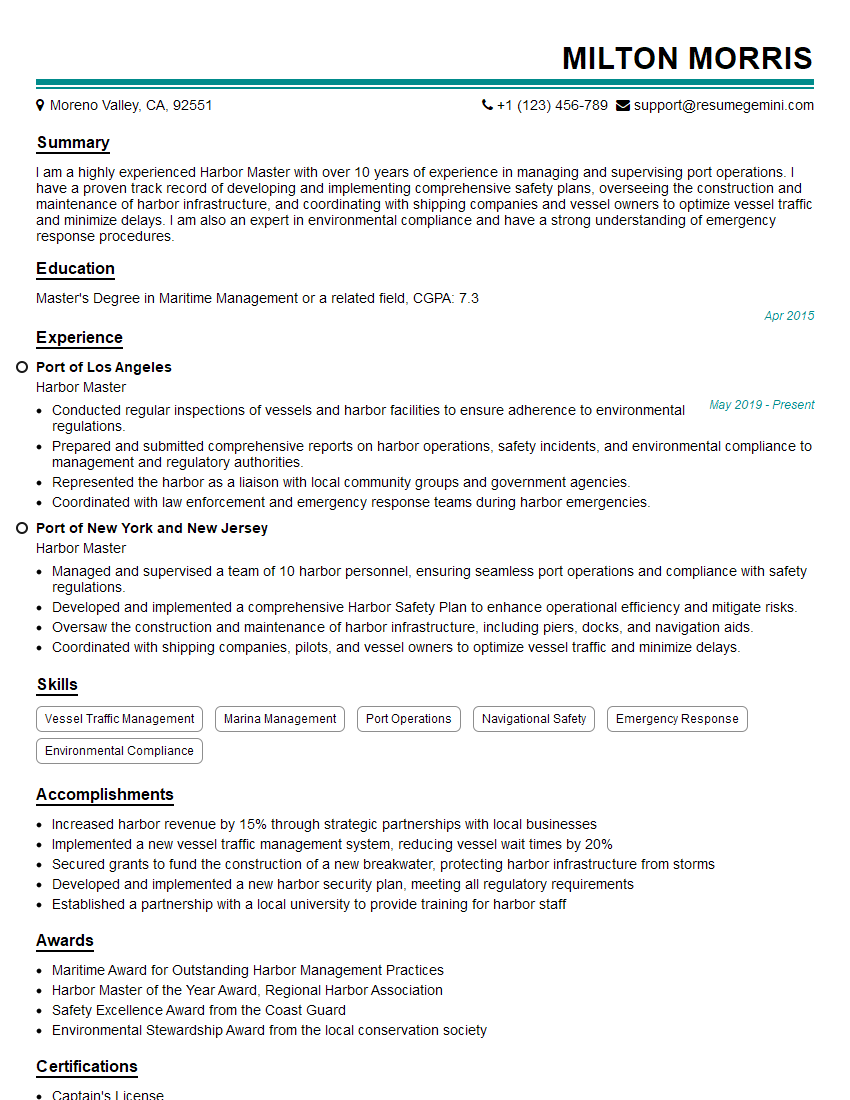
Harbor Master Resume Sample
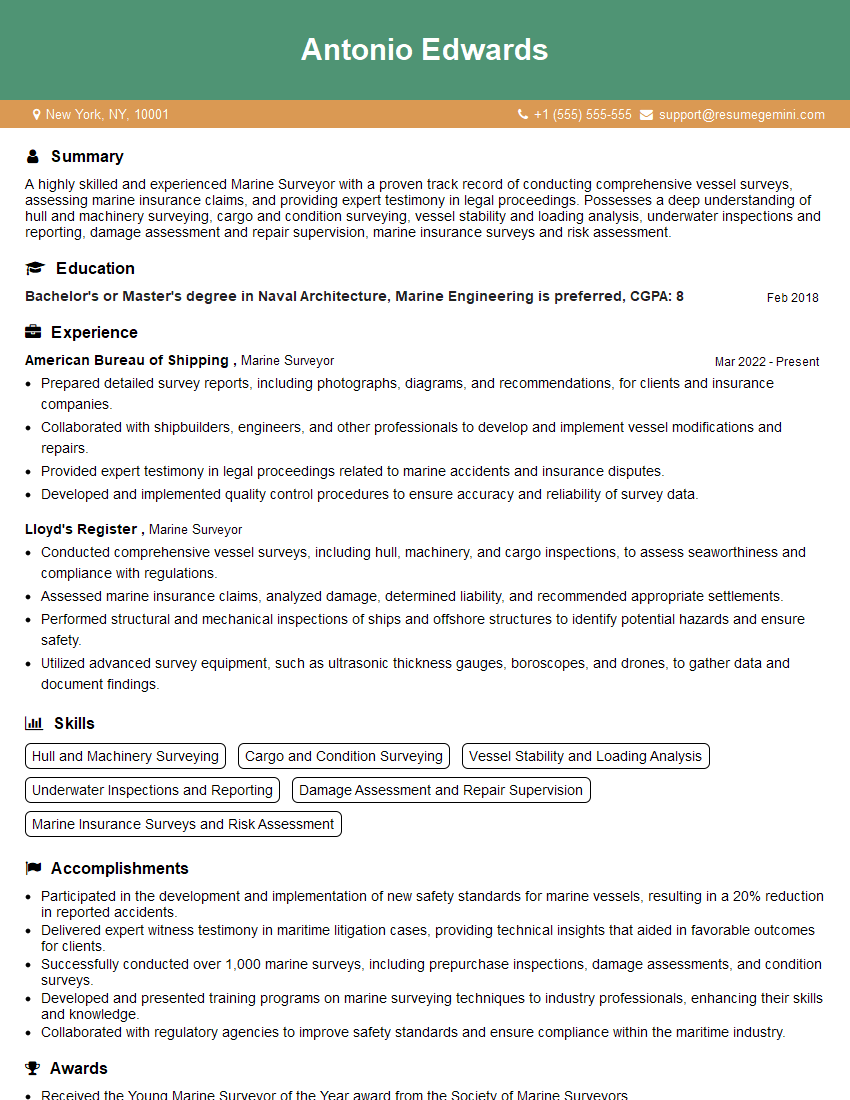
Marine Surveyor Resume Sample
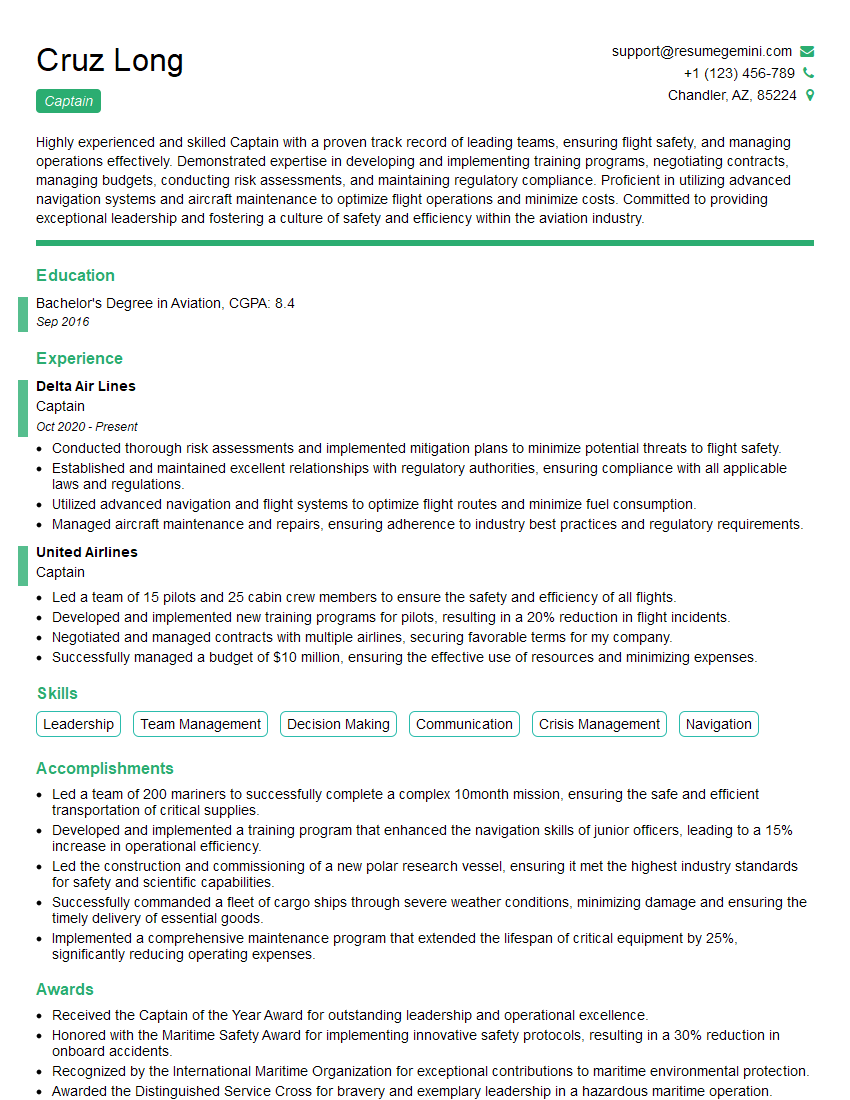
Captain Resume Sample
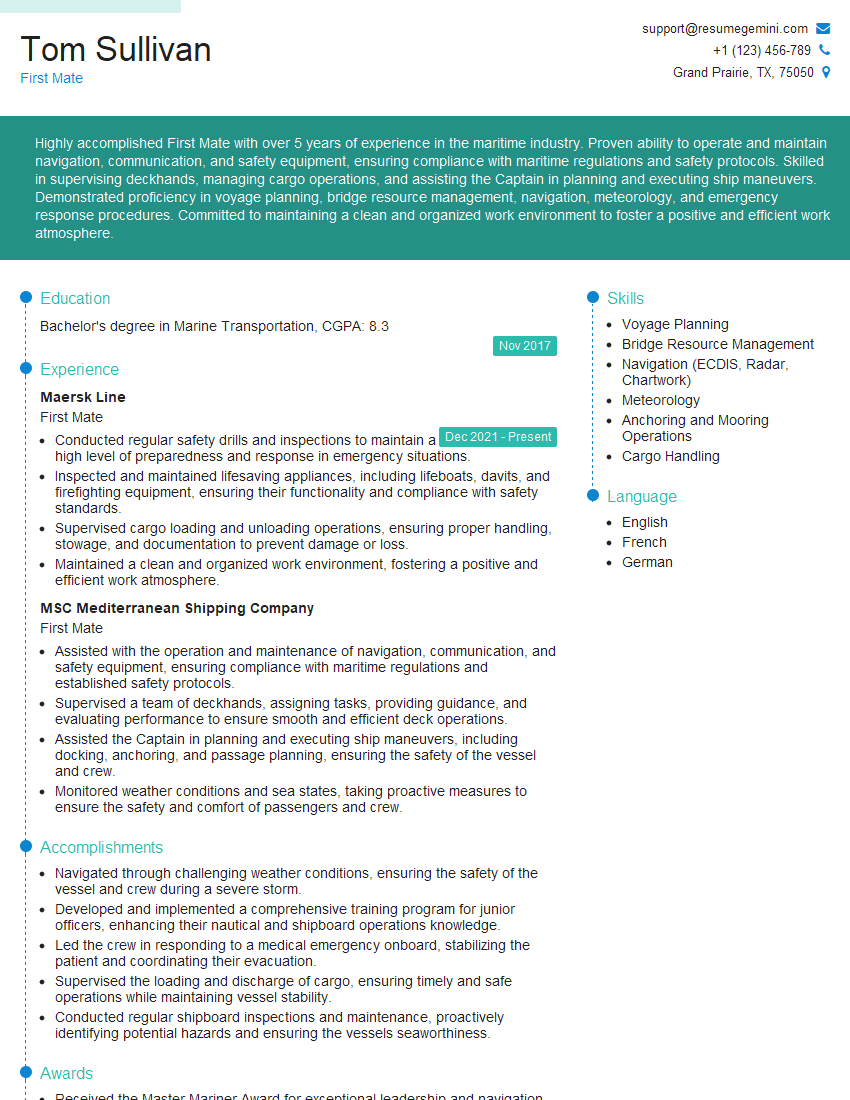
First Mate Resume Sample
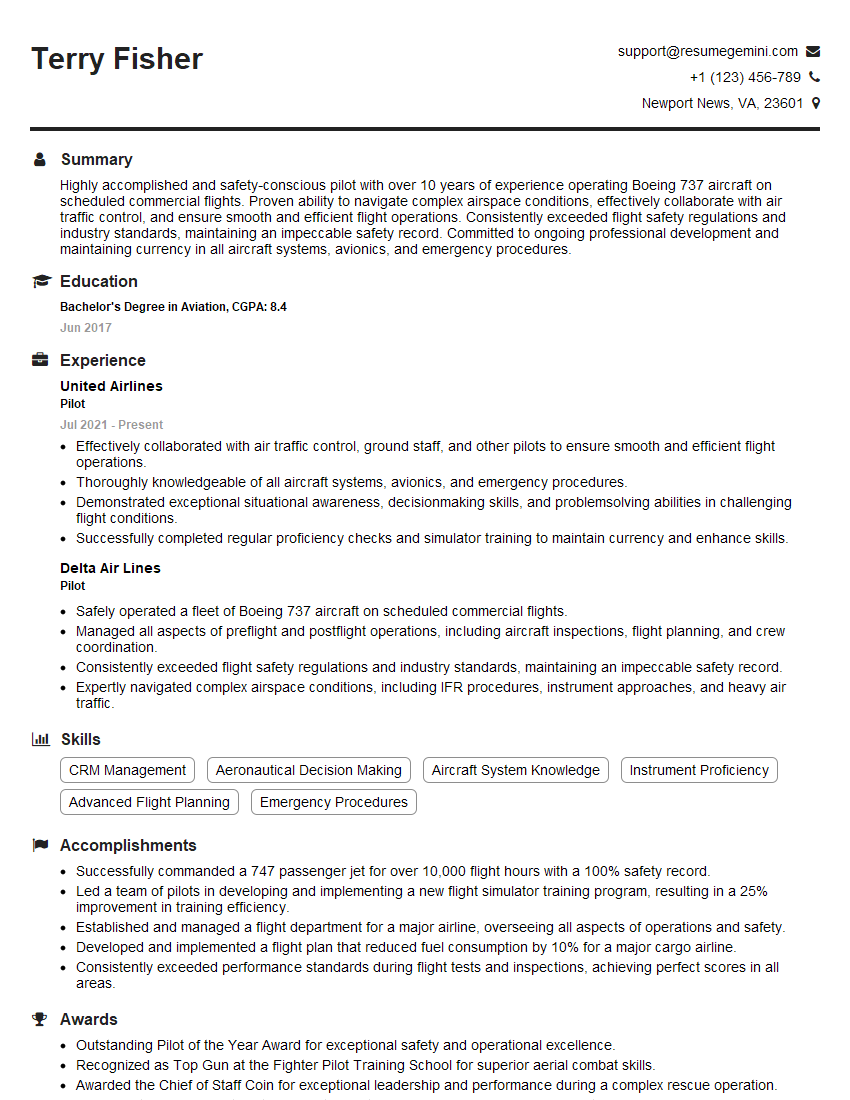
Pilot Resume Sample
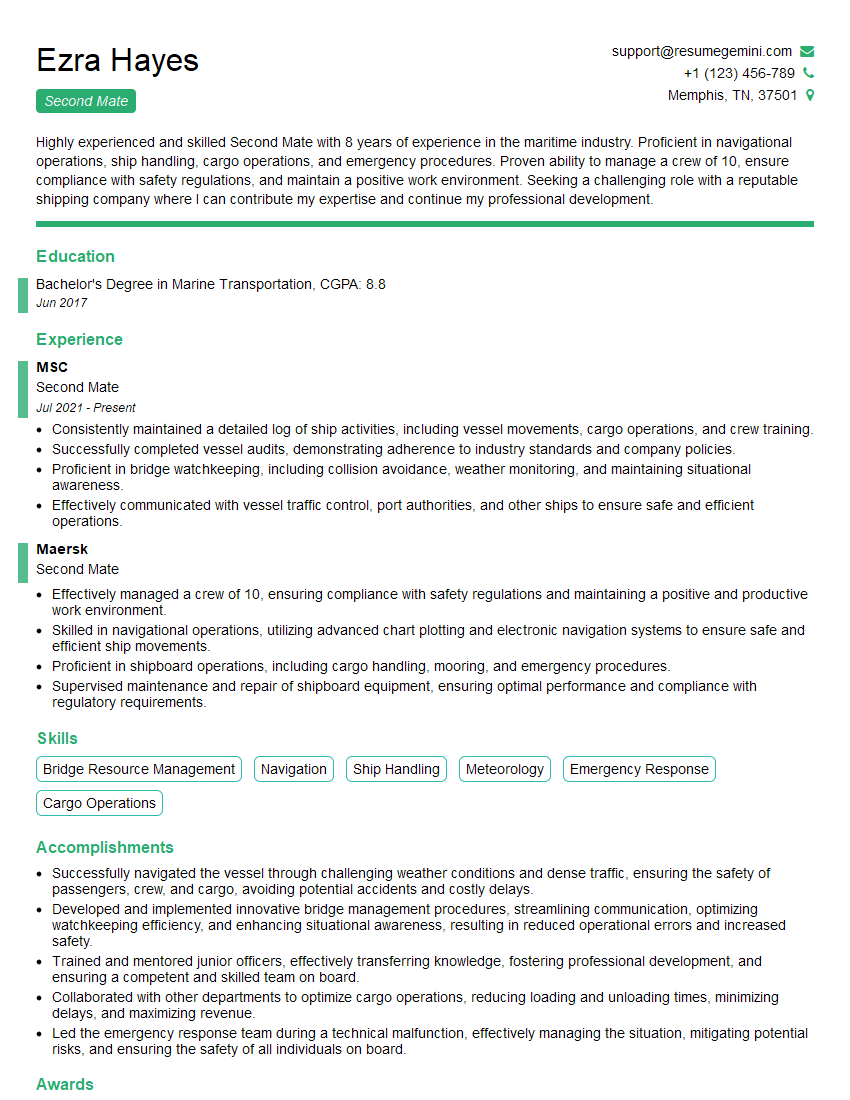
Second Mate Resume Sample
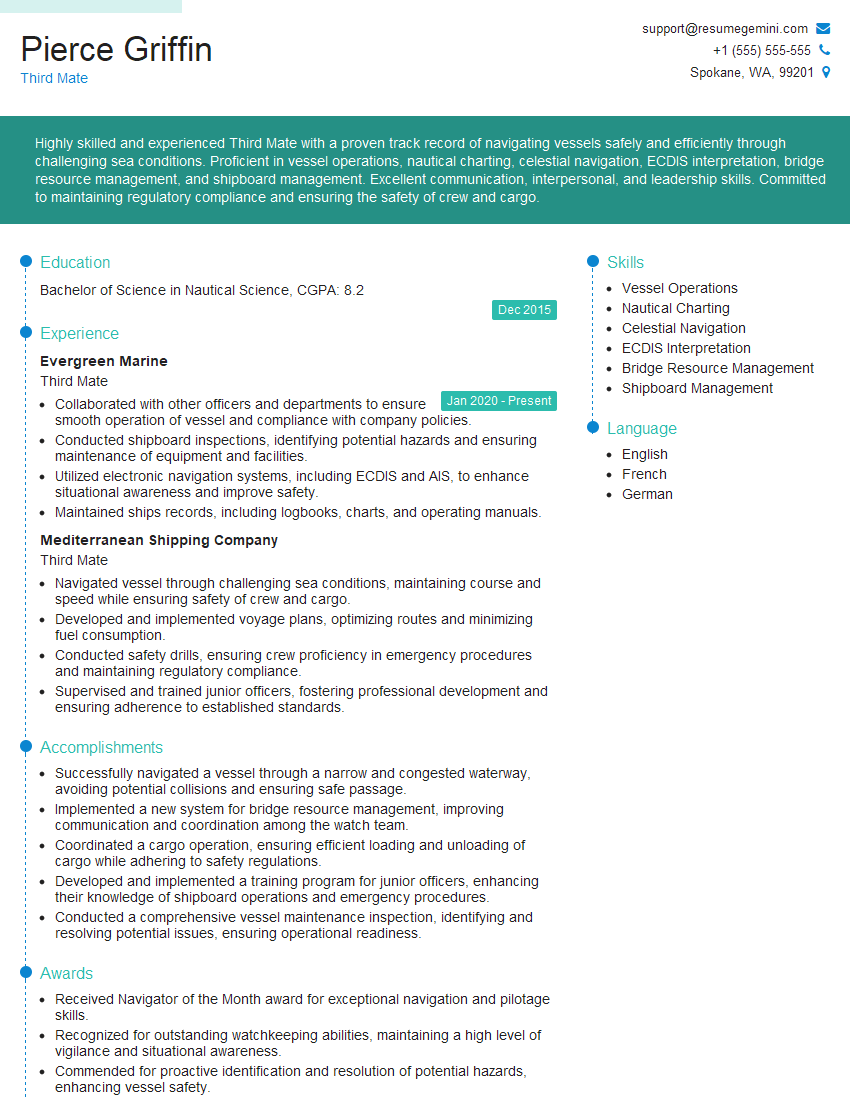
Third Mate Resume Sample
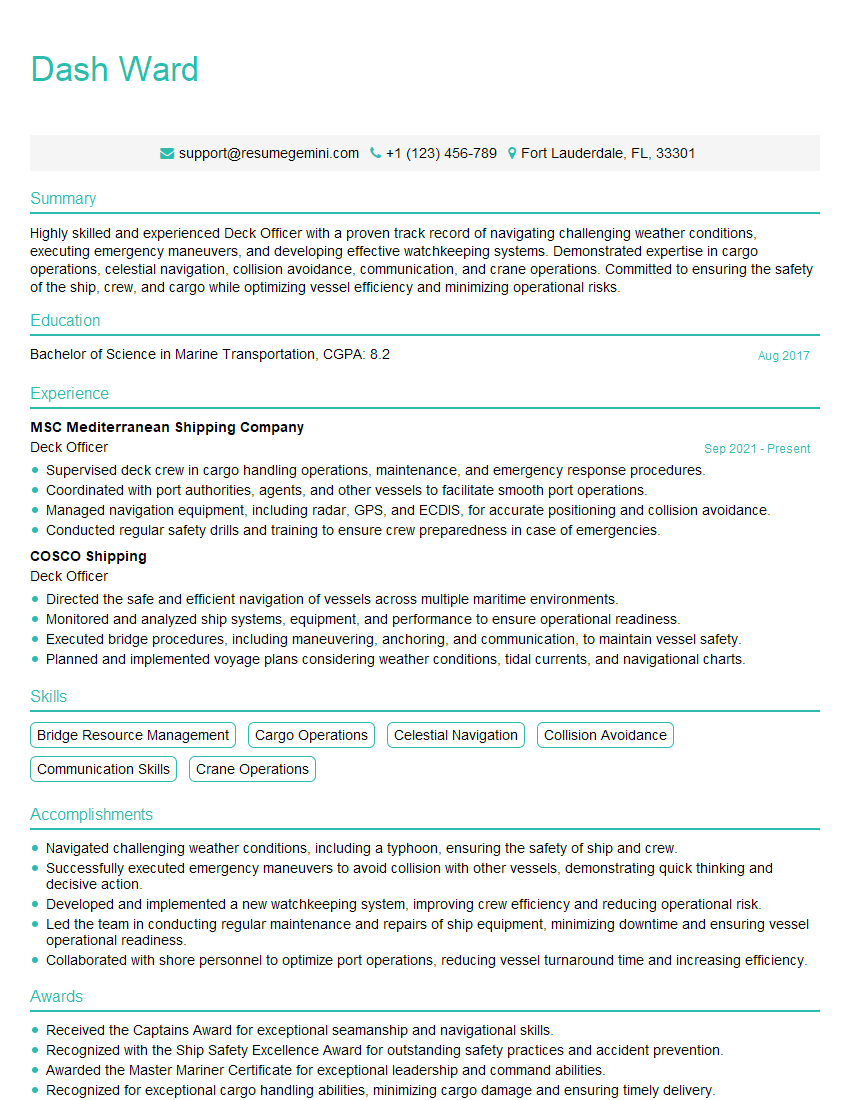
Deck Officer Resume Sample
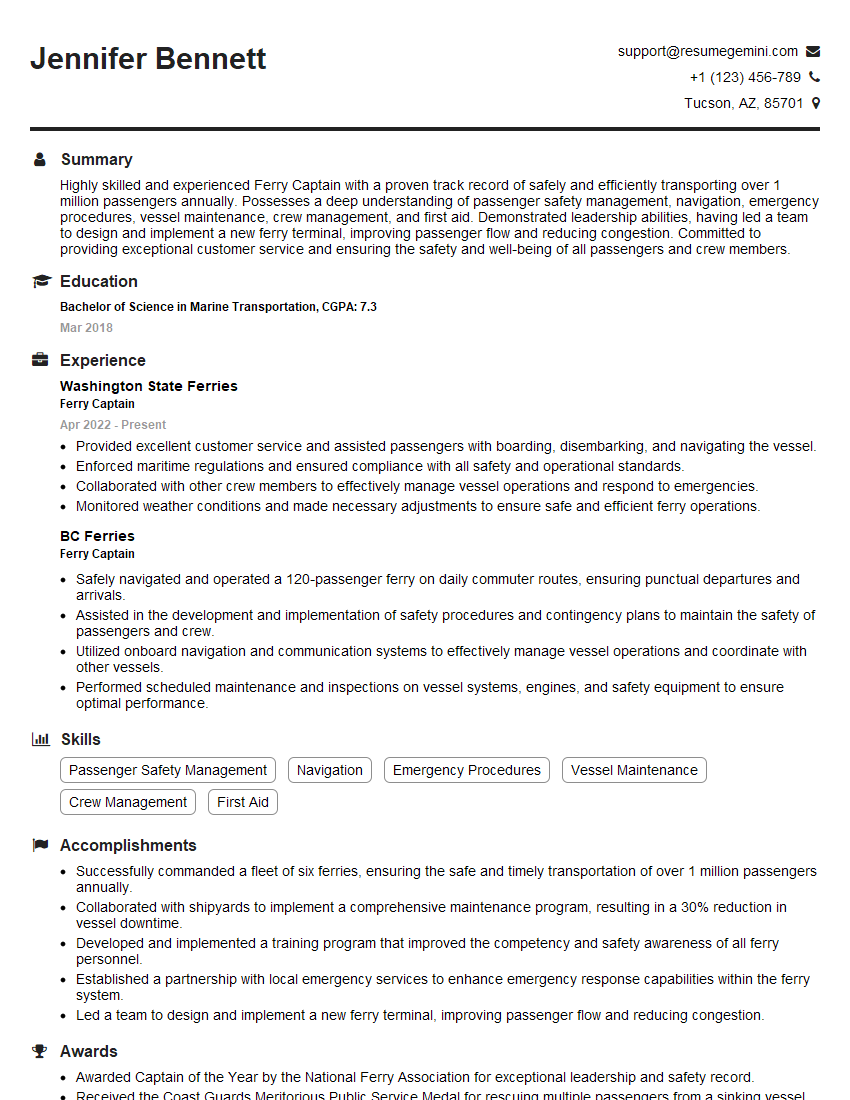
Ferry Captain Resume Sample
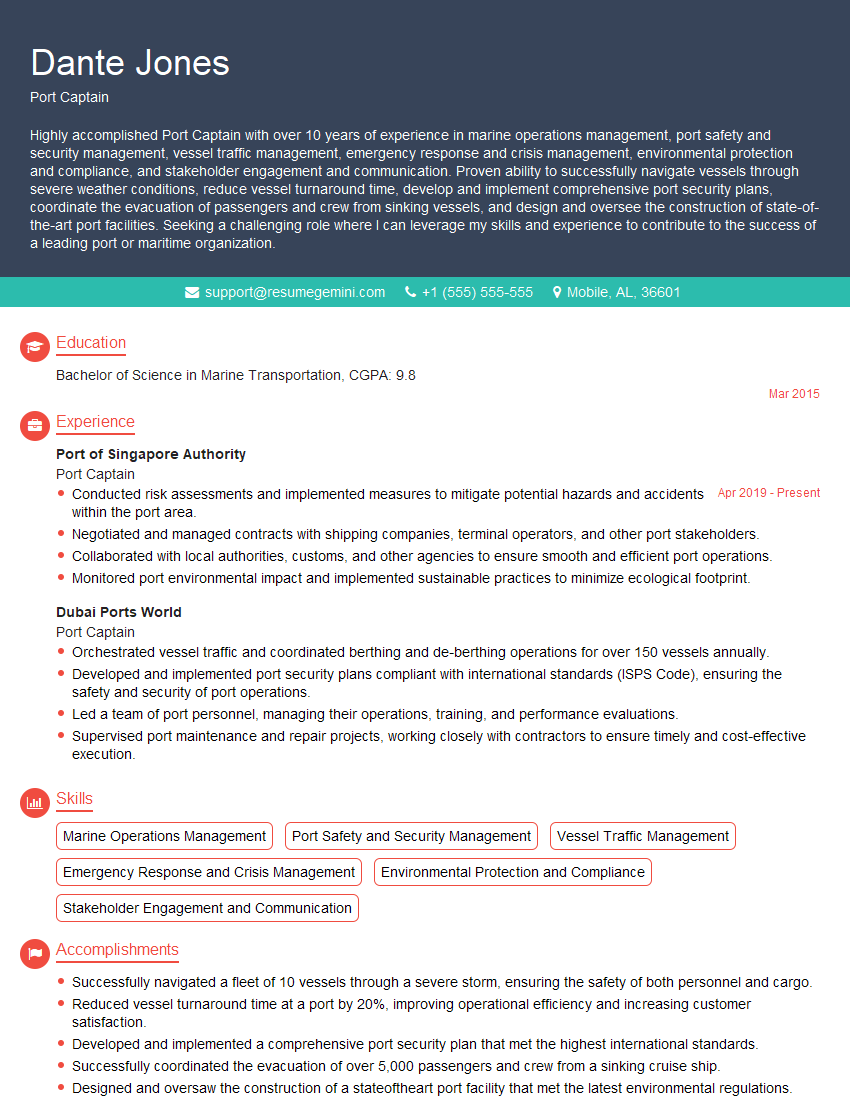
Port Captain Resume Sample
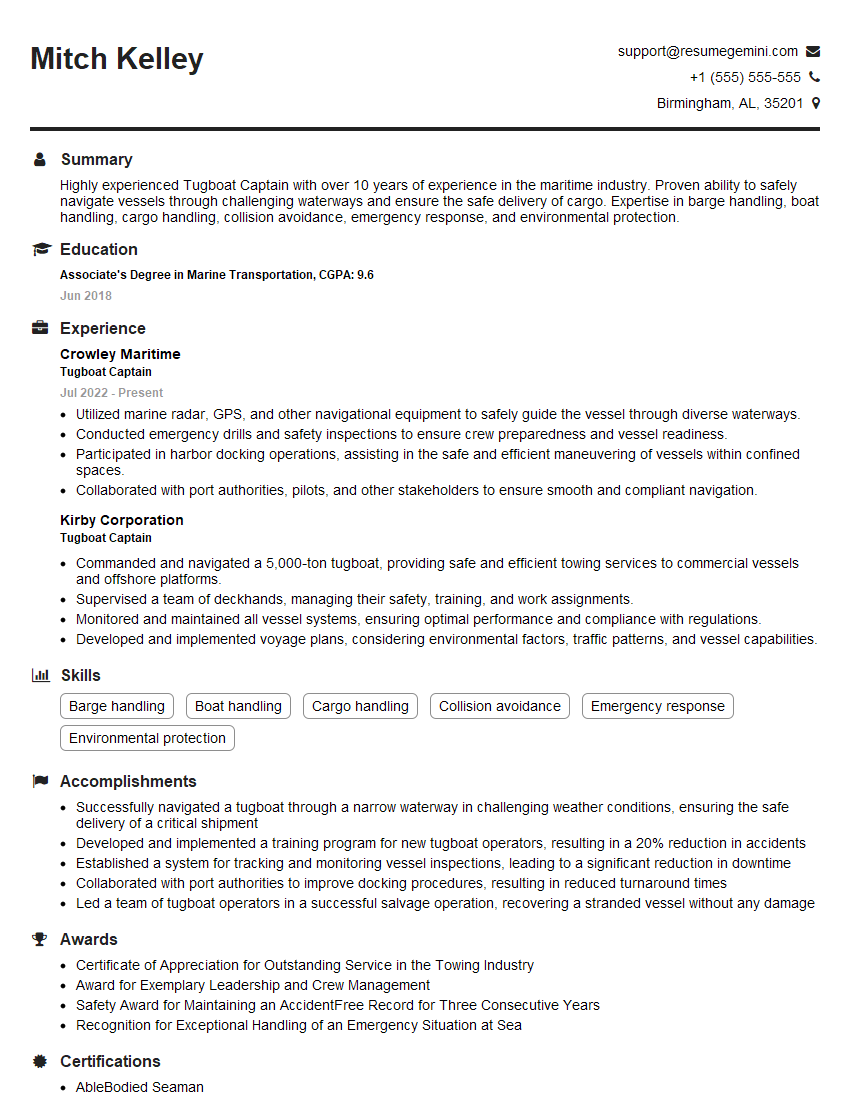
Tugboat Captain Resume Sample

Master Mariner Resume Sample
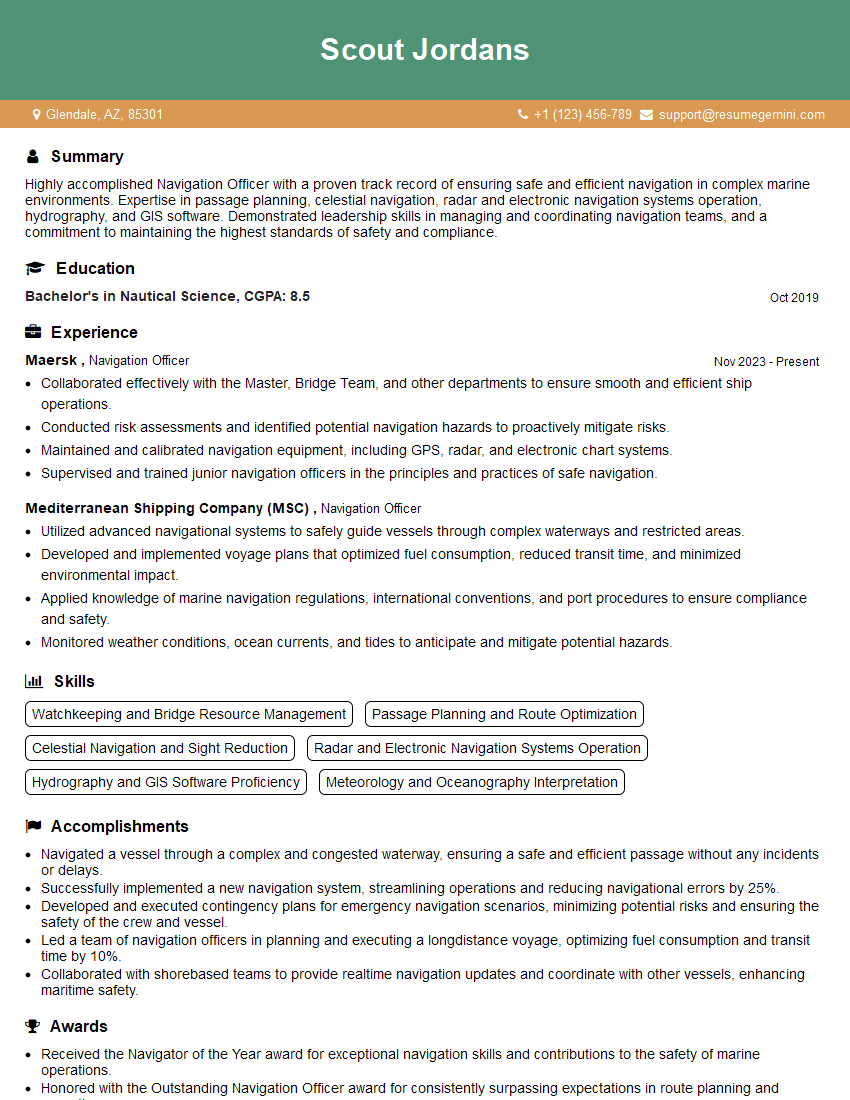
Navigation Officer Resume Sample
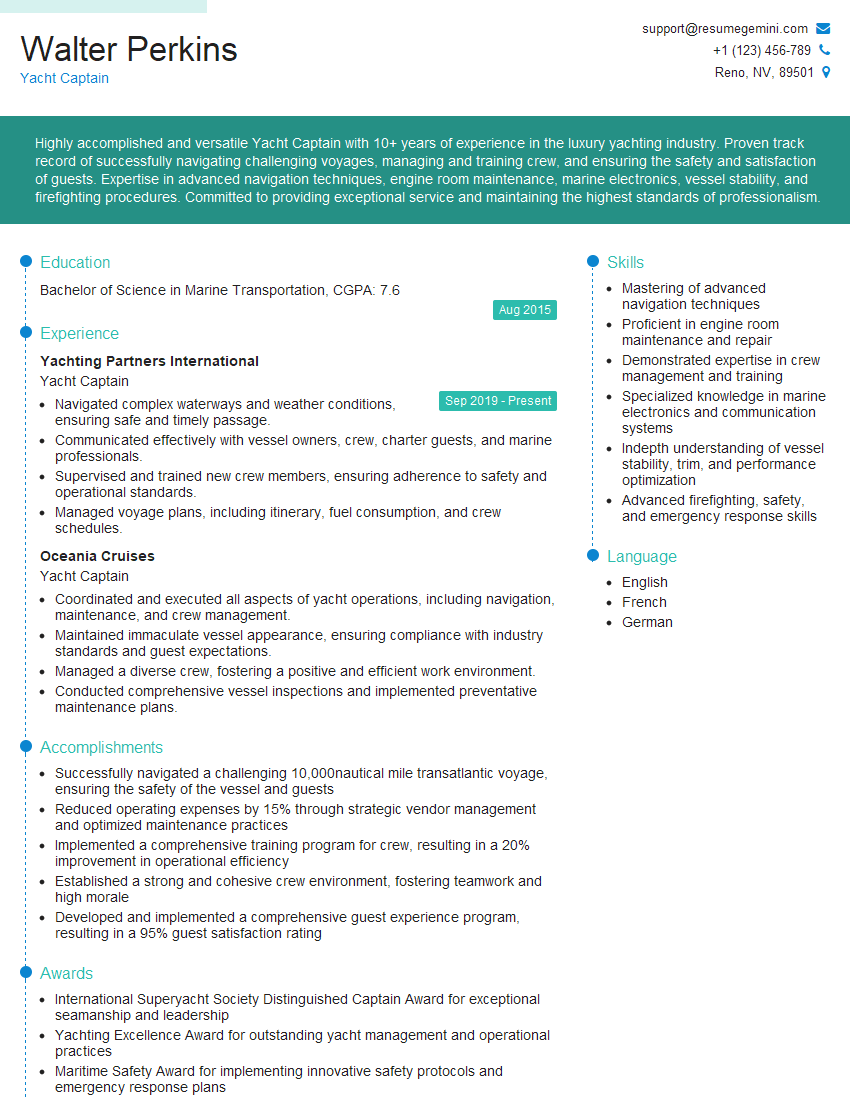
Yacht Captain Resume Sample
Explore more articles
Users Rating of Our Blogs
Share Your Experience
We value your feedback! Please rate our content and share your thoughts (optional).
What Readers Say About Our Blog
I Redesigned Spongebob Squarepants and his main characters of my artwork.
https://www.deviantart.com/reimaginesponge/art/Redesigned-Spongebob-characters-1223583608
IT gave me an insight and words to use and be able to think of examples
Hi, I’m Jay, we have a few potential clients that are interested in your services, thought you might be a good fit. I’d love to talk about the details, when do you have time to talk?
Best,
Jay
Founder | CEO