Unlock your full potential by mastering the most common Learning Styles interview questions. This blog offers a deep dive into the critical topics, ensuring you’re not only prepared to answer but to excel. With these insights, you’ll approach your interview with clarity and confidence.
Questions Asked in Learning Styles Interview
Q 1. Define the VARK model of learning styles.
The VARK model categorizes learning styles into four main preferences: Visual (learning through seeing), Auditory (learning through hearing), Reading/Writing (learning through reading and writing), and Kinesthetic (learning through doing and experiencing). It suggests that individuals learn best when information is presented in a way that aligns with their preferred sensory modality. For example, a visual learner might benefit from diagrams and charts, while an auditory learner might prefer lectures and discussions. The model is a useful tool for self-assessment and identifying preferred learning approaches, but it’s important to remember that individuals can and often do utilize multiple learning styles to varying degrees.
Q 2. Explain the strengths and limitations of the Kolb learning styles inventory.
Kolb’s Learning Style Inventory identifies four learning styles: Converger (active experimentation and abstract conceptualization), Diverger (concrete experience and reflective observation), Assimilator (abstract conceptualization and reflective observation), and Accommodator (concrete experience and active experimentation).
Strengths: Kolb’s model provides a comprehensive framework for understanding how individuals learn and process information. It highlights the importance of both concrete experience and abstract conceptualization, as well as active experimentation and reflective observation. This holistic approach can inform teaching strategies that cater to diverse learning preferences.
Limitations: The model has been criticized for its lack of empirical support and the possibility of learners being assigned to a single style, even though most individuals exhibit a blend of styles. Furthermore, focusing solely on learning styles can sometimes overlook other factors, such as motivation, prior knowledge, and learning environment, which also play significant roles in learning outcomes. Like VARK, it’s best used as a guide to understand general tendencies, not as a definitive label.
Q 3. How do visual learners best process information?
Visual learners thrive on visual information. They process information best when it’s presented in a visual format, such as diagrams, charts, graphs, mind maps, videos, and pictures. They often benefit from seeing the big picture before diving into details. Imagine trying to explain a complex concept like the water cycle – a visual learner would likely grasp it more easily with a well-illustrated diagram showing the stages of evaporation, condensation, and precipitation, compared to just a verbal explanation.
Q 4. What teaching strategies are effective for auditory learners?
Auditory learners learn best by hearing information. Effective teaching strategies for auditory learners include: lectures, discussions, group work involving verbal interactions, audio recordings of lessons, and verbal instructions. Think about using storytelling to convey information, or having students explain concepts to one another aloud. The simple act of reading aloud and paraphrasing information can greatly aid auditory learners in understanding and retaining the material. Instructors can even incorporate short audio clips or podcasts into their lessons.
Q 5. Describe appropriate learning activities for kinesthetic learners.
Kinesthetic learners, also known as tactile learners, learn best through hands-on activities and movement. Appropriate learning activities for them include: experiments, role-playing, building activities, using manipulatives, field trips, and physical demonstrations. For example, instead of just reading about the digestive system, a kinesthetic learner might benefit from a hands-on activity where they build a model of the digestive tract using different materials, thus creating a tactile understanding of its processes and components.
Q 6. How can you identify a student’s preferred learning style?
Identifying a student’s preferred learning style involves a multifaceted approach. You can use a combination of methods:
- Self-assessment questionnaires: VARK and Kolb’s Inventory are examples. These provide a starting point, but shouldn’t be the sole determining factor.
- Observation: Pay attention to how students interact with learning materials and activities. Do they prefer visual aids, actively participate in discussions, or seek hands-on experiences?
- Student interviews: Directly asking students how they best learn can provide valuable insights. Ask them about their preferences in studying and learning materials.
- Analyzing their work: How do they present information? Do their notes contain a lot of diagrams, or do they prefer written summaries?
Remember that learning styles are not rigid categories. A holistic approach, combining several methods, provides a more accurate understanding of individual learning preferences.
Q 7. What are the implications of ignoring learning styles in curriculum design?
Ignoring learning styles in curriculum design can have significant negative implications. When instruction doesn’t cater to diverse learning preferences, many students may struggle to process information effectively. This can lead to:
- Reduced comprehension and retention: If a visual learner is only given auditory instruction, their understanding and retention will likely suffer.
- Decreased motivation and engagement: Students who feel their learning style is not accommodated might become frustrated and disengaged.
- Lower academic performance: Consistent challenges in processing information can translate to poorer grades and overall academic achievement.
- Increased learning difficulties: Students whose learning styles are consistently mismatched with teaching methods might develop a sense of inadequacy or feel like they are ‘bad learners’.
Therefore, designing a diverse and inclusive curriculum that incorporates multiple teaching strategies is essential for maximizing student learning and ensuring equitable access to education.
Q 8. How can you adapt your teaching methods to accommodate diverse learning styles?
Adapting teaching to diverse learning styles involves recognizing that individuals process information differently. Instead of a one-size-fits-all approach, educators should offer a variety of learning experiences catering to visual, auditory, kinesthetic, and reading/writing preferences. This means incorporating diverse methods such as:
- Visual Learners: Using diagrams, charts, videos, and mind maps.
- Auditory Learners: Incorporating discussions, lectures, audio recordings, and group work.
- Kinesthetic Learners: Utilizing hands-on activities, experiments, role-playing, and movement.
- Reading/Writing Learners: Providing written materials, essays, research projects, and note-taking opportunities.
For example, when teaching about the solar system, you could show a video (visual), explain the concepts through a lecture (auditory), have students build a model (kinesthetic), and then have them write a report (reading/writing). This multi-sensory approach ensures all learners can engage with the material effectively.
Q 9. Explain the concept of multimodal learning.
Multimodal learning refers to the engagement of multiple senses and cognitive processes simultaneously during learning. It’s about providing information in various formats to cater to individual learning strengths. Instead of relying solely on lectures or textbooks, multimodal learning integrates visual, auditory, kinesthetic, and tactile elements. Think of it as a rich tapestry of learning experiences, not a single thread.
For instance, learning a new language could involve watching videos (visual), listening to audio clips (auditory), practicing pronunciation (kinesthetic), and writing sentences (reading/writing). The combination strengthens memory and understanding because the information is processed and stored in various parts of the brain.
Q 10. Discuss the role of learning styles in personalized learning.
Learning styles are fundamental to personalized learning. Personalized learning aims to tailor the educational experience to each student’s unique needs, strengths, and preferences. By understanding a student’s preferred learning style, educators can design instruction that resonates with them. This includes adjusting the format of materials, teaching methods, and assessment strategies.
For example, a student who is a visual learner might benefit from interactive simulations or mind maps, while a kinesthetic learner might thrive with hands-on projects. Identifying learning styles allows for the creation of customized learning pathways that enhance engagement and improve learning outcomes. It moves beyond a ‘one-size-fits-all’ curriculum to a more effective and inclusive approach.
Q 11. How can technology be used to support diverse learning styles?
Technology offers powerful tools to support diverse learning styles. Educational software, apps, and online resources can cater to different preferences. For example:
- Visual Learners: Interactive simulations, virtual reality experiences, and educational videos.
- Auditory Learners: Podcasts, audiobooks, and online lectures.
- Kinesthetic Learners: Interactive games, virtual manipulatives, and simulations requiring physical interaction.
- Reading/Writing Learners: E-books, online research tools, and digital note-taking apps.
Adaptive learning platforms can further personalize the experience by adjusting the difficulty and pace of instruction based on a student’s performance and learning style. Technology empowers educators to create engaging and accessible learning environments tailored to individual needs.
Q 12. Describe the differences between surface and deep learning approaches.
Surface learning focuses on memorizing facts and information for immediate assessment without deeper understanding or application. It’s often driven by grades and external rewards. Deep learning, on the other hand, involves active engagement with the material, seeking to understand underlying concepts, make connections to prior knowledge, and apply the information in new contexts.
Imagine learning about photosynthesis: surface learning might involve rote memorization of the equation, while deep learning involves understanding the process, its importance in the ecosystem, and its relevance to climate change. Deep learning leads to more lasting knowledge retention and better problem-solving skills.
Q 13. Explain how learning styles influence learning preferences.
Learning styles significantly influence learning preferences. Individuals naturally gravitate towards methods that align with their cognitive strengths. A visual learner, for example, might prefer diagrams and charts over lengthy lectures, while a kinesthetic learner might prefer hands-on activities over passive listening. These preferences aren’t arbitrary; they reflect how individuals process and retain information most effectively.
Recognizing these preferences is crucial for optimizing learning. By matching instructional methods to learning styles, we can significantly enhance student engagement, motivation, and comprehension. A student who struggles in a traditional lecture-based environment might flourish in a more interactive, activity-based setting.
Q 14. What are the ethical considerations related to using learning styles in education?
Ethical considerations surrounding learning styles in education primarily revolve around the potential for misinterpretations and misuse. While understanding learning preferences is beneficial, it’s crucial to avoid stereotyping students based on their presumed learning style. Not all individuals neatly fit into specific categories, and relying solely on learning style assessments can be limiting and potentially discriminatory.
Furthermore, overemphasizing learning styles can lead to a neglect of other factors that influence learning, such as prior knowledge, motivation, and socio-emotional factors. A balanced approach is essential – acknowledging learning preferences while also focusing on providing a rich and diverse learning experience that caters to all students’ needs.
Q 15. How can you assess the effectiveness of different learning styles interventions?
Assessing the effectiveness of learning styles interventions requires a multifaceted approach that goes beyond simply asking students whether they prefer visual or auditory learning. We need to look at concrete learning outcomes.
- Pre- and Post-Tests: Administering assessments before and after the intervention allows us to measure improvements in knowledge and skills directly related to the learning objectives. For example, if we implement a visual learning strategy for a science class, a pre-test and post-test focusing on understanding diagrams and interpreting data would be crucial.
- Observations and Qualitative Data: Observe student engagement and participation during lessons. Do students who were previously disengaged now seem more attentive? Are they actively participating in activities tailored to their identified learning styles? This type of qualitative data provides valuable insights. For example, observing a previously withdrawn student actively participating in a group project designed for kinesthetic learners shows positive impact.
- Surveys and Feedback: Use surveys to gauge student satisfaction and perception of the effectiveness of the intervention. While subjective, this provides valuable feedback to refine approaches. However, these should always be considered alongside objective measures.
- Tracking Performance Metrics: Focus on measurable outcomes like grades, project completion rates, and participation levels. If visual aids lead to higher test scores in a particular topic, it supports the effectiveness of that approach for that specific learning outcome.
By combining quantitative data from tests and performance metrics with qualitative data from observations and student feedback, we can obtain a holistic understanding of the intervention’s effectiveness.
Career Expert Tips:
- Ace those interviews! Prepare effectively by reviewing the Top 50 Most Common Interview Questions on ResumeGemini.
- Navigate your job search with confidence! Explore a wide range of Career Tips on ResumeGemini. Learn about common challenges and recommendations to overcome them.
- Craft the perfect resume! Master the Art of Resume Writing with ResumeGemini’s guide. Showcase your unique qualifications and achievements effectively.
- Don’t miss out on holiday savings! Build your dream resume with ResumeGemini’s ATS optimized templates.
Q 16. Describe a situation where you had to adapt your teaching to meet the needs of diverse learning styles.
In a recent advanced statistics course, I noticed a significant disparity in student understanding. Some excelled with complex formulas and equations (visual learners), while others struggled and preferred real-world applications and case studies (kinesthetic/auditory learners).
To address this, I adjusted my teaching strategy. I continued providing the foundational mathematical formulas, but supplemented these with:
- Real-world case studies: Presented complex statistical concepts in the context of business problems, allowing kinesthetic and auditory learners to engage more directly.
- Group work and discussions: Encouraged collaborative learning where students could explain concepts to each other, reinforcing understanding through verbalization (auditory) and interaction (kinesthetic).
- Visual aids and interactive simulations: Integrated diagrams, charts, and interactive software to cater to visual learners while allowing for active exploration (kinesthetic).
By incorporating diverse learning activities, I fostered a more inclusive learning environment and improved the overall comprehension and engagement of all students.
Q 17. What are some common misconceptions about learning styles?
One major misconception is that learning styles are fixed and unchanging. While individuals may have preferences, learning styles are not rigid categories that dictate how someone *must* learn. We are all capable of learning through various modalities; preferences simply indicate a potential starting point.
- The ‘One-Size-Fits-All’ Myth: Thinking that catering to one specific learning style is sufficient for all students is incorrect. A diverse class requires a diverse approach.
- Oversimplification: Reducing learning to just visual, auditory, and kinesthetic overlooks the complexity of cognitive processes and individual differences.
- Lack of Empirical Evidence: Extensive research has failed to conclusively prove that teaching strictly to a student’s preferred learning style significantly improves learning outcomes.
It’s more accurate to think of learning preferences as tendencies rather than rigid categories. Good teaching practices should accommodate individual preferences, but primarily should emphasize the content and skills to be learned, employing diverse methods to ensure mastery for all.
Q 18. Explain how learning styles can impact motivation and engagement.
Learning styles significantly impact motivation and engagement. When students are taught in a way that aligns with their preferences, they tend to be more motivated and engaged. For instance, a visual learner will find diagrams and presentations more engaging than lengthy lectures. A kinesthetic learner might be more engaged in hands-on activities and experiments.
Conversely, if instruction doesn’t cater to their preferred learning style, they may feel frustrated, disengaged, and less motivated. For example, a kinesthetic learner forced to sit through lengthy lectures might quickly lose interest and struggle to retain information.
Therefore, understanding and addressing learning style preferences can be a powerful tool for increasing student motivation and fostering a positive learning experience. It’s about making learning more accessible and enjoyable.
Q 19. What are the limitations of focusing solely on learning styles?
Focusing solely on learning styles has limitations. While acknowledging preferences is important, it’s crucial to avoid letting it dictate the entire curriculum.
- Overemphasis on Preferences over Content: The main goal is to learn the material; focusing solely on preferred methods can compromise deep understanding of the subject matter.
- Limited Generalizability: Teaching methods that only cater to specific learning styles might not equip students with the adaptability and flexibility needed to learn in various contexts outside the classroom.
- Neglecting other crucial factors: Intelligence, prior knowledge, motivation, and cognitive abilities all play significant roles in learning, which can be overshadowed by an overemphasis on learning styles.
A balanced approach that considers diverse learning preferences while prioritizing the effective delivery of content is more effective. It’s about finding the right balance, not pigeonholing students based on a single aspect of their learning profile.
Q 20. How do you approach designing instruction for students with multiple learning styles?
Designing instruction for students with multiple learning styles involves creating a flexible and multi-sensory learning environment.
- Varied Instructional Methods: Integrate a range of teaching approaches such as lectures, discussions, group work, hands-on activities, simulations, and technology-based learning. For instance, introduce a concept through a lecture, then reinforce it with a visual aid, a group activity, and a short quiz.
- Multi-Sensory Materials: Use a combination of visual aids (diagrams, videos, presentations), auditory materials (audio recordings, lectures, discussions), and kinesthetic activities (experiments, role-playing, simulations) to appeal to different preferences.
- Choice and Flexibility: Provide students with choices in how they complete assignments or demonstrate their understanding. Allow some students to create presentations, others to write essays, and still others to build models or conduct experiments.
- Technology Integration: Utilize educational software and apps that cater to diverse learning styles. Many interactive online platforms offer a variety of learning modalities.
By offering a rich and varied learning experience, we ensure that all students have multiple opportunities to engage with the material in ways that best suit their individual needs and preferences. This approach embraces the idea that learners are not fixed entities but rather adapt to different learning situations.
Q 21. Discuss the relationship between learning styles and cognitive styles.
Learning styles and cognitive styles are related but distinct concepts. Learning styles refer to the preferred ways individuals process and absorb information (visual, auditory, kinesthetic), while cognitive styles describe the way individuals approach tasks and problem-solving (e.g., analytical, intuitive, reflective).
The relationship lies in how cognitive styles influence the effectiveness of various learning strategies. For example, a student with an analytical cognitive style might benefit from structured, step-by-step instructions regardless of their learning style preference. An intuitive learner might prefer a more holistic approach, even if they primarily learn through visual means.
Effective instruction should consider both aspects. A lesson plan might incorporate visual aids for visual learners, while also providing structured, analytical frameworks to support students with analytical cognitive styles. It’s about creating an inclusive learning environment that respects both learning and cognitive preferences, offering a variety of pathways to achieve learning goals.
Q 22. How can you use formative assessment to identify students’ learning styles?
Formative assessment, the ongoing evaluation of student learning during the instructional process, is crucial for identifying learning styles. It’s not about assigning students to a specific ‘style’ label, but rather about understanding their preferred approaches to learning and adapting instruction accordingly. Instead of directly asking students ‘What’s your learning style?’, we use activities that reveal their strengths and preferences.
Observation: Observe students during group work, individual tasks, and class discussions. Do they prefer hands-on activities, visual aids, verbal explanations, or quiet reflection? For example, a student who consistently doodles in their notebook while listening to a lecture might indicate a visual-kinesthetic learning preference.
Short, low-stakes assignments: Assign brief tasks using different modalities. A quick quiz, a short written reflection, a brief presentation, and a hands-on activity can show which methods yield the best results for each student. A student who excels in the hands-on activity but struggles with the written reflection might benefit from more kinesthetic learning opportunities.
Student self-reporting (with caution): Include brief self-reflection prompts in assignments. Ask them to reflect on what helped them understand the material best. However, it’s vital to remember that self-reported learning styles can be unreliable and should be interpreted alongside observational data. A student might *believe* they are visual learners but struggle with purely visual instruction.
Analyzing work: Review student work for patterns. Do they take detailed notes, create mind maps, or use diagrams? Do they prefer concise written responses or lengthy explanations? Their approach to completing assignments can reveal clues about their preferred learning methods.
Remember, the goal is to gather data that informs your teaching, not to categorize students. The key is flexibility and responsiveness.
Q 23. What are some alternative frameworks for understanding individual learning differences besides learning styles?
While learning styles remain a popular concept, research has shown limitations in its predictive power. More robust frameworks focus on cognitive processes and individual differences. Some alternatives include:
Cognitive Load Theory: This theory focuses on how our working memory processes information. It suggests that instructional design should minimize cognitive load, thus making learning easier and more effective. This means considering the complexity of the information presented and providing appropriate scaffolding and support.
Universal Design for Learning (UDL): UDL provides a framework for creating flexible learning environments that cater to diverse learners. It emphasizes providing multiple means of representation, action & expression, and engagement.
Multiple Intelligences Theory: This theory proposes that individuals possess different strengths in various areas of intelligence (linguistic, logical-mathematical, spatial, bodily-kinesthetic, musical, interpersonal, intrapersonal, naturalist). Instructional design should draw upon these multiple intelligences to reach a wider range of learners.
Differentiated Instruction: This approach involves adapting instruction to meet the diverse needs of learners. This encompasses adjusting content, process, and product to provide appropriate challenges and support to each student.
These frameworks emphasize creating inclusive and adaptable learning environments rather than focusing on pre-defined learning styles.
Q 24. Explain the difference between learning styles and learning preferences.
Learning styles and learning preferences are often used interchangeably, but there’s a subtle difference. Learning preferences refer to the methods or approaches that students find most comfortable or enjoyable. They might prefer working individually or in groups, using visual aids, or listening to lectures. These preferences are subjective and can change depending on the context or subject matter.
Learning styles, however, often imply a more fixed cognitive process that dictates how information is most effectively processed. The idea is that certain styles (visual, auditory, kinesthetic) fundamentally shape how individuals learn best. However, the research supporting the strong impact of these rigid learning styles is largely unconvincing. It is more accurate to consider preferred modes of learning rather than fixed learning styles.
Think of it like this: your preference might be to eat your dessert first, but it doesn’t mean you *can’t* eat your main course before dessert. Similarly, a student might *prefer* visual aids, but that doesn’t mean they cannot learn from lectures or hands-on activities. Effective teaching adapts to preferences but doesn’t rely solely on them.
Q 25. How do learning styles relate to different learning strategies?
Learning styles and learning strategies are closely related but distinct concepts. Learning styles describe the way individuals prefer to learn; learning strategies are the conscious actions taken to enhance learning. While a student’s preferred learning style might influence their choice of strategies, it doesn’t determine their effectiveness. A student who prefers visual learning might utilize strategies like mind-mapping, creating diagrams, or using visual flashcards. A student with a preference for auditory learning might use strategies like recording lectures, discussing concepts with others, or reading aloud.
For example, a student with a preference for visual learning might choose to create diagrams to understand complex concepts, while a student with a preference for kinesthetic learning might choose to build a model or act out a scene to reinforce their understanding. In essence, learning strategies are the *tools* a learner uses to reach their learning goals, while learning style might influence the type of *tools* preferred. However, successful learning is also about having a repertoire of strategies to utilize regardless of one’s preference. The key is to have a range of effective learning strategies available.
Q 26. Discuss the impact of cultural background on learning styles.
Cultural background significantly impacts learning styles and preferences. Cultural norms influence communication styles, group dynamics, and attitudes towards learning. For instance, some cultures may emphasize collaborative learning, while others might prioritize individual achievement. Some cultures value oral traditions and storytelling, while others rely more on written texts. Furthermore, a student’s prior educational experiences might be significantly different and shape their approach to learning. Students from cultures that prioritize rote learning may find it challenging to adapt to more inquiry-based learning environments.
For example, a student from a culture that emphasizes respect for authority may be hesitant to participate actively in class discussions, whereas a student from a culture that encourages open expression may readily engage in debates. Understanding these cultural influences is essential for educators to create inclusive and respectful learning environments where all students can thrive. This includes adapting instructional methods, assessment strategies, and classroom interactions to reflect the diversity of cultural backgrounds represented in the classroom.
Q 27. What strategies do you use to cater to students with mixed or undefined learning styles?
Catering to diverse learners requires a multifaceted approach. Focusing on rigid learning styles can be limiting. Instead, I emphasize creating a flexible learning environment that incorporates multiple modalities and allows students choices. This is the essence of Universal Design for Learning.
Multiple modes of presentation: Present information in various ways – lectures, videos, readings, discussions, hands-on activities, real-world applications – to appeal to different preferences. For example, explaining a concept through a visual presentation, then supplementing it with a real-world example and a hands-on activity, engages various learning preferences.
Varied assessment methods: Offer different ways for students to demonstrate their understanding – written tests, oral presentations, projects, portfolios – allowing them to showcase their knowledge in their preferred manner. This might include offering students a choice between writing an essay and creating a presentation on the same topic.
Flexible grouping: Allow students to choose whether they prefer to work individually, in pairs, or in groups. This caters to the diverse social preferences of learners, and some activities lend themselves better to one type of collaboration than another.
Choice in activities: Offer students choices within assignments or projects, letting them select tasks that best suit their interests and strengths. This allows the learner to leverage the skills and methods they are most comfortable with.
Scaffolding and support: Provide clear instructions, models, and examples. Offer opportunities for peer support and collaboration. Offer various levels of support based on student need. This might include creating checklists, rubrics, or visual organizers for assignments.
By focusing on flexibility and choice, you create an inclusive environment where all students, regardless of their learning preferences, can find ways to succeed. The core idea is not to label students with a specific style but to provide them with a variety of learning options and methods.
Key Topics to Learn for Learning Styles Interview
- Defining Learning Styles: Understand the various theoretical frameworks (e.g., visual, auditory, kinesthetic, VARK) and their underlying principles. Explore the strengths and limitations of each style.
- Practical Application in Education: Learn how different learning styles impact teaching methodologies and curriculum design. Consider how to adapt instructional strategies to cater to diverse learning preferences.
- Assessment and Identification: Familiarize yourself with different methods used to identify individual learning styles and the importance of accurate assessment in personalized learning.
- Addressing Diverse Learners: Explore strategies for creating inclusive learning environments that effectively support students with varying learning styles. Discuss practical examples of inclusive teaching practices.
- Technology and Learning Styles: Discuss the role of technology in accommodating different learning styles. Explore how various educational technologies can be used to enhance learning experiences for diverse learners.
- Learning Style Misconceptions and Challenges: Understand common misconceptions surrounding learning styles and discuss potential challenges in applying learning style theory in real-world educational settings.
- The Future of Learning Styles Research: Explore current trends and future directions in learning styles research and the ongoing debate about its efficacy and application.
Next Steps
Mastering the nuances of learning styles is crucial for career advancement in education and related fields. A strong understanding of diverse learning needs demonstrates adaptability and a commitment to effective teaching practices, making you a highly desirable candidate. To significantly boost your job prospects, focus on creating a resume that is both ATS-friendly and highlights your relevant skills and experiences. ResumeGemini is a trusted resource that can help you build a professional and impactful resume tailored to your specific experiences and the requirements of your target roles. Examples of resumes tailored to highlight expertise in Learning Styles are available within ResumeGemini to further guide your resume creation process.
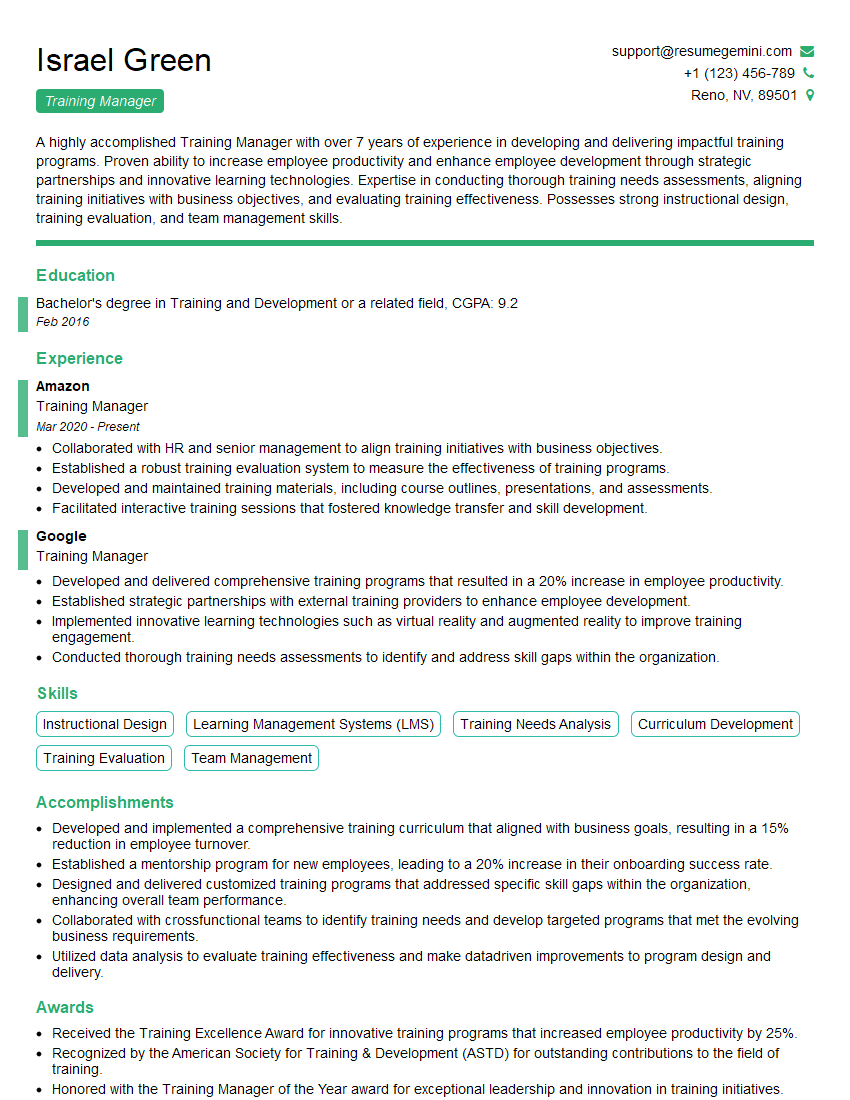
Training Manager Resume Sample
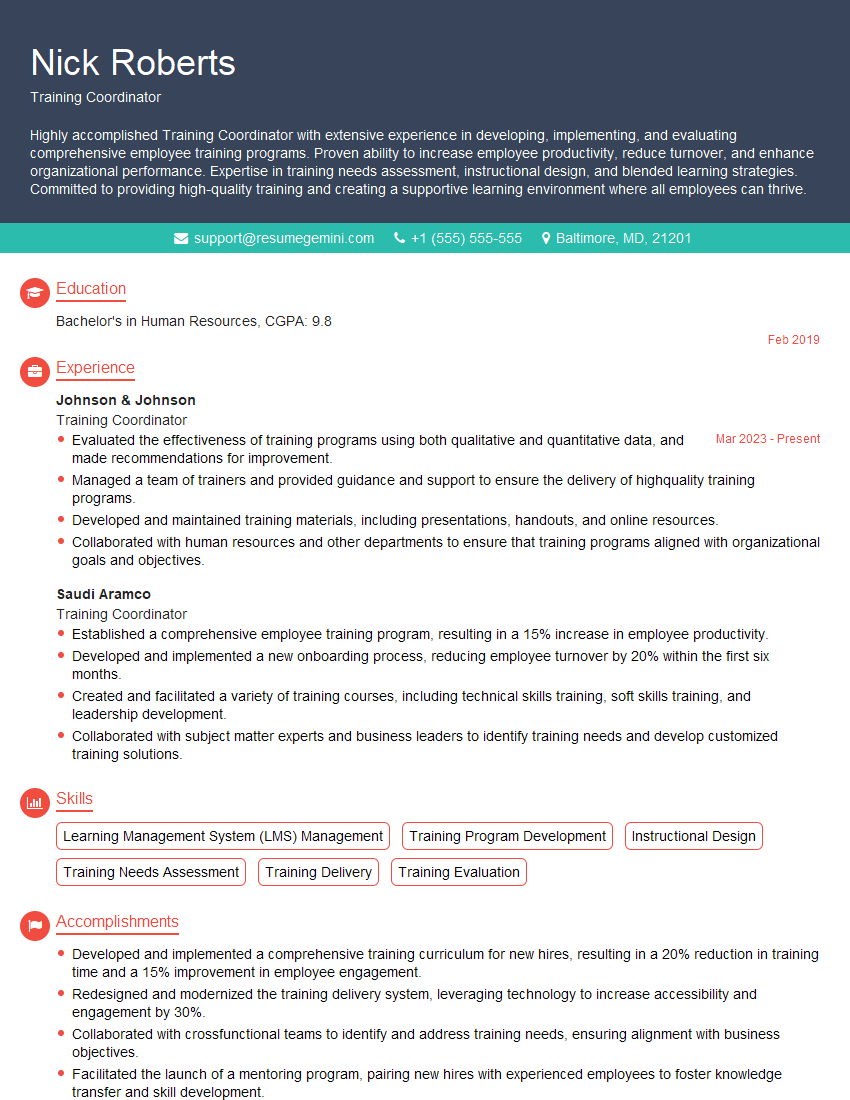
Training Coordinator Resume Sample
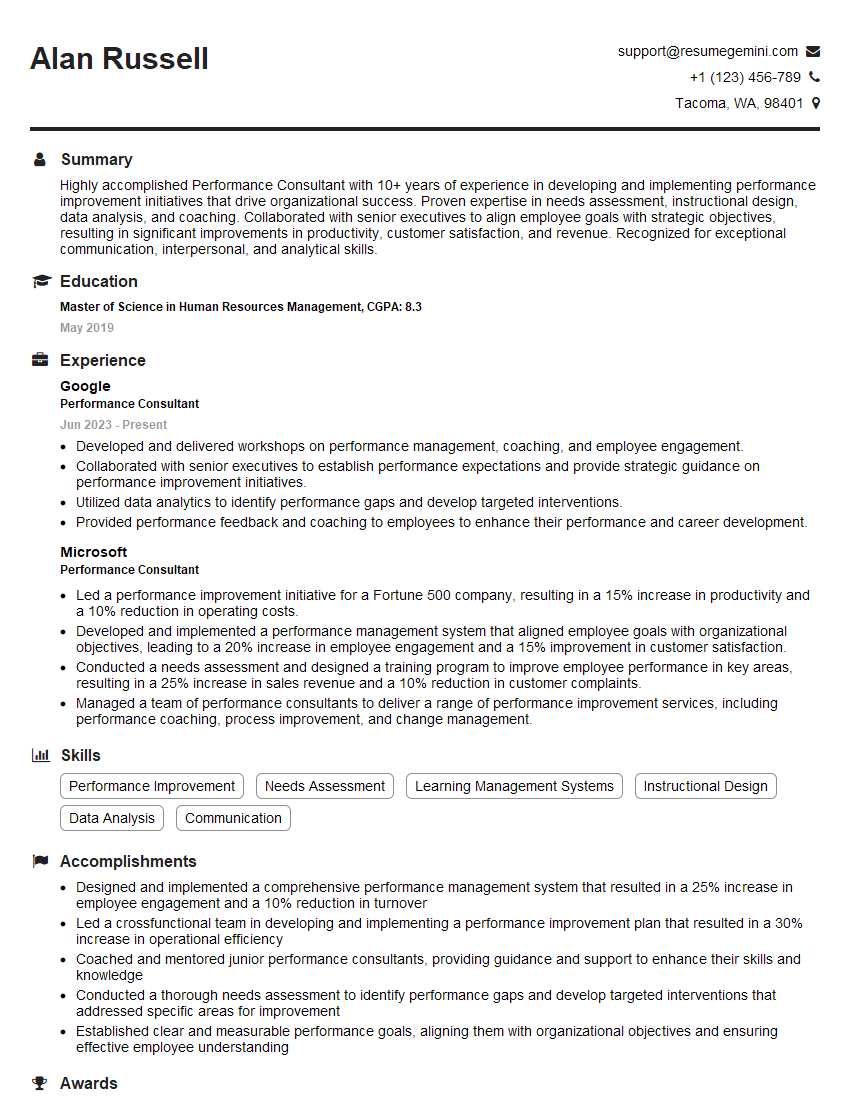
Performance Consultant Resume Sample
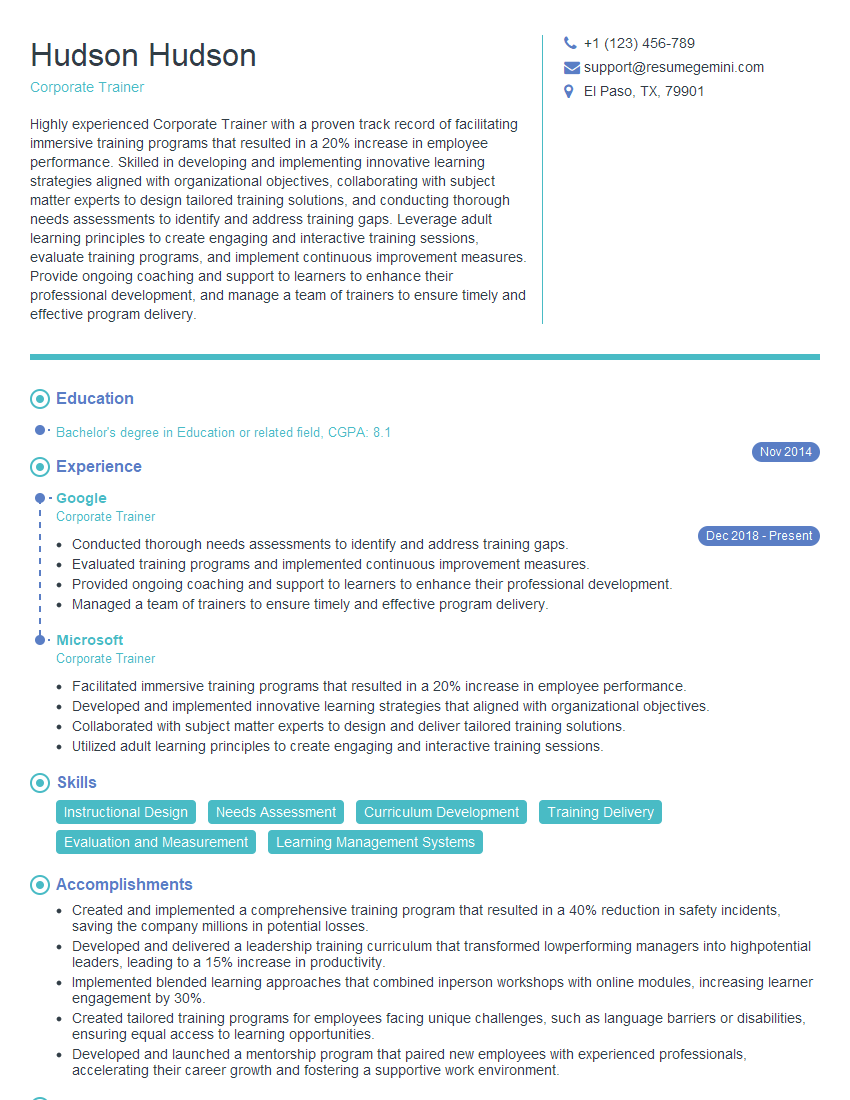
Corporate Trainer Resume Sample

Curriculum Developer Resume Sample
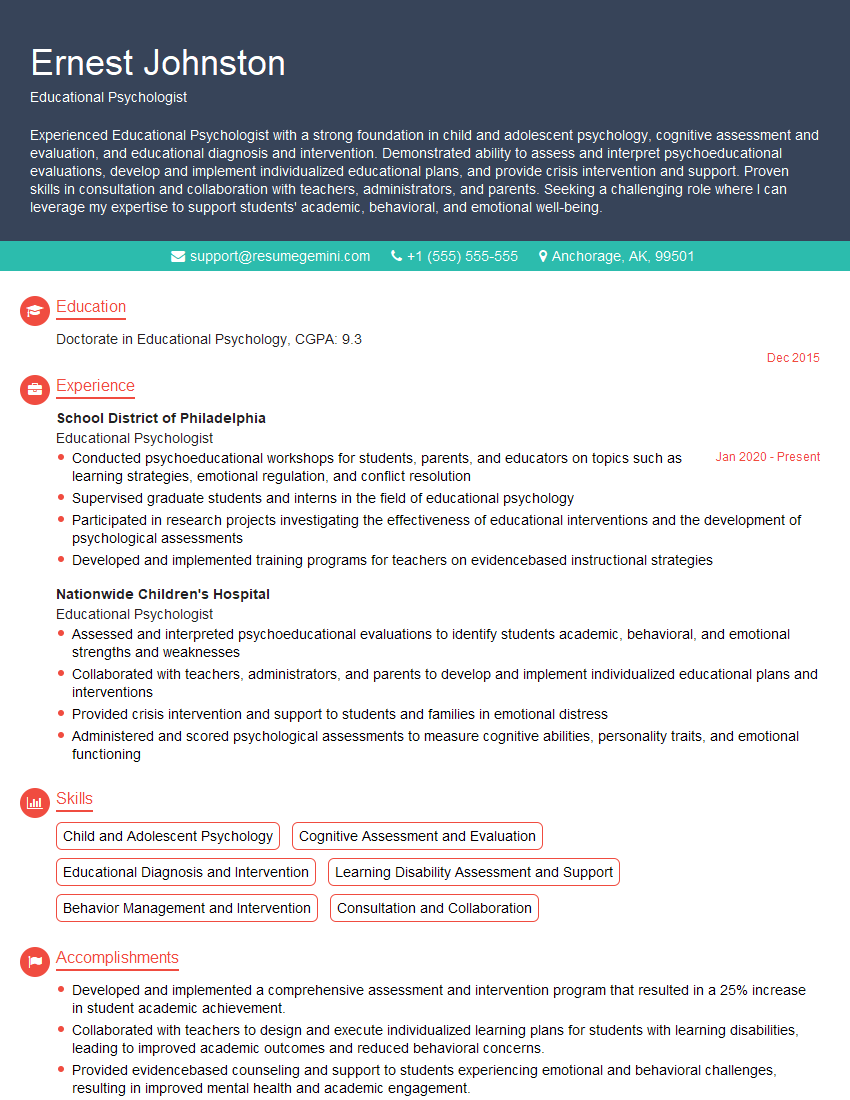
Educational Psychologist Resume Sample
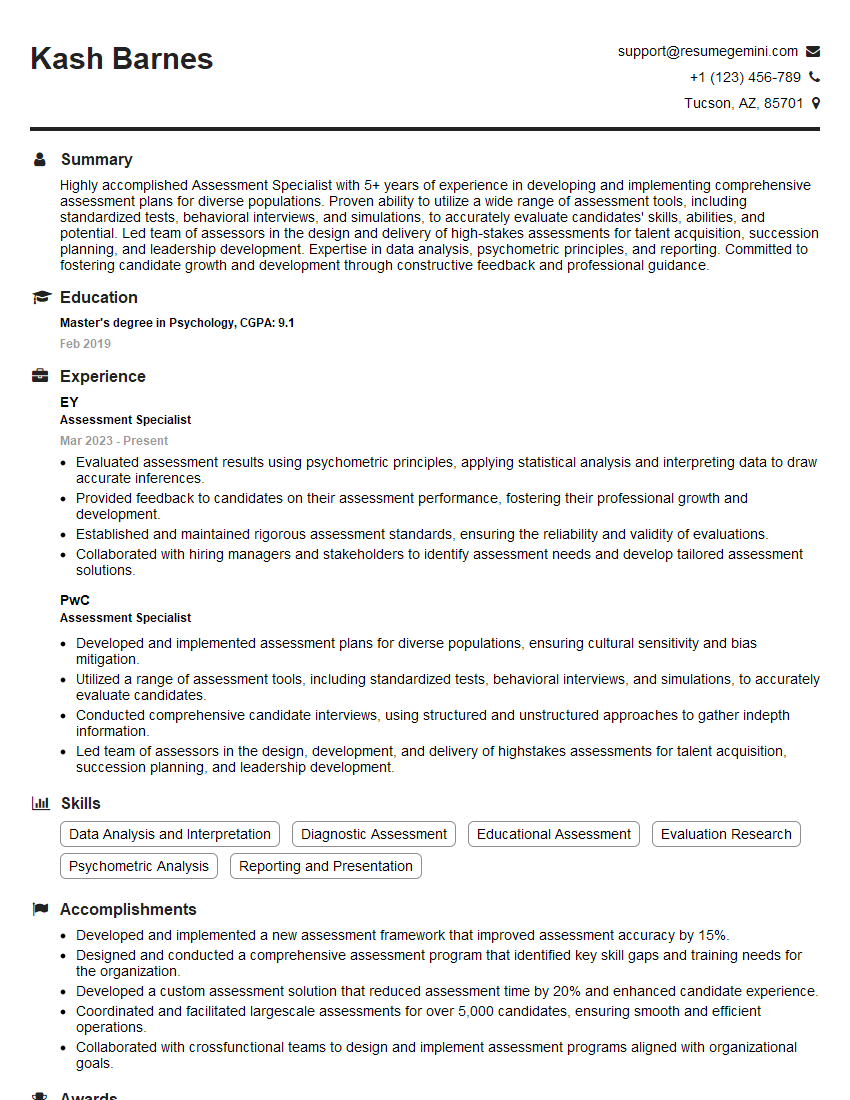
Assessment Specialist Resume Sample

Adult Education Instructor Resume Sample
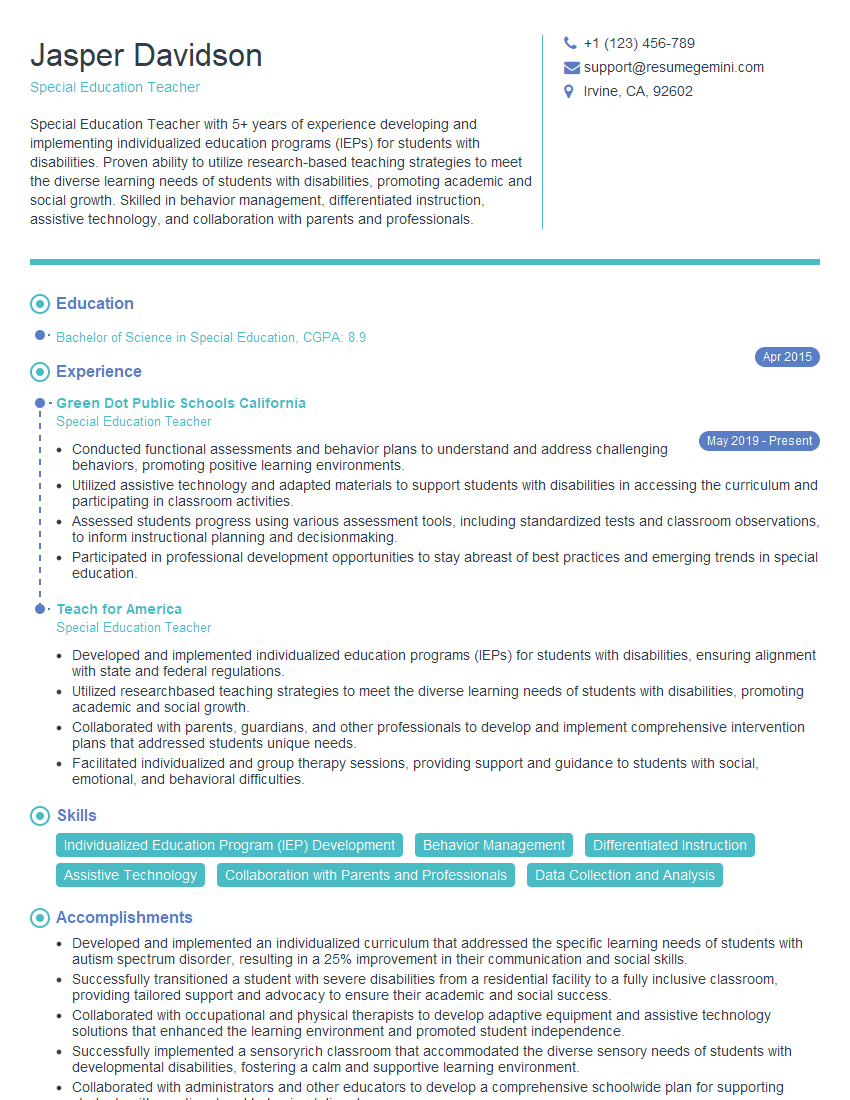
Special Education Teacher Resume Sample
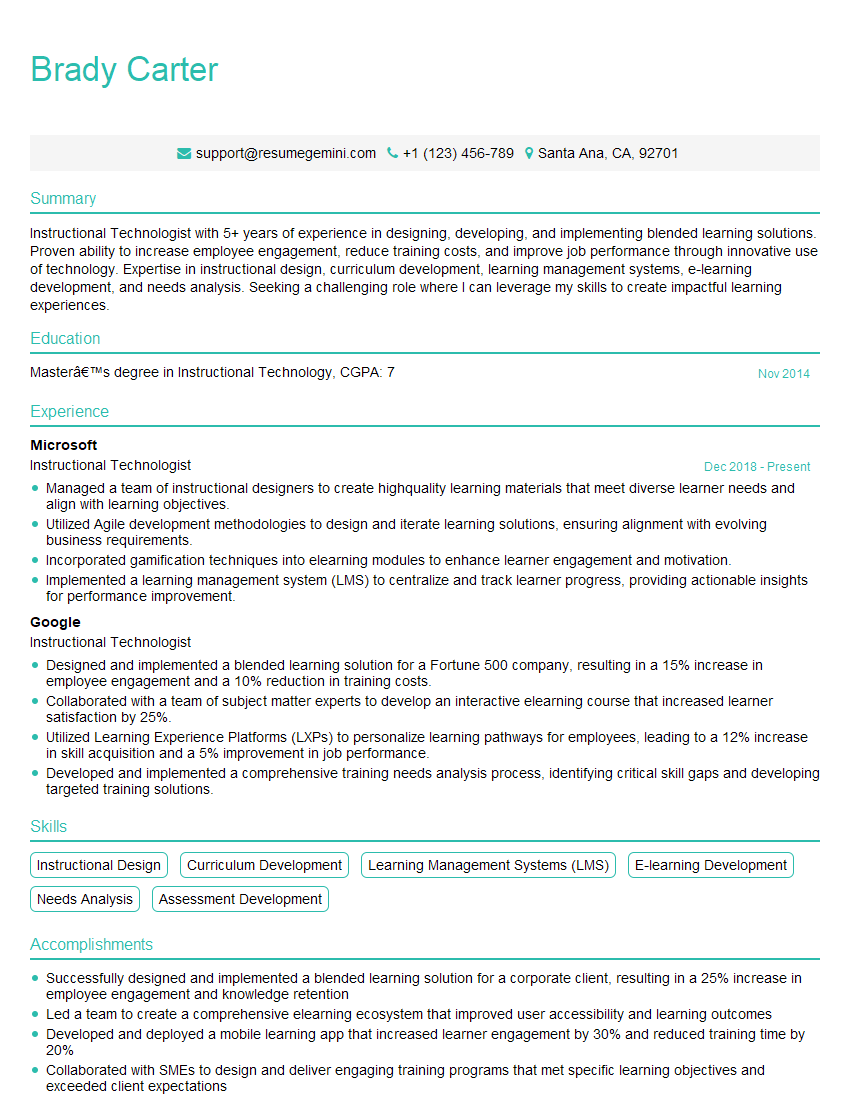
Instructional Technologist Resume Sample
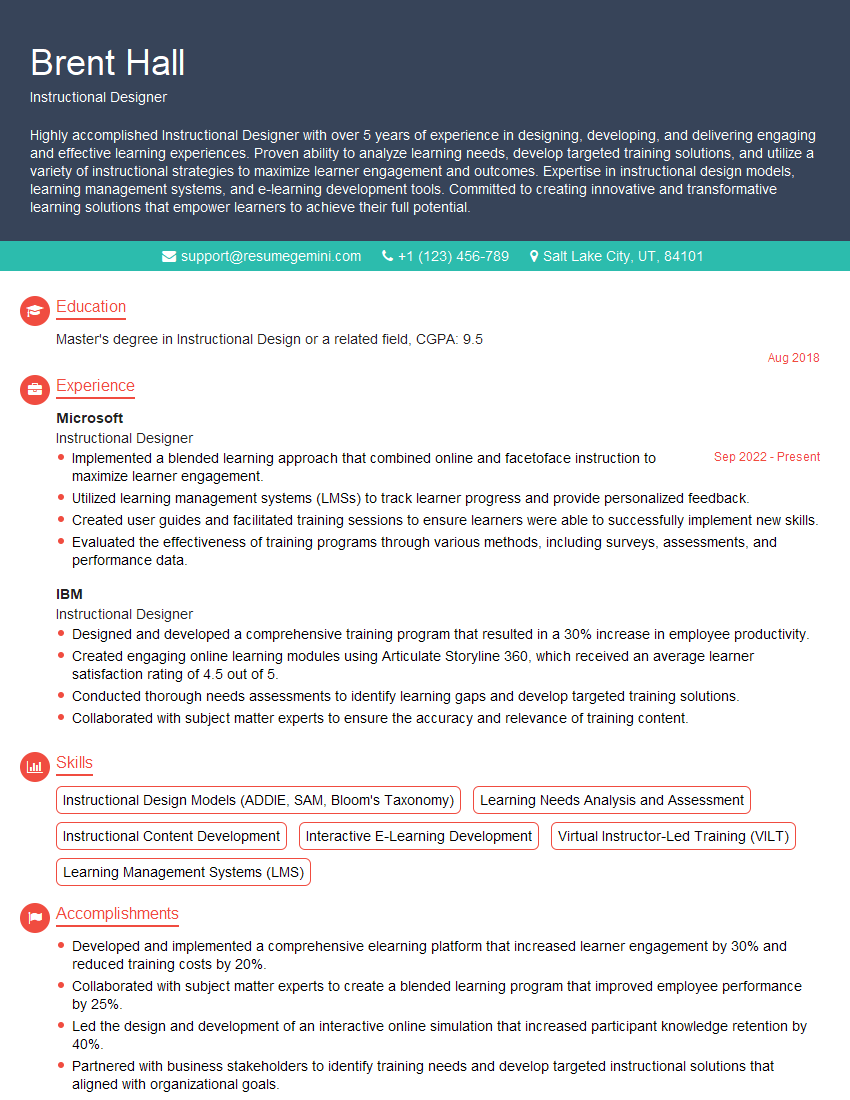
Instructional Designer Resume Sample
Explore more articles
Users Rating of Our Blogs
Share Your Experience
We value your feedback! Please rate our content and share your thoughts (optional).
What Readers Say About Our Blog
I Redesigned Spongebob Squarepants and his main characters of my artwork.
https://www.deviantart.com/reimaginesponge/art/Redesigned-Spongebob-characters-1223583608
IT gave me an insight and words to use and be able to think of examples
Hi, I’m Jay, we have a few potential clients that are interested in your services, thought you might be a good fit. I’d love to talk about the details, when do you have time to talk?
Best,
Jay
Founder | CEO