The thought of an interview can be nerve-wracking, but the right preparation can make all the difference. Explore this comprehensive guide to Food Stylist and Photography interview questions and gain the confidence you need to showcase your abilities and secure the role.
Questions Asked in Food Stylist and Photography Interview
Q 1. Describe your experience with various food styling techniques (e.g., glazing, steaming, substitution).
Food styling is all about making food look its absolute best for the camera. I’ve mastered a range of techniques to achieve this. Glazing, for instance, involves applying a thin, glossy coating to enhance shine and color. This is frequently used on meats, pastries, and even fruits to give them a mouthwatering sheen. I often use a simple mixture of honey and water, or specialized food glazes depending on the desired effect. Steaming is crucial for maintaining the freshness and vibrancy of vegetables. Gently steaming them just before the shoot prevents wilting and keeps their colors bright. Finally, substitution is a common practice. Sometimes, using a similar-looking item makes a world of difference. For instance, mashed potato can stand in for ice cream if it’s too melty, or a cleverly arranged carrot slice can create the perfect texture for a partially eaten cake.
- Example: For a shoot featuring a juicy steak, I’d use a combination of glazing and careful placement to highlight its marbling and texture. A quick steam on the accompanying asparagus would retain its vibrant green color.
- Example: To depict a creamy, luscious dessert, I might substitute a similarly colored but firmer food for ice cream that’s prone to melting quickly under studio lights.
Q 2. How do you maintain food freshness and appeal during long shoots?
Maintaining food freshness during long shoots is paramount. My strategy involves a multi-pronged approach. First, I meticulously plan the shoot schedule to minimize the time each food item is on set. Next, I utilize various preservation techniques – from chilling elements in between shots to using strategically placed ice packs. For perishable items, I often prepare multiple identical servings so that a fresh replacement is always ready. I also use techniques like strategically placed fans to create an illusion of steaming dishes that would otherwise cool down too quickly.
Think of it like a delicate dance – each dish is a performer, and my job is to ensure they maintain their best ‘stage presence’ throughout the performance. A poorly-maintained food item can be the difference between a stunning photograph and a mediocre one.
Q 3. Explain your process for creating a mood board for a food photography project.
Creating a mood board is my essential first step for every food photography project. It’s a visual roadmap that guides the entire creative process. I typically begin by gathering inspiration from various sources: Pinterest, magazines, other food photographers’ work, and even client-provided materials. I then select images that evoke the desired mood, color palette, and overall style. These images might showcase similar food items, lighting techniques, or even the general aesthetic vibe (rustic, modern, minimalist, etc.). I arrange these selected images on a digital board, adding notes on desired props, textures, and even specific color shades. This process helps visualize the final outcome and ensures everyone on the team is aligned from the start. A well-crafted mood board minimizes discrepancies and leads to more efficient production.
- Example: For a project featuring hearty autumnal dishes, my mood board might include images of warm earth tones, rustic wooden tables, and close-ups showcasing textures like fallen leaves or a pumpkin’s rough surface.
Q 4. What lighting techniques do you prefer for food photography, and why?
My lighting preference leans heavily towards natural light whenever possible. The soft, diffused quality of natural light provides a beautiful, realistic look, especially for food. However, I understand that controlling natural light is not always feasible, so I use a combination of continuous lighting and strobes. I prefer softboxes to diffuse the light and avoid harsh shadows. The key is to create a balanced lighting scheme that emphasizes the textures and colors of the food without causing distracting highlights or dark areas. I might use a main light, a fill light to soften shadows, and a back light to add depth and separation.
Consider this: Harsh, direct light can make food look flat and unappetizing, while soft, diffused light brings out its natural beauty and texture.
Q 5. How do you manage challenging food items (e.g., melting ice cream, wilting greens)?
Dealing with challenging food items requires quick thinking and proactive measures. For melting ice cream, I use a combination of chilled surfaces, strategic styling (placing it in a shadow or partially obscuring it), and very quick shooting. Alternatively, using a substitute like a well-chilled, similar-colored dairy product can solve the problem. For wilting greens, pre-chilling and using a damp paper towel to maintain freshness are critical. I sometimes apply a light mist of water to rejuvenate them, but this requires careful timing to avoid making them look overly wet.
Each food item has its quirks. Understanding these quirks and preparing for potential issues is a critical part of my work. Anticipation and quick problem-solving are essential skills.
Q 6. What software and equipment are you proficient in using for food photography and post-production?
My workflow integrates a range of software and equipment. For cameras, I primarily use high-resolution DSLRs or mirrorless cameras capable of producing excellent image quality. My lighting kit includes a variety of softboxes, reflectors, and strobes. Post-production is handled in Adobe Photoshop and Lightroom. Photoshop allows me to make detailed adjustments to colors, textures, and even minor imperfections. Lightroom is invaluable for efficient batch processing and color grading. I also use Capture One for tethered shooting and in-camera RAW processing.
The right tools are essential for delivering high-quality results, and I am adept at harnessing their capabilities.
Q 7. How do you collaborate effectively with clients, chefs, and other members of a photography team?
Collaboration is the cornerstone of successful food photography. I believe in open communication and a proactive approach. Before the shoot, I have detailed discussions with clients to understand their vision and expectations. With chefs, I collaborate closely to ensure the food is prepared according to the styling and photographic needs. With the photography team, clear communication regarding lighting, set design, and shot sequencing is vital. I always strive to create a positive and collaborative atmosphere where everyone feels valued and heard. This team-based approach is crucial for achieving the best results and making the project enjoyable for everyone involved.
A positive and collaborative atmosphere fosters creativity and high-quality results.
Q 8. Describe your approach to working within a specific budget and timeline.
Budget and timeline are paramount in food styling and photography. My approach begins with a thorough pre-production meeting with the client to clarify expectations and establish a detailed shot list. This allows me to create a comprehensive budget proposal outlining all costs, including food, props, location fees, and my styling and photography fees. For the timeline, I create a detailed schedule specifying each phase: sourcing ingredients, prop gathering, setup, shooting, and post-processing. I always build in buffer time for unforeseen circumstances.
For example, if a client has a tight budget, I might suggest using readily available ingredients instead of specialty items. If the timeline is short, I’ll prioritize the essential shots first and may need to adjust the overall style to something simpler. I’m adept at creative problem-solving within constraints, often suggesting cost-effective alternatives without compromising visual quality. My goal is to deliver high-quality imagery within the agreed-upon parameters.
Q 9. How do you ensure the food’s presentation aligns with the client’s branding and marketing objectives?
Aligning food presentation with a client’s branding is crucial. I start by thoroughly researching the client’s brand identity, including their color palette, target audience, and overall brand message. This informs every decision, from the type of food chosen to the props and background elements used. For example, if the brand is rustic and artisanal, I might opt for a natural, unrefined aesthetic with wooden surfaces and muted tones. Conversely, a modern, sleek brand might require a minimalist setup with clean lines and bright, bold colors. I work closely with the client to ensure the visual style is consistently reflected in each photograph, creating a strong brand narrative.
I’ll often create mood boards showcasing different styling options before starting the shoot, ensuring we’re all on the same page visually. This collaborative approach guarantees the final images resonate with the brand’s identity and effectively communicate its marketing objectives.
Q 10. What are your strategies for capturing visually appealing food compositions?
Creating visually appealing food compositions involves a blend of art and technical skill. I begin by considering the story the image should tell. Is it about freshness? Indulgence? Simplicity? This guides my choice of food and props. I use the rule of thirds for composition, paying close attention to lighting, color, and texture. I also employ techniques like negative space and leading lines to guide the viewer’s eye.
For example, I might use a shallow depth of field to emphasize a particular ingredient or use a contrasting background color to make the food pop. I always consider the overall balance and harmony of the composition, ensuring all elements work together to create a cohesive and visually arresting image. It’s about creating a visual feast that’s both aesthetically pleasing and emotionally engaging.
Q 11. Describe your experience with different photographic styles (e.g., macro, overhead).
My experience encompasses various photographic styles. Macro photography allows for incredibly detailed close-ups, perfect for showcasing the texture of a cake or the intricate details of a garnish. I use specialized lenses and lighting techniques to achieve the extreme sharpness and depth of field necessary for this style. Overhead shots, or flat lays, offer a different perspective, ideal for showcasing a variety of dishes or ingredients in a visually organized way. These are frequently used in recipe blogs or social media posts.
Beyond macro and overhead, I’m proficient in lifestyle photography, which emphasizes the context of the food, capturing it within a realistic setting. I’m also comfortable working with various lighting techniques, from natural light to studio setups, to achieve the desired mood and atmosphere. Adaptability and a keen eye for detail are crucial across all styles.
Q 12. How do you handle unexpected problems or technical issues during a photoshoot?
Unexpected problems are inevitable in food photography. My approach is proactive, incorporating contingency plans into my workflow. For instance, I always have backup ingredients and props on hand. If a technical issue arises, like a malfunctioning piece of equipment, I’ll have a backup plan ready. This could involve switching to a different camera or light source, or even adjusting the shot list to accommodate the issue.
For example, if the main light fails, I’ll quickly switch to natural light or a backup lighting setup, minimizing downtime. The key is to remain calm, assess the problem systematically, and find a creative solution quickly. Communication is key; I’ll keep the client updated throughout the process, maintaining transparency and managing expectations.
Q 13. Explain your post-processing workflow for food photography images.
My post-processing workflow involves careful image editing using software like Adobe Photoshop and Lightroom. I begin by adjusting the white balance and exposure to create a consistent look and feel across all images. Then, I focus on refining the colors, sharpening the details, and removing any blemishes or imperfections. I meticulously retouch the food without making it look artificial.
This involves selective adjustments to enhance textures and highlights, subtly adjusting colors for realism. The final step is color grading to maintain brand consistency and create a specific mood or atmosphere. My approach is subtle and natural, prioritizing maintaining the integrity of the original image while enhancing its visual appeal. I always check the final images for overall consistency and make any necessary adjustments before delivering them to the client.
Q 14. What are some common pitfalls to avoid in food styling and photography?
Several pitfalls can negatively impact food styling and photography. One common mistake is over-styling the food, making it look unrealistic and unappetizing. It’s crucial to strike a balance between aesthetically pleasing and visually realistic. Another common error is poor lighting; it can create harsh shadows or wash out colors, making the food appear dull. Proper lighting is crucial to highlighting textures and details.
- Over-processed images: Excessively retouched images can look unnatural and jarring.
- Ignoring the context: Failing to consider the overall setting and narrative can result in disconnected images lacking storytelling power.
- Inconsistent styling: Varying styles across images creates a disjointed visual experience.
Avoiding these pitfalls requires careful planning, attention to detail, and a keen eye for visual harmony. It’s also essential to constantly learn and adapt, staying current with the latest trends and techniques in food styling and photography.
Q 15. How do you stay current with trends and advancements in food photography and styling?
Staying ahead in food photography and styling requires a multi-pronged approach. It’s not just about passively absorbing information; it’s about actively seeking it out and integrating it into your practice.
- Following Key Influencers and Publications: I religiously follow leading food photographers and stylists on Instagram, Pinterest, and Behance. Publications like Food & Wine, Bon Appetit, and various culinary magazines provide insights into current trends. I also attend workshops and conferences when possible to network and learn from peers.
- Analyzing Trending Styles: I analyze the visual trends appearing in these sources, paying close attention to color palettes, composition techniques, and prop choices. For example, the recent shift towards more rustic and natural settings, away from highly stylized perfection, is something I’ve incorporated into my own work.
- Experimentation and Continuous Learning: I regularly experiment with new techniques and styles in my own shoots, pushing my creative boundaries. I also dedicate time to online courses and tutorials, focusing on emerging technologies and post-processing techniques. Recently, I completed a course on advanced lighting techniques using natural light, enhancing my ability to create dynamic images in diverse locations.
Career Expert Tips:
- Ace those interviews! Prepare effectively by reviewing the Top 50 Most Common Interview Questions on ResumeGemini.
- Navigate your job search with confidence! Explore a wide range of Career Tips on ResumeGemini. Learn about common challenges and recommendations to overcome them.
- Craft the perfect resume! Master the Art of Resume Writing with ResumeGemini’s guide. Showcase your unique qualifications and achievements effectively.
- Don’t miss out on holiday savings! Build your dream resume with ResumeGemini’s ATS optimized templates.
Q 16. What is your understanding of color theory and its application in food photography?
Color theory is fundamental to compelling food photography. Understanding its principles allows for deliberate manipulation of mood, appetite appeal, and overall visual impact.
- Color Harmonies: I often utilize complementary colors (colors opposite each other on the color wheel, like blue and orange) to create vibrant and energetic images. Analogous colors (colors adjacent to each other, like blue, blue-green, and green) offer a more harmonious and soothing feel.
- Color Temperature: Warm colors (reds, oranges, yellows) evoke feelings of comfort and warmth, often ideal for showcasing comfort foods. Cool colors (blues, greens, purples) can create a sense of freshness and sophistication, perfect for salads or seafood dishes.
- Color Saturation and Value: I carefully adjust the saturation and value (lightness or darkness) of colors to control the overall mood and impact. A highly saturated image might be suitable for a bold advertising campaign, while a lower saturation image could provide a more refined and elegant look.
- Example: For a photograph of a summer berry tart, I might use a cool, teal background to enhance the vibrancy of the red berries and create a visually appealing contrast.
Q 17. Describe your knowledge of different camera equipment and their capabilities.
My camera equipment choices depend on the specific project requirements, but I have a strong working knowledge of various options.
- DSLRs (Digital Single-Lens Reflex cameras): Offer exceptional image quality, interchangeable lenses, and manual control, providing maximum flexibility. I particularly value their ability to handle a wide range of lighting conditions.
- Mirrorless Cameras: These are becoming increasingly popular due to their compact size, lightweight design, and advanced features like faster autofocus and superior video capabilities. They are ideal for both studio and on-location shoots.
- Lenses: A variety of lenses is crucial. I use macro lenses for capturing detailed close-ups of food textures, wide-angle lenses for establishing a broader context, and telephoto lenses for compressing perspective and creating a shallow depth of field.
- Lighting Equipment: I work proficiently with both natural and artificial lighting. My kit includes continuous lighting (for video and live viewing) and strobe lighting (for freezing motion and creating dramatic effects). I also utilize light modifiers such as softboxes, reflectors, and umbrellas to shape and soften the light.
Q 18. How do you use props and backgrounds to enhance the visual storytelling in food photography?
Props and backgrounds are essential elements in visual storytelling. They set the scene, evoke a specific mood, and guide the viewer’s eye to the focal point—the food.
- Background Selection: I carefully choose backgrounds that complement the food without distracting from it. A simple, neutral background might emphasize the food’s color and texture, while a more textured background (like wood or linen) can add warmth and rustic charm.
- Prop Selection: Props should be carefully considered. They should relate to the food and enhance its narrative. For example, a rustic wooden board might be ideal for a cheese platter, while a sleek marble surface might be perfect for a modern dessert.
- Visual Hierarchy: I use props to guide the viewer’s eye. By strategically placing props, I can create visual interest and lead the viewer to the main subject.
- Example: For a photograph of a hearty steak, I might use a dark wooden cutting board, a simple knife, and some rosemary sprigs to create a sense of rustic elegance.
Q 19. Explain your process for selecting and working with models or talent in food photography.
While food photography often focuses on the food itself, sometimes models or hands are included to add a human element. My approach to selecting and working with talent focuses on collaboration and clear communication.
- Casting: I look for models whose appearance and demeanor align with the project’s overall style and message. Sometimes, a simple hand is all that’s needed to convey a sense of interaction with the food.
- Pre-Shoot Briefing: Before the shoot, I provide the talent with clear direction about posing, gestures, and the overall mood. This ensures they understand the vision and can contribute effectively.
- On-Set Direction: During the shoot, I provide ongoing guidance and feedback, encouraging natural and engaging poses.
- Collaboration: I believe in collaboration with the talent to create natural-looking and authentic images. I want them to feel comfortable and confident, allowing their personality to shine through.
Q 20. What is your approach to client communication and feedback throughout a project?
Client communication is paramount. I believe in building a strong relationship based on trust and transparency.
- Initial Consultation: I begin with a thorough consultation to understand the client’s vision, objectives, and target audience. This includes discussing the desired style, tone, and overall message of the photography.
- Mood Boards and Storyboards: I create mood boards and storyboards to visualize the concept and ensure alignment with the client’s expectations.
- Regular Updates: I provide regular updates throughout the project, sharing progress and addressing any concerns proactively. I might send sneak peeks of the images or discuss potential adjustments.
- Feedback Incorporation: I value client feedback and actively incorporate it into the final product, ensuring the images meet their needs and exceed their expectations.
Q 21. Describe your experience working in various shooting environments (e.g., studio, location).
I have extensive experience in various shooting environments, adapting my techniques to optimize each setting’s unique characteristics.
- Studio Shoots: Studio shoots offer complete control over lighting, background, and overall environment. This allows for highly stylized images with precise control over every detail. I’ve worked in numerous studios, from small, intimate spaces to large, professional setups.
- On-Location Shoots: On-location shoots, such as restaurant settings or outdoor locations, offer a sense of authenticity and realism. The challenge lies in working with unpredictable lighting and environmental factors. I am adept at using available light and creating visually stunning imagery despite limitations.
- Adaptability: Regardless of the location, my core focus is on creating visually compelling images that meet the client’s needs. I adapt my lighting, styling, and post-processing techniques to the specific circumstances of each shoot.
Q 22. How do you handle the ethical considerations of food styling and photography (e.g., food waste)?
Food waste is a significant ethical concern in food styling and photography. We aim for minimal waste through meticulous planning and resourceful techniques. For example, instead of preparing an entire cake for a single shot focusing on a slice, I’d only bake the necessary portion. I also prioritize donating leftover, edible food to local charities or food banks. Furthermore, I work closely with clients to define the scope of the shoot accurately, ensuring we only prepare what’s needed. This involves detailed shot lists and discussions about the usage of the final images (will we need multiple angles? close-ups? etc.). Creative solutions such as using clever substitutes (e.g., mashed potatoes for ice cream) are employed where appropriate, maintaining the visual integrity while minimizing waste. Ultimately, it’s about a balanced approach between achieving the desired visual effect and being responsible with resources.
Q 23. Explain your understanding of intellectual property rights in relation to food photography.
Intellectual property rights are crucial in food photography. The copyright for images I create automatically belongs to me as the photographer unless a written agreement states otherwise. This includes the composition, lighting, and styling choices. Clients often purchase usage rights for specific purposes (e.g., website usage, print advertising). I always ensure that clear contracts outline the scope of the usage rights sold, including geographic limitations and duration. Using someone else’s image without permission is a serious infringement. It’s vital to obtain model releases if identifiable individuals are present and property releases if recognizable locations are featured. For recipes that are styled and photographed, while the image itself is copyrightable, the underlying recipe itself might have separate copyright or trademark considerations depending on its originality and publication history. These points are always clarified beforehand, protecting both the client and myself.
Q 24. How do you manage the logistics of food preparation and sourcing for photoshoots?
Managing logistics for food photography shoots requires meticulous planning. First, I create a detailed shot list to define specific dishes and shots, informing my ingredient sourcing and preparation. Then, I collaborate closely with the client to establish a budget for ingredients and any potential outsourcing (e.g., professional bakers for complex pastries). Sourcing involves a combination of procuring ingredients from local farmers’ markets, specialty stores, and supermarkets, depending on the needs of the shoot. For specific, hard-to-find ingredients, I have a network of suppliers I can contact. A detailed schedule guides food preparation, considering the perishability of ingredients and the order of shots. This ensures everything looks its best at the appropriate moment. For example, I might prepare elements that wilt quickly closer to the shoot time and those that hold their shape longer beforehand. Efficient workflow is key, minimizing time between preparation and shooting to maintain freshness and visual appeal.
Q 25. What is your experience with different food photography genres (e.g., advertising, editorial)?
My experience spans various food photography genres. In advertising, I’ve worked on high-impact campaigns for major brands, focusing on creating visually arresting images that sell the product. This often involves working with art directors and creative teams to align the visual style with the brand’s message. For example, a campaign for a gourmet food brand would require a vastly different style than one for a fast-food chain. Editorial photography for magazines and websites demands a different approach, prioritizing storytelling and mood. Images need to be aesthetically pleasing while complementing the accompanying article. A recent project involved shooting rustic, home-style dishes for a magazine feature on healthy family recipes. These different genres necessitate adjusting my styling, lighting, and composition techniques to suit the specific publication’s style and target audience. My portfolio demonstrates the adaptability to these diverse styles and creative demands.
Q 26. What are your salary expectations for this role?
My salary expectations depend on the scope of the project, including the duration, complexity, and deliverables. My hourly rate is typically within the range of [Insert your desired range], but I’m open to discussing a project-based fee for larger assignments. This will be dependent on a detailed review of the project specifications and the agreed-upon deliverables. My experience and the unique creative solutions I offer justify my rates. I’m happy to provide a detailed breakdown of my costs for any specific project.
Q 27. Describe your availability and potential start date.
I am available to start within [Number] weeks. My schedule is flexible, and I’m happy to discuss any specific requirements you might have. I prioritize clear communication and collaborative project planning to ensure a smooth workflow. I am committed to meeting deadlines and delivering high-quality work within the agreed timelines.
Q 28. Do you have any questions for us?
Yes, I have a few questions. Firstly, could you provide more detail on the specific style and tone required for this project? Secondly, could you explain the project’s timeline and key deliverables? Finally, I’d like to understand more about your existing team and how my role would integrate with them.
Key Topics to Learn for Food Stylist and Photography Interview
- Understanding Light and Shadow: Mastering the use of natural and artificial light to enhance food textures and colors. Practical application: Knowing how to set up lighting for both still life and action shots.
- Food Styling Techniques: Proficiency in various techniques like creating appealing textures, preventing food from wilting, and using props effectively. Practical application: Demonstrate knowledge of using tools and materials to achieve desired visual effects (e.g., using sprays to add shine, creating realistic steam).
- Composition and Framing: Applying principles of visual design to create compelling food images. Practical application: Discuss examples of successful compositions and how different angles impact the viewer’s perception.
- Post-Processing and Editing: Expertise in using software like Photoshop or Lightroom to enhance images, correct color balance, and refine details. Practical application: Explain the workflow for editing food photography, including color grading and retouching.
- Client Communication and Collaboration: Effectively communicating with clients and understanding their vision to deliver exceptional results. Practical application: Discuss strategies for managing client expectations and resolving creative differences.
- Food Safety and Hygiene: Adhering to food safety regulations and maintaining a clean and organized workspace. Practical application: Explain protocols for handling food safely during a photoshoot.
- Understanding Camera Settings and Equipment: Familiarity with DSLR cameras, lenses, and other relevant equipment. Practical application: Discuss the advantages and disadvantages of different lenses and camera settings for food photography.
- Building a Portfolio: Creating a strong and diverse portfolio showcasing your best work. Practical application: Explain your strategy for curating a portfolio to highlight your skills and style.
Next Steps
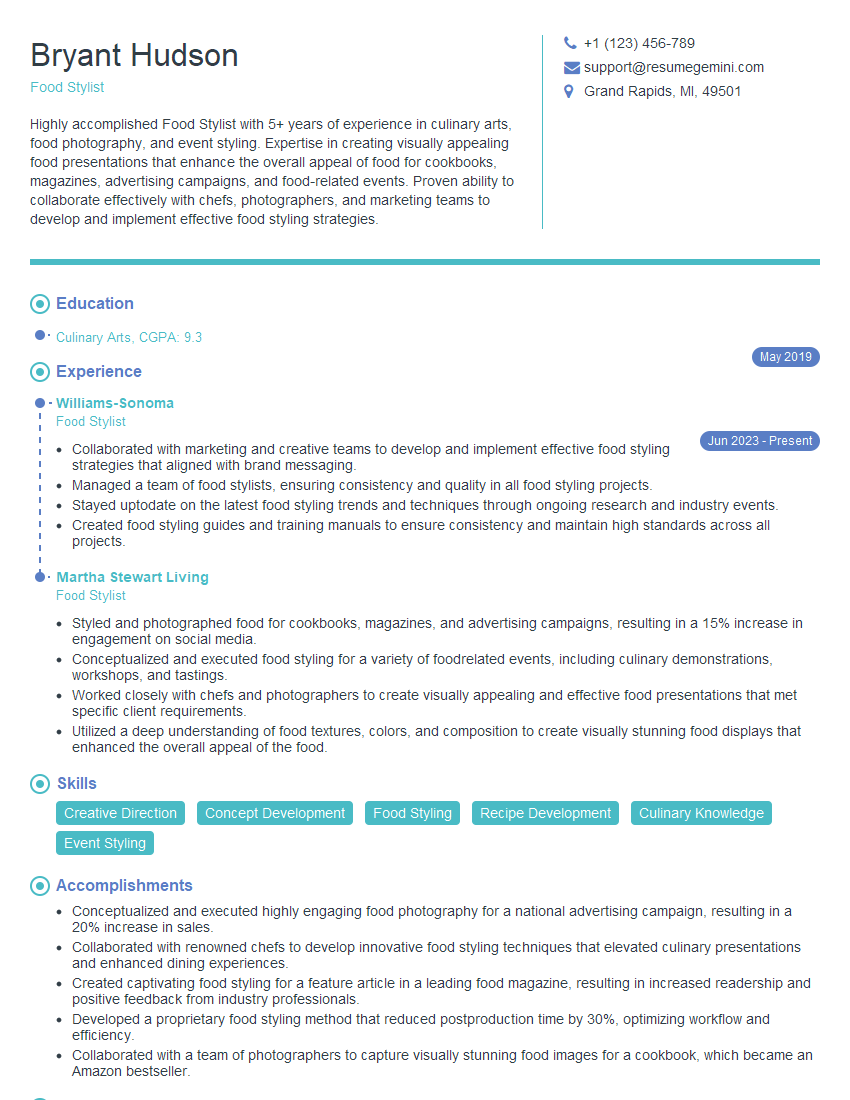
Mastering food styling and photography opens doors to exciting career opportunities in the culinary and advertising industries. A strong portfolio is essential, but a well-crafted resume is your first impression. To maximize your job prospects, create an ATS-friendly resume that effectively highlights your skills and experience. ResumeGemini is a trusted resource to help you build a professional and impactful resume. We provide examples of resumes tailored specifically for Food Stylist and Photography roles to help you get started.
Explore more articles
Users Rating of Our Blogs
Share Your Experience
We value your feedback! Please rate our content and share your thoughts (optional).
What Readers Say About Our Blog
Really detailed insights and content, thank you for writing this detailed article.
IT gave me an insight and words to use and be able to think of examples