Feeling uncertain about what to expect in your upcoming interview? We’ve got you covered! This blog highlights the most important Advanced Metrology and Inspection Techniques interview questions and provides actionable advice to help you stand out as the ideal candidate. Let’s pave the way for your success.
Questions Asked in Advanced Metrology and Inspection Techniques Interview
Q 1. Explain the principles of Coordinate Measuring Machine (CMM) operation.
A Coordinate Measuring Machine (CMM) is a device used to precisely measure the physical geometrical characteristics of an object. It works by using a probe to touch points on the object’s surface. The CMM’s computer system then uses the coordinates of these points to construct a three-dimensional model of the part, allowing for detailed analysis of its shape, size, and position.
The principles involve three primary components: a structured measuring system (usually a three-axis system – X, Y, Z), a probe to make contact with the part, and a sophisticated computer system that controls the movement and data acquisition. The probe’s position is continuously tracked as it moves across the part’s surface, generating coordinate data. This data is then processed using specialized software to perform various measurements and analyses, such as determining distances, angles, radii, and complex geometric features.
Think of it like a super-precise robotic arm with a very sensitive fingertip. The arm moves to specific points on the object, and the fingertip records the location. By mapping many such points, a detailed picture of the object’s shape emerges.
Q 2. Describe different types of CMM probes and their applications.
CMM probes come in various types, each suited for specific applications. The choice depends on the part’s geometry, material, and the required measurement accuracy.
- Contact Probes: These are the most common type, using a mechanical contact to measure points. They are further categorized into:
- Trigger Probes: These trigger a signal when a pre-defined force is applied to the stylus. They are versatile and suitable for a wide range of parts.
- Scanning Probes: These continuously acquire data as they move along a surface, providing a wealth of information about the part’s shape and surface texture. They’re ideal for complex curves and free-form surfaces.
- Non-Contact Probes: These utilize optical or laser techniques to measure the part without physical contact. This is beneficial for fragile or delicate parts.
- Optical Probes: Using techniques like structured light or laser triangulation to acquire surface data.
- Laser Probes: Employ laser beams for high accuracy measurements, often used for complex shapes and surface profiling.
For instance, trigger probes are perfect for measuring simple features like holes and edges, while scanning probes are preferred for complex curves and free-form surfaces found in automotive components or aerospace parts. Optical probes are beneficial for measuring delicate parts such as microchips.
Q 3. How do you ensure the accuracy and repeatability of CMM measurements?
Ensuring accuracy and repeatability in CMM measurements is paramount. This involves a multi-faceted approach:
- Regular Calibration: The CMM itself needs regular calibration using certified artifacts (standards of known dimensions). This verifies the accuracy of its movements and the probe’s measurements.
- Environmental Control: Temperature, humidity, and air currents can affect measurements. Maintaining a stable environment is crucial for consistent results.
- Probe Selection: Choosing the right probe for the task minimizes measurement errors. A poorly chosen probe can lead to inaccurate readings or damage to the part.
- Proper fixturing: Securing the part correctly prevents movement during measurement, which could introduce errors. Appropriate jigs and fixtures are essential.
- Measurement Planning: Careful planning of the measurement strategy, including the number and location of measured points, minimizes error. Software planning tools are widely used.
- Statistical Process Control (SPC): Analyzing data for trends and outliers using statistical methods helps identify and address potential sources of error.
For example, if we are measuring a critical dimension on an engine block, even minor temperature fluctuations can cause expansion or contraction, leading to measurement inaccuracies. Therefore, maintaining a stable temperature is essential. Calibration ensures that the CMM itself is providing accurate measurements, irrespective of the environmental factors.
Q 4. Explain the concept of Geometric Dimensioning and Tolerancing (GD&T).
Geometric Dimensioning and Tolerancing (GD&T) is a standardized system for defining and communicating engineering tolerances. It uses symbols and notations on engineering drawings to specify the permissible variations in a part’s geometry. Unlike traditional tolerancing (which only specifies limits on linear dimensions), GD&T allows for greater flexibility in manufacturing by specifying tolerances on form, orientation, location, and runout.
Instead of just saying a hole should be 10mm +/- 0.1mm in diameter, GD&T could specify its size, circularity, position relative to another feature, and how straight its axis is. This provides much clearer manufacturing instructions and allows manufacturers to focus on the functional aspects of the part.
Key concepts include:
- Form tolerances: Straightness, flatness, circularity, cylindricity
- Orientation tolerances: Perpendicularity, angularity, parallelism
- Location tolerances: Position, concentricity, symmetry
- Runout tolerances: Circular runout, total runout
GD&T provides a more complete and unambiguous description of a part’s requirements, ultimately leading to better quality and reduced manufacturing costs.
Q 5. Interpret a GD&T drawing and explain its implications for manufacturing.
Interpreting a GD&T drawing requires understanding the symbols and their meanings. Let’s consider a simple example: a hole with a position tolerance.
Imagine a drawing showing a hole that needs to be positioned within a specific zone relative to a datum (a reference point or plane on the part). The drawing might show a symbol indicating ‘Position’ and a tolerance zone, say, 0.1mm. This means the center of the hole must lie within a circular zone of 0.1mm diameter, relative to the specified datum. Any hole falling outside this zone is considered non-compliant.
For manufacturing, this has several implications:
- Manufacturing Process Selection: The tolerance zone influences the choice of manufacturing process. Tight tolerances might require more precise and potentially more expensive processes.
- Inspection Planning: The GD&T calls for specific inspection methods, like CMM measurement, to ensure that the manufactured part meets the specifications.
- Quality Control: GD&T ensures that the parts meet the functional requirements, leading to better assembly and performance.
- Cost Optimization: GD&T allows manufacturers to optimize the manufacturing process by focusing on the critical dimensions and tolerances that impact part functionality.
Failure to adhere to GD&T specifications can lead to assembly difficulties, part malfunction, and potentially costly rework or scrap.
Q 6. What are the different types of optical metrology techniques?
Optical metrology techniques utilize light to measure object dimensions and characteristics. Several techniques exist:
- Interferometry: Measures surface irregularities with nanometer-level precision by analyzing the interference patterns of light waves reflected from the surface. Common applications include surface roughness analysis and precision component inspection.
- Structured Light Scanning: Projects a pattern of light onto the object’s surface and analyzes the deformed pattern to create a 3D model. This is widely used for reverse engineering, rapid prototyping, and quality control.
- Photogrammetry: Uses multiple images taken from different angles to create a 3D model of an object. This technique is often used for large objects or those that are difficult to access.
- Moiré Interferometry: Uses the superposition of two similar gratings (one projected, one fixed) to measure displacements and deformations with high sensitivity.
- Laser triangulation: Measures distances and surface profiles by analyzing the angle of a laser beam reflected from the surface. This is used in scanners for industrial applications.
Each technique offers unique advantages and is selected based on the object’s characteristics and the desired measurement accuracy.
Q 7. Describe the principles of laser scanning and its applications in metrology.
Laser scanning uses a laser beam to measure the surface profile of an object. The basic principle involves emitting a laser beam onto the surface and measuring the time of flight (ToF) of the reflected light or analyzing the angle of reflection. This data is then processed to create a 3D point cloud representation of the object’s surface. Different methods exist based on how the data is acquired and processed.
Several applications exist:
- Reverse Engineering: Creating CAD models from existing physical objects.
- Rapid Prototyping: Generating 3D models for manufacturing.
- Quality Control: Inspecting parts for defects and dimensional accuracy.
- 3D Modeling: Creating realistic models for virtual reality, animation, or simulation.
- Heritage preservation: Documenting fragile artifacts through non-contact methods.
For example, in automotive manufacturing, laser scanning can be used to quickly and accurately measure the dimensions of car body panels, ensuring that they conform to design specifications. The point cloud data is directly compared to the CAD model to identify deviations and ensure quality.
Q 8. How do you compensate for thermal effects in precision measurements?
Thermal effects are a significant source of error in precision measurements, as temperature changes cause dimensional variations in the workpiece and the measuring instrument itself. Compensation involves a multi-pronged approach focusing on minimizing temperature fluctuations and correcting for residual effects.
- Temperature Control: The most effective method is to maintain a stable temperature environment in the measurement area. This can involve using temperature-controlled rooms or enclosures, thermally insulating the measuring instrument and workpiece, and using thermal barriers.
- Calibration at Relevant Temperatures: Calibrating the measuring instrument at the specific temperature where measurements will be taken is critical. This ensures the instrument’s accuracy reflects the actual conditions.
- Thermal Compensation Models: Sophisticated metrology systems incorporate thermal models to predict and correct for temperature-induced errors. These models consider the material properties of the workpiece and the instrument, and account for heat transfer mechanisms.
- Material Selection: Using materials with low thermal expansion coefficients (like Invar or Zerodur) for critical components minimizes the impact of temperature fluctuations.
- Measurement Timing: If complete temperature stabilization isn’t feasible, taking measurements at consistent times after temperature changes – when the system is in thermal equilibrium – can minimize errors.
For example, in a high-precision coordinate measuring machine (CMM) application, a temperature-controlled enclosure with a stable temperature of 20°C ± 0.1°C would be employed, along with thermal compensation software that accounts for the thermal expansion of both the CMM probe and the workpiece being measured. Ignoring thermal effects could lead to errors of several micrometers in dimensions.
Q 9. Explain the concept of uncertainty and its role in metrology.
Uncertainty in metrology quantifies the doubt associated with a measurement result. It reflects the range of values within which the true value is likely to lie. It’s not about mistakes, but rather the inherent limitations of the measurement process. Uncertainty is expressed as a numerical value and plays a crucial role in evaluating measurement reliability and making informed decisions.
The concept of uncertainty is governed by the Guide to the Expression of Uncertainty in Measurement (GUM), which provides a framework for evaluating and reporting uncertainty. This involves identifying all sources of uncertainty, quantifying their contributions, and combining them to determine the overall uncertainty of the measurement result.
For instance, in measuring the length of a part, uncertainty might arise from the resolution of the measuring instrument, the repeatability of the measurement, the calibration uncertainty of the instrument, and the environmental conditions. A low uncertainty indicates high precision and reliability, whereas a high uncertainty signifies a greater degree of doubt about the measured value.
Q 10. How do you perform statistical analysis of measurement data?
Statistical analysis of measurement data is essential for identifying trends, outliers, and overall data quality. The methods used depend on the nature of the data and the questions being addressed.
- Descriptive Statistics: Basic methods like mean, standard deviation, and variance provide a summary of the data’s central tendency and spread. Histograms and box plots visualize the data distribution.
- Inferential Statistics: Techniques like hypothesis testing and confidence intervals assess whether differences between groups are statistically significant or if the data supports certain claims.
- Regression Analysis: This method investigates the relationship between variables. For example, it could analyze how temperature affects a measurement.
- Analysis of Variance (ANOVA): ANOVA determines if there are significant differences between the means of multiple groups.
- Control Charts: These are crucial for process monitoring, identifying deviations from the expected values and signaling potential problems. They often use statistical process control (SPC) methodology.
Software packages like Minitab, JMP, and even spreadsheets like Excel are frequently used for these analyses. For example, I’ve used ANOVA to determine if different CMM probes produce statistically different results for the same part, and control charts to monitor the stability of a manufacturing process over time.
Q 11. What are the common sources of measurement errors in metrology?
Measurement errors are inevitable, stemming from various sources:
- Random Errors: These are unpredictable and occur due to uncontrolled variations in the measurement process. They cause scatter around the mean value and are typically minimized by repeated measurements and averaging.
- Systematic Errors: These errors are consistent and repeatable, often caused by biases in the measuring instrument or the measurement procedure. Examples include instrument miscalibration, environmental influences (like temperature drift), and operator biases.
- Gross Errors: These are large, obvious mistakes, such as reading the instrument incorrectly, misplacing decimal points or recording data incorrectly.
- Environmental Errors: Variations in temperature, humidity, vibration, and ambient light can influence the accuracy of measurements.
- Instrument Errors: These are imperfections in the measuring instrument itself, such as inaccuracies in the scale, drift in electronic components or resolution limitations.
- Operator Errors: Human errors in reading instruments, setting up the measurement, and data handling can contribute to inaccurate results.
Effective error analysis involves identifying the potential sources of error, quantifying their impact, and implementing corrective measures. A crucial aspect is using appropriate calibration procedures and ensuring proper training for operators. For instance, a systematic error caused by a miscalibrated gauge could be detected by comparing its measurements to a traceable standard.
Q 12. Explain your experience with different types of metrology software.
My experience encompasses a broad range of metrology software packages, each with its own strengths and limitations. I’m proficient in using software that provides:
- CMM Software: I have extensive experience with software like PC-DMIS, PolyWorks, and Zeiss CALYPSO, used for programming CMM routines, data acquisition, and analysis from coordinate measuring machines. These allow for complex geometric measurements, tolerance analysis, and report generation.
- Optical Metrology Software: I’m familiar with software for analyzing data from optical systems like laser scanners and structured light systems. This software enables surface reconstruction, point cloud processing, and dimensional analysis.
- Image Processing and Analysis Software: I have utilized software for image-based measurement tasks, such as automated inspection and dimensional analysis using techniques like photogrammetry and machine vision.
- Statistical Process Control (SPC) Software: Minitab and JMP are used to analyze the statistical variation in measurement data and identify sources of variability in production processes.
The selection of software depends on the specific metrology task and the available hardware. For example, while PC-DMIS is excellent for CMM data, PolyWorks is more versatile and can handle various 3D scanning data.
Q 13. Describe your experience with data acquisition and analysis in metrology.
Data acquisition and analysis are central to my metrology work. This involves a well-defined process:
- Planning: Defining the measurement objectives, selecting appropriate sensors and instruments, and developing a measurement plan that addresses potential sources of error.
- Data Acquisition: Using various instruments (CMMs, optical scanners, etc.) and software to acquire the necessary data. This might involve automated data capture from production lines or manual measurements.
- Data Preprocessing: Cleaning the data by removing outliers and correcting for known sources of error. This might involve filtering noisy data or compensating for thermal drift.
- Data Analysis: Employing statistical methods and software to interpret the data, identify trends, and draw conclusions. This could include regression analysis to model relationships between variables or statistical process control charts to monitor process stability.
- Report Generation: Creating clear and concise reports that communicate the findings and their uncertainty.
For instance, in a recent project, I used a laser scanner to acquire a point cloud of a complex part. After preprocessing the data to remove noise, I used specialized software to perform surface reconstruction and then analysis to assess form and dimensional accuracy. Finally, I generated a report containing the results, including uncertainty estimates.
Q 14. How do you develop and implement a metrology plan for a new product?
Developing a metrology plan for a new product is crucial for ensuring quality and compliance. This involves a systematic approach:
- Product Understanding: Thorough understanding of the product’s design, specifications, and intended use is paramount. This includes identifying critical features and dimensions that need to be measured.
- Tolerance Analysis: Determining the allowable tolerances for each critical feature. This considers the functional requirements of the product and the impact of variations on its performance.
- Measurement Strategy: Selecting appropriate measurement techniques and instruments based on the product’s geometry, tolerances, and material properties. This might involve CMMs, optical scanners, vision systems, or a combination of techniques.
- Measurement Plan: Creating a detailed plan that specifies the measurement procedures, the sequence of measurements, and the required data analysis. This should also define how to address potential sources of error.
- Resource Allocation: Identifying the resources needed, including personnel, equipment, software, and calibration standards.
- Implementation and Validation: Implementing the measurement plan, validating the results by comparing them to reference standards, and making adjustments as needed.
- Documentation: Creating comprehensive documentation that details the measurement plan, results, and any deviations from the plan. This documentation is important for traceability and audit purposes.
A successful metrology plan ensures that the measurement process is efficient, accurate, and provides reliable data for quality control and product development. For example, a new turbine blade would require a highly precise measurement plan considering blade profile, aerodynamic surface finish and internal cooling channels which may need different measurement methods like CMMs and optical metrology.
Q 15. How do you troubleshoot and resolve measurement inconsistencies?
Troubleshooting measurement inconsistencies begins with a systematic approach. Think of it like detective work – you need to gather clues to pinpoint the culprit. First, I’d meticulously review the measurement process itself: Were the correct instruments used? Were they properly calibrated and within their specified accuracy range? Was the setup correct? Were environmental factors (temperature, humidity, vibrations) controlled and accounted for? Next, I’d analyze the data. Look for patterns: Are inconsistencies random, or do they follow a specific trend? Random errors might indicate instrument noise, whereas systematic errors point to a flaw in the measurement process itself. For example, if I’m consistently measuring a part as being 0.02mm shorter than the CAD model, it could indicate a systematic error in the setup of my Coordinate Measuring Machine (CMM). To resolve the problem, I’d address the identified root cause. This could involve recalibrating equipment, refining the measurement procedure, improving environmental controls, or even replacing faulty equipment. A thorough investigation, utilizing statistical process control (SPC) techniques, is crucial to effectively isolate the issue and prevent recurrence.
Example: In a recent project involving laser scanning, we discovered inconsistencies in measurements taken at different times of day. Investigation revealed that temperature fluctuations were affecting the accuracy of the laser scanner. By implementing temperature control and compensating for thermal expansion, we resolved the inconsistencies.
Career Expert Tips:
- Ace those interviews! Prepare effectively by reviewing the Top 50 Most Common Interview Questions on ResumeGemini.
- Navigate your job search with confidence! Explore a wide range of Career Tips on ResumeGemini. Learn about common challenges and recommendations to overcome them.
- Craft the perfect resume! Master the Art of Resume Writing with ResumeGemini’s guide. Showcase your unique qualifications and achievements effectively.
- Don’t miss out on holiday savings! Build your dream resume with ResumeGemini’s ATS optimized templates.
Q 16. Describe your experience with calibration and traceability of measurement equipment.
Calibration and traceability are fundamental to ensuring the reliability of measurement data. Think of it as establishing a chain of custody for accuracy. My experience involves utilizing ISO 17025 accredited calibration laboratories for regular calibration checks of our metrology equipment. This ensures that our equipment’s performance is traceable to national and international standards. We maintain detailed calibration certificates and records, documenting the equipment’s accuracy, uncertainty, and the date of the last calibration. We adhere to rigorous schedules – frequent calibrations for critical equipment, less frequent for others depending on their usage and stability. This traceability demonstrates confidence in our results to clients and regulatory bodies. Failure to maintain proper calibration can lead to significant errors, resulting in rejected products, costly rework, or even safety hazards.
Example: For our CMM, we use a calibration artifact traceable to NIST standards. The calibration certificate confirms its accuracy and allows us to quantify the uncertainty associated with measurements taken using the CMM.
Q 17. What are the different standards and regulations relevant to metrology?
Numerous standards and regulations govern metrology, ensuring consistency and reliability in measurements across various industries. Some key standards include ISO 17025 (General requirements for the competence of testing and calibration laboratories), ISO 9001 (Quality management systems), and industry-specific standards such as those from the American Society for Testing and Materials (ASTM) or the Society of Automotive Engineers (SAE). These standards outline requirements for calibration, measurement procedures, data analysis, and reporting. Regulations vary by country and industry; for example, the aerospace industry often follows stricter standards than consumer goods. Understanding these standards is paramount for maintaining compliance, ensuring data integrity, and building confidence in our results. Non-compliance can lead to significant penalties, legal issues, and reputational damage.
Example: In the automotive industry, adherence to specific dimensional tolerances outlined in the relevant SAE standards is crucial for safety and performance.
Q 18. Explain your experience with different types of inspection techniques (e.g., visual inspection, non-destructive testing).
My experience spans various inspection techniques. Visual inspection forms the bedrock of many quality control processes. It involves thorough visual examination of parts using magnification tools (microscopes, etc.) to detect surface defects, scratches, or dimensional inconsistencies. Non-destructive testing (NDT) techniques are essential for evaluating internal flaws without damaging the part. I’m proficient in several NDT methods, including:
- Ultrasonic Testing (UT): Used to detect internal flaws through sound wave propagation.
- Radiographic Testing (RT): Uses X-rays or gamma rays to image internal structures and identify defects.
- Eddy Current Testing (ECT): Detects surface and subsurface flaws through electromagnetic induction.
Example: In a recent aerospace component inspection, we used UT to detect internal voids and RT to verify the integrity of welds before flight certification.
Q 19. How do you ensure the quality and integrity of your measurement results?
Ensuring the quality and integrity of measurement results is a multi-faceted process. It begins with rigorous planning and selection of appropriate measurement techniques and equipment. Proper calibration and traceability are essential, as discussed previously. Next, consistent application of measurement procedures, minimizing operator error through standardized protocols and training, plays a vital role. Data analysis using appropriate statistical methods (SPC) helps identify trends, outliers, and systematic errors. Finally, meticulous documentation, including detailed measurement reports that capture all relevant parameters, ensures transparency and accountability. Regular audits of our processes also contribute to continuous improvement and adherence to quality standards. A systematic approach to quality control is paramount, enabling us to provide reliable, trusted measurement data.
Example: We use control charts to track the variation in our CMM measurements over time, promptly identifying any drift or changes in performance.
Q 20. Describe your experience with various metrology equipment (e.g., CMMs, optical comparators, microscopes).
I have extensive experience operating and maintaining a range of metrology equipment. Coordinate Measuring Machines (CMMs) are workhorses for high-precision dimensional measurements. I’m proficient in using both contact and non-contact CMMs, employing various probing strategies and software packages for data acquisition and analysis. Optical comparators provide a visual means of comparing a part to a master or CAD model, excellent for detecting subtle variations in shape and geometry. Microscopes, both optical and digital, are crucial for detailed surface examination and micro-measurement. My expertise extends to using various types of microscopes, including stereo microscopes for 3D visualization, and metallurgical microscopes for analyzing material structure. Selecting the right tool for the job is key; for instance, a CMM is suited for large, complex parts, while a microscope might be more appropriate for analyzing microstructures.
Example: In a recent project, we used a CMM to inspect the dimensions of a complex aerospace component, and then used an optical comparator to verify the alignment of several critical features.
Q 21. Explain your understanding of tolerance analysis.
Tolerance analysis is crucial for determining the allowable variation in a part’s dimensions. It involves calculating the cumulative effect of tolerances on the overall assembly or system performance. Think of it like a puzzle: each individual part has a tolerance, and the goal is to ensure that when these parts are assembled, they still function correctly. Tolerance analysis uses statistical methods to estimate the probability of a component meeting its specified functionality within the given tolerances. Different approaches exist, including worst-case analysis (assuming all tolerances add up to the worst possible scenario) and statistical analysis (considering the probability distribution of tolerances). Software tools can greatly assist in tolerance analysis, particularly for complex assemblies. Understanding tolerance analysis ensures that designs are manufacturable and that parts meet functional requirements.
Example: If a shaft needs to fit snugly into a hole, tolerance analysis ensures the shaft diameter and hole diameter tolerances are compatible, preventing excessive looseness or tightness.
Q 22. How do you manage and interpret large datasets obtained from metrology measurements?
Managing and interpreting large metrology datasets requires a multifaceted approach combining statistical analysis, data visualization, and automation. Think of it like assembling a giant jigsaw puzzle – you need the right tools and techniques to see the complete picture.
Firstly, data cleaning and pre-processing are crucial. This involves identifying and handling outliers, missing values, and inconsistencies. Techniques like robust statistics and data smoothing can be employed. For instance, we might use a moving average to smooth out noisy sensor readings.
Next, statistical analysis helps uncover patterns and relationships. Descriptive statistics (mean, standard deviation, etc.) provide a summary, while inferential statistics (hypothesis testing, regression analysis) help draw conclusions about the measured parts or processes. We might use ANOVA to compare the performance of different measurement systems or regression analysis to model the relationship between process parameters and part dimensions.
Data visualization plays a critical role in understanding complex datasets. Histograms, scatter plots, and control charts can reveal trends and anomalies that might be missed in numerical summaries alone. A control chart might show us that a particular machine is drifting out of tolerance, requiring recalibration.
Finally, automation is essential for handling the sheer volume of data. Scripting languages like Python with libraries like Pandas and NumPy are invaluable for automating data processing, analysis, and report generation. This frees up time for more in-depth analysis and interpretation.
Q 23. Describe a challenging metrology problem you solved and how you approached it.
One challenging problem involved measuring the microscopic surface roughness of a newly developed medical implant. The implant’s intricate geometry and delicate surface made traditional contact profilometry inaccurate and potentially damaging. The tight tolerances demanded sub-nanometer precision.
My approach involved a multi-technique strategy. We first used confocal microscopy to obtain high-resolution 3D surface images. However, confocal microscopy struggles with extremely steep features. Therefore, we combined this with atomic force microscopy (AFM) for superior resolution in critical areas. AFM’s ability to measure very small features in detail is unmatched.
The challenge was integrating the data from these two techniques. The datasets had differing scales and resolutions. We developed a custom image registration algorithm using Python to accurately align and combine the data, creating a complete and highly accurate surface map. This allowed us to confidently assess surface roughness and identify any defects well below the required tolerances, ensuring the implant met the strict regulatory requirements.
Q 24. Explain your experience with automation in metrology processes.
I have extensive experience in automating metrology processes using a variety of techniques and technologies. Automation significantly improves efficiency, reduces human error, and enables high-throughput measurements.
I’ve worked with robotic systems for automated part handling and positioning within Coordinate Measuring Machines (CMMs). This dramatically speeds up inspection of large batches of parts, increasing throughput significantly. We’ve also implemented automated vision systems that use computer vision algorithms to automatically identify parts, orient them, and perform dimensional measurements. This greatly reduces manual handling and ensures consistent measurement methods.
Furthermore, I’ve utilized programmable logic controllers (PLCs) to integrate multiple metrology instruments and control the entire measurement process. This integrated approach optimizes workflows and streamlines data collection and analysis. Finally, software development played a crucial role in creating custom solutions to automate data processing and reporting, enhancing the effectiveness of our automated system.
Q 25. How do you ensure data integrity and traceability in a metrology system?
Data integrity and traceability are paramount in metrology. Imagine building a skyscraper without accurate blueprints and a detailed construction log – disaster is guaranteed! We must maintain a complete and auditable record of every measurement.
We achieve this through a combination of strategies. Calibration certificates for all measuring instruments, regularly verified against national or international standards, ensure accuracy. We meticulously document the measurement procedures, including instrument settings and environmental conditions. This is often done with automated recording software.
Unique identification numbers are assigned to each part and measurement, creating a traceable chain of custody. We use secure databases with access control to manage data and prevent unauthorized modifications. All data is backed up regularly to prevent loss. Finally, we follow the principles of Good Measurement Practice (GMP) and relevant ISO standards to ensure the highest levels of integrity and traceability throughout the entire metrology process.
Q 26. What are the key performance indicators (KPIs) for a metrology department?
Key Performance Indicators (KPIs) for a metrology department should reflect efficiency, accuracy, and contribution to overall quality. These are crucial to show the return on investment and the effectiveness of the department’s efforts.
Key KPIs include:
- Measurement accuracy and precision: This is measured by comparing measurement results to known standards or reference values.
- Throughput: The number of parts inspected or measured per unit time, reflecting efficiency.
- First-pass yield: The percentage of parts that pass inspection on the first attempt, indicating process capability.
- Defect detection rate: The percentage of actual defects detected by the metrology process.
- Turnaround time: The time taken to complete measurement and analysis.
- Calibration compliance: Percentage of instruments that are calibrated and within tolerance.
- Cost per measurement: Optimizing efficiency to reduce costs.
Regular monitoring of these KPIs provides valuable insights into the department’s performance and helps identify areas for improvement.
Q 27. How familiar are you with ISO standards related to quality management and metrology?
I am very familiar with ISO standards related to quality management and metrology. My understanding encompasses ISO 9001 (Quality Management Systems), ISO 17025 (General requirements for the competence of testing and calibration laboratories), and relevant ISO standards specific to different measurement techniques (e.g., dimensional metrology). These standards provide a framework for ensuring the quality and reliability of measurement processes.
I understand the importance of complying with these standards in maintaining traceability, ensuring competence, and managing uncertainty. My experience includes developing and implementing quality management systems that are compliant with these standards, performing internal audits to identify gaps, and implementing corrective actions where necessary.
Q 28. Describe your experience with root cause analysis related to metrology issues.
Root cause analysis (RCA) is a systematic approach to identifying the underlying reasons behind metrology issues. It is crucial for preventing recurrence and improving the overall measurement process. Think of it as detective work – you need to find the culprit, not just treat the symptoms.
I frequently use techniques like the 5 Whys, fishbone diagrams (Ishikawa diagrams), and Fault Tree Analysis (FTA) to investigate metrology problems. For example, if we consistently observe inaccurate measurements on a particular CMM, we use these methods to systematically uncover the reason – which could be anything from a faulty probe, incorrect software settings, or even environmental factors like temperature fluctuations.
The process typically involves collecting data, identifying potential causes, analyzing the data to determine the most likely cause, and implementing corrective actions. Documentation is crucial at each step to ensure traceability and to prevent similar issues in the future. Once the root cause is identified, effective corrective actions are implemented, and the process is monitored to confirm the effectiveness of the solution.
Key Topics to Learn for Advanced Metrology and Inspection Techniques Interview
Preparing for an interview in Advanced Metrology and Inspection Techniques requires a strong grasp of both theoretical foundations and practical applications. Success hinges on demonstrating your problem-solving abilities and understanding of the latest technologies within the field. Focus your preparation on these key areas:
- Dimensional Metrology: Understanding various measurement techniques (e.g., coordinate measuring machines (CMMs), laser scanning, optical metrology), their principles, limitations, and appropriate applications in manufacturing and quality control.
- Surface Metrology: Mastering the concepts of surface roughness, waviness, and form error. Familiarize yourself with different surface texture analysis techniques and their interpretation for quality assessment and process improvement.
- Optical Metrology: Explore techniques like interferometry, holography, and digital image correlation, understanding their strengths and limitations in high-precision measurements.
- Non-destructive Testing (NDT): Develop a comprehensive understanding of various NDT methods, including ultrasonic testing, radiographic testing, and eddy current testing, and their role in ensuring product integrity.
- Data Analysis and Interpretation: Practice analyzing complex metrology data, identifying trends, and drawing meaningful conclusions. Proficiency in statistical process control (SPC) and data visualization techniques is crucial.
- Advanced Calibration and Traceability: Understand the importance of calibration standards, traceability to national standards, and the implications of measurement uncertainty.
- Specific Software and Instrumentation: Familiarize yourself with industry-standard software packages and instrumentation commonly used in advanced metrology and inspection. Mention specific tools you are proficient in during the interview.
- Problem-Solving and Case Studies: Prepare to discuss real-world scenarios where advanced metrology techniques were used to solve a problem or improve a process. Highlight your analytical and problem-solving skills.
Next Steps
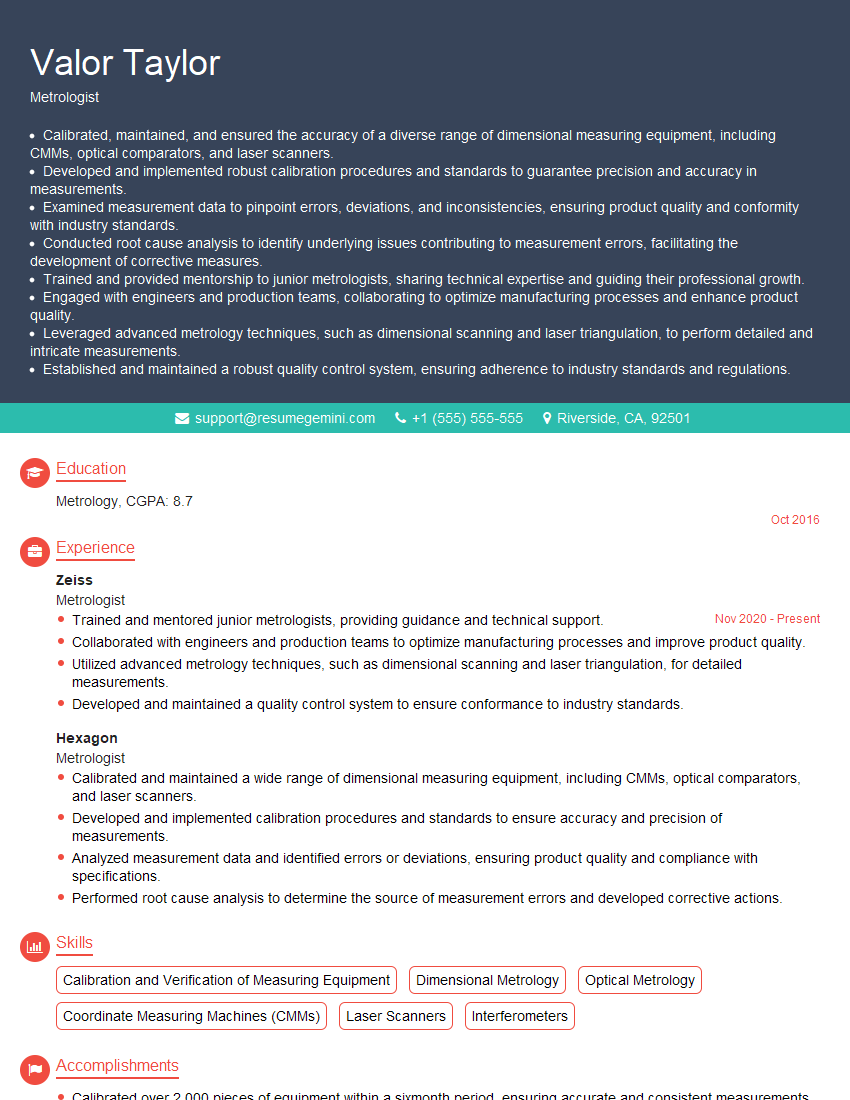
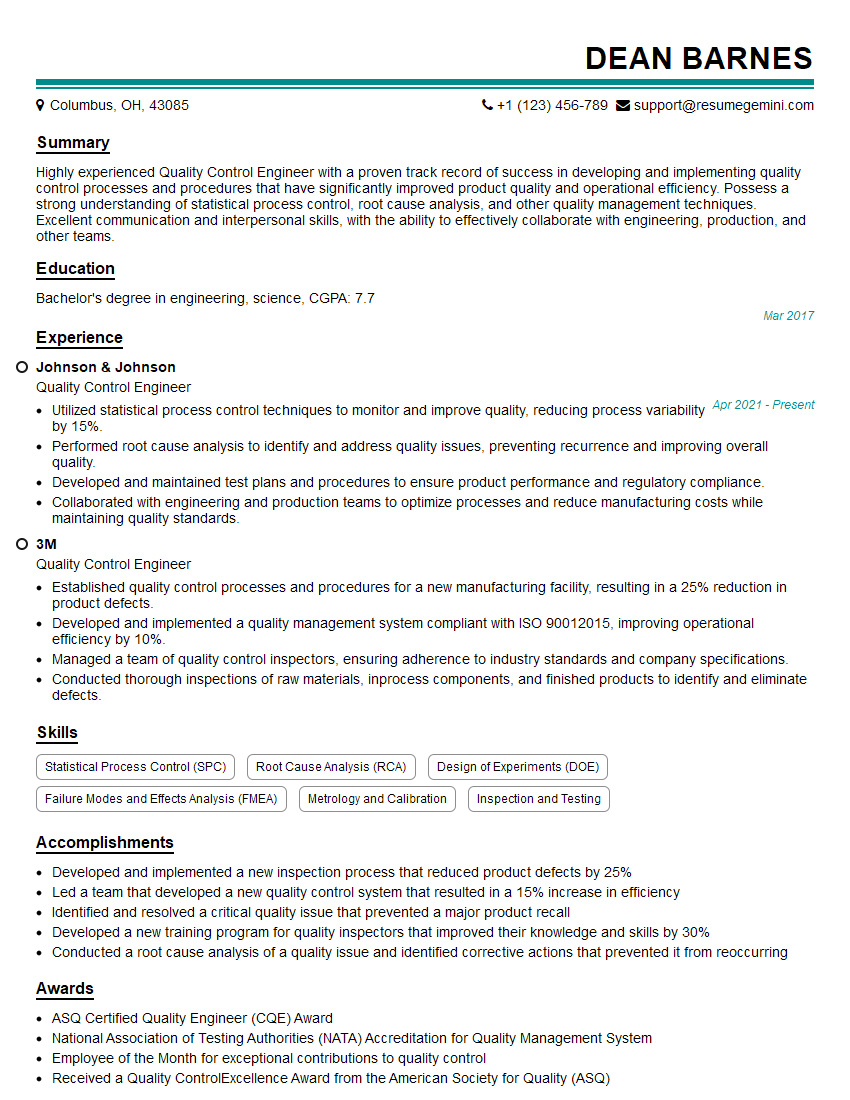
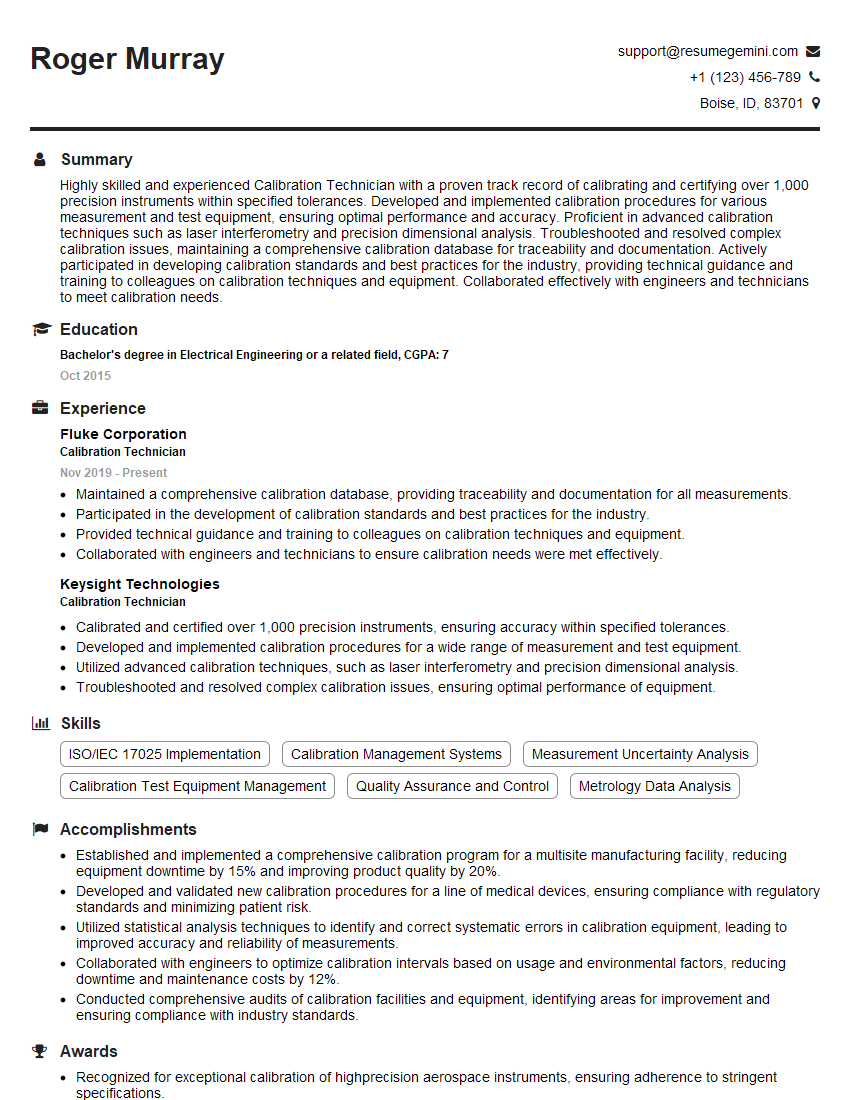
Mastering Advanced Metrology and Inspection Techniques opens doors to exciting career opportunities with significant growth potential in various industries. To maximize your job prospects, it’s essential to present your skills effectively. Creating a strong, ATS-friendly resume is the first step towards landing your dream job. ResumeGemini can be a trusted partner in this process. It provides the tools and resources you need to build a professional and compelling resume that highlights your expertise in Advanced Metrology and Inspection Techniques. Examples of resumes tailored to this field are available to help guide you.


Explore more articles
Users Rating of Our Blogs
Share Your Experience
We value your feedback! Please rate our content and share your thoughts (optional).
What Readers Say About Our Blog
I Redesigned Spongebob Squarepants and his main characters of my artwork.
https://www.deviantart.com/reimaginesponge/art/Redesigned-Spongebob-characters-1223583608
IT gave me an insight and words to use and be able to think of examples
Hi, I’m Jay, we have a few potential clients that are interested in your services, thought you might be a good fit. I’d love to talk about the details, when do you have time to talk?
Best,
Jay
Founder | CEO