Unlock your full potential by mastering the most common Reliability and Dependability interview questions. This blog offers a deep dive into the critical topics, ensuring you’re not only prepared to answer but to excel. With these insights, you’ll approach your interview with clarity and confidence.
Questions Asked in Reliability and Dependability Interview
Q 1. Explain the difference between reliability and availability.
Reliability and availability are closely related but distinct concepts in dependability engineering. Think of it like this: reliability is about how well something works, while availability is about how often it’s working and ready to use.
Reliability refers to the probability that a system will perform its intended function without failure for a specified period under stated conditions. It’s essentially the probability of continued operation. A highly reliable system is one that rarely fails.
Availability, on the other hand, considers both the system’s uptime (when it’s working) and downtime (when it’s not working, due to failure or maintenance). It’s the probability that a system will be operational when needed. Even a highly reliable system can have low availability if it takes a long time to repair after a failure.
Example: Imagine a critical server. It might be very reliable (rarely fails), but if repairing it takes days, its availability will be low. Conversely, a less reliable system with quick repairs could have higher availability. The key difference is that reliability focuses on failure-free operation, while availability encompasses both uptime and the time spent getting back online after a failure or scheduled maintenance.
Q 2. Describe various reliability testing methods.
Several methods exist for testing reliability, each with its strengths and weaknesses. The choice depends on factors such as the system’s complexity, cost constraints, and time available.
- Stress Testing: This involves subjecting the system to conditions exceeding its normal operating parameters to identify breaking points and weaknesses. Think of it like pushing a car to its limits to see where it falters.
- Burn-in Testing: Early failures are often caused by manufacturing defects. Burn-in involves operating the system continuously under normal conditions for a period to eliminate these early failures.
- Accelerated Life Testing: This speeds up the aging process by increasing stress levels (temperature, voltage, etc.) to observe failures quicker than under normal conditions. It helps predict the system’s lifetime under normal operating conditions.
- Fault Injection Testing: This method deliberately introduces faults into the system to assess its ability to handle them. This could involve injecting incorrect data, simulating hardware failures, or disrupting power supply.
- Software Testing (e.g., Unit, Integration, System): Rigorous software testing is critical for software reliability. It covers different aspects from individual components (unit testing) to the entire software system (system testing).
The data collected from these tests is statistically analyzed to estimate reliability parameters like MTBF (Mean Time Between Failures).
Q 3. What are common failure modes and effects analysis (FMEA) techniques?
Failure Modes and Effects Analysis (FMEA) is a systematic approach to identifying potential failure modes, their causes, and their effects on the system. It’s a proactive technique used to prevent failures rather than reacting to them.
Common FMEA techniques include:
- Design FMEA (DFMEA): Applied during the design phase to identify potential failures in the design itself.
- Process FMEA (PFMEA): Focuses on identifying potential failures in manufacturing or operational processes.
- System FMEA (SFMEA): Examines the interactions between different components or subsystems to identify potential systemic failures.
Each technique uses a structured format, typically including a table that lists potential failure modes, their causes, effects, severity, occurrence, and detection ratings. These ratings help prioritize the risks and guide corrective actions. The goal is to reduce the severity, occurrence, and detection of potential failures, improving overall reliability.
Q 4. How do you calculate Mean Time Between Failures (MTBF)?
Mean Time Between Failures (MTBF) is a key metric in reliability engineering. It represents the average time between successive failures of a repairable system. It’s expressed as a time unit (e.g., hours, days, years).
Calculation: MTBF is calculated as the total operating time divided by the number of failures.
MTBF = Total operating time / Number of failures
Example: If a system operates for 10,000 hours and experiences 5 failures, its MTBF is 10,000 hours / 5 failures = 2000 hours.
Important Note: MTBF is a statistical average and doesn’t predict when the next failure will occur. It’s more meaningful for systems with a relatively constant failure rate (constant hazard rate).
Q 5. What is Mean Time To Repair (MTTR) and how is it calculated?
Mean Time To Repair (MTTR) is the average time it takes to repair a failed system and restore it to operational status. It’s a crucial indicator of system availability.
Calculation: MTTR is calculated by summing the repair times for all failures and dividing by the number of failures.
MTTR = Sum of repair times / Number of failures
Example: If a system experiences 5 failures with repair times of 1, 2, 3, 1, and 2 hours respectively, the MTTR is (1+2+3+1+2) hours / 5 failures = 1.8 hours.
Reducing MTTR is a key focus in improving system availability. Strategies for achieving this include improved diagnostic tools, readily available spare parts, well-trained technicians, and streamlined repair procedures.
Q 6. Explain the bathtub curve and its significance in reliability analysis.
The bathtub curve is a graphical representation of the failure rate of a system over its lifetime. It’s called a bathtub curve because of its characteristic shape. The curve is divided into three phases:
- Early Failures (Infant Mortality): This initial phase shows a high failure rate due to defects in manufacturing or design. Failures are common in this phase, often due to design flaws or manufacturing imperfections.
- Useful Life (Constant Failure Rate): During this phase, the failure rate is relatively constant. The system operates reliably with a predictable failure rate. This phase is the ideal period of stable performance.
- Wear-out Failures: In the final phase, the failure rate increases significantly as the system ages and components wear out. This period is characterized by increased maintenance and an eventual decline in system functionality.
Significance: Understanding the bathtub curve is crucial for effective reliability management. It allows for the prediction of potential failure points and the implementation of preventive measures such as burn-in testing (to address early failures) and predictive maintenance (to mitigate wear-out failures). This understanding is crucial for planning maintenance, managing spare parts, and optimising system lifecycles.
Q 7. What are the key metrics used to assess system reliability?
Several key metrics are employed to assess system reliability, providing a comprehensive view of its dependability.
- Mean Time Between Failures (MTBF): The average time between failures of a repairable system.
- Mean Time To Repair (MTTR): The average time it takes to repair a failed system.
- Availability (A): The probability that a system is operational at a given time. Often expressed as a percentage (e.g., 99.99%).
- Reliability (R(t)): The probability that a system will function without failure for a specified time (t).
- Failure Rate (λ): The rate at which failures occur, often expressed in failures per unit of time (e.g., failures per million hours).
- Mean Time To Failure (MTTF): The average time until failure for a non-repairable system.
By tracking these metrics, engineers can identify areas for improvement, predict potential problems, and make informed decisions regarding system design, maintenance, and resource allocation.
Q 8. Describe different types of redundancy techniques.
Redundancy techniques are methods used to increase the reliability and availability of a system by incorporating multiple components or paths to perform the same function. If one component fails, another takes over seamlessly, preventing system failure. There are several types:
- Active Redundancy (Parallel Redundancy): Multiple components operate simultaneously, with one being the primary and others acting as backups. Think of a RAID 1 system in computing, where data is mirrored across two hard drives. If one fails, the other continues operation.
- Passive Redundancy (Standby Redundancy): A backup component only activates when the primary component fails. This is less resource-intensive than active redundancy but has a slightly slower failover time. An example is a backup power generator that kicks in only during a power outage.
- N-Modular Redundancy (NMR): This involves N identical components, with a voting mechanism determining the correct output. If one component malfunctions, the others continue to provide the correct output, making it very reliable. This is used in critical aerospace and safety systems.
- Hybrid Redundancy: This combines aspects of active and passive redundancy, offering a balance between resource utilization and failover speed. A system might have two active components with a standby as a further backup.
Q 9. What are the benefits and drawbacks of different redundancy strategies?
The choice of redundancy strategy depends on factors like cost, performance requirements, and criticality of the system.
- Active Redundancy: Benefits: High availability, fast failover. Drawbacks: Higher cost (more components), increased power consumption, potential for increased complexity.
- Passive Redundancy: Benefits: Lower cost, lower power consumption, simpler implementation. Drawbacks: Slower failover, potential for a longer downtime during the switch-over.
- N-Modular Redundancy: Benefits: Extremely high reliability, fault tolerance. Drawbacks: High cost, increased complexity, significant resource requirements.
- Hybrid Redundancy: Benefits: Offers a compromise between cost, performance, and reliability. Drawbacks: More complex design and configuration compared to simpler strategies.
For instance, in a banking system, active redundancy might be chosen for critical transaction processing to minimize downtime, while a less critical system might use passive redundancy for cost-effectiveness.
Q 10. How do you perform a fault tree analysis (FTA)?
Fault Tree Analysis (FTA) is a top-down, deductive method used to determine the causes of a system failure. It visually represents the combination of events that lead to a specific undesired event (top event). The process typically involves:
- Define the Top Event: Identify the specific system failure you are analyzing (e.g., system shutdown).
- Identify Contributing Events: Determine the events that could directly cause the top event.
- Develop the Fault Tree: Use logic gates (AND, OR) to represent the relationships between events and the top event. AND gates require all inputs to occur for the output to happen, while OR gates require at least one input to trigger the output.
- Assign Probabilities: Assign probabilities of occurrence to each basic event (lowest level events).
- Calculate the Probability of the Top Event: Using Boolean logic and probabilities, calculate the probability of the top event occurring.
FTA is widely used in various industries to assess risks, identify critical components, and make informed decisions regarding system design and maintenance. Imagine analyzing the failure of a power grid using an FTA – you’d start with the top event ‘Power Outage’ and work backward through sub-failures like generator malfunction, transmission line failure etc.
Q 11. What is Weibull analysis and how is it applied in reliability engineering?
Weibull analysis is a statistical method used to model the time-to-failure of a component or system. It’s particularly useful when dealing with data exhibiting non-constant failure rates. The Weibull distribution is characterized by two parameters:
- Shape parameter (β): Indicates the shape of the failure rate curve. β < 1 implies decreasing failure rate (infant mortality), β = 1 implies constant failure rate, and β > 1 implies increasing failure rate (wear-out).
- Scale parameter (η): Represents the characteristic life of the component (the time at which 63.2% of components would have failed if the failure rate was constant).
In reliability engineering, Weibull analysis is used to:
- Estimate the reliability function: Determine the probability of a component surviving beyond a given time.
- Predict the failure rate: Understand how the failure rate changes over time.
- Determine the mean time to failure (MTTF): Estimate the average time until failure.
- Compare different designs or materials: Assess the relative reliability of different options.
For example, Weibull analysis can be used to model the lifespan of light bulbs, predicting when a significant portion might fail and helping to schedule replacements.
Q 12. How do you use reliability block diagrams (RBDs)?
Reliability Block Diagrams (RBDs) are graphical representations of a system’s reliability, showing how components are connected and how their failures affect the overall system reliability. They use blocks to represent components and lines to represent the flow of operation. The use of RBDs involves:
- Creating the Diagram: Draw the diagram showing each component and its connections. Series connections imply that a failure in any component causes overall system failure, while parallel connections imply that the system functions as long as at least one component works.
- Assigning Reliability Parameters: Assign failure rates (λ), or reliability values (R) to each component, based on historical data, testing, or manufacturer’s specifications.
- Calculating System Reliability: Use mathematical formulas to calculate the overall reliability of the system based on the individual component reliabilities and their connections in the RBD.
- Analyzing Reliability: Identify the components that significantly affect the system reliability (weakest links).
For example, an RBD for a simple two-component system with parallel redundancy shows the individual reliabilities of each component, and the overall system reliability is calculated based on whether the components are functioning correctly.
Q 13. Explain the concept of system resilience.
System resilience refers to a system’s ability to withstand, adapt to, and recover from disruptions. It’s about maintaining essential functions even when facing unexpected events or failures. Resilience goes beyond simple reliability – it incorporates:
- Robustness: The ability to withstand shocks and maintain functionality.
- Adaptability: The ability to adjust to changing conditions and maintain functionality.
- Recovery: The ability to quickly restore functionality after a disruption.
- Prevention: Proactive measures taken to reduce the likelihood of failures.
A resilient system, unlike one that merely focuses on avoiding failure, can handle unexpected issues and minimize the impact on its overall functionality. For example, a resilient power grid would not only have backup generators but also intelligent systems to reroute power around affected areas, ensuring continuous supply to critical facilities.
Q 14. What is the role of preventive maintenance in improving reliability?
Preventive maintenance is a crucial aspect of improving system reliability. It involves performing scheduled maintenance tasks to prevent failures before they occur. This proactive approach reduces the likelihood of unexpected breakdowns, minimizes downtime, and extends the lifespan of components. Examples include:
- Regular inspections: Checking for wear and tear, potential issues, and loose connections.
- Lubrication: Applying lubricants to reduce friction and wear.
- Cleaning: Removing dirt and debris that could cause malfunctions.
- Calibration: Ensuring instruments and sensors are accurate.
- Component replacement: Replacing components before they reach the end of their useful life.
A well-planned preventive maintenance program can significantly improve the reliability and reduce maintenance costs of any system, whether it’s a complex industrial plant or a simple computer network.
Q 15. Describe your experience with reliability prediction and modeling.
Reliability prediction and modeling involves forecasting the likelihood of a system or component failing within a specific timeframe. This is crucial for proactive maintenance, resource allocation, and risk mitigation. I’ve extensively used various techniques, including:
- Statistical methods: Employing Weibull, Exponential, and Normal distributions to analyze historical failure data and predict future failures. For example, fitting a Weibull distribution to failure data from a batch of hard drives allowed us to predict the expected lifespan and plan for replacements before widespread failures occurred.
- Physics-of-failure (PoF) modeling: This approach utilizes an understanding of the underlying failure mechanisms (e.g., fatigue, corrosion, wear) to build more accurate models. In a project involving aircraft engines, we used PoF modeling to identify the critical components most susceptible to fatigue failure and recommend design improvements.
- Markov models: These are particularly useful for systems with multiple states and transitions, enabling us to assess the reliability of complex systems over time. We utilized Markov chains to evaluate the reliability of a telecommunication network, assessing the probabilities of different network states (e.g., fully operational, partially degraded, complete failure) and their impact on service quality.
- Software reliability growth models: These models are employed for predicting the reliability of software during development and testing. I have experience using models such as the Jelinski-Moranda and Musa models to estimate the number of remaining faults and plan for sufficient testing.
My experience spans various industries, including aerospace, telecommunications, and manufacturing, where I’ve successfully integrated these models to improve product reliability and reduce maintenance costs.
Career Expert Tips:
- Ace those interviews! Prepare effectively by reviewing the Top 50 Most Common Interview Questions on ResumeGemini.
- Navigate your job search with confidence! Explore a wide range of Career Tips on ResumeGemini. Learn about common challenges and recommendations to overcome them.
- Craft the perfect resume! Master the Art of Resume Writing with ResumeGemini’s guide. Showcase your unique qualifications and achievements effectively.
- Don’t miss out on holiday savings! Build your dream resume with ResumeGemini’s ATS optimized templates.
Q 16. How do you handle conflicting priorities between reliability and cost?
Balancing reliability and cost is a perpetual challenge in engineering. It often involves making trade-offs. My approach involves:
- Defining clear reliability targets: These targets should be aligned with business objectives and customer expectations. A thorough risk assessment can help prioritize critical components and subsystems demanding higher reliability investments.
- Cost-benefit analysis: Evaluating the cost of improving reliability (e.g., through enhanced materials, more rigorous testing, redundant components) against the potential cost of failures (e.g., downtime, repairs, warranty claims). This often involves quantifying the cost of downtime and potential business disruptions.
- Value engineering: This technique focuses on optimizing designs and processes to achieve the desired reliability while minimizing cost. For instance, we once substituted a costly high-reliability component with a more affordable alternative, combined with enhanced preventative maintenance strategies, achieving comparable overall system reliability at a significantly lower cost.
- Phased approach: Instead of aiming for perfect reliability upfront, a phased approach might involve initially launching a product with a slightly lower reliability level, but with robust monitoring and continuous improvement. This allows for feedback and optimization based on real-world data.
Ultimately, it’s about finding the optimal balance that meets business needs without compromising safety or customer satisfaction.
Q 17. Explain your understanding of reliability growth testing.
Reliability growth testing is a systematic process used to improve the reliability of a product or system during its development and testing phases. The goal is to identify and fix defects, thereby increasing the reliability over time. This process involves:
- Testing and Failure Analysis: The system or product is subjected to rigorous testing, and failures are meticulously documented and analyzed to identify root causes.
- Defect Correction: Corrective actions are implemented to address the root causes of failures, and the system is modified to prevent similar failures in the future.
- Retesting and Monitoring: After modifications, the system is retested to verify the effectiveness of the corrections. This cycle of testing, failure analysis, correction, and retesting continues until the desired reliability level is achieved.
- Reliability Growth Models: Mathematical models such as the Jelinski-Moranda model or the Duane model are used to track the reliability growth, predict the remaining defects, and plan for further testing.
For instance, in a software project, we implemented reliability growth testing, resulting in a significant reduction in the failure rate over several iterations. Using the data collected, we could reliably predict when the software would meet the specified reliability goals and plan the product launch accordingly.
Q 18. How would you approach investigating a sudden increase in failure rates?
A sudden increase in failure rates is a serious concern requiring a systematic investigation. My approach would be:
- Data Collection and Verification: Gather detailed failure data, including timestamps, failure modes, environmental conditions, and any preceding events. Verify the accuracy and completeness of the data. Any anomalies in data recording must be checked and accounted for.
- Failure Mode and Effects Analysis (FMEA): Conduct a thorough FMEA to identify potential failure modes and their effects on the system. This helps to prioritize potential root causes.
- Hypothesis Generation: Based on the data and FMEA, formulate hypotheses regarding the potential root causes of the increased failure rates. Examples include: new software release, environmental changes (temperature, humidity), changes in operational procedures, or component degradation.
- Verification and Validation: Design experiments to test the hypotheses. This may involve controlled testing, simulations, or field studies. Analyze the experimental results and validate or reject the hypotheses.
- Corrective Actions: Implement corrective actions based on the findings of the investigation. This may include component replacements, design modifications, improved operational procedures, or enhanced maintenance schedules.
- Monitoring and Continuous Improvement: Closely monitor the system’s reliability after implementing corrective actions to ensure the effectiveness of the solutions and identify any potential further issues.
A real-world example: A sudden spike in server failures was traced to a recent power surge. Through detailed analysis, we identified a vulnerable component and implemented protective measures, resolving the issue and preventing future occurrences.
Q 19. What are your strategies for communicating complex reliability data to non-technical audiences?
Communicating complex reliability data to non-technical audiences requires clear, concise, and visual communication. My strategies include:
- Visualizations: Charts and graphs (bar charts, pie charts, line graphs) are excellent tools for conveying trends and patterns in failure data. For instance, a simple bar chart illustrating the frequency of different failure modes can quickly communicate the most prevalent problems.
- Analogies and Metaphors: Relating reliability concepts to everyday experiences can help non-technical audiences grasp complex ideas. For example, comparing system reliability to the reliability of a car—the less likely it is to break down, the more reliable it is.
- Storytelling: Presenting data within a narrative context makes it more engaging and memorable. For instance, telling a story about a past reliability challenge and the actions taken to overcome it can be more effective than simply presenting statistical data.
- Focus on Key Metrics: Avoid overwhelming the audience with too much detail. Focus on the most important metrics, such as Mean Time Between Failures (MTBF) or system availability, and present them in a clear and understandable way. Use clear and concise language, avoiding technical jargon as much as possible.
- Interactive Dashboards: For ongoing monitoring, creating interactive dashboards allows non-technical users to readily understand system performance, and identify potential issues early.
By using these techniques, I ensure that the audience understands the key findings and implications of the reliability analysis without getting bogged down in technical details.
Q 20. Describe your experience with different software reliability tools.
My experience with software reliability tools encompasses various categories:
- Reliability prediction tools: I’ve used software such as ReliaSoft Weibull++, which allows for statistical analysis of failure data and prediction of future failures using various probability distributions. Other tools include specialized software for specific reliability growth models (e.g., for software reliability analysis).
- Simulation software: Monte Carlo simulation software is frequently used for assessing the reliability of complex systems. These tools allow for the simulation of thousands of possible scenarios and the statistical assessment of the system’s reliability characteristics. I have experience with specialized simulation packages for different system types.
- Failure analysis and reporting tools: Software tools are used to track and analyze failure data, helping to identify trends and patterns in failures. We use such tools to support FMEA and fault tree analysis. Many custom solutions exist to support different organizations.
- Data analysis and visualization tools: Tools such as R and Python are invaluable for analyzing large datasets and creating visualizations of reliability data. These tools offer a great deal of flexibility and power in analyzing data sets.
My selection of tools is always driven by the specific needs of the project and the available data. It is imperative to choose the right tools for the job to ensure accuracy and efficiency.
Q 21. How do you balance the need for innovation with the need for reliability?
Balancing innovation and reliability is a delicate act. Innovation often introduces new components and designs that may not have a proven track record, potentially impacting reliability. My approach emphasizes:
- Phased Rollout: Introducing innovative features or designs gradually, starting with a limited rollout to a subset of users or in a controlled environment. This allows for early detection and mitigation of any reliability issues.
- Robust Testing and Validation: Conducting rigorous testing and validation of new components or designs before widespread deployment. This includes stress testing, accelerated life testing, and simulations to uncover potential weaknesses.
- Redundancy and Fail-safes: Incorporating redundant systems or fail-safe mechanisms to minimize the impact of failures. This can be implemented in both hardware and software components.
- Continuous Monitoring and Feedback: Implementing comprehensive monitoring systems to track the performance and reliability of the system post-deployment. This allows for prompt identification and remediation of any reliability issues.
- Data-Driven Decision Making: Using data collected from monitoring to inform design improvements and prioritize actions for enhanced reliability.
For example, in a recent project, we introduced a new feature with a phased rollout, carefully monitoring its performance and making adjustments based on user feedback and performance data. This approach allowed us to launch the innovative feature while maintaining a high level of system reliability.
Q 22. Explain your approach to root cause analysis in a complex system.
Root cause analysis (RCA) in complex systems requires a systematic approach to identify the underlying reasons for failures, going beyond simply addressing symptoms. My approach combines several proven techniques.
Fault Tree Analysis (FTA): This top-down, deductive method starts with an undesired event (the top event) and works backward to identify the contributing factors, using Boolean logic to show how these factors combine to cause the failure. For example, if a system shutdown is the top event, FTA helps determine if it’s due to power failure, software bug, or hardware malfunction, and further branches down to specific component failures.
Failure Mode and Effects Analysis (FMEA): This proactive technique identifies potential failure modes, their effects, and their severity, occurrence, and detectability. It helps prioritize potential failures and allows us to implement preventative measures during the design phase. For instance, in designing a satellite, we would analyze the failure modes of each component (solar panels, communication systems, etc.) to assess their impact on mission success.
5 Whys: This iterative questioning technique helps uncover the root cause by repeatedly asking ‘why’ until the fundamental issue is identified. For example, if a server crashes, we’d ask: Why did the server crash? (Insufficient memory). Why was there insufficient memory? (Memory leak in an application). Why was there a memory leak? (Poor coding practice). Why was the coding practice poor? (Lack of code review).
Fishbone Diagram (Ishikawa Diagram): This visual tool helps organize potential causes of a problem by categorizing them into categories like people, methods, machines, materials, environment, and measurement. This is particularly useful in brainstorming sessions to gather diverse perspectives.
I often use a combination of these methods, selecting the most appropriate based on the complexity and nature of the system. Critical to my approach is involving a multidisciplinary team, leveraging their expertise to provide comprehensive analysis and prevent bias.
Q 23. Describe your experience with design for reliability (DFR).
Design for Reliability (DFR) is deeply ingrained in my approach to engineering. It involves proactively considering reliability throughout the entire design lifecycle, not just as an afterthought. My experience encompasses several key aspects:
Component Selection: I prioritize using highly reliable components with proven track records and robust specifications. This involves thorough research and vendor qualification, considering factors like Mean Time Between Failures (MTBF) and failure rates.
Redundancy and Fault Tolerance: I incorporate redundancy into critical systems to ensure continued operation even in the event of component failure. This could involve using multiple power supplies, backup systems, or employing fault-tolerant architectures. For example, in a critical server infrastructure, we’d use redundant power supplies and RAID storage to protect against hardware failure.
Derating Components: I routinely derate components to operate them well below their maximum ratings, which extends their lifespan and reduces stress. This provides a margin of safety against unexpected environmental conditions or manufacturing variations.
Environmental Stress Screening (ESS): I utilize ESS techniques to identify and eliminate early-life failures by subjecting components and systems to accelerated stress testing, simulating harsh operating conditions.
Failure Analysis and Prevention: I conduct thorough failure analysis to understand the root causes of past failures and implement preventive measures. This might include design modifications, improved manufacturing processes, or enhanced testing procedures.
My experience with DFR has significantly reduced the failure rates in various systems I’ve worked on, resulting in higher availability and reduced maintenance costs.
Q 24. How do you ensure effective collaboration with other engineering teams?
Effective collaboration is paramount in reliability engineering, as it often involves multiple engineering disciplines. My approach emphasizes clear communication, shared goals, and mutual respect.
Regular Meetings and Communication: I conduct regular meetings with other engineering teams to discuss progress, challenges, and potential issues. I utilize tools like shared document repositories and communication platforms for efficient information sharing.
Joint Problem Solving: I actively participate in brainstorming sessions and problem-solving workshops with other teams. I value diverse perspectives and encourage open discussion to find the best solutions.
Defined Roles and Responsibilities: I ensure clear roles and responsibilities are established to prevent overlap and confusion. This includes establishing clear communication channels and reporting structures.
Shared Goals and Metrics: I work closely with other teams to define shared reliability goals and metrics, creating a sense of shared ownership and accountability. This ensures that everyone is working towards the same objectives.
For example, when working on a complex embedded system, I collaborated closely with software engineers, hardware engineers, and manufacturing engineers to ensure the system met its reliability targets. This collaborative approach ensured a smooth development process and a highly reliable final product.
Q 25. How do you stay up-to-date with advancements in reliability engineering?
Staying current in the rapidly evolving field of reliability engineering requires a multi-faceted approach.
Professional Organizations: I actively participate in professional organizations like the Institute of Electrical and Electronics Engineers (IEEE) and the American Society for Quality (ASQ), attending conferences, workshops, and webinars to learn about new techniques and best practices.
Peer-Reviewed Publications: I regularly read peer-reviewed journals and publications in reliability engineering, focusing on emerging trends and research findings.
Online Courses and Training: I utilize online platforms such as Coursera and edX to enhance my knowledge in specific areas of reliability, such as predictive maintenance and reliability modeling.
Industry Events and Conferences: Attending industry conferences and events provides opportunities to network with other reliability engineers, learn about new technologies, and stay abreast of the latest advancements.
Mentorship and Networking: I seek out mentorship opportunities and engage in networking activities with experienced reliability professionals to gain insights and learn from their experiences.
This continuous learning ensures I remain at the forefront of reliability engineering practices and can effectively apply new techniques to improve system reliability.
Q 26. Explain your experience in developing and implementing reliability standards.
My experience in developing and implementing reliability standards involves creating and enforcing procedures to ensure systems meet required performance levels and minimize failures.
Standard Development: I’ve participated in the creation of reliability standards based on industry best practices and regulatory requirements. This involves defining metrics, test procedures, and acceptance criteria.
Standard Implementation: I have implemented reliability standards across various projects, ensuring consistent application throughout the development lifecycle. This includes training teams on the standards and monitoring adherence.
Compliance Audits: I have conducted compliance audits to assess the effectiveness of the implemented standards and identify areas for improvement. This involves reviewing documentation, observing processes, and conducting testing.
Continuous Improvement: I continuously strive to improve reliability standards by incorporating lessons learned from past projects and incorporating new techniques and technologies.
For instance, I helped develop and implement a reliability standard for a critical telecommunications system, defining acceptance criteria for MTBF and availability, and establishing a process for failure reporting and analysis. This improved system reliability and reduced operational downtime.
Q 27. How do you handle situations where reliability targets are not met?
When reliability targets are not met, a systematic investigation is crucial to understand the root causes and implement corrective actions. My approach is structured as follows:
Data Analysis: I begin by thoroughly analyzing reliability data to identify trends and patterns. This might involve examining failure rates, downtime data, and maintenance logs.
Root Cause Analysis: I then conduct a comprehensive RCA using the techniques described earlier (FTA, FMEA, 5 Whys, Fishbone diagrams). This helps pinpoint the underlying causes of the reliability shortfall.
Corrective Actions: Based on the RCA findings, I develop and implement corrective actions. This might involve design modifications, process improvements, or enhanced training.
Verification and Validation: I verify and validate the effectiveness of the corrective actions through further testing and data analysis. This ensures the implemented changes have improved the system’s reliability.
Lessons Learned: I document the lessons learned from the experience to prevent similar issues from recurring in future projects.
It’s crucial to approach this situation proactively, acknowledging the shortfall, and collaborating effectively with all stakeholders to identify and implement solutions. Transparency and communication are vital throughout this process.
Q 28. Describe a time you successfully improved the reliability of a system.
In a previous project involving a high-throughput data processing system, we were experiencing frequent crashes due to memory leaks in a critical component. The initial failure rate was unacceptable, resulting in significant downtime and data loss.
My team and I embarked on a thorough RCA, employing a combination of FMEA and the 5 Whys. We identified the specific code sections causing the memory leaks and discovered a lack of rigorous code review and testing procedures during development. Additionally, environmental factors such as server load and temperature fluctuations were also contributing factors.
To address these issues, we implemented several improvements: We introduced automated memory leak detection tools into our development pipeline, significantly enhancing our testing procedures. We improved our code review processes by incorporating rigorous checks for memory management and introduced load testing to simulate peak usage scenarios. Finally, we optimized the server environment and implemented better cooling measures.
The result was a dramatic improvement in system reliability. The failure rate decreased by over 80%, leading to significantly reduced downtime and improved data integrity. This success highlighted the importance of a robust development process, proactive failure detection, and rigorous testing.
Key Topics to Learn for Reliability and Dependability Interview
- System Architectures for Reliability: Understanding different system architectures (e.g., distributed systems, microservices) and their impact on reliability and fault tolerance.
- Failure Modes and Effects Analysis (FMEA): Proficiently conducting FMEAs to identify potential failure points and mitigate risks proactively. Practical application: Walking through a hypothetical system design and identifying potential failure modes.
- Redundancy and Fault Tolerance: Exploring various redundancy techniques (e.g., active-active, active-passive) and their trade-offs in terms of cost, performance, and complexity. Practical application: Designing a redundant system for a critical application.
- Metrics and Monitoring: Understanding key reliability metrics (e.g., Mean Time To Failure (MTTF), Mean Time To Repair (MTTR), availability) and how to effectively monitor system health and performance. Practical application: Interpreting monitoring data to diagnose and resolve issues.
- Reliability Testing and Validation: Knowledge of different reliability testing methodologies (e.g., stress testing, load testing) and how to validate system reliability claims. Practical application: Designing a robust testing strategy for a new system.
- Recovery and Resilience Strategies: Understanding techniques for system recovery from failures (e.g., rollback, failover) and strategies to enhance system resilience. Practical application: Designing a recovery plan for a critical service.
- Dependability Modeling and Analysis: Applying formal methods and models (e.g., Markov chains) to quantitatively analyze system dependability. Practical application: Using a model to predict the reliability of a system under different operating conditions.
Next Steps
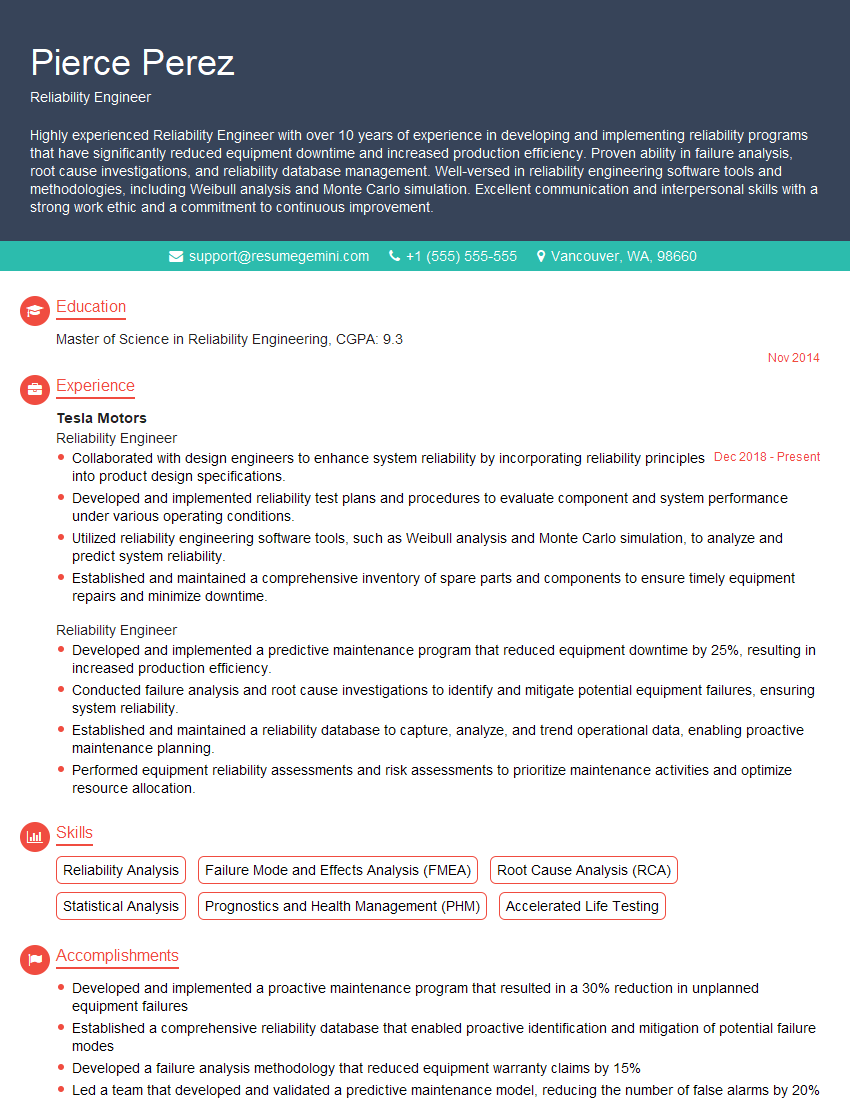
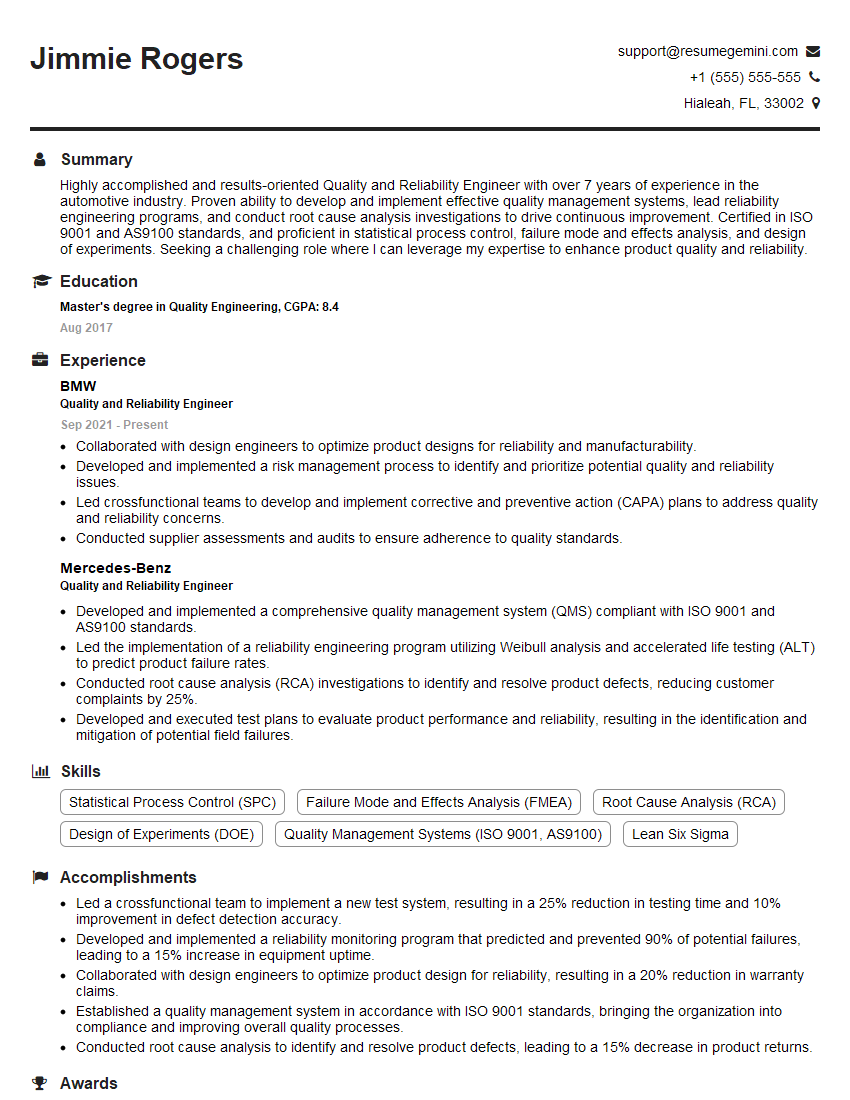
Mastering Reliability and Dependability is crucial for career advancement in today’s technology-driven world. These skills are highly sought after, opening doors to challenging and rewarding roles with significant growth potential. To maximize your job prospects, it’s vital to present your expertise effectively. Creating an ATS-friendly resume is key to ensuring your application gets noticed. ResumeGemini is a trusted resource that can significantly enhance your resume-building experience. We provide examples of resumes tailored specifically to highlight Reliability and Dependability expertise to help you showcase your skills and secure your dream job.
Explore more articles
Users Rating of Our Blogs
Share Your Experience
We value your feedback! Please rate our content and share your thoughts (optional).
What Readers Say About Our Blog
I Redesigned Spongebob Squarepants and his main characters of my artwork.
https://www.deviantart.com/reimaginesponge/art/Redesigned-Spongebob-characters-1223583608
IT gave me an insight and words to use and be able to think of examples
Hi, I’m Jay, we have a few potential clients that are interested in your services, thought you might be a good fit. I’d love to talk about the details, when do you have time to talk?
Best,
Jay
Founder | CEO