Feeling uncertain about what to expect in your upcoming interview? We’ve got you covered! This blog highlights the most important Automatic Stamping Machine Operation interview questions and provides actionable advice to help you stand out as the ideal candidate. Let’s pave the way for your success.
Questions Asked in Automatic Stamping Machine Operation Interview
Q 1. Describe your experience with different types of automatic stamping machines.
My experience encompasses a wide range of automatic stamping machines, from simple single-station presses to complex progressive dies and high-speed transfer presses. I’ve worked with mechanical presses, hydraulic presses, and servo-driven presses, each with its own unique characteristics and applications. For instance, I’ve extensively used mechanical presses for high-volume production of simple parts like washers and fasteners, while servo-driven presses were ideal for intricate parts requiring precise control and reduced wear and tear. I’m also familiar with various press sizes, ranging from small benchtop models to large industrial presses with capacities exceeding 1000 tons. Each type requires a different level of maintenance, setup, and operational expertise. This hands-on experience has given me a comprehensive understanding of the strengths and limitations of each type, allowing me to select the optimal machine for a given project.
Q 2. Explain the process of setting up a stamping die.
Setting up a stamping die is a precise and crucial process that requires meticulous attention to detail. It involves several steps. First, we carefully inspect the die for any damage or wear. Next, the die is securely mounted onto the press using appropriate tooling and fixtures. Precise alignment is paramount, often achieved using shims and alignment pins to ensure the punch and die cavities align perfectly. This prevents misalignment that could damage the die or lead to defective parts. Following this, we perform a trial run with scrap material to check the die’s alignment and functionality, adjust press settings like speed and ram stroke based on the material properties and die design, and making necessary adjustments to ensure optimal operation. We monitor the stamped parts for any defects and fine-tune the setup until the desired quality is achieved. It’s like assembling a complex puzzle where every piece must fit perfectly to create the final product.
Q 3. How do you troubleshoot common malfunctions in an automatic stamping machine?
Troubleshooting stamping machine malfunctions requires a systematic approach. Common issues include die breakage, misalignment, inconsistent part quality, and mechanical failures. My troubleshooting process begins with a thorough visual inspection of the machine and the die. I then check the press’s safety features, electrical systems, and hydraulic or pneumatic components. I might utilize diagnostic tools to pinpoint the problem. For example, if the parts are inconsistent, it suggests die wear or misalignment. A loud noise might indicate a bearing problem. By systematically examining potential issues based on symptoms, and using tools such as pressure gauges and electrical meters, I can quickly isolate the problem and implement the necessary repairs or adjustments. Documenting each step is critical for future reference and process improvement.
Q 4. What safety precautions do you follow when operating a stamping machine?
Safety is my top priority. Before operating any stamping machine, I always ensure that all safety guards are in place and functioning correctly. I never attempt to adjust or repair the machine while it’s running, and I always use appropriate personal protective equipment (PPE), including safety glasses, hearing protection, and steel-toed shoes. I also follow lockout/tagout procedures to prevent accidental startup during maintenance or repairs. Regular machine inspections and preventative maintenance are crucial for preventing accidents. Moreover, adhering to company safety protocols and training, and reporting any unsafe conditions immediately, are fundamental aspects of my operating procedure. Treating the machine with respect and understanding its potential dangers is paramount.
Q 5. How do you ensure the quality of stamped parts?
Ensuring the quality of stamped parts involves a multi-faceted approach. First, I carefully select the right material and die design to meet the required specifications. During the setup process, I use gauges and measuring tools to constantly monitor the dimensions and tolerances of the stamped parts. Statistical Process Control (SPC) charts are used to track key parameters and identify trends. Visual inspection plays a crucial role in detecting any surface defects. Furthermore, regular preventative maintenance of the machine and dies is critical in maintaining consistent part quality. A poorly maintained machine can introduce variability and defects. Ultimately, adhering to a strict quality control process, using appropriate quality control tools, and keeping meticulous records of the process guarantees quality.
Q 6. What are the different types of stamping dies?
Stamping dies come in various types, each designed for specific applications.
- Progressive Dies: These perform multiple operations in a single stroke, increasing efficiency. Think of making a complex part like a gear in one go.
- Compound Dies: Perform two or more operations simultaneously using different sets of punches and dies.
- Single-Action Dies: Perform a single operation per stroke. This is ideal for simpler parts.
- Blanking Dies: Primarily used for cutting out shapes from sheet metal.
- Bending Dies: Used for forming metal sheets into various shapes.
- Drawing Dies: Used to form cups or other shapes by drawing the metal through a die opening.
Q 7. Explain the concept of tonnage and its relevance to stamping operations.
Tonnage refers to the force, measured in tons, that a stamping press can exert. It’s crucial for determining whether a press is suitable for a particular stamping operation. The required tonnage depends on factors like the material’s thickness, strength, and the complexity of the stamping operation. For example, stamping a thick steel plate requires a significantly higher tonnage than stamping thin aluminum sheet. Selecting a press with insufficient tonnage can lead to die failure or producing substandard parts; choosing one with excessive tonnage is unnecessary and adds cost. Therefore, accurate tonnage calculation is essential for selecting the appropriate press and ensuring efficient and safe operation.
Q 8. How do you perform preventative maintenance on a stamping machine?
Preventative maintenance on a stamping machine is crucial for maximizing uptime and preventing costly breakdowns. It’s like regularly servicing your car – small, regular checks prevent major problems later. My approach involves a multi-faceted strategy focusing on lubrication, inspection, and cleaning.
Lubrication: I meticulously lubricate all moving parts according to the machine’s manufacturer specifications. This includes slides, bearings, and gears. I use the correct type and quantity of lubricant to prevent wear and tear. For example, I’d never use grease where oil is specified, as this can lead to gumming and damage.
Inspection: A thorough visual inspection is key. I check for signs of wear, such as scoring on slides, cracks in die components, or loose fasteners. I also pay close attention to the condition of belts, hydraulic lines, and electrical connections. A simple check of a loose bolt, for instance, could prevent a catastrophic failure.
Cleaning: Regular cleaning is paramount. I remove chips, shavings, and debris that accumulate during operation. This prevents buildup that can interfere with the machine’s operation or damage components. A clean machine is a more efficient machine.
Scheduled Maintenance: I adhere to a strict preventative maintenance schedule, which includes more extensive checks such as checking the hydraulic fluid levels and quality, checking the air pressure of pneumatic systems, and verifying the accuracy of safety interlocks. This schedule is tailored to the specific machine and its workload.
By diligently following this preventative maintenance routine, I contribute to the extended lifespan of the stamping machine and ensure consistent, high-quality production.
Q 9. What are the common causes of die failure?
Die failure is a common problem in stamping, often leading to costly downtime and production delays. The causes are varied, but some common culprits include:
Excessive Wear and Tear: Repeated stamping cycles gradually wear down the die components, especially the punches and dies themselves. This is accelerated by improper lubrication or using the wrong materials.
Improper Material: Using materials that are too hard or too brittle for the die can lead to cracking or chipping. Similarly, using materials with inconsistent hardness can cause uneven wear.
Overloading: Exceeding the die’s rated capacity can cause significant damage, potentially bending or breaking components. This can happen if the material thickness or the stamping force is too high.
Improper Maintenance: Neglecting regular maintenance, including lubrication and cleaning, can significantly accelerate die wear and increase the risk of failure.
Incorrect Die Design or Setup: Poorly designed dies or incorrect setup can lead to uneven stress distribution, causing premature failure. This often requires a skilled toolmaker to rectify.
Collisions: Collisions between the die and other machine components can cause immediate and catastrophic failure. This highlights the importance of proper machine guarding and safety protocols.
Identifying the root cause of die failure is crucial for implementing corrective actions and preventing future occurrences. This often involves a combination of visual inspection, material testing, and an analysis of the stamping process parameters.
Q 10. How do you identify and resolve issues related to part ejection?
Part ejection problems can significantly impact production efficiency. This is often caused by a malfunction in the ejection system, which is usually pneumatic or mechanical. I use a systematic approach to troubleshoot these issues:
Inspect the Ejector Pins: I start by visually inspecting the ejector pins for wear, damage, or misalignment. Bent or broken pins are common causes of ejection failure. A simple replacement often solves the problem.
Check Air Pressure (if pneumatic): If the system is pneumatic, I verify the air pressure is within the specified range. Low air pressure can weaken the ejection force, leading to parts sticking.
Examine the Ejection System Mechanisms: I carefully examine the entire ejection system, including springs, linkages, and actuators, for any malfunctions, wear, or damage. This might involve checking for worn cam lobes or sticking linkages.
Assess the Part Design: Sometimes the problem lies in the part design itself. Undercuts or complex geometries can make ejection difficult. Redesigning the part or modifying the ejector system to accommodate the part design might be necessary.
Inspect the Die: Sometimes, issues within the die itself can cause parts to stick. This requires a thorough examination of the die cavity to find any burrs, flashing, or other imperfections that hinder ejection.
Addressing part ejection problems often requires a combination of mechanical adjustments, system parameter changes, or even die modifications. I always prioritize safety and follow lockout/tagout procedures during any troubleshooting or repair activities.
Q 11. Describe your experience with different materials used in stamping.
My experience encompasses a wide range of materials commonly used in stamping, including:
Mild Steel: A workhorse material known for its formability and cost-effectiveness. I have extensive experience with different grades and thicknesses of mild steel, from thin gauge sheet metal to thicker plates.
Stainless Steel: I am proficient in stamping various grades of stainless steel, understanding the challenges associated with its higher strength and work hardening tendencies. Specialized lubrication and die designs are often required.
Aluminum: Aluminum alloys present unique challenges due to their softness and tendency to gall. I have worked with various aluminum alloys, adapting my techniques to minimize surface damage and ensure accurate stamping.
Copper and Brass: I have experience stamping copper and brass alloys, understanding their ductility and potential for springback. Die design and process parameters must be carefully chosen.
Other Alloys: I’m also experienced with specialized alloys, like titanium or high-strength steels, requiring careful selection of lubrication and tooling to manage their properties.
Material selection is critical in stamping, as the material’s properties significantly impact the die design, stamping parameters (e.g. tonnage, speed), and tooling lifespan. Understanding material behavior is key to optimizing the stamping process.
Q 12. How do you handle material jams or feeding problems?
Material jams or feeding problems are common occurrences in stamping. My approach to handling these issues involves a systematic troubleshooting process:
Identify the Cause: I begin by carefully determining the root cause of the jam. Is it due to a kink in the coil, improper coil alignment, insufficient feed force, or a problem with the material feeder mechanism itself?
Check Material Feed System: I inspect the entire material feed system, including the coil, straightener, and feeder rollers, looking for any obstructions, misalignments, or damage. This often requires removing the jammed material carefully and safely.
Adjust Feed Settings: I may need to adjust the feed settings, such as feed speed or roll pressure, to optimize material flow. Small adjustments can make a big difference.
Clean and Lubricate: Cleaning and lubricating the feed rollers can often resolve minor feeding issues. Accumulated debris can impede the smooth flow of material.
Verify Straightener Operation: I confirm the straightener is functioning correctly, ensuring the material is properly straightened before feeding into the die. A bent or damaged straightener can cause material jams.
Preventing material jams involves proper material handling, regular maintenance of the feed system, and choosing the right type of material feeder for the application. Proper operator training and attention to detail are equally important.
Q 13. What are your skills in using measuring instruments for quality control?
Accurate measurement is essential for quality control in stamping. I am proficient in using a variety of measuring instruments, including:
Micrometers: For precise measurements of part dimensions, ensuring tolerances are met.
Calipers: For measuring both internal and external dimensions, offering a quick and efficient method for dimensional checks.
Height Gauges: For precise measurements of height and depth.
Optical Comparators: For detailed inspection of part geometry, ensuring alignment and conformity to design specifications.
Coordinate Measuring Machines (CMMs): For complex parts needing 3-D measurements and automated data capture. The use of CMMs allows for a high degree of accuracy and repeatability, allowing for trend analysis.
I understand the importance of calibration and proper instrument handling to ensure accurate measurements. I document all measurements meticulously, contributing to effective quality control and process improvement.
Q 14. Explain your understanding of programmable logic controllers (PLCs) in stamping machines.
Programmable Logic Controllers (PLCs) are the brains of modern stamping machines, controlling various aspects of the process, from material feeding to die protection. My understanding of PLCs in stamping machines is comprehensive.
Control Sequence: PLCs manage the sequence of operations, ensuring each step occurs in the correct order. This includes controlling the press stroke, material feed, and ejection mechanisms.
Safety Systems: PLCs play a critical role in safety systems, monitoring emergency stops, light curtains, and other safety devices. This ensures the safety of the operator and prevents accidents.
Data Acquisition: PLCs collect data on various process parameters, such as press tonnage, stroke speed, and cycle time. This data is crucial for monitoring machine performance, detecting potential problems, and performing predictive maintenance. I can interpret this data to optimize the process.
Diagnostics: PLCs provide diagnostic capabilities, helping identify and troubleshoot malfunctions. Fault codes and error messages assist in pinpointing the source of problems.
Programming and Modification: While I don’t typically program PLCs from scratch, I possess a strong understanding of their functionality and can interpret ladder logic diagrams (or similar programming languages) to troubleshoot and modify existing programs. I can work with automation engineers to address control system issues.
My understanding of PLCs allows me to effectively operate, maintain, and troubleshoot stamping machines, ensuring optimal performance and safety. In essence, I understand how the ‘software’ of the machine controls its ‘hardware’, a crucial aspect of efficient and safe operation.
Q 15. How do you interpret engineering drawings and specifications related to stamping dies?
Interpreting engineering drawings and specifications for stamping dies requires a keen eye for detail and a solid understanding of manufacturing processes. I start by identifying the part’s geometry, dimensions, and tolerances. This involves carefully examining the views (front, top, side), sections, and details to fully understand the part’s three-dimensional shape. Then, I analyze the die design itself, looking at the various components like punches, dies, stripper plates, and guides. Crucially, I focus on identifying critical dimensions like punch and die clearances, which directly impact part quality. I also check for specified materials, surface finishes, and heat treatments. For example, if the drawing specifies a specific surface roughness (Ra value), I’ll ensure the chosen die materials and manufacturing processes are suitable to achieve that finish. Any discrepancies or ambiguities are immediately flagged for clarification with the engineering team to avoid errors in production. I’m proficient in using various CAD software (e.g., SolidWorks, AutoCAD) to visualize and analyze the drawings in 3D, further aiding in my understanding.
Career Expert Tips:
- Ace those interviews! Prepare effectively by reviewing the Top 50 Most Common Interview Questions on ResumeGemini.
- Navigate your job search with confidence! Explore a wide range of Career Tips on ResumeGemini. Learn about common challenges and recommendations to overcome them.
- Craft the perfect resume! Master the Art of Resume Writing with ResumeGemini’s guide. Showcase your unique qualifications and achievements effectively.
- Don’t miss out on holiday savings! Build your dream resume with ResumeGemini’s ATS optimized templates.
Q 16. Describe your experience with different types of lubricants and their applications.
My experience with lubricants spans various types, each suited for specific applications in stamping. For instance, I’ve worked extensively with drawing compounds, which are applied to the sheet metal before stamping to improve surface finish and reduce friction. These are often water-based or oil-based, chosen based on the material being stamped and the desired outcome. Then there are press lubricants, which are applied directly to the die surfaces during operation. These are usually heavy-duty oils or greases designed to withstand high pressures and temperatures, minimizing wear and tear on the dies. I’ve used both mineral-based and synthetic lubricants, with the choice depending on factors like material compatibility, operating temperature, and environmental concerns. For example, a high-pressure synthetic lubricant might be preferred for stamping titanium alloys due to its superior high-temperature stability and reduced friction compared to a mineral oil. Proper lubricant selection and application are critical to prevent galling, seizing, and extending die life. Regular monitoring of lubricant levels and condition is part of my standard operating procedure.
Q 17. How do you maintain accurate production records?
Maintaining accurate production records is essential for tracking productivity, identifying bottlenecks, and ensuring product quality. I utilize a combination of methods, including digital data logging systems integrated with the stamping machines, and manual record-keeping where necessary. The digital systems provide real-time data on the number of parts produced, cycle times, downtime, and any detected errors. This data is then meticulously cross-checked against manual production counts. For instance, I might use a spreadsheet to track parts rejected due to defects, categorizing them by the type of defect (e.g., burrs, scratches, dimensional inaccuracies). This detailed information allows for the timely identification of potential problems in the process. Furthermore, I make sure all records are properly dated, time-stamped, and signed, maintaining a clear audit trail. Regular reports are generated summarizing daily, weekly, and monthly production figures, which are then reviewed with supervisors to identify areas for improvement.
Q 18. What is your experience with different types of stamping machine controls?
Throughout my career, I’ve worked with a range of stamping machine controls, from older mechanical systems to modern PLC (Programmable Logic Controller) based controls. The mechanical controls, while simpler, require a deep understanding of the machine’s workings and precise adjustments. They rely on mechanical linkages, cams, and levers for controlling various aspects of the process. Modern PLC systems, however, offer significantly more flexibility and control, allowing for precise parameter adjustments, automated sequences, and real-time monitoring. I’m proficient in programming and troubleshooting PLC systems, which enables me to optimize the stamping process for speed, efficiency, and accuracy. For instance, I’ve implemented safety interlocks and automatic shut-off mechanisms using PLC programming to enhance operator safety. My expertise also extends to Human-Machine Interfaces (HMIs) which allow me to easily interact with and monitor the machines during operation.
Q 19. Explain your understanding of stroke adjustment and its impact on part quality.
Stroke adjustment refers to the precise control of the distance the stamping press’s ram travels during each cycle. It’s a critical parameter impacting part quality and die life. An insufficient stroke may lead to incomplete forming or stamping, resulting in parts that don’t meet specifications. Conversely, an excessive stroke can result in excessive wear and tear on the die, leading to premature failure or even damage to the machine. Think of it like baking a cake – you need the right amount of time in the oven for the desired outcome. Similarly, adjusting the stroke ensures that the punch completely forms the part without exceeding its limitations. I routinely adjust stroke lengths based on the specific part geometry, material properties, and die design. Fine-tuning is often necessary, and this is usually done incrementally while carefully monitoring the resulting part quality, using measuring tools and gauges to ensure that all dimensions and tolerances are met. Improper stroke adjustments can lead to scrap parts, and it’s essential to document any changes for consistent production.
Q 20. How do you handle emergency situations during operation?
Handling emergency situations requires quick thinking and adherence to safety protocols. My first response to any malfunction is to immediately shut down the machine using the emergency stop button. Then, I assess the situation, identifying the source of the problem while ensuring operator and machine safety. This might involve checking for obvious issues like broken tooling, electrical faults, or material jams. If the problem is beyond my immediate expertise, I follow the established communication protocols to notify the supervisor and/or maintenance personnel. For example, a sudden loud noise or unusual vibration could indicate a tool failure that requires expert intervention. In every scenario, maintaining safety is paramount. Before restarting the machine, I perform a thorough inspection to ensure all safety mechanisms are functioning correctly, the issue is resolved, and the machine is safe to operate.
Q 21. What are the common causes of press strokes?
Press strokes, or cycles, are initiated to form the parts. The common causes of a press stroke’s initiation can be broadly categorized as either operator-initiated or automated. In operator-initiated strokes, a button press or lever activation triggers the process. This is common in machines with manual or semi-automatic controls. Automated systems, however, use various sensors and control systems. For example, a sensor detecting the presence of a workpiece might trigger a stroke. Another common cause could be a PLC program completing a sequence of actions, resulting in a press stroke. In both cases, the sequence of events leading to the stroke is precisely defined, whether through mechanical linkage, electrical signals, or programmed instructions. Understanding these processes is vital for effective troubleshooting and process optimization. Analyzing abnormal stroke patterns can help pinpoint problems in sensors, controls, or the mechanical systems themselves.
Q 22. What are your experience and skills in reading and interpreting work orders?
Reading and interpreting work orders is fundamental to efficient stamping operations. It involves understanding the specifications for each job, including the part drawing, material requirements, quantity needed, and any specific instructions. I have extensive experience in this area, having worked with various formats, from simple handwritten notes to complex CAD-generated work orders. My process involves:
- Careful Review: I meticulously examine all aspects of the work order, ensuring I understand every detail, including tolerances, surface finish requirements, and any special tooling needs.
- Part Identification: I accurately identify the part number and cross-reference it with available blueprints and specifications to confirm material type, thickness, and dimensions.
- Tooling Verification: I verify that the correct tooling is available and in good working condition to match the work order’s specifications. This involves checking for wear, damage, or any potential issues that could impact the quality of the stamped parts.
- Material Selection: I ensure that the specified material is available and meets the required quality standards. I always check for any discrepancies or potential material shortages before commencing production.
- Clarification (when needed): If any part of the work order is unclear or ambiguous, I proactively seek clarification from the supervisor or engineering team before proceeding. This avoids potential mistakes and rework.
For example, I once encountered a work order with an unclear tolerance on a critical dimension. By promptly seeking clarification from the engineering team, I prevented the production of a large batch of defective parts, saving both time and resources.
Q 23. Describe your experience using various hand tools relevant to this type of operation.
Proficiency with various hand tools is essential for setup, maintenance, and troubleshooting in stamping operations. My experience encompasses a wide range of tools, including:
- Micrometers and Calipers: For precise measurement of sheet metal thickness and part dimensions to ensure accuracy and adherence to tolerances.
- Wrenches (various sizes): Used for adjusting dies, clamping fixtures, and securing various machine components.
- Screwdrivers (Phillips and flathead): Essential for assembling and disassembling tools, adjusting settings, and performing minor repairs.
- Hammer and punches: Used carefully for minor adjustments to dies or for removing stubborn parts.
- Safety glasses and gloves: Always worn to protect against flying debris, sharp edges, and potential injuries.
I’m adept at using these tools safely and effectively, understanding the proper techniques to avoid damage to the tools themselves or the equipment. For instance, I always use the correct size wrench to avoid stripping bolts and ensure the proper torque is applied.
Q 24. How would you determine the appropriate speed and pressure settings for a particular job?
Determining the appropriate speed and pressure settings for a particular stamping job is crucial for optimal production and part quality. This involves a combination of experience, understanding material properties, and careful observation. My approach is as follows:
- Material Properties: The thickness and type of sheet metal significantly influence the required speed and pressure. Thicker materials generally require higher pressure and slower speeds to prevent damage to the die or the press itself. Different metals also have varying levels of ductility and strength which need to be accounted for.
- Die Design: The complexity of the die and the intricacy of the stamped part influence the ideal pressure and speed. Intricate designs require more precise control and potentially slower speeds.
- Trial Runs and Adjustments: I often perform trial runs with various pressure and speed combinations, monitoring the results closely. This iterative approach allows for fine-tuning the settings to achieve optimal results.
- Monitoring for Defects: I carefully monitor for signs of defects such as cracks, wrinkles, or tearing. These indicators help me adjust the parameters to minimize defects and improve part quality.
For example, when working with a new type of high-strength steel, I started with conservative settings and gradually increased pressure and speed while closely monitoring for any signs of stress or failure. This prevented damage to the die and ensured the production of high-quality parts.
Q 25. Describe your experience with different types of safety interlocks and their functions.
Safety is paramount in stamping operations. I’m familiar with various safety interlocks, each serving a specific function to prevent accidents. These include:
- Light Curtains: These detect the presence of objects or personnel in the press’s danger zone, automatically stopping the machine if an obstruction is detected. This prevents accidental injury to operators.
- Two-Hand Controls: Require the operator to keep both hands engaged on separate controls before the press cycle can commence. This ensures the operator’s hands are safely away from the press ram during operation.
- Emergency Stop Buttons: Strategically positioned throughout the machine and work area, allowing for immediate shutdown in case of emergencies.
- Die Safety Locks: Prevent the press from operating unless the die is properly secured in place, ensuring against unintended movement or ejection.
- Pressure Sensors: Used to monitor and shut down the system if pressure exceeds safe operating parameters.
I thoroughly understand the function and importance of each interlock and regularly inspect them to ensure they are functioning correctly. I am also trained to recognize and address malfunctions that may compromise safety.
Q 26. Explain your experience in handling different types of sheet metal thickness.
Handling different sheet metal thicknesses requires adjusting machine settings and choosing the appropriate tooling. My experience encompasses a wide range of thicknesses, from thin gauge materials used for intricate designs to thicker gauges for robust components. I adjust my approach based on the thickness:
- Thin Gauge Materials: Require lower pressures and speeds to prevent tearing or wrinkling. Specialized dies are sometimes required for handling the delicate nature of thin materials.
- Medium Gauge Materials: Offer a balance between formability and strength, allowing for a wider range of stamping operations and design possibilities.
- Thick Gauge Materials: Need higher pressures and lower speeds to avoid die damage and ensure proper forming. This usually involves using more robust tooling and presses.
I carefully select tooling based on the sheet metal thickness to prevent damage or breakage. I also adjust the speed and pressure settings of the press, ensuring the material is formed correctly without defects.
Q 27. How would you train new employees on proper machine operation and safety procedures?
Training new employees involves a structured approach that emphasizes both safe operation and efficient production techniques. My training program would incorporate:
- Classroom Instruction: Covering machine operation, safety procedures, work order interpretation, and troubleshooting techniques.
- Hands-on Training: Starting with simpler stamping operations under close supervision, gradually progressing to more complex tasks.
- Safety Demonstration: Showing correct procedures for using safety equipment, inspecting the machine, and responding to emergencies.
- Practical Exercises: Allowing new employees to perform tasks under observation, providing feedback and guidance.
- Regular Assessments: To monitor progress and ensure understanding of concepts.
- Ongoing Mentorship: Providing continued support and answering questions.
I believe in a hands-on approach, emphasizing the importance of safe operation and promoting a culture of continuous learning. I find that a combination of theoretical knowledge and practical experience is the most effective method for training new employees.
Q 28. What is your experience with lean manufacturing principles in stamping operations?
Lean manufacturing principles are integral to maximizing efficiency and minimizing waste in stamping operations. My experience includes applying several lean methodologies:
- 5S Methodology: Implementing a structured approach to workplace organization, ensuring a clean, safe, and efficient work environment. This improves workflow and reduces the risk of errors.
- Kaizen Events: Participating in continuous improvement initiatives, identifying areas for optimization, and implementing changes to improve efficiency.
- Value Stream Mapping: Analyzing the entire stamping process to identify and eliminate waste, reducing lead times and improving overall productivity.
- Preventive Maintenance: Proactive maintenance strategies to minimize downtime and ensure consistent production. This includes regular inspections, lubrication, and component replacements.
- Just-in-Time Inventory: Optimizing material flow and storage to ensure components are available as needed, reducing inventory costs and storage space.
By applying these principles, I have contributed to reduced production times, lower defect rates, and improved overall efficiency in stamping operations. For example, a recent Kaizen event led to the implementation of a new tool storage system that reduced setup times by 15%, significantly improving overall production efficiency.
Key Topics to Learn for Automatic Stamping Machine Operation Interview
- Machine Setup and Calibration: Understanding the process of setting up the machine for different stamping jobs, including die selection, material adjustments, and pressure calibration. This includes pre-operational checks and safety procedures.
- Operational Procedures: Mastering the safe and efficient operation of the automatic stamping machine, including starting, stopping, and monitoring the process. This also involves understanding the machine’s control panel and error messages.
- Quality Control and Inspection: Knowing how to identify and address defects in stamped products, including understanding tolerances and quality standards. This involves implementing quality control measures and using inspection tools.
- Maintenance and Troubleshooting: Familiarizing yourself with routine maintenance tasks and common troubleshooting procedures. This includes identifying potential issues, performing minor repairs, and knowing when to escalate problems to maintenance personnel.
- Safety Regulations and Procedures: Demonstrating a thorough understanding of all relevant safety protocols, including lockout/tagout procedures, personal protective equipment (PPE) usage, and emergency response procedures.
- Material Handling and Storage: Understanding the proper procedures for handling and storing stamping materials, ensuring efficient workflow and minimizing waste.
- Production Optimization: Knowing how to optimize the stamping process for speed, efficiency, and minimal material waste. This includes understanding factors affecting production rates and implementing improvements.
Next Steps
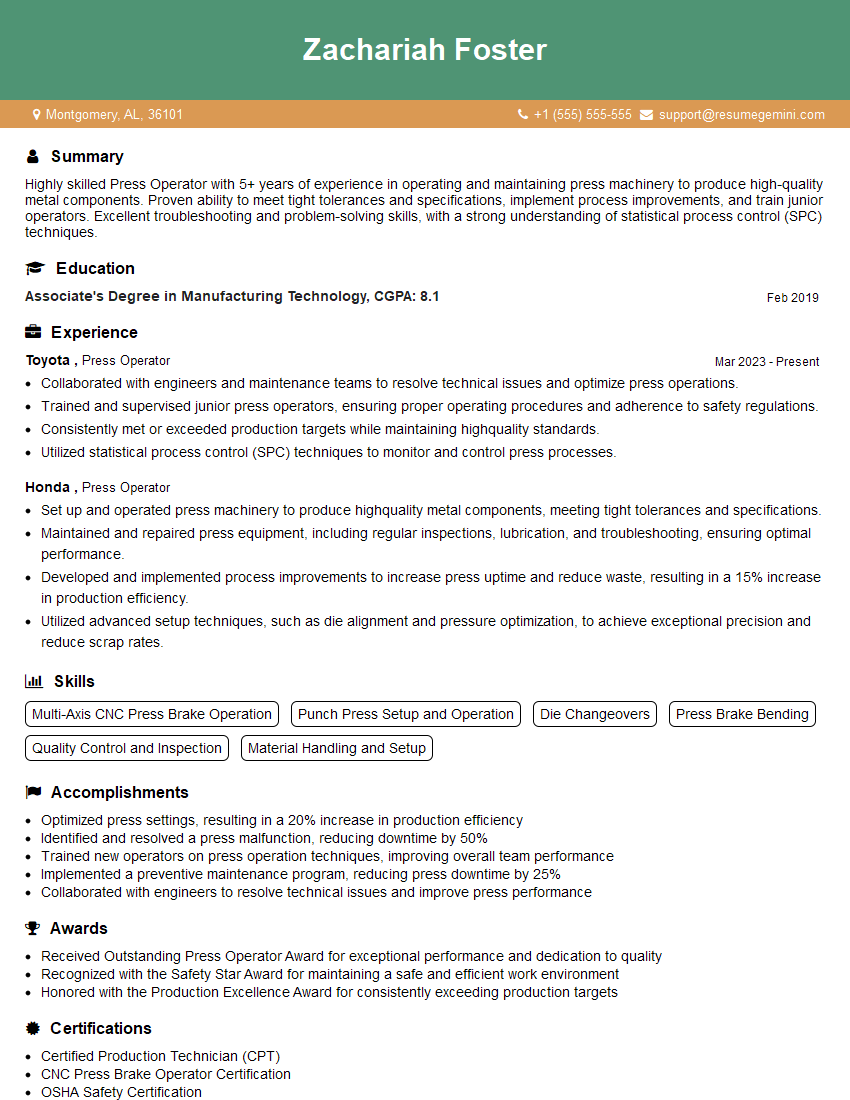
Mastering Automatic Stamping Machine Operation opens doors to a rewarding career with opportunities for advancement and specialization. A strong understanding of these machines is highly valued in manufacturing environments, leading to increased job security and earning potential. To maximize your chances of landing your dream role, a well-crafted resume is crucial. An ATS-friendly resume, optimized for Applicant Tracking Systems, significantly increases your visibility to potential employers. ResumeGemini is a trusted resource to help you build a professional, impactful resume tailored to your skills and experience. Examples of resumes tailored to Automatic Stamping Machine Operation are available to guide you through the process. Invest time in creating a strong resume – it’s your first impression!


Explore more articles
Users Rating of Our Blogs
Share Your Experience
We value your feedback! Please rate our content and share your thoughts (optional).
What Readers Say About Our Blog
I Redesigned Spongebob Squarepants and his main characters of my artwork.
https://www.deviantart.com/reimaginesponge/art/Redesigned-Spongebob-characters-1223583608
IT gave me an insight and words to use and be able to think of examples
Hi, I’m Jay, we have a few potential clients that are interested in your services, thought you might be a good fit. I’d love to talk about the details, when do you have time to talk?
Best,
Jay
Founder | CEO