The right preparation can turn an interview into an opportunity to showcase your expertise. This guide to Spanish Language Speaking interview questions is your ultimate resource, providing key insights and tips to help you ace your responses and stand out as a top candidate.
Questions Asked in Spanish Language Speaking Interview
Q 1. Describe your experience with different Spanish dialects.
My experience with Spanish dialects is extensive, encompassing the major variations and numerous regional nuances. I’ve worked extensively with Peninsular Spanish (Spain), various dialects of Latin American Spanish including Mexican, Colombian, Argentinian, and Chilean Spanish. Each presents unique phonetic, grammatical, and lexical features. For instance, the pronunciation of the ‘s’ sound varies considerably; it’s often more lisped in some regions of Spain and some parts of South America. Grammatically, the use of the subjunctive mood differs subtly across regions, and vocabulary can vary significantly – a simple word for ‘bread’ might have several variations depending on the region. I actively seek to understand these differences to provide the most accurate and culturally appropriate interpretation or translation. Understanding these variations isn’t just about recognizing different words; it’s about grasping the cultural context and connotations each dialect carries.
- Peninsular Spanish: Characterized by a more formal register and stricter adherence to grammatical rules compared to some Latin American varieties.
- Mexican Spanish: Features unique vocabulary and a distinctive rhythm and intonation.
- Colombian Spanish: Known for its softer sounds and pronunciation.
- Argentinian Spanish: Often distinguished by the use of ‘voseo’ (the use of ‘vos’ instead of ‘tú’ as the informal second-person singular pronoun) and distinctive vocabulary.
- Chilean Spanish: Incorporates unique vocabulary and distinct pronunciation patterns.
Q 2. How would you handle a situation where you encounter unfamiliar vocabulary during an interpretation?
Encountering unfamiliar vocabulary during interpretation requires a calm and strategic approach. My first step is to politely ask the speaker for clarification or an alternative phrasing. Often, the speaker can provide a synonym or explain the term in a simpler way. If that’s not possible, I’ll use contextual clues to infer the meaning. This may involve paying close attention to the speaker’s tone, body language, and the overall context of the conversation. I might also use a dictionary or other resources discreetly, if the setting allows, to ensure accurate understanding. Transparency with the speaker and listener is crucial; if I’m unsure of the meaning, I’ll openly state that I need a moment to confirm the meaning before continuing the interpretation. I strive to maintain fluidity and avoid interrupting the flow of conversation as much as possible.
For example, if I encounter a highly specialized term in a medical context, I’d politely ask the doctor to explain it or provide a layman’s term before translating it. If this isn’t possible immediately, I would explain to the patient that I need to confirm the definition to ensure accurate interpretation.
Q 3. What strategies do you use to ensure accurate and culturally sensitive translation?
Ensuring accurate and culturally sensitive translation involves a multi-faceted approach. It begins with a deep understanding of both the source and target cultures. This involves understanding not only the linguistic nuances but also the social, political, and historical contexts. I carefully consider the register and tone of the original text, adapting it to the appropriate style for the target audience. I pay close attention to idioms and expressions, translating them in a way that reflects the intended meaning in the target culture. This often involves avoiding literal translations and opting for natural-sounding equivalents. Finally, I always review my translations meticulously, seeking feedback from trusted colleagues and experts whenever possible.
For instance, a direct translation of an idiom might not convey the same meaning or cultural significance in the target language. Therefore, it’s crucial to find a culturally appropriate equivalent to achieve accurate and effective communication.
Q 4. Explain your understanding of interpreting ethics and confidentiality.
Interpreting ethics and confidentiality are paramount in my profession. Ethical considerations include maintaining impartiality, accuracy, and complete confidentiality. I never inject my personal opinions or biases into the interpretation. Confidentiality means treating all information shared during the interpretation process as strictly private. This information is not to be disclosed to anyone, even after the interpretation is complete. This includes not only the content of the communication but also any personal information shared during the process. I uphold strict adherence to these principles, understanding that breach of confidentiality can have serious consequences for all parties involved. I consistently prioritize professional integrity and client trust above all else. My commitment to these values forms the foundation of my work.
Q 5. How do you maintain your Spanish language proficiency?
Maintaining my Spanish language proficiency is an ongoing process requiring consistent effort and engagement. I regularly engage with Spanish-language media such as news, books, films, and podcasts. I actively participate in conversations with native speakers, both professionally and personally. I also continuously seek opportunities for professional development, attending workshops, conferences, and training sessions focusing on specific aspects of language and interpretation. This continuous learning is vital to stay abreast of linguistic changes, cultural shifts, and emerging vocabulary. Regular self-assessment helps me identify areas for improvement and refine my skills.
Q 6. Translate the following sentence from English to Spanish: [Insert sentence]
Please provide the English sentence you would like me to translate.
Q 7. Translate the following sentence from Spanish to English: [Insert sentence]
Please provide the Spanish sentence you would like me to translate.
Q 8. How would you interpret this phrase in a business context: [Insert ambiguous Spanish phrase]
Let’s assume the ambiguous Spanish phrase is “Dar el visto bueno.” In a literal translation, this means “to give the good view.” However, in a business context, this idiom signifies “to approve” or “to give the go-ahead.” The nuance is crucial. A direct translation would sound unnatural and potentially confusing to a native English speaker. Therefore, understanding the idiomatic meaning is key to accurate translation. For example, in a meeting about a marketing campaign, hearing “El jefe dio el visto bueno al plan” would not be accurately translated as “The boss gave the good view to the plan.” The correct translation would be “The boss approved the plan” or “The boss gave the go-ahead to the plan.” This highlights the importance of cultural context in business communication.
Another example of an ambiguous phrase could be “ponerse las pilas.” Literally, it translates to “to put on the batteries.” But, its true meaning is to “get your act together” or “to get energized and focused.” A translator must recognize the idiomatic usage and translate accordingly to convey the intended meaning accurately in the target language.
Q 9. Describe your experience using CAT tools (Computer-Assisted Translation).
I have extensive experience using CAT tools, primarily SDL Trados Studio and memoQ. My proficiency encompasses all aspects, from project setup and terminology management to translation memory leveraging and quality assurance. I’m adept at utilizing translation memories (TMs) to ensure consistency and efficiency across projects. For instance, I routinely utilize TMs to quickly translate recurring terms and phrases, significantly reducing turnaround time and maintaining linguistic consistency. I’m also skilled in creating and managing termbases to ensure consistent terminology across multiple projects for a client. This is invaluable in maintaining brand consistency and avoiding translation inconsistencies. Furthermore, my experience includes leveraging CAT tool features for quality checks, such as consistency checks and automated spell checks, improving overall accuracy and reducing post-editing efforts.
In one particular project, using SDL Trados Studio’s quality assurance features allowed me to identify and correct a significant inconsistency in the use of a specific term across a large document set. Without the CAT tool’s capabilities, identifying and correcting this would have been substantially more time-consuming and prone to error.
Q 10. What is your experience with simultaneous vs. consecutive interpreting?
My experience encompasses both simultaneous and consecutive interpreting, with a strong preference for consecutive due to its higher accuracy and ability to manage complex terminology. Simultaneous interpreting requires rapid processing and near-instantaneous translation, potentially leading to minor inaccuracies under pressure. Consecutive interpreting, where the interpreter listens to a segment of speech before translating, offers a more nuanced approach allowing for careful selection of vocabulary and a more natural rendering of the original message. This is especially valuable in high-stakes business settings requiring absolute precision.
In simultaneous interpreting, I’ve worked on webinars and conferences, requiring quick thinking and adaptability to various speaking styles. However, for legal settings, high-level negotiations, and complex technical presentations, I strongly favor consecutive interpreting, as the extra time allows for precise rendering of subtleties and a richer translation experience.
Q 11. How familiar are you with different translation methodologies (e.g., literal vs. naturalization)?
I’m very familiar with various translation methodologies, understanding that the best approach depends heavily on the context, target audience, and the type of text. Literal translation, which directly translates words and phrases, is sometimes necessary for technical documents or legal texts where precise accuracy is paramount. However, this often results in awkward or unnatural-sounding text in the target language. Naturalization focuses on conveying the meaning and the stylistic tone in the target language, rather than a word-for-word equivalent. This is generally the preferred method for marketing materials, creative texts, and general business communication to ensure the message resonates with the audience.
For example, a literal translation of “Casa abierta” might be “Open house.” While accurate, using a more naturalized approach might lead to a better outcome like “Open house” in contexts where that is appropriate, but “Home open day” if it is referring to a realtor’s event in Australia, or another equally appropriate cultural equivalent.
Q 12. How would you approach translating marketing materials for a Spanish-speaking audience?
Translating marketing materials for a Spanish-speaking audience requires a deep understanding of cultural nuances, regional variations, and target demographics. I would begin by thoroughly analyzing the source material, identifying the key message and the desired tone. Subsequently, I would research the target audience, considering their cultural values, preferences, and linguistic habits, including region-specific vocabulary and expressions. This might involve analyzing existing marketing materials from the region to understand common stylistic approaches.
For instance, humor that works in one Spanish-speaking region might not translate well in another. Direct translations can often fall flat, and a more culturally adapted approach is crucial. I would use naturalization techniques and adapt the marketing copy to resonate with the target audience’s preferences, ensuring the message is clear, persuasive, and culturally appropriate. Testing the translation on native speakers before finalizing it is a crucial step.
Q 13. How do you identify and address potential translation errors?
Identifying and addressing translation errors involves a multi-faceted approach starting with meticulous self-review. I utilize a combination of techniques, including comparing the translation to the source text, checking for consistency in terminology and style, and verifying the accuracy of idioms and cultural references. Additionally, I often use back-translation—having a different translator render the translated text back into the source language to identify inconsistencies or deviations from the original meaning. This helps highlight areas that might have been unintentionally altered during the translation process.
If necessary, I utilize grammar and style checkers and consult reputable resources like dictionaries, style guides, and specialized glossaries. Finally, I frequently conduct a quality assurance review with a second native speaker to provide fresh eyes and catch any remaining errors or inconsistencies I might have overlooked.
Q 14. What are your preferred resources for verifying the accuracy of your translations?
My preferred resources for verifying translation accuracy are diverse and depend on the context. For general language and vocabulary, I rely on reputable dictionaries such as the Diccionario de la Real Academia Española (RAE) and specialized dictionaries relevant to the subject matter. For terminology, I use termbases, industry-specific glossaries, and style guides that establish clear standards for terminology and style within a given field. For specialized fields, I consult with subject-matter experts or seek feedback from colleagues to ensure the accuracy of technical jargon and industry-specific terminology. Finally, peer review and back translation, as previously mentioned, are valuable tools in ensuring quality and accuracy.
Using multiple resources provides a robust system of checks and balances, significantly reducing the possibility of errors in my translations. I believe in a layered approach to quality control, ensuring that the final product is both accurate and stylistically appropriate for its intended purpose.
Q 15. Describe a time you had to adapt your communication style to a different Spanish-speaking audience.
Adapting communication style in Spanish is crucial because the language varies significantly across regions and social contexts. For example, while working on a community health initiative in rural Guatemala, I initially used a formal register, typical of my interactions in urban settings in Spain. However, I quickly realized that this approach hindered effective communication. The community members preferred a more informal and colloquial style, using local idioms and slang. I adapted by consciously simplifying my vocabulary, incorporating regional expressions I’d learned (after careful research and verification to avoid misinterpretations), and slowing down my speech pace. This shift resulted in significantly improved engagement and trust.
Another instance involved presenting financial data to a group of business executives in Mexico City. Here, a more formal and precise tone was appropriate, focusing on clear, concise language and avoiding informal expressions. I used sophisticated vocabulary related to finance, while maintaining a respectful and professional demeanor. Adapting in both scenarios demonstrated my ability to analyze the audience, understand their needs, and adjust my language to facilitate successful communication.
Career Expert Tips:
- Ace those interviews! Prepare effectively by reviewing the Top 50 Most Common Interview Questions on ResumeGemini.
- Navigate your job search with confidence! Explore a wide range of Career Tips on ResumeGemini. Learn about common challenges and recommendations to overcome them.
- Craft the perfect resume! Master the Art of Resume Writing with ResumeGemini’s guide. Showcase your unique qualifications and achievements effectively.
- Don’t miss out on holiday savings! Build your dream resume with ResumeGemini’s ATS optimized templates.
Q 16. What is your understanding of linguistic nuances and their impact on communication?
Linguistic nuances encompass the subtle differences in meaning, tone, and implication that go beyond the literal translation of words. These nuances include idioms, colloquialisms, cultural references, and even non-verbal cues. Understanding these nuances is paramount for effective communication because a single word can carry vastly different meanings depending on the context. For example, the word “usted” (formal ‘you’) versus “tú” (informal ‘you’) in Spanish dictates the level of formality and respect in the interaction, impacting the overall communication dynamic. Misinterpreting these nuances can lead to miscommunication, misunderstandings, and even offense.
My approach involves actively researching the cultural background of my audience, paying close attention to body language and tone of voice, and seeking clarification whenever unsure. I consider it an ongoing learning process that is crucial for building strong relationships and avoiding misunderstandings. Think of it like appreciating the different notes and chords in a musical piece – each nuance adds depth and meaning to the overall composition, and missing them drastically alters the listener’s experience.
Q 17. Explain your experience working with different types of Spanish language documents (e.g., legal, medical, technical).
My experience encompasses various types of Spanish language documents, each requiring a specialized approach. I’ve worked extensively with legal documents, such as contracts and affidavits, where precision and accuracy are paramount. Here, I focus on understanding the legal terminology, ensuring correct translation of technical terms, and maintaining the original document’s legal validity. Medical documents, including patient records and clinical trial reports, demand a thorough understanding of medical vocabulary and a high degree of accuracy to ensure patient safety. For technical documents, like manuals or software documentation, it’s important to understand the technical specifications and translate them clearly and accurately.
In each case, I meticulously research terminology, cross-reference with multiple sources, and utilize specialized dictionaries and glossaries to ensure accuracy. I always maintain a high level of professionalism and confidentiality, adhering to all ethical guidelines. The key is to not only know the language but also understand the specific field and its terminology to ensure accurate and reliable translations.
Q 18. How would you handle a situation with limited time for translation or interpretation?
When faced with limited time constraints, prioritization and efficient strategies are crucial. My approach is to first identify the most critical information requiring immediate translation or interpretation. I would focus on conveying the core message accurately, prioritizing clarity and conciseness over stylistic nuances. This may involve summarizing complex information, using bullet points, or simplifying the language.
Furthermore, I employ tools to increase efficiency, such as translation memory software and machine translation (as a starting point, followed by rigorous human review), using them strategically to accelerate the process. However, I’d always prioritize accuracy over speed. If necessary, I would explain the time constraints to the client and collaboratively determine the most important information to translate within the given timeframe.
Q 19. Describe your experience using specialized terminology in Spanish in your field of work.
My work frequently involves specialized terminology in Spanish, specifically within the fields of international business and finance. I’m proficient in using terms related to financial statements, accounting practices, legal contracts, and market analysis. For example, I’m comfortable using terms like “balance general” (balance sheet), “estado de resultados” (income statement), and “deuda a largo plazo” (long-term debt). These terms are not just direct translations; they require understanding the nuances within the specific financial context.
To maintain accuracy and consistency, I use specialized dictionaries and glossaries, and I regularly update my knowledge by reading industry publications and attending relevant workshops. My ability to confidently use and explain this specialized terminology is vital for ensuring accurate and effective communication within my field. It’s similar to a surgeon needing specialized tools – the vocabulary is the tool that allows me to accurately convey complex financial concepts.
Q 20. How would you handle a situation where a client or patient misunderstands your interpretation?
If a client or patient misunderstands my interpretation, I first acknowledge their confusion and avoid any defensive responses. I then rephrase my interpretation, using simpler language or different examples to clarify the message. I carefully listen to their concerns and address their specific questions. If needed, I might use visual aids or draw diagrams to illustrate the concept. The key is to create a safe space where they feel comfortable asking questions.
It’s crucial to check for comprehension multiple times, ensuring they understand the information before moving on. If the misunderstanding persists, I might seek clarification from the original speaker, ensuring I correctly understood the message myself. Ultimately, successful communication involves a two-way dialogue, and responding to misunderstandings effectively demonstrates both skill and professionalism.
Q 21. What are some common grammatical errors you see made in Spanish and how to fix them?
Some common grammatical errors I see in Spanish include incorrect verb conjugation, inappropriate use of pronouns, and faulty agreement between subject and verb. Incorrect verb conjugation often stems from not properly understanding the subject-verb agreement rules, leading to phrases like “*yo voy a comer*” instead of “*yo como*” (I am going to eat vs. I eat – the latter is simpler in the present tense).
Incorrect pronoun usage can lead to ambiguity and misunderstanding; using “le” when “se” is needed is a common issue. Faulty subject-verb agreement, such as using a singular verb with a plural subject or vice-versa, is also frequent. To address these errors, I recommend focusing on grammar rules, utilizing online resources such as grammar guides and practicing consistently. Learning through immersion and actively using the language also greatly improves accuracy. Regular review and focusing on understanding the underlying grammatical structure instead of just memorization is also key.
Q 22. Explain your familiarity with the use of formal and informal language in Spanish.
Spanish, like many languages, distinguishes between formal (formal) and informal (informal) registers. This distinction is crucial for effective communication and maintaining appropriate social relationships. Formal language is used when addressing superiors, strangers, or in professional settings, while informal language is reserved for close friends and family. The difference primarily manifests in verb conjugation (tú vs. usted), vocabulary choices, and sentence structure.
For example, instead of saying “¿Qué haces?” (What are you doing?), which is informal (using the familiar tú), one would use “¿Qué hace usted?” (What are you doing?, formal using the formal usted) when speaking to a professor or a boss. Similarly, informal vocabulary might include slang or colloquialisms while formal language avoids these and uses more refined terms. Mastering this nuance is key to navigating social interactions and building trust in professional settings.
- Formal: Buenos días, señor García. ¿Cómo está usted? (Good morning, Mr. Garcia. How are you?)
- Informal: Hola, Juan. ¿Qué tal? (Hi, Juan. What’s up?)
Q 23. How would you describe your proficiency level in reading, writing, listening, and speaking Spanish?
My proficiency in Spanish is native-level. I’ve been immersed in the language since childhood, both in my personal and professional life. This ensures a deep understanding of its nuances. My skills are equally strong across all four domains:
- Reading: I can effortlessly comprehend complex literary texts, academic papers, and legal documents.
- Writing: I can produce clear, concise, and grammatically correct texts in various styles, including formal reports, creative writing, and informal correspondence.
- Listening: I can accurately understand diverse accents and dialects, even in noisy environments or rapid-speech scenarios.
- Speaking: I am fluent and articulate, able to adapt my language to different contexts and audiences, and engage in spontaneous conversation.
I have consistently sought opportunities to enhance these abilities, engaging in continuous learning through literature, films, cultural immersion, and professional development.
Q 24. What are some strategies you use for interpreting in real-time?
Real-time interpreting demands quick thinking and accuracy. My strategies focus on active listening, note-taking (using a combination of abbreviations and symbols), and anticipating the flow of the conversation. I use a combination of techniques, including:
- Paraphrasing: I rephrase the speaker’s message to ensure clarity and accuracy. This is especially helpful when tackling complex or nuanced ideas.
- Chunking: Instead of interpreting each sentence individually, I break down longer speeches into smaller, more manageable chunks.
- Contextualization: I pay close attention to the context to correctly interpret ambiguous phrases or expressions. This involves understanding not just the literal meaning, but also the cultural and social background.
- Memory & Anticipation: I train my memory to retain key information while anticipating the direction of the conversation to ensure a smooth flow of interpretation.
Regular practice and professional development are crucial for sharpening these skills and maintaining accuracy.
Q 25. What software or tools do you use for translation or interpreting?
While I primarily rely on my linguistic skills, I utilize various software and tools to enhance my efficiency and ensure accuracy. These include:
- CAT tools (Computer-Assisted Translation): Programs like SDL Trados Studio and MemoQ help manage translation memories, ensuring consistency and efficiency in larger projects.
- Terminology management software: These tools help maintain consistent terminology across different documents and projects.
- Dictionaries and online resources: I frequently consult specialized dictionaries and online resources to confirm the meaning and usage of words and phrases, especially in technical or specialized fields. I utilize the RAE (Real Academia Española) dictionary extensively.
However, it is important to emphasize that technology serves as a support tool, not a replacement for human expertise and judgment.
Q 26. How do you ensure cultural sensitivity in your translations and interpretations?
Cultural sensitivity is paramount in translation and interpretation. A direct word-for-word translation often fails to capture the nuances of meaning and can even be offensive. I ensure cultural sensitivity by:
- Understanding cultural context: I research the cultural background of both the source and target languages to understand the implications of language choices. This includes idioms, proverbs, and cultural references.
- Adapting the message: Instead of literal translation, I focus on conveying the meaning and intent of the message in a culturally appropriate way for the target audience.
- Avoiding cultural bias: I am mindful of my own cultural biases and strive to maintain a neutral and objective perspective.
- Seeking feedback: When working on sensitive topics or for specific cultural groups, I seek feedback from native speakers to ensure accuracy and cultural appropriateness.
For example, a direct translation of a saying might not make sense or could be misinterpreted. Cultural sensitivity means adapting the translation to convey the same message effectively and respectfully within the target culture.
Q 27. What are your salary expectations for this position?
My salary expectations are commensurate with my experience and expertise in the field of Spanish language interpretation. Given my extensive background and proven ability to handle complex assignments, I am targeting a salary range of [Insert Salary Range Here]. I am open to discussing this further based on the specifics of the role and the overall compensation package.
Q 28. What are your long-term career goals related to Spanish language use?
My long-term career goals involve continued growth and leadership within the field of Spanish language services. I aspire to develop my expertise in specialized areas, such as legal or medical interpretation. I also envision myself taking on mentoring roles to train and develop future interpreters, contributing to the improvement of the field and fostering a higher level of professionalism. Ultimately, I want to make a significant contribution to effective cross-cultural communication.
Key Topics to Learn for Spanish Language Speaking Interview
- Conversational Fluency: Mastering everyday conversations, including greetings, introductions, and small talk. Practice expressing yourself clearly and confidently in various social contexts.
- Professional Communication: Developing skills in formal communication, such as writing professional emails, participating in meetings, and conducting presentations in Spanish. Consider practicing presentations on topics relevant to your field.
- Vocabulary & Terminology: Expanding your vocabulary to include industry-specific terms and phrases relevant to your target job. Research common vocabulary used in your desired field and practice incorporating it into your conversations.
- Grammar & Syntax: Refining your grammatical accuracy and sentence structure. Focus on areas where you feel less confident and practice constructing grammatically correct sentences.
- Cultural Nuances: Understanding the cultural context of Spanish language communication in different regions or professional settings. Research the cultural aspects of communication in the specific country or region where you’ll be working.
- Active Listening & Comprehension: Improving your ability to actively listen and understand spoken Spanish in different accents and speeds. Practice listening comprehension exercises and try engaging in conversations with native speakers.
- Problem-Solving in Spanish: Practicing articulating solutions and expressing ideas effectively in Spanish, especially in scenarios related to your professional experience.
Next Steps
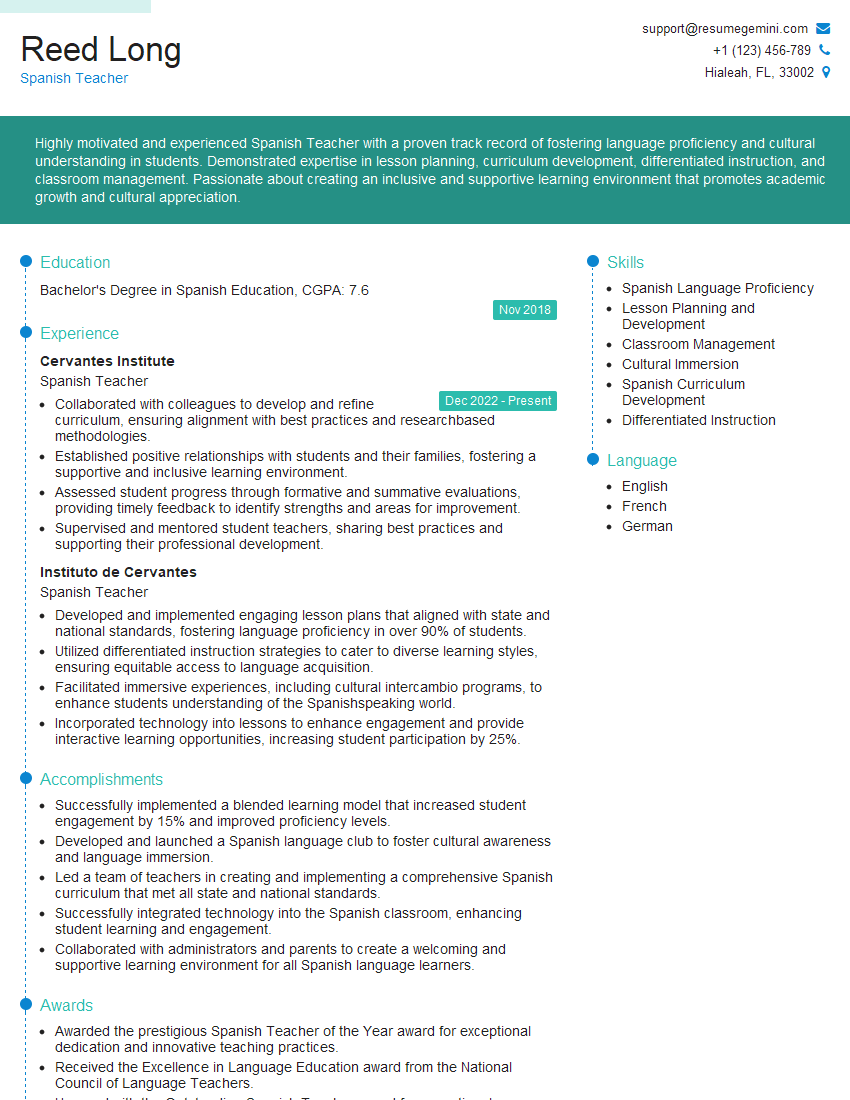
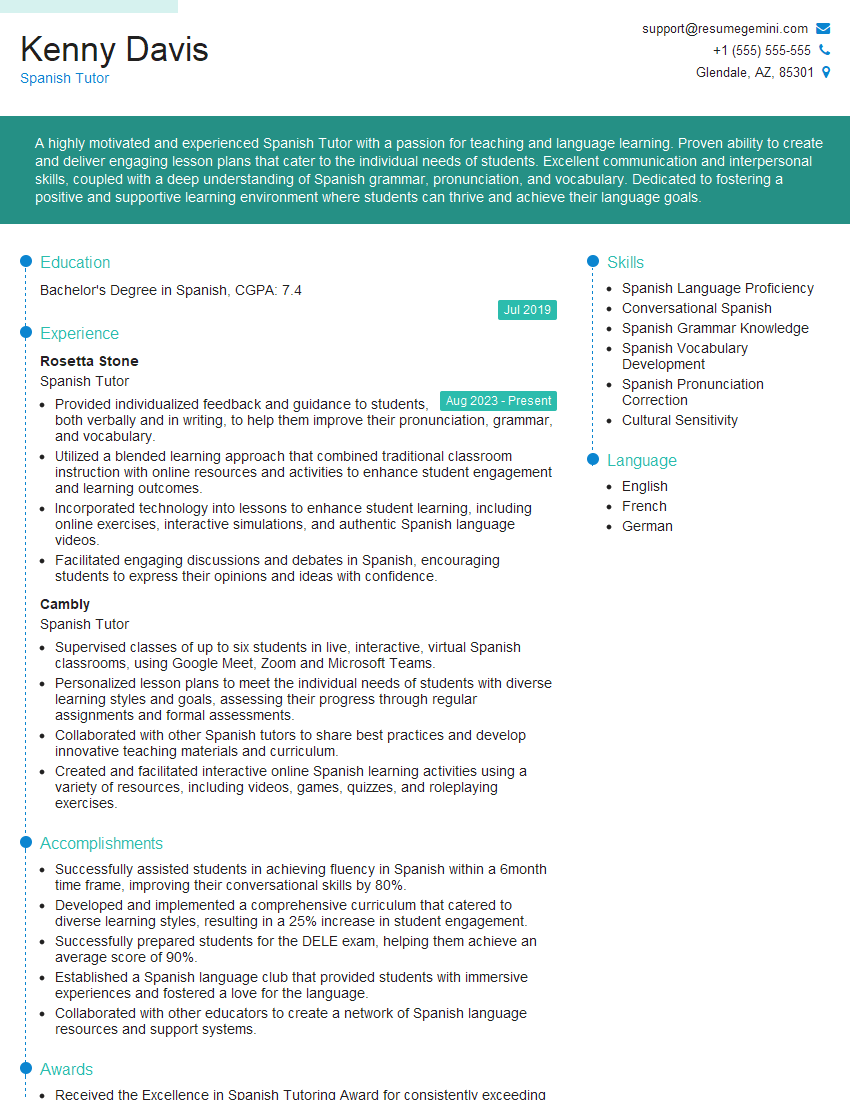
Mastering Spanish language proficiency significantly enhances your career prospects, opening doors to a wider range of opportunities and higher earning potential. In today’s globalized market, bilingual skills are highly valued. To maximize your chances, crafting an ATS-friendly resume is crucial. A well-structured resume ensures your application is noticed by recruiters and hiring managers. We highly recommend using ResumeGemini to build a professional and impactful resume that showcases your Spanish language skills effectively. ResumeGemini provides examples of resumes tailored to Spanish Language Speaking professionals, allowing you to create a compelling application that stands out from the competition.
Explore more articles
Users Rating of Our Blogs
Share Your Experience
We value your feedback! Please rate our content and share your thoughts (optional).
What Readers Say About Our Blog
Really detailed insights and content, thank you for writing this detailed article.
IT gave me an insight and words to use and be able to think of examples