Every successful interview starts with knowing what to expect. In this blog, we’ll take you through the top Preservation Metadata interview questions, breaking them down with expert tips to help you deliver impactful answers. Step into your next interview fully prepared and ready to succeed.
Questions Asked in Preservation Metadata Interview
Q 1. Explain the difference between descriptive, structural, and administrative metadata.
Think of metadata as the descriptive information that accompanies a digital asset, similar to a library catalog card for a book. It’s categorized into three main types: descriptive, structural, and administrative.
Descriptive metadata describes the content of the asset itself. Think of it as answering the ‘what’ – what is the subject, title, creator, and date of creation? Examples include the title of a document, the author’s name, and keywords describing the content.
Structural metadata explains the organization and relationships between parts of the digital asset. This answers the ‘how’ – how are the components organized? Think of it like a table of contents or the chapters within a book. Examples include navigation links within a website or the sequence of images in a multi-page document.
Administrative metadata deals with the management and technical aspects of the asset. This focuses on the ‘where’ and ‘when’ – where is it stored, who created it, and when was it last updated? Examples include file size, date of creation, the location of the file on a server, and copyright information.
Q 2. What are the key elements of a preservation metadata schema?
A robust preservation metadata schema needs several key elements to ensure the long-term accessibility and usability of digital assets. These elements often overlap, and the specifics will vary depending on the type of asset and the preservation environment.
- Identification: Unique identifiers for the asset (e.g., UUIDs), allowing it to be easily located and retrieved over time.
- Descriptive Metadata: Information about the content, such as title, creator, date, subject, and abstract (often using Dublin Core).
- Technical Metadata: Details about the file format, size, checksums (for integrity verification), and software used to create it. This is crucial for ensuring the file can be rendered in the future.
- Structural Metadata: Information about the relationships between parts of a larger asset (e.g., chapters in a book, scenes in a film).
- Administrative Metadata: Details about the asset’s provenance, custody, rights, and preservation actions taken (e.g., migration history).
- Preservation Metadata: Specifically notes about preservation actions taken, such as format migrations or file repairs. This is crucial for tracking the asset’s lifecycle.
A well-defined schema ensures that all necessary information is consistently captured, improving the chances of successful long-term preservation.
Q 3. Describe your experience with Dublin Core Metadata Element Set (DCMES).
I have extensive experience with the Dublin Core Metadata Element Set (DCMES). It’s a widely adopted standard for describing resources, and its simplicity and flexibility are key strengths. I’ve used it in numerous projects involving metadata creation, harvesting, and management for various digital asset types, including images, text documents, and audio files.
In one project, we used DCMES to create a searchable metadata catalog for a large archive of historical photographs. We focused on the ‘Title,’ ‘Creator,’ ‘Subject,’ and ‘Description’ elements to create easily discoverable records. We also added custom vocabularies for our specific archive’s needs. DCMES allowed us to create a metadata schema that was both standardized and adaptable to our specific requirements. My experience includes not just implementing DCMES, but also working with the various profiles and extensions to tailor it to different applications.
Q 4. What are the benefits of using controlled vocabularies in preservation metadata?
Controlled vocabularies are essential for ensuring interoperability and consistency in preservation metadata. They provide a standardized set of terms for describing aspects of the digital asset, reducing ambiguity and facilitating searching and retrieval. Think of them as a shared language for metadata.
For example, instead of using various spellings or synonyms for ‘landscape painting,’ a controlled vocabulary might use a specific, pre-defined term, ensuring consistency across all records. This simplifies searching and improves the accuracy of retrieval. Using controlled vocabularies also reduces the risk of human error and inconsistency in metadata descriptions. It significantly improves search and retrieval efficiency, providing greater discoverability and reusability of the digital assets.
Q 5. How do you ensure the long-term accessibility of digital assets through metadata?
Ensuring long-term accessibility of digital assets hinges on comprehensive and well-maintained metadata. It acts as a bridge between the digital asset and future users, ensuring it remains findable, understandable, and usable despite technological changes.
- Comprehensive Metadata: Capturing rich descriptive, technical, and administrative metadata at the time of creation is crucial. This includes details about the file format, software dependencies, and any known preservation challenges.
- Regular Audits: Regularly reviewing and updating the metadata ensures accuracy and addresses any obsolescence. This is essential to account for changes in technology or understanding.
- Format Migration Planning: Metadata provides the context for planning file format migrations. Knowing the original format and related software allows us to choose appropriate migration strategies.
- Controlled Vocabularies: Employing controlled vocabularies reduces ambiguity and ensures consistency, improving long-term searchability and retrievability.
- Metadata Schema Selection: Choosing a well-defined and widely used schema ensures interoperability with other systems and increases the chances of long-term compatibility.
By strategically incorporating these aspects, we create a robust and durable foundation for long-term digital asset accessibility. It’s a proactive approach, minimizing future difficulties and ensuring that valuable resources remain accessible to generations to come. This also ensures that the intellectual content is preserved beyond the technology it’s currently residing on.
Q 6. Explain the importance of using standardized metadata schemas.
Standardized metadata schemas are the backbone of effective digital preservation. They ensure interoperability, facilitating exchange and sharing of information between different systems and institutions. Think of them as a common language for digital objects, allowing diverse systems to communicate effectively.
Using a standardized schema prevents data silos and reduces the effort required for data integration. It also makes it easier to search and discover digital objects across different repositories. For example, if multiple archives all use the same metadata schema, researchers can easily search across all the archives using a single interface. Without standardization, each archive might have its own system, and searching would require individual searches across several different systems. This makes large-scale collaboration, aggregation, and analysis significantly more efficient and reliable.
Q 7. Describe your experience with Encoded Archival Description (EAD).
Encoded Archival Description (EAD) is a crucial standard for describing archival collections, particularly those with complex structures. I’ve extensively used EAD to create finding aids for archival materials, enhancing discoverability and access.
In one project, we used EAD to describe a large collection of personal papers. The hierarchical structure of EAD allowed us to represent the nested folders and sub-folders within the collection, providing users with a clear understanding of the collection’s organization. The ability to embed descriptive metadata alongside the structural information in EAD was key to providing rich context to the users. The use of EAD greatly improved the access and discoverability of the collection, contributing to better research opportunities.
My experience with EAD extends beyond simply creating finding aids. I am proficient in validating EAD XML, troubleshooting issues, and working with various EAD tools and software. I understand the nuances of encoding archival structures and the importance of adhering to best practices to ensure the long-term usability of the metadata.
Q 8. How do you handle metadata inconsistencies or errors?
Metadata inconsistencies and errors are a common challenge in preservation. Think of it like building a house – if your blueprints (metadata) are inaccurate or conflicting, the structure will be flawed. Handling these issues requires a multi-pronged approach.
Detection: Regular automated checks and manual reviews are crucial. Tools can flag missing or conflicting data elements. For example, a discrepancy between the file size recorded in the metadata and the actual file size is a red flag.
Correction: Depending on the severity and source of the error, we can either correct the metadata directly (e.g., updating a misspelled title) or flag it for review by a subject matter expert. A detailed audit trail tracks all changes, ensuring transparency and accountability.
Prevention: Implementing standardized metadata schemas and using controlled vocabularies minimizes ambiguity. Data validation during ingestion prevents common errors. Think of it as using pre-fabricated components for a house – less chance for errors in construction.
Data Cleaning: For large datasets with numerous errors, automated data cleaning techniques can help. This may involve standardizing formats, filling in missing values (carefully!), or resolving conflicting entries.
Ultimately, a proactive strategy combining automated checks, manual review, and robust quality control mechanisms is key to minimizing inconsistencies.
Q 9. What strategies do you employ for metadata quality control?
Metadata quality control ensures the accuracy, completeness, and consistency of our metadata. This is paramount for long-term preservation because unreliable metadata renders the digital assets essentially ‘lost’.
Schema Validation: We use tools to verify that metadata conforms to the chosen standard (e.g., PREMIS, MODS). This ensures that all required elements are present and formatted correctly. Imagine a checklist ensuring all necessary information is included in a museum catalog.
Data Type Validation: This confirms that the data in each field matches its designated type (e.g., date, integer, string). An unexpected data type might indicate an error or corruption.
Cross-Validation: We cross-check information across multiple metadata fields and external sources to identify inconsistencies or potential errors. For example, the date of creation in one field should match the date recorded elsewhere.
Regular Audits: Scheduled audits provide an independent assessment of metadata quality, helping to identify trends and areas for improvement. It’s like a house inspection – regularly identifying potential issues early on.
Automated Quality Control Tools: Software tools flag potential problems such as missing fields, invalid data types, or inconsistencies between metadata and the digital object itself. These tools help in making metadata quality control a streamlined process.
The effectiveness of our QC strategy lies in its balance of automated checks and human oversight, ensuring accuracy and completeness while minimizing manual intervention.
Q 10. Explain your understanding of metadata migration and its challenges.
Metadata migration involves transferring metadata from one system or format to another. It’s like moving from an old filing cabinet to a new, more efficient one. The challenges are numerous.
Schema Mapping: Different systems use different metadata schemas. Mapping fields from the source schema to the target schema requires careful consideration and often involves custom code to handle variations in terminology or data structure.
Data Transformation: Data may need to be transformed during migration. This could involve data type conversions, standardization of units, or resolving discrepancies in terminology.
Data Loss: Some data may be lost during migration if the target schema doesn’t accommodate all the elements in the source schema. It’s crucial to have a plan for handling such cases. Similar to losing files while transferring them to a new storage device.
Data Integrity: Maintaining data integrity throughout the migration process is critical. We use checksums and other validation techniques to ensure that data remains consistent.
Testing: Rigorous testing is essential to identify and resolve any issues before the full-scale migration. This minimizes the risks and ensures the success of the migration process.
Proper planning, careful schema mapping, and thorough testing are crucial to ensuring a successful and lossless metadata migration.
Q 11. How do you ensure the interoperability of your metadata with other systems?
Interoperability means that our metadata can be easily shared and used by other systems. This is achieved by adhering to widely accepted standards and employing best practices.
Standard Schemas: We primarily use standards such as PREMIS and MODS, which provide a common framework for describing digital objects. These are like a universal language for metadata, ensuring compatibility across systems.
Controlled Vocabularies: Using controlled vocabularies (e.g., subject headings, geographic names) ensures consistency and allows for easier searching and retrieval of information.
Metadata Encoding: Employing standard encoding formats (e.g., XML) enables automated processing and exchange of metadata between systems. This eliminates the need for manual data translation, increasing efficiency.
API Integration: We utilize application programming interfaces (APIs) to seamlessly exchange metadata with other systems, facilitating data sharing and collaboration. This approach enhances the automation of metadata related tasks across different platforms.
By adopting these strategies, we make sure our metadata is readily accessible and usable across various digital preservation systems.
Q 12. Describe your experience working with different metadata standards (e.g., PREMIS, MODS).
I have extensive experience working with various metadata standards, including PREMIS and MODS. PREMIS (Preservation Metadata Implementation Strategy) is a widely used standard specifically designed for digital preservation, focusing on the technical and intellectual characteristics of digital objects and their preservation events. It’s like a comprehensive patient medical record for a digital asset. MODS (Metadata Object Description Schema) is a more general-purpose schema suitable for describing a wide range of resources, including books, articles, and other scholarly materials.
My experience spans using these schemas to create and manage metadata for diverse collections. I understand their strengths and limitations and can adapt my approach based on the specific needs of the project. For instance, PREMIS’s detailed tracking of preservation actions is invaluable for demonstrating provenance, while MODS is ideal for richly describing the content of scholarly resources. I’m also familiar with other standards, such as Dublin Core, and I can readily adapt to the requirements of any given project.
Q 13. What is your experience with metadata creation tools and workflows?
I’m proficient in using a range of metadata creation tools and workflows, adapting my approach based on the specific requirements of the project and the scale of the collection. For smaller projects, I might use spreadsheet software combined with manual entry, while for larger collections, I’d utilize specialized metadata editing software or integrate with digital asset management systems.
Metadata Editing Software: I have experience with tools that allow for batch editing, validation, and export of metadata in various formats. This allows for efficient management of large amounts of metadata.
Scripting and Automation: For repetitive tasks, I leverage scripting languages like Python to automate metadata creation and validation. This ensures consistency and minimizes errors, especially in large-scale projects.
Digital Asset Management Systems (DAMs): I’m familiar with integrating metadata workflows into DAMs, leveraging their capabilities for metadata management, version control, and access control.
My approach always emphasizes efficiency, accuracy, and scalability, and is tailored to the project’s specific context and scale.
Q 14. How do you manage metadata for different file formats?
Managing metadata for different file formats requires a nuanced understanding of the unique characteristics of each format and its associated metadata requirements. A crucial element is associating the appropriate metadata schema with each file type.
For example, image files (like TIFF or JPEG) might require metadata about resolution, color space, and compression, whereas audio files (like WAV or MP3) might need data on bitrate, sample rate, and channels. For video files, you would expect information on frame rate, codecs, and video resolution.
The strategy is to establish clear guidelines and workflows for each file type, ensuring that relevant metadata is captured and maintained consistently. This may involve using different metadata schemas or extending existing ones to accommodate the specific needs of different file formats. A key component is the implementation of automated metadata extraction tools to streamline this process, especially for very large collections containing numerous files with various formats.
Q 15. What are the ethical considerations related to preservation metadata?
Ethical considerations in preservation metadata are crucial because this data directly impacts access to, and understanding of, cultural heritage and research data. We must consider issues of:
- Privacy and Confidentiality: Metadata can contain personally identifiable information (PII) or sensitive data. An ethical approach requires careful anonymization or redaction techniques to protect individuals’ privacy.
- Intellectual Property Rights: Metadata should accurately reflect copyright, licensing, and other intellectual property rights associated with the digital object. Failure to do so can lead to legal issues.
- Bias and Representation: Metadata schemas and the descriptive terms used can reflect biases of the creators. We must strive for inclusivity and accurate representation of diverse perspectives.
- Transparency and Openness: Metadata should be discoverable and understandable by as wide an audience as possible. Proprietary formats or overly technical metadata hinder access and should be avoided when feasible. Using open standards is paramount.
- Long-term Stewardship: Ethical considerations extend to the long-term maintenance and accessibility of the metadata itself. We have a responsibility to ensure that future generations can access and understand this crucial information.
For example, consider a historical archive containing personal letters. Metadata should accurately represent the contents without exposing sensitive personal information, perhaps using controlled vocabulary to categorize emotional tone or thematic content rather than explicit details.
Career Expert Tips:
- Ace those interviews! Prepare effectively by reviewing the Top 50 Most Common Interview Questions on ResumeGemini.
- Navigate your job search with confidence! Explore a wide range of Career Tips on ResumeGemini. Learn about common challenges and recommendations to overcome them.
- Craft the perfect resume! Master the Art of Resume Writing with ResumeGemini’s guide. Showcase your unique qualifications and achievements effectively.
- Don’t miss out on holiday savings! Build your dream resume with ResumeGemini’s ATS optimized templates.
Q 16. Explain the role of metadata in digital preservation planning.
Metadata is the backbone of any successful digital preservation plan. It provides the essential information needed to locate, identify, access, and manage digital objects throughout their lifecycle. Without accurate and comprehensive metadata, preserved items become essentially ‘lost’ – even if the data itself is intact.
In planning, metadata helps us to:
- Identify preservation needs: Metadata helps determine the format, technical characteristics, and risks associated with a digital object, informing our choice of preservation strategies.
- Select appropriate storage: Metadata allows for intelligent selection of suitable storage systems based on the object’s characteristics (e.g., file size, format, sensitivity).
- Develop migration strategies: Understanding file formats and software dependencies from metadata allows us to plan for format migrations to ensure future accessibility.
- Establish access controls: Metadata facilitates implementing access restrictions based on rights management information and security policies.
- Track preservation actions: Recording preservation events in metadata creates an audit trail, crucial for accountability and demonstrating adherence to preservation policies.
Think of metadata as a digital object’s passport – it identifies it, shows its origins, and guides its journey through time.
Q 17. How do you evaluate the completeness and accuracy of existing metadata?
Evaluating the completeness and accuracy of existing metadata involves a multi-faceted approach. I typically employ these steps:
- Identify Metadata Standards and Schemas: First, determine which metadata schemas (like Dublin Core, PREMIS, or MODS) are used. Understanding the schema is key to interpreting the data.
- Data Profiling and Analysis: Analyze the existing metadata using automated tools to identify patterns, inconsistencies, and missing data elements. This often reveals common problems like incomplete dates, missing subjects, or inconsistent terminology.
- Sampling and Validation: Randomly select a sample of records and manually verify the metadata against the original digital object or its accompanying documentation. This is crucial for identifying inaccuracies automated methods might miss.
- Controlled Vocabulary Review: Assess the consistency and appropriateness of terminology used in descriptive fields. Using controlled vocabularies helps ensure uniform application of terms across the collection.
- Completeness Checklists: Use pre-defined checklists to evaluate if essential metadata elements are present for all items. This can be tailored to the specific needs of the collection and its preservation objectives.
- User Feedback: Consider user feedback and search patterns to identify areas where metadata fails to enable effective discovery.
For instance, if I find inconsistencies in date formats (‘mm/dd/yyyy’ vs. ‘yyyy-mm-dd’), I would clean and standardize these. If crucial elements like file format are missing, I would investigate methods to obtain this information, possibly through file analysis tools.
Q 18. Describe your experience with metadata harvesting and aggregation.
I have extensive experience with metadata harvesting and aggregation, having worked on several large-scale projects. This usually involves:
- Identifying Data Sources: The initial step is to identify all relevant data sources containing metadata, whether these are local databases, web archives, or other repositories.
- Protocol Selection: Choosing the appropriate data harvesting protocol (like OAI-PMH or SPARQL) depending on the source’s capabilities and the metadata schema used.
- Data Transformation and Cleaning: Raw harvested metadata often requires significant transformation and cleaning to ensure consistency and conformity to the target schema. This includes resolving conflicting data formats, handling errors, and standardizing terminology.
- Data Aggregation and Integration: After cleaning, individual metadata records are integrated into a central repository. This often requires the development of custom scripts or using aggregation tools to manage the volume and complexity of the data.
- Quality Control: Throughout the entire process, stringent quality control measures are employed to detect and correct errors, ensuring the accuracy and integrity of the aggregated metadata.
In one project, we harvested metadata from multiple university archives using OAI-PMH, transformed it to the PREMIS schema using XSLT, and aggregated it into a single, searchable database. This greatly improved discoverability and accessibility across institutional boundaries.
Q 19. What are some common challenges in implementing preservation metadata?
Implementing preservation metadata faces several common challenges:
- Lack of Metadata Standards: The absence of universally adopted standards leads to interoperability issues. Different organizations may use different schemas, hindering data sharing and aggregation.
- Metadata Creation Costs: Creating high-quality metadata is time-consuming and resource-intensive. Efficient workflows and automated tools can alleviate some of these costs but not eliminate them entirely.
- Maintaining Metadata Accuracy Over Time: Metadata requires ongoing review and update to reflect changes in the digital object, its context, or its usage. This ongoing maintenance is often under-resourced.
- Scalability Challenges: Managing metadata for very large digital collections presents technical and logistical hurdles. Efficient storage, search, and retrieval mechanisms are crucial.
- Technical Expertise: Working with metadata effectively requires specialized knowledge of metadata schemas, data formats, and related technologies. A lack of trained personnel can hamper implementation.
For example, the lack of standardized geospatial metadata can prevent easy integration of geographically relevant digital objects across different archives.
Q 20. How do you balance the needs of preservation with the needs of access?
Balancing preservation with access is a core principle in digital curation. Preservation focuses on ensuring long-term accessibility, while access focuses on immediate usability. The key is to find solutions that satisfy both without compromising either. This involves:
- Format Preservation vs. Access Formats: Preserving the original format is ideal, but creating access copies in widely used formats makes the material easier to use now. This requires careful consideration of format migration strategies.
- Metadata Richness vs. Simplicity: Comprehensive metadata is essential for long-term preservation, but overly complex metadata can be challenging for users. We should prioritize metadata crucial for discovery while making it easily understandable.
- Security and Access Controls: Security measures are needed to preserve integrity and prevent unauthorized access. Access controls should balance the need for preservation with requirements for scholarly use.
- Flexible Metadata Structures: Employing metadata schemas that are flexible and extensible allows for future adaptation to meet new access needs without jeopardizing the preserved information.
- Prioritization: Recognize that some items may have higher priority for access than others, balancing resources and effort to meet both preservation and access goals.
Imagine a rare historical film: preservation prioritizes archiving the original high-resolution master, while access prioritizes making lower-resolution copies available for online viewing.
Q 21. How do you communicate technical metadata concepts to non-technical audiences?
Communicating technical metadata concepts to non-technical audiences requires careful planning and plain language. Here’s my approach:
- Avoid Jargon: Replace technical terms with simple, everyday language. For instance, instead of ‘OAI-PMH,’ I’d say ‘a way to share metadata between computers.’
- Use Analogies and Metaphors: Relate metadata concepts to familiar experiences. For instance, compare metadata to the cataloging system in a library or the information on the back of a book.
- Visual Aids: Use diagrams, charts, or images to illustrate complex concepts. A simple diagram showing the relationship between a digital object and its metadata can be very effective.
- Focus on Benefits: Highlight how metadata improves accessibility, discoverability, and understanding of digital objects. Emphasize how it protects the investment in digital collections.
- Interactive Demonstrations: If possible, conduct interactive demonstrations to show how metadata works in practice. This allows non-technical audiences to actively engage with the topic.
For instance, when explaining ‘rights metadata,’ I might say, ‘This is like the copyright information on a book. It tells us who owns the rights and how we can use the material.’
Q 22. Explain your experience with metadata repositories and their management.
Metadata repositories are essentially databases designed to store and manage metadata. Think of them as highly organized libraries for descriptive information about digital assets. My experience spans various repository types, from simple spreadsheet-based systems to complex, integrated digital asset management (DAM) systems and specialized preservation repositories like Fedora and Archivematica. Management includes not only the technical aspects – ensuring data integrity, scalability, and security – but also the governance aspects – defining metadata schemas, implementing controlled vocabularies, and establishing workflows for metadata creation, update, and quality control. For example, in a previous role, I oversaw the migration of a large collection’s metadata from a legacy system to a Fedora-based repository, requiring careful planning, data cleansing, and schema mapping.
- Experience with different repository software (Fedora, Archivematica, DSpace, etc.)
- Developing and implementing metadata ingest and export workflows.
- Managing user access and permissions within the repository.
- Ensuring data integrity and backup/recovery strategies.
Q 23. Describe your experience with metadata schemas for born-digital and digitized materials.
Metadata schemas are crucial for structuring metadata. They define the elements, data types, and relationships within the metadata describing an item. For born-digital materials (created digitally), schemas like Dublin Core, METS (Metadata Encoding and Transmission Standard), and MODS (Metadata Object Description Schema) are commonly used. These schemas offer flexibility to capture various aspects, from basic descriptive information to technical details about file formats and creation software. For digitized materials (analog materials converted to digital format), additional metadata elements are often needed to record information about the original analog item, such as its physical characteristics and provenance. Schemas may be customized or extended to accommodate specific needs. For instance, a museum might extend Dublin Core to include elements specific to artwork, such as artist, medium, and dimensions. In my experience, I’ve worked extensively with both pre-existing schemas and custom-designed ones, adapting them to the requirements of various collections and projects.
Q 24. How do you address metadata obsolescence?
Metadata obsolescence is a significant challenge. It arises when the metadata language, schema, or application used to create or manage metadata becomes outdated or unsupported. Imagine trying to open a file created in a software that no longer exists! The solution is multi-pronged. First, using established and widely adopted standards minimizes the risk. Second, implementing a robust migration strategy allows for adaptation to newer standards or systems as needed. Third, encouraging the use of persistent identifiers (like URIs) for resources and controlled vocabularies helps maintain semantic consistency. Regular audits are essential to identify obsolete elements and plan for upgrades. Finally, adopting flexible and extensible schemas rather than rigidly structured ones allows for easier expansion or modification of metadata without requiring a complete overhaul. In one project, we used a combination of automated scripts and manual review to update legacy metadata according to a revised schema.
Q 25. What are your preferred methods for metadata validation?
Metadata validation is critical for ensuring data quality and consistency. My preferred methods involve a combination of automated and manual checks. Automated validation uses tools and scripts to verify that metadata conforms to the defined schema. This can include checking data types, required fields, and adherence to controlled vocabularies. For example, I frequently use schema validation tools like xmlstarlet or dedicated validators provided by repository software. Manual validation involves human review to catch errors that automated tools might miss, such as inconsistencies in descriptive metadata or illogical relationships between data elements. A combination of these methods ensures both accuracy and consistency.
Q 26. Describe a time you had to troubleshoot a metadata-related problem. What was the solution?
I once encountered a problem where migrated metadata was causing unexpected errors in our digital repository. The automated validation checks passed, but searches and displays were failing. After investigating, we discovered that an unexpected character encoding issue was corrupting certain metadata fields during the migration process. The solution involved identifying and correcting the character encoding inconsistencies using a combination of regular expressions and text-processing tools to cleanse the data. We also revised our migration script to explicitly handle character encoding, implementing error handling and logging to prevent such issues in future migrations. This experience underscored the importance of thorough testing and comprehensive logging during any metadata transformation process.
Q 27. Explain your understanding of semantic web technologies and their relevance to preservation metadata.
Semantic web technologies, particularly Resource Description Framework (RDF) and linked data, are transforming preservation metadata. RDF allows for the creation of more expressive and interconnected metadata, enabling richer semantic relationships between digital objects and concepts. Imagine linking a photograph’s metadata to information about the photographer, the location, historical events, and related artworks – all seamlessly interlinked. This enhances findability, interoperability, and the potential for automated reasoning. Linked data facilitates data reuse and discovery across different repositories and systems, improving accessibility and long-term preservation. I see the integration of RDF and linked data principles as crucial for the future of preservation metadata, providing a more robust and flexible foundation for managing digital assets.
Q 28. What are your thoughts on the future of preservation metadata?
The future of preservation metadata is likely to be characterized by increased automation, interoperability, and semantic richness. We’ll see greater use of AI and machine learning for automated metadata creation and enrichment, reducing manual effort and improving consistency. Linked data and semantic web technologies will continue to play a crucial role in enhancing the accessibility and discoverability of digital assets. The development of more robust and adaptable metadata schemas capable of handling evolving data formats and semantic requirements will be vital. Furthermore, the focus will shift towards more user-centric metadata approaches, prioritizing ease of use and clear communication of information to a broader range of users. I anticipate significant innovations in how we manage provenance, ensuring the reliability and trust in digital records across time.
Key Topics to Learn for Preservation Metadata Interview
- Metadata Schemas and Standards: Understanding Dublin Core, PREMIS, METS, and other relevant schemas; their structure, elements, and application in different archival contexts.
- Data Models and Relationships: Conceptualizing how metadata describes digital objects and their relationships within a larger collection; practical experience with relational databases or graph databases is beneficial.
- Best Practices for Metadata Creation and Encoding: Knowing the importance of consistency, accuracy, and completeness in metadata creation; familiarity with controlled vocabularies and authority files.
- Digital Preservation Strategies: Understanding how metadata supports long-term preservation, including strategies for migration, emulation, and format preservation.
- Metadata Harvesting and Aggregation: Knowledge of methods for collecting and integrating metadata from diverse sources; understanding the challenges and solutions involved in metadata interoperability.
- Metadata Quality Control and Assessment: Methods for evaluating the quality and completeness of metadata; understanding the impact of metadata errors on access and preservation.
- Practical Application: Discuss experiences with implementing and managing metadata within a digital repository, including workflows and tools used.
- Problem-Solving Approaches: Prepare examples demonstrating your ability to troubleshoot metadata issues, handle inconsistencies, and design solutions for metadata challenges.
- Technical Aspects: For more technical interviews, delve into topics such as XML, RDF, and other related technologies used in metadata encoding and management.
Next Steps
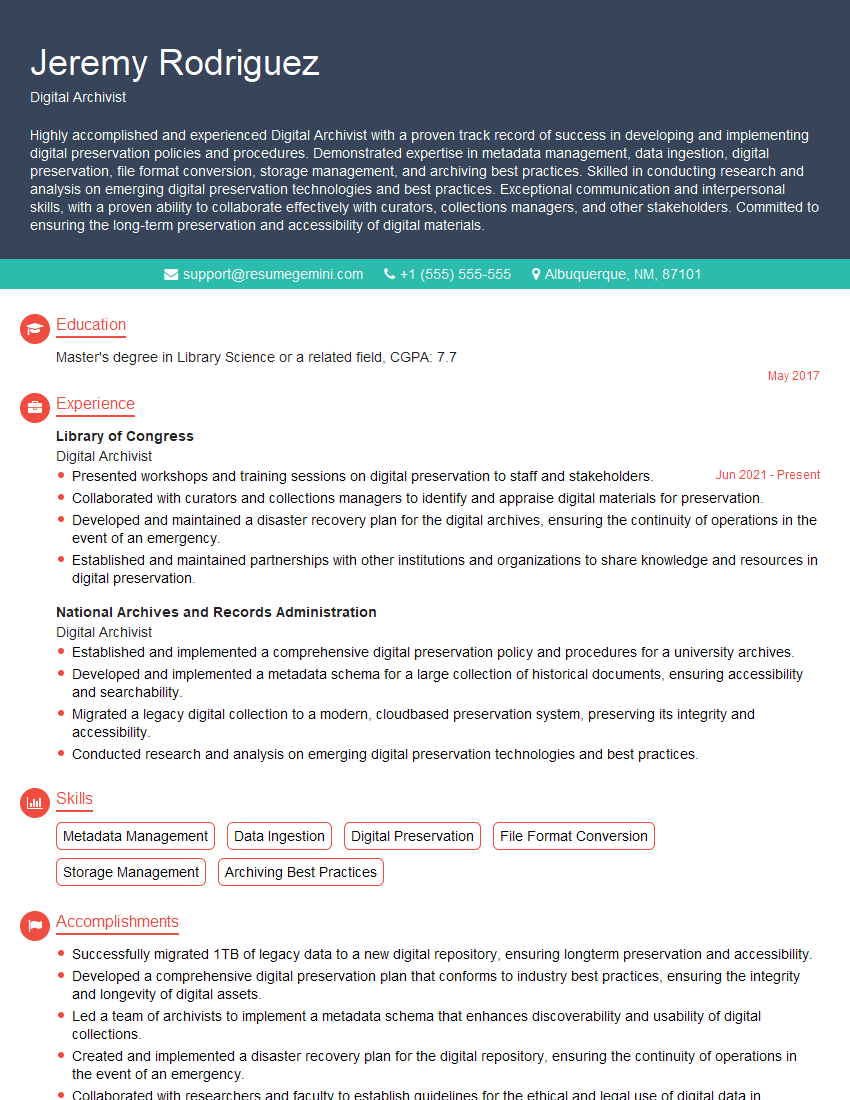
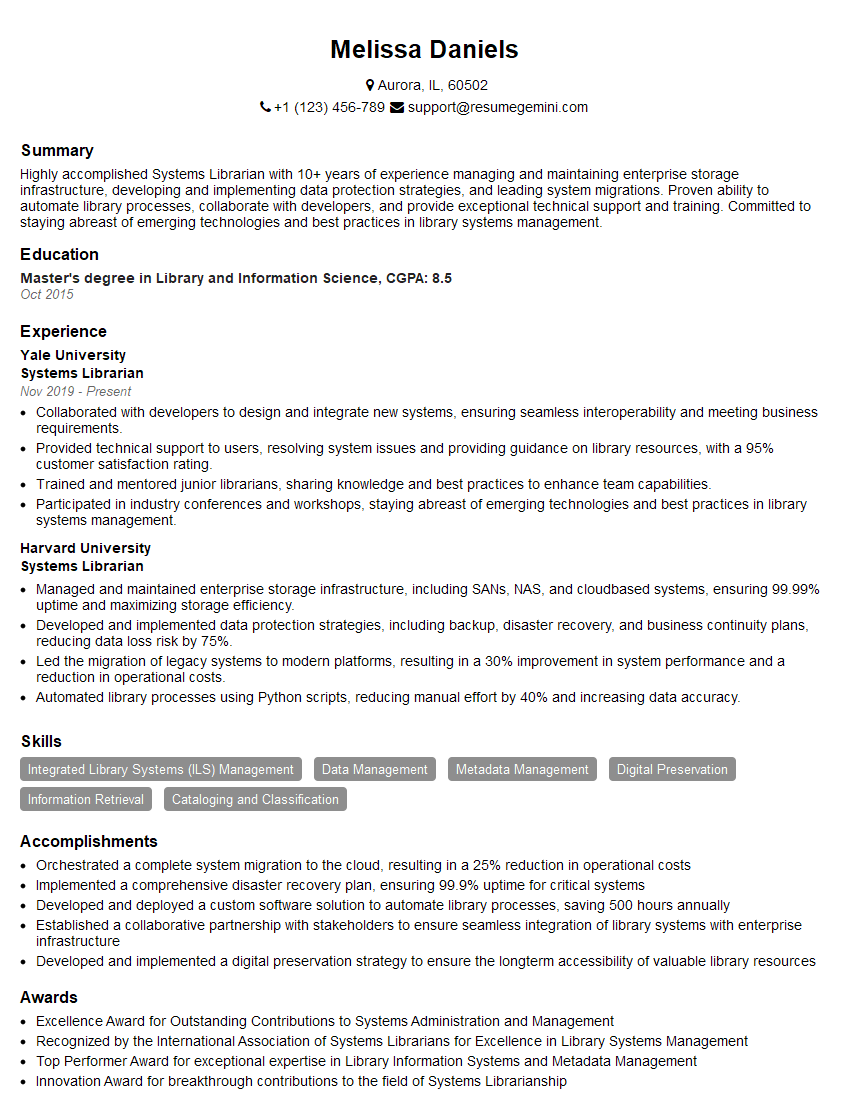
Mastering Preservation Metadata is crucial for career advancement in the digital archiving and library sciences fields, opening doors to exciting roles with significant impact. A strong resume is your key to unlocking these opportunities. Crafting an ATS-friendly resume that highlights your skills and experience is essential for getting your application noticed. To help you build a compelling and effective resume, we recommend using ResumeGemini, a trusted resource for creating professional resumes. Examples of resumes tailored to Preservation Metadata are available to guide you further.



Explore more articles
Users Rating of Our Blogs
Share Your Experience
We value your feedback! Please rate our content and share your thoughts (optional).
What Readers Say About Our Blog
Really detailed insights and content, thank you for writing this detailed article.
IT gave me an insight and words to use and be able to think of examples