Cracking a skill-specific interview, like one for Experience in Braille Transcription for Education, Employment and Independent living, requires understanding the nuances of the role. In this blog, we present the questions you’re most likely to encounter, along with insights into how to answer them effectively. Let’s ensure you’re ready to make a strong impression.
Questions Asked in Experience in Braille Transcription for Education, Employment and Independent living Interview
Q 1. Explain the difference between Grade 1 and Grade 2 Braille.
The main difference between Grade 1 and Grade 2 Braille lies in how words are represented. Grade 1 Braille, also known as uncontracted Braille, uses a separate braille cell for each letter of the alphabet. Think of it like spelling out every word phonetically – each letter gets its own symbol.
Grade 2 Braille, on the other hand, is contracted Braille. This system uses contractions and shortened forms of letters, common letter combinations, and whole words. For example, the word ‘and’ might be represented by a single braille cell instead of three (a-n-d). This significantly speeds up reading and writing.
Imagine writing a sentence. In Grade 1, it would be lengthy and repetitive. Grade 2 allows for a more efficient and compact representation.
- Grade 1 Example: The word ‘cat’ would be represented by three separate braille characters for ‘c’, ‘a’, and ‘t’.
- Grade 2 Example: The word ‘cat’ might use a single contraction if the system used one for ‘cat’, or slightly fewer characters than Grade 1.
The choice between Grade 1 and Grade 2 depends largely on the reader’s proficiency and the intended audience. Beginners often start with Grade 1 before transitioning to Grade 2 for faster reading and writing. Most literary texts are in Grade 2.
Q 2. Describe your experience with Braille formatting and layout standards.
My experience with Braille formatting and layout standards is extensive. I’m intimately familiar with the Braille Authority of North America (BANA) guidelines, which are the standard in the United States and Canada. These guidelines cover everything from formatting paragraphs, headings, and lists to handling tables, equations, and musical notation. It’s crucial to follow these standards precisely for accessibility and readability. Inconsistent formatting can lead to significant confusion for readers.
For instance, I know precisely how to correctly format footnotes, endnotes, and bibliographies using appropriate braille symbols and spacing. I’m adept at handling complex layouts, such as those found in textbooks or academic papers, ensuring proper structural clarity in Braille. For example, knowing the correct spacing around mathematical symbols is essential to the readability of the document.
I also have experience working with other international Braille standards. While the core principles are similar, there are nuances and differences to consider to ensure accuracy depending on the target region or reader.
Q 3. How do you ensure accuracy in Braille transcription?
Accuracy is paramount in Braille transcription. A single error can significantly impact the understanding of a text. My approach to ensuring accuracy involves a multi-layered process:
- Thorough understanding of the source material: Before even beginning the transcription, I carefully read and understand the entire document to grasp the context and identify any potential challenges.
- Using appropriate software and tools: I rely on proven Braille translation software, and regularly check for updates to leverage improved accuracy features.
- Double-checking and proofreading: I meticulously proofread my work, comparing the Braille output to the original text to identify and correct any errors. This often involves reading aloud.
- Blind review: When possible, I seek feedback from proficient Braille readers, who can independently verify accuracy and provide valuable feedback from a user’s perspective.
I treat every transcription as a critical communication tool and ensure the final product is as error-free as possible, understanding its vital role in education, employment, and independent living for visually impaired individuals.
Q 4. What software and tools are you proficient in for Braille transcription?
I am proficient in a range of software and tools essential for Braille transcription. My expertise includes:
- DUB: This is a highly versatile program used for creating and editing Braille files.
- Visual Braille: Another excellent tool with robust features for Braille translation and editing.
- Braille translation software: I have experience with various software that converts print to Braille, each offering unique features for different document types.
- Braille embossers: I’m skilled in using various embossers to produce high-quality Braille documents in different formats.
My proficiency extends beyond mere software operation. I understand the underlying principles of Braille codes and can troubleshoot and adapt to various software functionalities effectively. I choose my tools based on the specific requirements of each project, ensuring optimal output.
Q 5. How do you handle complex mathematical or scientific notation in Braille?
Handling complex mathematical or scientific notation in Braille requires specialized knowledge and adherence to specific Braille codes. Standard mathematical Braille uses a combination of symbols and standard Braille characters to represent numbers, equations, and other mathematical notations. This is where comprehensive knowledge of Nemeth Code or other similar mathematical Braille codes comes into play.
For example, representing fractions, exponents, and roots might involve specific braille symbols and arrangements. Similarly, matrices and other complex structures require careful formatting and correct application of the Nemeth code.
I have extensive experience in applying Nemeth code and other relevant mathematical Braille codes to ensure that complex mathematical or scientific information is accurately and clearly transcribed into Braille. This guarantees that visually impaired students and professionals can access complex materials without difficulty.
Q 6. Describe your process for proofreading and editing Braille documents.
My proofreading and editing process is a rigorous multi-step procedure. After completing the initial transcription, I follow these steps:
- Self-proofreading: I carefully review my work, comparing the Braille with the original text line by line. I read the Braille aloud to catch errors that might be missed through visual inspection.
- Software verification: I utilize my software’s built-in proofreading tools to identify and correct potential inconsistencies and errors.
- Blind review (where possible): I would ideally have a proficient Braille reader to check the accuracy and readability of the final document.
- Error correction: Errors are corrected meticulously, ensuring the final Braille document maintains accuracy and readability.
This systematic approach minimizes errors and ensures the highest possible quality of the final product, enabling the visually impaired individual to fully understand the content.
Q 7. Explain your understanding of Braille literacy and its importance.
Braille literacy is more than just reading and writing Braille; it’s the gateway to access information and participate fully in society for individuals who are blind or visually impaired. It empowers them to pursue education, find employment, and live independently. It’s about independence and self-reliance.
Without Braille literacy, many opportunities are inaccessible. Imagine trying to learn, work, or manage everyday tasks without the ability to read and write. This highlights the crucial role of Braille literacy. I firmly believe in promoting Braille literacy. The more accessible and higher-quality Braille materials we can produce, the greater opportunities will become for the visually impaired.
I’ve witnessed firsthand the transformative impact of Braille literacy on the lives of my clients. Seeing them achieve academic success, secure meaningful employment, and navigate life with confidence is incredibly rewarding. It’s a privilege to be a part of their journeys.
Q 8. How do you adapt your transcription style for different types of documents (e.g., literary, technical, legal)?
Adapting my transcription style for different document types is crucial for accuracy and readability. Think of it like translating—the same words can have vastly different meanings and connotations depending on the context.
Literary Works: For novels or poems, I prioritize preserving the author’s style and tone. This might involve using literary Braille conventions for formatting, such as indentation for stanzas or special symbols to indicate italics. For example, a specific symbol might represent a change in speaker’s voice in a play.
Technical Documents: With manuals or scientific papers, accuracy and clarity take precedence. I meticulously transcribe formulas, tables, and diagrams using standard Braille math and scientific symbols. This often involves careful use of Nemeth Braille Code for mathematical notations or other specialized codes to convey information effectively.
Legal Documents: Legal documents demand absolute precision. I pay close attention to formatting, including numbered paragraphs, legal citations, and signatures. Any deviation from the original can have serious consequences, so I adopt a methodical, cross-checking approach ensuring everything is correctly transcribed, including specific legal symbols.
Ultimately, my approach is to understand the unique requirements of each document type before starting the transcription to ensure the final Braille product is functional and accessible for the intended reader.
Q 9. What strategies do you use to maintain efficiency and accuracy while working under pressure?
Maintaining efficiency and accuracy under pressure is a skill honed through years of experience. It’s like a tightrope walk—balancing speed and precision. My strategies include:
Time Management: I meticulously plan my workload, breaking down large projects into smaller, manageable tasks. This allows me to track progress and address potential challenges proactively.
Proofreading Techniques: I use a multi-stage proofreading process. This includes a first pass for accuracy, a second for formatting, and a final check for overall consistency. I often find it useful to take short breaks between these stages to regain focus.
Error Detection Strategies: I’ve developed techniques for quickly identifying errors, such as comparing the transcribed Braille to a sample of the original text at regular intervals. This helps prevent minor errors from accumulating into major problems.
Ergonomics: Maintaining a comfortable and well-organized workspace is essential. This prevents fatigue and reduces the risk of errors.
Essentially, it’s about developing a systematic workflow that minimizes errors and maximizes productivity even when deadlines are tight.
Q 10. How familiar are you with different Braille codes and their applications?
I am highly proficient in various Braille codes and understand their specific applications. It’s not just about knowing the dots; it’s about understanding the nuances and choosing the right code for the right context.
Grade 1 Braille: This is a letter-by-letter system, primarily used for personal writing. It’s simpler but can be less efficient for longer documents.
Grade 2 Braille: This utilizes contractions and abbreviations, greatly increasing reading speed and efficiency. This is the most common system used in the majority of publications.
Nemeth Braille Code: This specialized code is crucial for transcribing mathematical formulas, scientific notation, and other technical symbols, making it accessible to visually impaired students and professionals in STEM fields.
Unified English Braille (UEB): This is the standard code currently being adopted internationally, standardizing various conventions and symbols, and aiming for increased compatibility between different Braille systems.
Knowing which code to apply based on the material type is fundamental to accurate and effective Braille transcription. Choosing the incorrect code is like using the wrong tools for the job—it can lead to inaccuracies and inconsistencies.
Q 11. Describe your experience with using Braille embossers and other assistive technologies.
My experience with Braille embossers and assistive technologies is extensive. I’m proficient in using various models, from older Perkins embossers to modern digital systems.
Braille Embossers: I am experienced with both manual and electronic embossers, understanding their strengths and limitations. This includes troubleshooting mechanical issues, optimizing settings for different paper types, and understanding the intricacies of paper feed and print quality.
Digital Braille Displays: I’m proficient with refreshable Braille displays, which offer a dynamic way to review and edit Braille before embossing. This allows me to catch errors easily and quickly.
Optical Character Recognition (OCR) Software: I utilize OCR software to convert scanned documents into digital text, making the transcription process faster and more efficient. This is especially useful for processing older documents or those not readily available in digital formats.
My skill with these technologies allows me to produce high-quality Braille quickly and efficiently, adapting to different technologies and workflows depending on the project’s needs.
Q 12. How do you handle ambiguous or unclear source material during transcription?
Handling ambiguous or unclear source material requires careful attention to detail and a problem-solving mindset. It’s akin to deciphering a code, only the code is poorly written.
Clarification with the Client: Whenever possible, I clarify any ambiguities with the client or author of the source material. This might involve asking for clarification on specific words, phrases, or sections that are unclear.
Contextual Clues: If clarification isn’t possible, I leverage contextual clues within the document to infer the intended meaning. I carefully examine surrounding sentences and paragraphs to understand the overall message and use my best judgement to interpret unclear sections.
Standard Practices: I follow established Braille transcription standards to guide my interpretations. These standards offer guidance on dealing with uncertainties and offer consistent approaches to handling ambiguous sections.
Documentation: I thoroughly document any ambiguities or assumptions made during transcription. This transparency is crucial for ensuring accuracy and facilitating any future review or correction.
It’s about being proactive, resourceful and documenting my rationale—ensuring the final Braille product represents the intent as accurately as possible, even amidst uncertainties.
Q 13. What is your process for resolving discrepancies between the source material and Braille standards?
Resolving discrepancies between source material and Braille standards requires a nuanced approach. It’s about finding a balance between adherence to standards and preserving the original meaning.
Prioritize Clarity and Accuracy: My primary focus is on ensuring the Braille version conveys the same information as the original. If a Braille standard conflicts with this goal, I prioritize the accuracy and clarity of the information being transcribed.
Documentation and Justification: I thoroughly document any deviations from Braille standards, explaining the rationale behind my choices. This transparency allows for review and ensures consistency in my work.
Consult Standards and Resources: I consult relevant Braille style guides and resources to ensure that my transcription adheres to best practices, while carefully noting any exceptions and justifications.
Collaboration (When Possible): If significant discrepancies arise, I may seek guidance from other experienced Braille transcribers or relevant authorities to ensure a consistent and accurate approach.
Essentially, resolving discrepancies is a process of careful consideration, transparent documentation, and adherence to best practices to ensure accuracy and consistency.
Q 14. How do you maintain quality control throughout your transcription workflow?
Quality control is paramount in Braille transcription. It’s not just about accuracy; it’s about ensuring the final product is user-friendly and accessible. My quality control measures include:
Multiple Proofreading Stages: As mentioned before, I utilize a multi-stage proofreading process, involving different techniques for catching different types of errors.
Self-Review and Peer Review: I perform a thorough self-review of the entire document, paying close attention to consistency and completeness, followed by a peer review, where another qualified Braille transcriber checks for accuracy and adherence to standards. This provides an additional layer of quality assurance.
Software Tools: I utilize various software tools that help identify potential errors or inconsistencies, such as grammar checkers and Braille editing programs.
Feedback Incorporation: I actively seek feedback from clients or users, using their input to improve accuracy and user-friendliness in future transcriptions.
Ultimately, my quality control process is an iterative and multi-faceted approach focused on producing high-quality, accessible Braille that meets the needs of its users.
Q 15. Describe your experience working with different types of Braille paper and materials.
My experience encompasses a wide range of Braille paper and materials, each with its own unique properties impacting transcription quality and reader experience. I’ve worked extensively with traditional paper such as Nemeth Code paper, which has a distinctive raised line structure to aid in cell alignment, ensuring accurate dot placement. This is crucial for mathematical and scientific notations. I’m also proficient with various thicknesses and textures, understanding that some materials are better suited for certain embossers or printing methods. For instance, thinner paper might be preferred for smaller, portable devices, while thicker paper might be needed for durability and to avoid ink bleed-through. Beyond paper, I have experience with plastic sheets and durable synthetic materials frequently used for labels, signs, and durable documents. Each material presents specific challenges; for example, achieving consistent embossing depth on plastic can require adjustments to embossing pressure and temperature. Choosing the right material is paramount in ensuring readability and longevity of the Braille document.
I’ve worked with both thermal and impact embossers and understand their respective impact on material selection. For example, some materials are better suited for heat embossing, while others may require the impact method. This knowledge allows me to select the appropriate materials for different applications and to anticipate potential issues during the production process.
Career Expert Tips:
- Ace those interviews! Prepare effectively by reviewing the Top 50 Most Common Interview Questions on ResumeGemini.
- Navigate your job search with confidence! Explore a wide range of Career Tips on ResumeGemini. Learn about common challenges and recommendations to overcome them.
- Craft the perfect resume! Master the Art of Resume Writing with ResumeGemini’s guide. Showcase your unique qualifications and achievements effectively.
- Don’t miss out on holiday savings! Build your dream resume with ResumeGemini’s ATS optimized templates.
Q 16. How familiar are you with the principles of inclusive design and accessibility?
Inclusive design and accessibility are fundamental to my work. It’s not just about translating text into Braille; it’s about ensuring the final product is usable and enjoyable for the visually impaired reader. This involves considering the entire user experience, from the physical characteristics of the Braille document (paper type, font size, layout) to the content’s clarity and organization. For example, when transcribing educational materials, I ensure proper formatting of headings, subheadings, and lists to create a logical and easy-to-navigate document. Incorporating accessibility features like alternative text descriptions for images is crucial when preparing materials for screen readers, complementing the tactile experience. I’m also mindful of using consistent Braille formatting according to established standards, enhancing the reading experience by promoting uniformity and predictability.
A prime example of my focus on accessibility was when I transcribed a complex biology textbook. I collaborated with the textbook’s authors and a visually impaired student to ensure the diagrams were accurately described and that the complex equations were presented in a way that could be easily understood using Braille.
Q 17. How do you stay current with changes and updates in Braille standards and technology?
Staying current in this field requires ongoing professional development. I regularly attend workshops and conferences related to Braille literacy and assistive technology. I’m a member of professional organizations such as the Braille Authority of North America (BANA) and actively participate in their discussions and updates. I subscribe to relevant journals and newsletters, and utilize online resources to stay informed about emerging technologies and best practices. For example, I’ve recently completed training on new embossing software that allows for more efficient and accurate Braille production.
Additionally, I actively seek feedback from visually impaired individuals to understand their needs and preferences regarding Braille materials. This direct interaction allows me to adapt my methods and improve the quality of my work, ensuring I meet the latest standards of accessibility and user experience.
Q 18. What are some common errors in Braille transcription, and how can they be avoided?
Common errors in Braille transcription can significantly impact readability and comprehension. These errors range from simple typos and inconsistent spacing to more complex issues related to mathematical or scientific notation (Nemeth Code). For example, a misplaced dot can completely change the meaning of a word or symbol. Inconsistent spacing can disrupt the flow and make the document harder to read. Errors in Nemeth Code, such as incorrect formatting of fractions or equations, can render the mathematical content incomprehensible.
To avoid these errors, I employ a multi-step process including careful proofreading, using Braille verification software, and peer review. This software helps to identify inconsistencies in spacing, punctuation, and the correct use of Braille symbols. Peer review by another skilled transcriber is invaluable for catching errors that might be missed by the initial transcriber, as they bring a fresh perspective to the work. I meticulously follow established Braille codes and formatting guidelines to minimize errors, and regular self-assessment helps to refine my skillset.
Q 19. Explain your understanding of copyright and intellectual property rights related to Braille transcription.
Copyright and intellectual property rights are paramount in Braille transcription. I understand that Braille transcription is a derivative work and requires permission from the copyright holder before undertaking the task. I always obtain the necessary permissions before transcribing any copyrighted material. I’m meticulous in acknowledging the original copyright holder and specifying the Braille transcription’s creation date. This respect for intellectual property ensures legal compliance and protects the rights of the original authors and publishers.
When working with publishers, I always clarify copyright permissions beforehand and adhere to their specific requirements for formatting and metadata. I treat all materials entrusted to me with confidentiality and professional integrity.
Q 20. How do you manage your time effectively to meet deadlines?
Effective time management is critical in meeting deadlines. I use a project management system to track tasks, prioritize assignments, and allocate time effectively. I break down large projects into smaller, manageable tasks, creating a detailed timeline with realistic deadlines for each stage. This allows me to monitor my progress and adjust my schedule as needed. I’m skilled in estimating the time required for transcription based on the complexity and length of the document. This accurate estimation enables me to provide reliable delivery timelines to clients.
Proactive communication with clients is a key element. I inform clients of potential delays early on and provide updates regularly on the project’s progress. This ensures transparency and avoids unexpected issues.
Q 21. Describe your experience collaborating with other professionals (e.g., editors, teachers, publishers).
Collaboration is essential in my profession. I’ve worked closely with editors, teachers, and publishers, fostering effective communication and a shared understanding of the project’s goals. With editors, my collaboration centers on ensuring the accuracy of the Braille transcription against the original text. We often discuss formatting concerns and clarifications on ambiguous sections. With teachers, collaboration focuses on ensuring the translated materials match their pedagogical approach. This might include adaptations for specific learning styles or the inclusion of supplementary Braille materials. Collaboration with publishers involves adherence to their style guides and formatting preferences, ensuring the Braille version seamlessly aligns with the print version. My communication style is open, clear, and proactive, contributing to seamless collaboration across all projects.
For example, on a recent project involving a children’s book, I worked with an illustrator to create accessible descriptions for images and diagrams, and collaborated with the author to ensure the Braille version maintained the original’s tone and style, thereby enhancing the reading experience for visually impaired children.
Q 22. How do you handle feedback and criticism on your work?
Feedback is crucial for growth in Braille transcription, a field demanding precision and accuracy. I approach feedback constructively, viewing it as an opportunity to improve my skills and refine my processes. I actively listen to the feedback, asking clarifying questions if needed to fully understand the points raised. For instance, if I receive feedback on inconsistencies in formatting, I’ll review the relevant style guides and implement the necessary corrections immediately. If the feedback points to a misunderstanding of a complex technical term or symbol, I will research and confirm the correct interpretation. I then document the feedback and the actions taken to address it, using this as a learning opportunity to avoid similar errors in future projects. I also appreciate positive feedback, as it reinforces successful practices and encourages continued excellence.
Q 23. What are your salary expectations for this role?
My salary expectations are in line with the industry standard for experienced Braille transcribers with my level of expertise and qualifications. I’ve considered factors like my experience, the complexity of the projects I handle, and the overall compensation packages offered for similar roles in the region. I am open to discussing a competitive salary range that reflects the value I bring to your organization.
Q 24. What are your long-term career goals in Braille transcription?
My long-term career goals in Braille transcription involve combining my transcription skills with emerging technologies. I am keen on exploring the possibilities of assistive technologies and software that can enhance the efficiency and accuracy of Braille production. Ideally, I see myself contributing to the development of such technologies, possibly through research or collaboration with developers. I also envision mentoring and training aspiring Braille transcribers, sharing my knowledge and expertise to foster a highly skilled workforce within the field. Ultimately, I aim to increase accessibility for visually impaired individuals through improved Braille production and wider adoption of inclusive technologies.
Q 25. Describe a challenging Braille transcription project you have completed, and how you overcame the challenges.
One challenging project involved transcribing a complex mathematical textbook. The text was filled with intricate equations, symbols, and diagrams, requiring a high level of precision and a thorough understanding of mathematical notation in Braille. The challenge lay in accurately representing the spatial relationships between elements within the equations and diagrams, ensuring the final Braille version remained logically consistent and easy to understand for a visually impaired reader. I overcame this challenge by systematically breaking down the task into smaller, manageable parts. I carefully analyzed each equation and diagram, creating a detailed plan outlining the Braille representation of each element and its position. I frequently cross-referenced my work against the original text to ensure accuracy. I also consulted Braille math style guides and sought clarification from experts where needed. Through meticulous planning and a methodical approach, I successfully produced an accurate and accessible Braille version of the textbook, receiving positive feedback on the clarity and accuracy of the final product.
Q 26. How do you prioritize tasks when you have multiple projects with competing deadlines?
When juggling multiple projects with competing deadlines, I utilize a prioritization system based on a combination of urgency and importance. I use a project management tool to list all my tasks, assigning each a priority level based on its deadline and the potential impact of delay. Urgent and high-impact projects take precedence. I then break down larger tasks into smaller, manageable steps, which makes the overall project less daunting and allows for better time management. I regularly review my schedule and adjust priorities as needed, ensuring that I remain on track to meet all deadlines. Communicating with clients about potential delays early on is also key, fostering a sense of partnership and transparency. Think of it like a conductor of an orchestra – each instrument (project) needs attention, but some need more focus at specific times to create a harmonious whole (successful completion of all projects).
Q 27. Are you comfortable working independently and as part of a team?
Yes, I’m comfortable working both independently and collaboratively. As a Braille transcriber, independent work is a significant part of the role, requiring focus and concentration. I’m highly self-motivated and disciplined, capable of managing my time effectively to meet deadlines working solo. However, I also value teamwork and collaboration. I believe in open communication and readily share knowledge and expertise with colleagues, seeking their input when necessary and offering assistance when I can. A collaborative environment can be particularly beneficial when tackling complex or unusual projects, allowing for the exchange of ideas and approaches that can lead to more efficient and accurate solutions. Working in tandem allows for a second set of eyes to check for errors, further enhancing quality. It also creates a more enjoyable working environment.
Q 28. What are your strengths and weaknesses as a Braille transcriber?
My strengths lie in my accuracy, attention to detail, and my thorough understanding of Braille codes and formatting standards. I possess a strong work ethic and am highly proficient in using Braille transcription software. I’m also adept at managing my time effectively and prioritizing tasks. A weakness, which I actively work on improving, is managing large, complex projects with many nuances without potentially overlooking small details; to combat this, I use a methodical approach with regular checkpoints and reviews. I’m committed to continuous learning and professional development to further refine my skills and overcome this challenge.
Key Topics to Learn for Experience in Braille Transcription for Education, Employment and Independent Living Interview
- Braille Code Proficiency: Demonstrate a thorough understanding of Grade 1 and Grade 2 Braille, including contractions, symbols, and formatting conventions. Be prepared to discuss your speed and accuracy in transcription.
- Transcription Software & Tools: Showcase familiarity with various Braille transcription software packages and assistive technologies. Discuss your experience using these tools to efficiently create accurate and accessible documents.
- Understanding Different Document Types: Highlight your experience transcribing diverse materials such as literary texts, academic papers, legal documents, and personal correspondence. Explain how you adapt your approach based on the document’s content and intended audience.
- Accuracy and Quality Control: Discuss your methods for ensuring accuracy in your transcriptions, including proofreading techniques and quality control measures. Be prepared to explain how you handle challenging or ambiguous text.
- Accessibility and Inclusivity: Demonstrate an understanding of the importance of accessible materials for individuals with visual impairments and how Braille transcription contributes to their education, employment, and independent living. Discuss ethical considerations in this field.
- Workflow and Time Management: Describe your typical workflow for transcribing documents, including steps like receiving the source material, transcribing, proofreading, and formatting the final Braille document. Discuss your strategies for efficient time management and meeting deadlines.
- Collaboration and Communication: Explain how you collaborate with authors, editors, and other professionals to ensure the accuracy and quality of Braille transcriptions. Be ready to discuss your communication skills and ability to work effectively in a team.
Next Steps
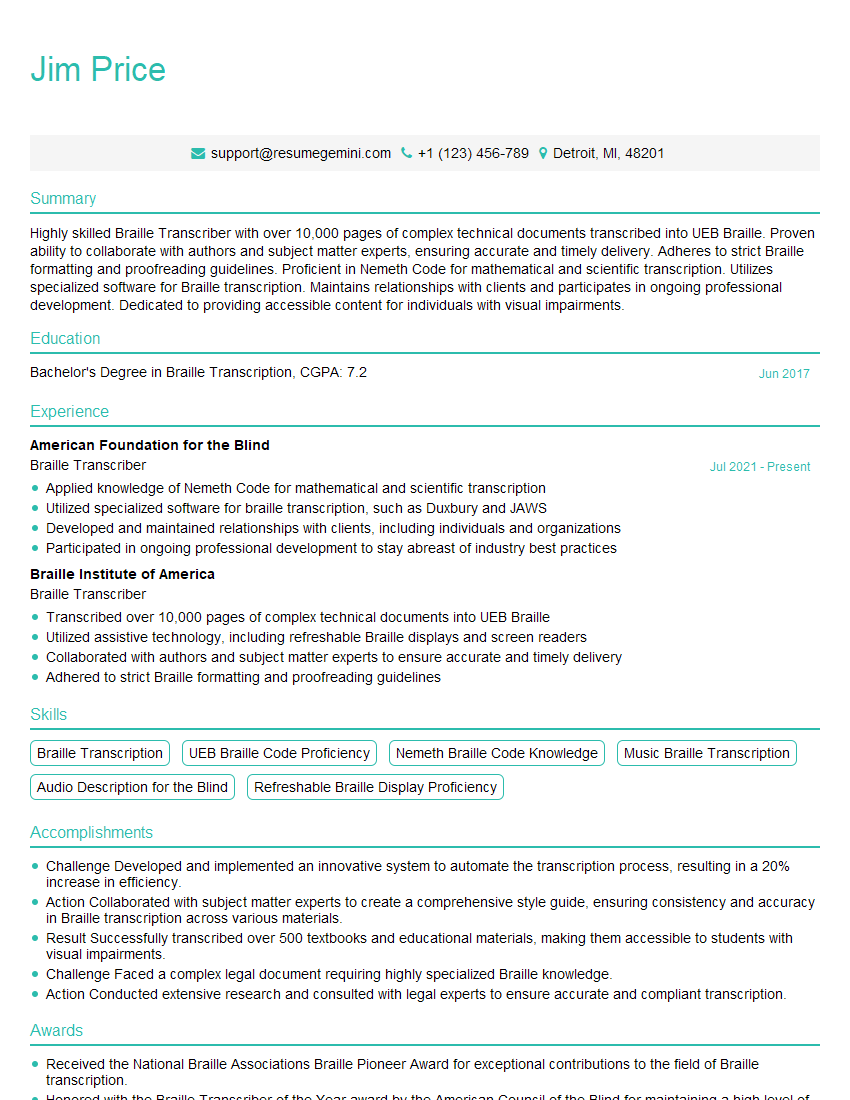
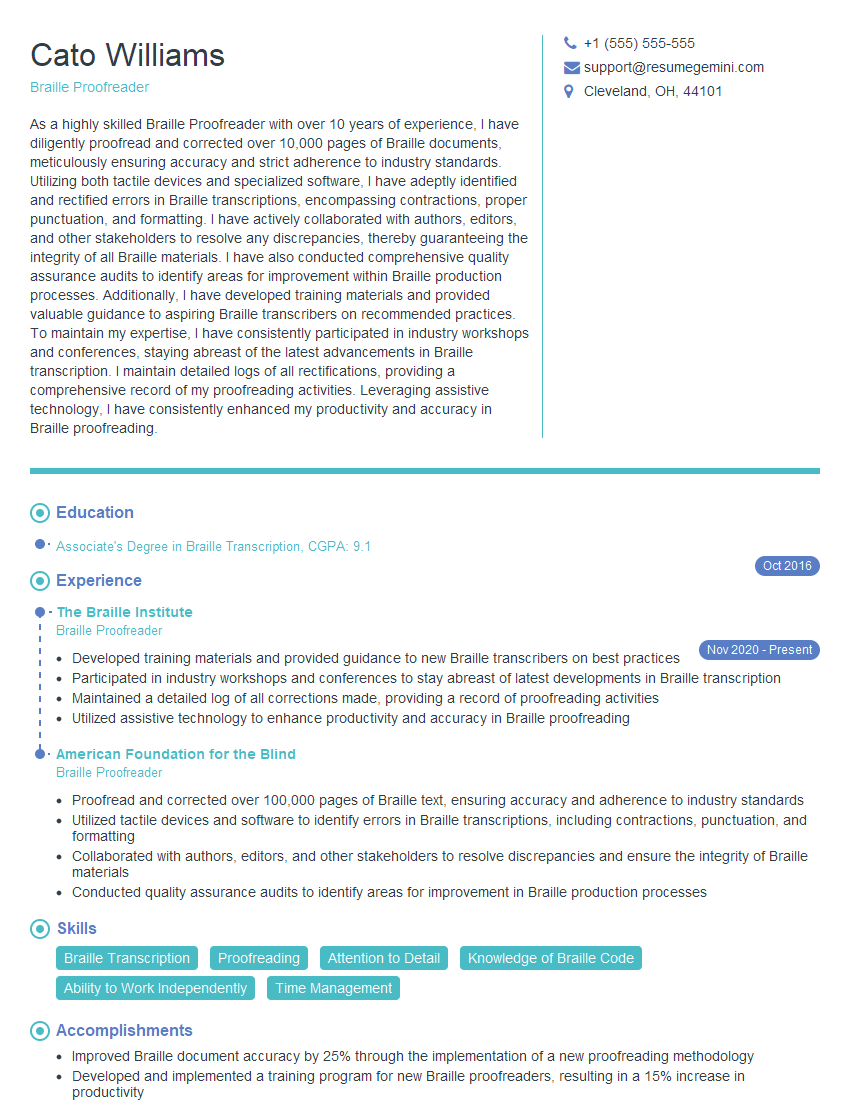
Mastering Braille transcription skills is crucial for a rewarding and impactful career. The ability to create accessible materials opens doors to diverse and fulfilling opportunities in education, publishing, government, and many other sectors. To maximize your job prospects, crafting an ATS-friendly resume is essential. ResumeGemini is a trusted resource that can help you build a professional and compelling resume tailored to highlight your skills and experience. Examples of resumes tailored to Braille transcription experience for Education, Employment and Independent Living are available to guide you.
Explore more articles
Users Rating of Our Blogs
Share Your Experience
We value your feedback! Please rate our content and share your thoughts (optional).
What Readers Say About Our Blog
I Redesigned Spongebob Squarepants and his main characters of my artwork.
https://www.deviantart.com/reimaginesponge/art/Redesigned-Spongebob-characters-1223583608
IT gave me an insight and words to use and be able to think of examples
Hi, I’m Jay, we have a few potential clients that are interested in your services, thought you might be a good fit. I’d love to talk about the details, when do you have time to talk?
Best,
Jay
Founder | CEO