Every successful interview starts with knowing what to expect. In this blog, we’ll take you through the top Volunteer Experience in organizations serving the blind and visually impaired interview questions, breaking them down with expert tips to help you deliver impactful answers. Step into your next interview fully prepared and ready to succeed.
Questions Asked in Volunteer Experience in organizations serving the blind and visually impaired Interview
Q 1. Describe your experience working with individuals who are blind or visually impaired.
My experience working with individuals who are blind or visually impaired spans over ten years, primarily within the context of volunteer program management at the Lighthouse for the Blind. I’ve had the privilege of working directly with volunteers of all ages and abilities, many of whom are blind or visually impaired themselves. This has involved everything from recruitment and training to program development and ongoing support. I’ve learned to appreciate the diverse range of skills and experiences within this community and the unique challenges and strengths each individual brings.
For example, I once worked with a visually impaired volunteer who had exceptional organizational skills. We tailored his role in our data entry program to leverage his strengths, using specialized software and assistive technologies, resulting in exceptional accuracy and efficiency. Another volunteer, proficient in Braille, provided invaluable assistance in translating documents and creating accessible materials for our clients. These experiences taught me the importance of person-centered planning and leveraging individual strengths.
Q 2. What assistive technologies are you familiar with?
I’m familiar with a wide range of assistive technologies, including screen readers (JAWS, NVDA), Braille displays, screen magnifiers, voice recognition software (Dragon NaturallySpeaking), and specialized navigation tools such as GPS apps with audio output. I also have experience with alternative input devices like refreshable Braille keyboards and specialized mice. Beyond the hardware, I’m proficient in using accessible document formats such as DOCX, PDF/UA, and EPUB, ensuring information is readily accessible to visually impaired individuals.
My familiarity extends to understanding the underlying principles of web accessibility (WCAG) and how to design inclusive digital content. I regularly assess and improve the accessibility of our organization’s website and training materials to ensure they meet the needs of individuals with visual impairments. For instance, I recently helped redesign our online volunteer training to incorporate audio descriptions for all videos and ensure clear text alternatives for all images.
Q 3. How would you adapt a training program for a visually impaired participant?
Adapting a training program for a visually impaired participant requires careful consideration of their individual needs and preferences. A one-size-fits-all approach is ineffective. The process begins with a thorough needs assessment, involving a conversation with the participant to understand their specific challenges and preferred learning styles.
- Format Conversion: All materials need to be converted into accessible formats, such as Braille, large print, or audio. Digital materials should be compatible with screen readers.
- Hands-on Activities: I would incorporate tactile learning exercises, including the use of three-dimensional models or real-world objects, whenever appropriate.
- Alternative Instructional Methods: We would leverage audio descriptions, tactile diagrams, and clear, concise verbal explanations to supplement visual materials.
- Assistive Technology Integration: The training would incorporate the use of assistive technologies relevant to the participant’s needs and skills. For example, if they use a screen reader, the training materials should be tested with that specific software to guarantee compatibility.
- Frequent Check-ins: I’d schedule regular check-ins to answer questions, address challenges, and provide personalized support throughout the training period.
For example, in a first-aid training, instead of just showing a diagram of CPR, I would use a manikin for hands-on practice and provide clear audio instructions.
Q 4. Explain your understanding of the challenges faced by visually impaired individuals in daily life.
Visually impaired individuals face a wide range of challenges in daily life, impacting their ability to navigate independently, access information, and participate fully in society. These challenges can be categorized broadly into:
- Mobility: Navigating unfamiliar environments, avoiding obstacles, and using public transportation can be significantly more difficult without sight.
- Access to Information: Many printed materials and digital content are not accessible without appropriate assistive technologies.
- Social Interaction: Misunderstandings can arise due to difficulties in reading facial expressions and body language.
- Independence: Performing daily tasks such as cooking, shopping, and managing personal finances may require more time and effort.
- Safety: Increased risks associated with navigating obstacles and encountering unfamiliar situations.
It’s crucial to remember that these challenges vary significantly depending on the individual’s level of vision, the type of visual impairment, and the availability of support systems. Understanding this diversity is key to providing appropriate and effective assistance.
Q 5. How would you handle a situation where a visually impaired volunteer needs additional support?
If a visually impaired volunteer needs additional support, my first step would be to have a private conversation to understand their specific needs and concerns in a safe and non-judgmental environment. Open communication is crucial. I would actively listen and validate their feelings.
Then, I would collaboratively develop a support plan, incorporating the following steps:
- Assess the situation: Identify the exact nature of the needed support – is it related to training, accessibility, assistive technology, or personal matters?
- Explore Solutions: Depending on the need, solutions might include providing additional training, procuring necessary assistive technologies, connecting them with appropriate support services, adjusting their tasks or responsibilities, or pairing them with a buddy volunteer.
- Implement and Monitor: Implement the agreed-upon support plan and regularly monitor its effectiveness, making adjustments as needed. Regular check-ins are essential to ensure the plan remains relevant and helpful.
- Document Everything: Maintain clear documentation of the situation, support provided, and the volunteer’s progress. This ensures accountability and helps with future support planning.
In a practical example, if a volunteer struggled with using screen reader software, I would arrange for one-on-one training with a technology specialist and provide access to online resources and tutorials.
Q 6. What strategies would you use to ensure inclusivity in volunteer activities?
Ensuring inclusivity in volunteer activities requires proactive planning and a commitment to accessibility. My strategies include:
- Accessible Venues and Materials: Choosing accessible locations with ramps, elevators, and clear signage. All training materials and communication are provided in accessible formats.
- Person-Centered Planning: Engage volunteers in the planning process to understand their individual needs and preferences and adapt activities accordingly.
- Assistive Technology Provision: Providing access to necessary assistive technology, including screen readers, Braille displays, and magnifiers. Training on how to use this technology is provided.
- Buddy System: Pairing visually impaired volunteers with sighted volunteers to provide assistance and support.
- Sensory Awareness: Being mindful of potential sensory overstimulation (noise, lighting) and making adjustments as needed.
- Clear Communication: Using clear, concise language, and providing alternative formats for information (audio descriptions, tactile materials).
For example, if we are organizing a volunteer event in a new venue, I would contact the venue in advance to verify its accessibility features and make any necessary accommodations.
Q 7. How do you ensure effective communication with individuals who are blind or visually impaired?
Effective communication with individuals who are blind or visually impaired requires clear and direct language, active listening, and awareness of the communication barriers they may face.
- Clear and Concise Language: Avoid jargon and use simple, direct language, avoiding ambiguous phrasing.
- Descriptive Language: When providing instructions or descriptions, use vivid and detailed language that emphasizes sensory details beyond sight.
- Active Listening: Pay attention to what the person is saying, both verbally and nonverbally, asking clarifying questions as needed.
- Provide Context: Explain the surroundings or situation clearly, especially in unfamiliar environments.
- Check for Understanding: Regularly confirm that the message has been understood, either by asking directly or by observing their response.
- Alternative Communication Methods: Be prepared to use alternative communication methods such as Braille, large print, or assistive technology.
For instance, instead of saying ‘the report is on the desk,’ I’d say ‘the report is on the desk, which is a brown wooden surface in the corner of the room, directly next to the blue file cabinet.’
Q 8. Describe your experience with Braille or other alternative communication methods.
My experience with Braille involves more than just reading; it’s about understanding the tactile communication it represents. I’ve completed a Braille literacy course and can confidently read and write Grade 2 Braille. I’m also familiar with other alternative communication methods, such as large-print materials, audio descriptions, and assistive technology like screen readers (JAWS, NVDA) and screen magnifiers. I understand the importance of adapting communication to suit individual needs and preferences. For instance, while some individuals might prefer Braille, others might find audio descriptions more accessible. My approach is always to ensure the method used is comfortable and effective for the visually impaired individual.
In practical scenarios, this means I can assist in tasks like creating Braille labels, transcribing documents into Braille, or using screen readers to access information together with a visually impaired individual. I’ve used these skills to help individuals navigate digital resources, write letters, and even create accessible crafts.
Q 9. What is your understanding of the Americans with Disabilities Act (ADA) and its relevance to volunteer work?
The Americans with Disabilities Act (ADA) is a landmark law that prohibits discrimination based on disability. In the context of volunteer work, it mandates that organizations make reasonable accommodations to ensure equal access for individuals with disabilities. This includes providing appropriate assistive devices, modifying tasks or environments, and ensuring communication is accessible. Failure to comply with the ADA can lead to legal repercussions for organizations.
For volunteers, understanding the ADA means being mindful of accessibility needs. It guides our actions to ensure the inclusive participation of visually impaired individuals. For example, we need to be aware that providing only visual materials is a barrier, and alternative formats must be offered. We must also adapt tasks to account for visual impairments and ensure a safe and welcoming environment.
Q 10. How would you assess the needs of a visually impaired individual and tailor your support accordingly?
Assessing the needs of a visually impaired individual requires a sensitive and individualized approach. It starts with open communication and active listening. I would begin by asking the individual about their specific needs and preferences, their level of visual acuity, and any assistive technologies they use. For example, I would ask about their preferred communication methods, their comfort level with mobility aids, and whether they have any additional disabilities.
Based on this assessment, I can tailor my support. This might involve providing clear verbal instructions, using tactile aids, adapting tasks to be more accessible, or offering assistance with mobility. For instance, if the individual uses a cane, I would offer assistance with navigation while respecting their independence. If they prefer to read Braille, I’d prepare materials in that format. Each individual has unique needs, and a tailored approach ensures they are comfortable, safe, and can fully participate.
Q 11. How would you promote volunteer opportunities to individuals who are blind or visually impaired?
Promoting volunteer opportunities to individuals who are blind or visually impaired requires utilizing accessible channels and formats. This goes beyond simply posting information online; it requires reaching them where they are comfortable. I would use a multi-pronged approach:
- Accessible Websites and Documents: Ensuring our websites and promotional materials are accessible through screen readers and offer alternative text for images.
- Audio Announcements: Utilizing podcasts or audio descriptions in promotional materials.
- Partnerships with Organizations: Collaborating with organizations serving the blind and visually impaired to spread the word through their established networks and newsletters.
- Braille and Large Print Materials: Providing printed materials in accessible formats.
- Social Media Accessibility: Employing strategies like detailed captions and alternative text descriptions for images on social media.
The key is making sure the information is available in multiple formats and through channels that reach the target audience.
Q 12. Explain your experience in creating or adapting activities for visually impaired participants.
My experience in creating and adapting activities involves a deep understanding of how visual impairments affect participation. I’ve adapted various activities such as cooking classes (using tactile labels and detailed verbal instructions), arts and crafts (using textured materials and auditory feedback), and even team sports (incorporating auditory cues and physical guidance).
For example, in a cooking class, instead of relying on visual cues like color changes, we’d use a thermometer to measure the temperature of the food. In arts and crafts, I’d incorporate tactile materials like textured fabrics or clay, allowing for creative exploration without relying on sight. The goal is always to maintain the integrity of the activity while ensuring full participation by all. A collaborative process, involving the individual in the planning and adaptation process, is always the most effective.
Q 13. Describe your understanding of orientation and mobility skills.
Orientation and mobility (O&M) skills are crucial for visually impaired individuals to navigate their environment safely and independently. O&M training teaches techniques like using a cane, understanding spatial awareness, and employing strategies for safe travel. It includes learning how to interpret environmental cues through touch, hearing, and even smell.
Understanding O&M allows me to effectively assist visually impaired individuals, respecting their autonomy while ensuring their safety. I wouldn’t take over their mobility unless specifically asked; instead, I’d provide guidance and support as needed. This might involve describing the environment, offering a guiding hand when crossing a street, or helping to identify obstacles. I believe in empowering individuals to use their own O&M skills to the fullest extent possible.
Q 14. How would you ensure the safety and well-being of a visually impaired individual during a volunteer activity?
Ensuring the safety and well-being of a visually impaired individual during a volunteer activity requires proactive measures and careful planning. This begins with a thorough risk assessment of the activity location and environment. We would identify potential hazards, such as uneven pavements, stairs without handrails, or busy traffic areas.
Then, we’d implement appropriate safety measures. This could involve providing clear and concise verbal instructions, offering physical guidance where necessary, ensuring adequate lighting, using tactile cues, and clearly marking potential hazards. I would always maintain communication and ensure the individual feels safe and secure throughout the activity. Their comfort and wellbeing are paramount. For example, before engaging in a group activity, we would create a mental map of the surroundings with the individual and establish clear communication signals.
Q 15. How familiar are you with different types of visual impairments?
Understanding the diverse range of visual impairments is crucial for effective volunteer support. Visual impairments aren’t monolithic; they exist on a spectrum. Some individuals may have low vision, meaning they can see but require assistive devices like magnifiers or large-print materials. Others may be legally blind, with visual acuity significantly below normal. Then there’s total blindness, where no light perception exists. Beyond acuity, conditions like cataracts, glaucoma, macular degeneration, and retinitis pigmentosa each impact vision differently, affecting contrast sensitivity, peripheral vision, and the ability to perceive light and color. For instance, someone with macular degeneration might have difficulty with central vision, while someone with retinitis pigmentosa may experience progressive tunnel vision. A volunteer coordinator must be sensitive to these nuances, adapting approaches accordingly.
Career Expert Tips:
- Ace those interviews! Prepare effectively by reviewing the Top 50 Most Common Interview Questions on ResumeGemini.
- Navigate your job search with confidence! Explore a wide range of Career Tips on ResumeGemini. Learn about common challenges and recommendations to overcome them.
- Craft the perfect resume! Master the Art of Resume Writing with ResumeGemini’s guide. Showcase your unique qualifications and achievements effectively.
- Don’t miss out on holiday savings! Build your dream resume with ResumeGemini’s ATS optimized templates.
Q 16. What resources would you use to find information and training related to serving the visually impaired?
Finding reliable information and training for serving the visually impaired relies on a multi-pronged approach. I would leverage resources like the American Foundation for the Blind (AFB), the National Federation of the Blind (NFB), and the Association for Education and Rehabilitation of the Blind and Visually Impaired (AER). These organizations offer extensive training materials, webinars, and publications on topics ranging from assistive technology to effective communication strategies. Additionally, I’d explore university programs with blindness and visual impairment studies, looking for workshops or online courses. Government websites, such as those affiliated with the Department of Education, often feature accessibility guidelines and best practices. Finally, networking with professionals within the field—either through professional organizations or at local support groups for the visually impaired—provides invaluable practical insight and connects me with current best practices.
Q 17. How would you respond to a challenging situation or conflict involving a visually impaired volunteer?
Addressing conflict involving a visually impaired volunteer requires a calm, empathetic, and solution-focused approach. My first step would be to listen actively and without judgment, ensuring the volunteer feels heard and understood. It’s crucial to acknowledge their perspective and validate their feelings. If the conflict involves a misunderstanding about tasks or expectations, I would clearly and patiently re-explain the roles and responsibilities, offering specific, tangible examples. If the issue involves a clash of personalities or work styles, I would facilitate a mediated discussion, encouraging open communication and compromise. Confidentiality would be paramount throughout this process. If the situation escalates or remains unresolved, I would consult with a supervisor or HR representative to seek guidance and develop a formal resolution plan. For example, if a volunteer felt they weren’t given adequate training or support, my immediate response would involve offering supplemental training, pairing them with a mentor, or adjusting their tasks to align better with their skills and comfort levels.
Q 18. Describe your experience working as part of a team in a supportive environment.
My experience working in supportive team environments has consistently shown the power of collaborative problem-solving. In a previous role, we were tasked with organizing a large-scale fundraising event for a charity supporting visually impaired children. The team comprised individuals with diverse skillsets—graphic designers, fundraising specialists, event planners, and volunteers with personal experience of visual impairment. By clearly defining roles, establishing open communication channels, and leveraging each member’s unique strengths, we successfully exceeded our fundraising goals. I fostered a culture of mutual respect and shared responsibility, ensuring everyone felt valued and heard. Regular team meetings, where ideas were freely shared and feedback was welcomed, were crucial to our success. We relied on collaborative tools, such as shared online calendars and task management software, to maintain transparency and streamline workflow. The success of this project underscored the importance of trust, effective communication, and a commitment to shared goals in achieving collective success.
Q 19. How would you ensure the confidentiality and privacy of visually impaired individuals?
Maintaining confidentiality and privacy is paramount when working with visually impaired individuals. This begins with adhering to strict data protection policies, ensuring that any personal information—whether it’s medical records, contact details, or even details about their daily routines—is handled according to best practices and legal requirements. This includes using secure data storage methods, limiting access to sensitive information to authorized personnel only, and actively educating volunteers about confidentiality protocols. In all interactions, I would be mindful of avoiding casual disclosure of personal information, particularly in public spaces. For instance, I would never publicly discuss a volunteer’s specific challenges or medical history, even in casual conversation. My commitment to confidentiality extends beyond formal policies, encompassing a mindful and respectful approach to every interaction.
Q 20. How comfortable are you using screen readers or other accessibility software?
I am highly comfortable using screen readers (such as JAWS and NVDA) and other accessibility software. I understand the importance of navigating digital environments from the perspective of a visually impaired user. My experience includes using screen readers to access various documents, websites, and applications. I’m familiar with keyboard shortcuts and various navigation techniques. Beyond screen readers, I have experience using other assistive technologies such as Braille displays and voice recognition software. I recognize that proficiency in these technologies is ongoing, and I remain committed to continuous learning and improvement in this area to best support the needs of visually impaired individuals. For example, I routinely use screen readers to review documents to ensure accessibility before sharing them.
Q 21. How would you address the potential barriers to participation faced by visually impaired individuals?
Addressing barriers to participation faced by visually impaired individuals requires a proactive and individualized approach. Some common barriers include lack of accessible transportation, inadequate training, inaccessible facilities, or insufficient adaptive equipment. To overcome these, I would first conduct thorough needs assessments, engaging visually impaired individuals in the process. This might involve surveys, interviews, or focus groups to understand their specific needs and preferences. Based on these assessments, I would create inclusive programs and activities, ensuring accessibility at all levels. This would involve offering transportation assistance, providing appropriate training using accessible formats (e.g., Braille, large print, audio), adapting workspaces and materials, and sourcing and providing necessary assistive technology. Regular check-ins with participants are also essential to monitor progress and address any emerging challenges. For instance, if a volunteer mentions difficulty navigating a particular area of the building, I would immediately arrange for wayfinding support or implement changes to improve accessibility.
Q 22. Describe your experience with providing emotional support to individuals with disabilities.
Providing emotional support to individuals with visual impairments requires a deep understanding of their unique challenges and a genuine empathy for their experiences. It’s not just about offering sympathy, but about actively listening, validating their feelings, and creating a safe space for them to express themselves. This involves recognizing that their emotional needs might be heightened due to the challenges they face in navigating the world.
For example, I’ve worked with individuals who experienced frustration and anxiety due to navigating unfamiliar environments or feeling isolated due to limited access to information. In these situations, I focused on active listening, offering practical solutions (like helping them learn a new assistive technology), and simply being present and supportive. I also focused on celebrating their achievements and resilience, which is crucial in building self-esteem and fostering independence. Another instance involved helping a visually impaired individual manage grief following a loss; it required patience, understanding, and a delicate approach to guide them through their emotional journey without imposing my own perspectives.
Q 23. What are your personal strengths and weaknesses relevant to this volunteer role?
My key strengths for this volunteer role include patience, empathy, and strong communication skills. I’m a good listener and adept at building rapport with people from diverse backgrounds. I am also highly organized and possess excellent time-management abilities, essential for coordinating volunteer tasks effectively. Moreover, I’m proactive and resourceful, always seeking ways to improve my support and the overall experience for those I assist.
One area where I could improve is my knowledge of specific assistive technologies beyond the basic ones I’ve encountered. I’m actively seeking opportunities to learn more about the latest advancements in accessible technology to better assist individuals. I believe that by actively acknowledging this area for growth and continuously seeking training, I can continuously improve my effectiveness in this role.
Q 24. How would you measure the success of your volunteer efforts?
Measuring the success of my volunteer efforts involves a multi-faceted approach. It’s not solely about quantifiable metrics but also about qualitative improvements in the lives of the individuals I support. I would measure success by:
- Increased independence and self-confidence: Observing a noticeable increase in an individual’s ability to manage daily tasks independently and a boost in their self-esteem.
- Improved social engagement: Seeing the individual participate more actively in social activities and build stronger relationships.
- Positive feedback and testimonials: Gathering feedback from the individuals I support, their families, or organization staff about their experience and the impact of my assistance.
- Progress towards personal goals: Tracking the progress the individuals make towards their personal goals, whether it’s learning a new skill, gaining employment, or simply improving their quality of life.
For instance, I would consider my efforts successful if I helped a visually impaired individual learn to use a screen reader, enabling them to access information independently and increasing their overall confidence. Similarly, if I helped someone overcome their fear of using public transportation, or I simply provided companionship to someone who was feeling lonely, I would consider that a success.
Q 25. What are your long-term goals regarding volunteer work?
My long-term goals regarding volunteer work involve deepening my expertise in supporting individuals with visual impairments and potentially taking on leadership roles within the organization or similar organizations. I aim to become a valuable asset, contributing to the development and implementation of innovative programs that enhance the lives of individuals with visual impairments. This might involve training other volunteers, developing new resources, or advocating for better accessibility within the community.
Ultimately, I aspire to contribute to a more inclusive society where individuals with visual impairments are empowered to lead fulfilling and independent lives. I envision myself continuing to volunteer even beyond this specific role, perhaps expanding my involvement to other areas of need within the disability community.
Q 26. Why are you interested in volunteering with this specific organization?
I am deeply interested in volunteering with this specific organization because of its [Insert organization’s name here]’s reputation for providing high-quality services and its commitment to empowering individuals with visual impairments. I’ve been particularly impressed by [Mention specific program, initiative, or value that resonates with you]. The organization’s focus on [Mention a specific area of their work that interests you] aligns perfectly with my desire to contribute meaningfully to the community and make a tangible difference in the lives of others.
Furthermore, the organization’s values of [Mention the organization’s values that attract you] resonate strongly with my own personal values, making this a particularly compelling opportunity for me to invest my time and skills.
Q 27. What are your expectations for this volunteer role?
My expectations for this volunteer role are to receive clear guidance on my responsibilities and to have opportunities for ongoing professional development. I anticipate collaborating effectively with staff and other volunteers, receiving constructive feedback on my performance, and contributing meaningfully to the organization’s mission. I also expect a safe and respectful environment where my contributions are valued and I can learn and grow both professionally and personally. Clear communication regarding scheduling and tasks is also crucial for my successful participation.
Q 28. Are you comfortable with ongoing training and professional development?
Yes, I am absolutely comfortable with ongoing training and professional development. I believe that continuous learning is essential for providing the best possible support to individuals with visual impairments. The field is constantly evolving, with new technologies and best practices emerging regularly. I am eager to participate in any training opportunities provided by the organization, whether it’s learning new assistive technologies, improving my communication skills, or enhancing my understanding of the challenges faced by individuals with visual impairments.
I see ongoing training not just as a requirement but as a valuable opportunity to refine my skills, improve the effectiveness of my volunteer work, and become a more valuable contributor to the organization’s mission.
Key Topics to Learn for Volunteer Experience in organizations serving the blind and visually impaired Interview
- Understanding the challenges faced by the visually impaired: Explore the diverse range of needs and experiences within the visually impaired community, including those related to mobility, communication, access to information, and social inclusion.
- Assistive technologies and adaptive techniques: Familiarize yourself with common assistive technologies (screen readers, Braille displays, etc.) and adaptive techniques used to enhance independence and participation. Be prepared to discuss practical applications and limitations.
- Communication and interaction strategies: Learn effective communication strategies for interacting respectfully and sensitively with individuals who are blind or visually impaired. This includes verbal communication, clear and concise instructions, and mindful body language.
- Volunteer roles and responsibilities: Research various volunteer roles within organizations serving the blind and visually impaired, such as reading services, mobility assistance, event support, administrative tasks, or technology training. Understand the expectations and responsibilities associated with each.
- Advocacy and inclusion: Gain an understanding of the principles of advocacy and inclusion for individuals with visual impairments. Be prepared to discuss ways to promote accessibility and equal opportunities.
- Problem-solving and adaptability: Prepare examples showcasing your ability to solve problems creatively and adapt your approach to meet diverse needs within a dynamic environment.
- Legal and ethical considerations: Familiarize yourself with relevant laws and ethical considerations pertaining to confidentiality, privacy, and professional conduct when working with vulnerable populations.
Next Steps
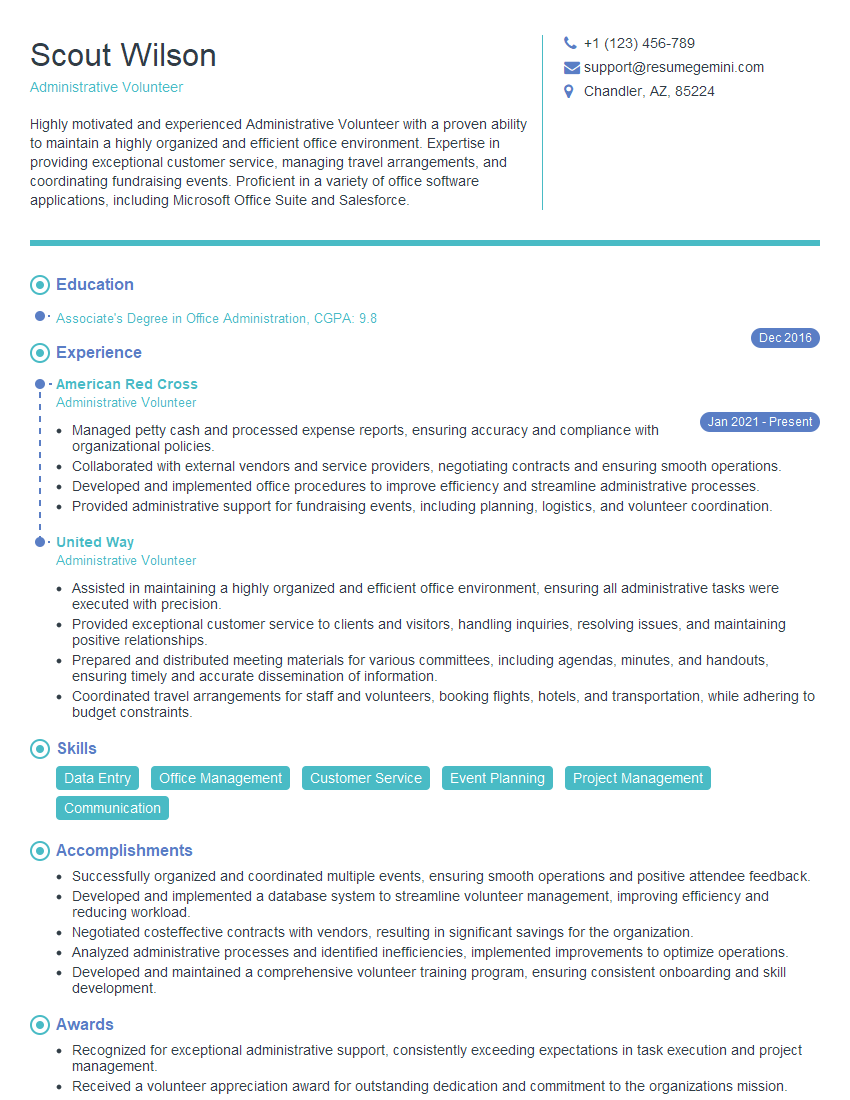
Mastering the nuances of volunteer experience in organizations serving the blind and visually impaired significantly enhances your empathy, problem-solving skills, and understanding of accessibility. This experience is highly valued by employers across various sectors, showcasing your commitment to social responsibility and your ability to work with diverse populations. To maximize your job prospects, crafting an ATS-friendly resume is crucial. ResumeGemini is a trusted resource that can help you build a professional and impactful resume tailored to highlight your unique skills and experiences. Examples of resumes tailored to Volunteer Experience in organizations serving the blind and visually impaired are available to further guide your preparation.
Explore more articles
Users Rating of Our Blogs
Share Your Experience
We value your feedback! Please rate our content and share your thoughts (optional).
What Readers Say About Our Blog
I Redesigned Spongebob Squarepants and his main characters of my artwork.
https://www.deviantart.com/reimaginesponge/art/Redesigned-Spongebob-characters-1223583608
IT gave me an insight and words to use and be able to think of examples
Hi, I’m Jay, we have a few potential clients that are interested in your services, thought you might be a good fit. I’d love to talk about the details, when do you have time to talk?
Best,
Jay
Founder | CEO