Feeling uncertain about what to expect in your upcoming interview? We’ve got you covered! This blog highlights the most important Paid Search Campaign Management interview questions and provides actionable advice to help you stand out as the ideal candidate. Let’s pave the way for your success.
Questions Asked in Paid Search Campaign Management Interview
Q 1. Explain the difference between Broad Match, Phrase Match, and Exact Match keywords.
Keyword match types in Google Ads determine how closely your keywords need to match a user’s search query before your ad shows. Think of it like targeting a specific audience: the broader your net, the more potential customers you reach, but also the more irrelevant clicks you might get.
- Broad Match: This is the widest net. Your ad can show for searches containing variations of your keyword, including misspellings, synonyms, and related searches. For example, if your keyword is “blue running shoes,” your ad might show for searches like “buy blue trainers,” “cheap running shoes blue,” or even “best running shoes for men blue.” It’s great for reaching a large audience, but it can also lead to wasted budget on irrelevant clicks.
- Phrase Match: This is a more precise targeting method. Your ad will show only when a user’s search includes your keyword phrase in the exact order, but it can have additional words before or after. For example, with the keyword “blue running shoes,” your ad might show for “best blue running shoes” but not “running blue shoes.” This offers a balance between reach and relevance.
- Exact Match: This is the most precise match type. Your ad will only show if a user’s search query exactly matches your keyword, or very close variations. With “blue running shoes,” your ad would only show for searches like “blue running shoes” or “blue running shoes for women” (depending on your match type settings). It’s great for highly targeted campaigns but might result in lower reach.
Choosing the right match type is crucial for optimizing your campaign’s performance. It depends on your goals, budget, and the competitiveness of your keywords.
Q 2. Describe your experience with keyword research and selection.
Keyword research is the foundation of any successful PPC campaign. I approach it systematically, using a combination of tools and techniques. I start with brainstorming – what are the key terms customers might use to find my client’s products or services? Then, I use tools like Google Keyword Planner, SEMrush, Ahrefs, and even explore competitor websites to identify relevant keywords.
Next, I analyze search volume, competition, and relevance. High search volume is good, but if the competition is fierce and the keyword isn’t highly relevant to my client’s offering, it might not be worth targeting. I look for keywords with a good balance of search volume, relatively low competition, and high relevance – the sweet spot for cost-effective campaigns. I often organize these keywords into thematic groups to structure my campaigns effectively. For example, if selling hiking boots, I might have groups for “hiking boots men,” “waterproof hiking boots,” and “best hiking boots for women.” This allows for more granular bidding and ad copy adjustments.
Finally, I continuously monitor and refine my keyword selection based on performance data. Poorly performing keywords are regularly reviewed and potentially paused or replaced with more effective alternatives. It’s an ongoing process of optimization.
Q 3. How do you determine the optimal bid strategy for a PPC campaign?
Determining the optimal bid strategy depends entirely on the campaign goals and the client’s budget. There’s no one-size-fits-all answer.
- Maximize Conversions: This automated strategy focuses on getting the most conversions possible within the given budget. It’s ideal when the primary goal is sales or lead generation.
- Target CPA (Cost-Per-Acquisition): This allows you to set a target cost per conversion. Google Ads will automatically adjust bids to try and achieve that target. It’s great for controlling costs while maintaining a focus on conversions.
- Target ROAS (Return on Ad Spend): This strategy aims to maximize your return on investment by setting a target ROAS. Google will adjust bids to try and hit that target. This is ideal when you have a clear understanding of your conversion value and want to prioritize profitability.
- Manual CPC (Cost-Per-Click): This provides the most control. You set individual bids for each keyword, allowing for highly customized bidding strategies. It requires more time and expertise but can be very effective when fine-tuned.
I usually start with an automated strategy, like Maximize Conversions or Target CPA, and then switch to more manual control as I gather more data and understand the campaign’s performance. Regular monitoring and adjustments are essential to ensure the strategy remains optimal. For example, if we’re not seeing enough conversions with Maximize Conversions, I might reduce the target CPA to try and improve conversion rates.
Q 4. What are the key performance indicators (KPIs) you track for PPC campaigns?
Tracking the right KPIs is critical for measuring the success of a PPC campaign and making data-driven optimizations. The specific KPIs depend on the campaign goals, but some key metrics I always monitor include:
- Click-Through Rate (CTR): Indicates how engaging your ads are. A low CTR suggests issues with ad copy or targeting.
- Conversion Rate: Measures the percentage of clicks that result in desired actions (purchases, sign-ups, etc.).
- Cost-Per-Click (CPC): Shows how much you’re paying for each click. High CPCs can strain your budget.
- Cost-Per-Acquisition (CPA): Represents the cost of each conversion. Lower CPA is always desirable.
- Return on Ad Spend (ROAS): Measures the revenue generated for every dollar spent on ads. High ROAS indicates profitability.
- Impression Share: Shows the percentage of times your ads were shown compared to the potential impressions.
- Quality Score: Reflects the relevance and quality of your keywords, ads, and landing pages. A high Quality Score generally leads to lower CPCs and better ad positions.
By tracking these KPIs and analyzing the data, I can identify areas for improvement and make adjustments to optimize the campaign’s performance. For instance, a low conversion rate might indicate a problem with the landing page, prompting A/B testing to find a more effective design.
Q 5. How do you manage and optimize a PPC budget?
Managing and optimizing a PPC budget requires a strategic approach. I typically begin with a thorough understanding of the client’s budget and campaign goals. This allows me to set realistic expectations and create a plan for allocating the budget effectively across different campaigns, keywords, and ad groups.
I use a combination of techniques for budget optimization. Firstly, I prioritize high-performing keywords and ad groups, allocating more budget to those that are delivering the best results. Secondly, I regularly monitor the campaign’s performance, making adjustments as needed to ensure the budget is spent efficiently. This may include pausing underperforming keywords or adjusting bids based on real-time data. Thirdly, I employ automated bidding strategies, like Target CPA or Target ROAS, that can help to maximize ROI within the set budget. Finally, I use tools to forecast and track spending. The goal is not simply to spend the entire budget but rather to get the best possible results.
For example, if a specific keyword group consistently underperforms, I would redirect its budget towards more successful groups. This iterative process helps to refine the campaign and ensure that the budget is allocated where it has the most impact.
Q 6. Explain your experience with A/B testing in PPC.
A/B testing is crucial for optimizing PPC campaigns. I routinely use it to test different elements of ads and landing pages to identify what performs best. This could include testing different headlines, descriptions, call-to-actions, images, or even the entire landing page design.
I follow a structured approach to A/B testing. I start by identifying a specific element to test, creating variations of that element, and then running the test for a sufficient period (usually until a statistically significant result is obtained). Tools like Google Optimize can help with this process. I always ensure to test only one element at a time to isolate the impact of each change.
For example, I might test two different headlines for the same ad group to see which one has a higher CTR. Or I might test two different versions of a landing page to determine which one converts better. Once the results are in, I implement the winning variation across the campaign. A/B testing is a continuous process, allowing me to continuously improve campaign performance.
Q 7. How do you handle negative keywords?
Negative keywords are crucial for improving the efficiency of your PPC campaigns by preventing your ads from showing for irrelevant searches. They act as a filter, ensuring your budget is spent only on qualified traffic. I use negative keywords strategically at multiple levels:
- Broad Match Negative Keywords: These prevent your ads from showing for searches that contain a specific word or phrase in any position. For example, if selling “new running shoes,” adding “used” as a broad match negative keyword prevents your ads from showing for searches like “used running shoes.”
- Phrase Match Negative Keywords: These prevent your ads from showing for searches that contain a specific phrase. If selling professional running shoes, adding “kids running shoes” as a phrase match negative keyword would stop your ads from appearing for searches containing that precise phrase.
- Exact Match Negative Keywords: These are the most restrictive, preventing your ads from showing for searches that exactly match a specific term. For example, “cheap running shoes” might be added as an exact match negative keyword if you only sell premium shoes.
I build up my negative keyword list iteratively. I start with an initial set based on my understanding of the client’s business and target audience and then regularly review search query reports. The search query reports show the actual searches that triggered your ads. This helps me identify unintended clicks and add relevant terms to my negative keyword list. This ensures that my budget is spent on highly relevant searches leading to more conversions and a better return on investment.
Q 8. How do you identify and fix low-performing keywords or ad groups?
Identifying and fixing low-performing keywords or ad groups is crucial for maximizing PPC campaign efficiency. It involves a systematic approach focusing on performance metrics and strategic adjustments.
Analyzing Performance Data: I start by reviewing key metrics like click-through rate (CTR), conversion rate, cost per conversion (CPC), and cost per acquisition (CPA) for each keyword and ad group. Keywords with consistently low CTRs (below average for the campaign), high CPAs, and low conversion rates are prime candidates for optimization.
Keyword Refinement: Low-performing keywords often indicate a mismatch between the search query and the landing page experience. I investigate the search terms triggering these keywords through Google Ads’ Search Terms report. If the search terms are irrelevant, I add them to a negative keyword list to prevent further wasted spend. For relevant but underperforming keywords, I might tighten the match type (from broad match to phrase or exact match) to improve targeting accuracy.
Ad Copy Optimization: Weak ad copy can significantly impact performance. I analyze the ad copy for clarity, relevance, and compelling call-to-actions. A/B testing different headlines, descriptions, and calls-to-action allows for data-driven improvements. I also ensure that ad copy closely aligns with the keywords and landing page experience.
Landing Page Experience: A poor landing page experience can lead to high bounce rates and low conversion rates, regardless of how well-targeted the keywords are. I ensure that the landing page is relevant to the ad copy and keywords, is fast-loading, and provides a clear path for conversion. I use tools like Google Analytics to track user behavior on the landing page, identifying areas for improvement.
Bidding Strategies: If a keyword has a good CTR but a high CPA, it may indicate that the bid is too high for the value derived. Adjusting the bidding strategy – perhaps using automated bidding strategies like Target CPA or Maximize Conversions – can optimize spending and improve ROI. Alternatively, I might pause low-performing keywords completely after thoroughly analyzing their performance.
Example: Let’s say a keyword ‘cheap laptops’ is underperforming. I’d examine search terms to see if people are searching for ‘cheap used laptops’ or ‘cheap gaming laptops’. I would then add ‘used’ and ‘gaming’ as negative keywords if they aren’t the target audience. If the landing page is only selling new laptops, I’d adjust the ad copy to reflect this or create a new ad group with more specific keywords.
Q 9. Describe your experience with different ad formats (e.g., text ads, responsive search ads).
I have extensive experience working with various ad formats, tailoring them to achieve specific campaign goals. Each format has strengths and weaknesses, and my approach involves selecting the optimal format based on the campaign’s objectives and target audience.
Text Ads: These are the foundational ads in search campaigns and remain highly effective. My experience includes crafting compelling headlines and descriptions that highlight key value propositions, incorporating strong calls to action, and A/B testing variations to optimize click-through rates. I focus on keyword relevance and utilizing ad extensions to enhance visibility and provide additional information.
Responsive Search Ads (RSAs): These are my go-to ad format for most campaigns due to their automation. I provide Google Ads with a large number of headlines and descriptions, allowing the algorithm to dynamically serve the most relevant combinations based on user searches and context. This approach maximizes reach and improves performance by testing a large number of variations automatically.
Other Formats: While less frequently used in search campaigns, I have also worked with other ad formats like Shopping ads (for e-commerce businesses), and app promotion ads when applicable to the client’s industry.
Example: For a client selling high-end furniture, I might utilize RSAs with headlines focusing on different aspects: ‘Luxury Furniture,’ ‘Handcrafted Designs,’ ‘Free Interior Design Consultation,’ and descriptions highlighting materials and craftsmanship. For a local business, I would use location extensions to target local customers.
Q 10. How do you measure the ROI of a PPC campaign?
Measuring the ROI of a PPC campaign is critical for demonstrating its value and justifying continued investment. It goes beyond simply looking at clicks and impressions; it requires a comprehensive understanding of revenue generated and the costs incurred.
Revenue Attribution: Accurately tracking conversions and attributing revenue to specific campaigns is essential. This involves setting up conversion tracking in Google Ads and integrating with Google Analytics to capture comprehensive data. I consider different attribution models (last-click, linear, time decay, etc.) to understand how different touchpoints contribute to the sales funnel.
Cost Calculation: Calculating the total cost of the campaign includes ad spend, management fees (if applicable), and any other related expenses. This provides a clear picture of the total investment.
ROI Calculation: The fundamental formula is:
ROI = ((Revenue - Cost) / Cost) * 100. For example, if a campaign generated $10,000 in revenue and cost $5,000, the ROI would be 100%. I always present ROI alongside other key metrics such as CPA, ROAS (Return on Ad Spend), and conversion rates to provide a complete picture.Beyond Monetary ROI: In some cases, ROI might not be solely monetary. Brand awareness campaigns, for instance, may have indirect benefits, such as increased website traffic or social media engagement, which need to be considered using qualitative metrics as well.
Example: A client running a campaign for a new product might see an immediate ROI through direct sales. However, I might also track longer-term metrics like brand searches to evaluate its long-term effectiveness.
Q 11. Explain your experience with Google Ads and/or Bing Ads.
I have extensive experience managing campaigns on both Google Ads and Bing Ads, understanding their respective strengths and targeting capabilities. My experience encompasses all aspects of campaign management, from keyword research and ad copy creation to bidding strategies and performance analysis.
Google Ads: My expertise includes utilizing Google’s diverse features, such as audience targeting (demographics, interests, in-market audiences, remarketing), campaign types (search, display, shopping, video), and automated bidding strategies (Target CPA, Maximize Conversions, Target ROAS). I’m proficient in utilizing Google Ads scripts for automation and reporting.
Bing Ads: While Google Ads typically commands a larger market share, Bing Ads offers valuable reach to a distinct audience. I leverage Bing’s features to complement Google Ads campaigns, often finding it beneficial for targeting older demographics or users in specific geographical areas.
Cross-Platform Optimization: I understand that both platforms have different algorithms and audiences, requiring tailored strategies for optimal results. I employ a comparative approach, regularly analyzing campaign performance on both platforms to identify areas for improvement and synergy.
Example: A client targeting a business-to-business audience might see better results on Bing Ads, while a client selling consumer goods would likely benefit more from Google Ads’ broader reach.
Q 12. What is your experience with campaign tracking and analytics platforms (e.g., Google Analytics)?
Effective campaign tracking and analytics are essential for data-driven decision-making. I leverage various platforms to gain a comprehensive understanding of campaign performance and user behavior.
Google Analytics: This is my primary analytics tool. I use it to track website traffic, user behavior (bounce rate, time on site, pages per visit), and conversions attributed to PPC campaigns. I utilize custom dashboards and reports to visualize key metrics and identify areas for improvement.
Google Ads Integration with Analytics: I ensure seamless integration between Google Ads and Google Analytics to accurately track conversions and attribute revenue to specific campaigns. This involves setting up proper conversion tracking and using UTM parameters to differentiate traffic sources.
Other Platforms: Depending on client needs, I may incorporate other analytics platforms or tools, such as CRM systems, for a more holistic view of the customer journey and campaign effectiveness. This often involves custom integrations or APIs.
Example: By analyzing bounce rates in Google Analytics, I might identify a problem with a landing page’s design or content, leading to optimization efforts within the landing page itself and the associated ad copy.
Q 13. How do you stay updated on the latest trends and changes in the paid search landscape?
Staying updated in the dynamic world of paid search requires a proactive and multi-faceted approach.
Industry Blogs and Publications: I regularly follow reputable blogs and publications (like Search Engine Land, Search Engine Journal) that cover industry news, best practices, and algorithm updates.
Google Ads Blog and Help Center: Google frequently updates its Ads platform, and I stay informed by monitoring the official blog and help center for announcements and changes.
Webinars and Conferences: Participating in industry webinars and conferences provides valuable insights from leading experts and networking opportunities.
Professional Networks: Engaging with professional networks and online communities (like LinkedIn groups) allows me to share knowledge, learn from others, and keep abreast of current trends.
Testing and Experimentation: I continuously test different strategies and features in my campaigns to discover new techniques and stay ahead of the curve. I document these experiments and their results, adding to my knowledge base.
Example: When Google announces a significant algorithm change, I immediately research its implications for my campaigns and adjust my strategies accordingly. This might involve adapting bidding strategies, refining keyword targeting, or revising ad copy.
Q 14. Explain your understanding of Quality Score.
Quality Score is a metric in Google Ads that reflects the quality and relevance of your keywords, ads, and landing pages. It’s a crucial factor that influences your ad’s position, cost-per-click (CPC), and overall campaign performance.
Components: Quality Score is composed of three primary components:
Expected CTR (Click-Through Rate): This measures how likely your ad is to be clicked when shown.
Ad Relevance: This assesses how well your ad text matches the user’s search query and the landing page content.
Landing Page Experience: This evaluates the user experience on your landing page after they click your ad. Factors like page speed, mobile-friendliness, and ease of navigation are considered.
Impact on Campaigns: A higher Quality Score leads to lower CPCs, improved ad positions, and increased visibility. Conversely, a lower Quality Score results in higher CPCs, lower ad positions, and decreased visibility.
Improving Quality Score: Strategies to improve Quality Score include using relevant keywords, writing compelling ad copy, creating high-quality landing pages, and ensuring a positive user experience. Regular monitoring and optimization are essential for maintaining a high Quality Score.
Example: If your Quality Score is low, you might need to refine your keywords, improve your ad copy to better match search intent, and ensure your landing page is relevant and user-friendly. A high Quality Score demonstrates to Google that your ads are valuable and relevant to users, leading to better ad performance.
Q 15. What is your experience with remarketing and retargeting?
Remarketing and retargeting are crucial strategies in paid search to re-engage users who have previously interacted with your website or ads. Remarketing focuses on showing ads to users who have already visited your site, while retargeting often targets users who have shown specific intent, such as adding items to a cart but not completing a purchase. My experience encompasses developing comprehensive remarketing campaigns across various platforms like Google Ads and Bing Ads, using different audience segmentation techniques to tailor messaging and maximize conversion rates.
For example, I once managed a remarketing campaign for an e-commerce client where we segmented users based on their browsing history. Users who viewed specific product categories received targeted ads showcasing related items, leading to a significant increase in conversion rates for that product line. Another successful campaign involved creating dynamic remarketing ads that showcased specific products users had previously viewed on the website, dramatically boosting click-through rates and ultimately sales.
I utilize various techniques including audience layering (combining different remarketing lists for more targeted messaging), frequency capping (to avoid ad fatigue), and A/B testing different creative assets to optimize campaign performance. I also prioritize ethical considerations, adhering strictly to privacy regulations and user experience best practices.
Career Expert Tips:
- Ace those interviews! Prepare effectively by reviewing the Top 50 Most Common Interview Questions on ResumeGemini.
- Navigate your job search with confidence! Explore a wide range of Career Tips on ResumeGemini. Learn about common challenges and recommendations to overcome them.
- Craft the perfect resume! Master the Art of Resume Writing with ResumeGemini’s guide. Showcase your unique qualifications and achievements effectively.
- Don’t miss out on holiday savings! Build your dream resume with ResumeGemini’s ATS optimized templates.
Q 16. How do you handle campaign audits and identify areas for improvement?
Campaign audits are vital for maintaining optimal performance. My process involves a thorough examination of all aspects of a campaign, starting with keyword research and analysis. I assess the relevance of keywords, identify low-performing keywords that may need to be paused or replaced, and examine search term reports to identify any unexpected search terms driving clicks but not conversions.
Next, I meticulously review ad copy, checking for clarity, call-to-actions, and overall effectiveness. Landing page analysis is also crucial – ensuring that the landing pages are relevant to the keywords and ad copy, offering a seamless user experience and optimized for conversions. I analyze quality score, checking for areas where improvements can lead to better ad positioning and lower costs.
Finally, I examine the bidding strategy, identifying any inefficiencies or opportunities for optimization. This includes assessing conversion rates, cost per conversion, and return on ad spend (ROAS). The whole process uses a combination of automated reporting tools and manual analysis to identify trends and actionable insights. For example, if I find a significant drop in conversion rates, I’ll investigate factors like changes in the landing page, seasonality, or competition.
Q 17. Describe your experience with different bidding strategies (e.g., manual CPC, automated bidding).
I have extensive experience with both manual CPC (Cost-Per-Click) and automated bidding strategies. Manual CPC offers granular control, allowing for precise budget allocation and keyword bidding. This is particularly useful for campaigns with limited budgets or where highly specific targeting is needed.
Automated bidding strategies, on the other hand, leverage machine learning to optimize bids automatically based on various performance metrics. Examples include Target CPA (Cost-Per-Acquisition), Maximize Conversions, and Maximize Clicks. Automated bidding can be highly efficient, especially for campaigns with sufficient data, but requires careful monitoring and adjustments to ensure it aligns with campaign goals.
My approach is to choose the bidding strategy that best suits the campaign’s goals and available data. For example, a new campaign with limited data might start with manual CPC to establish a baseline performance. As more data becomes available, the campaign can transition to an automated strategy like Target CPA for greater efficiency. Regular monitoring and analysis of results are essential regardless of the chosen strategy to ensure optimal performance and ROI.
Q 18. How do you manage and handle client communication and expectations?
Client communication is paramount. I establish clear communication channels early on, such as weekly or bi-weekly progress reports, coupled with ad-hoc updates as needed. I ensure reports are easy to understand, avoiding technical jargon and focusing on key performance indicators (KPIs) that are relevant to the client’s business objectives. This includes clearly explaining the strategy, data, and results, making sure clients understand the ‘why’ behind the decisions.
Managing expectations is critical. I always set realistic goals based on industry benchmarks and client-specific factors. I maintain transparency, openly discussing challenges and potential limitations, offering proactive solutions instead of simply presenting problems. Regular client meetings are a key part of this process, enabling proactive problem-solving and collaborative decision-making. A good example is explaining that a sudden drop in conversions might be due to seasonal factors, and how we’ll adapt the strategy accordingly, showing an understanding of their business context.
Q 19. Describe your approach to managing multiple PPC campaigns simultaneously.
Managing multiple PPC campaigns simultaneously requires efficient organization and prioritization. I utilize project management tools and spreadsheets to track campaign performance, deadlines, and client communication across all accounts. This includes a clear system for task assignment and progress monitoring, enabling me to stay organized and avoid conflicts.
Prioritization is key. I identify the campaigns that require the most immediate attention, typically those with the highest potential ROI or those experiencing significant performance issues. Regular audits and performance reviews across all campaigns ensure optimal resource allocation and prevent any one campaign from dominating resources at the expense of others. Automation is also essential – leveraging tools to automate repetitive tasks such as keyword research, bid adjustments, and report generation frees up time to focus on strategic decision-making.
Q 20. Explain your experience with conversion tracking and goal setting.
Conversion tracking and goal setting are fundamental to successful PPC management. Conversion tracking involves implementing tracking codes (like Google’s conversion tracking) on websites to monitor user actions that contribute to business objectives (e.g., purchases, form submissions, newsletter signups). Clear, measurable goals are crucial before any campaign begins. These goals should be SMART: Specific, Measurable, Achievable, Relevant, and Time-bound.
For example, if the client’s goal is to increase lead generation, we’ll set a target number of leads within a specific timeframe. This target, along with key metrics like cost-per-lead (CPL) and conversion rate, will guide optimization efforts. I then analyze the conversion data regularly to identify trends, pinpoint areas for improvement, and make data-driven adjustments to the campaigns. Proper conversion tracking also allows for accurate attribution modeling, helping to understand which channels and campaigns are most effective in driving conversions.
Q 21. How do you use data to inform your PPC strategy and optimize campaigns?
Data is the cornerstone of effective PPC strategy. I use a data-driven approach at every stage, from keyword research and campaign setup to ongoing optimization. This involves leveraging various tools and platforms to collect, analyze, and interpret data related to campaign performance.
Key data points I frequently analyze include: impressions, clicks, click-through rate (CTR), cost per click (CPC), conversion rate, cost per conversion (CPC), return on ad spend (ROAS), quality score, search query reports, and audience demographics. This analysis allows me to identify trends, spot anomalies, and make informed decisions to improve campaign performance. For example, if CTR is low, we might revise ad copy or targeting. If CPC is high, we might adjust bids or refine keyword targeting. A/B testing different ad variations, landing pages, and bidding strategies is also critical for data-driven optimization, providing concrete evidence of what works best.
Q 22. What are your strengths and weaknesses when it comes to managing Paid Search campaigns?
My greatest strength in managing Paid Search campaigns lies in my data-driven approach and analytical skills. I excel at identifying trends, interpreting performance data, and using these insights to optimize campaigns for maximum ROI. I’m proficient in all major platforms – Google Ads, Microsoft Advertising, and even some specialized platforms – and I’m always learning about new features and strategies. I’m also adept at A/B testing different elements of campaigns to refine targeting and messaging. For example, recently I improved a client’s conversion rate by 15% by meticulously testing various ad copy variations and landing page designs.
However, my biggest weakness is sometimes getting bogged down in the details. I have a tendency to meticulously analyze every metric, which can sometimes slow down the overall campaign implementation. To mitigate this, I’ve implemented time-blocking strategies and prioritized tasks based on their impact on campaign performance. I’m also actively working on delegating smaller tasks more effectively to free up time for strategic analysis.
Q 23. Describe a time you had to overcome a challenge in a PPC campaign.
One challenging campaign involved a client launching a new product with limited brand awareness. Initial click-through rates were low, and the cost-per-acquisition (CPA) was significantly higher than projected. My first step was to thoroughly analyze search query data to understand how users were searching for related products and identify relevant keywords we might have missed. We found a significant portion of searches contained long-tail keywords we hadn’t considered.
Next, we created highly targeted ad groups focused on these long-tail keywords and crafted more specific ad copy addressing the unique pain points and benefits this product offered. We also revised our landing page to focus on addressing user intent more directly, and included stronger calls to action. We further implemented remarketing campaigns to nurture leads that had interacted with our ads but didn’t convert. This multi-pronged approach significantly improved our click-through rates, reduced CPA, and ultimately led to a successful product launch.
Q 24. What is your experience with using landing pages for PPC campaigns?
Landing pages are absolutely crucial for successful PPC campaigns. They’re the bridge between the ad and the conversion. A poorly designed landing page will negate the efforts put into creating effective ads and targeting. My experience involves creating and optimizing landing pages for various clients across diverse industries. I focus on ensuring a seamless user experience, a clear and concise value proposition, and a strong call to action that’s aligned with the ad copy.
For instance, for a recent e-commerce client, I created separate landing pages for different product lines, tailoring the messaging, visuals, and calls to action to match each specific ad group. This resulted in a significant increase in conversion rates compared to using a generic landing page. I utilize A/B testing to continuously improve landing page performance, experimenting with different elements like headlines, images, form fields, and button designs to find the optimal combination.
Q 25. What is your understanding of search engine algorithms?
My understanding of search engine algorithms is that they are complex systems designed to deliver the most relevant results to users’ search queries. While the specific algorithms are proprietary and constantly evolving, their core principles remain consistent: relevance, authority, and user experience.
Relevance focuses on how well a webpage matches the keywords and intent behind a search query. Authority assesses the credibility and trustworthiness of a website through metrics like backlinks, content quality, and overall site structure. User experience considers factors like website speed, mobile-friendliness, and ease of navigation. To optimize for search engines, I focus on creating high-quality, relevant content, building strong backlinks, and improving website usability. Understanding these fundamentals helps me create PPC campaigns that align with search engine goals and improve ad ranking and quality scores.
Q 26. How do you leverage audience targeting options within paid search platforms?
Audience targeting is vital for maximizing campaign efficiency and ROI. I leverage various targeting options within paid search platforms to reach the most relevant users. This includes:
- Keywords: Precise keyword selection is fundamental. I use a combination of broad, phrase, and exact match keywords to balance reach and relevance. I also regularly analyze search query reports to identify new opportunities and refine keyword targeting.
- Demographics: Targeting specific age groups, genders, locations, and parental status allows for highly focused campaigns. For example, I might target a campaign for children’s toys towards parents aged 25-45 with children.
- Interests and Remarketing: Targeting users based on their interests or past website interactions (remarketing) allows for highly personalized messaging and increased conversion rates. This helps to re-engage users who showed interest but didn’t convert initially.
- In-Market Audiences: For e-commerce, I use in-market audiences to target users actively searching for and considering purchasing products or services similar to what my client offers.
By combining these targeting options, I can create highly efficient campaigns that reach the right users at the right time with the right message.
Q 27. Explain your experience with using different ad extensions.
Ad extensions are a crucial element of any successful paid search campaign. They enhance the visibility and clickability of ads by providing additional information and call-to-action options directly within the ad itself. My experience includes using a wide range of extensions:
- Sitelink Extensions: These provide links to different sections of a website, guiding users to specific pages relevant to their search.
- Call Extensions: Allow users to call a business directly from the ad, improving lead generation.
- Location Extensions: Display a business’s physical address and map location, crucial for local businesses.
- Callout Extensions: Highlight key features or benefits, such as free shipping or a sale.
- Structured Snippet Extensions: Showcase specific attributes like product categories or services offered.
I strategically select and implement extensions based on campaign goals and target audience. A/B testing different extension combinations helps determine optimal performance. For example, using call extensions for a service-based business led to a significant increase in calls and leads. Properly utilized, extensions significantly increase click-through rates and conversions.
Q 28. What is your understanding of the role of mobile optimization in paid search?
Mobile optimization is paramount in paid search because a substantial portion of searches now originate from mobile devices. Ignoring mobile optimization will severely limit campaign reach and effectiveness. My approach includes:
- Mobile-Friendly Landing Pages: Ensuring landing pages are responsive and provide a seamless experience across all devices.
- Mobile-Specific Keywords: Identifying and targeting keywords specifically used by mobile searchers.
- Location Targeting: Leveraging location extensions and targeting to reach users within a specific geographic area, particularly crucial for mobile users.
- App Promotion: Utilizing app install campaigns to drive downloads for businesses with mobile apps.
- Mobile-First Indexing: Understanding and optimizing for Google’s mobile-first indexing, where the mobile version of a site is primarily used for ranking.
By meticulously addressing these aspects, I ensure that campaigns are optimized to deliver superior performance on mobile devices, leading to increased visibility, click-through rates, and conversions.
Key Topics to Learn for Paid Search Campaign Management Interview
- Keyword Research & Targeting: Understanding keyword research methodologies (e.g., brainstorming, competitor analysis, keyword tools), match types (broad, phrase, exact, negative), and their impact on campaign performance. Practical application: Demonstrate your ability to identify relevant keywords for a given product or service and explain your rationale for choosing specific match types.
- Campaign Structure & Organization: Designing efficient campaign structures (e.g., single, multiple campaigns), utilizing campaign types (search, shopping, display), and managing ad groups effectively. Practical application: Explain how you would structure a campaign for a new client, considering factors like budget, target audience, and goals.
- Bidding Strategies & Optimization: Mastering various bidding strategies (manual CPC, automated bidding strategies like Maximize Clicks, Target CPA, etc.), understanding their strengths and weaknesses, and optimizing bids based on performance data. Practical application: Describe a scenario where you had to adjust bidding strategies to improve ROI or meet specific campaign goals.
- Ad Copy & Landing Page Optimization: Crafting compelling ad copy that aligns with keyword targets and landing page experience, A/B testing different ad variations, and understanding the importance of a user-friendly landing page. Practical application: Explain your approach to creating high-performing ad copy and optimizing landing pages for conversions.
- Performance Measurement & Reporting: Analyzing key performance indicators (KPIs) like CTR, conversion rate, ROAS, cost per acquisition (CPA), and using data to make informed decisions. Practical application: Describe how you would present campaign performance data to a client and what insights you would draw from the data to recommend improvements.
- Google Ads & Other Platforms: In-depth knowledge of Google Ads interface and functionality, familiarity with other paid search platforms (Bing Ads, etc.), and understanding their unique features and capabilities. Practical application: Discuss your experience managing campaigns across different platforms and highlight any platform-specific best practices you’ve utilized.
- Account Management & Client Communication: Understanding the importance of client communication, managing client expectations, and presenting data-driven recommendations for improvement. Practical application: Describe a situation where you had to manage conflicting client requests or communicate difficult performance updates.
Next Steps
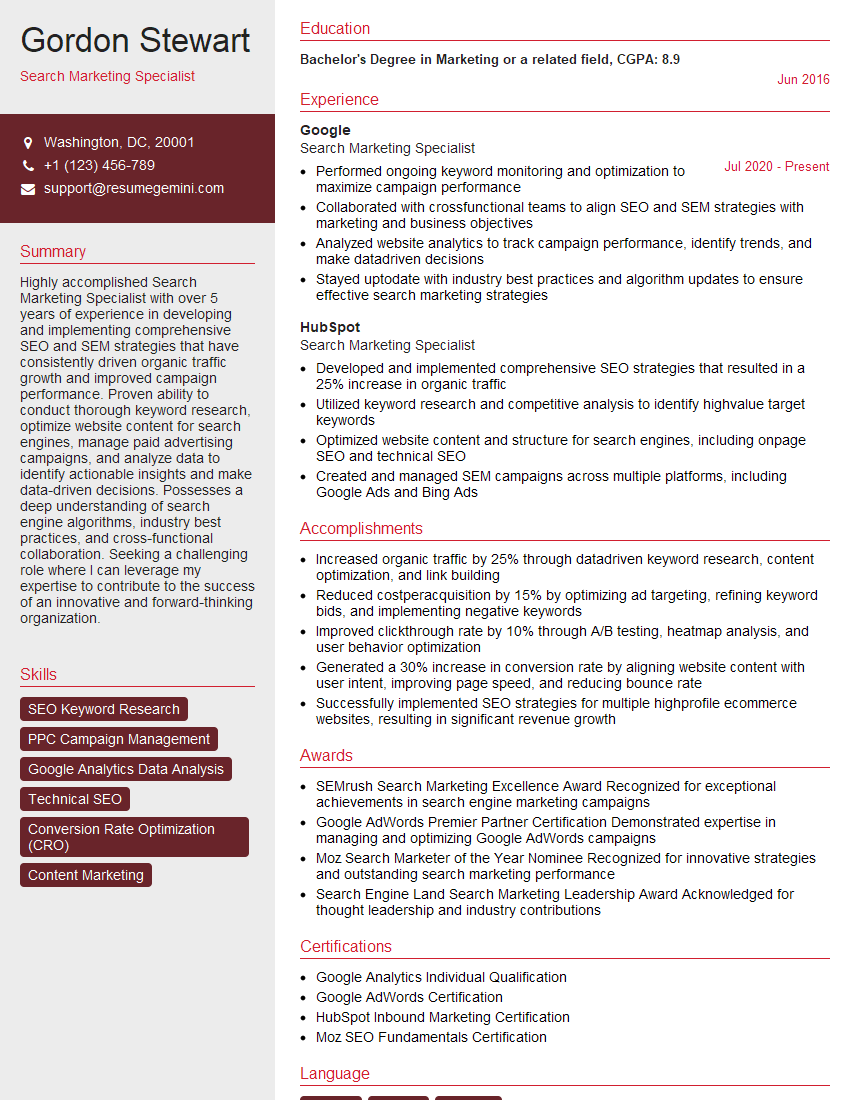
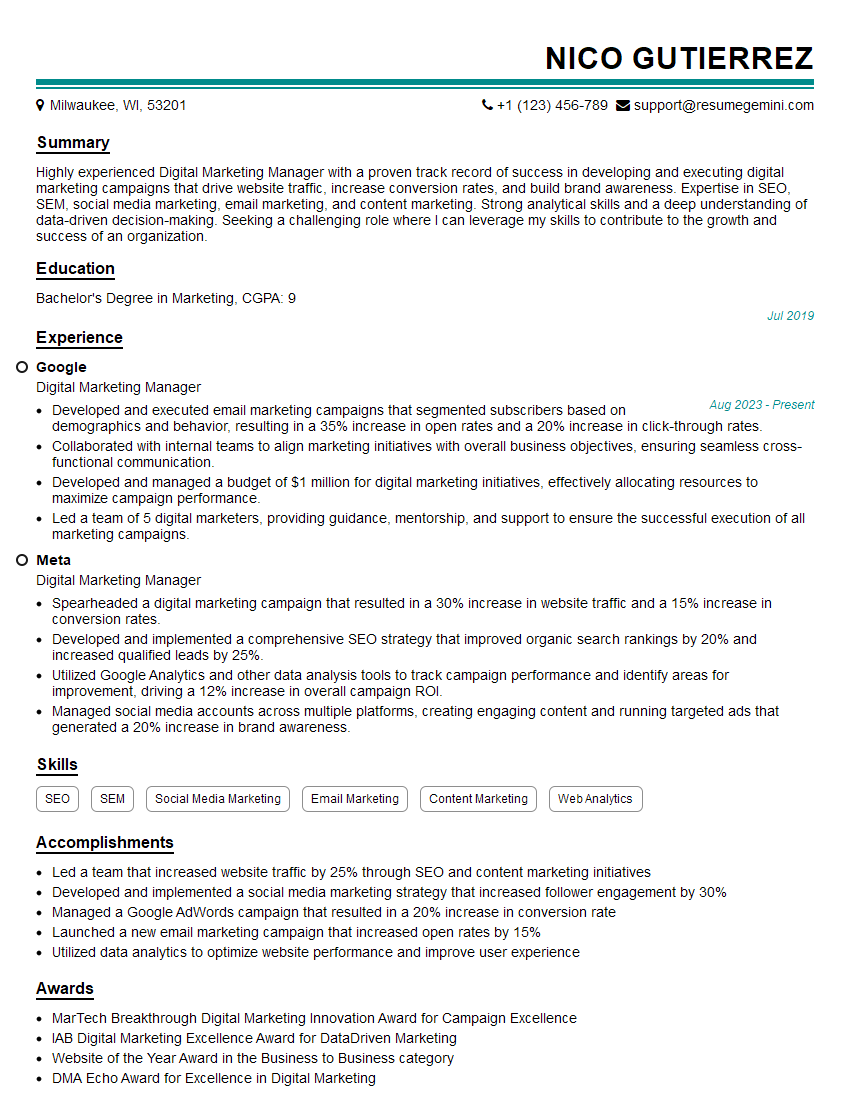
Mastering Paid Search Campaign Management opens doors to exciting career opportunities with significant earning potential and continuous learning. An ATS-friendly resume is crucial for getting your application noticed. ResumeGemini can help you create a compelling and effective resume that highlights your skills and experience in Paid Search Campaign Management. Take advantage of their resources and examples tailored to this field to present yourself as the ideal candidate. Examples of resumes tailored to Paid Search Campaign Management are available.
Explore more articles
Users Rating of Our Blogs
Share Your Experience
We value your feedback! Please rate our content and share your thoughts (optional).
What Readers Say About Our Blog
I Redesigned Spongebob Squarepants and his main characters of my artwork.
https://www.deviantart.com/reimaginesponge/art/Redesigned-Spongebob-characters-1223583608
IT gave me an insight and words to use and be able to think of examples
Hi, I’m Jay, we have a few potential clients that are interested in your services, thought you might be a good fit. I’d love to talk about the details, when do you have time to talk?
Best,
Jay
Founder | CEO