Interviews are opportunities to demonstrate your expertise, and this guide is here to help you shine. Explore the essential Telecom Network Planning interview questions that employers frequently ask, paired with strategies for crafting responses that set you apart from the competition.
Questions Asked in Telecom Network Planning Interview
Q 1. Explain the difference between circuit-switched and packet-switched networks.
The core difference between circuit-switched and packet-switched networks lies in how they handle data transmission. Imagine you’re ordering pizza:
- Circuit-switched networks are like reserving a dedicated phone line to the pizzeria. Before you order, a direct connection (circuit) is established between you and them. You have exclusive use of that line for the duration of your call (order). Once the order is placed (call ends), the line is released. This guarantees a dedicated bandwidth but can be inefficient if the line is idle. Traditional landline phones and early mobile networks are examples.
- Packet-switched networks are like sending emails. You break your order (data) into smaller packets, each with an address (destination). These packets travel independently across the network, taking different paths if necessary, and are reassembled at the pizzeria (destination). This is more efficient as many users can share the network resources simultaneously. The internet, with protocols like TCP/IP, is a prime example. It offers better resource utilization but may experience delays or packet loss.
In short: Circuit switching provides dedicated bandwidth but is less efficient; packet switching shares bandwidth, leading to higher efficiency but potential performance variability.
Q 2. Describe your experience with network optimization techniques.
My experience in network optimization encompasses various techniques, focusing on improving network performance, capacity, and user experience. I’ve worked on projects involving:
- Cell planning and site optimization: Utilizing tools like Atoll and Planet to optimize cell site locations, sectorization, and antenna tilt angles to maximize coverage and reduce interference, especially in challenging urban environments. For instance, in one project, we significantly improved coverage in a dense city area by strategically adding small cells and adjusting existing base station parameters.
- Frequency planning: Managing frequency allocation to minimize co-channel and adjacent channel interference, leading to better call quality and data rates. I’ve used software like Viavi’s TEMS to analyze interference patterns and optimize frequency assignments across different cell sites. A specific example was reducing dropped calls in a rural area by careful frequency reuse planning.
- Traffic engineering: Analyzing network traffic patterns to identify bottlenecks and improve resource allocation. This often involves optimizing routing protocols and adjusting Quality of Service (QoS) parameters. I’ve applied techniques to improve throughput in congested areas using techniques such as load balancing and traffic shaping.
- Network dimensioning: Estimating the required network capacity to meet predicted traffic demand. This process considers various factors such as subscriber growth, traffic patterns, and service requirements. For example, I used mathematical models to predict the capacity needs of a new 4G network deployment considering future subscriber growth forecasts.
Q 3. How do you determine the capacity needs for a new cellular network deployment?
Determining capacity needs for a new cellular network deployment is a multi-step process requiring a detailed understanding of several factors:
- Market Research and Forecasting: We begin with thorough market analysis to project subscriber growth, data consumption trends (voice, SMS, and data), and anticipated service requirements (e.g., 4G, 5G, IoT) in the target area. This involves considering demographics, economic factors, and competitor analysis.
- Traffic Modeling: Using specialized software (e.g., TEMS, Planet), we simulate the expected traffic load on the network under different scenarios. This includes modeling call arrival rates, call duration, data transfer volumes, and mobility patterns. These models help estimate traffic volumes under peak and off-peak conditions.
- Technology Selection and Planning: The choice of technology (e.g., 4G LTE, 5G NR) impacts capacity planning. 5G, for example, with its higher frequencies and massive MIMO technology, allows for higher capacity but requires more cell sites. Site selection is crucial, considering factors like population density, terrain, building obstructions, and existing infrastructure.
- Network Simulation and Optimization: We use network simulators to test different network configurations, antenna placements, and frequency allocations to optimize coverage and capacity while minimizing interference. This iterative process helps refine the initial design.
- Capacity Margin: We always include a safety margin (e.g., 20-30%) in our capacity calculations to account for unexpected traffic surges and future growth. This ensures the network can handle unforeseen demands.
This comprehensive approach ensures a robust and scalable network design that meets current and future capacity needs.
Q 4. What are the key performance indicators (KPIs) you monitor in network planning?
Key Performance Indicators (KPIs) are crucial for monitoring network health and performance. In network planning, I closely monitor the following:
- Coverage: Percentage of the target area covered by the network with acceptable signal strength. Poor coverage leads to dropped calls and slow data speeds.
- Call Setup Success Rate (CSSR): The percentage of successful call attempts. Low CSSR indicates problems with network access or handovers.
- Dropped Call Rate (CDR): The percentage of calls terminated prematurely. High CDR often signals problems with radio link quality or insufficient capacity.
- Data Throughput: The amount of data transmitted per unit of time. Low throughput points to network congestion or radio interference.
- Latency: The delay in data transmission. High latency impacts the user experience, particularly for real-time applications.
- Blocking Probability: The probability that a call attempt will be blocked due to insufficient network capacity. High blocking rates are unacceptable.
- Handoff Success Rate: The success rate of mobile handovers between cells. Frequent failures lead to dropped calls and service interruptions.
- Signal-to-Interference Ratio (SIR): The ratio of the desired signal strength to the strength of interfering signals. Low SIR indicates interference issues.
By continuously monitoring these KPIs, we can identify network issues proactively, optimize network performance, and ensure a positive user experience.
Q 5. Explain your understanding of different network topologies (mesh, star, ring, bus).
Network topologies describe the physical or logical arrangement of nodes (e.g., computers, routers, base stations) and connections in a network. Here’s a brief overview:
- Star Topology: All nodes connect to a central hub (e.g., switch or router). This is simple to manage but a hub failure disrupts the entire network. Examples: Most home Wi-Fi networks, early Ethernet networks.
- Bus Topology: All nodes connect to a single cable (bus). Easy to install but a cable failure can bring down the entire network. Less common in modern networks.
- Ring Topology: Nodes are connected in a closed loop. Data travels in one direction. Relatively simple but a single node failure can disrupt the entire ring. Less frequently used.
- Mesh Topology: Nodes are interconnected with multiple paths. This is highly robust, offering redundancy and fault tolerance. However, more complex to manage. Examples: Backbone networks, some wireless sensor networks.
The choice of topology depends on factors like network size, reliability requirements, cost, and manageability. Modern telecom networks often employ a hybrid approach, combining elements of various topologies to optimize performance and resilience.
Q 6. How do you handle interference in wireless network planning?
Handling interference in wireless network planning is critical for ensuring optimal network performance. Strategies include:
- Frequency Planning: Carefully allocating frequencies to different cells to minimize co-channel (same frequency) and adjacent channel (adjacent frequency) interference. Tools and algorithms help optimize frequency reuse patterns. We need to consider propagation characteristics and terrain when allocating frequencies to avoid interference.
- Antenna Placement and Design: Strategically placing antennas to reduce interference, often involving directional antennas to focus signal transmission towards desired areas, minimizing spillover into neighboring cells. Antenna height and tilt angle adjustments are also crucial.
- Cell Sectorization: Dividing a cell into multiple sectors (typically three), each using a separate set of frequencies. This reduces interference between sectors and increases capacity within the cell.
- Power Control: Adjusting the transmit power of base stations to optimize signal strength while minimizing interference with neighboring cells. Dynamic power control adapts to changing conditions and user locations.
- Interference Mitigation Techniques: Employing advanced techniques like adaptive modulation and coding to improve signal quality in the presence of interference. Software-defined radio offers better flexibility in managing interference.
- Coordination with Neighboring Operators: In dense urban areas, coordinating with nearby mobile network operators to avoid frequency clashes and minimize mutual interference.
These techniques, when employed effectively, lead to cleaner radio channels, higher signal quality, improved data rates, and fewer dropped calls.
Q 7. What are the challenges of deploying 5G networks?
Deploying 5G networks presents several significant challenges:
- Higher Frequency Bands: 5G utilizes millimeter wave (mmWave) frequencies which offer high bandwidth but suffer from high signal attenuation and limited range. This requires deploying a larger number of smaller cells (densification), which leads to increased infrastructure costs.
- Spectrum Acquisition and Licensing: Securing sufficient spectrum licenses for 5G deployment can be a complex and costly process, varying greatly by country and region.
- Backhaul Capacity: The increased data rates of 5G demand significant upgrades to the backhaul infrastructure (fiber optic network) to transport the large volumes of data efficiently. Failure to do so can create bottlenecks that negate the benefits of high-speed 5G.
- Integration with Existing Networks: Integrating 5G with existing 4G and other networks requires careful planning and testing to ensure seamless handover and interoperability.
- Device Ecosystem: The initial adoption of 5G devices and infrastructure can be slow, requiring time to build the supporting ecosystem of phones, routers and applications that fully utilize 5G capabilities.
- Deployment Complexity: Deploying a dense network of small cells is more complex than deploying traditional macro cells. Site acquisition and regulation approvals present significant hurdles. Moreover, the more complex network architecture increases operational complexity.
- Security Concerns: With increased connectivity and data flow, 5G security needs to be prioritized to protect against cyber threats and data breaches.
Addressing these challenges requires careful planning, significant investment, and collaboration among industry stakeholders, policymakers, and regulators.
Q 8. Describe your experience with network simulation tools.
Network simulation is crucial for planning efficient and robust telecom networks. My experience encompasses a wide range of tools, including industry-standard software like Atoll, Planet, and NS-3. I’ve used these tools extensively for various purposes, from predicting call blocking rates in a 4G network to optimizing the placement of base stations in a 5G deployment. For example, in a recent project involving the expansion of a rural cellular network, Atoll allowed us to model different scenarios, varying the number and location of base stations, and evaluate their impact on coverage and capacity before making any physical investments. This significantly reduced the risk and cost associated with the rollout. The ability to ‘virtually’ test different configurations saves considerable time and money compared to trial-and-error physical deployments. With NS-3, I have delved deeper into protocol-level simulations, helping us identify and troubleshoot potential bottlenecks before they arise in a live environment.
Q 9. How do you ensure network security in your planning process?
Network security is paramount in my planning process. It’s not an afterthought, but an integral part of the design from the outset. My approach involves a multi-layered strategy encompassing several key areas. Firstly, I advocate for robust physical security at all network sites, including access control measures and surveillance systems. Secondly, I insist on strong cryptographic protocols for securing data transmission across the network. This often includes using VPNs (Virtual Private Networks) to encrypt data in transit and implementing secure authentication mechanisms to control access to sensitive network resources. Thirdly, I employ regular security audits and penetration testing to identify and mitigate vulnerabilities. Finally, I work closely with the IT security team throughout the planning and implementation process, ensuring that all security best practices are followed. Think of it like building a fortress – multiple layers of defense make it significantly harder for any threat to penetrate.
Q 10. What is your experience with different network protocols (e.g., TCP/IP, MPLS)?
I possess extensive experience with various network protocols, including the foundational TCP/IP suite and the advanced MPLS (Multiprotocol Label Switching) technology. My understanding of TCP/IP encompasses the various layers – from the physical layer to the application layer – and their interaction. I’m proficient in analyzing network traffic using tools like Wireshark to pinpoint performance bottlenecks and security issues. With MPLS, I have experience in designing and optimizing MPLS VPNs for private network connectivity, ensuring efficient routing and quality of service (QoS) for critical applications. In a project involving a large financial institution, we utilized MPLS VPNs to secure their private network across multiple geographical locations, enhancing both security and performance. Understanding these protocols allows for better network design, ensuring efficient and reliable communication between network elements.
Q 11. Explain the concept of network segmentation.
Network segmentation is the practice of dividing a network into smaller, isolated sections or segments. This is a critical security measure that limits the impact of security breaches. Imagine a large office building; if a fire breaks out in one area, firewalls (in network terms, segmentation) prevent it from spreading to the entire building. Similarly, in a network, segmentation restricts the spread of malware or unauthorized access. It can be implemented using various methods like VLANs (Virtual LANs), firewalls, and VPNs. For example, separating the guest Wi-Fi network from the internal corporate network prevents unauthorized access to sensitive data. By logically partitioning the network, we can improve security, enhance performance (reducing congestion in individual segments), and simplify troubleshooting.
Q 12. How do you plan for network scalability and future growth?
Planning for scalability and future growth is essential for any telecom network. My approach involves a combination of strategies. Firstly, I utilize modular designs that allow for easy expansion without significant disruption. Think of LEGO blocks; you can easily add more blocks to build a larger structure. Similarly, a modular network design allows us to add more capacity as needed. Secondly, I select equipment and infrastructure with sufficient headroom to accommodate future growth. This includes choosing hardware and software that can be upgraded or scaled easily. Thirdly, I incorporate future-proofing technologies into the network design, anticipating advancements and trends in the telecom industry. Finally, I conduct regular capacity planning exercises to proactively identify potential bottlenecks and ensure sufficient resources are available to support future demands. We also employ predictive modeling techniques to forecast future growth and adjust our network capacity accordingly.
Q 13. Describe your experience with RF propagation modeling.
RF propagation modeling is a critical aspect of cellular network planning. It involves predicting how radio waves will travel through the environment, influencing signal strength, coverage, and interference. I have extensive experience using software such as Planet and others to create accurate propagation models. These models consider factors like terrain, buildings, vegetation, and atmospheric conditions. For instance, in a recent project involving a dense urban environment, we used RF propagation modeling to optimize the placement of small cells to maximize coverage and minimize interference. The software allows us to simulate various scenarios and visualize the impact of different antenna configurations and deployment strategies. Accurate propagation models are crucial for ensuring reliable network performance and meeting coverage targets.
Q 14. What are the key considerations for site selection in a cellular network?
Site selection for a cellular network is a multifaceted process requiring careful consideration of various factors. The primary objective is to optimize coverage, capacity, and network performance. Key considerations include:
- Coverage Area: The site should provide adequate coverage to the target area.
- Signal Propagation: The site’s location should minimize signal obstruction and maximize signal propagation.
- Interference: The site should minimize interference from other cellular networks and other radio sources.
- Infrastructure Availability: Access to power, backhaul connectivity (fiber or microwave links), and land are crucial.
- Regulatory Compliance: Adherence to local zoning regulations and permitting requirements is essential.
- Cost: Land acquisition, construction, and operational costs must be carefully considered.
- Environmental Impact: Minimizing the environmental impact of the site is increasingly important.
Q 15. Explain your experience with network monitoring and troubleshooting.
Network monitoring and troubleshooting are crucial for ensuring the smooth operation of any telecom network. My experience encompasses proactive monitoring using tools like Nagios, Zabbix, and SolarWinds, which allow for real-time visibility into key performance indicators (KPIs) such as latency, packet loss, and CPU utilization across various network elements (routers, switches, base stations). This proactive approach allows for early detection of potential problems.
When troubleshooting, I follow a structured approach. This usually starts with identifying the symptoms, isolating the affected area, and then systematically investigating potential causes. Tools like Wireshark for packet capture and analysis are invaluable. For example, I once diagnosed intermittent service disruptions in a specific geographic area by analyzing network logs and correlating them with weather data, ultimately identifying the cause as lightning strikes affecting an outdoor fiber optic cable.
Troubleshooting involves using a range of techniques, from checking physical cabling and device configurations to analyzing network protocols and logs. A key aspect is understanding the network architecture thoroughly to trace the flow of data and pinpoint the source of issues. It’s a blend of technical skill and problem-solving acumen, often requiring collaboration with multiple teams.
Career Expert Tips:
- Ace those interviews! Prepare effectively by reviewing the Top 50 Most Common Interview Questions on ResumeGemini.
- Navigate your job search with confidence! Explore a wide range of Career Tips on ResumeGemini. Learn about common challenges and recommendations to overcome them.
- Craft the perfect resume! Master the Art of Resume Writing with ResumeGemini’s guide. Showcase your unique qualifications and achievements effectively.
- Don’t miss out on holiday savings! Build your dream resume with ResumeGemini’s ATS optimized templates.
Q 16. How do you balance cost and performance in network planning?
Balancing cost and performance in network planning is a constant challenge. It’s about finding the optimal solution that meets service level agreements (SLAs) without unnecessary expenditure. This involves a careful consideration of various factors.
- Technology Selection: Choosing the right technology for the job is crucial. For instance, using cost-effective technologies like microwave links for backhaul in areas with limited fiber availability can significantly reduce infrastructure costs, while ensuring sufficient bandwidth.
- Capacity Planning: Accurate forecasting of future traffic demands is essential to avoid over-provisioning (leading to wasted resources) or under-provisioning (leading to performance degradation). This involves analyzing historical data, predicting growth trends, and employing appropriate mathematical models.
- Network Optimization: Techniques like traffic engineering, routing optimization, and efficient resource allocation (bandwidth, spectrum) are vital in maximizing network performance while minimizing resource consumption. Regular network audits help identify and rectify inefficiencies.
- Vendor Selection: Choosing vendors offering competitive pricing without compromising quality and reliability is important. This often involves negotiating contracts and evaluating vendor support capabilities.
Think of it like building a house – you can build a luxurious mansion, but you may not need it if a well-designed, moderately priced home meets your needs. The key is to find the ‘sweet spot’ that meets the required functionalities within budget.
Q 17. What is your experience with different network technologies (e.g., LTE, Wi-Fi)?
My experience spans various network technologies, including LTE, Wi-Fi, and 5G. With LTE, I’ve worked on network design, optimization, and performance analysis, including aspects like cell planning, handover optimization, and interference management. I’m proficient in using tools like Atoll and Planet to simulate and analyze network performance. My work has involved optimizing LTE networks to improve coverage and throughput, particularly in challenging environments like dense urban areas.
In Wi-Fi, I have experience deploying and managing both enterprise and public Wi-Fi networks. This includes site surveys, selecting appropriate access points, configuring security protocols (WPA2/WPA3), and optimizing channel utilization to minimize interference and maximize performance. I understand the trade-offs between different Wi-Fi standards (802.11a/b/g/n/ac/ax) and their suitability for different applications.
With the advent of 5G, I’ve been involved in early-stage planning and deployment projects, focusing on aspects like spectrum allocation, network slicing, and edge computing. Understanding the unique characteristics of 5G, such as its higher bandwidth and lower latency, and its implications for network design is key.
Q 18. Explain your understanding of QoS (Quality of Service).
Quality of Service (QoS) refers to the capability of a network to provide better service to selected network traffic over others. It’s like having different lanes on a highway – some lanes might be reserved for emergency vehicles (high-priority traffic), while others are for regular traffic. In a telecom network, this is crucial for ensuring that critical applications like VoIP calls or video streaming receive priority over less sensitive data like email.
QoS mechanisms involve classifying traffic based on various parameters (e.g., IP address, port number, application type), assigning priority levels, and then implementing traffic management techniques such as queuing, shaping, and policing to control and prioritize traffic flow. Common QoS technologies include DiffServ (Differentiated Services) and IntServ (Integrated Services). For example, DiffServ uses differentiated service code points (DSCP) to mark packets with different priority levels. Properly configured QoS is essential for providing a satisfactory user experience, especially in environments with high traffic loads.
Q 19. How do you handle network failures and outages?
Handling network failures and outages requires a structured and systematic approach. The first step is to rapidly detect the outage using network monitoring tools. Once an outage is detected, the next steps involve:
- Incident Triage: Determining the scope and impact of the outage (how many users are affected, which services are down).
- Root Cause Analysis: Investigating the root cause using network monitoring tools, logs, and potentially physical inspection of equipment. This may involve analyzing error messages, checking hardware status, and tracing network traffic.
- Restoration: Implementing a solution to restore service as quickly as possible, this might involve rerouting traffic, replacing faulty equipment, or applying software patches. Prioritization of critical services is key during restoration.
- Post-Incident Review: Analyzing the incident to identify areas for improvement in network design, monitoring, and incident response procedures to prevent similar outages in the future.
Effective communication with users and stakeholders during the outage is also crucial. Regular updates on the status of the restoration efforts help mitigate negative impact. I’ve successfully used this approach in various scenarios, ranging from minor equipment failures to widespread network disruptions caused by natural disasters.
Q 20. Describe your experience with network documentation and reporting.
Comprehensive network documentation and reporting are essential for efficient network management and troubleshooting. My experience involves creating and maintaining various types of documentation, including:
- Network Diagrams: Detailed visual representations of the network infrastructure, including devices, connections, and routing protocols.
- Configuration Documents: Detailed records of device configurations, including settings for routers, switches, and other network equipment.
- Troubleshooting Logs: Records of troubleshooting activities, including the steps taken, findings, and solutions implemented.
- Performance Reports: Regular reports summarizing network performance metrics, such as latency, throughput, and error rates. These reports usually highlight trends and potential issues.
I am proficient in using various documentation tools, including Visio and various network management system platforms. Well-maintained documentation is invaluable for onboarding new personnel, streamlining troubleshooting, and ensuring smooth network operations. Reporting provides crucial insights into network health and facilitates informed decision-making.
Q 21. What are the key factors to consider when designing a data center network?
Designing a data center network requires careful consideration of several key factors:
- High Availability and Redundancy: Data centers demand high availability, so redundancy is paramount. This means having redundant paths for data transmission (using techniques like STP or RSTP), backup power systems (generators and UPS), and redundant network devices to ensure continued operation even in case of failures.
- High Bandwidth and Low Latency: High bandwidth is crucial for handling large amounts of data traffic, while low latency is essential for performance-sensitive applications. This often necessitates using high-speed technologies like 10 Gigabit Ethernet or even faster connections, alongside efficient routing protocols.
- Security: Data centers hold sensitive data, so security is paramount. This includes implementing firewalls, intrusion detection/prevention systems, access control lists (ACLs), and robust security protocols to protect against unauthorized access and cyber threats.
- Scalability: The network design should be scalable to accommodate future growth. This involves planning for future capacity needs and selecting technologies and architectures that can be easily expanded as needed.
- Management and Monitoring: Implementing robust network management and monitoring tools is essential for tracking performance, detecting and resolving issues, and proactively managing the network’s health. Centralized management systems provide a single point of control and monitoring.
A well-designed data center network is the backbone of any modern organization’s IT infrastructure. Careful planning in these key areas ensures optimal performance, reliability, and security, supporting business operations and critical applications.
Q 22. Explain your experience with network virtualization technologies.
Network virtualization is a paradigm shift in telecom network architecture, allowing for the decoupling of network functions from dedicated hardware. Instead of relying on physical devices, network functions like routing, firewalls, and load balancing are virtualized as software running on general-purpose servers or cloud platforms. This offers significant advantages in terms of flexibility, scalability, and cost-effectiveness.
My experience includes designing and implementing virtualized network functions (VNFs) using platforms like OpenStack and VMware vSphere. I’ve worked on projects involving the deployment of virtualized evolved packet core (vEPC) networks, virtualized radio access networks (vRAN), and software-defined networking (SDN) controllers. For example, in one project, we migrated a legacy core network to a vEPC architecture, resulting in a 30% reduction in capital expenditure and improved agility in service deployment. We also leveraged SDN to programmatically manage network resources and optimize traffic flow, leading to a noticeable improvement in network performance.
I understand various virtualization technologies, including Network Functions Virtualization Infrastructure (NFVI) components like compute, storage, and networking, and have experience with orchestration platforms like Kubernetes and OpenMANO. I’m proficient in troubleshooting performance bottlenecks in virtualized environments and ensuring high availability and resilience.
Q 23. How do you ensure compliance with relevant regulations and standards?
Compliance is paramount in telecom network planning. We must adhere to a wide range of regulations and standards, including those related to data privacy (like GDPR and CCPA), network security (like NIST Cybersecurity Framework), and spectrum allocation (depending on the country and frequency bands used). My approach involves a multi-faceted strategy.
- Proactive Monitoring: Staying abreast of changes in regulations and standards through industry publications, regulatory agency websites, and participation in industry forums. This enables us to design and deploy networks that are compliant from the outset.
- Risk Assessment: Conducting thorough risk assessments to identify potential compliance gaps and vulnerabilities. This helps prioritize actions and resource allocation towards addressing high-risk areas.
- Documentation and Auditing: Maintaining comprehensive documentation of network designs, configurations, and security practices. Regular audits are conducted to ensure ongoing compliance and identify areas for improvement.
- Collaboration: Working closely with legal and compliance teams to ensure that our network plans and operations align with regulatory requirements.
For instance, in a recent project involving the deployment of 5G network infrastructure, we ensured compliance with relevant spectrum allocation regulations by obtaining the necessary licenses and adhering to strict power limits. We also implemented robust security measures to meet the stringent requirements for data privacy and protection against cyber threats.
Q 24. What are your thoughts on the future of Telecom Network Planning?
The future of Telecom Network Planning is being shaped by several converging trends. We are moving towards a highly automated, intelligent, and software-defined future.
- Increased Automation: AI and Machine Learning will play a larger role in network planning, optimization, and troubleshooting. This will enable more efficient resource allocation, proactive fault management, and faster service deployment.
- Edge Computing: The rise of edge computing will necessitate the design and deployment of distributed network architectures capable of supporting low-latency applications and high bandwidth requirements at the network edge.
- Network Slicing: Network slicing will enable the creation of virtual networks tailored to specific service requirements, offering greater flexibility and efficiency in resource allocation.
- Open RAN: The move toward Open RAN will increase competition and innovation, leading to more cost-effective and flexible radio access network solutions.
- Sustainability: There’s an increasing focus on energy efficiency and environmentally friendly network solutions. Network planning will need to incorporate sustainability considerations at every stage.
I believe that network planners will need to develop expertise in these emerging technologies and adapt their skillsets to meet the demands of this evolving landscape. The ability to work effectively with AI/ML tools, understand cloud-native architectures, and manage complex, distributed networks will be crucial.
Q 25. Describe a complex network planning project you worked on and the challenges you faced.
One challenging project involved planning and implementing a nationwide fiber optic network expansion for a major telecommunications provider. The scale of the project was immense, covering diverse geographical terrains and requiring careful consideration of various factors.
- Challenge 1: Route Optimization: Finding optimal fiber routes that minimized costs while maximizing network coverage and reliability proved to be a significant challenge. We used advanced GIS tools and algorithms to analyze terrain data, assess right-of-way availability, and identify the most cost-effective routes.
- Challenge 2: Regulatory Compliance: Navigating the complex regulatory landscape related to right-of-way access and permitting was a significant hurdle. We worked closely with legal and regulatory affairs teams to ensure compliance throughout the project.
- Challenge 3: Project Management: Managing a large and geographically dispersed team of contractors and engineers presented logistical challenges. We employed robust project management methodologies and tools to coordinate activities, track progress, and ensure timely completion.
We overcame these challenges by adopting a phased approach, rigorous project planning, effective communication, and close collaboration among various stakeholders. The successful completion of this project demonstrated our ability to handle complex large-scale network planning initiatives.
Q 26. How do you stay updated with the latest advancements in telecom technology?
Staying updated in the fast-paced world of telecom technology requires a multi-pronged approach.
- Industry Publications and Journals: I regularly read industry publications such as IEEE Communications Magazine, Lightwave, and others to stay abreast of the latest research and developments.
- Conferences and Workshops: Attending industry conferences and workshops (like those hosted by the IEEE, ITU, or GSMA) provides valuable insights and networking opportunities.
- Online Courses and Certifications: Taking online courses and pursuing relevant certifications (like those offered by Coursera, edX, or vendor-specific training programs) helps deepen my knowledge and skillset.
- Industry Forums and Communities: Participating in online forums and communities (such as LinkedIn groups focused on telecom network planning) provides access to valuable insights and discussions with peers and experts.
- Vendor Interactions: Engaging with vendors and technology providers keeps me updated on the latest product offerings and industry trends.
This combination of continuous learning and engagement with the industry helps me maintain my expertise and adapt to the ever-changing landscape of telecom technology.
Q 27. What is your preferred method for presenting complex technical information to non-technical audiences?
When explaining complex technical information to non-technical audiences, I prioritize simplicity and clarity. My preferred approach is to use analogies and real-world examples to illustrate complex concepts.
- Visual Aids: I use clear and concise visual aids such as diagrams, charts, and presentations to help illustrate key concepts and data.
- Storytelling: I often use storytelling to make the information more engaging and memorable. For instance, I might explain the complexity of routing protocols by comparing it to a city’s road network and how efficient routing is key for traffic flow.
- Avoid Jargon: I carefully avoid technical jargon and use simple, everyday language whenever possible. If technical terms are unavoidable, I always define them clearly.
- Interactive Sessions: I encourage questions and discussions to ensure the audience understands the material and can apply it to their own context.
For example, when explaining the concept of network latency to a board of directors, I would avoid complex technical details and instead use an analogy like a crowded highway: the more cars on the road (data packets), the slower the traffic (slower data transmission). This helps everyone understand the importance of optimizing network capacity.
Q 28. Describe your experience with budgeting and resource allocation in network planning projects.
Budgeting and resource allocation are critical aspects of network planning. My experience includes developing detailed budgets, allocating resources effectively, and tracking expenses throughout a project’s lifecycle.
- Budget Development: I begin by developing a comprehensive budget that accounts for all relevant costs, including hardware, software, labor, and operational expenses. This involves analyzing project requirements, estimating resource needs, and considering potential contingencies.
- Resource Allocation: I allocate resources efficiently to meet project goals and deadlines. This includes optimizing the use of personnel, equipment, and software tools. I leverage resource allocation software tools to track usage and allocate resources optimally based on project needs.
- Cost Tracking and Reporting: Throughout the project lifecycle, I track costs meticulously and generate regular reports to monitor progress and identify any potential cost overruns. This data helps inform decision-making and enables proactive measures to stay within budget.
- Value Engineering: I constantly look for opportunities to optimize costs without compromising quality or performance. This might involve exploring alternative technologies, negotiating with vendors, or streamlining processes.
For instance, in a recent project, by carefully planning the deployment phase and negotiating favorable contracts with vendors, I was able to save the company 15% of the initial projected budget without sacrificing project quality or timeline.
Key Topics to Learn for Telecom Network Planning Interview
- Radio Frequency (RF) Engineering Fundamentals: Understanding propagation models, path loss, interference, and cell planning principles. Practical application includes optimizing cell site placement for optimal coverage and capacity.
- Network Optimization Techniques: Mastering techniques like drive testing, performance analysis, and optimization tools. This includes troubleshooting network issues and identifying areas for improvement in real-world scenarios.
- Network Capacity Planning: Developing strategies for forecasting future network demands and ensuring sufficient capacity to meet growing subscriber needs. Practical application involves using traffic models and forecasting tools to predict future growth and plan for network expansion.
- Telecom Network Technologies: Deep understanding of 2G, 3G, 4G, and 5G technologies, including their architectures, protocols, and performance characteristics. This includes comparing the strengths and weaknesses of different technologies and their suitability for different applications.
- Network Design and Implementation: Familiarity with network design principles, including site selection, equipment selection, and network deployment strategies. Practical application involves designing a new network or upgrading an existing one to meet specific performance requirements.
- Network Security: Understanding the security challenges in telecom networks and the measures to mitigate risks. This includes knowledge of various security protocols and best practices.
- Data Analytics and Reporting: Analyzing network performance data to identify trends, patterns, and areas for improvement. This involves using data visualization tools and statistical methods to present findings effectively.
Next Steps
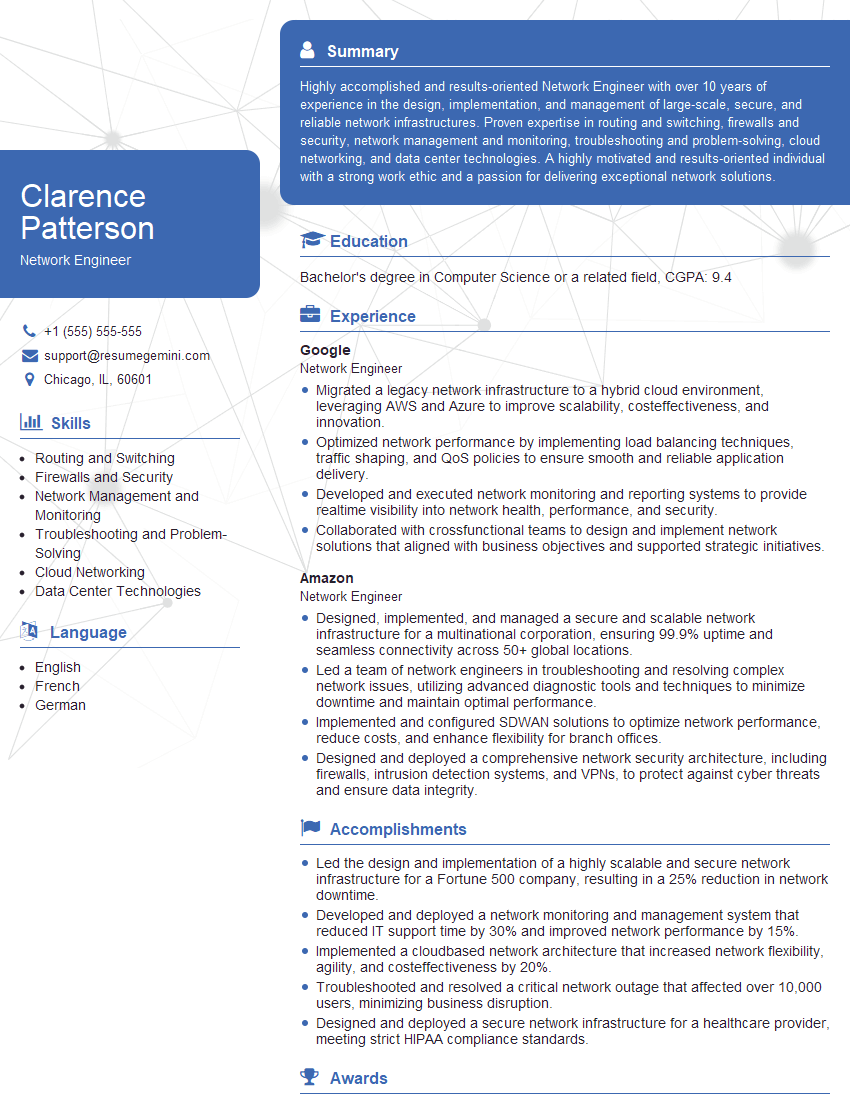
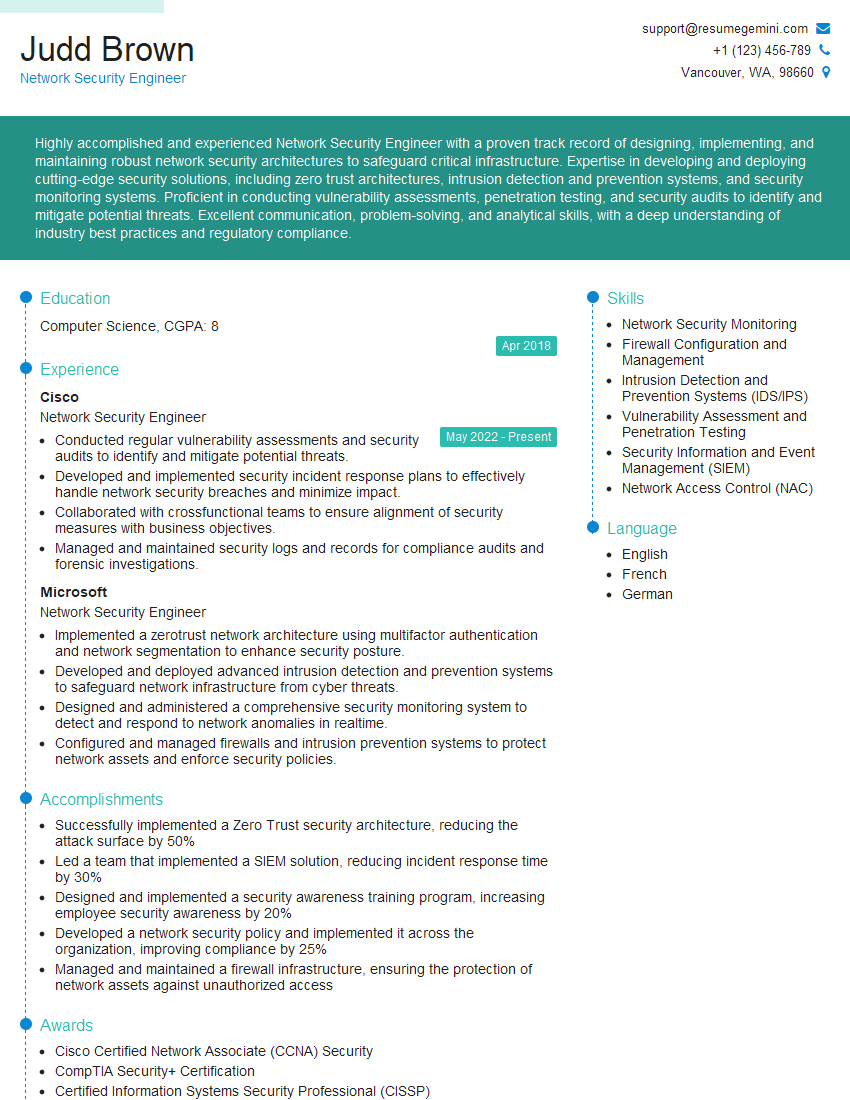
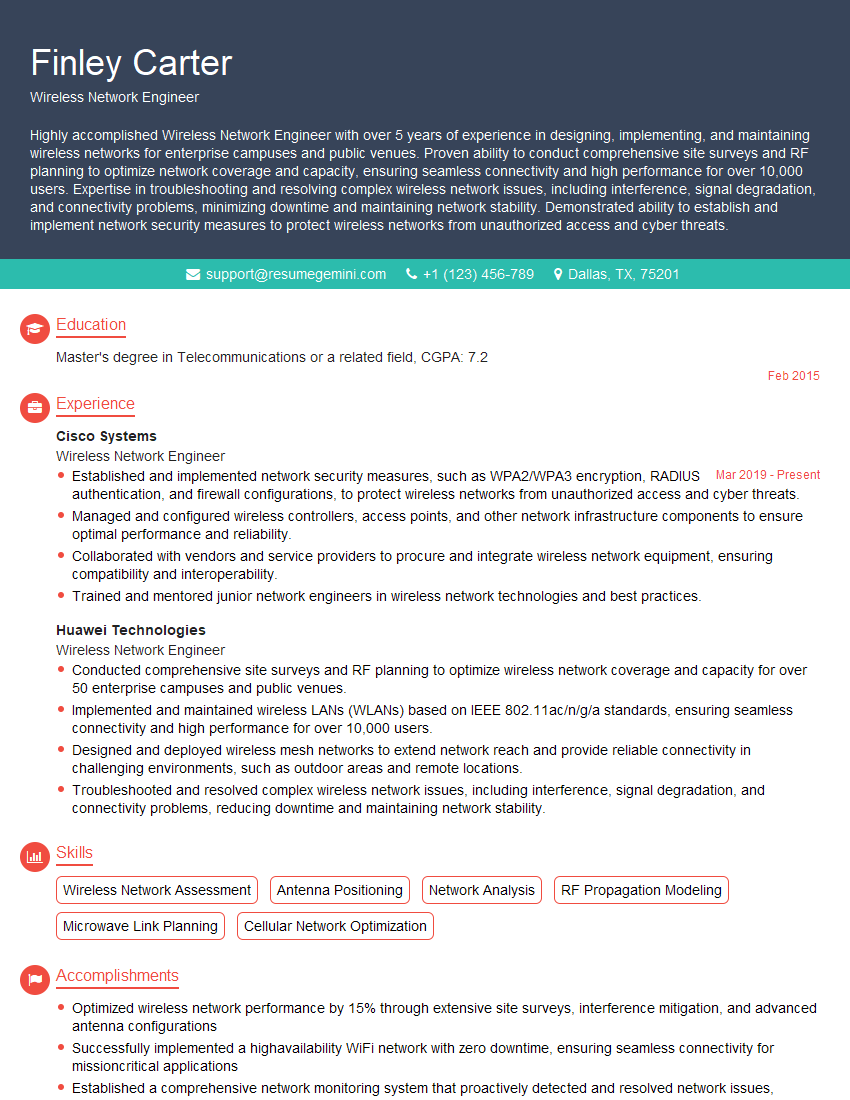
Mastering Telecom Network Planning opens doors to exciting career advancements, offering opportunities for specialization and leadership roles within the dynamic telecommunications industry. To maximize your job prospects, crafting a compelling and ATS-friendly resume is crucial. ResumeGemini can help you build a professional resume that highlights your skills and experience effectively. We provide examples of resumes tailored to Telecom Network Planning to guide you in creating a standout application. Invest time in building a strong resume; it’s your first impression with potential employers.
Explore more articles
Users Rating of Our Blogs
Share Your Experience
We value your feedback! Please rate our content and share your thoughts (optional).
What Readers Say About Our Blog
I Redesigned Spongebob Squarepants and his main characters of my artwork.
https://www.deviantart.com/reimaginesponge/art/Redesigned-Spongebob-characters-1223583608
IT gave me an insight and words to use and be able to think of examples
Hi, I’m Jay, we have a few potential clients that are interested in your services, thought you might be a good fit. I’d love to talk about the details, when do you have time to talk?
Best,
Jay
Founder | CEO