Interviews are opportunities to demonstrate your expertise, and this guide is here to help you shine. Explore the essential Tutoring Experience interview questions that employers frequently ask, paired with strategies for crafting responses that set you apart from the competition.
Questions Asked in Tutoring Experience Interview
Q 1. Describe your experience differentiating instruction to meet diverse learning needs.
Differentiating instruction is crucial for catering to the diverse learning needs within a group. It’s about recognizing that students learn at different paces and through different modalities. My approach involves a multifaceted strategy, starting with understanding individual learning profiles. This includes considering students’ strengths and weaknesses, preferred learning styles (visual, auditory, kinesthetic), and any learning differences such as dyslexia or ADHD.
Pre-assessment & Profiling: I begin by using pre-tests or informal assessments to gauge existing knowledge and identify learning gaps. This helps me tailor my instruction to address specific areas needing improvement.
Varied Instructional Methods: I incorporate diverse teaching methods to appeal to various learning styles. This might include lectures, discussions, hands-on activities, visual aids, group work, and technology integration. For example, when teaching a math concept, I might use visual diagrams for visual learners, verbal explanations for auditory learners, and manipulatives for kinesthetic learners.
Flexible Grouping: I frequently use flexible grouping strategies, sometimes pairing students with differing strengths to facilitate peer learning. This allows stronger students to reinforce their understanding by explaining concepts to others, while struggling students benefit from peer support and different explanations.
Differentiated Materials: I prepare materials at varying levels of difficulty. For instance, I might provide different worksheets – one with simpler problems, another with more challenging ones – to accommodate different skill levels. This allows all students to feel challenged and successful.
For example, in a history class, I might use primary source documents for advanced students, while providing simplified summaries and graphic organizers for students who struggle with reading comprehension.
Q 2. How do you assess a student’s learning style and adapt your teaching methods accordingly?
Assessing learning styles is an iterative process. It’s not about pigeonholing students into rigid categories but about understanding their preferences and adapting my methods accordingly. I use a combination of observational techniques and direct interaction to determine a student’s learning style.
Observation: I carefully observe how a student interacts with learning materials. Do they prefer taking notes, actively participating in discussions, or engaging in hands-on activities? Do they seem more attentive to visual aids or auditory explanations?
Direct Interaction: I engage in conversations with students to understand their preferences and challenges. Asking questions like ‘What study methods work best for you?’ or ‘What do you find most helpful when learning a new concept?’ provides valuable insights.
Learning Style Inventories (with Caution): I might use validated learning style inventories as a starting point, but I wouldn’t rely solely on these instruments. These questionnaires can provide a general indication but should be complemented by my observation and direct interaction.
Once I’ve identified a student’s learning preferences, I adapt my teaching accordingly. For example, a visual learner might benefit from mind maps and diagrams, while a kinesthetic learner might appreciate hands-on projects or role-playing activities.
Q 3. What strategies do you use to create a positive and engaging learning environment?
Creating a positive and engaging learning environment is essential for student success. It’s about fostering a sense of community, respect, and trust, where students feel comfortable taking risks and asking questions.
Establish Clear Expectations: I start by clearly outlining classroom rules and expectations, ensuring that they are fair, consistent, and understood by all students. This creates a predictable and supportive environment.
Positive Reinforcement: I consistently provide positive feedback and encouragement. This could be through verbal praise, awarding points, or acknowledging effort and improvement. Even small gestures of encouragement can boost a student’s confidence and motivation.
Incorporate Fun and Engaging Activities: I incorporate activities that make learning fun and engaging, such as games, debates, projects, and technology-based learning. This helps keep students interested and motivated.
Respectful Communication: I create a space where students feel comfortable sharing their ideas and thoughts without fear of judgment. I model respectful communication and encourage students to treat each other with respect.
Collaboration and Teamwork: Collaborative projects and group work activities help build relationships and teamwork skills while enhancing learning outcomes.
For example, incorporating a ‘student of the week’ recognition for positive contributions or effort can help create a supportive and encouraging environment.
Q 4. Explain your approach to managing classroom or tutoring session time effectively.
Effective time management is critical for maximizing learning during a tutoring session. My approach involves careful planning and execution.
Lesson Planning: Before each session, I create a detailed lesson plan outlining specific learning objectives, activities, and time allocations for each segment. This ensures focused learning and avoids unnecessary time wastage.
Structured Activities: I structure activities to keep students focused and on track. Time limits for each activity are clearly communicated, preventing tasks from dragging on unnecessarily.
Transitions: I ensure smooth transitions between activities to maintain momentum and minimize disruptions. Clear instructions and a designated time for switching activities are crucial.
Flexibility: While having a structured plan is vital, I remain flexible and adjust the pace and activities based on the student’s progress and engagement. Sometimes, delving deeper into a specific topic takes more time, and that’s acceptable.
Regular Breaks: Short breaks are incorporated to prevent student fatigue and maintain focus. These breaks help maintain students’ energy and attention.
For instance, a 60-minute session might be structured into 15-minute segments, with a short break in between each section. This helps manage time and allows for flexibility within the session.
Q 5. How do you motivate students who are struggling or disengaged?
Motivating struggling or disengaged students requires a compassionate and strategic approach. It’s crucial to identify the root cause of the disengagement, which could be academic difficulties, lack of confidence, or external factors.
Understanding the Root Cause: I start by having open conversations with the student to understand their struggles. Are they overwhelmed by the material, lacking confidence, or facing personal challenges?
Breaking Down Tasks: Overwhelming assignments can be demotivating. I break down large tasks into smaller, manageable steps. This makes the work seem less daunting and allows for incremental progress and positive reinforcement along the way.
Setting Realistic Goals: I help students set realistic, achievable goals. Starting with small, easily attainable goals builds confidence and motivates further effort.
Positive Reinforcement & Encouragement: Consistent positive feedback, focusing on effort and improvement rather than solely on grades, is vital. Recognizing small victories helps maintain motivation.
Making Learning Relevant: Connecting the learning material to the student’s interests can dramatically boost engagement. Finding real-world applications or linking topics to their hobbies can make learning more meaningful.
Finding Their Strengths: Highlighting the student’s strengths and building on them can enhance self-esteem and create a positive learning experience. Success in one area can build confidence to tackle other challenges.
For example, a student struggling with algebra might benefit from starting with basic arithmetic problems and gradually building up to more complex equations. Celebrating each step of progress keeps the motivation going.
Q 6. What methods do you employ to provide constructive feedback to students?
Providing constructive feedback is crucial for student growth. It involves offering specific, actionable suggestions for improvement rather than just stating what was wrong. I focus on both positive aspects and areas needing attention.
Specific & Actionable Feedback: Instead of saying ‘Your essay is weak,’ I might say, ‘Your essay’s introduction lacks a clear thesis statement. Try rephrasing it to clearly state your main argument.’ This provides clear guidance on how to improve.
Focus on Effort & Improvement: I emphasize the effort the student has put in and highlight their progress. Even if the outcome wasn’t perfect, recognizing effort encourages continued learning.
Balance Positive & Constructive Feedback: I start with positive feedback to highlight the student’s strengths before addressing areas needing improvement. This creates a more receptive environment for constructive criticism.
Two-Way Communication: I encourage a two-way conversation. I ask students for their thoughts on their work and their understanding of my feedback. This fosters self-reflection and ensures they understand the feedback.
Use of Rubrics: Using a rubric to assess work helps to be more objective and provides the student with a clear understanding of the expectations and criteria for success.
For instance, when reviewing a student’s math solution, I might comment, ‘Your approach is excellent, but there’s a small calculation error in step 3. Let’s review the multiplication again.’ This offers specific, actionable feedback while acknowledging their positive efforts.
Q 7. How do you handle challenging student behaviors?
Handling challenging student behaviors requires a calm, consistent, and proactive approach. It’s about understanding the underlying reasons for the behavior and addressing them effectively.
Identify the Root Cause: I try to understand the reason behind the behavior. Is the student feeling frustrated, overwhelmed, or lacking attention? Is there a personal issue impacting their behavior?
Establish Clear Expectations & Consequences: Clear, consistently enforced classroom rules and consequences are crucial for managing behavior. This creates a sense of predictability and structure.
Positive Reinforcement: I focus on rewarding positive behaviors rather than solely punishing negative ones. Positive reinforcement helps encourage desired behaviors.
De-escalation Techniques: When faced with challenging behavior, I use de-escalation techniques to calm the situation. This might involve remaining calm, active listening, and showing empathy.
Individualized Approach: Addressing the behavior should be tailored to the individual student and their specific needs. What works for one student might not work for another.
Collaboration with Parents/Guardians: For persistent or severe behavioral issues, collaboration with parents/guardians is essential to create a consistent approach at home and in the tutoring setting.
For example, if a student is consistently disruptive, I might try to understand the underlying reason for their behavior. It could be boredom, a lack of understanding of the material, or even a personal issue outside of the tutoring session. Addressing the root cause is key to resolving the disruptive behavior.
Q 8. Describe a time you had to adapt your lesson plan due to unexpected circumstances.
Adaptability is crucial in tutoring. A lesson plan, while meticulously crafted, is a guideline, not a rigid script. One instance involved a high school student struggling with quadratic equations. My lesson plan focused on factoring and the quadratic formula. However, during the session, it became clear the student’s foundational algebra skills were weak. Instead of pushing forward, I adapted by revisiting fundamental concepts like order of operations and simplifying expressions. This meant temporarily deviating from the planned sequence but ultimately led to a much stronger understanding of quadratics.
I utilized a ‘spiral curriculum’ approach. This involves revisiting concepts periodically at increasing levels of complexity. So, while factoring was postponed slightly, it was reintroduced later, built upon a now-stronger foundation. The key was identifying the knowledge gap and addressing it proactively, prioritizing understanding over sticking rigidly to the initial plan. This reactive adjustment ensured the student didn’t become overwhelmed or frustrated and successfully mastered the quadratic equations by the end of the planned time frame.
Q 9. How do you track student progress and measure learning outcomes?
Tracking student progress is paramount. I employ a multi-faceted approach incorporating formative and summative assessments. Formative assessments, like quizzes, short assignments, and ongoing observation of problem-solving, provide continuous feedback and allow me to adjust my strategies. Summative assessments, such as tests or larger projects, evaluate the student’s overall learning.
I use a combination of methods: I maintain detailed records in a digital spreadsheet, noting student performance on assessments, strengths and weaknesses identified, and areas needing further focus. I also communicate progress to parents via regular email updates or virtual meetings, providing specific examples of achievements and areas needing improvement. Using graphs and charts within the spreadsheet to visually represent progress helps both the student and parent understand the learning curve. Regular feedback and goal setting is an integral part of ensuring accountability and motivating the student towards success.
Q 10. What resources and technologies do you use to support your tutoring?
Technology is a powerful tool in tutoring. I utilize a variety of resources to enhance the learning experience. Online platforms like Khan Academy, IXL, and Quizlet provide interactive exercises and adaptive learning paths tailored to individual needs. For visual learners, I employ tools like GeoGebra (for geometry) or Desmos (for graphing). I also use digital whiteboards like Google Jamboard for collaborative problem-solving and visual note-taking. These tools allow for real-time interaction and visual representations that enhance engagement and understanding.
Furthermore, I frequently use educational videos on YouTube or dedicated educational websites as supplemental learning materials or for explaining complex concepts in a different way. This diverse technology toolkit ensures personalized learning experiences tailored to the student’s learning style and subject matter.
Q 11. How do you build rapport and trust with students and parents?
Building rapport and trust is fundamental. It starts with active listening and showing genuine interest in the student’s life, not just their academics. I create a safe and supportive environment where students feel comfortable asking questions and sharing concerns without judgment. I celebrate their successes, no matter how small, and help them navigate challenges with empathy and patience. Regular, open communication with parents is equally important, keeping them informed of progress, challenges, and strategies used.
For example, I start each session with a brief informal chat, asking about their day or their interests. This helps to establish a connection and build a friendly, trusting relationship. Parents are included in this process via weekly or bi-weekly progress reports that include anecdotes illustrating the student’s progress and attitude.
Q 12. What is your experience with different tutoring methodologies (e.g., project-based learning, inquiry-based learning)?
My experience spans various methodologies. Project-based learning (PBL) encourages critical thinking and problem-solving skills through in-depth exploration of a topic. I’ve used this successfully with science students, designing experiments to test hypotheses and present findings. Inquiry-based learning (IBL) focuses on student-led investigations. This works well for history or literature, guiding students to formulate their questions and seek answers independently. I adapt the approach to the subject and the student’s learning style.
For example, a student struggling with historical context was better served by an inquiry-based approach, allowing them to explore their own questions regarding a historical period. Meanwhile, a student better suited to a more structured approach benefitted greatly from a project-based learning model which offered a framework for research and presentation.
Q 13. Describe your experience working with students with learning disabilities or IEPs.
I have experience working with students with learning disabilities and IEPs (Individualized Education Programs). My approach is centered on understanding the student’s specific needs and adapting my teaching methods accordingly. This involves collaborating closely with parents and school professionals to implement strategies outlined in the IEP. This could involve modifying assignments, providing extra time, or using alternative assessment methods.
For instance, a student with dyslexia benefited greatly from the use of audiobooks and assistive technologies that allowed for text-to-speech and improved comprehension. Working closely with their teacher and parents to ensure consistency in the methodologies between our sessions and school setting was also crucial. Patience, understanding, and a commitment to individualized instruction are key in successfully tutoring students with IEPs.
Q 14. How do you incorporate technology into your tutoring sessions?
Technology seamlessly integrates into my tutoring sessions to enhance engagement and learning. I leverage interactive whiteboards for collaborative note-taking and problem-solving. Educational software and apps provide targeted practice and immediate feedback. Online simulations and virtual labs offer experiential learning opportunities, especially in science. Video conferencing allows for convenient sessions and collaboration, regardless of location.
For example, using a shared online document allows for collaborative work on assignments, providing real-time feedback and allowing for asynchronous work outside of the scheduled session. The use of educational games can make learning more engaging and fun, making it more accessible and motivating for the student.
Q 15. What is your experience with standardized tests and test preparation?
My experience with standardized tests encompasses both test-taking strategies and content mastery. I’ve helped numerous students prepare for exams like the SAT, ACT, and various state assessments. My approach goes beyond simple memorization; it focuses on understanding the underlying concepts and applying critical thinking skills to solve problems effectively. For example, with the SAT math section, I wouldn’t just teach formulas; I’d explain the logic behind them and practice problem-solving techniques to build confidence and accuracy. I’ve also incorporated practice tests and timed drills into my preparation plans to help students manage time effectively under pressure and identify their areas of weakness. This data-driven approach allows me to tailor my instruction to each student’s specific needs and learning style, maximizing their potential.
I am familiar with different test formats, question types, and scoring systems for various standardized tests. I help students learn to break down complex questions into manageable parts, identify keywords, and eliminate incorrect answer choices strategically. This systematic approach helps alleviate test anxiety and improve performance. One student, initially overwhelmed by the SAT, saw a significant score increase after we focused on improving their time management and strategic answer selection techniques.
Career Expert Tips:
- Ace those interviews! Prepare effectively by reviewing the Top 50 Most Common Interview Questions on ResumeGemini.
- Navigate your job search with confidence! Explore a wide range of Career Tips on ResumeGemini. Learn about common challenges and recommendations to overcome them.
- Craft the perfect resume! Master the Art of Resume Writing with ResumeGemini’s guide. Showcase your unique qualifications and achievements effectively.
- Don’t miss out on holiday savings! Build your dream resume with ResumeGemini’s ATS optimized templates.
Q 16. How do you maintain confidentiality and ethical practices in your tutoring work?
Maintaining confidentiality and ethical practices is paramount in my tutoring work. I adhere to strict professional boundaries, treating all student information with the utmost respect. This includes never discussing a student’s performance or personal details with others, even family members unless explicitly authorized by the student or parent. I follow FERPA regulations (Family Educational Rights and Privacy Act) and any other relevant regulations that protect student information. All materials shared by the student, including assignments, essays, or projects, remain private and are handled with care.
Ethical conduct also extends to maintaining professional relationships with parents and colleagues. I always act with integrity, providing honest feedback and maintaining open communication. For instance, I carefully avoid making any promises I cannot keep, being transparent about my expertise and limitations. If a student is struggling with a particular subject beyond my expertise, I will readily recommend other resources or specialists. Open and honest communication with parents is vital, creating a collaborative environment where we work together to support the student’s learning journey.
Q 17. Describe your communication style with students, parents, and other professionals.
My communication style is adaptable and responsive to the individual needs of students, parents, and other professionals. With students, I strive for a clear, encouraging, and engaging style, using language they understand and making learning fun and interactive. I encourage questions and actively listen to their concerns, creating a safe space for learning. Visual aids, real-world examples, and hands-on activities are frequently incorporated to make concepts more accessible.
With parents, I communicate regularly through email, phone calls, or scheduled meetings, providing updates on the student’s progress, challenges, and goals. My communication is always respectful and professional, ensuring they feel informed and involved in their child’s education. I provide constructive feedback, focusing on growth and improvement rather than just grades. With other professionals, such as teachers or counselors, I maintain professional courtesy and collaboration, exchanging information and insights to support the student holistically. For instance, I might coordinate with a teacher to ensure alignment between my tutoring approach and classroom instruction.
Q 18. How do you stay current with best practices in education and tutoring?
Staying current with best practices in education and tutoring requires ongoing professional development. I regularly attend workshops, conferences, and webinars focused on innovative teaching methodologies, effective learning strategies, and emerging technologies in education. I also actively engage with professional organizations such as the National Tutoring Association, subscribe to educational journals, and participate in online learning communities. This ongoing learning process enables me to stay abreast of new research and adapt my teaching practices accordingly.
I continuously evaluate my own tutoring methods through self-reflection and feedback from students and parents. I utilize data-driven approaches, tracking student progress and adjusting my strategies based on results. For example, if a specific teaching method isn’t proving effective for a particular student, I’m willing to adjust my approach, trying different techniques until we find what works best. This commitment to ongoing professional growth ensures I provide high-quality, effective instruction.
Q 19. How do you handle parental concerns or requests?
Handling parental concerns or requests is a crucial part of my role. I actively listen to their perspectives, acknowledging their concerns and demonstrating empathy. I strive to understand the root of their concerns – is it about academic performance, learning styles, or behavioral issues?
My response is tailored to the specific concern. If it’s about academic performance, I’ll provide a detailed analysis of the student’s strengths and weaknesses, outlining a plan to address the areas needing improvement. If it’s about learning styles, I’ll explain my strategies for adapting my approach to meet the student’s individual needs. If behavioral issues are involved, I’ll maintain open communication with the parents and, if appropriate, recommend seeking additional support. I believe in open and transparent communication, providing regular updates and involving parents in the decision-making process regarding the student’s learning plan. This collaborative approach builds trust and ensures we’re all working towards the same goal.
Q 20. What is your approach to lesson planning and curriculum development?
My approach to lesson planning and curriculum development is highly individualized and student-centered. I begin by conducting a thorough assessment of the student’s current knowledge, learning style, and goals. This assessment may involve diagnostic tests, interviews, or observation of their work.
Based on the assessment, I develop a customized lesson plan that incorporates various teaching strategies to cater to their specific needs. This may include visual aids, hands-on activities, collaborative projects, or technology integration. I focus on breaking down complex concepts into smaller, manageable parts, using real-world examples to make the material more relatable and engaging. Regular progress checks and assessments allow me to monitor the student’s understanding and make necessary adjustments to the lesson plan. The curriculum is designed to be flexible and adaptable, always responsive to the student’s evolving needs and progress. I believe that effective lesson planning fosters active learning and promotes meaningful engagement.
Q 21. Describe your experience with different age groups or subject matter.
I have experience tutoring students across various age groups and subject matters. I’ve worked with elementary school students in reading and math, middle school students in algebra and science, and high school students in advanced placement courses and test preparation. My subject matter expertise includes math (algebra, geometry, calculus), science (biology, chemistry, physics), English language arts (reading comprehension, writing, grammar), and test preparation for standardized exams.
My approach is consistently adapted to suit each age group’s developmental stage and learning preferences. With younger students, I incorporate more hands-on activities and games to make learning fun and engaging. With older students, I focus on critical thinking, problem-solving, and independent learning skills. My flexibility and adaptability allow me to work effectively with diverse learners across various academic levels and backgrounds. I’ve found that a deep understanding of child development and individual learning styles is crucial for effective tutoring, regardless of age or subject matter.
Q 22. How do you manage your time effectively when juggling multiple tutoring assignments?
Effective time management is crucial when juggling multiple tutoring assignments. I utilize a combination of strategies to ensure I’m organized and productive. Firstly, I maintain a detailed calendar, not just for appointments, but also for planning lesson preparation, grading assignments, and administrative tasks. This allows for a bird’s-eye view of my workload and prevents scheduling conflicts.
Secondly, I prioritize tasks based on urgency and importance. Using methods like the Eisenhower Matrix (urgent/important), I focus on high-priority items first, ensuring deadlines are met. For example, preparing for a crucial exam review session for one student takes precedence over creating supplemental materials for another.
Thirdly, I allocate specific time blocks for different activities. This prevents multitasking, which can be less efficient. I might dedicate two hours on Monday evening to creating lesson plans and another hour on Tuesday to grading assignments. This structured approach helps maintain balance and prevent burnout.
Finally, I communicate proactively with students and parents regarding scheduling needs and any potential delays. Open communication ensures everyone is informed and expectations are managed realistically.
Q 23. How do you assess a student’s understanding of a concept?
Assessing a student’s understanding is an ongoing process, not a single event. I employ a variety of methods to gain a comprehensive picture of their grasp of a concept. This includes observing their participation in class discussions, their problem-solving approach during practice exercises, and their ability to apply concepts to new situations.
I use formative assessments, like short quizzes or quick check-ins, to gauge immediate understanding. This allows me to address any misconceptions promptly. For instance, if a student struggles with a particular problem type, I’ll provide additional practice problems and targeted explanations.
Summative assessments, such as tests or larger projects, provide a broader evaluation of their overall comprehension. Beyond just grades, I analyze their work to identify areas of strength and weakness. For example, a student might demonstrate mastery of algebraic equations but struggle with word problems. This informs my future lesson planning and allows me to focus on personalized instruction. The key is to provide consistent feedback that helps students understand not just if they got the answer right, but why.
Q 24. What are your strengths and weaknesses as a tutor?
My strengths lie in my patience, adaptability, and ability to create a supportive learning environment. I’m adept at breaking down complex concepts into digestible parts, tailoring my approach to each student’s learning style. For example, I successfully helped a student who struggled with visual learning by incorporating more hands-on activities and real-world examples.
One area I’m continually working to improve is my time management when handling unexpected disruptions during a tutoring session. While I have established strategies, there are times where unforeseen events require quick adaptation. I actively seek feedback from students and parents to pinpoint areas where I can improve my responsiveness and overall effectiveness.
Q 25. How do you handle conflict resolution with students or parents?
Conflict resolution is an important part of tutoring. My approach centers around open communication and active listening. I start by ensuring I understand the student’s or parent’s perspective. I create a safe space where they feel comfortable expressing their concerns without judgment.
I then work collaboratively to find a solution that addresses everyone’s needs. This might involve adjusting lesson plans, setting clearer expectations, or finding alternative learning strategies. For example, if a student is struggling with a particular topic, we might explore different teaching methods or resources to find what works best. If a parent expresses concerns about their child’s progress, I provide detailed feedback and a collaborative plan to improve outcomes. The goal is always to foster a positive and productive learning relationship.
Q 26. What are your salary expectations?
My salary expectations are commensurate with my experience and qualifications, and competitive with the market rate for similar tutoring positions in this region. I am open to discussing specific compensation details further once I understand more about the position’s scope and responsibilities.
Q 27. What are your long-term career goals related to tutoring?
My long-term career goals involve expanding my expertise in educational technology and potentially developing my own curriculum or online learning resources. I am passionate about creating engaging and effective learning experiences. Tutoring provides valuable experience in understanding individual learning styles and needs, which will be invaluable as I progress in my career.
Q 28. Why are you interested in this specific tutoring position?
I’m interested in this specific tutoring position because [insert specific reasons, e.g., the organization’s reputation, the opportunity to work with a specific age group or subject matter, the chance to utilize a particular teaching methodology]. The position aligns perfectly with my skills and experience, and I’m confident I can make a significant contribution to your team.
Key Topics to Learn for Tutoring Experience Interview
- Understanding Diverse Learning Styles: Explore various learning styles (visual, auditory, kinesthetic) and how to adapt your teaching methods accordingly. Consider practical examples of how you’ve identified and catered to different learning preferences in past experiences.
- Effective Communication & Feedback Techniques: Master clear and concise communication, both verbal and written. Practice providing constructive feedback that motivates students and promotes learning. Think about how you’d explain a complex concept simply and engagingly.
- Curriculum Development & Lesson Planning: Learn to design engaging and effective lesson plans tailored to specific learning objectives and student needs. Consider the importance of incorporating diverse teaching methods and assessment strategies.
- Classroom Management & Student Engagement: Develop strategies for creating a positive and productive learning environment. Explore techniques for managing student behavior and maintaining engagement during sessions. Think about scenarios where you’ve had to address disruptive behavior or keep students motivated.
- Assessment & Evaluation Methods: Understand different assessment techniques (formative and summative) and how to use them effectively to track student progress and inform instruction. Consider how you would assess a student’s understanding beyond just grades.
- Differentiation & Individualized Instruction: Learn how to adapt your teaching to meet the individual needs of students with diverse learning abilities and backgrounds. Think about how to provide support for students who are struggling while also challenging those who are excelling.
- Technology Integration in Tutoring: Explore the effective use of technology to enhance the learning experience (e.g., online platforms, educational apps). Consider examples of how you’ve used technology to supplement your tutoring sessions.
- Professionalism & Ethical Conduct: Understand the importance of maintaining professional boundaries, confidentiality, and ethical conduct in tutoring. Consider examples showcasing your professionalism and commitment to student well-being.
Next Steps
Mastering the art of tutoring significantly enhances your career prospects, showcasing valuable skills like communication, patience, and adaptability – qualities highly sought after in many professions. To stand out, create an ATS-friendly resume that highlights your unique tutoring experience and skills. ResumeGemini is a trusted resource to help you build a professional resume that grabs recruiters’ attention. Examples of resumes tailored to tutoring experience are available to guide you.
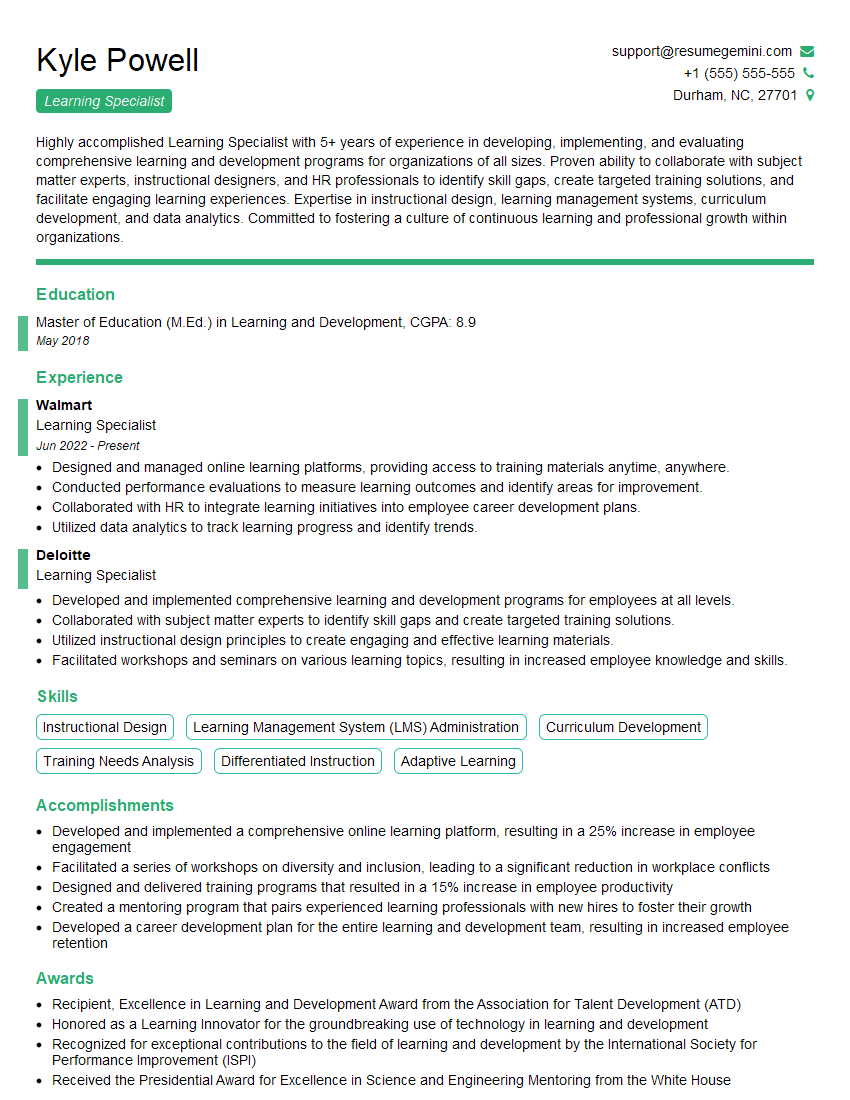
Learning Specialist Resume Sample
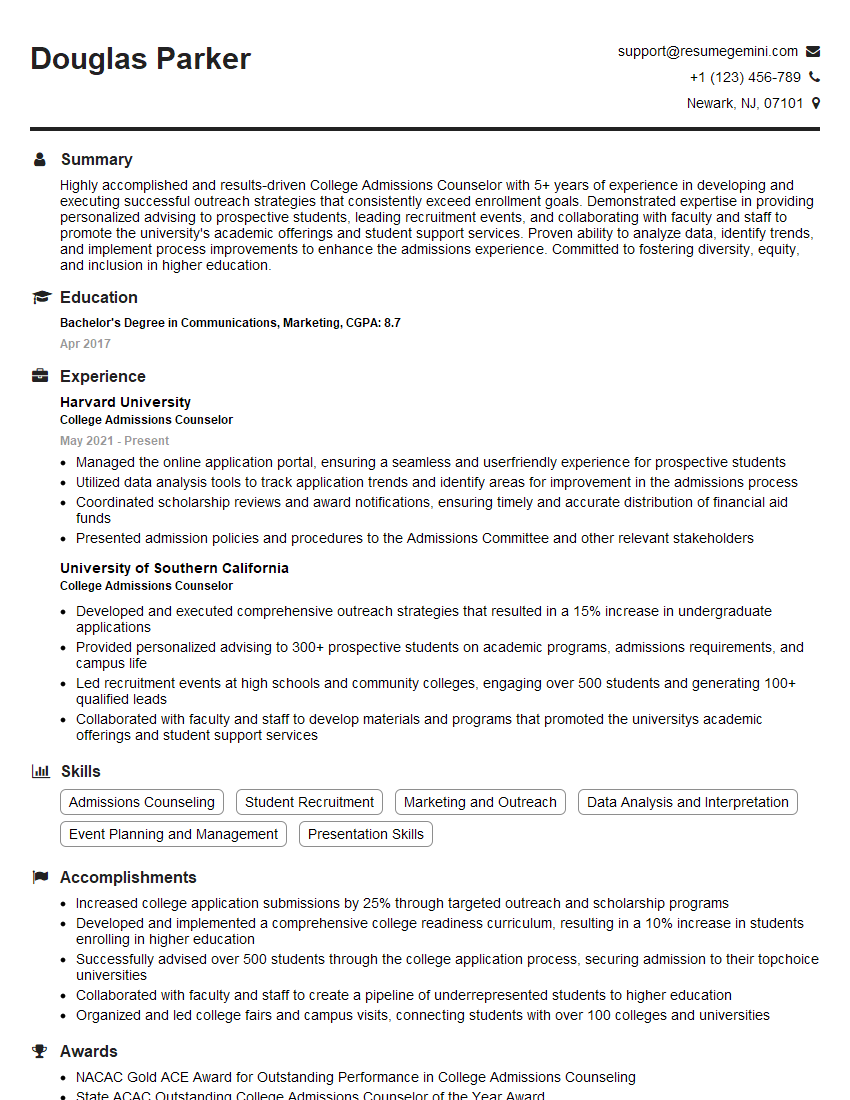
College Admissions Counselor Resume Sample

Curriculum Developer Resume Sample
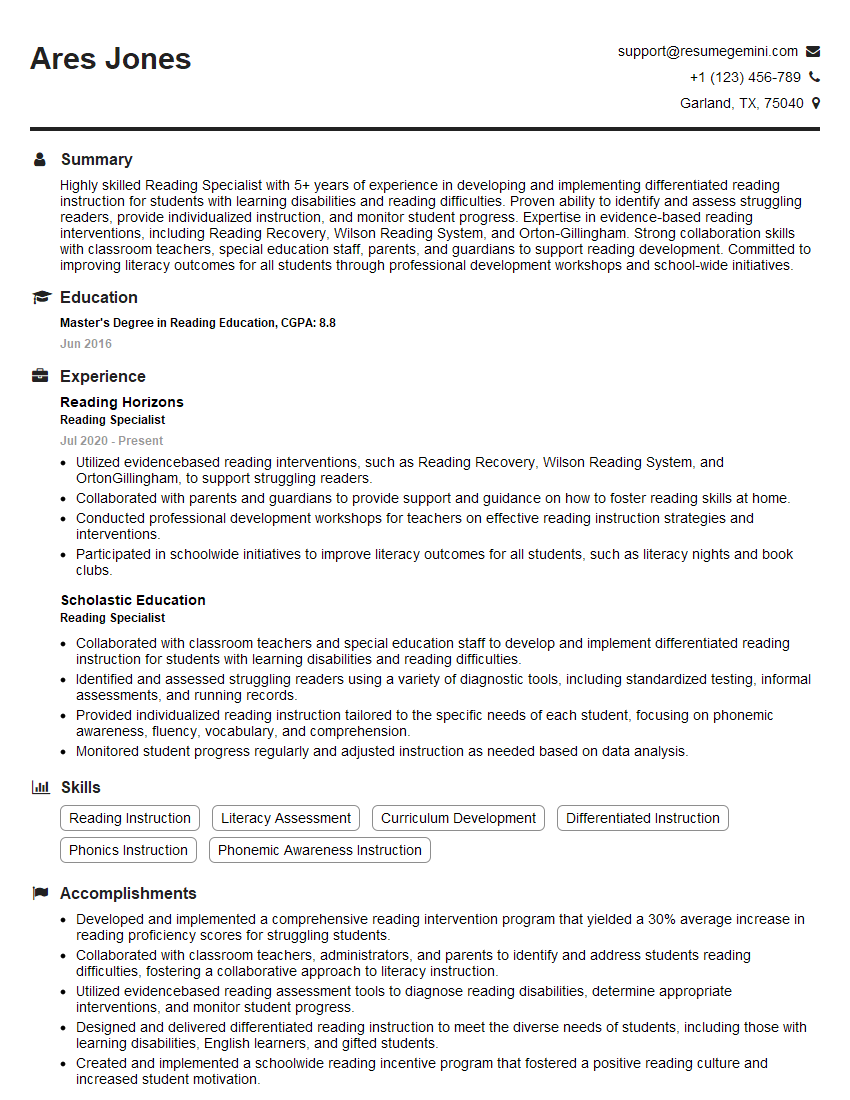
Reading Specialist Resume Sample

Tutor Resume Sample
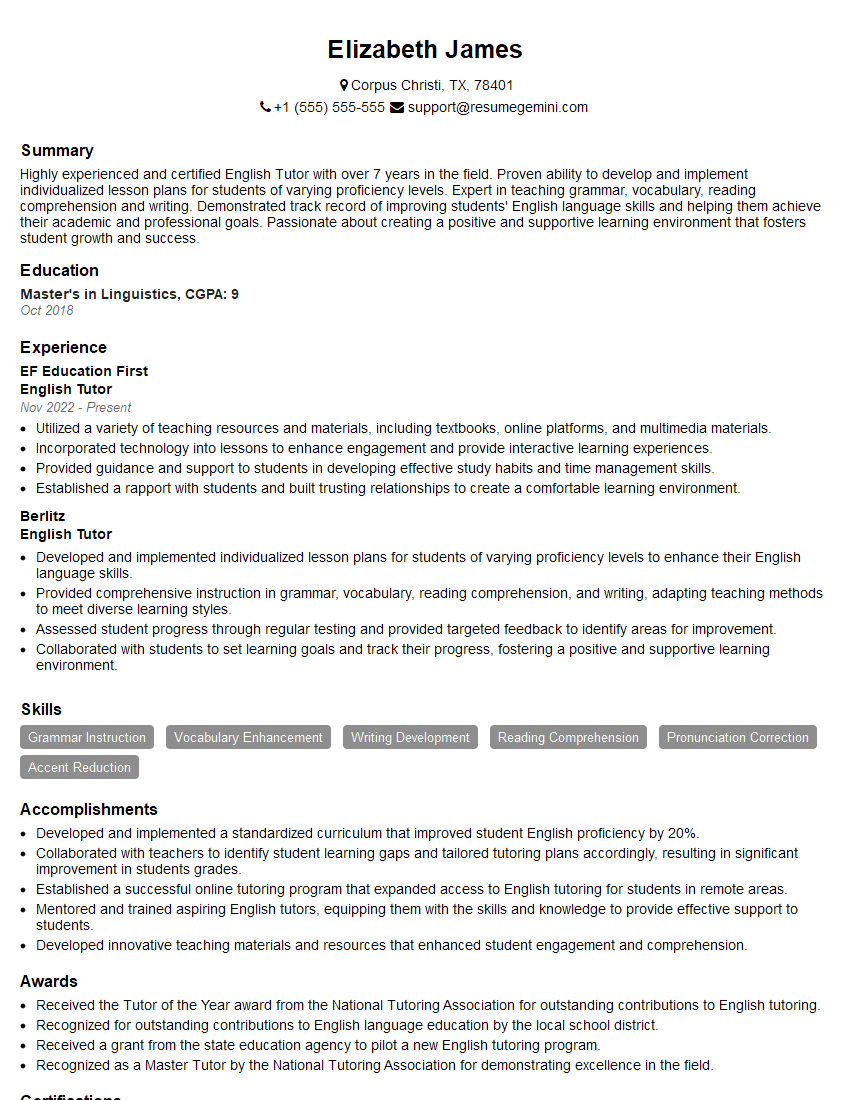
English Tutor Resume Sample
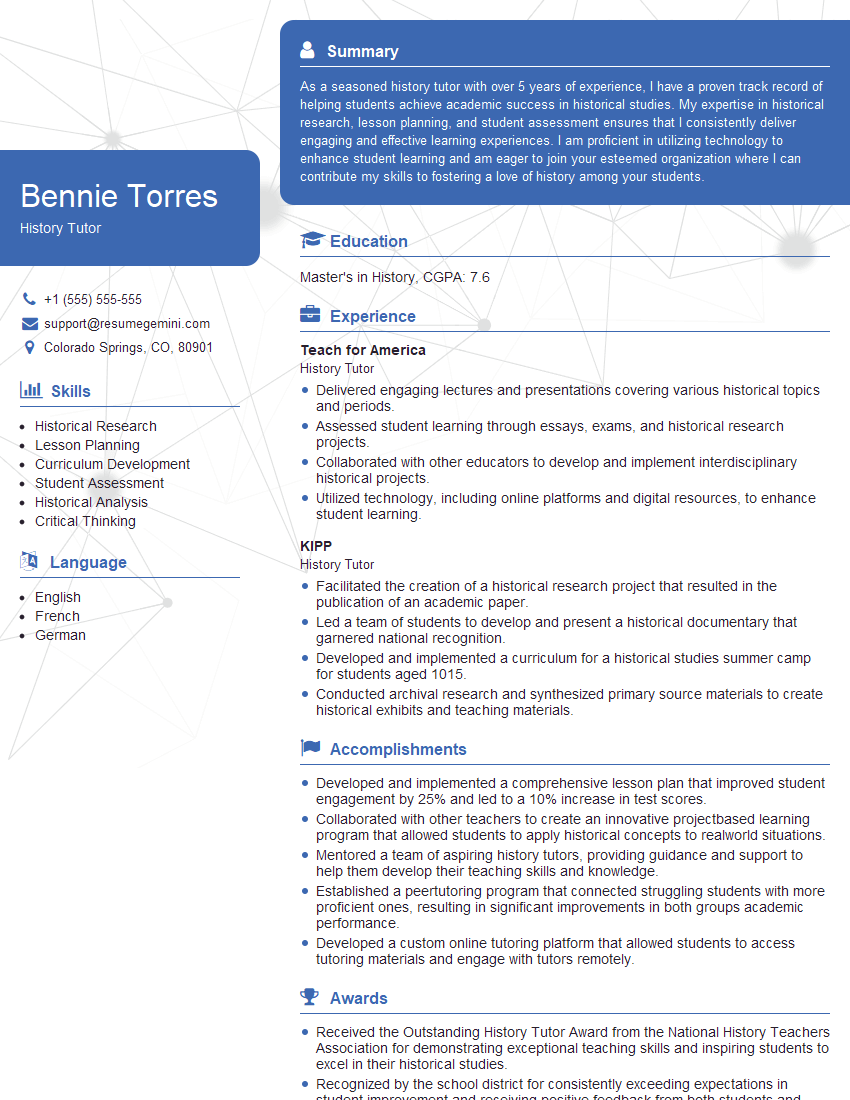
History Tutor Resume Sample
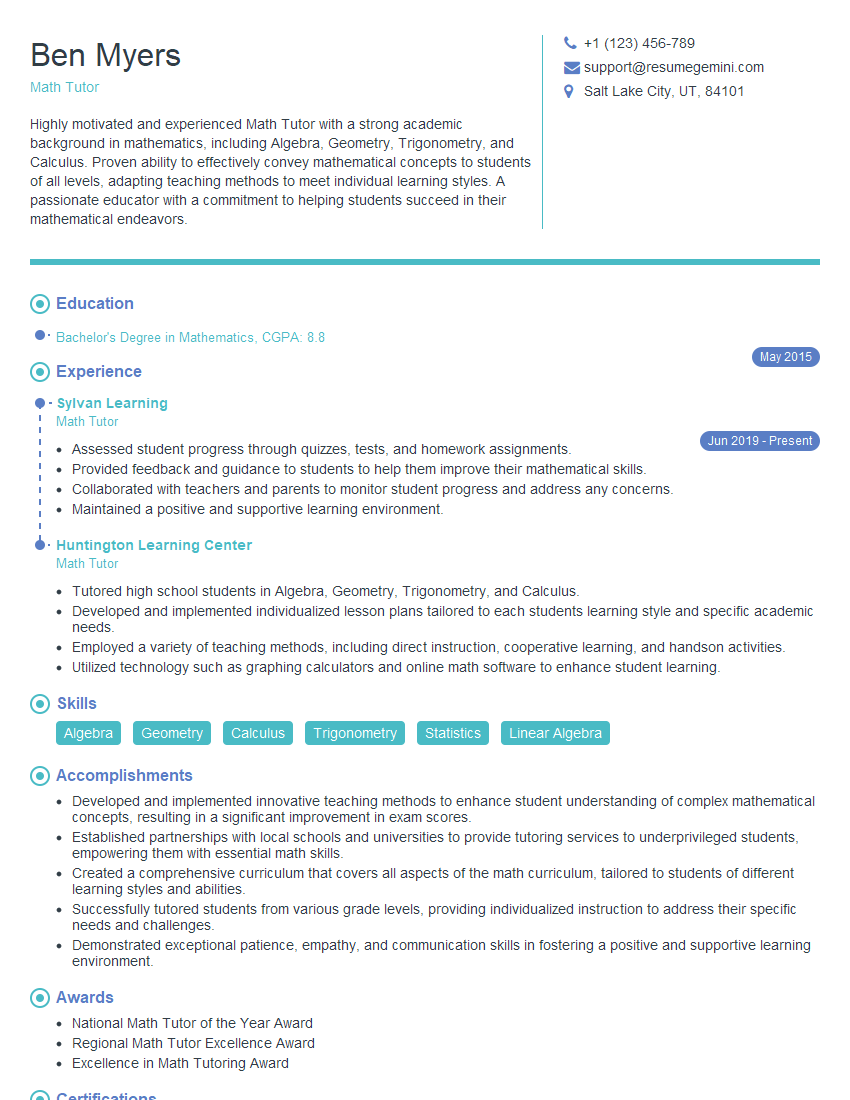
Math Tutor Resume Sample

Online Tutor Resume Sample
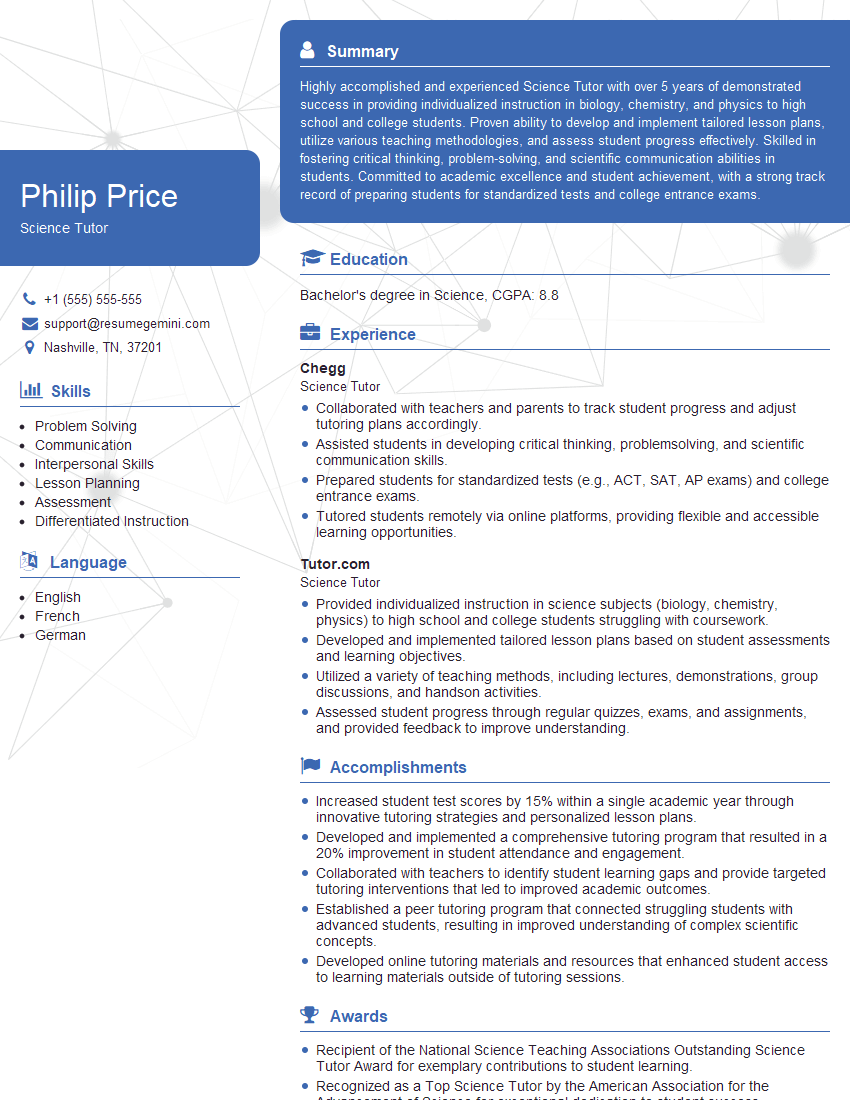
Science Tutor Resume Sample
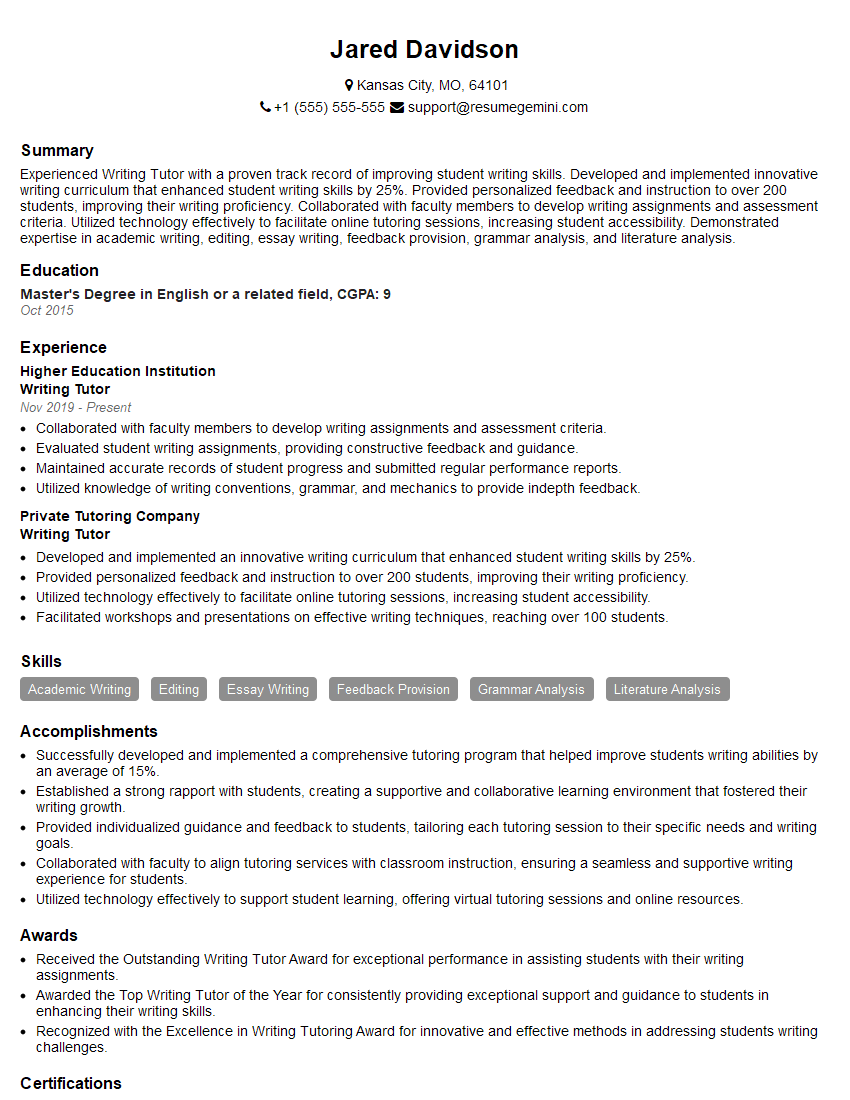
Writing Tutor Resume Sample
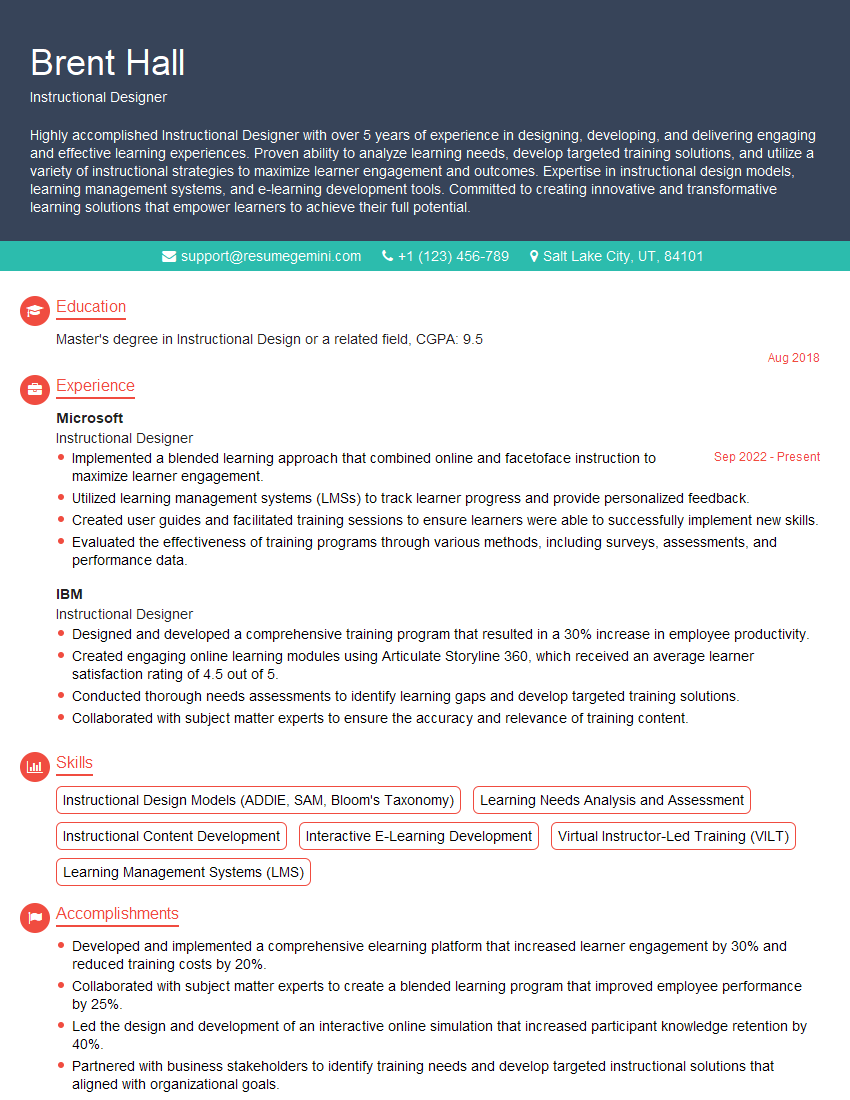
Instructional Designer Resume Sample

Educational Technologist Resume Sample
Explore more articles
Users Rating of Our Blogs
Share Your Experience
We value your feedback! Please rate our content and share your thoughts (optional).
What Readers Say About Our Blog
I Redesigned Spongebob Squarepants and his main characters of my artwork.
https://www.deviantart.com/reimaginesponge/art/Redesigned-Spongebob-characters-1223583608
IT gave me an insight and words to use and be able to think of examples
Hi, I’m Jay, we have a few potential clients that are interested in your services, thought you might be a good fit. I’d love to talk about the details, when do you have time to talk?
Best,
Jay
Founder | CEO