The thought of an interview can be nerve-wracking, but the right preparation can make all the difference. Explore this comprehensive guide to Advanced Structural Analysis Techniques interview questions and gain the confidence you need to showcase your abilities and secure the role.
Questions Asked in Advanced Structural Analysis Techniques Interview
Q 1. Explain the finite element method (FEM) and its applications in structural analysis.
The Finite Element Method (FEM) is a powerful numerical technique used to solve complex engineering problems, particularly in structural analysis. Imagine you have a complex shape, like a car chassis, that’s subjected to various forces. Instead of trying to solve the equations governing its behavior all at once (which is nearly impossible), FEM breaks down the structure into many smaller, simpler shapes called ‘finite elements’. Each element is analyzed individually, and the results are then combined to approximate the overall behavior of the entire structure. This allows us to predict things like stress, strain, displacement, and natural frequencies under different loading conditions.
In structural analysis, FEM is used extensively for:
- Analyzing stress and strain in bridges, buildings, and aircraft.
- Predicting the buckling behavior of columns and beams.
- Simulating the dynamic response of structures to earthquakes or wind loads.
- Optimizing structural designs for weight and cost efficiency.
- Analyzing the effects of cracks and other imperfections on structural integrity.
For example, FEM is used in the design of skyscrapers to ensure they can withstand high winds and seismic activity. Engineers use software to model the building as a collection of elements, apply wind and earthquake loads, and then analyze the stresses and displacements to determine if the design is safe.
Q 2. Describe different types of finite elements used in structural analysis (e.g., beam, shell, solid).
Different finite element types are chosen depending on the geometry and behavior of the structure being analyzed. Common types include:
- Truss Elements: These are one-dimensional elements used to model structures composed of slender members subjected primarily to axial forces. Think of a simple bridge truss.
- Beam Elements: Also one-dimensional, these model beams and columns that are subjected to bending, shear, and axial forces. Consider a simple supported beam with a point load.
- Shell Elements: These two-dimensional elements model thin structures like plates and curved shells. This is crucial for analyzing aircraft fuselages or car bodies, where bending and in-plane stresses are significant.
- Solid Elements: These three-dimensional elements are used for modeling thicker components where stresses vary significantly in all three directions. Think of a complex engine block.
The choice of element type significantly influences accuracy and computational cost. Shell elements, for instance, are computationally cheaper than solid elements for thin structures, but they’re inaccurate for thick structures.
Q 3. What are the advantages and disadvantages of using FEM?
Advantages of FEM:
- Handles complex geometries: FEM can analyze structures with intricate shapes and features that are difficult or impossible to solve using analytical methods.
- Versatile: It can handle various material properties, boundary conditions, and loading scenarios.
- Accurate: With proper meshing and element selection, FEM provides highly accurate results.
- Widely available software: Numerous commercial and open-source FEM software packages are available.
Disadvantages of FEM:
- Computational cost: Analyzing large and complex structures can be computationally expensive and time-consuming.
- Mesh dependence: The accuracy of the results depends heavily on the quality of the mesh (the arrangement of finite elements).
- Requires expertise: Effective use of FEM requires a good understanding of the method and the software.
- Potential for errors: Errors can be introduced during model creation, mesh generation, and data interpretation.
Q 4. How do you choose an appropriate mesh density for a finite element analysis?
Choosing the right mesh density is crucial for balancing accuracy and computational cost. A finer mesh (more elements) leads to greater accuracy but increases computational time. A coarser mesh is faster but might be less accurate. The optimal mesh density depends on several factors:
- Geometry complexity: Areas with sharp corners or significant curvature require finer meshes.
- Expected stress gradients: Regions where stress is expected to change rapidly require finer meshes to capture the variations accurately.
- Accuracy requirements: Higher accuracy demands finer meshes.
- Computational resources: Available computing power limits the achievable mesh density.
A common approach is to start with a relatively coarse mesh, analyze the results, and then refine the mesh in areas with high stress gradients or where the solution shows significant changes with mesh refinement. This adaptive mesh refinement technique improves accuracy where needed without unnecessarily increasing computational cost everywhere.
Q 5. Explain the concept of convergence in FEA.
Convergence in FEA refers to the process where the solution obtained from the analysis approaches the true solution as the mesh is refined. Imagine you’re approximating the area of a circle using smaller and smaller squares. As the squares get smaller, their total area gets closer to the actual area of the circle. Similarly, in FEA, as you use a finer mesh (smaller elements), the solution converges towards the exact solution of the underlying equations.
Lack of convergence can indicate problems with the model, such as improper boundary conditions or numerical instability. Monitoring convergence is crucial for ensuring the reliability and accuracy of the results. This is often checked by comparing solutions obtained with different mesh densities. If the difference between the solutions is small enough, convergence is considered to have been achieved.
Q 6. What are the different types of boundary conditions used in structural analysis?
Boundary conditions are essential constraints applied to the model to simulate real-world supports and constraints. Common types include:
- Fixed Support: Completely restricts all degrees of freedom (displacements) at a point or surface. Think of a fixed end of a cantilever beam.
- Hinged Support: Restricts displacement in specific directions, allowing rotation around one or more axes. Think of the support at the end of a simply supported beam.
- Roller Support: Restricts displacement in one direction while allowing movement in other directions. Think of a wheel resting on a rail.
- Prescribed Displacement: Imposes a specific displacement value at a point or surface. This could represent thermal expansion or a movement caused by a jack.
- Symmetry Conditions: Exploit symmetry in a structure to reduce the computational effort by analyzing only a portion of the model.
Choosing the correct boundary conditions is critical for obtaining realistic and accurate results. Incorrect boundary conditions can lead to inaccurate predictions of stress, strain, and displacement.
Q 7. How do you handle non-linear material behavior in FEA?
Many real-world materials exhibit non-linear behavior, meaning their stress-strain relationship is not linear. This can be due to factors like plasticity (permanent deformation), creep (time-dependent deformation), or material damage. Handling non-linearity in FEA requires specialized techniques:
- Non-linear material models: The software uses constitutive models that accurately represent the non-linear stress-strain relationship of the material (e.g., plasticity models like von Mises or Drucker-Prager).
- Iterative solution methods: Because the equations governing non-linear behavior are not solvable directly, iterative methods like Newton-Raphson are employed. These methods solve the equations iteratively, converging on a solution.
- Nonlinear geometric effects: Large displacements or rotations can affect the stiffness of the structure, leading to geometric non-linearity. This requires considering the updated geometry during the analysis.
For example, analyzing a metal structure undergoing plastic deformation requires using a plasticity model and an iterative solver. The software will adjust the material stiffness at each iteration based on the current stress and strain levels. This is essential for accurate prediction of failure in structures subjected to high loads.
Q 8. Explain the concept of plasticity and its influence on structural response.
Plasticity describes a material’s ability to deform permanently under stress. Unlike elastic materials that return to their original shape after unloading, plastic materials retain some deformation. This permanent deformation is crucial in structural analysis because it significantly alters a structure’s response to loads.
Imagine bending a paperclip: initially, it bends elastically and springs back. However, bend it far enough, and it permanently deforms—this is plastic behavior. In structures, plastic behavior can lead to things like permanent sagging, reduced stiffness, and even collapse, depending on the material’s properties and the magnitude of the load. We use stress-strain curves to define the elastic and plastic regions of a material’s behavior. The yield stress marks the transition from elastic to plastic deformation. Structures designed to withstand extreme loads often utilize materials exhibiting significant plasticity, allowing for controlled deformation before failure, providing a degree of warning before catastrophic collapse. This is particularly important in earthquake engineering where ductile behavior is prioritized.
Q 9. Describe different types of non-linear analysis (e.g., geometric, material).
Nonlinear analysis accounts for complexities in structural behavior that linear analysis cannot. Two key types are geometric and material nonlinearity.
Geometric Nonlinearity: This considers changes in a structure’s geometry under load. Large displacements or rotations cause the stiffness matrix to change, making the problem nonlinear. Think of a slender column: as it bends, its stiffness changes, altering the load-deformation relationship. This is often crucial for slender structures, flexible beams or shells, or those undergoing significant deformations.
Material Nonlinearity: This accounts for material behavior that isn’t linearly elastic. Plasticity, as discussed earlier, is a prime example. Other forms include creep (time-dependent deformation) and damage models (e.g., concrete cracking). Material nonlinearity significantly influences the accuracy of the analysis, especially for structures subjected to high loads.
Often, both geometric and material nonlinearity are considered simultaneously in a full nonlinear analysis. Software packages like ABAQUS, ANSYS, and LS-DYNA are commonly used to perform these analyses.
Q 10. How do you model contact between different structural components in FEA?
Modeling contact between structural components in Finite Element Analysis (FEA) is crucial for accurate simulations. It’s essential to correctly represent how components interact: friction, gaps, and pressure all play a role. Different contact algorithms are used, depending on the complexity of the interaction.
Node-to-Surface Contact: A common method where nodes of one component interact with the surface of another. This is relatively simple but might need mesh refinement for accuracy.
Surface-to-Surface Contact: More accurate, especially for complex geometries, it considers the interaction between two surfaces. It requires careful meshing to avoid numerical issues.
Contact parameters such as friction coefficient (μ) are essential inputs. A higher friction coefficient implies a stronger resistance to relative movement between surfaces. The choice of contact algorithm and the accurate definition of contact parameters are critical for realistic simulation results. Incorrect modeling can lead to inaccurate stresses, displacements, and potentially dangerous predictions.
Q 11. Explain the concept of buckling and how it is analyzed.
Buckling is a sudden, large deformation of a structural member under compressive load, occurring when the compressive load exceeds a critical value. It’s a stability problem, not a strength problem—the member may fail due to buckling even though its material strength isn’t exceeded.
Imagine a perfectly straight, slender column loaded axially. As the load increases, the column will initially compress elastically. But at a critical load, it will suddenly buckle, often exhibiting a significant sideways deflection. This critical load depends on the column’s length, cross-sectional properties (area and moment of inertia), and material properties (Young’s modulus). Buckling analysis often uses linear eigenvalue analysis to find the critical buckling load and mode shapes. Software packages use advanced methods such as the finite element method to accurately analyze buckling in complex structures.
Preventing buckling is a critical consideration in structural design. Techniques include increasing the member’s cross-sectional area, shortening the length, using materials with a higher Young’s modulus, and incorporating bracing or stiffeners to increase lateral stability.
Q 12. How do you perform modal analysis and what is its significance?
Modal analysis determines the natural frequencies (how fast something vibrates naturally) and mode shapes (the pattern of vibration) of a structure. It’s a linear eigenvalue problem, essential for understanding a structure’s dynamic behavior and designing for dynamic loads.
In simple terms, imagine plucking a guitar string. It vibrates at a specific frequency, its natural frequency. Modal analysis identifies these natural frequencies and the corresponding vibration patterns for a structure. If an external dynamic load (e.g., wind, earthquake) matches one of these natural frequencies, resonance can occur, leading to amplified vibrations and potentially catastrophic failure. Therefore, modal analysis is crucial in ensuring that a structure’s natural frequencies are far from the frequencies of anticipated dynamic loads.
The results of modal analysis guide design modifications to shift the natural frequencies away from critical ranges. This is vital in many engineering applications, including designing tall buildings, bridges, and aircraft to avoid resonance.
Q 13. Describe different methods for performing dynamic analysis (e.g., time history, response spectrum).
Dynamic analysis examines a structure’s response to time-varying loads like earthquakes, wind gusts, and blasts. Several methods exist:
Time History Analysis: This method directly simulates the structure’s response to a time-dependent load, using numerical integration techniques to solve equations of motion. It requires detailed time-dependent load data, often obtained from recordings or simulations. This provides the most detailed response information but can be computationally expensive for complex structures.
Response Spectrum Analysis: A less computationally intensive method, this approach uses a response spectrum, which represents the maximum response of a single-degree-of-freedom system (SDOF) subjected to a specific ground motion. The structure’s response is then estimated by combining the modal responses and the response spectrum. It’s often used for earthquake engineering, providing an upper bound estimate of the structure’s response without the need for detailed time-history data.
Other methods include frequency response analysis and random vibration analysis, each suited to different scenarios and available data. The selection of the optimal method depends on the complexity of the structure, the nature of the dynamic load, and the level of accuracy required.
Q 14. How do you model seismic loads in structural analysis?
Seismic loads are modeled in structural analysis using various techniques, primarily through ground motion records or response spectra.
Time History Analysis with Ground Motion Records: This involves inputting recorded accelerations from past earthquakes (obtained from seismographs) as time-varying ground motion inputs in the dynamic analysis. This method accounts for the complexity and variations in real-world earthquake ground motions. The accuracy of the analysis depends heavily on the suitability of the selected ground motion record and its compatibility with the site’s soil conditions. Using multiple records to assess variability is common practice.
Response Spectrum Analysis: Instead of using complete time histories, response spectra (containing maximum response values for different frequencies) are used. This is a simplified approach, but less computationally expensive and often sufficient for design purposes. The selection of the appropriate response spectrum is critical and typically guided by seismic design codes and site-specific ground motion hazard assessments.
Proper modeling also requires considerations for soil-structure interaction (SSI), the influence of the soil on the structure’s dynamic response. Ignoring SSI can significantly underestimate the structural response. The choice between using time-history analysis or response spectrum analysis depends on project requirements and the availability of data.
Q 15. What are the different types of failure criteria used in structural analysis?
Failure criteria in structural analysis dictate when a structure is deemed to have failed. They’re crucial for ensuring safety and predicting structural behavior under various loads. Different criteria are used depending on the material’s behavior (ductile or brittle) and the type of failure anticipated (yielding, fracture, buckling).
- Maximum Stress Theory (Rankine): This is the simplest, stating failure occurs when the maximum principal stress exceeds the material’s yield strength. Think of it like a single, weak link breaking a chain. It’s suitable for brittle materials.
- Maximum Shear Stress Theory (Tresca): This theory posits failure occurs when the maximum shear stress exceeds the material’s shear yield strength. Imagine twisting a wire until it snaps – that’s shear failure. It’s a better fit for ductile materials.
- Maximum Distortion Energy Theory (von Mises): This theory considers the distortion energy in a material element. Failure is predicted when this energy exceeds the material’s yield strength. It’s more accurate than the previous two and widely used for ductile materials because it accounts for multiaxial stress states.
- Mohr-Coulomb Criterion: Specifically for materials with both tensile and compressive strength, like concrete or soil, this criterion considers the shear and normal stresses on a failure plane.
Choosing the right criterion is critical. For instance, designing a pressure vessel would likely utilize the von Mises criterion for its ductile steel, while designing a brittle ceramic component would necessitate the maximum stress theory.
Career Expert Tips:
- Ace those interviews! Prepare effectively by reviewing the Top 50 Most Common Interview Questions on ResumeGemini.
- Navigate your job search with confidence! Explore a wide range of Career Tips on ResumeGemini. Learn about common challenges and recommendations to overcome them.
- Craft the perfect resume! Master the Art of Resume Writing with ResumeGemini’s guide. Showcase your unique qualifications and achievements effectively.
- Don’t miss out on holiday savings! Build your dream resume with ResumeGemini’s ATS optimized templates.
Q 16. Explain the concept of fatigue and its impact on structural integrity.
Fatigue is a progressive and localized structural damage that occurs when a material is subjected to cyclic loading. Imagine repeatedly bending a paperclip – eventually, it’ll break, even though the stress in each cycle might be far below its yield strength. This is fatigue.
The impact on structural integrity is significant. Fatigue cracks initiate at stress concentrations (like notches or holes) and propagate gradually, leading to unexpected and catastrophic failure. This can happen long before the structure reaches its static strength limit. Factors influencing fatigue life include the magnitude of cyclic stress, the number of cycles, the material properties, and the environment (e.g., corrosion).
Analyzing fatigue involves using S-N curves (Stress vs. Number of cycles to failure) to predict fatigue life. Finite Element Analysis (FEA) is crucial for identifying stress hotspots and simulating the crack propagation process. Proper fatigue design is paramount in industries like aerospace, where component lifespan under repeated loading is critical.
Q 17. How do you validate your FEA results?
Validating FEA results is paramount to ensure the model accurately represents the real-world behavior of the structure. This involves several steps:
- Comparison with experimental data: The most reliable method. Conducting physical experiments (e.g., testing a prototype) and comparing the measured stresses, strains, or displacements with the FEA predictions. Discrepancies should be investigated and the model refined accordingly.
- Mesh convergence studies: Refining the FEA mesh (dividing the model into smaller elements) until the results stabilize. This ensures the solution is independent of the mesh size, which is a key indicator of accuracy.
- Benchmarking against analytical solutions: For simpler structures, analytical solutions may exist. Comparing the FEA results with these solutions provides a valuable check on the model’s accuracy.
- Peer review: Having another experienced analyst review the model, mesh, boundary conditions, material properties, and results helps identify potential errors or inconsistencies.
- Verification of assumptions: A critical step involves reviewing the assumptions made during modeling, such as material properties, boundary conditions, and loading conditions. These assumptions should be carefully justified.
A good validation process ensures confidence in the FEA results and reduces the risk of design errors.
Q 18. What software packages are you proficient in for structural analysis (e.g., ANSYS, ABAQUS, NASTRAN)?
I’m proficient in several industry-standard software packages for structural analysis. My expertise includes:
- ANSYS: Extensive experience with static, dynamic, and nonlinear analyses, including fatigue and thermal stress analysis. I’ve used it for a variety of applications, including component design and structural health monitoring.
- ABAQUS: Proficient in using its advanced capabilities for complex nonlinear analysis, such as large deformation, contact problems, and material nonlinearities. It’s my go-to software for intricate simulations.
- NASTRAN: Skilled in using NASTRAN for large-scale linear and nonlinear finite element analyses, particularly in aerospace applications. I’ve used it for model optimization and modal analysis.
My proficiency extends beyond basic analysis; I’m comfortable with advanced features like custom element development (in ANSYS and ABAQUS) and scripting for automation.
Q 19. Describe your experience with pre- and post-processing in FEA.
Pre- and post-processing are integral parts of any FEA workflow. Pre-processing involves defining the geometry, material properties, boundary conditions, and mesh. Post-processing involves visualizing and interpreting the results.
Pre-processing: My experience encompasses creating geometric models using CAD software, assigning material properties (including nonlinear material models), applying appropriate loads (static, dynamic, thermal), defining constraints (fixed supports, hinges), and generating high-quality meshes (using different element types based on the application). I’m adept at using meshing tools to optimize element sizes based on stress gradients for accuracy and computational efficiency.
Post-processing: This involves visualizing stress contours, displacement fields, and other results. I analyze the data to identify critical areas, evaluate stress concentrations, and determine factors of safety. I frequently use animation to track deformation and failure modes and can generate detailed reports to communicate my findings.
Q 20. Explain your experience with mesh refinement techniques.
Mesh refinement is a critical technique to enhance the accuracy of FEA results, particularly in regions with high stress gradients. A poorly refined mesh can lead to inaccurate results and potentially missed critical areas.
My experience includes using various mesh refinement techniques:
- h-refinement: Reducing the element size in critical areas (stress concentrations). This is the most common method.
- p-refinement: Increasing the order of the interpolation functions within the elements. This increases accuracy without increasing the number of elements, but is computationally more expensive.
- r-refinement: Relocating nodes within the existing mesh to improve accuracy. Often combined with other refinement techniques.
I use adaptive meshing techniques in sophisticated analyses where the regions of high stress are not initially known. The software automatically refines the mesh based on the solution obtained in the previous iteration. The balance between accuracy and computational cost is always a key consideration.
Q 21. How do you handle uncertainties and variations in material properties in FEA?
Uncertainties and variations in material properties are unavoidable in real-world applications. Ignoring them can lead to inaccurate and potentially unsafe designs.
I handle these uncertainties using several techniques:
- Probabilistic Finite Element Analysis (pFEA): This involves incorporating statistical distributions for material properties (e.g., Young’s modulus, Poisson’s ratio, yield strength) and performing multiple simulations to obtain a range of results, including the probability of failure. This approach provides a more realistic assessment of structural behavior.
- Sensitivity analysis: This identifies which material properties have the most significant influence on the structural response. Focus is placed on refining measurements or models for the most sensitive parameters.
- Deterministic approach with safety factors: For simpler cases, applying conservative safety factors based on the expected range of variations in material properties is used.
The choice of technique depends on the complexity of the problem, the availability of data, and the desired level of accuracy. For critical applications, pFEA is preferred to obtain a more comprehensive understanding of risk.
Q 22. Describe your experience with experimental verification of FEA results.
Experimental verification of Finite Element Analysis (FEA) results is crucial for validating the accuracy and reliability of the numerical model. It involves comparing FEA predictions with real-world measurements obtained through physical testing. This process helps identify potential discrepancies and refine the model for improved accuracy in future simulations.
In my experience, this typically involves designing and conducting experiments on physical prototypes or representative specimens. For instance, I worked on a project involving the structural analysis of a bridge. We conducted FEA simulations to predict stress and displacement under various load conditions. Then, we built a scaled-down physical model of the bridge and subjected it to similar loads, using strain gauges and displacement transducers to collect experimental data. By comparing the FEA-predicted stresses and displacements with those measured experimentally, we were able to assess the accuracy of the FEA model and identify areas where the model could be improved, for instance, by refining the mesh or adjusting material properties.
Another project involved testing composite materials. Here, we used digital image correlation (DIC) to measure the strain field on the surface of the composite during a tensile test. The DIC results were then compared to the strain predictions from the FEA, allowing us to validate the material models used in the simulation. Discrepancies between experimental and numerical data often highlighted the need to refine the material model or consider more sophisticated failure criteria.
Q 23. How do you determine the appropriate level of detail for a structural model?
Determining the appropriate level of detail for a structural model is a critical decision that balances accuracy with computational cost. Overly detailed models can be computationally expensive and time-consuming, while overly simplified models may not accurately capture the relevant structural behavior. The ideal level of detail depends on several factors, including the specific objectives of the analysis, the complexity of the structure, the available computational resources, and the required accuracy.
My approach involves a systematic evaluation of these factors. First, I clearly define the goals of the analysis. Are we interested in overall structural behavior, or do we need highly accurate predictions of stress concentrations in specific regions? Next, I assess the complexity of the structure, considering factors like geometry, material properties, and loading conditions. Simple structures may require only a coarse mesh, while complex structures with intricate geometries may necessitate a finer mesh and more detailed modeling of individual components.
Computational resources also play a significant role. Large, complex models may require high-performance computing resources, which may not always be available. Finally, the desired accuracy determines the level of detail. If only a rough estimate is needed, a simplified model may suffice. However, for critical applications where high accuracy is essential (e.g., aerospace or nuclear engineering), more detailed models are necessary.
For example, in the design of a simple beam, a simple 1D beam element model might be sufficient. However, for a complex aerospace component, a 3D model with solid elements might be necessary to accurately capture stress concentrations around holes or other geometric features.
Q 24. Describe your experience with optimization techniques in structural design.
Optimization techniques are essential for efficient and effective structural design. They enable engineers to find the optimal design that satisfies specified constraints while minimizing weight, cost, or maximizing performance. I have extensive experience applying various optimization techniques in structural design, leveraging both gradient-based and gradient-free methods.
Gradient-based methods, like the method of steepest descent or conjugate gradient methods, require calculating the gradient of the objective function. This can be computationally expensive but can be highly effective when applicable. Gradient-free methods, such as genetic algorithms or simulated annealing, are particularly useful for complex, non-linear problems where the gradient may be difficult to compute. They are more robust to discontinuities or noise in the objective function.
In a recent project, we used topology optimization to design a lightweight yet strong component for an automotive application. This involved defining a design space and using an optimization algorithm to iteratively remove material from areas of low stress, ultimately leading to a component with a significantly reduced weight while maintaining structural integrity. The optimization process was integrated with FEA to efficiently evaluate the structural performance of each design iteration.
Another project involved shape optimization using a genetic algorithm to minimize the deflection of a cantilever beam under a given load, subject to constraints on the maximum allowable stress and volume. This allowed us to find the optimal shape of the beam that minimizes deflection without exceeding the design constraints.
Q 25. What are the limitations of FEA?
While FEA is a powerful tool, it has several limitations that engineers need to be aware of to avoid misinterpretations or inaccurate results. These limitations stem from the inherent approximations and assumptions made during the modeling process.
- Mesh Dependency: The accuracy of the results can be significantly affected by the mesh quality and density. A poorly refined mesh can lead to inaccurate stress concentrations and overall inaccurate results. Mesh refinement studies are essential to ensure convergence and minimize mesh dependency.
- Material Model Assumptions: FEA relies on constitutive models that describe the material behavior. These models are often simplified representations of the actual material response, particularly under complex loading conditions. For example, linear elastic material models are often used despite the fact that most real-world materials exhibit non-linear behavior at high stress levels.
- Boundary Conditions: The accuracy of the results is highly sensitive to the applied boundary conditions. Inaccurate or improperly defined boundary conditions can lead to erroneous results. Careful consideration of boundary conditions is essential.
- Computational Cost: FEA can be computationally expensive, especially for large and complex models. This can limit the ability to perform extensive parametric studies or explore many design alternatives.
- Contact Problems: Modeling contact between different parts is often challenging, and accurate prediction of contact forces and stresses can be difficult.
Understanding these limitations is crucial for interpreting FEA results critically and avoiding over-reliance on the numerical predictions. Experimental validation and engineering judgment are essential complements to FEA.
Q 26. How do you interpret and communicate complex FEA results to non-technical stakeholders?
Communicating complex FEA results to non-technical stakeholders requires careful consideration and a clear strategy. The key is to translate technical jargon into plain language and focus on the information that is most relevant to their decision-making process.
My approach involves a multi-pronged strategy: First, I summarize the key findings in a concise and easily understandable manner, avoiding technical jargon whenever possible. I use visual aids such as graphs, charts, and animations to illustrate the results in a way that is easy to grasp. For example, instead of discussing stress tensors, I might focus on the maximum stress experienced by a critical component and its implications for safety or performance.
Second, I focus on the implications of the results. Rather than presenting a deluge of numerical data, I emphasize the actionable insights derived from the analysis. For instance, instead of showing stress contour plots, I’d explain how the analysis informs design decisions, such as material selection, component geometry, or safety factors. I will emphasize the implications in terms of cost, weight reduction, or performance improvements.
Third, I use analogies and real-world examples to make the concepts more relatable. This makes it easier for stakeholders to understand the significance of the results and their implications for the project. For example, I might compare stress concentrations to weak points in a chain, highlighting the importance of addressing these critical areas.
Finally, I encourage questions and open discussions to address any uncertainties or concerns. This helps ensure that stakeholders fully understand the results and can make informed decisions based on the FEA analysis.
Q 27. Describe your experience with parallel computing in FEA.
Parallel computing is essential for tackling large-scale FEA simulations, enabling significant reductions in computational time and making it feasible to analyze complex models that would otherwise be intractable. I have considerable experience utilizing parallel computing techniques to accelerate FEA simulations.
My experience spans various parallel computing paradigms, including distributed memory parallel computing using message passing interface (MPI) and shared memory parallel computing using OpenMP. MPI is particularly useful for very large models that require distributing the computational workload across multiple processors or computer nodes in a cluster. OpenMP is suitable for smaller problems that can be efficiently parallelized within a single computer with multiple cores.
For instance, in a project involving the analysis of a large-scale industrial structure, we employed MPI to distribute the computational load across a cluster of high-performance computers. This drastically reduced the simulation time, allowing for more comprehensive analysis and design optimization. The use of MPI allowed us to perform simulations that would have been impossible using a single machine.
In other projects, I’ve utilized OpenMP for smaller models, particularly when using commercial FEA software packages with built-in OpenMP support. OpenMP often provides a simpler and more convenient way to parallelize the computations compared to using MPI directly, especially for those less familiar with the intricacies of message passing.
The choice between MPI and OpenMP depends on the size of the problem, the available hardware resources, and the complexity of the model. For extremely large problems, distributed memory parallelization with MPI is often necessary. For smaller models, shared memory parallelization with OpenMP can be more efficient and easier to implement.
Q 28. Explain your experience with advanced topics such as fracture mechanics or composite materials.
My expertise extends to advanced topics in structural analysis, including fracture mechanics and composite materials. These areas often require specialized modeling techniques and a deep understanding of material behavior under complex loading conditions.
In fracture mechanics, I have experience using various techniques such as linear elastic fracture mechanics (LEFM) and elastic-plastic fracture mechanics (EPFM) to predict crack initiation and propagation. LEFM is often used for brittle materials, while EPFM is more appropriate for ductile materials. These analyses often involve sophisticated techniques for modeling crack growth and determining fracture toughness. For instance, I’ve used FEA to simulate crack propagation in a pressure vessel, using virtual crack closure techniques (VCCT) to estimate the stress intensity factor.
My experience with composite materials involves modeling the behavior of these materials using various micromechanical models and homogenization techniques. This allows us to predict the overall mechanical properties of the composite based on the properties of the individual constituents (fibers and matrix). I have also used advanced FEA techniques to simulate the failure of composite structures under complex loading conditions, considering factors like fiber orientation, damage evolution, and delamination. This often involves the use of cohesive elements to model the interaction between different layers or plies in the composite structure. For example, I’ve worked on modeling the impact behavior of composite panels, utilizing progressive damage models to simulate the failure process and predict the resulting damage patterns.
In both fracture mechanics and composite materials modeling, careful consideration of material properties, failure criteria, and the appropriate FEA techniques is crucial for obtaining accurate and reliable predictions.
Key Topics to Learn for Advanced Structural Analysis Techniques Interview
- Finite Element Analysis (FEA): Understand the theoretical basis of FEA, including mesh generation, element types (beam, shell, solid), and solution methods. Be prepared to discuss practical applications in various industries, such as aerospace, automotive, and civil engineering.
- Nonlinear Analysis: Master the concepts of material nonlinearity (plasticity, creep), geometric nonlinearity (large displacements, buckling), and their combined effects. Discuss practical examples where nonlinear analysis is crucial for accurate structural design.
- Advanced Material Models: Familiarize yourself with constitutive models beyond linear elasticity, including viscoelasticity, viscoplasticity, and damage mechanics. Be ready to explain their application in specific material scenarios.
- Dynamic Analysis: Gain a strong grasp of modal analysis, seismic analysis, and transient dynamic analysis. Understand the practical implications of these techniques in designing structures for dynamic loads.
- Stability Analysis: Comprehend the theoretical foundations of buckling and instability phenomena. Be prepared to discuss different buckling modes and methods for evaluating structural stability.
- Optimization Techniques in Structural Analysis: Explore methods for optimizing structural designs for weight, cost, or performance. Discuss algorithms and their application in real-world projects.
- Software Proficiency: Showcase your expertise in relevant software packages such as ABAQUS, ANSYS, or SAP2000. Be ready to discuss your experience with pre-processing, solving, and post-processing.
- Experimental Validation: Understand the importance of comparing analytical results with experimental data and how this process informs the accuracy and reliability of structural analysis models.
Next Steps
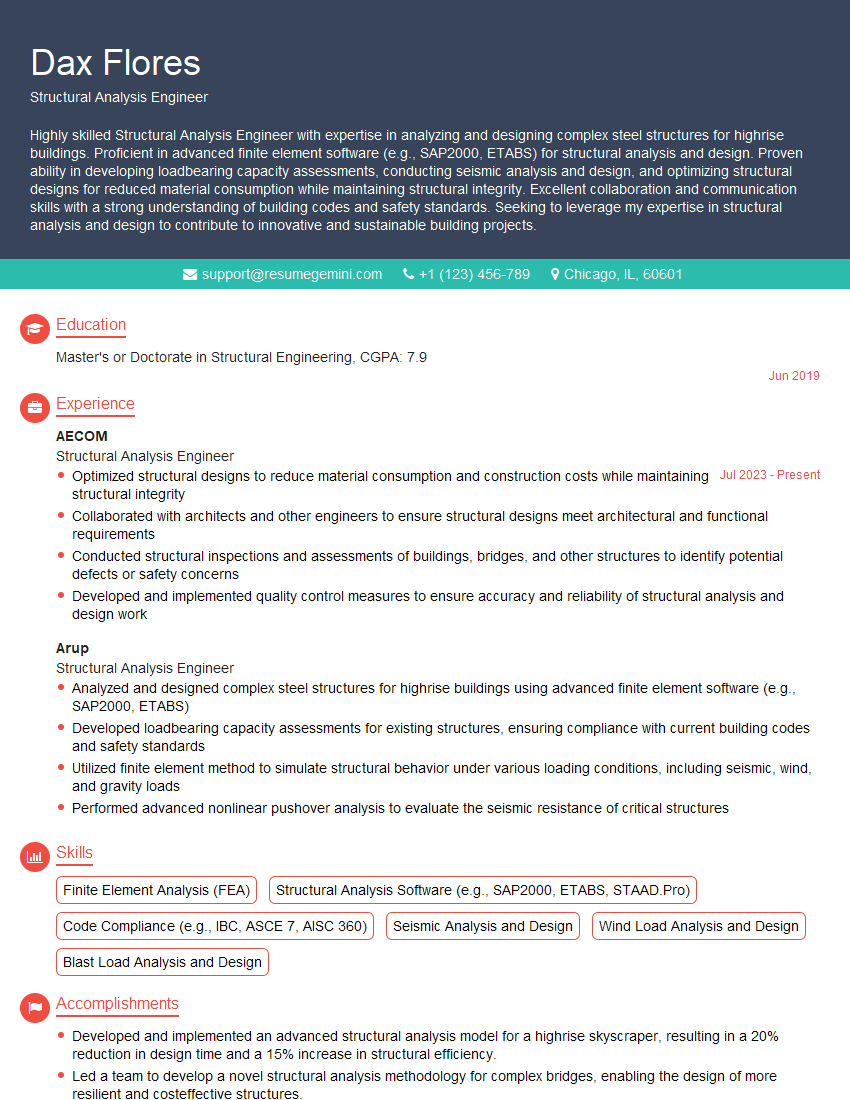
Mastering advanced structural analysis techniques is crucial for career advancement in engineering, opening doors to challenging and rewarding roles with higher earning potential and greater responsibility. To maximize your job prospects, creating a compelling and ATS-friendly resume is essential. ResumeGemini is a trusted resource that can help you build a professional and effective resume tailored to highlight your skills and experience in Advanced Structural Analysis Techniques. Examples of resumes specifically tailored to this field are available to guide you. Take the next step towards your dream career; invest in your resume and stand out from the competition.
Explore more articles
Users Rating of Our Blogs
Share Your Experience
We value your feedback! Please rate our content and share your thoughts (optional).
What Readers Say About Our Blog
I Redesigned Spongebob Squarepants and his main characters of my artwork.
https://www.deviantart.com/reimaginesponge/art/Redesigned-Spongebob-characters-1223583608
IT gave me an insight and words to use and be able to think of examples
Hi, I’m Jay, we have a few potential clients that are interested in your services, thought you might be a good fit. I’d love to talk about the details, when do you have time to talk?
Best,
Jay
Founder | CEO