Interviews are opportunities to demonstrate your expertise, and this guide is here to help you shine. Explore the essential Welding Education and Training interview questions that employers frequently ask, paired with strategies for crafting responses that set you apart from the competition.
Questions Asked in Welding Education and Training Interview
Q 1. Describe your experience in developing welding curricula.
Curriculum development in welding education requires a multifaceted approach, balancing theoretical knowledge with hands-on practical skills. My experience involves a thorough needs assessment, identifying industry demands and learner prerequisites. This informs the structure of the curriculum, determining the sequence of modules and the depth of coverage for each welding process. For example, a curriculum for entry-level welders might start with basic safety procedures and Shielded Metal Arc Welding (SMAW), progressing to Gas Metal Arc Welding (GMAW) and Gas Tungsten Arc Welding (GTAW) as proficiency increases. I incorporate various learning methods, such as lectures, demonstrations, practical exercises, and assessments, ensuring a comprehensive and engaging learning experience. I also integrate industry-standard codes and best practices throughout the curriculum, preparing students for real-world applications. Furthermore, I regularly review and update curricula to reflect technological advancements in welding equipment and techniques. For instance, the rise of robotic welding necessitates incorporating relevant training modules and simulated robotic welding environments.
Q 2. What welding processes are you proficient in teaching?
My proficiency in teaching welding processes spans several widely used techniques. I’m highly experienced in instructing Shielded Metal Arc Welding (SMAW), commonly known as stick welding, which is fundamental for many welders. I also teach Gas Metal Arc Welding (GMAW), or MIG welding, emphasizing its speed and efficiency in various applications. Gas Tungsten Arc Welding (GTAW), or TIG welding, is another area of my expertise, focusing on its precision and ability to create high-quality welds. Beyond these core processes, I also teach Flux-Cored Arc Welding (FCAW), which is robust and suitable for outdoor applications, and often include instruction on advanced techniques such as welding different metal types (stainless steel, aluminum, etc.) and specialized joint configurations. My approach always involves a combination of theory – explaining the physics behind arc formation and metal transfer – and extensive hands-on practice to build confidence and proficiency.
Q 3. Explain your approach to assessing student welding skills.
Assessing student welding skills is a crucial aspect of welding education. My assessment strategy is multifaceted and includes both formative and summative assessments. Formative assessments, such as ongoing observation during practical exercises and regular quizzes, allow me to provide timely feedback and identify areas needing improvement. Summative assessments are more comprehensive. They typically involve practical weld tests where students are tasked with producing specific welds according to given specifications – including joint type, welding parameters, and material. These welds are then evaluated based on various criteria using visual inspection techniques and, in some cases, destructive or non-destructive testing methods to assess the weld’s internal structure and strength. For example, students might be asked to create a fillet weld on a specific plate according to AWS D1.1 standards, and the assessment would evaluate factors such as penetration, reinforcement, and overall appearance. Documentation of all welds and assessments is meticulously maintained for quality control and record-keeping purposes. Numerical grading scales are used in conjunction with written feedback, offering students clear insight into their strengths and areas for improvement.
Q 4. How do you maintain a safe welding training environment?
Maintaining a safe welding training environment is paramount. My approach starts with comprehensive safety training at the beginning of each course, covering all potential hazards associated with welding, including burns, electrical shocks, fire, and respiratory issues. Students are required to follow strict safety protocols at all times, including the mandatory use of appropriate Personal Protective Equipment (PPE), such as welding helmets, gloves, and clothing. The welding area is equipped with fire extinguishers, emergency eyewash stations, and adequate ventilation systems to mitigate the risk of fire and fumes. Regular inspections of the equipment and the workspace are conducted to ensure everything is in safe working order. Furthermore, I emphasize proper handling and storage of welding materials and gases. Safety drills are regularly conducted to prepare students to react to unexpected situations, and I continuously reinforce safety awareness throughout the course, treating safety not as a separate module but as an integrated part of every learning activity.
Q 5. What safety regulations are crucial in a welding classroom?
Several safety regulations are crucial in a welding classroom. These include adherence to OSHA (Occupational Safety and Health Administration) guidelines, which set standards for workplace safety, including those related to welding. Specific regulations concerning ventilation, fire protection, PPE requirements, and emergency procedures must be strictly enforced. Proper handling and storage of compressed gases are critical, adhering to guidelines preventing leaks and explosions. The use of appropriate respiratory protection is mandatory, given the potential for exposure to harmful fumes. Furthermore, regular inspections and maintenance of welding equipment are crucial to prevent malfunctions that could lead to accidents. Documentation of all safety procedures, training, and inspections must be meticulous and readily available for review. Regular safety meetings and awareness campaigns keep safety at the forefront of the learning process.
Q 6. How do you address diverse learning styles in your welding classes?
Addressing diverse learning styles in welding classes necessitates a flexible and multi-modal teaching approach. I incorporate various methods to cater to visual, auditory, and kinesthetic learners. Visual learners benefit from demonstrations, diagrams, and videos, whereas auditory learners find lectures and explanations effective. Kinesthetic learners, who learn best by doing, receive ample hands-on practice. I use a combination of these methods in my teaching: demonstrating techniques, providing clear verbal instructions, and encouraging active participation through practical exercises. Furthermore, I use a variety of assessment methods, tailoring them to the individual learning style. For instance, visual assessments can include drawings and diagrams, auditory assessments might involve oral explanations, and kinesthetic assessments could be practical demonstrations. I also encourage peer-to-peer learning, believing students learn effectively from one another, particularly when diverse learning styles are represented within a group.
Q 7. Describe your experience with welding equipment maintenance.
Experience with welding equipment maintenance is essential for ensuring a safe and productive learning environment. My experience encompasses routine inspection and maintenance procedures for various welding machines, including SMAW, GMAW, and GTAW equipment. This includes checking for gas leaks, inspecting cables and connections for wear and tear, and cleaning and maintaining the welding torches and nozzles. I am proficient in troubleshooting common equipment malfunctions, such as arc instability or wire feed problems, and am capable of performing minor repairs as needed. Regular servicing of the equipment is arranged with qualified technicians, ensuring compliance with safety standards and optimal machine performance. I incorporate equipment maintenance as a practical learning component in the curriculum, training students on basic inspection and upkeep procedures, reinforcing the connection between equipment functionality and safety. I view equipment maintenance not just as a technical skill but also as a crucial safety protocol, instilling good habits from day one.
Q 8. What methods do you use to provide constructive feedback to students?
Constructive feedback in welding education is crucial for student growth. I employ a multifaceted approach focusing on both the technical aspects of the weld and the student’s overall process. This isn’t about criticism, but about guiding improvement.
- Specific and Actionable Feedback: Instead of saying ‘Your weld is bad,’ I’d say, ‘The penetration on this bead is insufficient; try increasing your amperage slightly and maintaining a consistent travel speed.’ I always focus on what can be improved and *how* to improve it.
- Positive Reinforcement: I highlight what the student did well. For example, ‘Your bead consistency is excellent in this section. Keep maintaining that consistent speed and arc length.’ Positive reinforcement motivates and builds confidence.
- Visual Aids: I often use visual aids such as photographs of good and bad welds, or even videos demonstrating correct techniques. A picture is worth a thousand words, especially in welding.
- One-on-One Sessions: I schedule individual sessions with students to discuss their progress, answer questions, and address concerns. This allows for personalized feedback and tailored guidance.
- Self-Assessment and Reflection: I encourage students to self-assess their work using checklists and rubrics before I provide feedback. This promotes self-awareness and ownership of their learning.
For instance, one student struggled with consistent bead width. By using a combination of visual examples and adjusting their travel speed during practice, we were able to improve their technique considerably. This is a classic example of how precise feedback can directly translate into skill improvement.
Q 9. How do you adapt your teaching methods to different skill levels?
Adapting teaching methods to diverse skill levels is paramount. I use a differentiated instruction approach, offering varied learning experiences based on individual needs.
- Assessment of Prior Knowledge: I begin by assessing students’ existing welding skills through practical tests and questionnaires. This helps me identify their strengths and weaknesses.
- Differentiated Instruction: For beginners, I start with the fundamentals, focusing on safety and basic techniques. For advanced students, I introduce more complex projects, advanced techniques, like specialized welding processes (TIG, MIG, etc.), and problem-solving activities.
- Individualized Learning Plans: I develop individualized learning plans for each student to cater to their specific learning styles and pace. Some might thrive with hands-on practice, while others benefit from visual learning or collaborative work.
- Group Work and Peer Learning: I incorporate group projects to foster collaboration and peer learning. More experienced students can assist those struggling, promoting a supportive learning environment.
- Use of Technology: I use simulations and online resources to cater to different learning styles. Visual learners might benefit from videos and diagrams, while kinesthetic learners will benefit from hands-on practice.
For example, in one class, I had beginners working on simple butt welds while more advanced students tackled complex fillet welds with different metal types. This strategy ensures everyone is challenged appropriately and can progress at their own pace.
Q 10. Explain your experience with welding certification programs.
I have extensive experience with various welding certification programs, including AWS (American Welding Society) and ASME (American Society of Mechanical Engineers) certifications. My experience encompasses both the preparation and administration of these programs.
- Curriculum Development: I’ve helped develop curricula aligned with specific certification requirements, ensuring students receive the necessary training to pass their exams.
- Exam Preparation: I provide intensive training in preparation for certification exams, including practice tests and detailed reviews of relevant codes and standards.
- Proctoring Exams: I’ve proctored certification exams, ensuring the integrity and fairness of the testing process.
- Maintaining Current Standards: Staying updated on the latest codes and standards is crucial. I attend workshops and training to keep my knowledge current, guaranteeing my teaching remains relevant and effective.
- Tracking Student Progress: I meticulously track student progress toward certification, identifying areas needing extra attention and providing targeted support.
I’ve witnessed firsthand the value of these certifications for students, opening doors to better job opportunities and career advancement. The rigorous training required builds confidence and competence.
Q 11. How do you incorporate industry best practices into your training?
Integrating industry best practices is fundamental to my training. I ensure my teaching reflects the real-world demands and expectations of the welding industry.
- Industry Connections: I maintain strong relationships with local welding companies and industry professionals, learning about current practices and emerging technologies.
- Guest Speakers: I invite industry professionals to share their experiences and expertise with students, providing valuable insights into the workplace.
- Current Codes and Standards: My curriculum adheres strictly to the latest AWS and ASME codes and standards, equipping students with the knowledge they need to succeed in the field.
- Safety Procedures: Safety is paramount. I emphasize proper safety procedures and equipment usage, mirroring real-world workplace protocols.
- Real-World Projects: I incorporate projects that mimic real-world welding challenges, exposing students to the practical application of their skills.
For instance, a recent project involved students repairing a section of a simulated pipeline, forcing them to apply their knowledge of different welding techniques and safety protocols, much like a real-world scenario.
Q 12. What strategies do you use to encourage student engagement?
Student engagement is key to successful learning. I employ a variety of strategies to keep students motivated and actively involved.
- Hands-on Activities: Welding is a hands-on skill, so I emphasize practical exercises and projects that let students apply what they learn.
- Interactive Demonstrations: I conduct interactive demonstrations, allowing students to observe and participate in the welding process.
- Collaborative Learning: Group projects and peer learning encourage interaction and teamwork.
- Gamification: I incorporate elements of gamification, such as competitions and challenges, to make learning more engaging.
- Regular Feedback: Providing timely and constructive feedback keeps students motivated and on track.
A successful example was a competition where students designed and welded their own small projects, fostering creativity and healthy competition while solidifying their skills.
Q 13. Describe your experience with assessing welding projects.
Assessing welding projects requires a thorough and objective approach. I use a combination of methods to evaluate student work.
- Visual Inspection: I carefully examine each weld for visual defects, such as cracks, porosity, or lack of fusion. I use standardized visual inspection criteria.
- Dimensional Accuracy: I check the dimensions and alignment of the welded components to ensure they meet the project specifications.
- Mechanical Testing (when applicable): For certain projects, I conduct destructive or non-destructive testing to assess the weld’s strength and integrity.
- Documentation: Students are required to maintain thorough documentation of their work, including procedures, parameters, and observations. This helps me understand their decision-making process.
- Rubrics and Checklists: I use rubrics and checklists to ensure consistent and fair grading. These tools clearly define the criteria for assessment.
For example, in assessing a pipe welding project, I would evaluate the visual appearance of the weld, measure the penetration depth, and potentially conduct a pressure test to verify the structural integrity. This multi-faceted approach ensures a comprehensive assessment of the student’s work.
Q 14. How do you handle student disciplinary issues in the welding lab?
Maintaining a safe and productive welding lab requires addressing disciplinary issues promptly and fairly. My approach is based on a combination of prevention and intervention.
- Clear Expectations: I establish clear expectations for safety, conduct, and attendance from day one. These expectations are clearly communicated and documented.
- Consistent Enforcement: Consistent enforcement of rules and regulations is crucial. I address infractions promptly and consistently, ensuring fairness and impartiality.
- Progressive Discipline: I use a progressive discipline approach, starting with verbal warnings and progressing to more serious consequences if necessary.
- Documentation: I maintain detailed records of all disciplinary actions, including dates, incidents, and actions taken.
- Collaboration: For more serious issues, I collaborate with school administration to ensure appropriate handling and support for the student.
A key aspect is preventive measures. A well-structured and enforced safety program reduces the chances of accidents and misconduct. Open communication with students also helps in addressing concerns and preventing problems before they escalate.
Q 15. How do you stay updated on the latest welding techniques and technologies?
Staying current in the dynamic field of welding requires a multifaceted approach. I actively participate in professional organizations like the American Welding Society (AWS), attending conferences and webinars to learn about the newest techniques and technologies. These events offer invaluable opportunities to network with industry experts and learn firsthand about advancements in equipment, processes, and safety protocols. I also subscribe to industry-leading journals and publications, such as the Welding Journal, which provides in-depth articles and research on cutting-edge welding processes.
Furthermore, I regularly engage with online resources, including manufacturer websites and online forums dedicated to welding. These platforms provide updates on new equipment features, software enhancements, and best practices. Finally, hands-on experimentation is crucial. I actively seek opportunities to try out new welding techniques and equipment in a controlled environment to gain practical experience and assess their effectiveness firsthand.
Career Expert Tips:
- Ace those interviews! Prepare effectively by reviewing the Top 50 Most Common Interview Questions on ResumeGemini.
- Navigate your job search with confidence! Explore a wide range of Career Tips on ResumeGemini. Learn about common challenges and recommendations to overcome them.
- Craft the perfect resume! Master the Art of Resume Writing with ResumeGemini’s guide. Showcase your unique qualifications and achievements effectively.
- Don’t miss out on holiday savings! Build your dream resume with ResumeGemini’s ATS optimized templates.
Q 16. Describe a time you had to adapt a lesson plan due to unforeseen circumstances.
During a Gas Metal Arc Welding (GMAW) class, a crucial piece of equipment—the wire feeder—malfunctioned unexpectedly. The original lesson plan focused on advanced techniques like pulse welding. Instead of scrapping the entire lesson, I adapted it by focusing on the fundamental principles of GMAW using a different, simpler feeder. We spent the time troubleshooting the basic settings of the replacement equipment, discussing the importance of voltage, amperage, and wire feed speed in relation to the weld bead appearance. This allowed students to directly experience the effects of adjusting these parameters, providing them with a valuable practical skill regardless of the initial equipment failure. We then moved onto a simplified demonstration of the pulse welding technique with the replacement machine, focusing on the core concepts rather than the advanced applications. This approach ensured a valuable learning experience even in the face of the unforeseen equipment problem.
Q 17. How do you ensure the quality and consistency of your welding instruction?
Maintaining quality and consistency in welding instruction demands a multi-pronged approach. First, I establish clear learning objectives for each lesson, outlining specific skills and knowledge students should acquire. These objectives are directly linked to industry standards and certifications, ensuring relevance and practicality. Each lesson incorporates a blend of theoretical instruction, practical demonstrations, and hands-on exercises to reinforce understanding.
To ensure consistent evaluation, I utilize standardized testing methods and practical assessments, such as weld tests evaluated using AWS D1.1 (Structural Welding Code—Steel) criteria. I provide regular, constructive feedback to students, emphasizing both strengths and areas for improvement. This feedback process is essential for identifying and addressing individual learning needs and ensuring that each student consistently meets the required proficiency standards. I also conduct regular self-assessments of my teaching methods, adapting my approach based on student performance and feedback to ensure consistent improvement and effectiveness.
Q 18. What are some common welding defects and how do you teach students to avoid them?
Several common welding defects can significantly impact the structural integrity and aesthetic quality of a weld. These include porosity (tiny holes in the weld metal), incomplete penetration (weld metal not fully fusing with the base material), lack of fusion (failure to fuse the weld metal to the base material), undercut (grooves along the weld toe), and excessive spatter (metal droplets ejected during welding). Teaching students to avoid these defects involves a structured approach emphasizing process control and proper technique.
I start by explaining the causes of each defect, linking them to factors like incorrect welding parameters (amperage, voltage, travel speed), improper joint preparation, contaminated materials, and inadequate shielding gas coverage. Hands-on practice is essential; students learn to visually identify defects and correlate them with their welding techniques. Through iterative practice and feedback, students gradually improve their skills and learn to self-correct, minimizing the occurrence of common defects. We also utilize various visual aids, including macro photographs and cross-sections of faulty welds to enhance their understanding.
Q 19. Explain your approach to troubleshooting welding equipment problems.
Troubleshooting welding equipment problems requires a systematic approach. My first step is always safety: ensuring the power is off and the equipment is cool before attempting any repair. Then, I follow a structured diagnostic process. This involves carefully observing the symptoms – is there a lack of arc, inconsistent arc, excessive spatter, or unusual sounds? Based on these symptoms, I systematically check each component, starting with the power supply, then the wire feeder (for GMAW), gas flow, and electrode condition.
I use a process of elimination to pinpoint the issue. For example, if there’s no arc, I’d check the power supply, electrode connections, and ground clamp. If there’s inconsistent arc, I might check the wire feeder’s settings, gas flow, and electrode condition. I frequently consult the equipment’s manual, and if necessary, I contact technical support for guidance. The goal is to equip students not just with welding skills but also with the ability to confidently troubleshoot equipment malfunctions, which is a crucial skill for any welder.
Q 20. Describe your experience with using different welding inspection techniques.
My experience encompasses various welding inspection techniques, both visual and non-destructive. Visual inspection is fundamental, checking for surface imperfections like cracks, porosity, undercut, and lack of fusion. I teach students to use magnifying glasses, calibrated rulers, and lighting to thoroughly examine weld joints. Non-destructive testing (NDT) methods, such as radiographic testing (RT), ultrasonic testing (UT), and liquid penetrant testing (PT), are crucial for detecting internal flaws.
I have experience in interpreting radiographic film to identify internal porosity and cracks and in using ultrasonic equipment to detect subsurface flaws. Liquid penetrant testing, a simpler technique for surface cracks, is also part of my expertise. Instruction on these NDT methods involves not only theoretical understanding but also extensive hands-on training and interpretation of test results. Students learn the limitations of each technique and how to select the most appropriate method depending on the weld joint design and material.
Q 21. What is your experience with managing welding lab resources?
Managing welding lab resources effectively is crucial for efficient and safe instruction. This involves inventory management, equipment maintenance, safety protocols, and the proper allocation of resources to meet the curriculum’s demands. I maintain a detailed inventory of all equipment, including consumables like electrodes, shielding gases, and safety gear. Regular maintenance schedules are essential to prevent equipment malfunctions and ensure student safety. This includes preventative checks, cleaning, and prompt repairs of malfunctioning equipment.
A robust safety program is paramount. Students receive thorough training on the safe operation of equipment and adhere to strict safety regulations. The lab is equipped with appropriate safety measures, including fire extinguishers, eye protection, ventilation, and protective screens. Resource allocation involves careful planning to balance the needs of different courses and student numbers, ensuring that sufficient equipment and consumables are available for each practical session. Efficient resource management translates to seamless instruction and maximized student learning while ensuring a safe working environment.
Q 22. How do you integrate technology into your welding training programs?
Integrating technology into welding training is crucial for providing a modern, engaging, and effective learning experience. We utilize several methods, including:
Virtual Reality (VR) and Augmented Reality (AR): VR simulators allow students to practice welding techniques in a safe, risk-free environment, receiving immediate feedback on their performance without wasting expensive materials. AR overlays can provide real-time guidance and instructions during actual welding practice.
Welding Simulation Software: Software programs accurately simulate various welding processes, allowing students to experiment with different parameters and settings before performing welds on real materials. This reduces material waste and allows for repeated practice until proficiency is achieved.
Digital Learning Platforms: We leverage online learning platforms to deliver supplementary materials, including videos, interactive exercises, and assessments, making learning accessible anytime, anywhere. This allows for personalized learning paths and efficient knowledge acquisition.
Data Acquisition Systems: These systems monitor welding parameters during practice, providing quantitative data on the quality and consistency of the welds. This allows for detailed analysis and improvement of welding techniques.
For example, we use a VR system that simulates the GTAW process, allowing students to practice precision control and puddle manipulation before working with actual materials. The software provides feedback on arc length, travel speed, and other critical parameters, leading to faster skill development.
Q 23. What are your strategies for developing practical, hands-on welding skills?
Developing practical, hands-on skills is paramount in welding education. Our strategy centers on a progressive approach combining theoretical knowledge with extensive practical application:
Structured Progression: Students start with fundamental techniques like setting up equipment, striking an arc, and understanding basic joint types. They then progress to more complex joints and welding processes.
Realistic Projects: We incorporate projects that mimic real-world scenarios, such as building simple structures or repairing damaged metal components. This contextualizes learning and reinforces skills in a practical setting.
Individualized Instruction: We provide personalized feedback and coaching to address individual student needs and challenges. This ensures that each student receives the support they need to master welding techniques.
Regular Practice and Feedback: Consistent practice is key. Students receive frequent feedback on their welds, allowing them to identify areas for improvement and adjust their techniques accordingly. We also employ various testing methods including visual inspection, destructive and non-destructive testing techniques.
Industry-Standard Equipment: We utilize industry-standard equipment to ensure students gain experience with the tools and technologies they will encounter in professional settings.
For instance, students might start by practicing bead formation on a flat plate, gradually moving to fillet welds and finally to more challenging joints like lap and T-joints. Throughout this progression, they receive regular feedback to refine their technique.
Q 24. Describe your experience working with industry partners for placement opportunities.
Building strong industry partnerships is essential for student success. We actively engage with local and national companies through:
Industry Advisory Boards: We collaborate with industry professionals to design our curriculum, ensuring alignment with current industry demands and best practices.
Company Visits and Guest Speakers: Regular visits to welding facilities and guest lectures from industry experts provide students with real-world insights and networking opportunities.
Internships and Apprenticeships: We facilitate internships and apprenticeships with partner companies, providing students with valuable hands-on experience and a pathway to employment.
Job Placement Services: Our dedicated placement services connect graduating students with job opportunities within our network of industry partners. We actively work with companies to highlight student skills and ensure a smooth transition into the workforce. This includes assisting with resume preparation, interview skills development and career counseling.
One successful partnership involved a local manufacturing company who provided internships to our students. Several of those interns were subsequently hired full-time upon graduation, demonstrating the success of this collaborative approach.
Q 25. How do you assess the effectiveness of your welding training programs?
Assessing the effectiveness of our training programs is an ongoing process involving multiple methods:
Student Performance Tracking: We monitor student progress throughout the program, tracking their performance on practical exercises, written exams, and projects.
Employer Feedback: We regularly solicit feedback from employers who hire our graduates, evaluating the skills and knowledge our students possess upon entering the workforce.
Certification and Accreditation: Our programs are designed to meet industry standards and lead to recognized certifications, providing a measure of competency.
Alumni Surveys: We conduct alumni surveys to gather feedback on their career progression and identify areas for improvement in our curriculum.
Continuous Improvement: We regularly review our assessment data and incorporate feedback to continuously improve our programs and ensure they remain relevant and effective.
For instance, consistent low scores on a specific welding technique might indicate a need for curriculum adjustments or additional instructor training on that technique. Employer feedback helps identify skill gaps and areas for improvement in our curriculum.
Q 26. What are the key differences between GMAW, GTAW, and SMAW processes?
GMAW (Gas Metal Arc Welding), GTAW (Gas Tungsten Arc Welding), and SMAW (Shielded Metal Arc Welding) are distinct arc welding processes with key differences:
GMAW (MIG): Uses a consumable electrode wire fed continuously into the weld pool, shielded by an inert gas (e.g., argon, carbon dioxide, or mixtures). Known for its high deposition rates and ease of use, suitable for a wide range of materials. It’s typically faster and more efficient compared to SMAW and often used in automotive and industrial manufacturing.
GTAW (TIG): Employs a non-consumable tungsten electrode to create the arc, with shielding provided by an inert gas (usually argon). Offers precise control and produces high-quality welds, particularly suitable for thin materials and critical applications like aerospace. It’s known for its clean welds and versatility in materials, but it’s slower than GMAW.
SMAW (Stick): Utilizes a consumable electrode coated with flux, which provides shielding and deoxidizing properties. Relatively inexpensive and portable, suitable for various applications and outdoor work where gas shielding might be difficult. While versatile, it produces less consistent welds and the slag needs to be removed, making it less efficient than GMAW.
The choice of process depends on factors such as the material being welded, weld joint design, required weld quality, and available equipment. For instance, GMAW is ideal for mass production, while GTAW is often preferred for high-precision applications.
Q 27. Explain your familiarity with AWS D1.1 structural welding code.
The AWS D1.1 Structural Welding Code is a widely recognized standard that specifies the requirements for welding structural steel. My familiarity includes:
Understanding of Code Sections: I understand the different sections of the code, including those dealing with welder qualification, welding procedures, weld symbols, and acceptance criteria.
Application to Welding Procedures: I know how to use the code to develop and qualify welding procedures for specific applications, including material types, thicknesses, and joint designs.
Interpretation of Weld Symbols: I can interpret weld symbols as per the code’s specifications, including dimensions, types of welds, and other relevant parameters.
Compliance and Quality Control: I understand the importance of adhering to the code’s requirements to ensure the quality and safety of structural welds. This involves understanding different testing methods (visual inspection, radiography, etc.) to ensure compliance.
In practical terms, this knowledge ensures that our training aligns with industry standards, preparing students for real-world applications. We use the code as a reference when designing projects, ensuring that the welds produced meet the required specifications. For example, a project involving the fabrication of a steel beam would require adherence to the specifications provided in AWS D1.1.
Q 28. How would you handle a situation where a student is struggling with a specific welding technique?
Addressing a student’s struggle with a specific welding technique requires a multi-faceted approach:
Identify the Root Cause: First, I would carefully observe the student’s technique, identify the specific problem, and determine if it stems from a lack of understanding of the theory, improper equipment setup, or a physical limitation.
One-on-One Instruction: I would provide individualized instruction, demonstrating the correct technique and providing hands-on guidance. This might involve slowing down the process, emphasizing specific steps, or breaking down complex movements into smaller, more manageable ones.
Adjust the Learning Approach: Depending on the nature of the issue, I might adjust the pace, provide additional practice materials, or use different teaching methods to cater to the student’s learning style. For instance, visual learners might benefit from more demonstrations, whereas kinesthetic learners might learn better through hands-on practice.
Positive Reinforcement: Encouragement and positive reinforcement are crucial. I would focus on the student’s progress and celebrate small victories to maintain their motivation and confidence.
Troubleshooting and Problem-Solving: I would work collaboratively with the student to troubleshoot any issues related to equipment setup or material selection. I would empower them to independently identify and address potential problems.
For instance, if a student struggles with maintaining a consistent arc length in GMAW, I would guide them through adjusting the wire feed speed, voltage, and travel speed, providing demonstrations and feedback until the issue is resolved. The key is patience and a commitment to individualized support.
Key Topics to Learn for a Welding Education and Training Interview
- Welding Processes: Understanding various welding techniques (e.g., MIG, TIG, stick, arc) including their applications, advantages, and limitations. Be prepared to discuss specific process parameters and their impact on weld quality.
- Weld Metallurgy: Knowledge of the metallurgical changes that occur during welding, including the formation of different weld zones and potential defects. This includes understanding how different base materials and filler metals interact.
- Blueprint Reading and Interpretation: Demonstrate your ability to read and interpret welding symbols, dimensions, and tolerances on technical drawings. Practice interpreting complex blueprints and specifications.
- Safety Procedures and Regulations: Showcase your understanding of OSHA regulations, safety protocols, and personal protective equipment (PPE) required in welding environments. Discuss safe work practices and hazard mitigation strategies.
- Welding Equipment and Maintenance: Familiarity with various welding equipment, including their operation, maintenance, and troubleshooting. Discuss preventative maintenance procedures and common equipment malfunctions.
- Quality Control and Inspection: Explain your understanding of welding inspection techniques, including visual inspection, non-destructive testing (NDT) methods, and quality control procedures to ensure weld integrity.
- Curriculum Development and Instructional Strategies: If applying for an instructor role, be ready to discuss effective teaching methodologies, curriculum design principles, and strategies for assessing student learning in a welding environment.
- Problem-Solving and Troubleshooting: Prepare examples from your experience showcasing your ability to identify and solve welding-related problems, including troubleshooting equipment malfunctions and addressing weld defects.
Next Steps
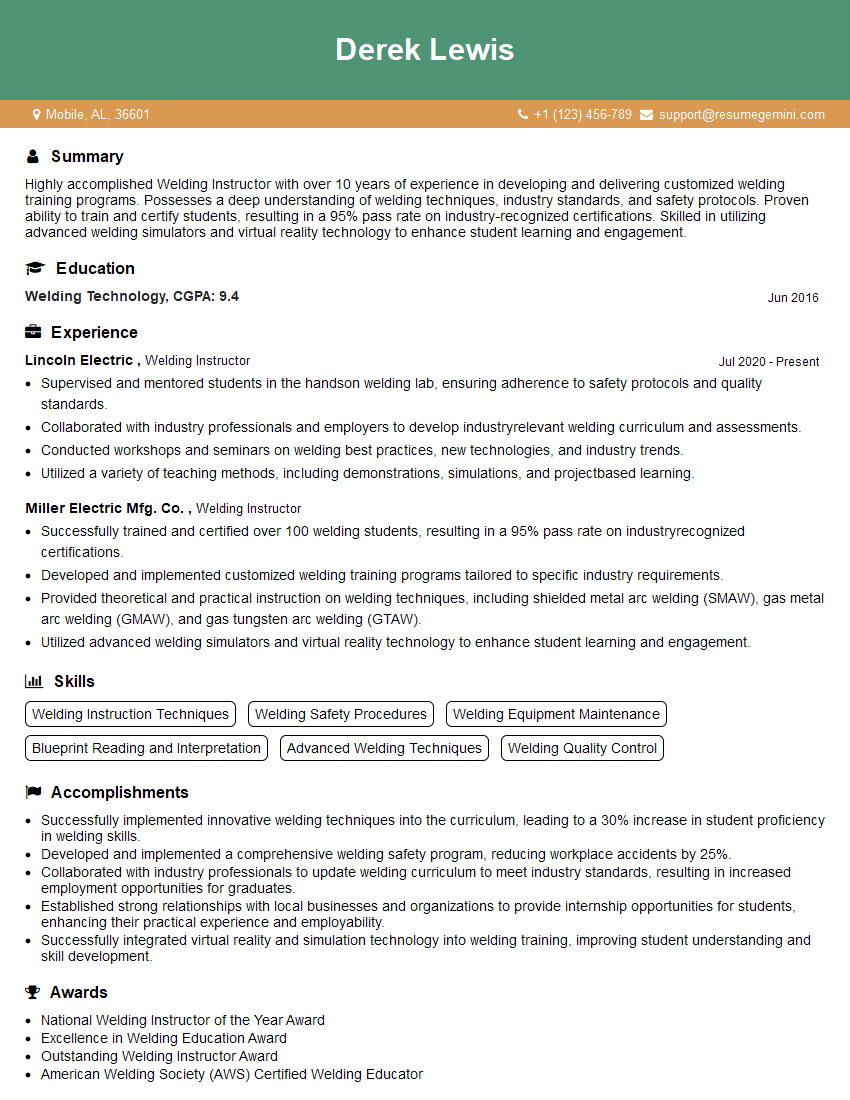
Mastering Welding Education and Training opens doors to rewarding careers with excellent growth potential. Whether you’re aiming for a teaching position, a supervisory role, or a specialized welding position, a strong foundation in these areas is crucial for success. To maximize your job prospects, create an ATS-friendly resume that highlights your skills and experience effectively. ResumeGemini is a trusted resource that can help you build a professional and impactful resume. They provide examples of resumes tailored to Welding Education and Training to help guide you. Invest the time to craft a compelling resume—it’s your first impression on potential employers.
Explore more articles
Users Rating of Our Blogs
Share Your Experience
We value your feedback! Please rate our content and share your thoughts (optional).
What Readers Say About Our Blog
I Redesigned Spongebob Squarepants and his main characters of my artwork.
https://www.deviantart.com/reimaginesponge/art/Redesigned-Spongebob-characters-1223583608
IT gave me an insight and words to use and be able to think of examples
Hi, I’m Jay, we have a few potential clients that are interested in your services, thought you might be a good fit. I’d love to talk about the details, when do you have time to talk?
Best,
Jay
Founder | CEO