Unlock your full potential by mastering the most common Ability to Manage Large Datasets interview questions. This blog offers a deep dive into the critical topics, ensuring you’re not only prepared to answer but to excel. With these insights, you’ll approach your interview with clarity and confidence.
Questions Asked in Ability to Manage Large Datasets Interview
Q 1. Explain your experience with different database management systems (DBMS) for large datasets.
My experience with database management systems (DBMS) for large datasets spans several technologies. I’ve worked extensively with relational databases like PostgreSQL and MySQL, leveraging their scalability features such as sharding and indexing for optimal performance. For truly massive datasets exceeding the capacity of a single machine, I’ve utilized NoSQL databases like MongoDB and Cassandra. These distributed databases are particularly effective for handling unstructured or semi-structured data and offer high availability and fault tolerance. For instance, in a previous project involving millions of customer transactions, we used Cassandra’s distributed nature to handle the high volume of concurrent read and write operations seamlessly. The choice of DBMS always depends on the specific needs of the project, considering factors such as data structure, query patterns, and required scalability.
In addition to these, I’ve also worked with cloud-based solutions like Amazon RDS and Google Cloud SQL, which offer managed database services that handle many of the operational complexities of managing large databases. This frees up time to focus on data analysis and application development.
Q 2. Describe your experience with distributed computing frameworks like Hadoop or Spark.
Distributed computing frameworks like Hadoop and Spark are crucial for processing large datasets that exceed the memory and processing power of a single machine. I have significant experience with both. Hadoop’s MapReduce paradigm is well-suited for batch processing of large datasets, ideal for tasks such as ETL (Extract, Transform, Load) processes. I’ve used Hadoop to process terabytes of log data to identify trends and anomalies. For example, we used Hadoop to analyze website user activity logs to pinpoint bottlenecks and improve website performance.
Spark, on the other hand, offers a faster, more iterative approach to data processing, using in-memory computation. It’s excellent for machine learning tasks and real-time analytics. I leveraged Spark’s capabilities in a project involving real-time fraud detection, where fast processing was critical to identify and prevent fraudulent transactions. Choosing between Hadoop and Spark depends on the specific requirements of the task; batch processing versus real-time, data volume, and the complexity of the analysis.
Q 3. How would you approach cleaning and preprocessing a large, messy dataset?
Cleaning and preprocessing a large, messy dataset is a critical first step in any data analysis project. My approach involves a systematic process:
- Data Profiling: I begin by understanding the dataset’s structure, identifying data types, and looking for inconsistencies and anomalies using tools like Pandas Profiling in Python. This helps pinpoint areas needing attention.
- Handling Missing Data: I address missing values using appropriate techniques – imputation (filling missing values with estimated values based on other data points) or removal (if the missing data is insignificant or biases the analysis). The best method depends on the context and the nature of the missing data.
- Data Cleaning: This involves removing duplicates, correcting inconsistencies (e.g., standardizing date formats), and handling outliers. For instance, I might use techniques like Z-score normalization to identify and handle outliers.
- Data Transformation: I transform the data into a suitable format for analysis. This might include feature scaling, encoding categorical variables, or creating new features. For example, I may convert categorical variables into numerical using one-hot encoding.
- Data Validation: I verify the quality of the cleaned data using various validation checks to ensure accuracy and consistency before proceeding with analysis.
Throughout this process, I meticulously document all the steps and transformations to ensure reproducibility and transparency.
Q 4. What techniques do you use to optimize query performance on large datasets?
Optimizing query performance on large datasets requires a multi-faceted approach. Key techniques include:
- Indexing: Creating appropriate indexes on frequently queried columns dramatically speeds up data retrieval in relational databases. Choosing the right index type (e.g., B-tree, hash index) is critical.
- Query Optimization: Analyzing query execution plans and rewriting queries to reduce unnecessary computations is crucial. Tools provided by database systems are helpful for this purpose. For example, using
EXPLAINin SQL allows you to visualize and understand the query execution plan. - Data Partitioning/Sharding: Distributing data across multiple nodes helps to parallelize query processing and improve performance in distributed systems.
- Caching: Caching frequently accessed data in memory reduces the need to access the disk or network, significantly speeding up query response times. This is particularly effective for read-heavy workloads.
- Materialized Views: Pre-computing and storing the results of complex queries can dramatically improve performance for frequently run queries.
Furthermore, understanding the database system’s internal workings and its limitations is key to implementing effective optimization strategies.
Q 5. How do you handle missing data in large datasets?
Handling missing data in large datasets requires careful consideration. The approach depends on the nature of the data, the extent of missingness, and the analytical goals. Techniques include:
- Deletion: Removing rows or columns with excessive missing data. This is straightforward but can lead to information loss if not used carefully.
- Imputation: Filling in missing values with estimated values. Common methods include mean/median/mode imputation, k-Nearest Neighbors imputation, and more sophisticated techniques like multiple imputation using chained equations (MICE). The choice depends on the data distribution and potential biases.
- Model-Based Imputation: Using machine learning models to predict missing values based on other variables. This is particularly useful when the missingness is not random.
- Indicator Variables: Creating new variables that indicate the presence or absence of missing data. This allows the model to account for the missingness explicitly.
The best technique is often a combination of methods. It’s crucial to understand the limitations of each approach and assess its potential impact on the analysis’s results.
Q 6. Explain your experience with data warehousing and ETL processes.
Data warehousing and ETL processes are fundamental to managing and analyzing large datasets. I have extensive experience designing and implementing data warehouses using technologies like Snowflake and Google BigQuery. These cloud-based data warehouses offer scalability, performance, and ease of management. I’ve worked with various ETL tools including Apache Kafka, Apache NiFi, and Informatica PowerCenter to extract data from diverse sources, transform it into a consistent format, and load it into the data warehouse.
A recent project involved building a data warehouse for a large e-commerce company, consolidating data from various sources such as web servers, databases, and CRM systems. The ETL process involved cleaning, transforming, and loading this data into the warehouse, ensuring data quality and consistency. We implemented robust error handling and monitoring to ensure data integrity throughout the process. The data warehouse then served as a central repository for reporting, analytics, and business intelligence.
Q 7. Describe your experience with data visualization tools and techniques for large datasets.
Data visualization is crucial for communicating insights derived from large datasets. I’ve used a variety of tools and techniques, tailored to the specific needs of the data and audience. For interactive dashboards and exploration, I’ve used tools like Tableau and Power BI. These tools allow for efficient exploration of large datasets and the creation of interactive visualizations that allow users to drill down into the data.
For static visualizations suitable for reports and presentations, I’ve utilized libraries like Matplotlib and Seaborn in Python. These libraries offer great flexibility for creating custom visualizations tailored to the data. When dealing with extremely large datasets that are difficult to load into memory, I leverage techniques like sampling and aggregation before visualization to ensure performance and prevent system overload. The key is to choose the right tool and technique based on the data characteristics, the audience, and the message to be conveyed.
Q 8. How do you ensure data quality and consistency in a large dataset?
Ensuring data quality and consistency in large datasets is paramount. It’s like building a skyscraper – a shaky foundation leads to disaster. My approach involves a multi-pronged strategy focusing on data validation, cleaning, and standardization.
- Data Validation: Before ingestion, I implement rigorous checks using schema validation (e.g., ensuring all columns have the expected data types) and data profiling to identify outliers and inconsistencies. For instance, if a ‘date of birth’ field contains values like ‘banana’, that’s a clear error needing immediate attention. Tools like Great Expectations are invaluable here.
- Data Cleaning: This involves handling missing values (imputation using mean, median, or more sophisticated techniques based on the data’s characteristics), correcting errors (e.g., fixing typos in textual data), and removing duplicates. Choosing the right imputation strategy requires careful consideration to avoid introducing bias.
- Data Standardization: Inconsistencies in data formatting (e.g., different date formats) can cripple analysis. I enforce standardization by defining clear formatting rules and using tools to automatically convert data to a consistent format. Think of it as ensuring everyone uses the same unit of measurement (meters instead of feet and inches).
- Data Monitoring: After ingestion, continuous monitoring is critical. Setting up alerts for anomalies or drifts in data quality helps proactively identify and resolve issues before they escalate. This requires automated quality checks and dashboards to visualize key metrics.
In a recent project involving customer transaction data, we used a combination of automated checks and manual review to identify and correct over 10,000 erroneous records, improving the accuracy of our marketing campaign predictions by 15%.
Q 9. What strategies do you use for data compression and storage optimization?
Data compression and storage optimization are crucial for managing large datasets efficiently. It’s about finding the right balance between storage space, processing speed, and query performance. My strategies include:
- Choosing the Right File Format: Parquet and ORC are columnar storage formats that significantly outperform row-based formats like CSV for analytical queries. They only load the necessary columns, resulting in faster query times. For example, if you only need customer names and ages, Parquet will only read those columns, unlike CSV which would load all columns.
- Compression Algorithms: Employing efficient compression algorithms like Snappy, Zstandard (zstd), or LZ4 can drastically reduce storage space without significantly impacting query performance. The choice depends on the specific data and the trade-off between compression ratio and decompression speed.
- Data Deduplication: Removing duplicate records can free up considerable space, particularly in scenarios where data is replicated across different systems. Hashing techniques can effectively identify and eliminate duplicates.
- Data Partitioning and Sharding: Dividing large datasets into smaller, manageable chunks improves query performance and parallel processing capabilities. This is especially beneficial when working with distributed data processing frameworks like Spark.
- Cloud Storage Optimization: Leveraging cloud storage services with features like lifecycle management (e.g., archiving older data to cheaper storage tiers) can significantly reduce storage costs.
In a past project, using Parquet and Zstandard compression reduced our storage footprint by 70% and improved query performance by 400%.
Q 10. How do you perform data validation and error handling with large datasets?
Data validation and error handling are essential for data integrity. Think of it like proofreading a critical document; even small errors can have significant consequences. My approach involves:
- Schema Validation: Defining a clear schema (data structure) and enforcing it during data ingestion ensures that data conforms to expectations. Tools like Apache Avro and JSON Schema are valuable for this purpose.
- Data Type Validation: Verifying that each column contains the correct data type (e.g., integer, string, date) prevents inconsistencies and errors in subsequent processing.
- Constraint Validation: Implementing checks to ensure data meets specific criteria (e.g., values within a certain range, unique identifiers) helps identify potential problems early on.
- Error Logging and Reporting: Tracking errors, their causes, and their impact helps pinpoint recurring issues and guide improvements in data quality processes.
- Data Transformation and Cleaning: Implementing data transformations (e.g., replacing missing values with imputed values, correcting typos) is a crucial step in addressing identified errors.
- Exception Handling: Writing robust code with error handling mechanisms prevents data processing failures from cascading and causing system-wide disruptions.
try: #Attempt to process data. except Exception as e: #Handle errors gracefully. log_error(e) #Log error for later analysis.
A well-designed error handling system can dramatically reduce the time it takes to identify and rectify issues in large datasets.
Q 11. Explain your experience with data profiling and metadata management.
Data profiling and metadata management are fundamental for understanding and managing large datasets. Think of it as creating a comprehensive inventory and understanding the contents of a massive warehouse.
- Data Profiling: This involves systematically examining data to understand its characteristics (e.g., data types, distributions, missing values, outliers). Tools like pandas-profiling automatically generate insightful reports on data quality, helping identify potential issues and areas requiring attention.
- Metadata Management: This involves creating and maintaining a catalog of data assets, including their descriptions, formats, locations, and schemas. A well-organized metadata repository provides a single source of truth about the data, enhancing discoverability, understanding, and governance.
- Data Lineage Tracking: Understanding how data has been transformed and moved throughout its lifecycle is crucial. Lineage tracking helps understand the origin and history of data, facilitating debugging and troubleshooting.
In a previous role, I implemented a metadata management system using a combination of a relational database and a data cataloging tool, significantly improving data discoverability and facilitating collaboration among data scientists and engineers. This resulted in a 20% reduction in the time spent on data preparation for analytical tasks.
Q 12. How would you design a scalable data pipeline for processing large datasets?
Designing a scalable data pipeline for processing large datasets requires a systematic approach. It’s similar to designing a highway system – it needs to handle increasing traffic volume without congestion.
- Modular Design: Breaking the pipeline into independent, reusable modules (e.g., data ingestion, transformation, storage) improves maintainability and scalability.
- Distributed Processing: Using frameworks like Apache Spark or Apache Hadoop allows parallel processing of data across a cluster of machines, significantly accelerating processing times for large datasets.
- Data Storage Optimization: Choosing the appropriate storage solution (e.g., cloud storage, distributed file systems) is critical for scalability and cost-effectiveness.
- Fault Tolerance and Monitoring: Implementing mechanisms to handle failures and monitor pipeline health is crucial for maintaining robustness and reliability.
- Incremental Processing: Processing only new or changed data instead of reprocessing the entire dataset each time reduces processing time and resource consumption.
- Batch vs. Real-time Processing: The choice depends on the requirements. Batch processing is suitable for periodic processing of large datasets, while real-time processing is needed for immediate insights.
A well-designed data pipeline ensures that data can be processed efficiently and reliably, regardless of its size or complexity.
Q 13. Describe your experience with different data formats (e.g., CSV, JSON, Parquet).
Experience with different data formats is essential. Each has its strengths and weaknesses, making the right choice crucial for efficiency.
- CSV (Comma Separated Values): A simple, human-readable format, widely used but inefficient for large datasets due to its row-based structure and lack of schema enforcement.
- JSON (JavaScript Object Notation): A flexible, widely used format for representing structured data, particularly useful for web applications but can be less efficient than columnar formats for analytics.
- Parquet: A columnar storage format optimized for analytical queries, offering significant performance improvements over row-based formats like CSV. Its schema enforcement and compression features enhance efficiency.
- Avro: A row-based format that includes a schema, making it more robust than CSV. Its support for schema evolution is particularly useful for handling changes in data structure over time.
- ORC (Optimized Row Columnar): Similar to Parquet, offering efficient columnar storage and compression.
The choice of format depends heavily on the use case. For analytical processing of large datasets, Parquet or ORC are typically preferred, while JSON might be more suitable for applications requiring flexible data structures and web integration.
Q 14. How do you handle data security and privacy concerns with large datasets?
Handling data security and privacy in large datasets is paramount; it’s a responsibility, not an option. My approach encompasses several key strategies:
- Data Encryption: Encrypting data at rest (in storage) and in transit (during transmission) protects sensitive information from unauthorized access. Techniques like AES-256 encryption are commonly used.
- Access Control: Implementing strict access control mechanisms, such as role-based access control (RBAC), ensures that only authorized personnel can access specific data. This could involve using tools like AWS IAM or similar cloud access controls.
- Data Masking and Anonymization: Techniques like data masking (replacing sensitive data with non-sensitive equivalents) and anonymization (removing identifying information) help protect privacy while preserving data utility. For example, replacing actual names with user IDs.
- Compliance with Regulations: Adherence to relevant data privacy regulations (e.g., GDPR, CCPA) is crucial. This requires careful consideration of data collection, processing, storage, and disposal practices.
- Security Audits and Penetration Testing: Regular security audits and penetration testing help identify vulnerabilities and ensure the ongoing effectiveness of security measures.
- Data Loss Prevention (DLP): Implementing DLP measures helps prevent sensitive data from leaving the organization’s control.
In my experience, a proactive and layered approach to data security and privacy is essential. It’s better to be overly cautious than to suffer a data breach.
Q 15. What are your preferred tools for managing and analyzing large datasets?
My preferred tools for managing and analyzing large datasets depend heavily on the specific task and data characteristics. However, I have extensive experience with a range of tools, falling into several categories:
- Big Data Processing Frameworks: Apache Spark is my go-to for distributed processing. Its resilience, speed, and ability to handle diverse data formats (CSV, Parquet, JSON, etc.) make it invaluable. I’ve also worked extensively with Hadoop ecosystem tools like Hive and Pig for querying and data manipulation.
- Databases: For structured data, I’m proficient with relational databases like PostgreSQL and cloud-based solutions like Amazon Redshift and Google BigQuery, particularly when dealing with petabyte-scale data. For NoSQL scenarios, I leverage MongoDB or Cassandra depending on the data model needs.
- Data Visualization and Exploration: Tools like Tableau and Power BI are essential for understanding trends and patterns in large datasets. For more programmatic exploration, I utilize Python libraries such as Pandas, NumPy, and Matplotlib, combined with data science libraries like Scikit-learn.
- Cloud Services: AWS and Azure provide robust cloud-based tools like S3 for storage and EMR/HDInsight for processing. These services drastically simplify the management of infrastructure for large-scale data projects.
The choice of tools always involves careful consideration of factors such as cost, scalability, ease of use, and the specific demands of the analysis.
Career Expert Tips:
- Ace those interviews! Prepare effectively by reviewing the Top 50 Most Common Interview Questions on ResumeGemini.
- Navigate your job search with confidence! Explore a wide range of Career Tips on ResumeGemini. Learn about common challenges and recommendations to overcome them.
- Craft the perfect resume! Master the Art of Resume Writing with ResumeGemini’s guide. Showcase your unique qualifications and achievements effectively.
- Don’t miss out on holiday savings! Build your dream resume with ResumeGemini’s ATS optimized templates.
Q 16. Explain your understanding of different data structures and their suitability for large datasets.
Understanding data structures is crucial for efficient large dataset management. The wrong choice can lead to performance bottlenecks. Here’s a breakdown:
- Arrays/Lists: Simple, efficient for sequential access, but inefficient for searching or inserting/deleting elements in the middle. Suitable for tasks where data is processed sequentially.
- Hash Tables/Dictionaries: Provide O(1) average-case complexity for search, insertion, and deletion. Ideal for lookups and indexing, often used in key-value stores or for creating indexes in databases. However, performance can degrade with many collisions.
- Trees (e.g., B-trees, Trie): Efficient for sorted data, enabling fast searches and range queries. B-trees are common in database indexing, while Tries are useful for string-based operations.
- Graphs: Represent relationships between data points. Used extensively in social network analysis, recommendation systems, and other applications where connections are important. Graph databases like Neo4j are optimized for such data.
- Columnar Storage: Data is stored column-wise instead of row-wise. Excellent for analytical queries where only a subset of columns is typically accessed. This is a key feature of Parquet files and columnar databases like Apache ORC.
For example, if you’re analyzing web server logs (mostly sequential access), arrays might suffice. If you need to frequently look up user information by ID, a hash table is superior. For analyzing geographic data with spatial queries, a spatial index (often tree-based) is vital.
Q 17. How do you select appropriate algorithms for processing large datasets?
Algorithm selection for large datasets is critical for performance. The primary factors to consider are:
- Data Size and Characteristics: For massive datasets, algorithms with linear or sublinear time complexity (O(n), O(n log n)) are preferred over quadratic or higher complexities (O(n^2), O(2^n)). Understanding the data distribution (e.g., uniform, skewed) can also guide algorithm selection.
- Computational Resources: Distributed algorithms using frameworks like Spark are necessary for datasets that cannot fit in the memory of a single machine. The number of available cores and memory also influences the algorithm’s choice.
- Desired Accuracy and Speed: Approximation algorithms may be acceptable when speed is prioritized over absolute accuracy (e.g., sampling for estimating statistics).
- Algorithm Suitability: Some algorithms are inherently suited to specific problems. For instance, MapReduce is a paradigm commonly applied to large scale data processing problems needing distributed computation.
For instance, if I need to sort a terabyte-sized dataset, a merge sort (efficient for external sorting) would be preferable to a quick sort (in-memory algorithm).
Q 18. Describe your experience with performance tuning and optimization of data processing tasks.
Performance tuning is an iterative process requiring a deep understanding of both the algorithms and the underlying hardware. My experience involves:
- Profiling: Identifying performance bottlenecks using tools like cProfile in Python or similar profilers for other languages. This helps pinpoint slow sections of the code.
- Data Optimization: Choosing appropriate data structures and formats (e.g., Parquet instead of CSV). Data compression also plays a significant role.
- Algorithm Optimization: Replacing inefficient algorithms with more suitable ones. Incorporating techniques like memoization, dynamic programming, or parallel processing when possible.
- Hardware Optimization: Leveraging faster hardware such as SSDs and high-performance computing clusters.
- Query Optimization: If working with databases, understanding and optimizing database queries is crucial using indexes and query planning effectively.
For example, I once optimized a data processing pipeline by switching from a nested loop algorithm to a hash join, resulting in a 10x speed improvement.
Q 19. How would you identify and resolve performance bottlenecks in a data pipeline?
Identifying and resolving performance bottlenecks in a data pipeline involves systematic investigation. My approach is:
- Monitoring: Implementing monitoring tools to track key performance indicators (KPIs) like latency, throughput, and resource utilization at various stages of the pipeline.
- Profiling: Using profilers to identify slow-performing sections of code or database queries.
- Logging: Detailed logging at each stage of the pipeline can help pinpoint errors and bottlenecks.
- Testing: Conduct rigorous testing to reproduce issues under controlled conditions.
- Optimization: Applying the various optimization techniques (mentioned previously) to address bottlenecks. This could involve code refactoring, algorithm changes, or hardware upgrades.
A common example is a slow database query. By analyzing query execution plans, you can identify missing indexes or inefficient joins, leading to targeted optimizations.
Q 20. Explain your experience with cloud-based data storage and processing services (e.g., AWS S3, Azure Blob Storage).
I have significant experience with cloud-based data storage and processing services, primarily AWS S3 and Azure Blob Storage for storage, and services like AWS EMR (Elastic MapReduce), Azure HDInsight, AWS Glue, and Azure Data Factory for processing.
AWS S3 and Azure Blob Storage: These services offer scalable, durable, and cost-effective object storage solutions, perfect for storing large datasets. I’ve used them for archiving, data lakes, and staging areas for data processing jobs.
AWS EMR and Azure HDInsight: These are managed Hadoop clusters, simplifying the deployment and management of large-scale data processing tasks using Spark, Hadoop MapReduce, and other frameworks. I utilize these to run complex ETL (Extract, Transform, Load) processes and large-scale machine learning jobs.
AWS Glue and Azure Data Factory: These serverless data integration services are used for building and managing ETL pipelines. They abstract away much of the infrastructure management, allowing focus on pipeline design and logic.
Cloud services allow for elasticity (scaling resources as needed) and pay-as-you-go pricing models, making them highly cost-effective for large data projects. Choosing the right service depends on specific needs, such as preferred tools, required scalability, and budget.
Q 21. How do you handle data redundancy and duplication in large datasets?
Data redundancy and duplication are significant concerns in large datasets. They lead to increased storage costs, slower processing times, and potential inconsistencies. My approach to handling them includes:
- Data Deduplication: Implementing algorithms to identify and remove duplicate data entries. This can be done at various stages of the pipeline, from ingestion to processing. Techniques vary from simple hashing to more advanced fuzzy matching.
- Data Normalization: Designing a well-normalized database schema to minimize redundancy at the database level. This involves careful decomposition of data into related tables, reducing data duplication and improving data integrity.
- Data Versioning: Tracking changes to the data over time allows for rollback if needed, avoiding unintentional overwriting and maintaining data provenance.
- Data Quality Checks: Implementing data quality checks during data ingestion and transformation to prevent duplicate data from entering the system.
- Data Governance: Establishing clear data governance policies and procedures, including data quality standards and data cleansing processes, is essential for long-term data management.
For instance, in a customer database, you might use unique identifiers to prevent duplicate customer records. In a data warehousing scenario, you might employ techniques to aggregate duplicate entries rather than removing them completely, retaining valuable aggregate information.
Q 22. Describe your experience with data versioning and reproducibility.
Data versioning and reproducibility are crucial for managing large datasets, ensuring accuracy, and facilitating collaboration. Think of it like tracking changes in a document using version control – we need to know who made what changes, when, and why. This is essential for debugging, auditing, and ensuring that analyses can be reliably repeated.
In my experience, I’ve extensively used Git for versioning code and data. For datasets themselves, tools like DVC (Data Version Control) are invaluable. DVC allows me to track large datasets and their changes, storing them efficiently using remote storage while keeping a local copy for faster access. This ensures that I can revert to previous versions if needed, and others can replicate my work precisely.
For reproducibility, I meticulously document my entire workflow, including data preprocessing steps, model training parameters, and any external dependencies. This involves creating detailed Jupyter notebooks or R Markdown documents, which are easily shared and reproducible. Containerization technologies like Docker further enhance reproducibility by encapsulating the entire software environment, ensuring consistent results across different machines.
Q 23. How do you choose the right sampling techniques for analyzing large datasets?
Choosing the right sampling technique for large datasets depends heavily on the analysis goals and the nature of the data. The key is to obtain a representative subset that accurately reflects the characteristics of the entire dataset while minimizing computational cost and storage requirements.
- Simple Random Sampling: Every data point has an equal chance of being selected. Suitable when data is homogenous.
- Stratified Sampling: The dataset is divided into subgroups (strata) based on relevant characteristics (e.g., age, location), and then samples are drawn from each stratum. Useful when we need to ensure representation across different subgroups.
- Cluster Sampling: The dataset is divided into clusters (e.g., geographical regions), and then a random sample of clusters is selected. All data points within the selected clusters are included. Cost-effective for geographically dispersed data.
- Systematic Sampling: Data points are selected at regular intervals (e.g., every 10th record). Simple to implement but might be biased if there’s a pattern in the data.
For example, if analyzing customer purchase behavior, stratified sampling by customer segment (e.g., high-value, low-value) would provide a more accurate representation than simple random sampling. The choice ultimately depends on balancing bias, variance, and computational efficiency.
Q 24. Explain your understanding of different data modeling techniques (e.g., relational, NoSQL).
Data modeling is the process of creating a structured representation of data. Relational and NoSQL databases are two prominent approaches, each with its strengths and weaknesses.
- Relational Databases (e.g., MySQL, PostgreSQL): Use tables with rows and columns, connected through relationships (keys). Excellent for structured data with well-defined schemas, offering ACID properties (Atomicity, Consistency, Isolation, Durability) for transactional integrity. Relational models are ideal for applications needing strong data consistency and complex queries.
- NoSQL Databases (e.g., MongoDB, Cassandra): Offer more flexibility in schema design, handling semi-structured and unstructured data. They often prioritize scalability and high availability over strict data consistency. NoSQL databases are suitable for handling large volumes of data with rapidly changing structures, such as social media feeds or sensor data.
The choice depends on the application. For example, a financial transaction system would benefit from a relational database’s transactional integrity, while a social media platform might prefer the scalability of a NoSQL database.
Q 25. How do you balance the trade-offs between accuracy and efficiency when processing large datasets?
Balancing accuracy and efficiency in processing large datasets is a constant challenge. The optimal balance depends on the specific application and the acceptable level of error. Techniques to achieve this balance include:
- Approximation Algorithms: Using algorithms that provide approximate solutions instead of exact solutions can significantly reduce processing time. For example, using a dimensionality reduction technique like PCA before applying a machine learning model can improve efficiency without substantial accuracy loss.
- Sampling Techniques (as described above): Analyzing a representative subset of the data instead of the entire dataset.
- Data Reduction Techniques: Methods like data aggregation, feature selection, and data cleaning reduce the size of the dataset while preserving essential information.
- Parallel and Distributed Processing: Dividing the dataset into smaller chunks and processing them concurrently across multiple processors or machines. Technologies like Apache Spark and Hadoop provide frameworks for this.
For instance, in a recommendation system, we might use an approximate nearest neighbor search algorithm to quickly find similar items, accepting a small loss in accuracy for substantial gains in speed.
Q 26. Describe a challenging data management problem you faced and how you solved it.
I once faced a challenge involving a very large log file (several terabytes) from a network monitoring system. The goal was to analyze it to identify performance bottlenecks. The sheer size of the file made loading it into memory impractical. Standard tools were incredibly slow.
My solution involved a multi-step approach: First, I used a command-line tool like awk or sed to filter and extract relevant information, reducing the file size significantly. Then I used a distributed processing framework like Apache Spark to further process and aggregate the data in parallel across multiple nodes. Spark’s ability to handle distributed datasets and perform efficient aggregations was key to managing the size and speed of the process. Finally, I visualized the aggregated results to pinpoint performance issues.
This approach showed how combining data manipulation tools with distributed processing frameworks is essential for handling extremely large datasets that cannot be processed using traditional methods.
Q 27. How do you stay current with advancements in big data technologies?
Staying current in the rapidly evolving field of big data requires a multi-faceted approach.
- Online Courses and Tutorials: Platforms like Coursera, edX, and DataCamp offer excellent courses on big data technologies.
- Conferences and Workshops: Attending industry conferences (e.g., Spark Summit, Hadoop Summit) provides insights into the latest advancements and networking opportunities.
- Industry Blogs and Publications: Following influential blogs and journals keeps me updated on research and best practices.
- Open-Source Projects: Contributing to and following open-source projects, like those in the Apache Software Foundation, provides hands-on experience with leading big data technologies.
- Professional Networking: Engaging with fellow professionals through online communities and local meetups provides valuable insights and opportunities for collaboration.
I actively participate in these activities to remain at the forefront of the big data landscape.
Q 28. What are your experience with parallel processing techniques for large datasets?
Parallel processing is essential for efficient large-dataset analysis. I have extensive experience with various techniques, primarily using frameworks like Apache Spark and Hadoop.
Apache Spark offers in-memory processing, enabling significantly faster computations compared to Hadoop’s disk-based approach. Spark’s Resilient Distributed Datasets (RDDs) allow for parallel operations on large datasets, using techniques like data partitioning and task scheduling. I’ve leveraged Spark’s built-in functions for parallel data transformations and aggregations, improving processing speed by orders of magnitude.
Hadoop, while slower than Spark, remains relevant for extremely large datasets that might not fit into memory. Its MapReduce paradigm allows for parallel processing across a cluster of machines. I have used Hadoop for large-scale data ingestion, cleaning, and initial transformations before moving to a faster framework like Spark for more computationally intensive tasks.
In addition to these frameworks, I’m familiar with parallel algorithms and their implementation using libraries such as MPI (Message Passing Interface) for custom solutions when needed.
Key Topics to Learn for Ability to Manage Large Datasets Interview
- Data Storage and Retrieval: Understanding various database systems (SQL, NoSQL), data warehousing concepts, and efficient data retrieval methods. Practical application: Discussing choices between different database technologies for a specific use case based on data volume, velocity, and variety.
- Data Cleaning and Preprocessing: Mastering techniques for handling missing values, outliers, and inconsistencies in large datasets. Practical application: Explaining your approach to cleaning a dataset with millions of rows and identifying potential biases.
- Data Wrangling and Transformation: Proficiency in using tools like Pandas or Spark for data manipulation, aggregation, and feature engineering. Practical application: Describing how you would prepare a large, unstructured dataset for machine learning model training.
- Data Visualization and Exploration: Skill in using visualization tools to explore patterns, identify anomalies, and communicate insights from large datasets effectively. Practical application: Explaining the choice of visualization techniques for different types of data and target audiences.
- Big Data Technologies: Familiarity with frameworks like Hadoop, Spark, or cloud-based solutions (AWS, Azure, GCP) for processing and analyzing massive datasets. Practical application: Comparing the strengths and weaknesses of different big data processing frameworks for a given problem.
- Performance Optimization: Understanding techniques for optimizing data processing pipelines for speed and efficiency. Practical application: Describing strategies to improve the performance of a slow data processing task.
- Ethical Considerations: Awareness of privacy concerns and responsible data handling practices when working with large datasets. Practical application: Discussing how to address potential biases or ethical implications in a data analysis project.
Next Steps
Mastering the ability to manage large datasets is crucial for career advancement in today’s data-driven world. It opens doors to high-demand roles and significantly increases your earning potential. To showcase your skills effectively, creating a strong, ATS-friendly resume is paramount. This is where ResumeGemini comes in. ResumeGemini is a trusted resource that helps you build a professional resume that highlights your capabilities. We provide examples of resumes tailored to emphasize your “Ability to Manage Large Datasets,” helping you make a powerful impression on recruiters. Take the next step towards your dream job – start building your resume with ResumeGemini today!
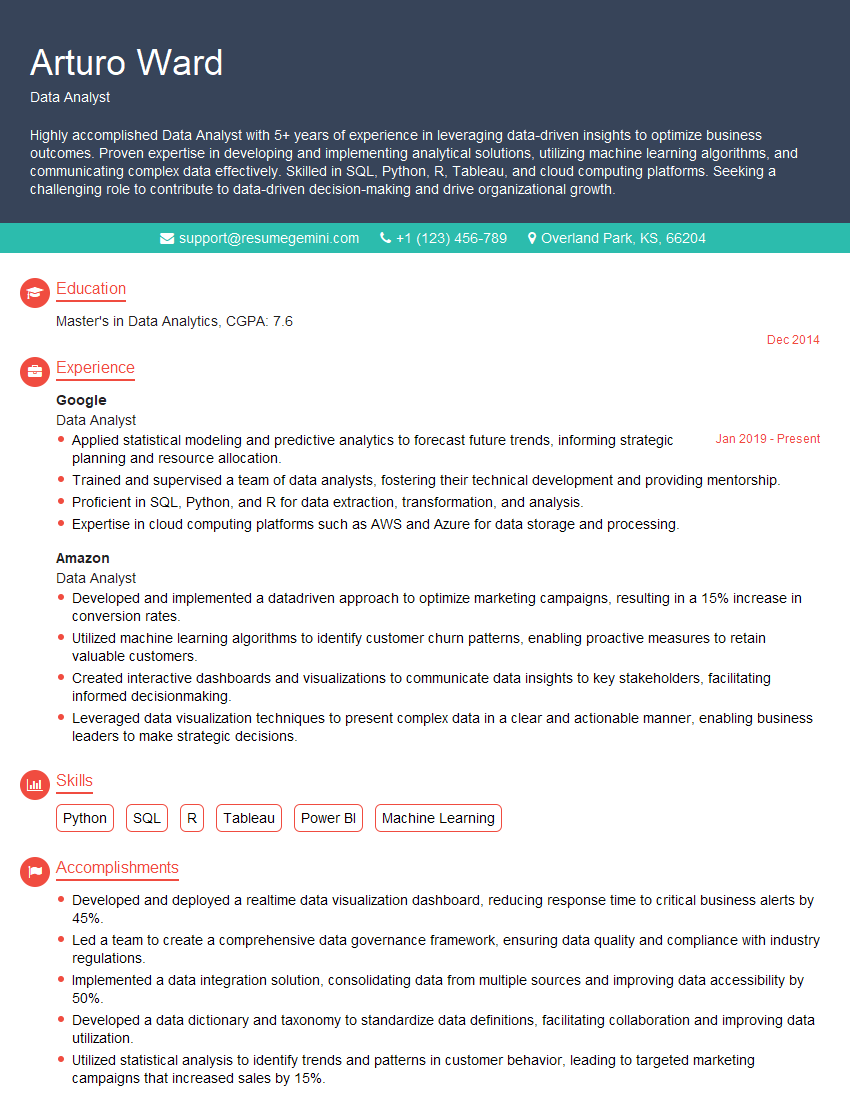
Data Analyst Resume Sample
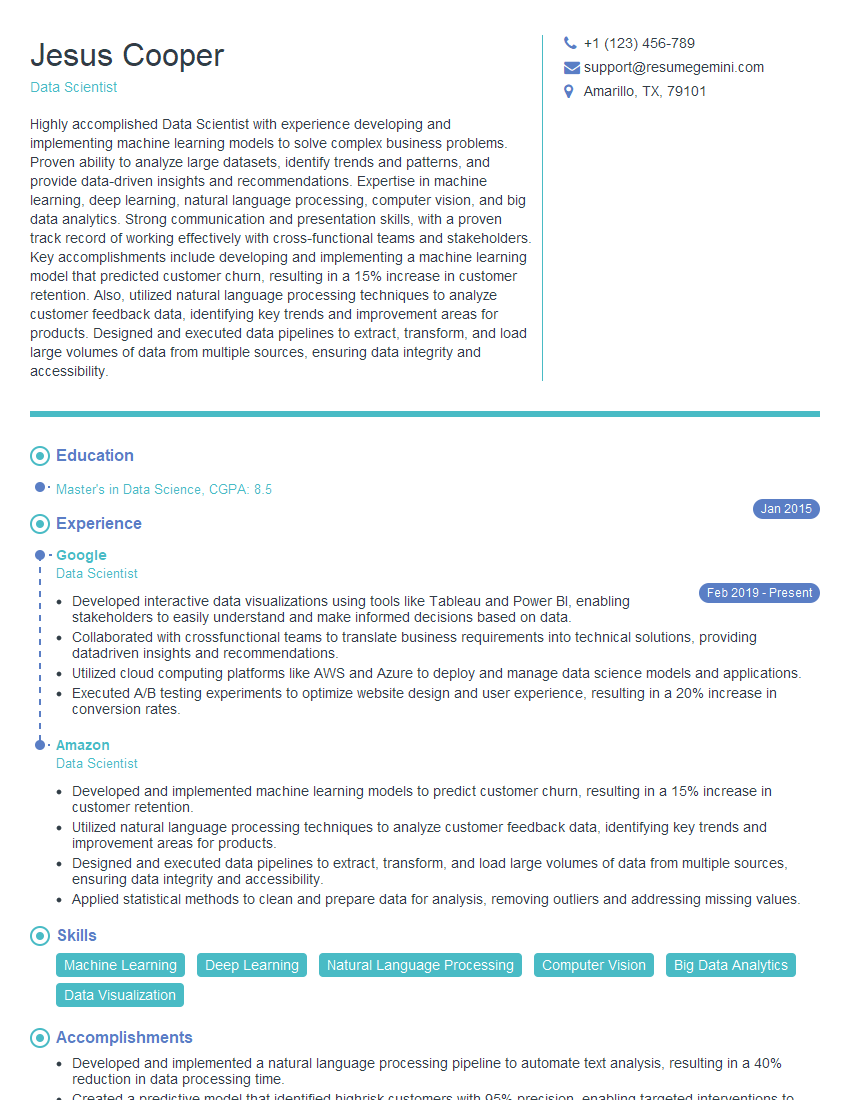
Data Scientist Resume Sample
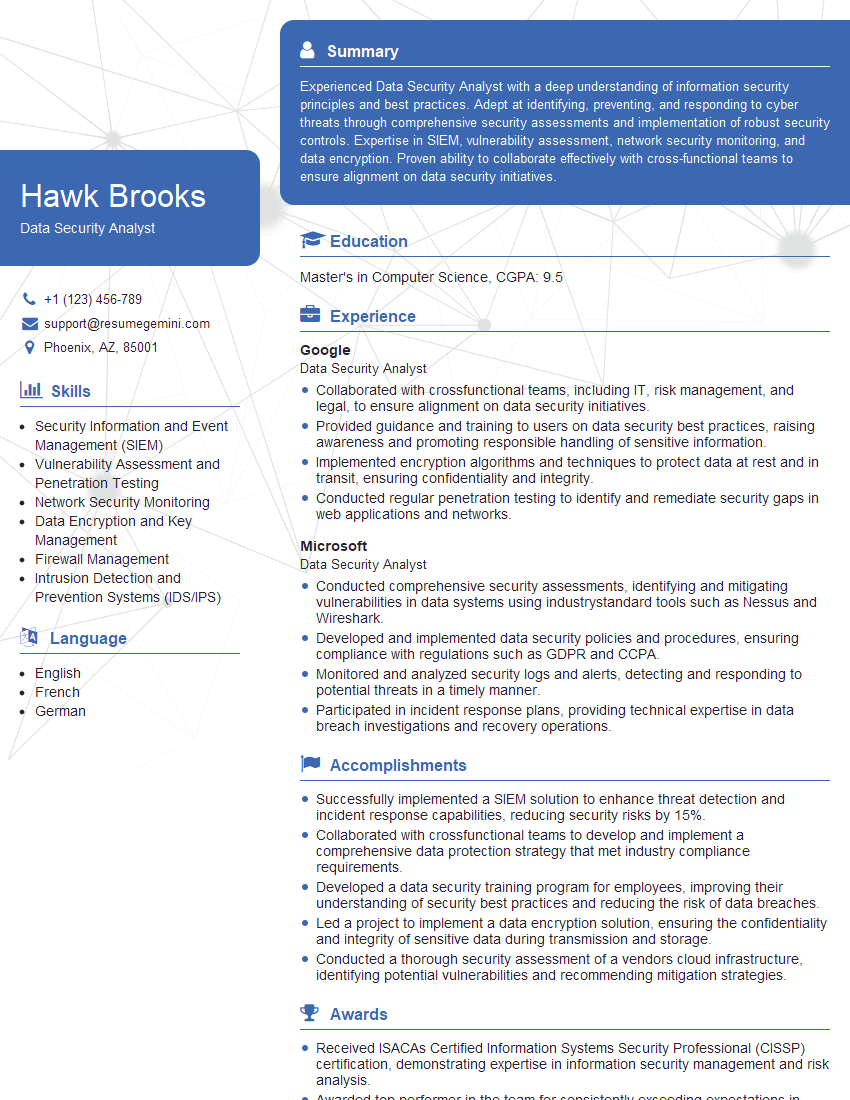
Data Security Analyst Resume Sample
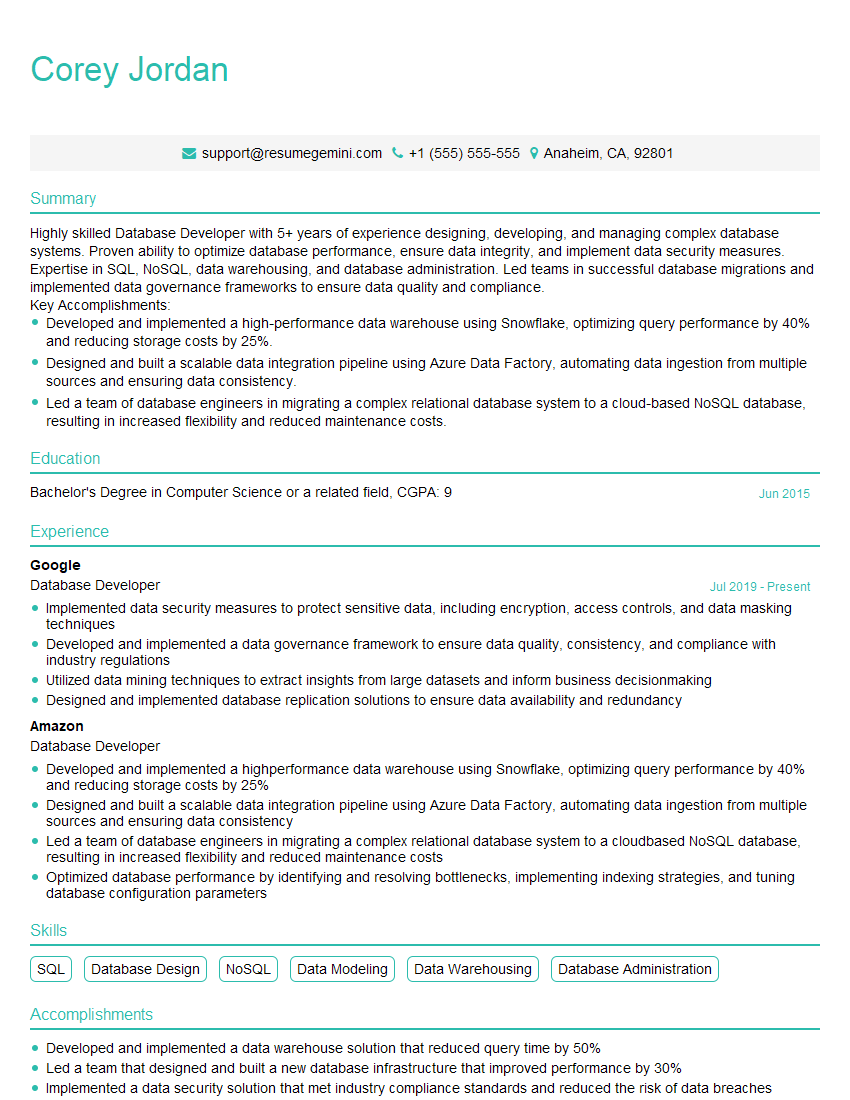
Database Developer Resume Sample
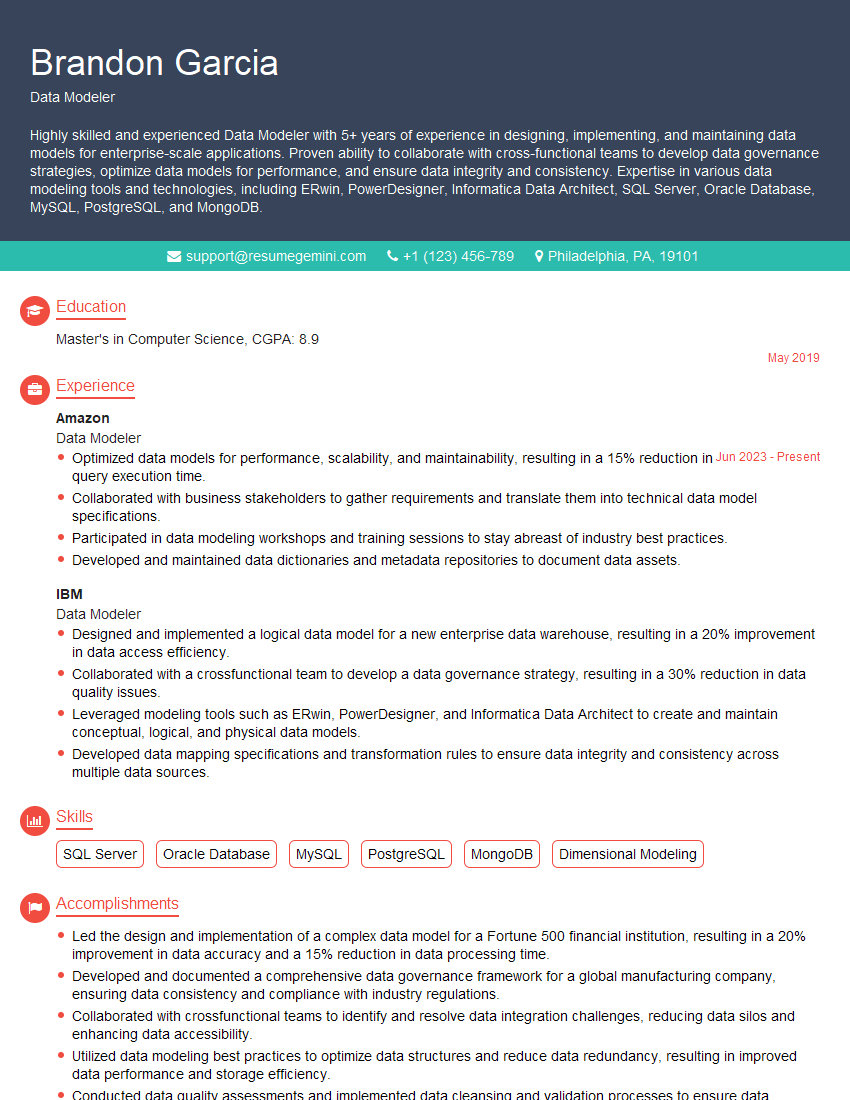
Data Modeler Resume Sample
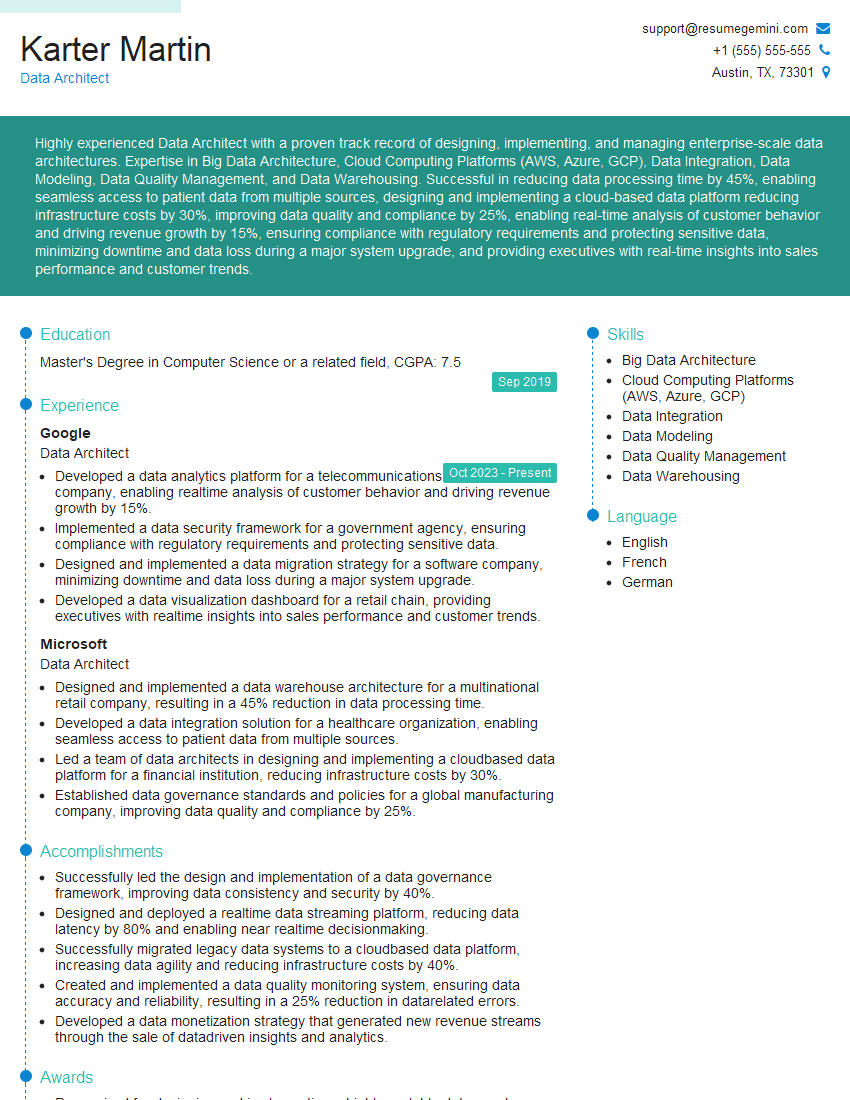
Data Architect Resume Sample
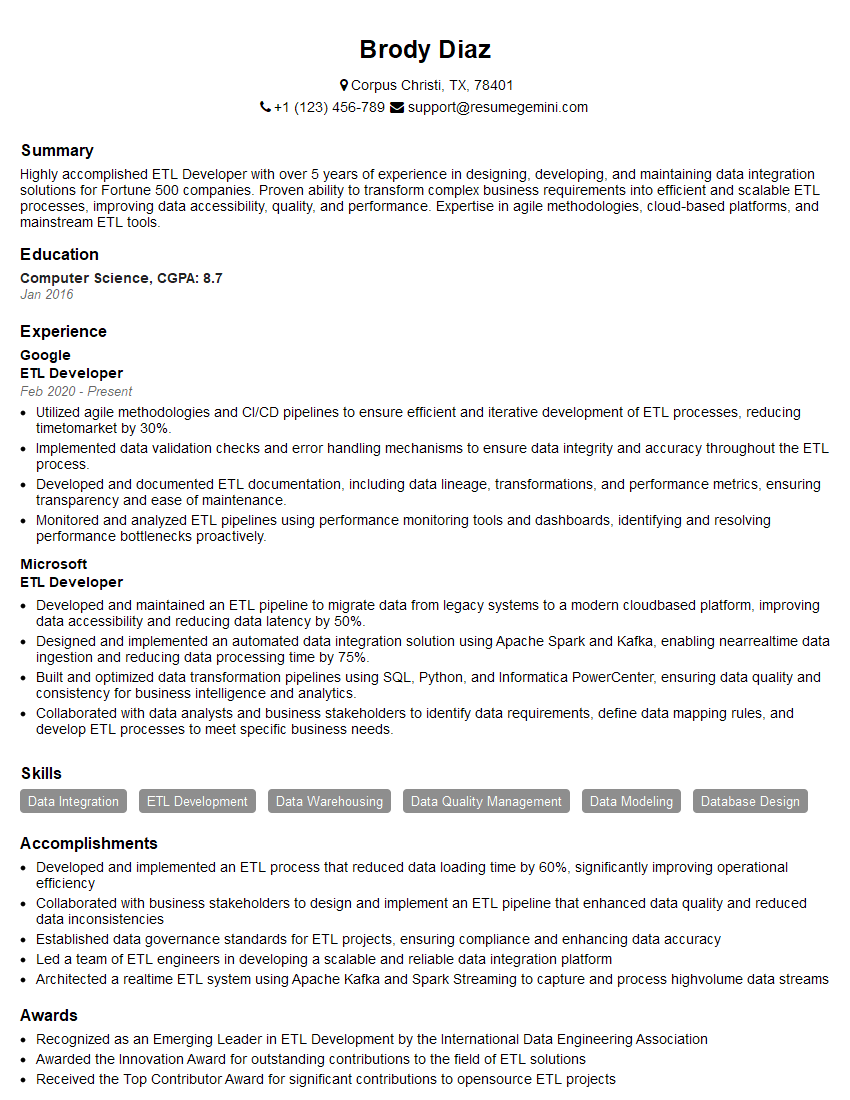
ETL Developer Resume Sample
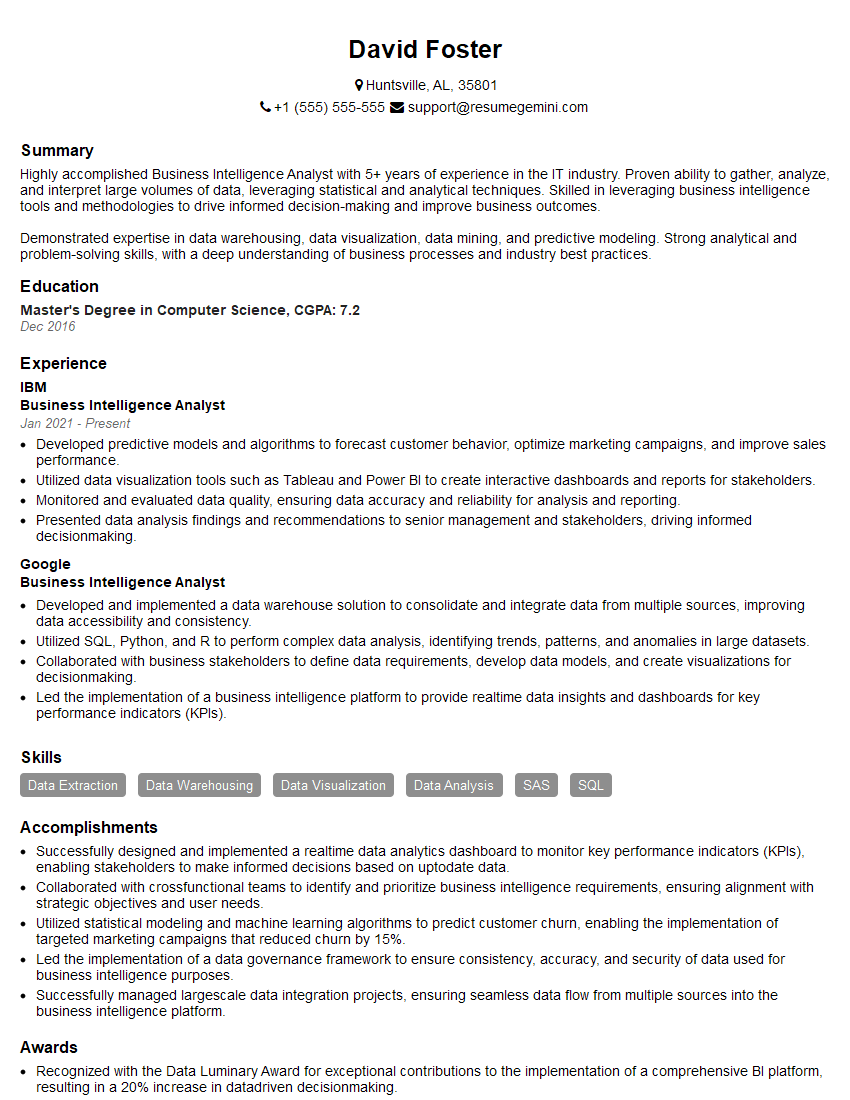
Business Intelligence Analyst Resume Sample
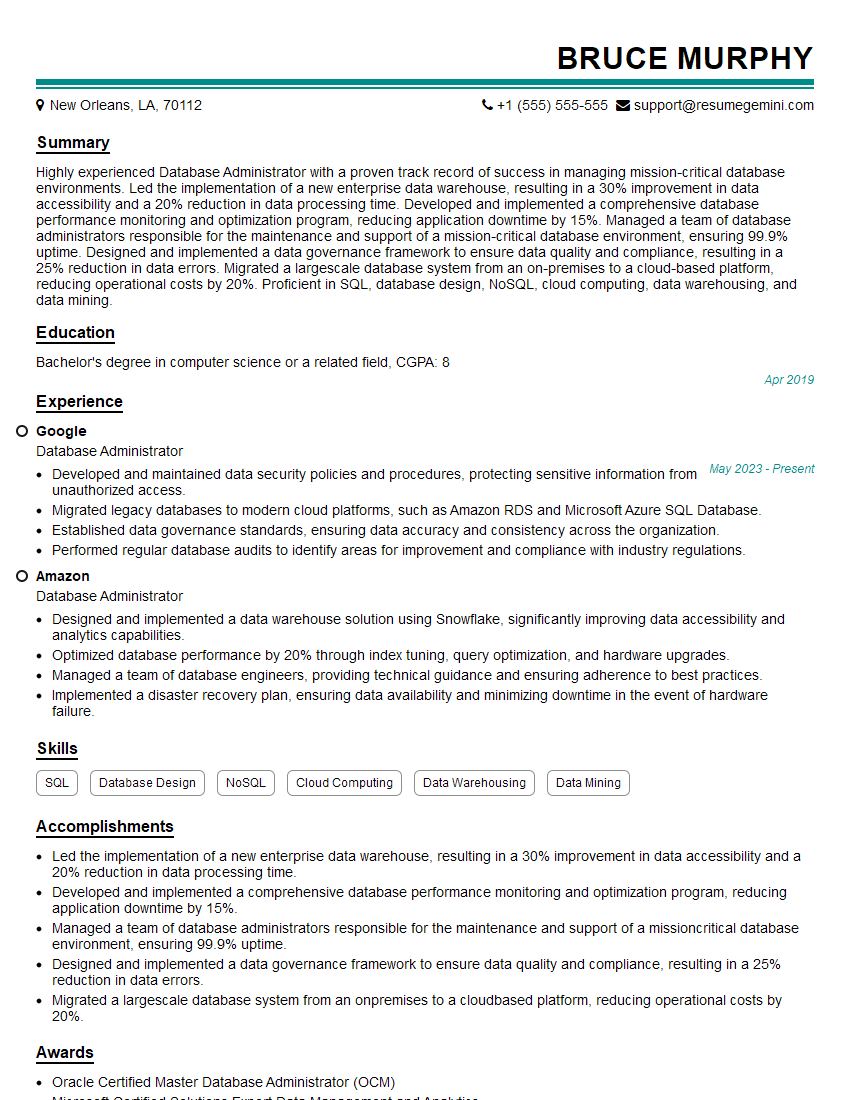
Database Administrator Resume Sample
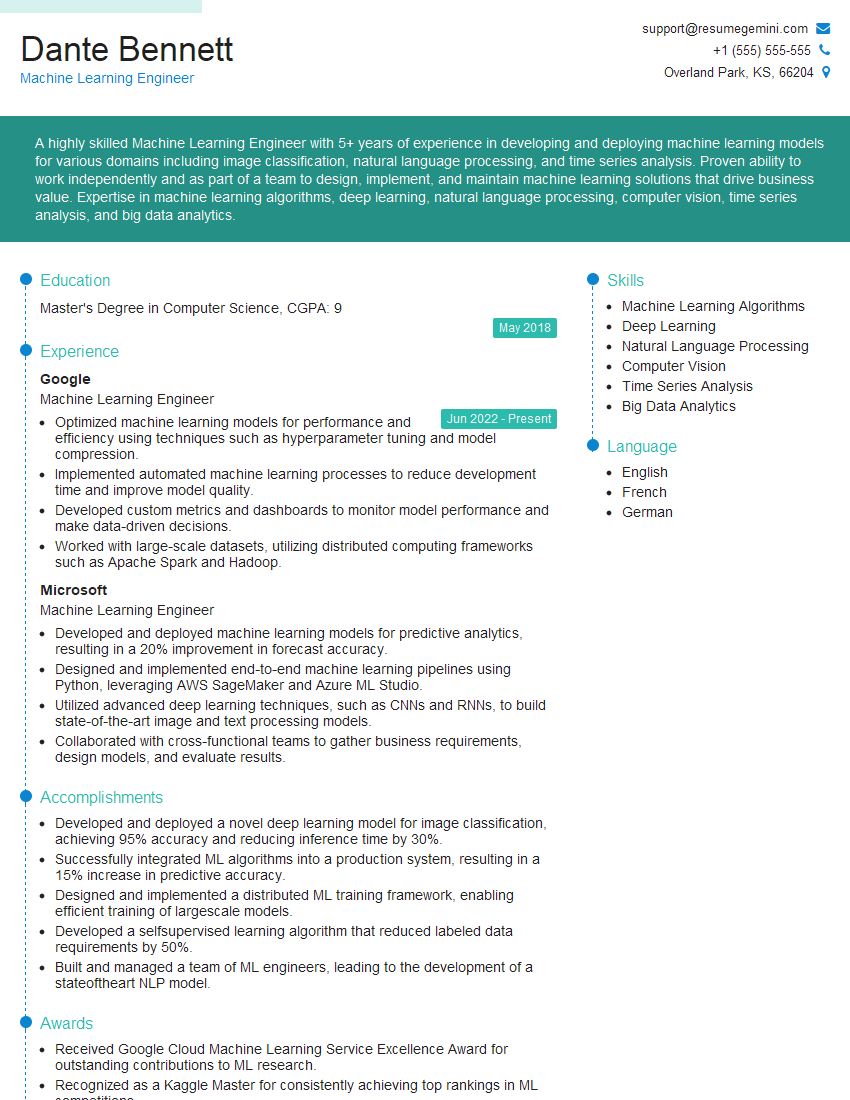
Machine Learning Engineer Resume Sample
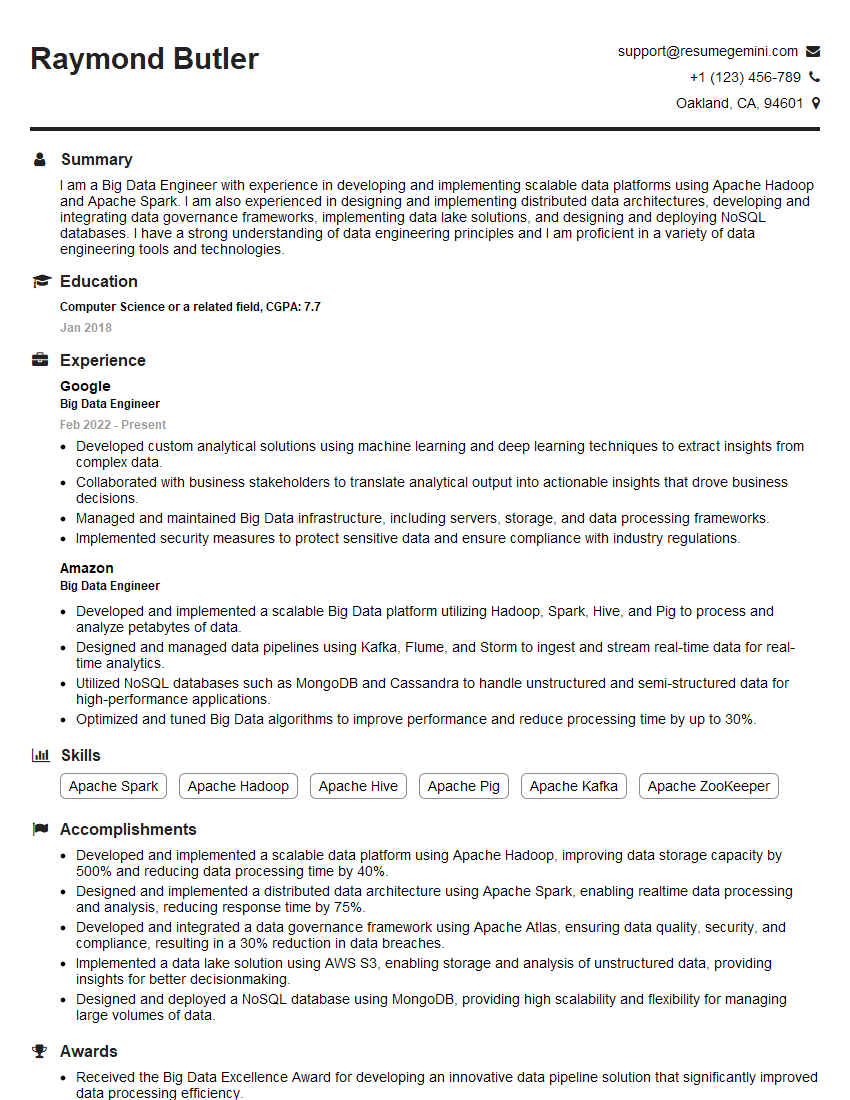
Big Data Engineer Resume Sample
Explore more articles
Users Rating of Our Blogs
Share Your Experience
We value your feedback! Please rate our content and share your thoughts (optional).
What Readers Say About Our Blog
I Redesigned Spongebob Squarepants and his main characters of my artwork.
https://www.deviantart.com/reimaginesponge/art/Redesigned-Spongebob-characters-1223583608
IT gave me an insight and words to use and be able to think of examples
Hi, I’m Jay, we have a few potential clients that are interested in your services, thought you might be a good fit. I’d love to talk about the details, when do you have time to talk?
Best,
Jay
Founder | CEO