Cracking a skill-specific interview, like one for Advanced Surveying Technologies, requires understanding the nuances of the role. In this blog, we present the questions you’re most likely to encounter, along with insights into how to answer them effectively. Let’s ensure you’re ready to make a strong impression.
Questions Asked in Advanced Surveying Technologies Interview
Q 1. Explain the difference between GPS and RTK-GPS.
GPS (Global Positioning System) and RTK-GPS (Real-Time Kinematic GPS) are both satellite-based positioning systems, but they differ significantly in accuracy. Standard GPS uses signals from multiple satellites to determine a position, resulting in accuracies typically in the range of several meters. Think of it like aiming for a target with a blurry scope – you’ll get close, but not precise. RTK-GPS, however, leverages a technique called differential correction. This involves a base station with a known, highly accurate position receiving the same satellite signals. The difference between the base station’s known position and its GPS-derived position is then used to correct the positions of roving receivers in real-time. This dramatically increases accuracy, down to centimeter-level precision. Imagine now using a laser sight; your aim is pinpoint accurate.
In essence, GPS provides approximate locations, while RTK-GPS provides highly accurate positions crucial for surveying applications requiring millimeter to centimeter precision, such as construction layout, boundary demarcation, and precise mapping.
Q 2. Describe the process of LiDAR data acquisition and processing.
LiDAR (Light Detection and Ranging) data acquisition involves using a laser scanner mounted on an aircraft, vehicle, or even a tripod to emit laser pulses. These pulses reflect off objects on the ground, and the time it takes for the pulses to return is measured. This information, coupled with the scanner’s location and orientation, allows for the precise determination of three-dimensional coordinates of points on the Earth’s surface. Think of it like a sophisticated flash that measures how long it takes for the light to bounce back – the longer it takes, the further away the object.
Processing LiDAR data involves several steps: First, the raw data is cleaned, removing noise and errors. Then, point cloud data is classified into ground points, vegetation, buildings, etc., using algorithms that identify patterns and characteristics. These classified points are then used to create various outputs, such as digital elevation models (DEMs), digital surface models (DSMs), and orthophotos – detailed maps revealing the three dimensional structure of the area.
For example, in a highway project, LiDAR can create a highly accurate terrain model to assist in route planning and cut/fill calculations. The data can identify obstacles and determine the optimal path.
Q 3. What are the various error sources in GPS surveying, and how are they mitigated?
GPS surveying is susceptible to various error sources that can affect the accuracy of measurements. These include:
- Atmospheric Effects: Ionospheric and tropospheric delays caused by variations in the atmosphere can affect signal travel time.
- Satellite Geometry: The geometric arrangement of satellites in the sky affects the precision of position calculations (dilution of precision or DOP).
- Multipath Errors: Signals bouncing off buildings or other objects can distort the signal, resulting in inaccurate positioning.
- Receiver Noise: Electronic noise within the receiver can introduce small errors.
- Satellite Clock Errors: Inaccuracies in the atomic clocks onboard satellites can cause positional errors.
Mitigation strategies include:
- Differential GPS (DGPS): Using a base station to correct for atmospheric and satellite errors.
- RTK-GPS: Real-time kinematic GPS provides centimeter-level accuracy by applying corrections in real-time.
- Precise Point Positioning (PPP): Uses precise satellite orbits and clock information from a global network for high-accuracy positioning.
- Careful Antenna Placement: Minimizing multipath effects by placing antennas in clear view of the sky.
- Data Post-Processing: Applying additional corrections using specialized software after data collection.
By employing these techniques, surveyors significantly reduce the impact of error sources and ensure high-quality results.
Q 4. How does photogrammetry contribute to advanced surveying projects?
Photogrammetry uses overlapping photographs taken from various angles to create 3D models and accurate measurements. In advanced surveying, this technique plays a crucial role by offering cost-effective and efficient solutions for a wide range of applications.
For instance, photogrammetry can be used to:
- Create detailed topographic maps: Generating high-resolution elevation models from aerial imagery.
- Model buildings and structures: Producing precise 3D models for architectural projects or infrastructure assessments.
- Monitor changes over time: Comparing images to detect changes in landscapes, coastline erosion, or construction progress.
- Document archaeological sites: Creating detailed 3D models for preservation and research.
Integrating photogrammetry with other surveying technologies, like LiDAR, offers a comprehensive approach, combining the strengths of both techniques for enhanced accuracy and data richness. For example, using both allows for generating highly accurate 3D models that capture both surface features and elevation information with high precision. It significantly reduces time and costs compared to traditional ground surveying methods.
Q 5. Explain the concept of coordinate systems and datums.
Coordinate systems and datums are fundamental concepts in surveying. A coordinate system is a mathematical framework used to define the location of points on the Earth’s surface. The most common is the geographic coordinate system, which uses latitude and longitude. Other systems include projected coordinate systems, which transform the curved Earth surface onto a flat plane (e.g., UTM – Universal Transverse Mercator).
A datum defines the origin and orientation of the coordinate system. It’s essentially a reference model of the Earth’s shape and size. Different datums exist because the Earth is not a perfect sphere, and various models are used to approximate its shape (e.g., WGS84 – World Geodetic System 1984, NAD83 – North American Datum 1983). Choosing the correct datum is critical as using incompatible datums can lead to significant positional errors. Imagine using different maps with different scales – you’ll find locations to be greatly offset.
Understanding coordinate systems and datums is crucial for ensuring data compatibility and accurate spatial analysis. Failure to consider this can lead to errors in mapping, construction layout, and other applications.
Q 6. What are the advantages and disadvantages of using UAVs for surveying?
Unmanned Aerial Vehicles (UAVs), or drones, have revolutionized surveying. They offer several advantages:
- Cost-effectiveness: Often cheaper and faster than traditional methods like manned aircraft.
- Accessibility: Can reach difficult-to-access areas, such as steep slopes or dense forests.
- High-resolution imagery: Can capture very high-resolution images and videos.
- Flexibility: Can be deployed quickly and easily.
However, there are also disadvantages:
- Weather dependent: Wind, rain, and other weather conditions can limit their use.
- Regulatory restrictions: Operating UAVs requires adherence to strict regulations.
- Data processing: Processing large amounts of imagery can be time-consuming.
- Limited flight time: Battery life limits the time UAVs can stay airborne.
The decision to use UAVs for surveying depends on the specific project requirements, budget, and regulatory environment. For instance, they are extremely beneficial for monitoring large construction sites, generating orthomosaics for mapping, and inspecting infrastructure such as powerlines or bridges.
Q 7. Describe your experience with different types of surveying equipment.
Throughout my career, I’ve had extensive experience with a range of surveying equipment. This includes:
- Total Stations: These are electronic instruments that measure angles and distances, crucial for precise land surveying and construction layout. I’ve used them extensively on various projects, from boundary surveys to building construction.
- GNSS Receivers (GPS/RTK): I’m proficient in operating both single-frequency and dual-frequency receivers, using both static and kinematic surveying techniques to obtain highly accurate positional data. I’ve used RTK GPS for tasks such as precise positioning in infrastructure projects and high-accuracy mapping.
- LiDAR Scanners: I’ve worked with both terrestrial and airborne LiDAR systems, processing and analyzing the resulting point cloud data to create digital terrain models, surface models, and other products. This experience includes creating detailed models of both urban and rural environments.
- UAVs (Drones): I have experience operating and processing data from various UAV platforms, equipped with high-resolution cameras and sensors. This has been vital for projects such as creating orthomosaics, 3D models, and monitoring infrastructure.
- Leveling instruments and EDM: Traditional surveying equipment remains useful and necessary. I am well-versed in using them for precise elevation measurements, particularly in situations where electronic solutions are not optimal.
My familiarity with this equipment allows me to select the most appropriate technology for a given task, ensuring efficiency and accuracy.
Q 8. How do you ensure the accuracy and precision of your survey data?
Ensuring accuracy and precision in survey data is paramount. It’s a multi-faceted process starting even before fieldwork begins. We meticulously plan the survey, selecting appropriate instruments and techniques based on the project’s requirements and the terrain. For example, if high accuracy is needed for a construction project, we might use Real-Time Kinematic (RTK) GPS along with a total station for independent verification.
During fieldwork, we employ rigorous quality control measures. This includes regularly calibrating our equipment, performing instrument checks, and maintaining detailed field notes. We also use redundant measurements – taking multiple readings of the same point from different setups to identify and mitigate potential errors. Post-processing is crucial. We use robust software to analyze the data, identifying and correcting outliers or systematic errors. A well-defined quality control plan is essential, specifying acceptable tolerances and outlining procedures for handling any discrepancies.
Imagine building a skyscraper – a centimeter of error in the foundation could have disastrous consequences. Our commitment to accuracy ensures that such scenarios are avoided. We continuously monitor the results, comparing them against pre-defined tolerances and investigating any deviations. Finally, a comprehensive report documenting all procedures and results provides transparency and accountability.
Q 9. What software packages are you proficient in for data processing and analysis?
My proficiency spans several leading software packages. For data processing and analysis, I’m highly skilled in industry-standard software such as AutoCAD Civil 3D, Leica GeoMos, and Trimble Business Center. AutoCAD Civil 3D is my go-to for creating and managing digital terrain models (DTMs), designing alignments, and generating detailed construction plans. Leica GeoMos and Trimble Business Center are excellent for processing data from total stations and GNSS receivers, allowing for efficient error correction and coordinate transformation.
Beyond these, I also have experience with specialized software for specific tasks like photogrammetry processing (Agisoft Metashape) and point cloud analysis (CloudCompare). I understand the importance of data interoperability and am comfortable working with different file formats to ensure seamless integration of data from various sources.
Q 10. Explain the principles of Total Station surveying.
Total Station surveying relies on the principles of electro-optical distance measurement (EDM) and precise angular measurement. A total station is an electronic instrument that measures both horizontal and vertical angles, as well as the distance to a target. It uses a laser beam to determine distances, offering high accuracy and efficiency. The instrument calculates coordinates based on these measurements and known coordinates of a reference point.
Imagine a spider spinning its web: the total station is at the center, measuring angles and distances to each point (the ‘flies’) to determine their precise locations. The data is then processed to generate accurate maps and plans. This process involves setting up the instrument at a known point, taking measurements to other points, and using trigonometry and coordinate geometry to calculate the relative positions of all measured points. Modern Total Stations frequently incorporate features like atmospheric correction (accounting for temperature and pressure variations) and automatic target recognition, enhancing accuracy and speed.
Q 11. How do you handle challenging terrain during a surveying project?
Challenging terrain demands adaptable strategies. For steep slopes or inaccessible areas, we often employ techniques like robotic total stations, which allow for remote operation, improving safety and efficiency. In dense vegetation, we might use GPS or other techniques less affected by line of sight obstructions.
On a recent project involving a mountainous region, we utilized a combination of drone-based photogrammetry for initial data acquisition, followed by ground-based total station measurements for precise detail and verification in critical areas. This approach not only accelerated the survey process but also mitigated risks associated with working in hazardous terrain. Careful planning and risk assessment are always key – we prioritize safety and develop contingency plans for unforeseen circumstances.
Q 12. Describe your experience with different types of surveying calculations.
My experience in surveying calculations is extensive, encompassing various types including:
- Traverse Calculations: Determining coordinates of points using angles and distances measured along a traverse line. This is fundamental to many survey projects.
- Triangulation and Trilateration: Establishing points’ positions using angles (triangulation) or distances (trilateration) from known points. This is crucial for establishing control networks.
- Leveling Calculations: Determining elevations using leveling instruments, involving calculations of height differences between points. Precise leveling is vital for engineering projects.
- Coordinate Transformations: Transforming coordinates between different datums and coordinate systems. This is necessary for integrating data from various sources.
- Volume Calculations: Determining volumes of earthworks or excavations using survey data. This is crucial for cost estimation and material management.
I’m proficient in performing these calculations using both manual methods and specialized software, ensuring accurate and reliable results.
Q 13. How do you manage and organize large datasets from various surveying techniques?
Managing large datasets effectively requires a structured approach. We utilize database management systems (DBMS) like ArcGIS and relational databases (e.g., PostgreSQL) to store and organize survey data. This allows us to easily query, filter, and analyze data from various sources (GNSS, total station, aerial imagery). We implement rigorous data naming conventions and file management systems to maintain consistency and avoid confusion.
For example, a recent project involving multiple survey techniques (LiDAR, photogrammetry, ground surveys) generated terabytes of data. We utilized a cloud-based GIS platform to store and process this data, enabling collaborative access and efficient data analysis. The structured organization allowed us to easily extract specific information for reports and analysis, significantly improving efficiency and reducing errors.
Q 14. What is your experience with quality control and quality assurance procedures in surveying?
Quality control and quality assurance (QC/QA) are integral to my surveying workflow. QC focuses on checking the quality of individual tasks, while QA evaluates the overall quality of the final product. My QC procedures include regular instrument checks, redundant measurements, and data validation at each stage of the survey process. We use statistical methods to analyze the data and identify potential errors or outliers. For example, we monitor the standard deviation of measurements to ensure they fall within acceptable tolerances.
QA involves a comprehensive review of the entire project, including the survey plan, field procedures, data processing, and final deliverables. We maintain detailed records, including field notes, instrument calibrations, and data processing logs. This documentation allows for traceability and ensures that any discrepancies can be quickly identified and addressed. Adherence to relevant standards and best practices is paramount, contributing to high-quality and reliable survey data.
Q 15. How do you integrate surveying data with other engineering disciplines like BIM?
Integrating surveying data with Building Information Modeling (BIM) is crucial for creating accurate and coordinated building models. Survey data provides the foundational geospatial context—the ‘where’—while BIM provides the ‘what’ (building design and components). The integration process typically involves exporting survey data, often in formats like LandXML or COGO files, into the BIM software. This data can include points, lines, and surfaces representing the existing site conditions, topography, and utility locations. Within the BIM software, this data is then used to create a 3D model of the site, informing the design process and enabling clash detection between proposed structures and existing utilities. For example, importing a point cloud from a laser scan allows architects to accurately model the existing building footprint before designing renovations.
Imagine constructing a new building next to an existing one. A precise survey would be necessary to establish the exact location and orientation of the new structure relative to the existing one, avoiding conflicts. This survey data (points, lines defining boundaries, etc.) would then be imported into BIM software to create a detailed 3D model of both buildings, ensuring that the new construction doesn’t encroach on the existing building or utility lines. This prevents costly redesigns and construction delays.
Career Expert Tips:
- Ace those interviews! Prepare effectively by reviewing the Top 50 Most Common Interview Questions on ResumeGemini.
- Navigate your job search with confidence! Explore a wide range of Career Tips on ResumeGemini. Learn about common challenges and recommendations to overcome them.
- Craft the perfect resume! Master the Art of Resume Writing with ResumeGemini’s guide. Showcase your unique qualifications and achievements effectively.
- Don’t miss out on holiday savings! Build your dream resume with ResumeGemini’s ATS optimized templates.
Q 16. Describe your experience with different types of surveying projects (e.g., construction, cadastral).
My experience spans various surveying project types. In construction surveying, I’ve been involved in setting out buildings, monitoring deformation, and creating as-built models. This includes using total stations and GPS to accurately locate points and check the alignment of structures during construction. One project involved a large-scale highway construction where we used robotic total stations to increase efficiency and accuracy in setting out earthworks. In cadastral surveying, I’ve been involved in boundary surveys, subdivision of land parcels, and preparation of legal plans. A significant project included a complex land subdivision where we employed drone-based photogrammetry to create accurate topographic models for boundary definition, streamlining the process significantly compared to traditional methods. My experience also extends to topographic surveys, where I’ve used various techniques like LiDAR scanning to create highly detailed 3D models of the terrain, crucial for projects like dam construction and environmental impact assessments.
Q 17. Explain the concept of georeferencing and its importance.
Georeferencing is the process of assigning geographic coordinates (latitude and longitude) to spatial data, effectively linking it to a known location on the Earth’s surface. It’s analogous to placing a picture on a map, accurately showing its position. The importance of georeferencing lies in its ability to allow different datasets to be integrated and analyzed together. For example, satellite imagery, topographical maps, and survey data can all be overlaid and compared accurately when georeferenced using a common coordinate system like UTM or geographic coordinates. This integration allows for informed decision-making in many applications, from urban planning to environmental monitoring. Imagine trying to analyze flood risk – georeferenced elevation data from LiDAR, flood zone maps, and property information would all need to be in a common coordinate system to accurately assess the areas at risk.
Q 18. What are the ethical considerations in surveying practices?
Ethical considerations in surveying are paramount. Accuracy and precision are key—errors can have significant legal and financial ramifications. We must maintain the highest standards of professional competence, ensuring our data and reports are unbiased and truthful. Client confidentiality is crucial; all project information should be handled with utmost discretion. Properly disclosing any conflicts of interest is essential to maintain integrity. Additionally, complying with all relevant legislation and regulations related to data acquisition, processing, and storage is non-negotiable. For instance, ensuring the accuracy of boundary surveys is not just a matter of professional pride but also a critical aspect of protecting property rights.
Q 19. How do you stay updated with the latest advancements in surveying technologies?
Staying current in this rapidly evolving field requires a multifaceted approach. I actively participate in professional organizations like the American Congress on Surveying and Mapping (ACSM), attending conferences and workshops to learn about the newest technologies and best practices. I regularly read industry publications and journals, keeping abreast of technological advancements and research findings. I also utilize online learning platforms and participate in webinars to expand my knowledge of specific software and techniques. Further, hands-on experience with new equipment and software through projects is essential. Learning new software or techniques via online tutorials allows me to put new knowledge directly into use.
Q 20. Explain your experience with data visualization and presentation techniques.
Effective data visualization is critical to communicating survey findings. I employ a range of techniques, including 2D and 3D mapping, cross-sections, profiles, and animations. Software like ArcGIS and AutoCAD Map 3D are used to create high-quality maps and visualizations. For instance, for a large-scale infrastructure project, I might create an animated fly-through of the terrain model to illustrate the proposed design’s impact on the landscape. Similarly, creating clear and concise reports that effectively communicate complex data to clients and stakeholders is an essential skill. This often involves using tables, charts, and diagrams to visually represent key findings. My presentations are tailored to the audience, ensuring the information is easily understood and impactful.
Q 21. How do you handle conflicts or discrepancies in survey data?
Discrepancies in survey data require careful investigation and resolution. The first step is to identify the source of the conflict. This could involve reviewing field notes, checking equipment calibration, and examining data processing procedures. If the discrepancy stems from field measurements, a re-survey might be necessary. If the issue is with data processing, we need to identify and correct errors in the software or calculations. In cases of conflicting data from multiple sources, we use statistical analysis to determine the most probable value. Documenting each step of the conflict resolution process is crucial, ensuring transparency and accountability. For example, discovering a discrepancy between GPS measurements and total station measurements would prompt a review of both datasets, and potentially a re-measurement of critical points to identify the root cause.
Q 22. What is your understanding of different types of surveying errors (systematic, random)?
Surveying errors can be broadly classified into two categories: systematic and random errors. Systematic errors are consistent and repeatable, meaning they follow a predictable pattern. They’re caused by factors like instrument malfunction, incorrect calibration, or a flawed methodology. These errors can be identified and corrected by understanding their source. For example, if a total station’s internal angle sensor is slightly misaligned, it will consistently introduce a small error in all angle measurements. We can correct this by calibrating the instrument or applying a correction factor to the measurements.
Random errors, on the other hand, are unpredictable and vary in magnitude and direction. They’re essentially due to chance factors, such as variations in atmospheric conditions, human observation errors, or inherent limitations in instrument precision. We can’t eliminate random errors completely, but we can minimize their effect through techniques like repeated measurements and statistical analysis (e.g., calculating the mean and standard deviation). Think of it like throwing darts: systematic error is like consistently aiming too high or too low, while random error is like having your throws vary slightly in direction and distance even if you are aiming correctly.
- Systematic Error Example: Incorrectly levelled theodolite causing consistently high or low readings.
- Random Error Example: Slight variations in reading a measuring tape due to different observers.
Q 23. Describe your experience with using cloud-based solutions for surveying data management.
I have extensive experience leveraging cloud-based solutions like Autodesk BIM 360 and Bentley Connect for surveying data management. These platforms offer several advantages over traditional methods. Firstly, they facilitate seamless collaboration among team members, regardless of their physical location. This is crucial for projects spanning multiple sites or involving subcontractors. Real-time data sharing eliminates the delays and inconsistencies associated with manual data transfers. Secondly, cloud solutions provide robust data backup and security, minimizing the risk of data loss. I’ve personally used cloud platforms to manage terabytes of point cloud data, geospatial imagery, and CAD drawings, ensuring project data remains accessible and secure. Furthermore, these platforms offer powerful data analysis and visualization tools, simplifying the process of generating reports and presentations. For instance, I’ve used cloud-based software to automatically generate terrain models and volume calculations directly from drone-acquired point cloud data, saving significant time and effort.
Q 24. How do you ensure the safety of yourself and your crew during a surveying project?
Safety is paramount in surveying. Before any fieldwork commences, a thorough site-specific risk assessment is crucial. This involves identifying potential hazards like uneven terrain, proximity to traffic, overhead power lines, or wildlife. Based on this assessment, we develop a comprehensive safety plan, which includes clear communication protocols, the use of appropriate personal protective equipment (PPE) – including high-visibility clothing, safety helmets, and safety footwear – and emergency procedures. Daily toolbox talks reinforce safety awareness among team members. Furthermore, we utilize technologies like GPS trackers to monitor the location of team members, particularly in remote areas. When working near traffic, we implement traffic management plans and use warning signs. The use of drones for data acquisition also requires adherence to strict safety regulations and awareness of airspace restrictions. In all instances, a clear chain of command and designated safety officers help maintain a safe working environment.
Q 25. What is your experience with using different types of sensors in surveying?
My experience encompasses a wide range of sensors utilized in modern surveying. I’m proficient in using total stations for precise distance and angle measurements, GPS/GNSS receivers for high-accuracy positioning, and laser scanners for generating detailed 3D point clouds of the environment. I’ve also worked extensively with inertial measurement units (IMUs) integrated with GPS receivers for kinematic surveying applications, enabling highly efficient data collection in challenging environments. Moreover, I’m experienced in utilizing imagery from various sensors, including aerial cameras and LiDAR (Light Detection and Ranging) systems mounted on drones and airplanes, for creating orthophotos, digital surface models (DSMs), and digital terrain models (DTMs). Each sensor type offers unique advantages and disadvantages depending on the project requirements. For instance, while laser scanners provide incredibly dense point clouds, they can be time-consuming to operate. GPS can provide accurate location, but is susceptible to multipath errors.
Q 26. Explain your experience with data modeling and analysis in a GIS environment.
I’m proficient in using GIS software (ArcGIS, QGIS) for data modeling and analysis. This involves importing, processing, and analyzing geospatial data from various sources, including surveying instruments, remotely sensed imagery, and existing GIS databases. My experience includes creating and managing geodatabases, performing spatial analysis operations (e.g., overlay analysis, buffer analysis), and generating thematic maps and reports. I often use spatial analysis to identify patterns, relationships and trends within my data. For example, using slope analysis of a DSM to understand drainage patterns or using proximity analysis to delineate zones within a defined radius of a pipeline route. Data visualization is a key aspect of my workflow. I’m adept at creating compelling maps and charts using GIS software to effectively communicate survey findings to stakeholders.
Q 27. How would you approach a surveying project with limited resources and time constraints?
When dealing with limited resources and time constraints, a highly efficient and well-planned approach is crucial. This begins with a clearly defined scope of work and meticulous project planning. Prioritizing tasks based on their importance and urgency is key. We need to leverage cost-effective technologies and streamline workflows to maximize efficiency. For example, opting for drone surveying instead of traditional ground methods can significantly reduce time and labor costs. Furthermore, we can focus on obtaining the minimum necessary data to satisfy project objectives, avoiding unnecessary data collection. Careful selection of appropriate surveying techniques and tools is essential to balance accuracy with efficiency. Finally, continuous monitoring of progress and proactive problem-solving will assist in staying on schedule and within budget.
Q 28. Describe a challenging surveying problem you faced and how you solved it.
I once faced a challenging situation during a large-scale construction project where we needed to accurately survey the alignment of a tunnel through a highly unstable mountainous terrain. Traditional surveying methods were hindered by the difficult topography and safety concerns. To overcome this, we integrated multiple technologies. We first used UAV-based LiDAR to acquire a high-resolution digital terrain model (DTM) of the area. This provided a safe and efficient way to capture the terrain data. We then used a combination of GPS and total stations for ground control points to ensure the accuracy of the LiDAR data. Finally, we used this data to model the tunnel alignment in a 3D environment, allowing us to identify and mitigate potential problems before construction began. This multi-sensor approach saved valuable time and resources and ensured the safe and efficient completion of the project.
Key Topics to Learn for Advanced Surveying Technologies Interview
- GNSS Technology: Understanding various GNSS systems (GPS, GLONASS, Galileo, BeiDou), differential corrections (RTK, PPK), and error sources. Practical application: Analyzing GNSS data for precise positioning in challenging environments.
- LiDAR and Laser Scanning: Principles of LiDAR operation, data acquisition techniques, point cloud processing, and applications in terrain modeling, 3D mapping, and infrastructure inspection. Practical application: Processing LiDAR data to create accurate digital elevation models (DEMs).
- Photogrammetry and Image Processing: Understanding principles of aerial and terrestrial photogrammetry, image orientation, 3D model reconstruction, and orthorectification. Practical application: Creating accurate and detailed orthomosaics from drone imagery.
- Inertial Measurement Units (IMUs) and Integrated Navigation Systems: Knowledge of IMU sensors, data fusion techniques, and their integration with GNSS for improved accuracy and reliability in challenging conditions. Practical application: Utilizing IMU data for precise positioning in areas with GNSS signal blockage.
- Advanced Surveying Software and Data Analysis: Proficiency in using industry-standard software for data processing, analysis, and visualization. Practical application: Performing advanced data analysis to detect errors and ensure data quality.
- Data Management and Quality Control: Understanding best practices for data management, quality control procedures, and error analysis in surveying projects. Practical application: Implementing robust quality control measures throughout the surveying workflow.
- Emerging Technologies: Familiarity with emerging trends in surveying such as mobile mapping systems, crowdsourced mapping, and the application of AI/ML in surveying. Practical application: Discussing the potential of these technologies to improve surveying efficiency and accuracy.
Next Steps
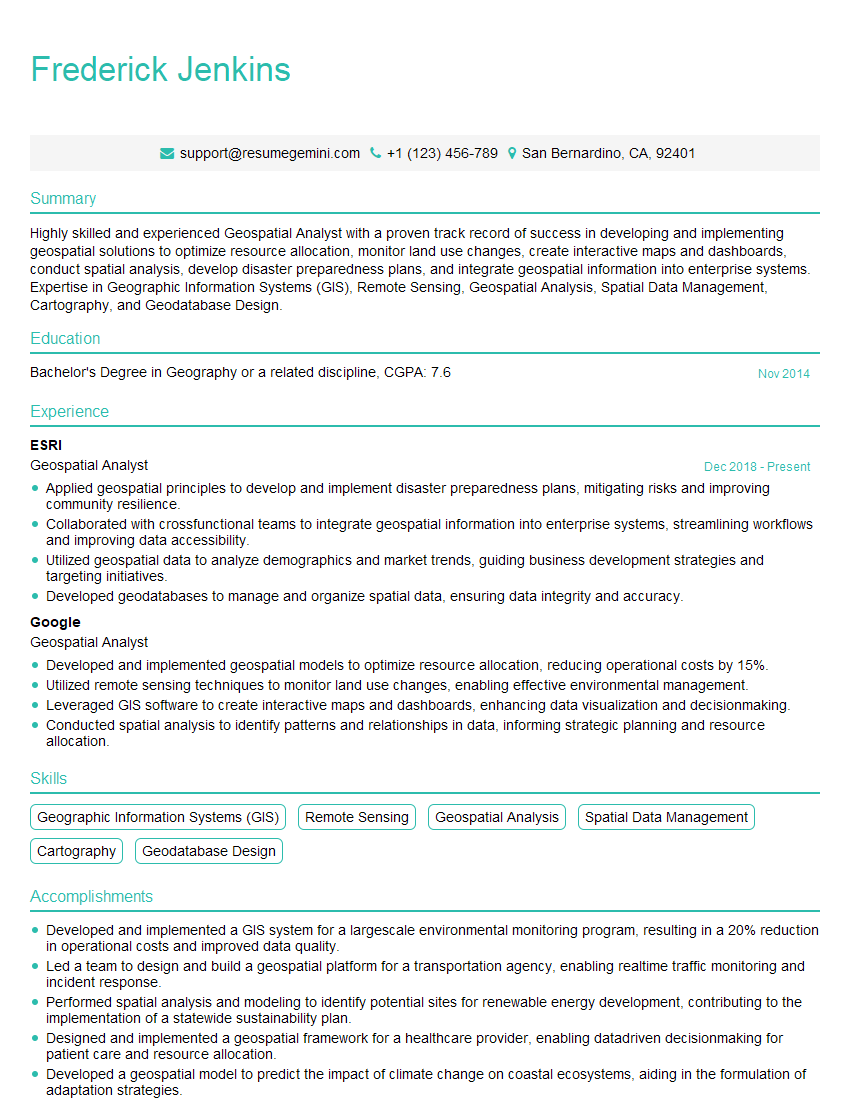
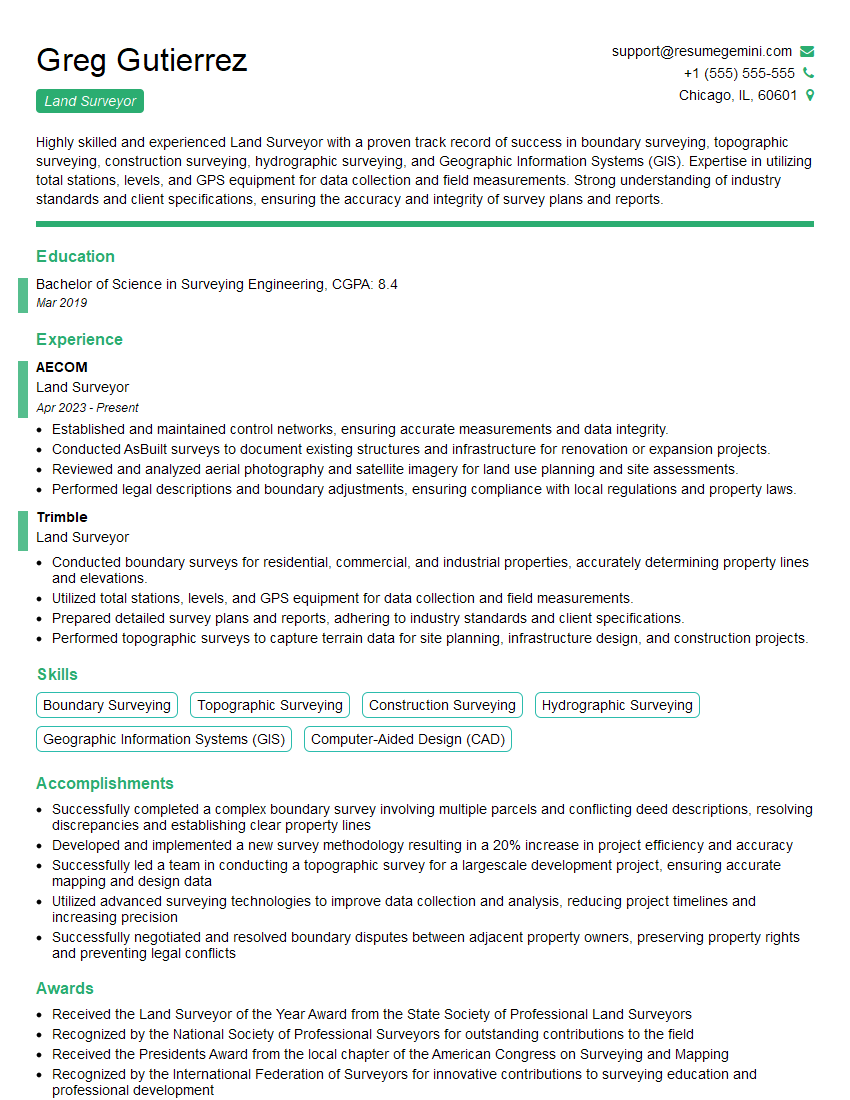
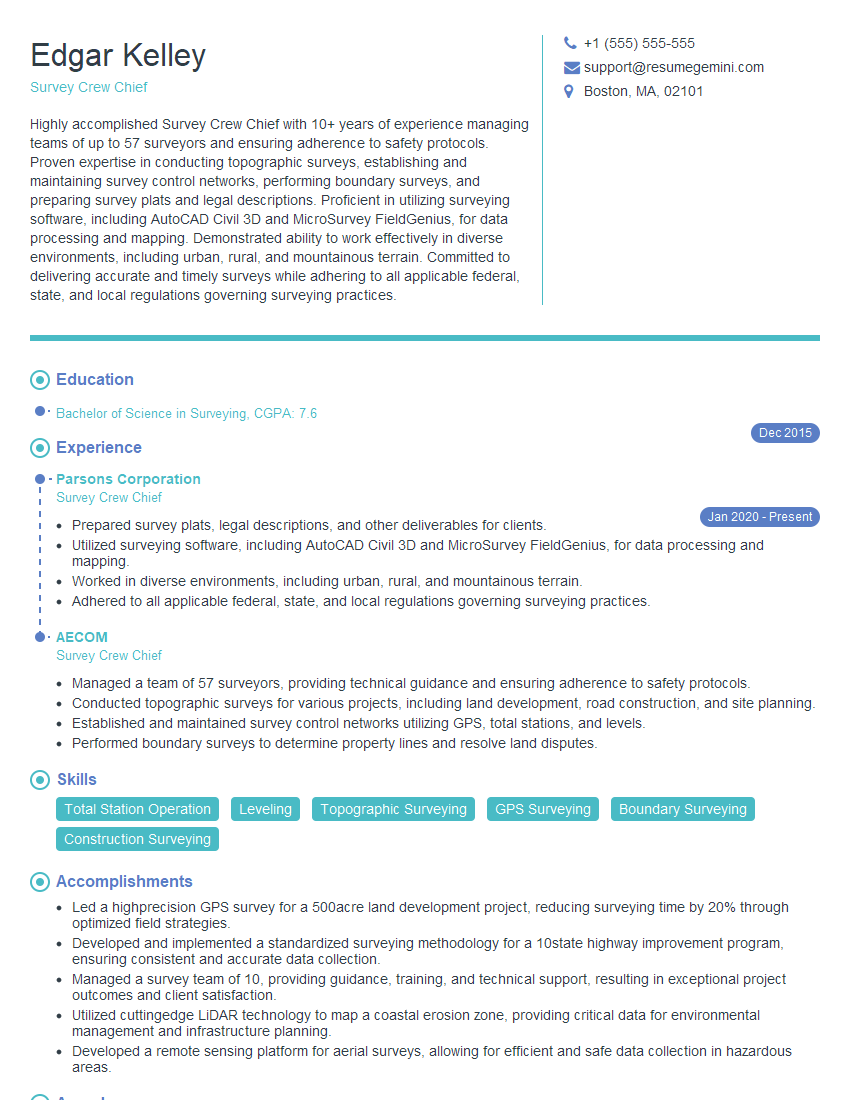
Mastering Advanced Surveying Technologies is crucial for career advancement in this rapidly evolving field. Demonstrating expertise in these areas will significantly enhance your job prospects and open doors to exciting opportunities. To maximize your chances of success, it’s vital to create a compelling and ATS-friendly resume that effectively highlights your skills and experience. ResumeGemini is a trusted resource to help you build a professional and impactful resume. We provide examples of resumes tailored to Advanced Surveying Technologies to guide you through the process.



Explore more articles
Users Rating of Our Blogs
Share Your Experience
We value your feedback! Please rate our content and share your thoughts (optional).
What Readers Say About Our Blog
I Redesigned Spongebob Squarepants and his main characters of my artwork.
https://www.deviantart.com/reimaginesponge/art/Redesigned-Spongebob-characters-1223583608
IT gave me an insight and words to use and be able to think of examples
Hi, I’m Jay, we have a few potential clients that are interested in your services, thought you might be a good fit. I’d love to talk about the details, when do you have time to talk?
Best,
Jay
Founder | CEO