Cracking a skill-specific interview, like one for Furniture Finishing, requires understanding the nuances of the role. In this blog, we present the questions you’re most likely to encounter, along with insights into how to answer them effectively. Let’s ensure you’re ready to make a strong impression.
Questions Asked in Furniture Finishing Interview
Q 1. What types of wood finishes are you familiar with?
I’m familiar with a wide range of wood finishes, each with its own unique properties and applications. They can be broadly categorized into several types:
- Shellac: A natural resin finish known for its warm tone and buildable layers. It’s excellent for highlighting the wood grain but can be more sensitive to moisture and alcohol.
- Lacquer: A fast-drying finish available in both solvent-based and water-based formulations. It offers durability and a smooth, hard surface, making it popular for furniture and floors.
- Varnish: Typically oil-based, varnish creates a protective, durable finish that’s resistant to scratches and water damage. It’s often used for outdoor furniture or areas that require high durability.
- Polyurethane: Another durable option, polyurethane comes in both water-based and oil-based formulas. It offers excellent protection and is relatively easy to apply. Water-based polyurethanes are becoming increasingly popular due to their lower VOCs (Volatile Organic Compounds).
- Oil Finishes (e.g., Tung oil, linseed oil): These penetrate the wood, enhancing its natural beauty and providing a protective layer. They offer a more natural look and feel than film-forming finishes, but require more maintenance.
My experience encompasses working with all these types, allowing me to select the optimal finish for each project based on its requirements – from delicate antique restoration to the robust finishing of modern outdoor furniture.
Q 2. Describe your experience with different staining techniques.
Staining techniques are crucial for enhancing the color and character of wood. My experience includes various methods:
- Water-based stains: These are easier to clean up and have lower VOCs, making them a more environmentally friendly option. They tend to raise the grain slightly, requiring careful sanding before topcoating.
- Oil-based stains: These penetrate the wood more deeply, resulting in richer, more vibrant colors. They’re also more resistant to fading but require solvents for cleanup and have higher VOCs.
- Gel stains: Thicker than water-based or oil-based stains, gel stains are ideal for vertical surfaces as they are less likely to run. They’re great for hiding imperfections but can be more challenging to apply evenly.
- Nector stains: These are specially formulated to penetrate deeply and seal against moisture, creating a high-quality, even finish. This is particularly useful on porous woods.
- Glazing: This technique involves applying a translucent layer of color over a base coat to create depth and shading. It’s a fantastic way to add visual interest and highlight specific features.
I often experiment with combining techniques – for example, applying a water-based stain for even color, followed by a gel stain to highlight details, and finishing with a glaze for added depth. The best technique depends entirely on the wood type, desired color, and the overall aesthetic goal.
Q 3. How do you prepare wood surfaces for finishing?
Proper surface preparation is paramount for a flawless finish. It’s akin to preparing a canvas before painting. My process generally involves these steps:
- Cleaning: Removing dust, dirt, and debris with a tack cloth or vacuum is essential for optimal adhesion.
- Sanding: I use progressively finer grit sandpaper (e.g., 120, 180, 220) to smooth the surface, removing any imperfections or previous finishes. The direction of sanding is important to avoid creating scratches.
- Grain Raising: Water-based finishes will raise the wood grain. After the initial sanding, I apply a damp cloth, allow it to dry, and sand again to create a perfectly smooth surface.
- Dust Removal: After each sanding step, I meticulously remove all dust particles using a tack cloth or vacuum to avoid imperfections in the final finish.
- Filling: Wood filler can be used to fill any holes, cracks, or imperfections before sanding.
The level of preparation depends on the wood’s condition and the desired finish. For high-end pieces, meticulous sanding and multiple dust removal steps are crucial to achieve a flawless result.
Q 4. What are the steps involved in applying a lacquer finish?
Applying a lacquer finish requires precision and attention to detail. The process typically involves these steps:
- Preparation: Ensure the wood surface is clean, smooth, and properly prepared as described above.
- Thinning (if necessary): Lacquer may need to be thinned with the appropriate thinner to achieve the correct viscosity for spraying or brushing.
- Application: Lacquer can be applied using various methods such as spraying (for a smooth, even coat), brushing (for a more textured look), or padding (for a more traditional finish). Multiple thin coats are generally preferred over one thick coat to prevent runs and drips.
- Drying: Allow each coat to dry completely before applying the next. The drying time will vary depending on the type of lacquer, environmental conditions, and coat thickness.
- Sanding (between coats): Lightly sand between coats with very fine grit sandpaper (e.g., 320 or higher) to smooth out any imperfections before applying the next coat. Be sure to thoroughly remove all dust before proceeding.
- Final Finishing: Once the desired number of coats is applied, allow the finish to cure completely (this can take several days or weeks).
The number of coats will depend on the desired level of durability and the type of lacquer being used. Consistent technique and attention to detail are crucial for achieving a professional finish.
Q 5. Explain the difference between oil-based and water-based finishes.
Oil-based and water-based finishes differ significantly in several aspects:
- VOCs (Volatile Organic Compounds): Water-based finishes generally have lower VOCs, making them a more environmentally friendly choice. Oil-based finishes have much higher VOCs and require better ventilation during application and drying.
- Drying Time: Oil-based finishes typically take longer to dry, sometimes days or even weeks for complete curing. Water-based finishes are usually much faster drying, often just hours.
- Clean-up: Water-based finishes are easily cleaned up with soap and water. Oil-based finishes require solvents like mineral spirits for cleanup, posing additional safety concerns.
- Durability: Both offer good durability, but oil-based are typically more resistant to scratches and water damage, while water-based are increasingly durable with modern formulations.
- Appearance: Oil-based finishes often produce a richer, warmer look, while water-based finishes can sometimes appear slightly more matte.
The choice between oil-based and water-based depends on factors like environmental concerns, drying time constraints, desired finish characteristics, and the project’s specific needs. In my work, I select the appropriate finish based on these factors, always considering the best balance of performance and environmental impact.
Q 6. How do you troubleshoot common finishing problems like runs, drips, or bubbles?
Troubleshooting finishing problems requires careful diagnosis and a methodical approach. Here’s how I address common issues:
- Runs and Drips: These are usually caused by applying too much finish at once. The solution involves lightly sanding the affected area once dry and applying a very thin, even coat to blend it in.
- Bubbles: Bubbles can result from trapped air, too-thick finish, or contaminated surfaces. Lightly sanding and reapplying thin coats usually resolves this. In some cases, a slow-release thinner may be helpful.
- Dust nibs: These are small particles embedded in the finish. Thorough dust removal before applying each coat is critical. If this happens, you may need to wet-sand and reapply a coat.
- Uneven Finish: Uneven surfaces often stem from poor preparation, inadequate sanding, or inconsistent application. Carefully reassess your preparation steps and apply thin, even coats, possibly using a different application technique.
- Fish eyes: These are small imperfections that resemble fish eyes. These can result from silicone contamination, so meticulous cleaning and preparation are critical. A commercial fish-eye remover may help.
Careful observation and identifying the root cause is key. For persistent problems, it is helpful to start over with proper surface preparation.
Q 7. What safety precautions do you take when working with finishes?
Safety is paramount when working with wood finishes. My approach includes:
- Ventilation: I always work in a well-ventilated area, ideally with a respirator and air purifier, especially when using oil-based or solvent-based products. This is critical to avoid inhaling harmful fumes.
- Personal Protective Equipment (PPE): I consistently use appropriate PPE, including gloves, eye protection, and respirators to protect myself from skin and eye irritation and inhalation of hazardous materials. The specific PPE varies according to the product being used.
- Fire Safety: Many finishes are flammable. I ensure that there are no open flames or sparks nearby. I use proper storage and handling procedures to minimize risks.
- Waste Disposal: I properly dispose of all waste materials according to local regulations. This includes used rags and solvents, as they can pose a fire hazard if not disposed of correctly.
- Material Safety Data Sheets (MSDS): I always consult the MSDS before using any finish to understand its hazards and safety precautions. This is the best source of information for safe handling practices.
Safety is not just a matter of following regulations; it’s about respect for one’s health and the environment. A safe working environment leads to better quality work and a healthier outcome.
Q 8. What is your experience with spray finishing equipment?
My experience with spray finishing equipment is extensive, encompassing both HVLP (High Volume Low Pressure) and conventional air spray systems. I’m proficient in setting up and maintaining these systems, understanding the crucial relationship between air pressure, fluid viscosity, and nozzle size to achieve optimal atomization and finish quality. I’ve worked with a variety of spray guns, from basic gravity-fed models to more advanced pressure-fed systems with adjustable fan patterns. This allows me to adapt to different projects and finishing requirements, whether it’s applying a fine lacquer to delicate woodwork or a more robust enamel to a sturdy kitchen cabinet. For example, when spraying a high-gloss finish, I carefully adjust the air pressure and fluid flow to minimize orange peel and ensure a flawlessly smooth surface. I also understand the importance of proper safety precautions, including respirator use and proper ventilation.
Q 9. How do you achieve a consistent finish on large pieces of furniture?
Achieving a consistent finish on large pieces of furniture requires a systematic approach. Preparation is key – ensuring the surface is flawlessly sanded and prepared before applying any finish. For large pieces, I often work in manageable sections, applying the finish in overlapping passes to avoid visible lap marks. Maintaining a consistent distance and spray pattern is also crucial. This often involves using a spray gun with a wide fan pattern and employing a methodical approach—I might use masking tape to define spray zones and ensure even coverage. For exceptionally large pieces, I might even consider using a plural component spray system for superior efficiency and finish consistency. Regular cleaning and maintenance of the spray equipment is essential to prevent clogs and inconsistencies throughout the project. Think of it like painting a wall – you wouldn’t do it in one go without stopping to reload your brush; similarly, with large furniture pieces, a section-by-section approach is crucial for a professional outcome.
Q 10. Describe your experience with different types of sanding techniques.
My sanding expertise spans various techniques and grits, ranging from rough sanding with coarse grit sandpaper to fine sanding with ultra-fine grits. I’m proficient in both hand sanding and using power sanders, including random orbital sanders, belt sanders, and detail sanders. Each tool has its purpose – for example, a random orbital sander is ideal for large, flat surfaces to create a smooth, even finish, while a detail sander is perfect for intricate curves and moldings. The selection of sandpaper grit is crucial – starting with a coarser grit to remove imperfections and gradually moving to finer grits to achieve a perfectly smooth surface. Knowing when to change sanding direction and applying even pressure are critical to avoiding sanding marks. For instance, when sanding figured wood, I carefully adjust my technique to avoid sanding through the delicate grain patterns. Careful attention to detail at every stage of sanding is essential for a quality finish.
Q 11. What is your experience with grain filling?
Grain filling is a crucial step for open-pored woods like oak or walnut, preventing uneven finishes and enhancing the overall appearance. I’m experienced with both paste and liquid grain fillers, selecting the appropriate type based on the wood’s porosity and the desired final finish. The process involves applying the filler to the open pores, allowing it to dry, and then sanding it flush with the surface. I often use a flexible putty knife or a specialized grain filler applicator to ensure even coverage, paying close attention to the details to avoid excess filler that might interfere with subsequent coats. A final light sanding is vital to create a smooth, even surface ready for topcoating. If the grain is extremely open, I may apply several thin coats of filler to build up the surface gradually.
Q 12. How do you match existing finishes on antique furniture?
Matching existing finishes on antique furniture is a challenging but rewarding aspect of my work. It often requires a keen eye for detail and an understanding of antique finishing techniques. I start by carefully examining the existing finish to determine its type (e.g., shellac, lacquer, varnish) and color. I then create small test patches on inconspicuous areas to experiment with different combinations of stains, dyes, and topcoats until a close match is achieved. Patience and meticulous attention to detail are crucial in this process. For instance, if the original finish is shellac, I would use a compatible shellac to blend any repairs. If the finish has significant damage, I may need to employ techniques like French polishing to restore the finish to its original glory. It’s a delicate process that requires a lot of skill and experience.
Q 13. What types of finishing tools are you proficient with?
My proficiency extends to a wide range of finishing tools, including various types of spray guns, hand sanding blocks, random orbital sanders, detail sanders, scrapers, putty knives, brushes (both natural and synthetic bristle), and various types of applicators for stains, glazes, and fillers. I’m also comfortable using specialized tools such as French polishing pads and rubbing compounds. Selecting the right tool for each step in the process is critical for efficiency and quality. For example, I would use a soft bristle brush for applying a delicate glaze, but a more robust brush for applying a thicker paint or varnish. Proficiency in using each tool appropriately ensures a high-quality and professional finish.
Q 14. Explain your experience with using shellac.
Shellac is a natural resin finish that I use extensively due to its durability, beauty, and compatibility with other finishes. I’m familiar with applying shellac using both pad application (French polishing) and brushing techniques. I understand the importance of dewaxed shellac for compatibility with other topcoats. My experience encompasses creating various shellac finishes, from delicate blonde shellac to rich, amber-toned finishes. I understand that shellac requires a specific environment, including proper temperature and humidity levels, to prevent issues like blushing. I am experienced in troubleshooting common problems, like uneven application or blushing, making sure that the final product is free of blemishes and delivers the perfect sheen. Working with shellac is an art that requires both skill and understanding of the material’s properties.
Q 15. Describe your understanding of different finish durability levels.
Finish durability is categorized by its resistance to wear, tear, and chemical damage. Think of it like a car’s paint job – some are more resistant to scratches and fading than others. We generally classify durability levels based on the type of finish and the number of coats applied.
- Low Durability: This typically involves a single coat of wax or a very thin varnish. It’s suitable for items with minimal handling, like decorative pieces or items in a low-traffic area. Think of a delicate antique needing minimal protection.
- Medium Durability: This usually involves multiple coats of varnish, lacquer, or polyurethane. These finishes offer decent protection against scratches and spills and are suitable for everyday furniture. This is the most common level for dining tables and chairs.
- High Durability: This involves several coats of high-quality polyurethane, catalyzed lacquer, or other exceptionally hard finishes. These finishes are extremely resistant to scratches, stains, and wear, making them ideal for high-traffic areas or items that experience frequent use, like kitchen cabinets or children’s furniture. Think of a commercial-grade finish.
The choice of durability level depends greatly on the intended use and the piece’s location.
Career Expert Tips:
- Ace those interviews! Prepare effectively by reviewing the Top 50 Most Common Interview Questions on ResumeGemini.
- Navigate your job search with confidence! Explore a wide range of Career Tips on ResumeGemini. Learn about common challenges and recommendations to overcome them.
- Craft the perfect resume! Master the Art of Resume Writing with ResumeGemini’s guide. Showcase your unique qualifications and achievements effectively.
- Don’t miss out on holiday savings! Build your dream resume with ResumeGemini’s ATS optimized templates.
Q 16. How do you clean and maintain your finishing equipment?
Maintaining finishing equipment is crucial for consistent results and the longevity of the tools. Neglecting this step can lead to poor finishes and damage to your equipment.
- Spray Guns: After each use, I thoroughly clean my spray guns with appropriate solvents, following the manufacturer’s instructions. This usually involves rinsing with a solvent like lacquer thinner, followed by a cleaning solution to remove any remaining residue. I then lubricate the parts to prevent corrosion.
- Brushes: For brushes, I use a brush cleaner or solvent to remove the finish, carefully working the bristles to ensure all traces are removed. I then rinse with clean solvent and reshape the bristles before storing them in a protective container to maintain their shape.
- Sanding Equipment: Sandpaper and sanding blocks are disposed of after each use. Orbital sanders require cleaning of the sanding pads and dust collection systems to prevent clogging and ensure smooth operation.
- Work Area: Maintaining a clean workspace is paramount. I ensure spills are cleaned promptly, and all dust is removed using a vacuum or tack cloth. This prevents contamination and promotes a professional finish.
Regular maintenance extends the life of my equipment, guarantees clean and consistent finishes, and maintains a safe working environment. It’s an investment in my profession.
Q 17. What is your experience with color matching?
Color matching is an art that combines technical skill and a keen eye for detail. I rely on a combination of methods to achieve accurate matches.
- Color Charts and Catalogs: I use these as a starting point for selecting finishes that are close to the desired color.
- Color Mixing Systems: I’m proficient in using computerized color mixing systems. These machines provide precise formulations based on entered color codes or samples. This ensures accurate and repeatable results.
- Manual Mixing: I’m also experienced in manually mixing colors. This involves trial and error, careful measurement of pigments, and an understanding of how colors interact. This is essential when working with unique or custom colors not found in readily available charts.
- Sample Creation: Before committing to a final finish, I always create small test samples on scrap wood of the same species as the project. I test under varied lighting conditions to confirm the accuracy of the match.
My experience has taught me that patience and attention to detail are critical in ensuring a successful color match. It’s a matter of achieving consistency and accurately translating a customer’s vision into reality.
Q 18. How do you handle different wood species and their unique finishing requirements?
Different wood species possess unique characteristics that influence how they absorb and react to finishes. Understanding these differences is fundamental to achieving a high-quality finish.
- Porosity: Open-grained woods like oak require careful preparation to prevent uneven finish absorption. Filling the grain before finishing is often necessary. Close-grained woods like maple require less preparation.
- Density: Denser woods often require more sanding to achieve a smooth surface before applying the finish. Softer woods can be more easily marred during sanding.
- Color and Grain: The natural color and grain of the wood influence the final appearance of the finish. Some finishes enhance the grain while others minimize it.
- Finish Choice: Some woods are more suited to certain finishes than others. For instance, oil-based finishes might be more suitable for certain woods than water-based finishes.
For example, I might use a wood filler on oak to even out its open grain, ensuring an even finish application, while for maple, I might focus on careful sanding to achieve a smooth surface.
Q 19. What are your preferred methods for applying topcoats?
My preferred methods for applying topcoats depend on the project’s size, desired finish, and my personal preference for specific tools.
- Spray Application: This method is ideal for achieving a smooth, even finish, especially on larger projects. It allows for excellent control and minimal brush strokes.
- Brush Application: For smaller projects or detailed work, brush application allows for more control and precise application. The choice of brush is important – high-quality natural bristle brushes are ideal for many finishes.
- Wipe-on Polyurethane: This is a good option for certain projects, especially when a more natural, less uniform look is desired. It’s easy to apply and allows for a rustic effect.
Regardless of the method, I always follow a methodical approach. This ensures each coat is applied evenly, allowing adequate drying time between coats. Multiple thin coats are always preferable to one thick coat, ensuring a durable and even finish.
Q 20. Explain your experience with working with high-gloss finishes.
High-gloss finishes are challenging but rewarding. They demand meticulous preparation and application to achieve a flawless, reflective surface.
- Surface Preparation: Achieving a truly high-gloss finish starts with impeccable surface preparation. This involves multiple sanding steps using progressively finer grits of sandpaper, ensuring a perfectly smooth surface. Any imperfections will be magnified under a high-gloss finish.
- Finish Selection: The choice of finish is crucial. High-quality lacquers and catalyzed polyurethane offer the best clarity and durability for high-gloss applications.
- Application Technique: Spray application is often preferred for high-gloss finishes, as it allows for a more uniform and even coat. If brushing, very smooth strokes are essential to prevent visible brush marks.
- Multiple Coats: Multiple thin coats are crucial to build depth and shine. Allowing sufficient drying time between coats is essential to prevent problems like runs or sagging.
- Final Polishing: Once cured, very fine abrasive compounds and rubbing compounds can be used to achieve a mirror-like finish. It’s a delicate process requiring patience and attention to detail.
I’ve found that patience and attention to detail are paramount when working with high-gloss finishes. A seemingly minor imperfection in the preparation stage can significantly affect the final result.
Q 21. How do you deal with challenging wood grain patterns?
Challenging wood grain patterns can present unique challenges but also provide opportunities for creative solutions. My approach is based on understanding the grain’s characteristics and adapting my techniques accordingly.
- Grain Filling: For highly figured or open-grained woods, I might use grain fillers to level the surface, creating a smoother base for the finish. This helps minimize the uneven absorption of the finish.
- Sanding Techniques: Careful sanding is essential. I might use different sanding techniques, such as hand-sanding in the direction of the grain, to avoid creating scratches or disturbing the natural pattern.
- Finish Selection: The type of finish can affect how the grain is highlighted. Some finishes emphasize the grain while others downplay it. This choice is a critical aspect of the design.
- Highlighting or Minimizing: I can use specific staining techniques or layering of finishes to either emphasize or de-emphasize certain grain patterns depending on the desired aesthetic.
For example, a highly figured mahogany might require grain filling to achieve a perfectly smooth surface before applying a high-gloss finish, while a piece of rustic walnut could benefit from a finish that accentuates its natural variation.
Q 22. How do you ensure the longevity of a finish?
Ensuring the longevity of a finish involves a multi-step process focusing on proper surface preparation, selecting the right finish, and applying it correctly. Think of it like building a house – a weak foundation will lead to problems down the line.
- Thorough Surface Preparation: This is paramount. It includes sanding to the appropriate grit, removing any dust or debris, and filling imperfections. Skipping this step is like painting a wall without priming – the finish won’t adhere properly and will peel or chip easily.
- Choosing the Right Finish: Different finishes offer varying degrees of durability. For high-traffic areas, a durable polyurethane is ideal. For a more delicate piece, a shellac might be preferable. The choice depends on the piece’s intended use and environment.
- Proper Application: This involves applying thin, even coats, allowing sufficient drying time between coats, and following the manufacturer’s instructions meticulously. Rushing this process will compromise the finish’s durability.
- Regular Maintenance: Even the most durable finish will benefit from regular cleaning and occasional touch-ups. Avoid harsh chemicals and abrasive cleaners. A soft cloth and a gentle cleaner is usually sufficient.
For example, I once restored an antique table. By meticulously sanding, applying multiple coats of high-quality polyurethane, and regularly cleaning it, the finish has remained beautiful and protected for over 10 years.
Q 23. What are your methods for achieving a smooth, even finish?
Achieving a smooth, even finish is an art that requires precision and patience. It’s like baking a cake – you need the right ingredients and technique to get a perfect result.
- Careful Sanding: This is the foundation of a smooth finish. I start with coarser grits to remove imperfections, gradually moving to finer grits to achieve a flawless surface. The transition between grits should be smooth and even.
- Proper Application Technique: This includes using the right tools – brushes, spray guns, or cloths – and applying thin, even coats to prevent runs or drips. Consistent application pressure and technique is key.
- Environmental Control: Temperature, humidity, and dust all affect the finish. A clean, controlled environment ensures a better outcome.
- Multiple Thin Coats: Instead of applying one thick coat, which can lead to imperfections, I prefer multiple thin coats, allowing each coat to dry completely before applying the next. This helps build a smooth, durable layer.
I once had a client who wanted a mirror-like finish on their dining table. By carefully following this process, we achieved a flawless result that exceeded their expectations.
Q 24. What is your experience with repairing finish damage?
Repairing finish damage requires careful assessment of the damage and choosing the appropriate repair method. This is like patching a hole in a wall – the right technique depends on the size and nature of the damage.
- Minor Scratches: These can often be buffed out with a polishing compound or touched up with a matching stain and finish.
- Chips and Gouges: These require filling with wood filler, sanding smooth, and then refinishing the area. I color-match the filler to the surrounding wood carefully to ensure a seamless repair.
- Significant Damage: Extensive damage might necessitate stripping the old finish and completely refinishing the piece. In these cases, the original finish might be replicated, or an entirely new finish chosen.
For example, I once repaired a deep gouge in a client’s antique desk. I carefully filled the gouge, sanded it smooth, and applied a matching stain and finish, leaving no visible sign of repair.
Q 25. How do you maintain quality control throughout the finishing process?
Maintaining quality control throughout the finishing process is crucial for consistent results. Think of it as a quality control checklist in a manufacturing plant, but on a smaller scale.
- Regular Inspections: At each stage of the process – from sanding to final finishing – I perform thorough inspections to identify and correct any imperfections.
- Consistent Materials and Techniques: I use high-quality materials consistently, and adhere to my proven finishing techniques. This reduces the chances of variability.
- Proper Tool Maintenance: Clean and well-maintained tools are essential for a quality finish. This ensures smooth, consistent application.
- Documentation: I maintain detailed records of the finishing process for each piece, including materials used, techniques employed, and any challenges encountered. This helps in troubleshooting and ensures consistency.
By implementing these quality control measures, I ensure that every piece I finish meets the highest standards.
Q 26. Describe your experience with different types of sealers.
My experience encompasses a wide range of sealers, each with its unique properties and applications. It’s like having a toolbox full of different hammers – each serves a purpose.
- Shellac: A traditional, natural sealer that produces a warm, amber tone. It’s easy to work with, but less durable than some other options. Ideal for delicate pieces and where a natural look is desired.
- Lacquer: A fast-drying, durable sealer available in various sheens. It’s excellent for high-traffic areas but can be more difficult to repair. It offers good protection against scratches and wear.
- Polyurethane: A very durable, water-resistant sealer, offered in water-based and oil-based formulations. Water-based polyurethane is more environmentally friendly. This is my go-to sealer for many projects due to its durability and easy application.
- Varnish: Similar to polyurethane but often offers a slightly different look and feel. Comes in various formulations, including spar varnish designed for exterior applications.
The choice of sealer depends on several factors including the wood type, intended use of the piece, and desired aesthetic. I carefully consider these factors to select the most appropriate sealer for each project.
Q 27. What are the environmental considerations related to furniture finishing?
Environmental considerations are becoming increasingly important in furniture finishing. It’s like choosing environmentally friendly products when you shop for groceries – minimizing impact is crucial.
- VOC Emissions: Many finishing chemicals contain volatile organic compounds (VOCs) that contribute to air pollution. I prioritize using low-VOC or water-based finishes whenever possible.
- Waste Disposal: Proper disposal of finishing materials and waste is crucial to prevent environmental damage. I follow all local regulations and utilize recycling options whenever available.
- Sustainable Materials: I choose sustainable wood sources and try to incorporate recycled or reclaimed materials when possible. This contributes to responsible forestry practices.
- Energy Efficiency: I use energy-efficient equipment and techniques, such as airless spray systems, to reduce energy consumption during the finishing process. This minimizes the carbon footprint of the process.
My commitment to sustainability is not only environmentally responsible, but also resonates with an increasing number of clients who are seeking eco-friendly options.
Q 28. What are your skills in using different finishing chemicals safely and effectively?
Safety and effectiveness are paramount when working with finishing chemicals. It’s like working in a chemistry lab – safety procedures are essential.
- Proper Ventilation: I always work in a well-ventilated area, using respirators and protective eyewear when necessary. Many finishing chemicals release fumes that can be harmful.
- Personal Protective Equipment (PPE): This includes gloves, respirators, eye protection, and appropriate clothing. This ensures protection from splashes, inhalation, and skin contact.
- Material Safety Data Sheets (MSDS): I always refer to the MSDS for each chemical I use, which details hazards, safe handling procedures, and first aid information. This is the instruction manual for the chemicals.
- Proper Storage: I store all chemicals in a cool, dry, well-ventilated area, away from ignition sources, and following manufacturer recommendations. This prevents accidental spills or fires.
- Waste Disposal: I follow all local and national regulations regarding disposal of hazardous waste. This protects the environment and ensures responsible practices.
My experience and training have equipped me with the skills to handle finishing chemicals safely and effectively, ensuring both my safety and the quality of my work.
Key Topics to Learn for Furniture Finishing Interview
- Wood Preparation: Understanding different wood types, their properties, and appropriate preparation techniques (sanding, cleaning, etc.) for optimal finish application.
- Stain Application: Practical knowledge of various stain types (water-based, oil-based), application methods (brush, rag, spray), and achieving consistent color and grain enhancement. Troubleshooting issues like blotchiness or uneven color.
- Finishing Techniques: Familiarity with different finishing methods including shellac, lacquer, varnish, polyurethane, and their respective properties, application techniques, and drying times. Understanding the benefits and drawbacks of each finish type for different applications.
- Topcoat Application: Mastering the application of topcoats to protect the finish and enhance durability. Understanding the importance of proper layering and achieving a smooth, even surface. Addressing issues like runs, drips, or imperfections.
- Safety Procedures and Regulations: Knowledge of relevant safety protocols, including handling hazardous materials (solvents, stains), proper ventilation, and disposal of waste. Adherence to industry standards and regulations.
- Troubleshooting and Problem Solving: Ability to diagnose and rectify common finishing problems, such as uneven color, bubbling, cracking, or dust nibs. Practical experience in finding solutions and preventing defects.
- Tools and Equipment: Familiarity with various tools and equipment used in furniture finishing, including spray guns, brushes, sanders, and finishing materials. Understanding their proper use and maintenance.
- Finishing Styles and Trends: Awareness of current trends and styles in furniture finishing, and the ability to adapt techniques to achieve desired aesthetic outcomes.
Next Steps
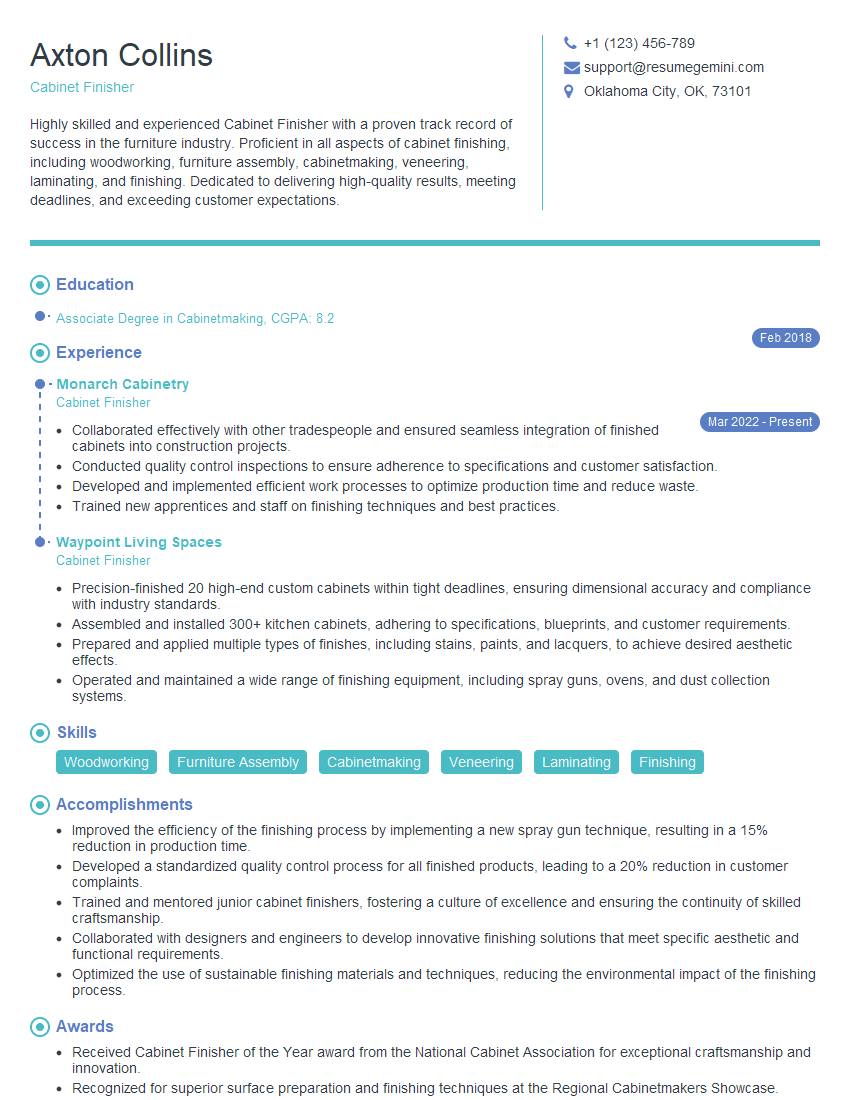
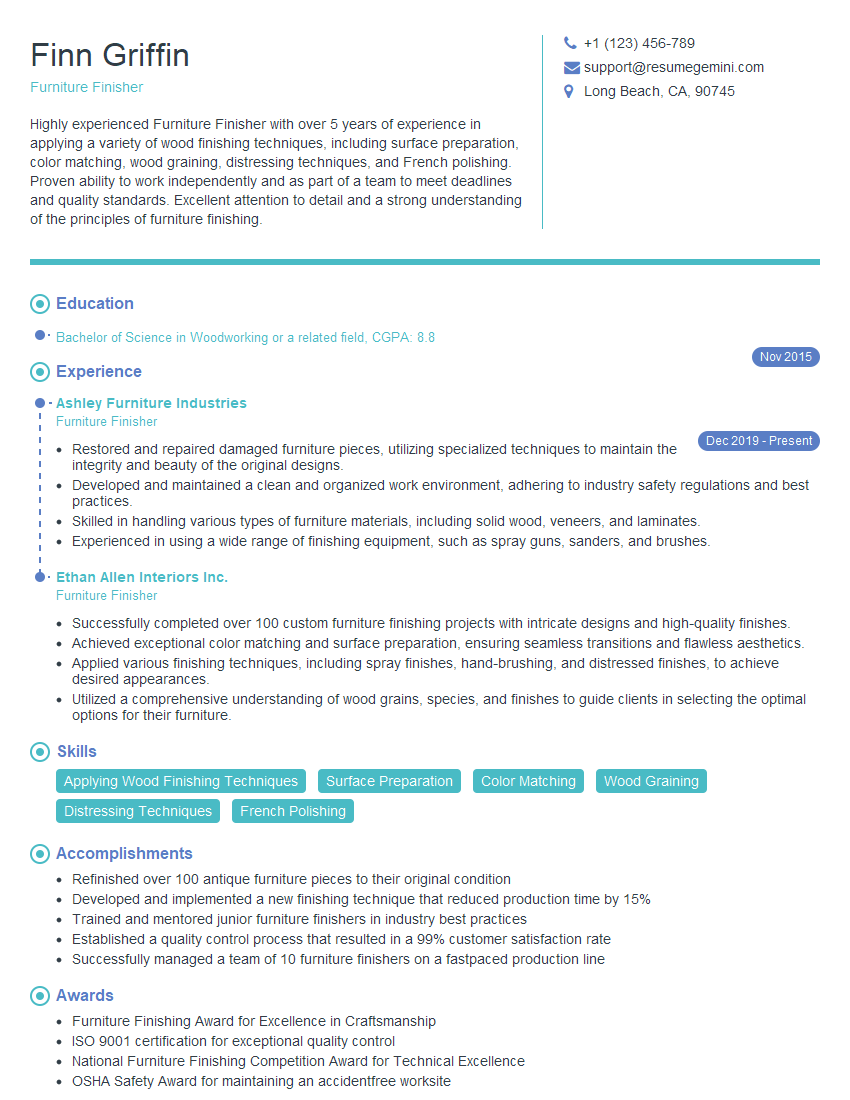
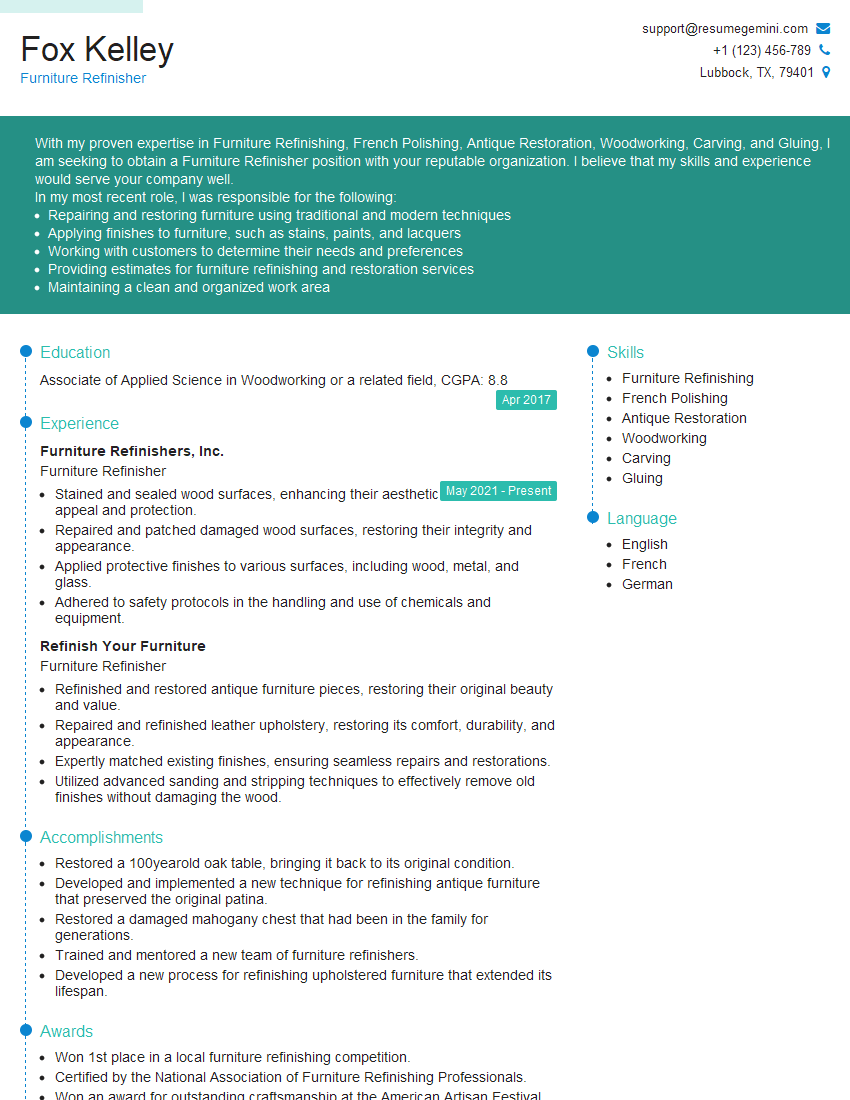
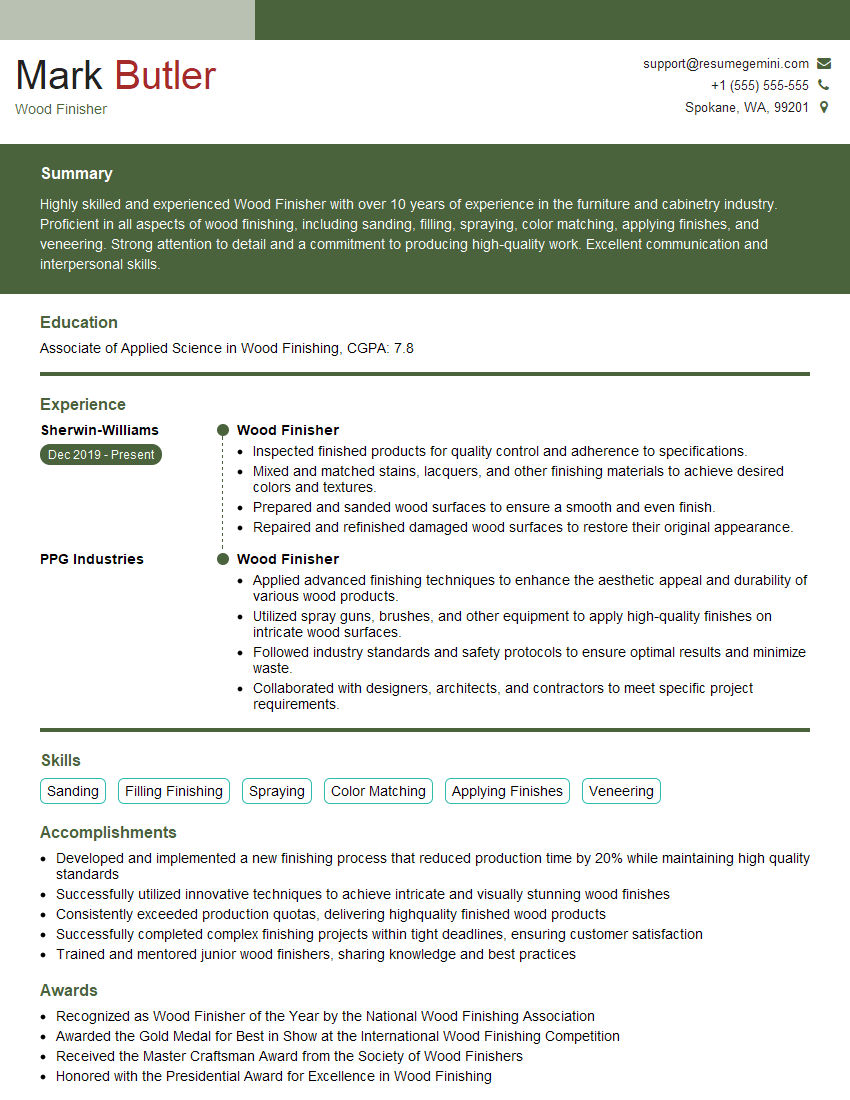
Mastering furniture finishing opens doors to a rewarding career with diverse opportunities for growth and specialization. Building a strong foundation in these key areas will significantly enhance your interview performance and future career prospects. To maximize your job search success, crafting an ATS-friendly resume is crucial. ResumeGemini is a trusted resource that can help you create a professional and impactful resume, designed to catch the eye of recruiters. Examples of resumes tailored to the Furniture Finishing field are available to help guide you. Invest the time to create a compelling resume – it’s your first impression and a significant step towards your dream job.



Explore more articles
Users Rating of Our Blogs
Share Your Experience
We value your feedback! Please rate our content and share your thoughts (optional).
What Readers Say About Our Blog
Really detailed insights and content, thank you for writing this detailed article.
IT gave me an insight and words to use and be able to think of examples