Interviews are opportunities to demonstrate your expertise, and this guide is here to help you shine. Explore the essential Laser Bonding interview questions that employers frequently ask, paired with strategies for crafting responses that set you apart from the competition.
Questions Asked in Laser Bonding Interview
Q 1. Explain the principle behind laser bonding.
Laser bonding relies on the principle of localized heating using a laser beam to join two materials. The laser’s energy is absorbed by one or both materials, causing a localized increase in temperature. This heat melts or softens the materials at the interface, creating a bond as they cool and solidify. Think of it like using a highly precise, controlled heat source to weld materials together, but without the need for a filler material in many cases.
The type of bond formed depends on the materials and laser parameters. For example, it can create a fusion bond, where the materials melt and intermix, or a diffusion bond, where the materials are joined by atomic diffusion at the interface. In some instances, an adhesive might be used to facilitate the bonding process.
Q 2. What are the different types of lasers used in laser bonding?
Several laser types are used in laser bonding, each with its own advantages and disadvantages. The choice depends on the materials being bonded and the desired bond characteristics.
- Nd:YAG lasers: These are very common, offering good versatility and power control. Their infrared wavelength is suitable for many materials.
- Fiber lasers: These are becoming increasingly popular due to their high efficiency, compact size, and excellent beam quality. They are well-suited for high-speed applications.
- CO2 lasers: These lasers emit infrared radiation suitable for bonding polymers and certain ceramics, but they require a more complex setup.
- Diode lasers: These are smaller and more economical, but their power is generally lower, making them better for more delicate applications.
The selection of the laser is crucial and involves careful consideration of the properties of both the laser and the materials being bonded.
Q 3. Describe the advantages and disadvantages of laser bonding compared to other joining methods.
Laser bonding offers several advantages over traditional joining methods like adhesive bonding, soldering, or welding.
- Precision: Laser bonding offers exceptional precision, allowing for micro-bonding of very small components.
- Speed: The process can be highly automated and fast, leading to increased throughput.
- Non-contact: No physical contact between the bonding tool and the materials is required, minimizing damage or contamination.
- Flexibility: Laser bonding can be used for a wide range of materials, including metals, polymers, ceramics, and composites.
However, there are disadvantages:
- Cost: The initial investment for laser bonding equipment can be significant.
- Complexity: Precise control of laser parameters is crucial for successful bonding, requiring specialized expertise and often complex process optimization.
- Heat-affected zone: Depending on parameters, a heat-affected zone may be generated, which can alter material properties near the bond line.
The best joining method is always application-specific. For example, if precision and speed are paramount, laser bonding may be preferred over adhesive bonding, which might be slower and less precise, but potentially simpler and less costly.
Q 4. What factors influence the selection of a suitable laser for a specific bonding application?
Several factors influence laser selection for a specific bonding application. These include:
- Material compatibility: The laser wavelength must be efficiently absorbed by the material(s) to generate sufficient heat for bonding. Some materials absorb infrared radiation better than others, guiding the choice of laser type (e.g., Nd:YAG or CO2).
- Required bond strength: The laser power and pulse duration determine the achievable bond strength. Higher power and longer pulse durations generally lead to stronger bonds but can also increase the risk of material damage.
- Bonding speed: Fiber lasers are preferred for high-speed applications due to their high power and efficiency.
- Throughput: For mass production, a high-speed, high-power laser with automated systems is essential.
- Cost and maintenance: The cost of the laser system and ongoing maintenance should be factored into the decision.
Choosing the appropriate laser involves thorough material analysis and simulation to optimize parameters before practical application.
Q 5. How do you ensure the quality and consistency of laser bonding processes?
Ensuring the quality and consistency of laser bonding processes requires careful attention to several aspects:
- Process parameter control: Precise control of laser power, pulse duration, wavelength, and scanning speed is critical. Automated systems with closed-loop feedback mechanisms are vital for consistent results.
- Material preparation: Surface cleanliness and preparation (e.g., cleaning, pre-treatment) are essential to ensure optimal bonding. Surface roughness and contamination can significantly affect the bond quality.
- Real-time monitoring: Using sensors to monitor parameters like temperature and bond strength during the process helps maintain quality and detect anomalies.
- Statistical process control (SPC): Applying SPC methodologies to track process parameters and output quality helps detect deviations and improve process stability.
- Destructive and non-destructive testing: Testing the bonded samples using methods like tensile testing, microscopy, and ultrasonic inspection helps ensure that bonds meet specified requirements.
Regular calibration and maintenance of the laser system and associated equipment are essential for consistent and reliable results. Documentation of all process parameters and test results is critical for traceability and quality assurance.
Q 6. What are the common challenges encountered during laser bonding and how are they addressed?
Common challenges in laser bonding include:
- Porosity: Voids or pores in the bond line weaken the joint. This can be addressed by optimizing laser parameters, ensuring proper material preparation, and using appropriate bonding techniques.
- Material degradation: Excessive heat can degrade the materials near the bond line. Careful control of laser parameters is essential to minimize this effect.
- Inconsistent bonding: Variations in material properties or laser parameters can lead to inconsistent bond strength. Statistical process control and careful monitoring are necessary to mitigate this issue.
- Alignment challenges: Precise alignment of the components is critical for successful bonding, particularly in micro-bonding applications. Precise automated systems and high-resolution imaging are crucial here.
Addressing these challenges often involves iterative process optimization, experimentation, and the use of advanced diagnostic tools. Collaboration with material scientists and laser experts is frequently beneficial.
Q 7. Explain the importance of laser parameters (power, pulse duration, wavelength) in achieving a successful bond.
Laser parameters—power, pulse duration, and wavelength—are crucial for successful bonding. They directly influence the amount of heat delivered to the materials, the heating rate, and the depth of penetration. Improper selection can lead to poor bond quality or material damage.
- Power: Higher power leads to increased heat input, facilitating melting or softening of the materials. However, excessive power can cause material degradation or vaporization.
- Pulse duration: Shorter pulse durations generally lead to more precise heating, minimizing the heat-affected zone. Longer pulses deliver more energy but increase the risk of overheating.
- Wavelength: The wavelength must be chosen to maximize absorption by the materials being bonded. Different materials absorb different wavelengths more efficiently, dictating the choice of laser type.
Optimizing these parameters is often an iterative process, involving experimentation and simulation to determine the settings that produce the strongest, most reliable, and most consistent bonds while minimizing material damage. Careful process monitoring and characterization are critical to achieve optimal results.
Q 8. Describe the different types of materials that can be effectively bonded using lasers.
Laser bonding’s versatility stems from its ability to join a wide range of materials. The key is selecting the appropriate laser wavelength and parameters to achieve optimal bonding. Think of it like choosing the right glue for the job – you wouldn’t use superglue on delicate fabric, right? Similarly, laser bonding needs the right ‘glue’ (laser energy) for each material pair.
- Metals: Laser bonding is very effective with metals, particularly for joining dissimilar metals where traditional welding might be challenging. Examples include gold to silicon in microelectronics and steel to aluminum in automotive applications. The choice of laser (e.g., Nd:YAG, fiber laser) depends on the specific metals and desired joint characteristics.
- Ceramics: Ceramics can be challenging due to their brittleness and sensitivity to thermal shock. However, laser bonding, with careful control of parameters, allows for strong and reliable joints in applications like dental restorations and high-temperature components.
- Polymers: Laser bonding is effective for joining various polymers, including thermoplastics and thermosets. The process often involves laser-induced melting and subsequent re-solidification, creating a strong bond. It’s commonly used in the manufacturing of electronics and medical devices.
- Glass: Laser welding is frequently used for joining glass components in optical systems and precision instruments. The precision nature of the laser allows for creating very fine and delicate bonds without damaging the glass.
- Composites: Laser bonding is utilized for joining composite materials used in the aerospace and automotive industries. Controlling the energy distribution helps to avoid damaging the composite structures.
The success of laser bonding depends heavily on material compatibility, surface preparation, and precise laser control. For example, surface cleanliness is crucial – contaminants can weaken the bond.
Q 9. How do you assess the strength and integrity of a laser bond?
Assessing the strength and integrity of a laser bond involves a multi-pronged approach combining destructive and non-destructive testing methods. It’s like checking the strength of a bridge – you need to evaluate it from various perspectives.
- Tensile testing: This destructive method measures the bond’s strength by pulling the joined components apart until failure. The force required to break the bond indicates its tensile strength.
- Shear testing: This also destructive method measures the strength of the bond under shear forces, relevant for components under lateral stress.
- Microscopy (optical and electron): Provides high-resolution images of the bond interface, allowing for detailed analysis of the microstructure, porosity, and presence of any defects. It’s like zooming in with a powerful microscope to spot any weaknesses.
- Ultrasonic testing: This non-destructive technique uses sound waves to detect internal flaws like voids or cracks within the bonded area, identifying potential weak points without damaging the sample.
- Visual inspection: A simple, initial inspection to check for obvious defects like cracks or gaps at the bond line.
The choice of testing methods depends on the specific application and the desired level of detail. Often, a combination of methods is employed for a comprehensive evaluation.
Q 10. What safety precautions are essential when working with laser bonding equipment?
Safety is paramount when working with laser bonding equipment. Lasers emit high-intensity light that can cause serious eye injuries and skin burns. The level of hazard depends on the laser’s power and wavelength, and appropriate safety protocols must be strictly followed.
- Eye protection: This is the most crucial safety measure. Specialized laser safety glasses or goggles, specifically rated for the laser’s wavelength and power, must be worn at all times when the laser is operational. Never underestimate the importance of correct eye protection – a moment of negligence can have catastrophic results.
- Laser safety enclosure: Many laser systems are housed in enclosures to prevent accidental exposure. The enclosure must be properly designed and maintained to ensure adequate safety.
- Interlocks and safety sensors: Systems should have interlocks to prevent laser operation unless all safety precautions are in place. Safety sensors should monitor exposure levels and shut down the laser in case of a breach.
- Proper training: All personnel working with the laser bonding system must undergo comprehensive training on safe operating procedures and emergency response protocols. This includes understanding the laser’s capabilities, limitations, and potential hazards.
- Personal protective equipment (PPE): In addition to eye protection, other PPE such as laser-resistant clothing and gloves should be worn, especially when working with higher power lasers.
Regular safety checks and maintenance of the equipment are vital to ensure continuous, safe operation. Remember, even a small oversight can have significant consequences.
Q 11. Explain the role of fixturing in laser bonding.
Fixturing plays a crucial role in laser bonding by precisely positioning and holding the components to be joined during the bonding process. Think of it as a precise jig that ensures parts are perfectly aligned before the glue (laser) is applied.
Accurate fixturing ensures consistent and repeatable bond quality. Without proper fixturing, misalignment can lead to weak bonds, incomplete bonding, or even damage to the components. Key aspects of fixturing include:
- Material selection: The fixture material must be compatible with the laser and the components being bonded. It shouldn’t react with the laser or interfere with the bonding process.
- Design and construction: The design must ensure stable, precise positioning of the parts during the bonding process. The construction must be robust and accurate enough to minimize any movement.
- Alignment mechanisms: Accurate alignment is critical for achieving consistent bond quality. The fixture should incorporate mechanisms for precise adjustment and alignment of the components.
- Thermal management: The fixture may need to incorporate features for managing heat during the bonding process. This can involve cooling systems to prevent overheating or damage to components.
Custom fixturing is often required to accommodate the specific geometries and requirements of the components. The cost and complexity of fixturing can vary significantly, but the impact on the quality of the bonds justifies the investment.
Q 12. How do you troubleshoot common issues in laser bonding, such as porosity or incomplete bonding?
Troubleshooting laser bonding issues requires a systematic approach. Let’s consider two common problems: porosity and incomplete bonding.
Porosity: Porosity refers to the presence of voids or pores within the bonded area. This weakens the bond and reduces its strength. Potential causes include:
- Insufficient laser power: Not enough energy to melt the materials completely, leading to incomplete fusion and the formation of pores.
- Contamination: Presence of contaminants (oils, dust) on the surfaces prevents proper wetting and fusion, creating pores.
- Incorrect process parameters: Incorrect settings for laser power, pulse duration, and scan speed can lead to incomplete melting and porosity.
Troubleshooting Steps for Porosity:
- Clean the surfaces thoroughly: Use appropriate cleaning solvents to remove any contaminants.
- Increase laser power gradually: Increase the laser power in small increments until you achieve full melting without causing damage.
- Optimize process parameters: Experiment with pulse duration and scan speed to find the optimal settings.
- Inspect the bond interface: Use microscopy to analyze the bond and identify the cause of porosity.
Incomplete Bonding: This occurs when the materials don’t fully fuse, leading to a weak or no bond. Possible reasons include:
- Insufficient laser power: Not enough energy to melt the materials and create a sufficient bond.
- Poor surface preparation: Improper surface preparation, such as insufficient cleaning or surface roughness, hinders proper wetting and bonding.
- Misalignment: Misalignment of the components can prevent proper contact and bonding.
Troubleshooting Steps for Incomplete Bonding:
- Verify alignment: Ensure the components are properly aligned using the fixture.
- Improve surface preparation: Clean the surfaces thoroughly and ensure sufficient roughness for proper wetting.
- Increase laser power: Increase the laser power in small increments to ensure proper melting and bonding.
- Check for shielding gas issues: If applicable, ensure adequate shielding gas flow and purity to prevent oxidation.
A systematic approach, combining careful observation and experimentation, is essential for successful troubleshooting.
Q 13. What are the different types of laser beam delivery systems used in laser bonding?
The choice of laser beam delivery system depends on the specific application and the characteristics of the materials being bonded. Several methods are available, each with its own advantages and disadvantages:
- Fiber delivery: This method uses optical fibers to guide the laser beam to the workpiece. Fiber delivery is highly flexible and allows for precise beam positioning, making it suitable for complex geometries and applications requiring precise control.
- Galvanometer scanning system: This system uses two high-speed galvanometers to steer the laser beam across the workpiece’s surface. It’s particularly useful for applications requiring high-speed and complex bonding patterns. Imagine it as a very precise, fast laser ‘drawing’ tool.
- Free-space delivery: This involves directly directing the laser beam from the source to the workpiece using mirrors and lenses. It’s a simpler approach, but it’s less flexible and requires careful alignment.
- Scanning systems with focusing optics: These systems combine the use of scanning systems (galvanometers) with focusing optics, for example, to achieve highly controlled welding in microelectronic applications.
The choice of delivery system significantly influences the quality, speed, and efficiency of the laser bonding process. Selecting the right system requires careful consideration of the application requirements and budget limitations.
Q 14. Describe the process of setting up and calibrating a laser bonding system.
Setting up and calibrating a laser bonding system is a crucial step to ensure reliable and repeatable results. The process generally involves:
- Installation and alignment: Begin by installing the laser system according to the manufacturer’s instructions. Careful alignment of optical components is critical to ensure proper beam delivery and focus. This often involves precise adjustments to mirrors and lenses, sometimes using specialized alignment tools. Think of it as carefully adjusting a telescope for a clear view.
- Parameter optimization: The laser’s parameters, such as power, pulse duration, and repetition rate, need to be optimized for the specific materials being bonded. This often involves a series of test runs with different parameter settings to determine the optimal combination. This might require a design of experiments (DOE) to optimize the parameters for specific needs.
- Fixturing setup: The fixturing system must be properly set up to ensure accurate positioning and clamping of the components. This requires careful attention to detail and ensures all materials are securely held during the process. Incorrect fixturing can lead to poor bond quality.
- Calibration of power and beam profile: A power meter should be used to measure the laser’s output power, and a beam profiler can be used to check the beam’s shape and size. These measurements are essential to ensure consistent and reliable bonding results. This is like making sure your equipment has been correctly tested and is ready for operation.
- Test runs: After setting up and calibrating the system, perform several test runs to evaluate bond quality. These tests can involve visual inspection, microscopic examination, and mechanical testing to validate the efficacy of the process.
- Documentation: All settings and test results should be meticulously documented for future reference. This allows for traceability and ensures consistency between batches.
Setting up and calibrating a laser bonding system is a time-consuming process, but it’s crucial for ensuring the quality and reliability of the bonds. A well-calibrated system will lead to increased productivity and reduce defects.
Q 15. How do you select the appropriate laser beam profile for a given application?
Selecting the appropriate laser beam profile is crucial for successful laser bonding. The ideal profile depends heavily on the materials being bonded and the desired bond geometry. Think of it like choosing the right tool for a job – a hammer won’t work for screwing in a screw.
For instance, a Gaussian beam profile, with its intensity peaking at the center and gradually decreasing towards the edges, is often suitable for bonding smaller components or those requiring a precise, localized heat input. This minimizes heat-affected zones and prevents damage to surrounding areas.
Conversely, a top-hat beam profile, with a relatively uniform intensity across the beam diameter, is better for bonding larger areas or materials needing a more consistent heat distribution. This approach ensures uniform bonding across the entire interface.
Factors like the materials’ thermal conductivity and absorptivity, the desired bond strength, and the size and geometry of the parts all influence the selection. In practice, I often utilize simulations and experimental testing with various profiles to determine the optimal choice for a given application.
Career Expert Tips:
- Ace those interviews! Prepare effectively by reviewing the Top 50 Most Common Interview Questions on ResumeGemini.
- Navigate your job search with confidence! Explore a wide range of Career Tips on ResumeGemini. Learn about common challenges and recommendations to overcome them.
- Craft the perfect resume! Master the Art of Resume Writing with ResumeGemini’s guide. Showcase your unique qualifications and achievements effectively.
- Don’t miss out on holiday savings! Build your dream resume with ResumeGemini’s ATS optimized templates.
Q 16. What is the role of process monitoring and control in ensuring consistent laser bonding quality?
Process monitoring and control are absolutely paramount in laser bonding. Without it, you’re essentially bonding blindly. Imagine trying to bake a cake without checking the temperature – you’d likely end up with a disaster. Consistent quality demands real-time monitoring and precise control of several key parameters.
- Laser Power: Monitoring the laser power ensures consistent energy delivery to the bonding interface.
- Beam Position: Precise control of beam placement guarantees accurate and repeatable bonding.
- Temperature: Monitoring the temperature of the materials during bonding is critical for preventing damage and ensuring optimal bond formation. This often involves using thermocouples or infrared cameras.
- Bond Strength Measurement: Post-bonding strength testing using methods like tensile testing, shear testing, or ultrasonic techniques is essential for quality control and process optimization.
Feedback control loops, often incorporated into automated laser bonding systems, continuously adjust laser parameters based on real-time measurements, allowing for dynamic corrections and ultimately leading to more consistent and reliable bonds.
Q 17. Explain the concept of laser-induced damage in materials and how it can be minimized.
Laser-induced damage is a significant concern in laser bonding. It occurs when the laser energy exceeds the material’s damage threshold, leading to various forms of degradation. Think of it like overheating a metal – it can melt, crack, or even vaporize. This damage can manifest as:
- Melting or Ablation: Excessive laser energy can melt or ablate the material, compromising the bond quality and potentially creating defects.
- Cracking: Rapid heating and cooling cycles can induce thermal stresses that lead to cracking.
- Color Change: Some materials exhibit discoloration due to laser-induced structural changes.
Minimizing laser-induced damage involves:
- Careful Selection of Laser Parameters: Using appropriate laser power, pulse duration, and wavelength.
- Optimizing Beam Profile: Using a beam profile that ensures uniform energy distribution.
- Material Pre-treatment: Cleaning and surface preparation techniques help improve energy absorption and reduce damage.
- Cooling Systems: Implementing effective cooling strategies to minimize thermal stresses.
Proper understanding of the material’s thermal and optical properties is crucial in preventing damage. Often, I perform preliminary experiments to determine the damage threshold for specific materials before proceeding to actual bonding.
Q 18. Describe your experience with different types of laser bonding techniques (e.g., conduction, transmission, absorption).
My experience encompasses various laser bonding techniques. The choice depends on the materials’ optical properties and the desired bond characteristics:
- Conduction Bonding: This technique uses the laser to heat a conductive material (often a metal) which then transfers heat to the materials being bonded. I’ve used this for bonding dissimilar materials that have poor laser absorption. It’s like using a soldering iron to connect two wires.
- Transmission Bonding: The laser beam passes through a transparent material to heat the underlying layers. I’ve utilized this method in applications requiring bonding through protective coatings or transparent substrates.
- Absorption Bonding: The laser is directly absorbed by one or both of the materials being bonded, leading to localized heating and melting. This is a widely used method, but requires careful control to avoid overheating and damage. I’ve utilized it extensively for various polymer-to-metal and polymer-to-polymer bonds.
Each technique has its strengths and weaknesses, and the selection depends heavily on the specific requirements of the application.
Q 19. How do you determine the optimal laser power and processing time for different materials?
Determining optimal laser power and processing time is a critical aspect of laser bonding and often involves iterative experimentation and simulation. Think of it like finding the perfect recipe – you need the right balance of ingredients and cooking time.
I typically start by developing a Design of Experiments (DOE) matrix, systematically varying laser power and pulse duration to observe their effects on bond strength and quality. Material properties, particularly thermal conductivity and absorptivity, heavily influence the optimal values. Materials with high thermal conductivity will require higher power or longer duration, whereas highly absorptive materials may need lower power to avoid damage.
Non-destructive evaluation techniques, such as infrared thermography or ultrasonic testing, help monitor the process in real-time and provide feedback for optimization. Post-bonding analysis includes mechanical testing to validate the bond strength and quality.
Q 20. Explain the importance of material compatibility in laser bonding.
Material compatibility is absolutely essential for successful laser bonding. Using incompatible materials can result in weak bonds, degradation, and even catastrophic failure. Think of trying to glue oil and water – it simply won’t work.
Factors to consider include:
- Thermal Expansion Coefficients: Large differences can lead to stress and cracking upon cooling.
- Melting Points: The laser power must be carefully controlled to avoid melting one material before the other.
- Chemical Compatibility: Reactions between the materials can weaken the bond or cause material degradation.
- Optical Properties: Materials’ absorption and reflectivity dictate how effectively the laser energy is utilized.
Before embarking on a laser bonding process, I always thoroughly investigate the material properties and compatibility to avoid potential issues. Material selection plays a crucial role in the overall success of the project.
Q 21. Describe your experience with different types of laser systems (e.g., CO2, Nd:YAG, fiber lasers).
My experience includes work with several laser systems, each with its strengths and limitations:
- CO2 Lasers: These lasers operate at a longer wavelength (10.6 μm), making them suitable for processing many polymers and some ceramics. Their high power output is advantageous for larger-scale bonding applications. However, they are not suitable for all materials.
- Nd:YAG Lasers: These solid-state lasers operate in the near-infrared region, making them versatile for a range of materials, including metals and some ceramics. Their shorter pulse durations offer better control and precision compared to CO2 lasers.
- Fiber Lasers: These lasers provide high power, excellent beam quality, and high efficiency, making them ideal for many applications. They offer good control over pulse shape and duration. The inherent robustness of fiber lasers minimizes downtime due to maintenance.
The choice of laser system ultimately depends on the specific materials, the required bonding precision, and the overall process requirements. Each laser system has unique characteristics, and selecting the right one is key to the success of the bonding process.
Q 22. What is your experience with automated laser bonding systems?
My experience with automated laser bonding systems spans over ten years, encompassing various platforms from leading manufacturers like IPG Photonics and Coherent, Inc.. I’ve worked extensively with both pulsed and continuous-wave lasers, integrating them into high-throughput production lines for applications such as microelectronics packaging, medical device assembly, and sensor manufacturing. This experience includes system design, process development, and troubleshooting. For instance, I led a project to automate the bonding of micro-opto-electro-mechanical systems (MOEMS) using a robotic arm integrated with a precision laser system. This involved developing custom software for control, vision systems for alignment, and sophisticated process monitoring to ensure consistent bond quality.
I’m proficient in programming various laser control interfaces (e.g., RS-232, Ethernet/IP, Profinet) and integrating these systems with supervisory control and data acquisition (SCADA) software for real-time process monitoring and data analysis. My expertise extends to implementing safety protocols and machine vision systems crucial for automated high-speed laser bonding.
Q 23. How do you handle variations in material properties during laser bonding?
Handling variations in material properties is crucial for successful and reliable laser bonding. We address this through a multi-pronged approach. Firstly, precise characterization of the materials is essential. We use techniques like FTIR (Fourier Transform Infrared Spectroscopy) and DSC (Differential Scanning Calorimetry) to understand the thermal and optical properties of each material. This helps determine the optimal laser parameters (power, pulse duration, spot size) required for each material combination.
Secondly, advanced process control strategies are employed. This includes using closed-loop feedback systems that monitor the bond formation process in real-time (e.g., through vision systems or thermal sensors). Any deviations from the desired parameters trigger adjustments in laser power or other process variables, maintaining consistency despite material variations. Imagine it like a self-adjusting thermostat – it senses the temperature and adjusts the heating accordingly.
Thirdly, statistical process control (SPC) is implemented to continuously monitor and manage the process. This involves collecting data and applying statistical techniques to identify trends and potential issues before they lead to defects. Control charts help us identify assignable causes of variation and implement corrective actions.
Q 24. How do you ensure the repeatability and reproducibility of the laser bonding process?
Repeatability and reproducibility are paramount in laser bonding. We achieve this through a combination of meticulous process control and rigorous quality assurance measures. This includes standardizing all parameters – laser power, pulse width, speed, focus, and material handling. Detailed standard operating procedures (SOPs) are developed and strictly adhered to. Each step in the process, from material preparation to post-bond inspection, is carefully documented.
Regular calibration and maintenance of the laser system and associated equipment are crucial. We employ laser power meters, wavemeters, and beam profilers to verify the laser’s stability and consistency. Automated quality control checks, including vision systems for bond assessment and strength testing, are integrated into the process to detect and reject any defective bonds.
Furthermore, we employ Design of Experiments (DOE) methodologies to optimize process parameters and minimize variability. This systematic approach allows us to identify the most influential factors affecting bond quality and improve process robustness.
Q 25. Explain the role of process optimization techniques in achieving high-quality laser bonds.
Process optimization techniques are vital for achieving high-quality laser bonds, maximizing throughput, and minimizing costs. These techniques include:
- Design of Experiments (DOE): A statistical method used to systematically vary process parameters to identify the optimal settings for achieving desired bond strength and quality.
- Statistical Process Control (SPC): Monitoring process variables in real-time to detect and correct deviations from the target values and ensure consistent bond quality.
- Machine Vision: Integrating cameras and image processing algorithms to inspect bonds in real-time, providing immediate feedback to adjust the process and reject defective bonds.
- Thermal Management: Optimizing the cooling system to prevent overheating and ensure consistent bond quality, especially when bonding heat-sensitive materials.
- Material Selection and Preparation: Careful selection of materials and preparation methods (e.g., cleaning, surface treatment) to ensure proper adhesion and bond strength.
For example, in a recent project involving the bonding of glass to silicon, we used DOE to identify the optimal laser power and pulse duration, resulting in a 20% increase in bond strength and a 15% reduction in processing time.
Q 26. What is your experience with laser bonding process validation and qualification?
My experience in laser bonding process validation and qualification encompasses all aspects of regulatory compliance, including meeting standards like ISO 13485 (for medical devices) and IPC-A-610 (for electronics). This includes developing validation protocols to demonstrate that the process consistently produces bonds that meet pre-defined specifications. We utilize statistical methods to demonstrate process capability and ensure that the process remains stable over time.
Process validation typically involves performing qualification runs with multiple samples under various conditions. This includes testing the robustness of the process to variations in material properties, environmental conditions (temperature, humidity), and operator variability. Detailed documentation, including equipment qualification, method validation, and stability studies, is compiled to satisfy regulatory requirements.
Qualification studies involve demonstrating that the process produces bonds with acceptable strength, consistency, and reliability. This may involve destructive and non-destructive testing methods such as tensile testing, shear testing, and microscopy.
Q 27. Describe your experience with laser system maintenance and troubleshooting.
Laser system maintenance and troubleshooting are critical for ensuring consistent performance and preventing costly downtime. My experience covers preventative maintenance, including routine cleaning of optical components, laser alignment checks, and monitoring of cooling systems. We maintain a detailed maintenance log to track all activities and ensure compliance with safety regulations.
Troubleshooting laser systems requires a systematic approach. We use diagnostic tools such as laser power meters, beam profilers, and spectral analyzers to pinpoint the source of problems. Issues such as beam instability, power fluctuations, or alignment errors can be systematically investigated and resolved. For example, if a bond consistently fails due to insufficient laser power, we would check the laser’s power output, the optical path alignment, and the laser control system.
I have successfully resolved numerous issues, including fixing laser alignment problems through careful adjustments of optical components, identifying and replacing faulty components, and optimizing cooling systems to prevent overheating. Proactive maintenance and detailed troubleshooting logs contribute to system uptime and consistent production of high-quality laser bonds.
Key Topics to Learn for Laser Bonding Interview
- Laser Fundamentals: Understand the principles of laser operation, including types of lasers (e.g., Nd:YAG, fiber lasers), laser beam characteristics (wavelength, power, beam quality), and laser safety procedures.
- Material Interactions: Explore how different materials absorb and react to laser energy, focusing on the specific materials commonly used in laser bonding applications (e.g., metals, polymers, ceramics).
- Bonding Processes: Master the various laser bonding techniques, such as conduction bonding, transmission bonding, and absorption bonding. Understand the parameters that influence bond strength and quality (laser power, pulse duration, spot size, etc.).
- Process Optimization: Learn how to optimize laser bonding parameters to achieve desired bond strength, consistency, and minimal heat-affected zones. This includes understanding process control and monitoring techniques.
- Quality Control and Inspection: Familiarize yourself with non-destructive testing methods used to verify the quality of laser bonds (e.g., ultrasonic testing, microscopy). Understand common failure mechanisms and their causes.
- Applications and Case Studies: Research real-world applications of laser bonding across various industries (e.g., microelectronics, medical devices, automotive). Be prepared to discuss specific case studies demonstrating your understanding of practical applications.
- Troubleshooting and Problem Solving: Develop your ability to identify and troubleshoot common problems encountered during laser bonding, such as poor bond strength, inconsistent bonds, or material damage. Consider how you would approach such problems systematically.
Next Steps
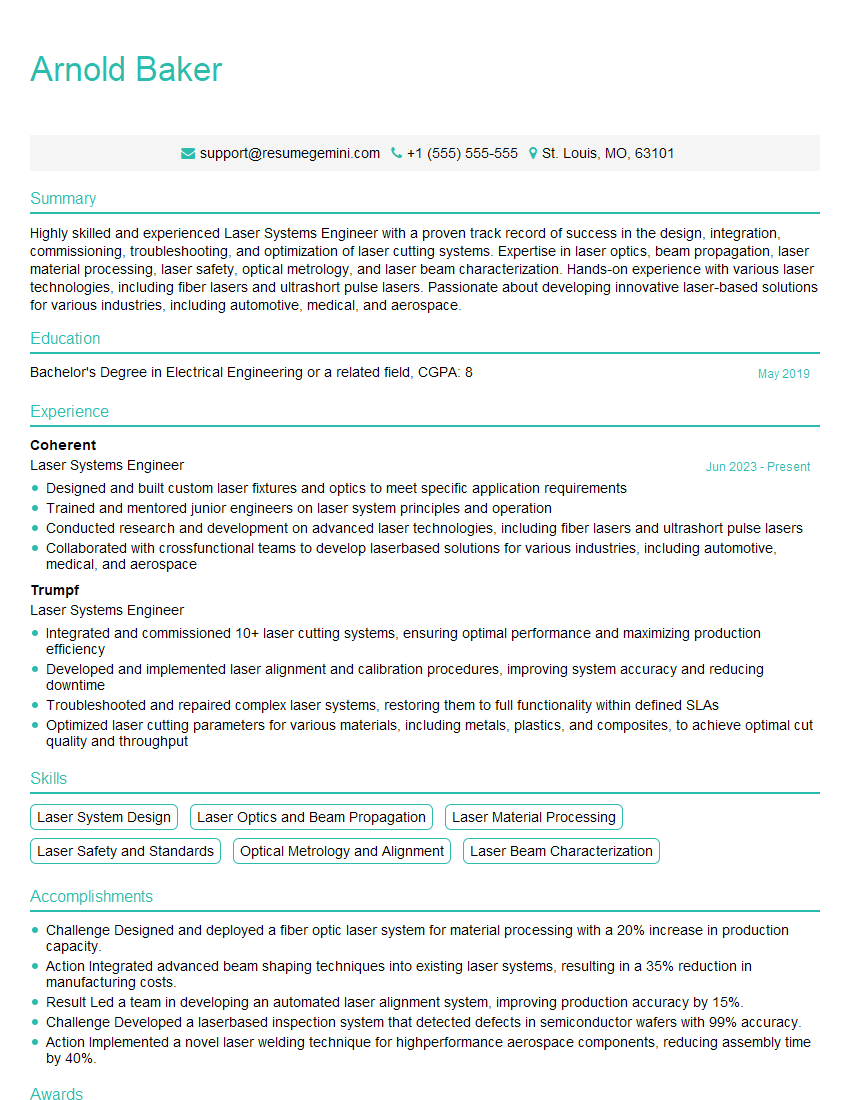
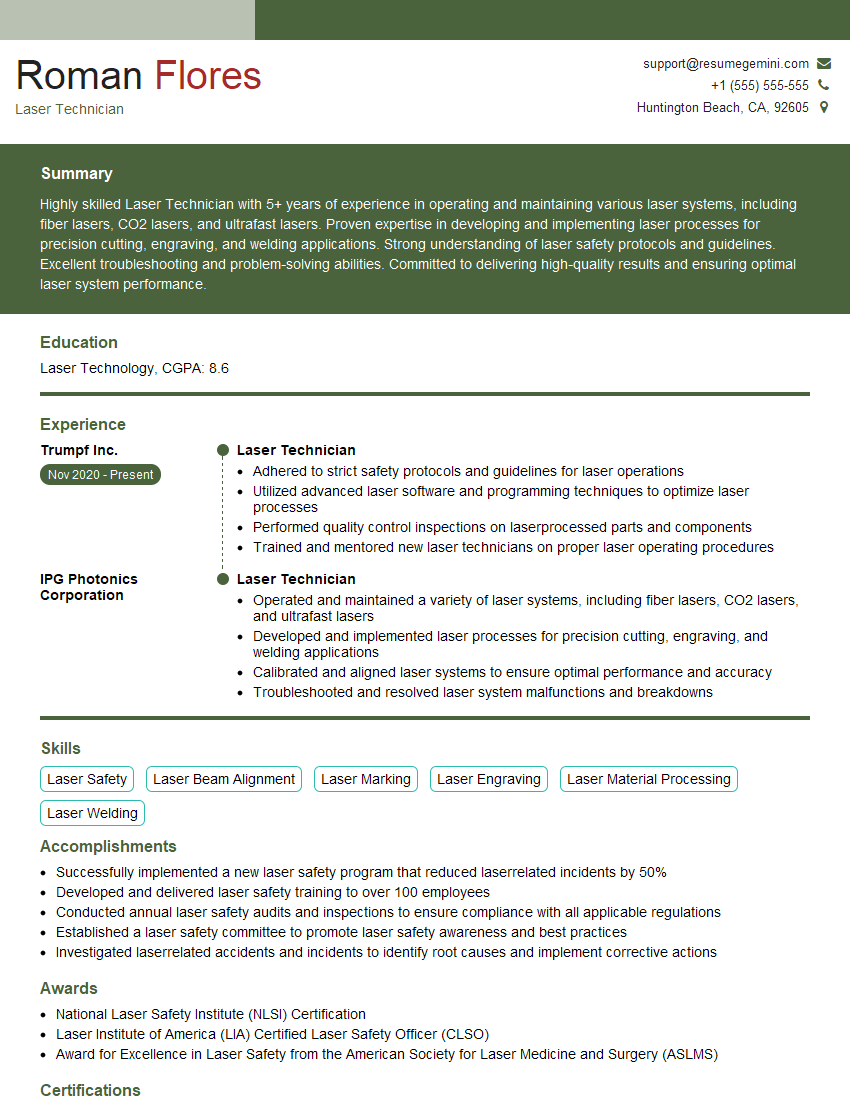
Mastering Laser Bonding opens doors to exciting career opportunities in cutting-edge industries. To maximize your chances of landing your dream job, creating a strong, ATS-friendly resume is crucial. This ensures your application gets noticed by recruiters and hiring managers. ResumeGemini is a trusted resource that can help you build a professional and impactful resume tailored to the Laser Bonding field. We offer examples of resumes specifically designed for this industry to guide you. Take the next step towards your career success – build your best resume with ResumeGemini.
Explore more articles
Users Rating of Our Blogs
Share Your Experience
We value your feedback! Please rate our content and share your thoughts (optional).
What Readers Say About Our Blog
Really detailed insights and content, thank you for writing this detailed article.
IT gave me an insight and words to use and be able to think of examples