The thought of an interview can be nerve-wracking, but the right preparation can make all the difference. Explore this comprehensive guide to Floor Stripping and Waxing interview questions and gain the confidence you need to showcase your abilities and secure the role.
Questions Asked in Floor Stripping and Waxing Interview
Q 1. What types of floor stripping equipment are you familiar with?
Floor stripping equipment varies depending on the size and type of floor, but I’m proficient with several types. For smaller areas or detail work, I use handheld floor stripping machines – essentially powerful scrubbers with rotating pads that agitate and remove old wax and finish. For larger spaces, I utilize automatic floor scrubbers. These machines are significantly more efficient, using powerful brushes and a vacuum system to simultaneously clean and extract the soiled stripping solution. Finally, for extremely stubborn finishes or large commercial jobs, I employ a combination of these machines with specialized attachments like burnishing pads. The choice depends heavily on the job’s scope and the floor material itself.
For example, a small office might only require a handheld machine, while a large retail space would need an automatic scrubber for efficiency. Different pad types – nylon, synthetic, or even specialized abrasives – further enhance the machine’s effectiveness depending on the floor’s condition and the type of finish being removed.
Q 2. Describe the process of stripping a vinyl floor.
Stripping a vinyl floor is a delicate process, requiring careful attention to avoid damaging the floor’s surface. The first step is always thorough preparation. This includes clearing the area completely, protecting any adjacent surfaces, and pre-cleaning the floor to remove loose debris. Then, I apply a commercial-grade vinyl floor stripper according to the manufacturer’s instructions. It’s crucial to understand that different strippers are formulated for different vinyl types, so using the correct product is essential.
Once applied, the stripper needs time to dwell, usually 10-15 minutes, allowing it to break down the old wax or finish. Afterward, using a floor stripping machine (handheld or automatic, depending on the area), I scrub the floor, working in small sections to ensure thorough coverage. The soiled solution is collected by the machine’s vacuum system. If needed, I may repeat the process to ensure all the old finish is removed. Finally, I rinse the floor with clean water several times, ensuring all traces of the stripper are removed. Proper rinsing is critical to avoid residue buildup and potential damage to the vinyl. The floor is then allowed to dry completely before applying a new finish.
Q 3. How do you determine the appropriate type of wax for a particular floor?
Choosing the right wax depends entirely on the type of floor and the desired finish. Hardwood floors, for example, often benefit from a paste wax for a rich, high-gloss shine, while vinyl floors may require a water-based acrylic finish for durability and ease of maintenance. The level of traffic the floor endures also influences the choice; high-traffic areas might necessitate a more durable, commercial-grade wax.
I always consult the floor manufacturer’s recommendations. They often provide specifications about suitable waxes, helping prevent damage. For instance, some delicate stone floors may only tolerate specific types of sealers, while others might only need a water-based acrylic sealer. Proper identification of the floor type is paramount. Often, I will conduct a small, inconspicuous test area to ensure compatibility before applying the wax to the entire floor.
Q 4. What are the different types of floor waxes available?
There’s a wide range of floor waxes, each with its properties and applications. Paste waxes offer a deep, lustrous shine but require more effort to apply and buff. Liquid waxes are easier to apply but may not produce as high a gloss. Self-leveling waxes are convenient but can be more expensive. Water-based acrylic finishes are popular for their durability and ease of maintenance, while emulsion waxes provide a good balance between ease of use and shine.
Commercial-grade waxes are formulated for heavy traffic areas and offer enhanced protection. Finally, there are specialized waxes designed for specific flooring types like hardwood, vinyl, or even marble. Choosing the right type is a crucial aspect of achieving a durable and aesthetically pleasing finish.
Q 5. Explain the process of applying a wax finish to a hardwood floor.
Applying wax to a hardwood floor starts with meticulous preparation. The floor needs to be thoroughly cleaned and dried. Any existing finish should be removed or properly prepared. Next, I select the appropriate wax, considering the type of wood and desired finish. I typically work in small sections, applying the wax evenly using a clean applicator pad or lambswool applicator. The method of application depends on the type of wax; paste waxes often require a more deliberate application, while liquid waxes might require a wider, thinner spread.
Once applied, I allow the wax to dry according to the manufacturer’s instructions, usually for a few hours. Then, using a buffer machine with a clean pad, I buff the floor to a high shine. This process removes excess wax and creates a smooth, even surface. Multiple coats might be necessary depending on the desired level of protection and shine.
Q 6. How do you ensure even application of floor wax?
Even application is key to a professional finish. I achieve this through several strategies. First, meticulous preparation is crucial. A clean, dry floor ensures consistent wax absorption and prevents streaks. Next, I use consistent application pressure and overlapping strokes to avoid missed spots. For larger areas, I use a specialized applicator or a floor waxer to ensure uniform coverage.
Small sections and systematic work are invaluable. I work methodically in small, manageable areas, ensuring each section receives equal attention before moving on. Regular checks for consistency throughout the process are essential to detect any unevenness early on. After drying, the buffing stage further contributes to evenness by removing excess wax and polishing the surface.
Q 7. What safety precautions do you take when handling floor stripping chemicals?
Safety is paramount when handling floor stripping chemicals. I always wear appropriate personal protective equipment (PPE), including gloves, eye protection, and a respirator. This protects me from potential skin irritation, eye damage, and inhalation of harmful fumes. The work area is well-ventilated to reduce the concentration of chemical vapors. Furthermore, I follow the manufacturer’s instructions diligently regarding dilution, application, and disposal.
I also ensure that children and pets are kept away from the work area while the chemicals are in use and until the floor has completely dried. Spill kits and emergency eyewash stations are readily available. Proper disposal of chemical waste is also a critical safety aspect; I carefully follow all local regulations and guidelines for the disposal of chemical materials.
Q 8. How do you deal with difficult stains or damage before stripping and waxing?
Addressing difficult stains or damage before stripping and waxing is crucial for achieving a flawless finish. Think of it like prepping a canvas before painting a masterpiece – you wouldn’t start without ensuring the surface is clean and sound. My approach involves a multi-step process:
Identification: First, I carefully identify the type of stain or damage. Is it a water stain, a scuff mark, a burn mark, or something else? Different stains require different treatments.
Pre-Treatment: For water stains, I might use a wood cleaner specifically designed to lift the stain without damaging the finish. Scuffs might require a gentle abrasive cleaner. For more stubborn stains, I may need to use a specialized stain remover, always testing it in an inconspicuous area first to ensure it doesn’t damage the floor.
Repair: In cases of significant damage like gouges or scratches, I might need to perform minor repairs before stripping. This could involve filling the damage with wood filler, sanding it smooth, and then staining to match the surrounding area.
Cleaning: After treating and repairing any damage, a thorough cleaning is essential to remove any residue from the cleaning or repair process. This ensures a clean and even surface for the stripping process.
For example, I once worked on a gym floor with deep scuff marks from weight equipment. I used a combination of a heavy-duty cleaner and a rotary buffer with a coarse pad to lift the scuffs, followed by a fine pad to smooth the surface before stripping and waxing.
Q 9. What are the signs of a floor that needs stripping and re-waxing?
A floor needs stripping and re-waxing when it shows signs of wear and tear, much like an old coat needs replacing. These signs include:
Dullness: The most obvious sign is a significant loss of shine. The floor appears dull and lifeless.
Scratches and Scuff Marks: Excessive scratches and scuffs indicate the protective wax layer is worn down.
Build-up of Old Wax: Layers of old wax can create a cloudy or sticky appearance. This buildup also reduces the effectiveness of cleaning and can trap dirt.
Deteriorating Finish: Cracking, peeling, or bubbling of the wax layer is a clear indication it needs replacing.
Uneven Appearance: Patches of shine or dullness reveal inconsistencies in the wax application or wear.
Imagine a car – a dull, scratched-up paint job needs a new coat. Similarly, a worn-out floor needs stripping and re-waxing to restore its original beauty and protection.
Q 10. How do you maintain the shine and longevity of a waxed floor?
Maintaining the shine and longevity of a waxed floor involves a combination of regular cleaning and protective measures. Think of it as regular maintenance for a car to keep it running smoothly:
Regular Cleaning: Dust and debris should be removed regularly using a dust mop or vacuum cleaner. Avoid using excessive water, as this can damage the wax.
Periodic Damp Mopping: Periodically mop the floor using a slightly damp mop with a neutral pH cleaner specifically designed for waxed floors. Avoid harsh chemicals that can strip the wax.
Protective Mats: Place mats at entrances to prevent dirt and debris from being tracked onto the floor.
Furniture Pads: Use furniture pads to protect the floor from scratches and indentations caused by furniture legs.
Periodic Buffing: Occasionally, you can use a buffer with a polishing pad to restore shine and even out the wax layer. This is especially helpful to prevent the build-up of old wax.
Protective Coating (Optional): In high-traffic areas, consider applying a protective topcoat over the wax to increase its durability and longevity.
For instance, a high-traffic office floor will require more frequent cleaning and buffing than a low-traffic bedroom floor. Adapting your maintenance routine to the specific area’s needs is essential.
Q 11. What are the common problems encountered during floor stripping and waxing?
Several common problems can arise during floor stripping and waxing. Being aware of these potential issues allows for proactive measures:
Uneven Stripping: This occurs if the stripper isn’t applied evenly or if the floor isn’t properly prepared. It results in a patchy finish.
Residual Stripper: If the stripper isn’t completely removed, it can interfere with the wax application, leading to poor adhesion and a dull finish.
Improper Wax Application: Applying too much or too little wax can lead to an uneven or dull finish. The incorrect type of wax for the floor type can also be problematic.
Streaking: This often results from improper application techniques, uneven drying, or not allowing sufficient drying time between coats.
Chemical Reactions: Using incompatible cleaning products or chemicals can damage the floor or react negatively with the wax.
For example, I once encountered a situation where the previous contractor hadn’t completely removed the old stripper, resulting in a sticky, uneven wax finish. To solve this, I had to thoroughly clean the floor again, ensuring complete removal of the residue before re-applying the wax.
Q 12. How do you troubleshoot a poorly applied wax finish?
Troubleshooting a poorly applied wax finish requires a systematic approach. First, identify the specific problem: is it uneven, dull, sticky, or streaky?
Uneven Finish: This could indicate uneven wax application. The solution is to lightly strip the floor (using a gentle stripper) and reapply the wax, paying close attention to even distribution.
Dull Finish: This might be due to insufficient wax, old wax buildup, or residual stripper. Cleaning and buffing can help restore some shine. If this doesn’t work, a light stripping and re-waxing might be necessary.
Sticky Finish: This often means insufficient drying time between coats or residual stripper. Thoroughly cleaning the floor and allowing ample drying time between coats is crucial for resolving this issue.
Streaky Finish: Streaks usually result from improper application techniques. Using the right tools and techniques, like applying thin, even coats and allowing adequate drying time, is key. In some cases, a light stripping may be necessary.
Remember that patience is key. In some instances, a complete re-waxing might be the best solution; however, a light stripping or a careful cleaning can often resolve minor issues.
Q 13. Describe your experience with different floor types (e.g., hardwood, vinyl, tile).
My experience encompasses various floor types, each requiring a tailored approach:
Hardwood: Hardwood floors are beautiful but delicate. Stripping and waxing hardwood requires careful selection of strippers and waxes to avoid damage. I use low-pH strippers and high-quality waxes specifically formulated for hardwood to protect the natural wood.
Vinyl: Vinyl floors are more resilient and require less delicate handling. However, using abrasive cleaners or strippers can damage the vinyl’s surface. I utilize strippers and waxes designed specifically for vinyl to maintain its appearance without causing damage.
Tile: Tile floors are usually easier to maintain, but the grout needs specific attention. I often focus on deep cleaning the grout lines before waxing the tile surface to ensure a clean and even appearance. Using a non-yellowing wax is also crucial for tile floors.
Each floor type presents unique challenges and requires specific knowledge and technique. For example, stripping a hardwood floor requires more delicate handling compared to stripping a resilient vinyl floor. I adjust my techniques and materials based on the floor’s material and condition.
Q 14. What are the best practices for disposing of floor stripping chemicals?
Proper disposal of floor stripping chemicals is vital for environmental safety and compliance with regulations. Never pour these chemicals down the drain or into the environment.
Check Local Regulations: Always consult your local waste disposal guidelines for specific instructions on how to dispose of hazardous waste, including floor stripping chemicals.
Neutralization (If Possible): Some strippers can be neutralized before disposal. Check the product’s safety data sheet (SDS) for instructions. Neutralization reduces the chemical’s harmful effects.
Designated Hazardous Waste Disposal: Most municipalities offer designated hazardous waste collection centers. These centers handle hazardous materials safely and properly.
Proper Container Labeling: Always label the containers clearly with the contents and any relevant hazard warnings. This prevents accidents and makes disposal easier for waste handlers.
Professional Waste Removal: For large-scale projects, it’s recommended to hire a professional waste removal service specializing in hazardous waste disposal.
Ignoring safe disposal practices can lead to serious environmental damage and health risks. Always prioritize safety and comply with all applicable regulations.
Q 15. How do you ensure the safety of yourself and others while working with stripping chemicals?
Safety is paramount when working with floor stripping chemicals. These solutions are often caustic and can cause skin irritation, respiratory problems, or eye damage. My approach to safety is multifaceted and begins long before I even start stripping.
- Personal Protective Equipment (PPE): I always wear appropriate PPE, including chemical-resistant gloves (nitrile is preferred), safety glasses or goggles, and a respirator specifically designed for the chemicals being used. This protects against splashes, fumes, and dust.
- Ventilation: Adequate ventilation is crucial. I use industrial-strength fans to circulate air and exhaust fumes to the outside. In poorly ventilated areas, I may even consider using a specialized air-purifying respirator.
- Proper Handling and Mixing: I carefully follow the manufacturer’s instructions for mixing and handling the stripping solution. This includes using the correct ratio of concentrate to water and avoiding splashing. I always mix in a well-ventilated area.
- Safety Training and Awareness: All my crew members receive comprehensive safety training, and we regularly review safety procedures to ensure everyone is aware of the potential hazards and how to mitigate them. This includes knowing the location of emergency eyewash stations and safety showers.
- Emergency Preparedness: Before beginning the project, I ensure that emergency response plans are in place, and everyone on the team knows what to do in case of an accident. We maintain a readily available supply of neutralizing agents and first-aid materials.
Think of it like this: we treat these chemicals with the respect they deserve. A small amount of extra caution goes a long way in preventing injuries and ensuring a safe work environment.
Career Expert Tips:
- Ace those interviews! Prepare effectively by reviewing the Top 50 Most Common Interview Questions on ResumeGemini.
- Navigate your job search with confidence! Explore a wide range of Career Tips on ResumeGemini. Learn about common challenges and recommendations to overcome them.
- Craft the perfect resume! Master the Art of Resume Writing with ResumeGemini’s guide. Showcase your unique qualifications and achievements effectively.
- Don’t miss out on holiday savings! Build your dream resume with ResumeGemini’s ATS optimized templates.
Q 16. What is the proper way to clean and maintain stripping and waxing equipment?
Maintaining stripping and waxing equipment is critical for its longevity and optimal performance. Neglecting this can lead to costly repairs, inefficient work, and even safety hazards.
- Floor Buffers: After each use, I remove all residue from the buffer pad using a stiff brush or appropriate cleaning solution. The buffer itself should be thoroughly wiped down, and any remaining solution should be rinsed and dried. Regular lubrication according to the manufacturer’s guidelines is essential, too. Storage in a dry location is critical to preventing rust and damage.
- Vacuum Cleaners/Extractors: Empty and clean the dust collection bin and filter after each use. The vacuum’s exterior should be wiped clean. If using an extraction machine for stripping solution recovery, then emptying, cleaning, and flushing the tank are necessary steps. Regularly check the vacuum’s hoses and belts for any damage or wear and tear.
- Mixing Buckets and Tools: Rinse and thoroughly clean all mixing buckets, squeegees, and mops immediately after use. Allow them to air-dry completely to prevent mildew and bacterial growth. Store tools and equipment in a designated area, organized and away from chemical spills.
Regular maintenance is like preventative medicine for your equipment. It saves money in the long run and keeps everything working smoothly and efficiently.
Q 17. What are the different types of floor buffers and their uses?
Several types of floor buffers are used in floor stripping and waxing, each suited for specific tasks.
- Single-Disc Machines: These are highly versatile and used for stripping, scrubbing, polishing, and buffing. They’re excellent for smaller areas or intricate work because of their maneuverability. The speed and pad type are adjustable depending on the task.
- Burnishing Machines: High-speed machines used to create a high gloss on finished floors. They are typically used after waxing to achieve a mirror-like shine and have extremely fine abrasive pads.
- Orbital Buffers: These are commonly used for waxing and polishing. Their orbital motion prevents scuffing and reduces the chances of damage to the floor. They are ideal for larger areas and offer less aggressive polishing compared to single-disc machines.
- High-Speed Buffers: These machines are capable of higher RPMs and are primarily used for polishing and enhancing shine on waxed floors, often in larger commercial settings. It’s crucial to use appropriate pads to prevent damage.
Choosing the right buffer depends entirely on the job. For example, a high-speed buffer would be overkill for a small residential area, while a single-disc machine is extremely versatile and well-suited for most situations. The right tool makes all the difference in achieving a professional finish.
Q 18. How do you calculate the amount of stripping solution needed for a given area?
Calculating the amount of stripping solution needed is crucial for efficient and cost-effective work. It avoids waste and ensures adequate coverage. I typically follow these steps:
- Measure the area: Accurately measure the area of the floor to be stripped in square feet (or square meters).
- Check the manufacturer’s instructions: Consult the stripping solution’s label or the technical data sheet for dilution ratios and coverage rates (typically expressed as gallons or liters per square foot/meter).
- Calculate the needed quantity: Multiply the floor area by the manufacturer’s recommended coverage rate. This provides the total amount of *diluted* solution needed.
- Adjust for concentration: If the solution is a concentrate, adjust the calculation according to the dilution ratio provided on the product label. For example, if the ratio is 1:4 (concentrate to water), you’ll need 1/5 of the total calculated volume as concentrate.
Example: Let’s say the floor area is 500 square feet, and the manufacturer recommends 1 gallon of diluted solution per 100 square feet. You would need 5 gallons of diluted solution. If it’s a 1:4 concentrate, you would use 1 gallon of concentrate and 4 gallons of water.
Accurate measurement and following the manufacturer’s instructions are essential for a successful stripping job.
Q 19. How do you manage your time effectively when stripping and waxing large areas?
Efficient time management on large projects involves careful planning and execution. This is not about rushing, but about strategic workflow.
- Detailed planning: I thoroughly assess the area, taking into account the type of flooring, the existing finish, and the overall condition. I then create a detailed work schedule, breaking the project into manageable sections. This schedule includes time for stripping, rinsing, drying, and waxing.
- Teamwork and division of labor: For large areas, I utilize a team, assigning specific tasks to each member. This includes one team for stripping, one for rinsing, and another for waxing. Each team moves in a systematic manner, ensuring efficient progress.
- Prepping the area: Clearing the area of furniture and obstructions is a major time saver. Protecting walls and baseboards with masking tape prevents damage during the stripping and waxing process.
- Proper equipment and supplies: Having all necessary materials and equipment readily available prevents delays in searching for items, and reduces downtime. This includes having extra pads, buckets, and solutions on hand.
- Monitoring progress: Regularly monitor the team’s progress and address any bottlenecks or challenges promptly to maintain the project schedule.
Think of it like an assembly line; each team member has a specific role, and a well-coordinated effort maximizes efficiency and minimizes overall project time.
Q 20. What are some common mistakes to avoid during the floor stripping process?
Several common mistakes can compromise the floor stripping process and lead to subpar results. Avoiding these is crucial.
- Using the wrong stripping solution: Using a solution not compatible with the floor type can damage the flooring itself. Always carefully review the product information and select the appropriate solution for the type of flooring.
- Incorrect dilution ratio: Not adhering to the manufacturer’s recommended dilution ratio can result in ineffective stripping, leaving residue, or even damaging the floor surface. Always meticulously follow the instructions.
- Insufficient dwell time: Not allowing the stripping solution enough time to break down the old wax can lead to incomplete removal. Allow the solution to dwell for the recommended amount of time as per the manufacturer’s instructions.
- Inadequate rinsing: Leaving stripping solution residue on the floor can negatively impact the adhesion of the new wax. Thorough rinsing and neutralisation is key to achieving a high-quality finish.
- Applying wax too thickly: This can result in long drying times and can lead to a sticky or uneven finish. Follow recommended application rates provided by the manufacturer.
These seemingly small errors can easily cause major problems and necessitate additional work. A little forethought and adherence to best practices always pay off.
Q 21. How do you identify and address different floor damage types before waxing?
Identifying and addressing floor damage before waxing is critical for a long-lasting, attractive finish. Neglecting this can lead to premature wear and tear.
- Scratches and gouges: Minor scratches can often be buffed out, while deep gouges may require filling with a suitable filler before waxing. This ensures a smooth surface for a uniform wax application.
- Cracks and chips: Larger cracks or chips require repair using appropriate patching compounds, allowing ample drying time before waxing.
- Stains: Some stains may be removed with specialized cleaners, but others might require more invasive treatments like sanding or refinishing. For persistent stains, consulting a flooring specialist might be necessary.
- Loose or damaged tiles: Loose or damaged tiles should be replaced or repaired before waxing to prevent further damage or unevenness. This is especially true for tiled surfaces.
- Uneven surfaces: Significant unevenness can compromise the wax layer, making it susceptible to wear and tear. Addressing these imperfections before waxing is crucial.
Think of floor preparation like preparing a canvas for painting. A damaged canvas yields poor artwork, just as damaged floors won’t hold a polished wax finish properly. Addressing these issues proactively ensures a top-quality result.
Q 22. What is your experience with using different types of floor stripping machines?
My experience with floor stripping machines spans over a decade, encompassing various types, from smaller, single-disc machines ideal for smaller areas and intricate detailing, to larger, industrial-sized orbital machines perfect for large spaces like gymnasiums or warehouses. I’m proficient with both propane and electric models. For instance, I’ve used the Tennant T12 floor machine for its robust performance on heavy-duty stripping jobs, and smaller, battery-powered machines for precise work in sensitive areas like hallways with intricate designs. The choice of machine always depends on the job; the square footage, the type of floor (concrete, wood, vinyl), and the condition of the existing finish heavily influence my machine selection. I’m also familiar with the safety protocols and maintenance procedures associated with each type of machine.
- Single-disc machines: Excellent for detail work and smaller areas.
- Orbital machines: Ideal for larger areas and provide a more even stripping action.
- Propane machines: Offer powerful stripping for heavily soiled floors.
- Electric machines: More environmentally friendly and quieter than propane counterparts.
Q 23. Describe your experience working with different types of floor finishes.
My expertise extends to a wide range of floor finishes, including acrylics, urethanes, sealers, and waxes. I understand the unique characteristics of each and how these characteristics impact the stripping and re-finishing process. For example, acrylic finishes are generally easier to strip than urethanes, which can require multiple passes and stronger solutions. Working with epoxy finishes requires a specialized approach, and I have experience handling these challenges effectively. I’ve worked with various gloss levels, from high-gloss finishes that demand precision to matte finishes that require a different application technique. In one project, we were tasked with removing a decades-old layer of shellac from a historic hardwood floor. This required a careful, methodical approach, using specialized stripping agents and gentle scrubbing to avoid damage.
- Acrylics: Relatively easy to strip and maintain.
- Urethanes: Durable but require more aggressive stripping methods.
- Epoxy: Needs specialized stripping solutions and techniques.
- Wax: Requires multiple stripping and cleaning steps for complete removal.
Q 24. How do you ensure that the finished floor is free from streaks and unevenness?
Achieving a streak-free and even finish is paramount. This is a matter of careful technique, proper equipment, and the right products. It begins with thorough preparation, which includes a meticulous initial stripping process to remove all old finish completely. I ensure all residues are removed with multiple rinses. During the application of the new finish, I use consistent and overlapping strokes, working in sections to maintain a wet edge. This prevents lap marks and ensures even distribution. The use of high-quality equipment, like a well-maintained floor buffer or automatic scrubber-dryer, contributes significantly to a uniform finish. Finally, careful attention to drying time and avoiding interruptions during the drying process prevents imperfections.
- Thorough stripping: Remove all residue from previous finishes.
- Multiple rinses: Remove all traces of stripping solution.
- Consistent application: Overlapping strokes to avoid lap marks.
- Proper equipment: Use well-maintained buffers and scrubbers.
- Controlled drying: Allow adequate drying time without interruption.
Q 25. Explain your understanding of various floor sealant types and their applications.
My understanding of floor sealants is comprehensive. I’m familiar with various types, including water-based sealers, oil-based sealers, and specialized sealants for specific flooring types like concrete or wood. Water-based sealers are generally easier to clean up but might not offer the same durability as oil-based options. Oil-based sealants offer superior protection but require more careful handling. The choice of sealant depends heavily on the type of floor, the intended use of the space, and the desired level of protection. For example, a high-traffic commercial kitchen would benefit from a durable, high-gloss urethane sealant, while a residential setting might be better suited to a more low-maintenance, water-based option. I’m skilled in applying each type effectively, understanding the drying times and curing periods for optimal results.
- Water-based sealers: Easy cleanup, lower durability.
- Oil-based sealers: Higher durability, more challenging cleanup.
- Specialty sealants: Designed for specific floor types (e.g., concrete, wood).
Q 26. How do you prioritize different floor cleaning tasks in a busy environment?
Prioritizing tasks in a busy environment requires a systematic approach. I use a combination of urgency and importance to determine the order. High-priority tasks, such as addressing immediate safety hazards (e.g., spills), always take precedence. Then, I assess the impact of each task on the overall cleanliness and appearance of the facility. Tasks that affect high-traffic areas generally get prioritized over those in less-used spaces. I often create a schedule that combines both preventative maintenance (e.g., routine cleaning) and reactive maintenance (e.g., addressing damage) to keep everything running smoothly. Using checklists and communication with the client or management helps ensure that I address everything efficiently and effectively.
- Safety hazards: Immediate attention to spills or damaged areas.
- High-traffic areas: Prioritize cleaning and maintenance in these spaces.
- Preventative maintenance: Regular cleaning and polishing to prevent more serious problems.
- Reactive maintenance: Addressing unexpected issues like damage or spills.
Q 27. What is your experience with environmentally friendly floor stripping and waxing products?
I have significant experience with environmentally friendly products for floor stripping and waxing. These products are formulated to minimize the impact on the environment and the health of workers. They often utilize biodegradable solvents and are designed to reduce VOC (Volatile Organic Compound) emissions. I’m familiar with various brands and their specific product lines, understanding their strengths and limitations. For instance, I’ve used citrus-based strippers that are effective yet gentler on the environment than traditional chemical strippers. While they might require a slightly longer stripping process, the environmental benefits make the trade-off worthwhile. Furthermore, I’m knowledgeable about proper disposal procedures for both used products and waste materials to ensure responsible environmental stewardship. I find these products perform nearly as well as traditional ones, making the switch a seamless process.
- Biodegradable solvents: Reduce environmental impact.
- Low-VOC formulas: Minimize harmful emissions.
- Citrus-based strippers: Effective and environmentally friendly alternative.
- Proper disposal: Adherence to responsible waste management practices.
Key Topics to Learn for Your Floor Stripping and Waxing Interview
- Floor Surface Preparation: Understanding different floor types (e.g., vinyl, hardwood, concrete), their specific needs, and appropriate preparation techniques before stripping and waxing.
- Chemical Selection and Application: Knowing the properties of various floor strippers and waxes, including their strengths, weaknesses, and safe handling procedures. This includes understanding the importance of proper dilution and application methods.
- Stripping Techniques: Mastering different stripping methods (e.g., machine stripping, hand stripping) and choosing the best approach based on floor type and condition. This includes understanding the importance of proper pressure and speed to avoid damage.
- Wax Application and Buffing: Knowing the proper techniques for applying different types of wax (e.g., paste wax, liquid wax) and achieving a smooth, even finish through effective buffing. This involves understanding the importance of even coats and drying time.
- Safety Procedures and Regulations: Understanding and adhering to all relevant safety regulations, including proper personal protective equipment (PPE) use and handling of chemicals. This includes awareness of potential hazards and emergency procedures.
- Equipment Maintenance and Troubleshooting: Familiarizing yourself with common floor stripping and waxing equipment (e.g., floor buffers, scrubbers) and performing basic maintenance and troubleshooting. This includes understanding preventative maintenance and recognizing signs of malfunction.
- Time Management and Efficiency: Demonstrating an understanding of efficient work practices to complete projects on time and within budget. This includes optimizing workflows and utilizing resources effectively.
- Quality Control and Inspection: Knowing how to inspect finished floors for imperfections and ensuring they meet high quality standards. This includes understanding the importance of detail-oriented work and identifying potential issues before they become significant problems.
Next Steps
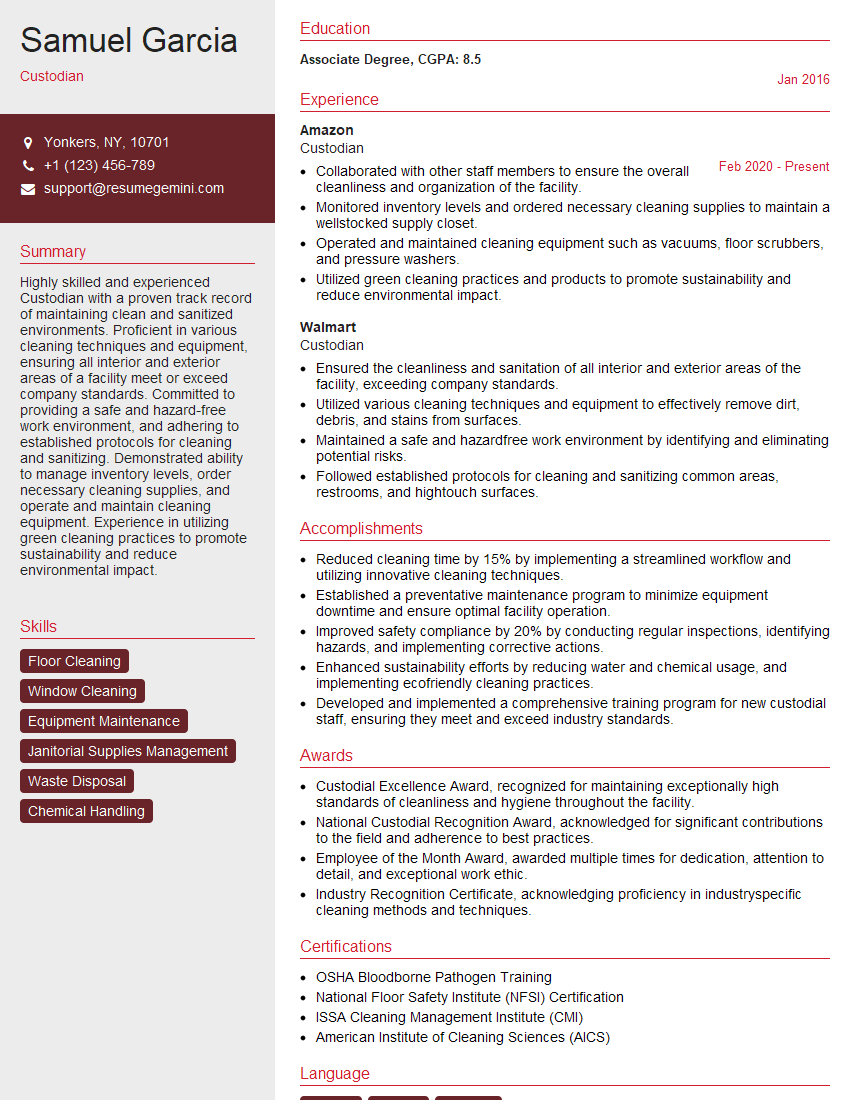
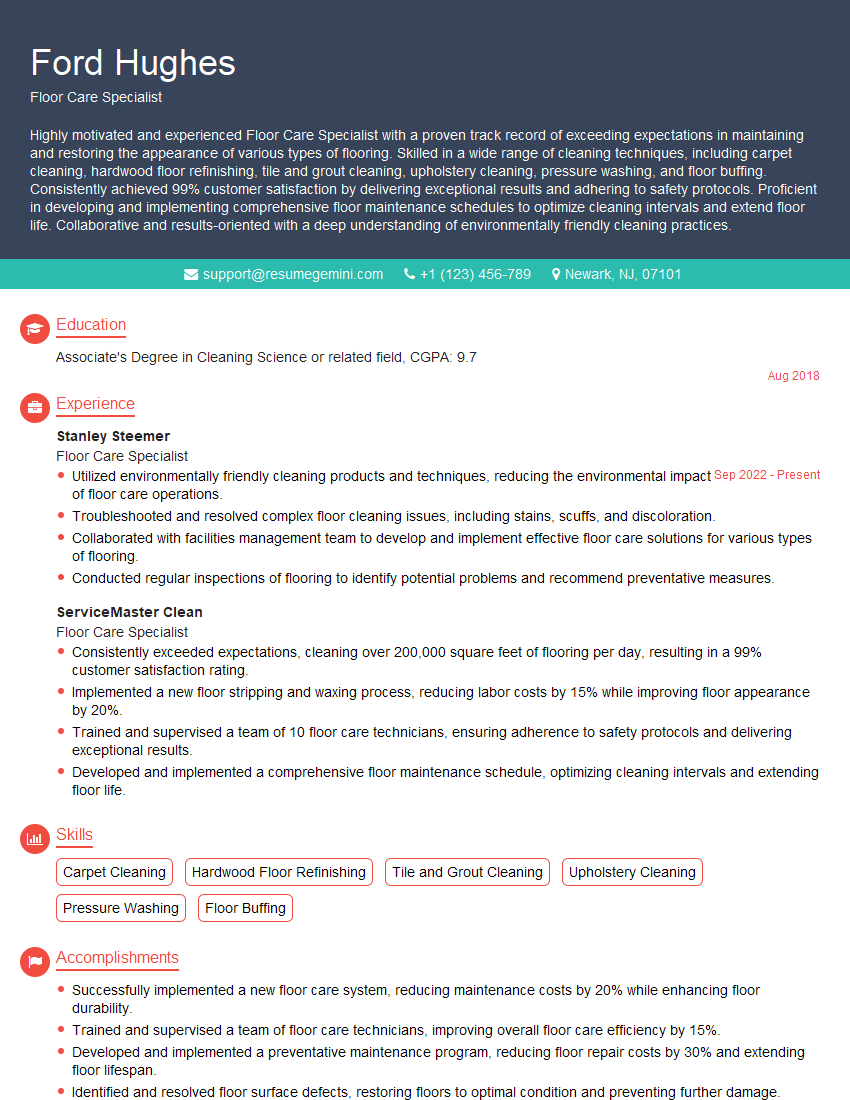
Mastering floor stripping and waxing is a valuable skill that opens doors to diverse opportunities and career advancement within the facilities maintenance industry. A well-crafted resume is crucial for showcasing your abilities and securing your ideal role. Make your resume stand out by using ResumeGemini to create an ATS-friendly resume that highlights your expertise. ResumeGemini provides examples of resumes tailored specifically to the Floor Stripping and Waxing field to help you get started. Invest in your future; craft a resume that reflects your skills and experience and lands you the interview you deserve.






Explore more articles
Users Rating of Our Blogs
Share Your Experience
We value your feedback! Please rate our content and share your thoughts (optional).
What Readers Say About Our Blog
Really detailed insights and content, thank you for writing this detailed article.
IT gave me an insight and words to use and be able to think of examples