Cracking a skill-specific interview, like one for Drywall repair and patching, requires understanding the nuances of the role. In this blog, we present the questions you’re most likely to encounter, along with insights into how to answer them effectively. Let’s ensure you’re ready to make a strong impression.
Questions Asked in Drywall repair and patching Interview
Q 1. What types of drywall are you familiar with?
Drywall comes in various types, each suited for different applications. The most common are:
- Standard Gypsum Drywall: This is the most frequently used type, offering good strength and fire resistance. It’s readily available and relatively inexpensive, making it ideal for most residential projects.
- Moisture-Resistant Drywall (MR): Designed for bathrooms and other high-humidity areas, this type contains additives that help it resist moisture damage. It’s crucial to use MR drywall in these locations to prevent mold and mildew growth.
- Fire-Resistant Drywall (FR): This drywall has added materials that significantly enhance its fire resistance rating. It’s often used in areas requiring stricter fire safety codes, such as around fireplaces or in commercial buildings.
- Type X Drywall: A more robust fire-resistant type, Type X drywall provides a higher level of fire protection compared to standard FR drywall. It’s often mandated in certain construction projects.
- Cement Board: While not technically drywall, cement board is often used in areas subject to extreme moisture, such as exterior walls or shower surrounds. Its strength and water resistance make it a perfect choice for these demanding environments.
Understanding the different types of drywall is key to choosing the right material for any repair job, ensuring longevity and preventing future problems.
Q 2. Describe your experience with drywall taping and mudding techniques.
Drywall taping and mudding is the art of seamlessly blending repaired areas with existing drywall. My experience encompasses all aspects of this process, from preparing the surface to applying multiple coats of compound to achieve a smooth, flawless finish. I’m proficient in using various taping knives, from 4-inch to 12-inch blades, to create clean, even tape lines. I understand the importance of applying thin, even coats of joint compound (mud) to prevent cracking and ensure a professional-looking repair. I’m also adept at techniques like feathering the edges of the mud to create a gradual transition into the surrounding wall. I’ve worked on both small patches and large-scale projects, consistently achieving superior results by paying meticulous attention to detail. For example, on a recent job, I had to repair a significant section of damaged drywall in a high-traffic hallway. By carefully applying multiple coats of mud and diligently sanding between each coat, I achieved a finish that was virtually invisible, even upon close inspection.
Q 3. How do you prepare a wall surface for drywall repair?
Preparing the wall surface is crucial for a successful drywall repair. Think of it like prepping a canvas before painting—a smooth, clean base is essential for a flawless finish. The process involves several steps:
- Cleaning the area: Remove any loose debris, dust, or old paint that might interfere with adhesion.
- Removing loose drywall: Carefully scrape away any loose or damaged drywall material until you reach a solid, stable base. For small holes you could use a utility knife and for larger you might have to use a hammer and chisel.
- Priming (if necessary): If the underlying material is absorbent (like wood or plaster), applying a primer will help prevent the joint compound from being absorbed too quickly, creating a smoother finish.
- Sanding (if necessary): After removing loose material or applying primer, lightly sand the area to create a smooth surface for the patch.
Proper preparation prevents common issues like cracking and poor adhesion, guaranteeing a durable and professional-looking repair.
Q 4. Explain the process of patching a small hole in drywall.
Patching a small hole is a straightforward process. Assuming the hole is less than a foot in diameter, here’s how I approach it:
- Clean the area: Remove any loose debris from the hole.
- Cut a clean edge: Use a utility knife to create a clean, square or rectangular edge around the hole. This ensures a better bond with the patch.
- Apply a patch: Cut a piece of drywall slightly larger than the hole. You might need to use self-adhesive mesh tape over the edges and holes to reinforce them. Press it firmly into place.
- Apply joint compound: Apply thin coats of joint compound, feathering the edges each time to blend it with the surrounding wall. Allow each coat to dry completely before applying the next.
- Sand the area: Once the mud is dry, sand the patch smooth to match the surrounding wall. Use progressively finer sandpaper.
- Prime and paint: Prime the area to improve paint adhesion and then paint to match the wall color.
This method ensures a seamless and undetectable repair for smaller imperfections.
Q 5. How do you repair a larger damaged section of drywall?
Repairing larger damaged sections requires a more involved approach. For holes larger than a foot, replacing the section entirely is generally the best solution. Here’s the process:
- Cut out the damaged section: Using a utility knife and drywall saw, carefully cut out a rectangular section of drywall that encompasses the damaged area, ensuring you create straight, clean edges.
- Install a backing: If the hole goes all the way through the wall, you’ll need to install a backing piece of wood or metal to support the new drywall.
- Cut a replacement piece: Cut a new piece of drywall to fit the opening, ensuring it’s slightly larger than the cutout.
- Fasten the replacement piece: Secure the new piece to the wall using drywall screws. Make sure the screws are countersunk slightly below the surface.
- Tape and mud: Apply drywall tape over the seams and edges and apply several coats of joint compound, sanding between each coat until it’s smooth.
- Prime and paint: Prime and paint the repaired area to match the surrounding wall.
This method ensures structural integrity and a professional finish for larger repairs. For extremely large damaged areas, professional assistance may be necessary.
Q 6. What tools and materials are essential for drywall repair?
The essential tools and materials for drywall repair include:
- Drywall knife (6”, 8”, 12”): For applying joint compound and removing loose material.
- Utility knife: For cutting drywall and cleaning edges.
- Putty knife: For applying smaller amounts of compound.
- Drywall saw: For cutting larger sections of drywall.
- Sandpaper (various grits): For smoothing surfaces.
- Joint compound (mud): Comes in various types; all purpose is suitable for many projects.
- Drywall tape: Paper tape for seams and mesh tape for cracks.
- Drywall screws: For securing drywall pieces.
- Measuring tape and pencil: For accurate measurements and markings.
- Safety glasses and dust mask: For protection during sanding.
- Primer and paint: To match the surrounding wall.
Having these tools at hand ensures efficient and effective repairs. Remember to always prioritize safety by using appropriate safety gear.
Q 7. How do you match the texture of existing drywall when patching?
Matching the texture of existing drywall is crucial for a seamless repair. The existing wall’s texture might be smooth, lightly textured, or heavily textured (like a knockdown or orange peel). Here’s how to approach this challenge:
- Smooth walls: Achieving a smooth finish is relatively simple; just apply thin coats of compound and sand thoroughly.
- Lightly textured walls: After smoothing the compound, you can use a sponge or a textured roller to lightly apply texture to the patch. Practice on a scrap piece of drywall first to get the hang of it.
- Heavily textured walls: This requires more skill and often specialized tools like knockdown knives or hopper guns to replicate the original texture. For these more complex textures, it is often best to bring in a professional. In many cases, a professional will still need to use a specialized tool like a hopper gun.
Careful observation and attention to detail are key to successfully matching existing textures, ensuring a flawless repair that is practically invisible.
Q 8. What are the different types of drywall joint compound?
Drywall joint compound, also known as mud, comes in several types, each suited for different stages of the finishing process. The key differences lie in their consistency and drying time.
- All-Purpose Compound: This is a versatile option suitable for most patching and taping jobs. It’s relatively easy to sand and offers a good balance of workability and drying time.
- Lightweight Compound: Lighter than all-purpose, it’s ideal for larger areas because it’s less likely to crack as it dries. It’s also easier to apply multiple coats.
- Setting-Type Compound: This compound dries much faster than others, which is useful when you need quick turnaround time. However, it’s crucial to work quickly as it sets rapidly.
- Taping Compound: Specifically formulated for taping drywall seams, it’s designed for embedding the tape and creating a smooth base for subsequent coats. It’s usually thinner than all-purpose compound.
Choosing the right type depends on the project’s scope and your timeline. For a small patch, all-purpose might suffice. For extensive work or a fast-paced job, lightweight or setting-type compounds offer advantages.
Q 9. How do you ensure a smooth, seamless finish after patching?
Achieving a seamless, smooth finish after patching requires meticulous attention to detail and a systematic approach. Think of it like baking a cake; you need the right ingredients and technique.
- Proper Preparation: Ensure the area is clean and the patch is securely attached. Any loose debris or unevenness will show through the final finish.
- Thin Coats: Apply multiple thin coats of compound rather than one thick coat. This prevents cracking and allows for easier sanding between coats. It’s better to apply several thin layers than one thick one which can sag and crack.
- Feathering: Blend the edges of the patch smoothly into the surrounding wall by gradually reducing the thickness of each successive coat. This creates a seamless transition.
- Sanding: Use progressively finer grit sandpaper (e.g., 120, then 180, then 220) to sand between coats, removing any imperfections. Always sand lightly to avoid damaging the surrounding wall.
- Patience: Allow each coat to dry completely before sanding and applying the next. Rushing this process is a surefire way to ruin your work!
Consider using a flexible sanding sponge for curved surfaces to ensure even sanding. With practice and attention to detail, you’ll achieve a perfectly smooth, invisible patch.
Q 10. Explain your experience with various drywall finishing techniques (e.g., knockdown, orange peel).
Drywall finishing techniques allow for a wide variety of textures and styles. My experience includes both the common and more specialized finishes.
- Knockdown Texture: This involves applying a heavier coat of compound and then using a knockdown knife to create a textured, slightly rough surface. The depth of the knockdown determines the texture’s coarseness. I’ve used this extensively in homes with more rustic or informal styles.
- Orange Peel Texture: This technique employs a spray application of compound creating a speckled, orange-peel-like texture. It’s a very popular choice for concealing minor imperfections while adding visual interest. I prefer this method for creating a consistent texture across large areas.
- Smooth Finish: This classic approach aims for a perfectly smooth surface, requiring meticulous sanding and multiple thin coats. This is a more time-consuming process but ideal for contemporary or minimalist designs where clean lines are paramount.
Beyond these, I’m also proficient in creating custom textures by experimenting with different tools and techniques. The key is understanding the properties of the compound and having a steady hand.
Q 11. How do you handle water damage to drywall?
Water damage to drywall is a serious issue that requires immediate attention to prevent mold growth and structural damage. First, address the source of the water leak.
- Assess the Damage: Determine the extent of the water damage. If it’s only superficial, you might be able to clean and dry the area. But if the drywall is soft, discolored, or shows signs of mold, it needs to be replaced.
- Dry the Area: Use fans, dehumidifiers, and open windows to thoroughly dry the affected area. This is crucial in preventing mold growth.
- Remove Damaged Drywall: Cut out the damaged section, extending beyond the visibly affected area to ensure all compromised material is removed. The cut should be clean and square.
- Install New Drywall: Install a new piece of drywall, ensuring it’s properly secured to the studs.
- Finish and Paint: Once dry, patch and finish the new drywall using the appropriate techniques and prime and paint to match the surrounding area.
Remember, when dealing with significant water damage, it is always advisable to consult with a professional to ensure proper remediation and avoid future issues. Mold remediation often requires specialized skills and equipment.
Q 12. What is the proper way to prime and paint repaired drywall?
Proper priming and painting are essential for ensuring the longevity and appearance of your drywall repair. It’s not enough just to paint over it; you need to create a solid base.
- Prime: Use a high-quality drywall primer designed to seal the surface and improve paint adhesion. This is particularly crucial for patches, as the repaired area may absorb paint differently than the surrounding wall.
- Allow Drying: Allow the primer to dry completely according to the manufacturer’s instructions. This usually takes several hours.
- Paint: Use at least two coats of paint, allowing each coat to dry before applying the next. This ensures complete coverage and a uniform finish. The second coat helps to even out the color and ensure a flawless result.
- Matching Paint: When repairing an existing wall, it is crucial to either obtain a sample of the existing paint color and try to match it exactly or to purchase enough of the original paint to complete the repair. This prevents noticeable color discrepancies that would highlight the patch.
Using a high-quality brush or roller will help to achieve a smoother and more professional finish. Consider using a slightly damp cloth to carefully remove any excess paint or drips before they dry.
Q 13. Describe your experience with drywall corner bead installation and repair.
Corner bead installation and repair are crucial for protecting drywall corners from damage and ensuring a clean, finished look. It’s a skill that takes practice, but the results are noticeable.
- Installation: Corner beads are typically fastened using drywall screws every 6-8 inches. Ensure the bead is flush with the drywall surface. Application of compound follows to embed the bead and create a smooth transition.
- Repair: If a corner bead is damaged, carefully remove the damaged section. Attach a new bead, ensuring proper alignment and secure fastening. Apply compound to cover the seams and create a seamless finish, using the same techniques applied for drywall patching.
- Types of Corner Beads: There are various types of corner beads, including standard, bullnose, and inside corner beads. Each is designed for a specific application, and selecting the appropriate type is crucial for a successful outcome. Using the incorrect type can ruin the appearance of the finished work.
Proper corner bead installation and repair are critical for long-lasting durability and visual appeal. A poorly executed corner bead is a common eyesore, especially in high traffic areas.
Q 14. How do you deal with cracks in drywall?
Cracks in drywall can be caused by several factors, including settling, movement, or improper installation. Addressing them correctly is vital for preventing further damage.
- Assess the Crack: Determine the size, depth, and cause of the crack. Hairline cracks may simply require filling, while larger or deeper cracks might require more extensive repair.
- Prepare the Crack: Clean the crack thoroughly to remove any loose debris. For larger cracks, you may need to widen the crack slightly to allow for better compound adhesion. This helps to ensure the repair lasts.
- Fill the Crack: Use an appropriate joint compound to fill the crack. Apply it in thin layers, allowing each to dry before sanding. Feathering the edges is key to a seamless appearance.
- Reinforcement (if needed): For larger or recurring cracks, consider using a mesh tape or fiberglass tape to reinforce the repair, preventing the crack from reappearing.
- Sand and Finish: Sand the repaired area smoothly and finish with primer and paint to match the surrounding wall.
Ignoring cracks can lead to further structural damage. Addressing them promptly and using proper techniques ensures a strong, lasting repair.
Q 15. How do you repair holes caused by nails or screws?
Repairing nail or screw holes in drywall is a common task, and the approach depends on the hole’s size. Small holes, usually from picture hooks or small nails, can often be filled with spackle. Larger holes require a more involved process.
- Small Holes (less than 1/4 inch): Simply apply spackle directly into the hole, ensuring to press it firmly and remove any excess. Allow it to dry completely before sanding smooth.
- Medium Holes (1/4 to 1 inch): Use a drywall patch, cutting it slightly larger than the hole. Apply joint compound (mud) over the patch and feather the edges to blend seamlessly with the surrounding wall. Allow it to dry completely and sand smooth. This involves gradually applying thinner coats of mud to ensure a smooth transition to avoid a noticeable patch.
- Large Holes (greater than 1 inch): For larger holes, you’ll need to cut a clean, square or rectangular hole to create a solid base for the repair. A piece of drywall cut to fit the opening provides the most structurally sound repair. Secure it with screws and then proceed with the application of joint compound, feathering and sanding as needed. This step ensures that the patch is not loose, which would later lead to cracking or failure.
Remember to always prime the repaired area before painting to ensure proper adhesion and prevent the patch from showing through.
Career Expert Tips:
- Ace those interviews! Prepare effectively by reviewing the Top 50 Most Common Interview Questions on ResumeGemini.
- Navigate your job search with confidence! Explore a wide range of Career Tips on ResumeGemini. Learn about common challenges and recommendations to overcome them.
- Craft the perfect resume! Master the Art of Resume Writing with ResumeGemini’s guide. Showcase your unique qualifications and achievements effectively.
- Don’t miss out on holiday savings! Build your dream resume with ResumeGemini’s ATS optimized templates.
Q 16. What are the safety precautions you take when performing drywall repairs?
Safety is paramount when performing drywall repairs. I always prioritize the following precautions:
- Eye Protection: Safety glasses are essential to protect against dust and debris from sanding.
- Respiratory Protection: A dust mask, ideally an N95, is crucial to prevent inhaling drywall dust, which can irritate the lungs.
- Hearing Protection: If using power tools like a sanding machine, earplugs or muffs are necessary to protect hearing from excessive noise.
- Proper Ventilation: Work in a well-ventilated area or use a respirator to mitigate dust accumulation. Drywall dust is very fine and can remain suspended in the air for long periods.
- Fall Protection: When working at heights, always use a safety harness and appropriate fall protection measures.
- Tool Safety: Always use tools according to their instructions. Maintain sharp blades on utility knives to avoid accidental slips.
- Clean-up: Thoroughly clean up all dust and debris after completion to prevent hazards and maintain a clean workspace.
By adhering to these safety measures, I ensure my safety and the safety of those around me during the drywall repair process.
Q 17. Explain your experience working with different types of ceilings (e.g., popcorn, smooth).
I have extensive experience working with various ceiling types, including popcorn and smooth ceilings. Each presents unique challenges and requires different techniques.
- Popcorn Ceilings: Repairing popcorn ceilings requires careful attention to matching the texture. Often, I’ll use a spray-on texture to match the existing ceiling. If the damage is extensive, I’ll often take a sample of the popcorn texture to a paint store for matching, to ensure a seamless and almost undetectable repair. The key with popcorn ceilings is matching the texture and blending the repair.
- Smooth Ceilings: Smooth ceilings are generally easier to repair than popcorn ceilings. The focus is on creating a smooth, seamless surface using joint compound and meticulous sanding. However, careful application and sanding are critical to avoid visible imperfections. Often, I’ll use multiple thin coats of mud to avoid noticeable build-up, allowing each to dry completely before sanding.
Regardless of ceiling type, proper preparation, careful application of materials, and meticulous sanding are crucial for a professional finish.
Q 18. How do you handle difficult or unusual drywall repair challenges?
Difficult drywall repair challenges often involve extensive damage, unusual materials, or tricky access. I approach these situations methodically and creatively. For example:
- Extensive Water Damage: This often requires removing damaged drywall and replacing it entirely, ensuring proper drying to prevent mold growth. I’d inspect for any potential mold and moisture issues before beginning repairs to ensure long-term success.
- Unusual Materials: I have experience working with various materials beyond standard drywall, such as plaster walls. These repairs might involve specialized techniques or materials to match the existing surface. I would research and gather the appropriate tools and materials before beginning the repair.
- Tricky Access: Working in tight spaces or at heights requires careful planning and the use of specialized tools, such as a drywall lift (which I’ll discuss later). Safety is always the priority in these situations.
My experience allows me to assess the situation, develop a comprehensive plan, and utilize appropriate techniques and tools for a successful repair.
Q 19. What is your experience with skim coating?
Skim coating is a technique where a thin layer of joint compound is applied to an entire wall or ceiling to create a smooth, even surface. It’s frequently used to cover imperfections, prepare surfaces for painting, or create a consistent texture. It’s a skill that takes practice to master, requiring even pressure to avoid imperfections and uneven drying.
My experience includes both hand-skimming and using tools like a hopper gun for large surfaces. Hand-skimming allows for precise control, ideal for smaller projects, while a hopper gun is more efficient for large areas, provided you have the right experience and training to avoid creating a mess.
Successful skim coating requires multiple thin coats, allowing each to dry completely before sanding. This process is important to ensure the best quality and long-lasting finish. Any flaws in the application will be multiplied with each layer, so patience is key.
Q 20. What is your experience with using a drywall lift?
I have significant experience using drywall lifts, which are essential for safely and efficiently handling large sheets of drywall, especially on ceilings. They reduce strain on the back and body, allowing for a more efficient workflow, whilst also improving safety when handling larger and heavier materials.
Knowing how to properly set up, operate, and secure a drywall lift is critical for preventing accidents. I’m proficient in all aspects of their use, from adjusting the lift height to ensuring the drywall is securely fastened before raising it. This ensures both safety and ease of completion.
Q 21. What is your preferred method for sanding drywall?
My preferred method for sanding drywall involves a combination of techniques, depending on the size and type of repair. For smaller patches, I use hand sanding with various grits of sandpaper, starting with coarser grits to remove larger imperfections and progressing to finer grits for a smooth finish. For larger areas, I use a drywall sander, which significantly speeds up the process and provides more consistent results. This is particularly useful for skim coating.
Regardless of the tool, I always use dust collection systems, such as a shop vac, to minimize dust and maintain a clean working environment. The key is to sand in a systematic manner, overlapping your strokes to prevent leaving sanding marks, checking regularly to ensure a completely smooth and even finish.
Q 22. How do you diagnose the cause of drywall damage?
Diagnosing drywall damage starts with a thorough visual inspection. I look for the type of damage – is it a small hole, a large crack, water damage, or impact damage? The location is crucial; damage near plumbing suggests water leaks, while cracks along walls might indicate settling. I then investigate the cause. For example, a small hole is usually easy to fix, but a large crack might indicate structural issues requiring a professional engineer’s assessment. Water damage needs to be addressed before any repair, and sometimes requires mold remediation. I use a moisture meter to check for hidden water damage. I also carefully examine the surrounding area for additional hidden damage. It’s like being a detective, piecing together clues to understand the ‘crime scene’ and plan the repair.
- Type of damage: Hole, crack, water stain, impact dent
- Location of damage: Near plumbing, corners, seams
- Surrounding area: Check for expansion or other potential issues
Q 23. How do you estimate the time and materials needed for a drywall repair project?
Estimating time and materials for drywall repair involves a systematic approach. First, I carefully assess the extent of the damage, measuring the area needing repair. Then, I consider the type of repair: a small hole is quicker than extensive water damage repair requiring board replacement. For materials, I calculate the amount of drywall, joint compound (mud), tape, primer, and paint needed. I also factor in the cost of any specialized tools required, like a drywall lift for large projects. My experience allows me to accurately estimate time – a small patch might take a few hours, while a large area could take multiple days. For example, a small hole repair might need only a sheet of drywall patch, mud, and sandpaper; whereas a water damaged section might require removing sections of the wall, treating for mold, installing new drywall, taping, mudding, sanding, priming and painting. I always factor in extra time for unexpected issues.
I use various estimation software and templates to streamline this process, creating a detailed proposal outlining the project scope, materials, and labor costs.
Q 24. Describe your experience working with different types of drywall tools.
Over the years, I’ve become proficient with a wide range of drywall tools. My everyday tools include utility knives, putties knives (various sizes), taping knives (6”, 12”), a drywall saw, a hammer, and various sanding tools (sandpaper, sanding block, random orbital sander). For larger projects or more complex repairs, I use specialized tools like a drywall lift for hanging large sheets, a mud pan for efficient mudding, and even specialized tools for removing old nails or screws. I’m also comfortable using power tools like a reciprocating saw for precise cuts and a pneumatic nail gun for faster installation. The key is knowing when to use the right tool for the job; using a large taping knife on a small hole is inefficient, and using a utility knife instead of a drywall saw for large cuts can be dangerous.
Q 25. How do you maintain the quality of your drywall work?
Maintaining high-quality drywall work is a combination of skill and attention to detail. It begins with proper preparation – thoroughly cleaning the area, ensuring the surface is dry and stable. Accurate measuring and cutting are crucial; using the right tools and techniques ensures clean, even cuts. Applying joint compound (mud) in thin coats allows for proper drying and prevents cracking. Sanding is key to achieving a smooth, seamless finish; I use different grits of sandpaper for each stage to progressively refine the surface. Finally, using high-quality primers and paints enhances the final appearance and durability of the repair. I always do a thorough inspection before declaring the project complete. It is like baking a cake: every step, from preparation to finishing, must be precise for perfect results.
Q 26. What are your strengths and weaknesses related to drywall repair?
My strengths lie in my meticulous attention to detail, my proficiency in various drywall techniques, and my ability to troubleshoot problems effectively. I’m also a fast and efficient worker. A weakness, if I had to identify one, is that I sometimes get caught up in perfecting small details, which can occasionally slightly extend the project timeline. However, I’m always working on balancing speed and quality; I’ve developed project management techniques to overcome this challenge.
Q 27. Describe a time you had to troubleshoot a drywall repair problem.
I once encountered a situation where a seemingly simple hole repair kept cracking after multiple attempts. I initially suspected poor quality drywall, but upon closer inspection, I discovered a small hairline crack extending from the original hole. This indicated a potential structural issue. Instead of just patching the hole, I investigated further, and found a loose stud. I then reinforced the framing before re-patching the wall, ensuring the repair was stable and durable. This highlights the importance of thorough investigation; a simple fix may not always solve the root problem. Sometimes, the initial diagnosis needs to be revised based on the response to the initial repair.
Q 28. Are you familiar with relevant building codes and safety regulations?
Yes, I am familiar with relevant building codes and safety regulations. I understand the importance of fire safety and ensure that all my work complies with local building codes regarding fire-resistant drywall installation and proper use of materials. I prioritize safety throughout the entire project: using appropriate personal protective equipment (PPE) like safety glasses, dust masks, and gloves and following safe practices when handling power tools. I’m always up-to-date on the latest building regulations and safety standards to ensure the highest quality and safest work possible.
Key Topics to Learn for Drywall Repair and Patching Interview
- Understanding Drywall Types: Knowing the differences between drywall types (e.g., standard, moisture-resistant, fire-resistant) and their appropriate applications is crucial for successful repairs.
- Assessing Damage: Learn to accurately identify the extent of damage, differentiating between minor cracks, holes, and larger areas requiring significant repair. This includes understanding the underlying cause of the damage.
- Surface Preparation: Mastering techniques for cleaning, sanding, and priming the damaged area before patching is essential for a smooth, professional finish. This includes knowing which tools and materials to use for different types of damage.
- Patching Techniques: Become proficient in various patching methods, from simple repairs using joint compound to more complex techniques for larger holes, including using mesh tape and multiple layers of compound.
- Finishing and Sanding: Learn the art of achieving a seamless, invisible finish. This includes techniques for feathering edges, sanding smoothly, and achieving a perfectly flat surface ready for painting.
- Tool Knowledge: Demonstrate familiarity with the tools of the trade, including knives, trowels, sanders, and other specialized equipment. Understanding their proper use and maintenance is vital.
- Problem-Solving: Be prepared to discuss how you approach challenges like uneven surfaces, difficult-to-reach areas, or unexpected complications during a repair job. Highlight your ability to adapt and find solutions.
- Safety Procedures: Showcase your understanding of safety protocols related to drywall repair, including proper handling of tools, dust control, and personal protective equipment (PPE).
Next Steps
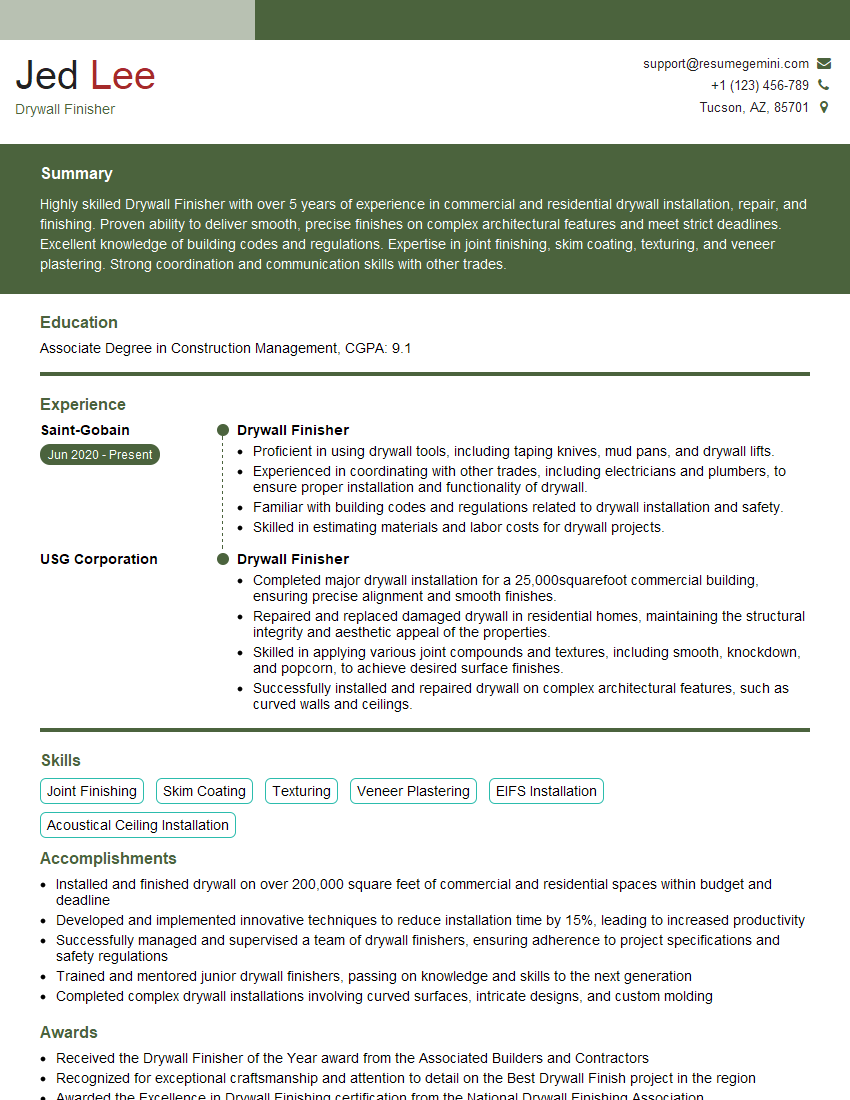
Mastering drywall repair and patching skills opens doors to a variety of rewarding career opportunities, offering excellent potential for growth and specialization. A strong resume is your key to unlocking these opportunities. Creating an ATS-friendly resume is essential for getting your application noticed by potential employers. To make this process easier and more effective, consider using ResumeGemini. ResumeGemini provides a user-friendly platform for building professional resumes, and we offer examples of resumes tailored specifically to drywall repair and patching professionals to help you showcase your skills and experience effectively. Take the next step towards your dream career today!


Explore more articles
Users Rating of Our Blogs
Share Your Experience
We value your feedback! Please rate our content and share your thoughts (optional).
What Readers Say About Our Blog
Really detailed insights and content, thank you for writing this detailed article.
IT gave me an insight and words to use and be able to think of examples