The thought of an interview can be nerve-wracking, but the right preparation can make all the difference. Explore this comprehensive guide to Silkscreening interview questions and gain the confidence you need to showcase your abilities and secure the role.
Questions Asked in Silkscreening Interview
Q 1. Explain the process of emulsion coating a screen.
Emulsion coating is the crucial first step in screen printing, where a photosensitive emulsion is applied to the screen mesh to create the image stencil. Think of it as painting the screen with a light-sensitive paint.
The process typically involves:
- Preparing the Screen: The screen is thoroughly cleaned to remove any debris or oils that might interfere with emulsion adhesion. This often involves a degreasing agent.
- Mixing the Emulsion: The emulsion, usually a mixture of diazo compounds and a binder, is mixed according to the manufacturer’s instructions. This needs to be done carefully to ensure a consistent coating.
- Coating the Screen: Using a scoop coater or a trough and squeegee, a thin, even layer of emulsion is applied to both sides of the screen. The technique requires practice to avoid streaking or uneven coating. Think of it like spreading frosting on a cake—it needs to be smooth and consistent.
- Drying the Emulsion: The coated screen is then dried in a dark, dust-free environment. This allows the emulsion to solidify and become photosensitive. A darkroom or a dedicated drying rack are ideal.
- Exposure: Once dry, the screen is exposed to UV light through a film positive of the desired design. The exposed areas harden, while the unexposed areas remain soft and easily removable.
Inconsistent coating leads to variations in image density and can create issues during printing. Proper emulsion coating is essential for sharp, well-defined prints.
Q 2. Describe different types of screen mesh and their applications.
Screen mesh comes in various types, each with different thread counts and materials, impacting the print quality and application. The thread count (e.g., 110 mesh, 230 mesh) refers to the number of threads per linear inch. Higher thread counts result in finer detail but reduce ink deposit.
- Low Thread Count (e.g., 43-77 mesh): Used for printing large, bold images, high ink deposits, and applications requiring a high degree of ink lay-down, such as textile printing on coarse fabrics.
- Medium Thread Count (e.g., 110-156 mesh): A versatile choice suitable for a wide range of applications, offering a good balance between detail and ink deposit. Ideal for general-purpose printing and various fabric types.
- High Thread Count (e.g., 190-305 mesh): Excellent for fine detail printing, requiring precise, controlled ink deposits. Suitable for applications needing intricate designs, like fine-art prints or printing on smooth materials.
Materials: While polyester is the most common material due to its durability and strength, nylon is also used, particularly for applications needing increased flexibility and softness in the print.
Choosing the correct mesh is crucial; a too-coarse mesh can lead to blurry prints, while a too-fine mesh can clog easily.
Q 3. How do you achieve accurate registration in multi-color screen printing?
Accurate registration in multi-color screen printing ensures that each color aligns perfectly with the previous one. This is critical for achieving a sharp, clean final product, as misregistration leads to blurry and unprofessional results.
Methods to achieve accurate registration include:
- Precise Screen Clamping: Using high-quality screen clamps and ensuring consistent pressure across the screen frame.
- Registration Marks: Including registration marks (small, precisely placed targets) on the artwork and the screen itself. These marks act as guides for aligning the screens.
- Micrometer Adjustments: Utilizing micrometer adjustments on the press to fine-tune the screen position.
- Pallet System: Employing a pallet system to register the artwork consistently.
- Film Positives: Creating accurate film positives with the registration marks already included.
Imagine trying to create a layered painting without aligning the layers—the result would be a mess. The same principle applies to multi-color screen printing; precise alignment is crucial for quality.
Q 4. What are the different types of inks used in silkscreen printing?
The choice of ink is paramount in screen printing, influencing the final look, feel, and durability of the print. Different inks are formulated for specific substrates and effects.
- Plastisol Inks: Popular for their vibrant colors, durability, and ability to produce a raised, tactile print. They are commonly used on textiles and are known for their excellent washability.
- Water-Based Inks: Environmentally friendly, offering a softer, less-tacky feel. They are often preferred for applications requiring a more delicate finish or where sustainability is crucial. They may require specific curing techniques.
- UV-Curable Inks: Cured using ultraviolet light, offering fast drying times and excellent durability. Widely used for printing on a variety of materials, including plastics and metals. Their quick drying time is a huge advantage for high volume printing.
- Discharge Inks: Used to remove color from fabrics, creating a faded or bleached-out effect on already colored materials.
Ink selection depends on the substrate (material being printed on), the desired effect, and environmental concerns.
Q 5. Explain the importance of proper screen tension.
Proper screen tension is crucial for consistent ink flow and preventing screen distortion during printing. A properly tensioned screen remains taut and flat, ensuring even ink deposition and minimizing the risk of blurry or distorted prints.
Insufficient tension leads to:
- Distorted Images: The screen may sag, causing the printed image to be uneven.
- Uneven Ink Deposit: Variations in ink thickness and coverage.
- Screen Damage: The screen may be more susceptible to damage during use.
Excessive tension can lead to screen breakage. Think of it like a drum—too loose and the sound is muffled, too tight and the drum can break. Finding the optimal tension is key to print quality and screen longevity.
Q 6. How do you troubleshoot a clogged screen?
A clogged screen significantly impacts print quality, resulting in missing areas or uneven ink deposition. Troubleshooting involves a systematic approach.
Steps to unclog a screen:
- Identify the Clog: Determine if the clog is due to dried ink, emulsion residue, or other debris.
- Clean the Screen: Use appropriate screen cleaning solutions (depending on the ink type). This might involve solvents, water, or specialized cleaning agents. Gently scrub the screen to remove blockages, avoiding excessive pressure which can damage the mesh.
- Check the Squeegee: Ensure the squeegee is clean and free of debris, as a dirty squeegee can contribute to clogging.
- Adjust Ink Viscosity: If the ink is too thick, thin it according to manufacturer instructions. This prevents the ink from clogging the screen.
- Inspect the Mesh: If clogging persists, the screen mesh might be damaged or too fine for the ink being used. This might require replacement.
Prevention is key! Regular screen maintenance and the use of appropriate cleaning methods are crucial in preventing clogging.
Q 7. Describe your experience with different drying methods for inks.
Drying methods for screen-printed inks vary depending on the type of ink used and the substrate. Each method serves a specific purpose in ensuring the final print’s durability and quality.
- Air Drying: Suitable for water-based inks, air drying is a natural, low-cost method. However, it’s slower and can be influenced by environmental factors like humidity and temperature. This is best suited for lower-volume projects where speed is not paramount.
- Forced Air Drying: Using fans or industrial air dryers speeds up the drying process compared to air drying. This is particularly useful for water-based inks and in environments with high humidity.
- Convection Oven Drying: Ovens provide controlled temperature environments for drying, particularly helpful for plastisol inks and other inks that require specific curing temperatures. Ensures consistent results across a higher volume of prints.
- UV Curing: This method utilizes ultraviolet light to instantly cure UV-curable inks. This is incredibly fast and efficient and creates a very durable finish.
The choice of drying method is critical for proper ink adhesion and overall print quality. Improper drying can lead to smearing, cracking, or poor adhesion, ultimately affecting the finished product’s appearance and lifespan.
Q 8. What are the safety precautions involved in using screen printing chemicals?
Screen printing chemicals, such as emulsion, cleaners, and inks, pose various health risks. Safety precautions are paramount to prevent injury and maintain a healthy work environment. This includes:
- Proper Ventilation: Always work in a well-ventilated area to minimize inhalation of fumes. This might involve using exhaust fans or working outdoors.
- Personal Protective Equipment (PPE): This is non-negotiable. Always wear gloves (nitrile is recommended), eye protection (safety glasses or goggles), and a respirator, especially when dealing with emulsions and solvents. Long sleeves and closed-toe shoes are also crucial.
- Chemical Handling Procedures: Follow the manufacturer’s instructions meticulously. This includes understanding the storage requirements (temperature, light exposure), proper mixing techniques, and disposal methods.
- Emergency Preparedness: Have a readily accessible eyewash station and safety shower. Know the location of emergency exits and have a first aid kit available. Familiarize yourself with the Material Safety Data Sheets (MSDS) for all chemicals used.
- Waste Disposal: Dispose of chemicals according to local regulations and guidelines. Never pour chemicals down the drain unless explicitly permitted.
For example, when working with diazo emulsion, improper ventilation can lead to respiratory irritation, while neglecting glove use can cause skin sensitization. Always prioritize safety – it’s an investment in your health and the longevity of your business.
Q 9. How do you clean and maintain your screen printing equipment?
Maintaining screen printing equipment is key to efficient and high-quality production. Regular cleaning and preventative maintenance can significantly extend the lifespan of your presses and screens.
- Press Maintenance: After each printing session, remove excess ink from the squeegee and the screen clamps. Wipe down the press surface with a damp cloth. Regularly lubricate moving parts according to the manufacturer’s instructions. Check for any loose screws or worn parts and address them promptly.
- Screen Cleaning: This is crucial. The cleaning method depends on the type of ink used (water-based, plastisol, etc.). Water-based inks are generally easier to clean, often requiring only soap and water. Plastisol requires specialized solvents. After removing excess ink, use a screen cleaning solution appropriate for your ink type. Thoroughly rinse the screen with water and allow it to dry completely before storage.
- Screen Storage: Store clean, dry screens flat to prevent warping. To avoid emulsion degradation, protect them from direct sunlight and extreme temperatures.
I regularly inspect my presses for any signs of wear and tear, such as loose belts or misaligned components. I treat my equipment like an extension of myself—careful maintenance ensures consistent output and prevents costly downtime.
Q 10. Explain the process of reclaiming screens.
Reclaiming screens refers to the process of removing the emulsion from a used screen to reuse it. This is a cost-effective way to manage screen printing materials. The process typically involves:
- Ink Removal: Thoroughly clean the screen to remove all ink residue using appropriate solvents and a pressure washer (if available). This step is crucial; residual ink can interfere with the emulsion removal process.
- Emulsion Removal: Several methods exist. A common technique is using an emulsion remover chemical, following the manufacturer’s instructions. Alternatively, a pressure washer with hot water can sometimes be effective, but may not be suitable for all emulsions. Some prefer a combination of chemical remover and pressure washing.
- Screen Cleaning: After removing the emulsion, thoroughly rinse and clean the screen with water and detergent. This ensures the screen is free of any chemical residue.
- Drying: Allow the screen to dry completely before storing or re-coating with fresh emulsion.
Reclaiming screens is environmentally friendly and saves money on materials. However, improper reclaiming can damage the screen mesh. It requires patience and attention to detail to ensure a successful outcome and avoid damaging the screen.
Q 11. What are the different types of screen printing presses?
There’s a range of screen printing presses available, each with its own advantages and disadvantages:
- Manual Presses: These are entry-level, affordable options, ideal for small-scale operations or hobbyists. They require manual operation for each print, making them slower but easier to learn.
- Semi-Automatic Presses: These offer some automation, such as micro-registration or pallet indexing, increasing efficiency compared to manual presses. They strike a balance between cost and automation.
- Automatic Presses: These are high-production machines suitable for large-scale operations. They automate almost the entire printing process, including ink dispensing, screen placement, and printing speed. They require significant investment but significantly increase output.
- Carousel Presses: These are a type of automatic press that uses a rotating cylinder to hold multiple screens, allowing for efficient multi-color printing. They are very efficient for high volume jobs with multiple colors.
- Cylinder Presses: These are specialized presses used for rotary printing, mainly in textile printing. They provide exceptional precision and repeatability.
The choice of press depends on production volume, budget, and the complexity of the printing jobs.
Q 12. Describe your experience with automatic screen printing presses.
My experience with automatic screen printing presses has been overwhelmingly positive. I’ve worked extensively with several models, primarily focusing on high-volume production runs. The efficiency gains are remarkable. For instance, in one project involving printing thousands of t-shirts, the automatic press reduced production time by approximately 60% compared to using a manual press. The consistent print quality and reduced manual labor are significant advantages.
However, automatic presses require a higher initial investment and specialized maintenance. Understanding the intricate mechanisms and troubleshooting any malfunctions necessitates dedicated training and expertise. Furthermore, the setup and programming for each job require precision and careful attention to detail. Despite these considerations, the overall increase in productivity and print consistency makes automatic presses an indispensable asset in high-volume screen printing.
Q 13. How do you calculate the amount of ink needed for a specific job?
Accurately calculating ink requirements is crucial for efficient production and minimizing waste. The calculation depends on several factors:
- Print Area: The total area to be printed on each garment or substrate.
- Number of Prints: The total number of items to be printed.
- Ink Coverage: The percentage of the print area covered by ink (e.g., solid, halftone).
- Ink Viscosity: The thickness of the ink, influencing its spread rate.
- Number of Colors: The number of different inks used in the print design.
A simplified calculation might be: Total Ink Needed (ml) = (Print Area (cm²) * Number of Prints * Ink Coverage %) / 100 * Ink Viscosity Factor. The ink viscosity factor is an estimation based on the ink’s properties; it often needs adjustment through experience. This is a very basic formula. Most experienced printers also consider a wastage factor of 10-15% to account for losses during printing and cleaning.
For complex designs or multiple colors, it’s often more effective to conduct a test run to determine the actual ink consumption. This provides a more accurate estimate, minimizes waste, and fine-tunes the printing process.
Q 14. How do you prepare artwork for screen printing?
Preparing artwork for screen printing involves several crucial steps to ensure high-quality prints:
- Vector Artwork: Artwork should be created in vector format (e.g., AI, EPS, SVG). Vector graphics are resolution-independent, ensuring crisp, clean prints regardless of size. Raster images (JPEG, PNG) can lead to pixelation and poor print quality when scaled.
- Color Separation: For multi-color prints, separate color channels are needed for each ink. This is usually handled by design software or using color separation techniques. Each color channel becomes a separate film positive for a screen.
- Film Output: Film positives are created from the separated artwork using a high-resolution output device. These films act as masks during the screen exposure process.
- Film Accuracy: Carefully review the films to ensure accuracy in color separation, registration marks, and overall design. Any errors at this stage will be reflected in the final print.
- Screen Preparation: Using the films as masks, emulsion-coated screens are exposed to UV light to create the stencil for each color.
Accurate artwork preparation is essential for consistent, high-quality screen prints. Any flaws in the artwork will be directly translated onto the final product. Using vector art, precise color separation, and meticulous film review ensures professional results.
Q 15. Explain the concept of halftone screens in silkscreen printing.
In silkscreen printing, halftone screens are crucial for reproducing images with continuous tones, like photographs, using a process that only allows for solid colors. Think of it like creating a mosaic—a seemingly smooth image is built from tiny dots of different sizes. These dots are created using a halftone screen, which is a pattern of dots on a film that dictates the density of ink at various points. The size of the dots determines the lightness or darkness of an area. A larger dot means more ink, creating a darker area; a smaller dot means less ink, creating a lighter area.
The screen itself is usually described by its Line Screen Ruling (LSR), measured in lines per inch (lpi). A higher LSR, like 150 lpi, creates a finer, smoother image with more detail, whereas a lower LSR, like 65 lpi, yields a coarser, more textured look. The choice of LSR depends on the desired print quality and the substrate being used; coarse screens are sometimes preferred for rough textures. The angle of the screen is also important, especially when printing multiple colors to avoid moiré patterns, which are unwanted interference patterns that appear as shimmering or wavy textures.
Career Expert Tips:
- Ace those interviews! Prepare effectively by reviewing the Top 50 Most Common Interview Questions on ResumeGemini.
- Navigate your job search with confidence! Explore a wide range of Career Tips on ResumeGemini. Learn about common challenges and recommendations to overcome them.
- Craft the perfect resume! Master the Art of Resume Writing with ResumeGemini’s guide. Showcase your unique qualifications and achievements effectively.
- Don’t miss out on holiday savings! Build your dream resume with ResumeGemini’s ATS optimized templates.
Q 16. What are some common screen printing defects and how are they corrected?
Common defects in screen printing range from minor inconsistencies to significant print failures. Some frequently encountered issues include:
- Pinholes: Tiny holes in the screen allow ink to bleed through unwanted areas. This is often caused by improper emulsion coating or damage during the screen-making process. Solution: Careful emulsion application, proper stencil cleaning, and using high-quality screens can prevent pinholes.
- Bleeding: Ink spreads beyond the intended area. This can be due to ink viscosity issues, pressure applied during printing, or damage to the screen mesh. Solution: Adjust ink viscosity, control squeegee pressure and angle, and inspect the screen for any imperfections.
- Halation: A fuzzy or blurred edge around an image. This is often due to overexposure of the screen during the image creation process or poor ink adhesion. Solution: Optimize the exposure time and use suitable inks and pre-treatments for the substrate.
- Off-register: The colors don’t align correctly, resulting in misaligned images. This usually stems from improper setup of the screen or inaccurate alignment of multiple color screens. Solution: Precise alignment of screens and the use of registration marks is essential.
- Inconsistent ink deposit: Uneven ink layer leads to variation in color and opacity across the print. This often happens due to inconsistent squeegee pressure, speed, or angle. Solution: Maintain a consistent printing technique.
Addressing these issues requires a systematic approach; examining the entire printing process from screen preparation to ink application and press setup, and ensuring every step is precise.
Q 17. Describe your experience with different types of squeegees and their uses.
Squeegees are critical tools in screen printing. The choice of squeegee blade depends on the ink viscosity, mesh count of the screen, and the desired print quality. I have extensive experience working with different materials and hardnesses:
- Rubber squeegees: These are the most common, offering a balance of flexibility and durability. Different durometers (Shore A hardness) are available. A softer squeegee (lower durometer) is better for finer details and less aggressive ink transfer, while a harder squeegee (higher durometer) is suitable for thicker inks and coarser meshes.
- Polyurethane squeegees: These are more durable than rubber and resist abrasion and chemical degradation, making them ideal for long production runs or specialized inks. They provide better ink release and are generally preferred for plastisol inks.
- Metal squeegees: These are typically used for very thick inks or for specialized effects. However, their rigidity can damage screens easily and requires considerable skill to avoid scratching and tearing.
For example, when working with delicate fabrics and water-based inks, I prefer a softer rubber squeegee to avoid damaging the fabric and ensure a smooth print. Conversely, printing thick plastisol inks onto a sturdy substrate might require a harder polyurethane squeegee for optimal ink transfer.
Q 18. How do you ensure consistent ink film thickness?
Consistent ink film thickness is paramount for achieving uniform color and opacity across the print. This is controlled through several factors:
- Squeegee pressure: Applying too much pressure can force too much ink through the mesh, while too little pressure results in a thin, uneven layer. I usually find the “sweet spot” through experimentation.
- Squeegee angle: The angle of the squeegee in relation to the screen impacts the amount of ink deposited. A shallower angle generally deposits more ink than a steeper angle.
- Squeegee speed: A slower speed allows for more ink deposit, while faster speeds result in thinner layers. Finding the right balance is crucial.
- Ink viscosity: The thickness of the ink itself plays a crucial role. Thicker inks require more pressure and may need a harder squeegee. Proper ink mixing and adjusting viscosity are essential for consistent results.
- Screen tension: A properly tensioned screen prevents sagging which can lead to inconsistent ink deposit.
Maintaining consistency requires diligent attention to detail and regular calibration of these factors. I often use test prints to fine-tune my technique, ensuring consistent results.
Q 19. How do you handle color matching and consistency?
Color matching and consistency are critical aspects of screen printing, particularly in multi-color jobs. Achieving precise color matching requires a combination of skill, experience, and tools:
- Color matching systems: Using color matching software and spectrophotometers allows for precise measurements and reproduction of colors. This allows for creating consistent Pantone matches or custom color formulas.
- Ink mixing: Many times, matching specific colors requires meticulous mixing of base inks to achieve the desired shade. Accurate measuring and careful blending are essential.
- Test prints and adjustments: Making test prints throughout the process allows for adjustments to ink formulas and printing parameters to refine the color. It’s common to do multiple test prints, and make small changes until the desired color is consistently achieved.
- Substrate considerations: The substrate’s color and texture can affect the final appearance of the printed color. Substrate pre-treatment (like primer) might be necessary for better color consistency.
- Environmental factors: factors such as temperature and humidity can also influence ink drying and color appearance, and need consideration.
My experience involves utilizing spectrophotometers to quantify colors, ensuring precision and repeatability throughout the job. Consistent color matching is a testament to meticulous attention to detail and process control.
Q 20. What is your experience with spot color printing?
Spot color printing involves using specific pre-mixed inks, often Pantone colors, to achieve accurate and consistent color reproduction. It’s distinct from process color printing (CMYK) which uses cyan, magenta, yellow and black to create a wider range of colors. My experience with spot color printing includes:
- Pantone matching: Accurately mixing inks to match specific Pantone colors using color matching systems, this is crucial for consistent brand colors and maintaining a corporate identity.
- Color separations: Properly creating screen films for spot colors, ensuring clean and precise color registration. This involves working with graphic designers to confirm color choices and ensure file preparation is adequate for creating accurate separations.
- Ink selection: Choosing the appropriate inks (plastisol, water-based, etc.) for different substrates and printing techniques to achieve the best color results. This requires understanding the properties and limitations of each ink type.
- Troubleshooting color variations: Diagnosing and resolving color inconsistencies, which might arise from environmental conditions, ink mixing issues, or printing process flaws. This requires understanding the variables that influence color and a methodical approach to troubleshooting.
Working with spot colors necessitates a deep understanding of color theory and meticulous attention to detail to ensure the accuracy and consistency of the final product.
Q 21. Describe your experience with different types of substrates (e.g., fabrics, paper, plastics).
I’ve worked with a wide variety of substrates in silkscreen printing, each requiring a different approach to achieve optimal results:
- Fabrics (cotton, polyester, blends): These require careful consideration of ink type (water-based, plastisol, discharge) and pre-treatment to ensure proper adhesion and color vibrancy. The fabric’s weave and texture influence the print quality and may require adjustments to the printing technique.
- Paper (card stock, poster board, fine art papers): Ink absorption varies significantly depending on the paper type and its finish. Some papers may require a pre-treatment or specific inks to prevent bleeding or feathering.
- Plastics (polyester, acrylics, PVC): Plastics require different inks (UV-cured, plastisol) due to their non-porous nature and may need pre-treatment to improve ink adhesion and prevent peeling. The printing process needs to take into account the substrate’s flexibility and potential for distortion during printing and curing.
- Metals (aluminum, steel): Printing on metals often requires specialized inks and techniques, taking into account the surface treatment and the need for high-durability printing. Pre-treatment is usually essential.
Adapting my techniques to different substrates demonstrates my versatility and problem-solving skills. Successful printing requires deep understanding of each substrate’s properties and the appropriate ink and printing technique to achieve high-quality prints.
Q 22. What is your experience with underbase printing?
Underbase printing is a crucial technique in silkscreening, especially when working with light-colored garments or substrates. It involves laying down a solid layer of white or another light-colored ink before applying the main design colors. This base layer ensures the vibrancy and opacity of the subsequent colors, preventing them from appearing dull or transparent on the underlying material.
My experience with underbase printing encompasses a wide range of applications, from creating vibrant designs on dark t-shirts to achieving intense color saturation on tote bags. I’m proficient in selecting appropriate underbase inks to match the final design and substrate, considering factors like ink opacity, drying time, and compatibility with other inks. I’ve also worked extensively with different printing techniques to ensure proper registration and prevent issues like bleeding or smudging.
For instance, on a recent project printing a complex multi-color design on black hoodies, using a white underbase was essential to achieve the desired color accuracy and prevent the dark base color from muddying the pastel hues of the main design.
Q 23. How do you manage inventory of inks, screens, and other materials?
Managing inventory for a silkscreen printing operation requires a systematic and organized approach. I utilize a combination of methods to keep track of inks, screens, and other materials. This includes maintaining a detailed spreadsheet with information on each item – ink color, quantity on hand, date of purchase, and supplier. This spreadsheet is updated regularly upon receipt of new supplies and after each print job. Additionally, I conduct regular physical inventory checks to validate the data and identify any discrepancies.
For inks, I employ a FIFO (First-In, First-Out) system to minimize waste from ink expiration. Screens are stored in a designated, organized rack to protect them from damage and ensure easy retrieval. I also maintain a minimum stock level for frequently used items to avoid production delays. For less frequently used materials, orders are placed strategically to avoid unnecessary storage costs.
Think of it like running a well-stocked kitchen – you need enough of the essentials on hand, but you don’t want to overstock perishable ingredients (inks) or take up too much space with infrequently used specialty items.
Q 24. How do you troubleshoot issues with ink adhesion?
Ink adhesion problems can stem from various issues, and troubleshooting requires a systematic approach. I first identify the problem by assessing the affected prints. Is the ink cracking, peeling, or simply not sticking to the substrate? Then, I systematically check the following:
- Substrate Preparation: Is the substrate clean and properly pre-treated? This is often the most overlooked step. Dirt, oils, or even sizing can significantly affect adhesion.
- Ink Selection: Is the correct ink being used for the substrate? Certain inks are designed for specific materials (cotton, polyester, etc.).
- Screen Mesh: Is the screen mesh appropriate for the ink viscosity? A mesh that’s too fine or too coarse can lead to poor ink deposition.
- Squeegee Technique: Is the squeegee pressure and speed consistent? Too much pressure can cause the ink to spread too thin, while too little can result in poor adhesion.
- Curing: Is the ink being cured properly? Inadequate curing can lead to poor adhesion, especially with plastisol inks. I use a combination of temperature and time testing based on the ink specification.
A step-by-step approach, along with careful observation, allows me to pinpoint the root cause and implement the necessary corrections. For example, I recently encountered ink peeling on a polyester shirt. After checking all aspects, I realized the pre-treatment step had been overlooked; once corrected, the problem was resolved.
Q 25. What is your experience with digital screen printing technology?
My experience with digital screen printing technology is limited, as it’s a relatively new technology in the field. However, I am aware of the advancements. I’ve had opportunities to learn and engage with the concept, though my primary experience rests in traditional methods.
I understand the principles behind Direct-to-Screen (DTS) printing, where a digital printer exposes the screen directly instead of using a film positive. This eliminates the need for film creation and reduces processing time. However, I am also aware of the limitations, such as the high initial investment for equipment and the learning curve associated with the specialized software and hardware involved. While traditional screen printing provides a greater degree of tactile control and flexibility for specialized inks and effects, DTS is undoubtedly more efficient in large-scale productions of simple designs.
My approach is to stay updated on industry trends, which includes digital advancements, to understand its applicability for specific projects and client needs.
Q 26. Describe a time you solved a complex screen printing problem.
During a large-scale print job for a music festival, we encountered a significant issue with registration – the colors in the multi-color design were not aligning properly. This threatened to delay the festival merchandise delivery. The problem wasn’t immediately obvious. We initially suspected the screens, but after thorough inspection, the screens were fine. We then checked our alignment process, but there was no apparent issue there either.
After careful examination and a process of elimination, we discovered the problem lay in the slight warping of the print pallets we were using. The slight inconsistencies in the pallet’s flatness across various surfaces were subtly affecting the alignment between print passes. By replacing the warped pallets with new, perfectly flat ones, the registration issue was instantly resolved. This experience taught me the importance of considering even seemingly minor details that can have a significant impact on the final product’s quality.
Q 27. Explain your understanding of color separation for silkscreen printing.
Color separation is a critical step in multi-color silkscreen printing. It’s the process of breaking down a full-color image into individual color layers, each represented by a separate screen. Each screen will only print one color in the artwork. This allows us to print each color precisely and in registration.
Traditionally, this involved using film separations and creating a film positive for each color. Software such as Photoshop or Illustrator can create these separations using the CMYK (Cyan, Magenta, Yellow, Key/Black) or spot color models. Each color is assigned to a different screen, which receives a different exposure. This method relies on precise registration for all the colors to align correctly. Careful consideration of ink layering and transparency is also crucial for achieving the desired final effect.
Think of it like layering paints; to get a perfect shade of green you need to layer yellow and blue, ensuring that each color lays down correctly.
Q 28. What experience do you have with different curing methods?
Curing is the process of drying and setting the ink to ensure its permanence and durability. My experience encompasses several curing methods:
- Convection Oven Curing: This is a common method for plastisol inks. The garments are placed in a heated oven for a specified time and temperature based on the ink’s manufacturer’s recommendation. It’s highly efficient for large-scale production but requires investment in ovens and proper safety measures.
- Flash Curing: This involves using a flash cure unit to partially dry the ink before subsequent layers are applied in a multi-color print. This prevents smearing or smudging during the next print stage.
- Infrared (IR) Curing: IR curing utilizes infrared lamps to quickly dry inks. This method is popular for its speed and efficiency, particularly for thinner inks. However, it may require specific precautions to avoid overheating the garment.
The choice of curing method depends on several factors, including the type of ink, the substrate, and the production volume. Careful monitoring of temperature and time is essential to ensure optimal curing and prevent damage to both the print and garment. I always follow the manufacturer’s recommendations for each specific ink and adhere to safety protocols for the equipment being used.
Key Topics to Learn for Your Silkscreening Interview
- Screen Preparation: Understanding emulsion types, coating techniques, exposure methods (UV, contact), and proper screen cleaning and maintenance. Practical application: Explain your experience optimizing emulsion application for different mesh counts and ink types.
- Ink Selection and Mixing: Knowledge of various ink types (plastisol, water-based, discharge), their properties, and how to mix colors accurately and consistently. Practical application: Describe a situation where you had to troubleshoot an ink mixing issue and the steps you took to resolve it.
- Printing Techniques: Mastering different printing methods (flood, flash, off-contact), understanding squeegee pressure and angle, and achieving consistent print quality. Practical application: Explain your experience with different printing techniques and how you adapted your approach for various substrates (e.g., cotton, polyester).
- Troubleshooting and Problem-Solving: Identifying and resolving common printing defects such as pinholes, clogging, and registration issues. Practical application: Describe a challenging printing project and how you overcame technical hurdles to achieve the desired results.
- Safety Procedures and Regulations: Familiarity with relevant safety protocols for handling inks, chemicals, and equipment. Practical application: Explain your understanding of proper waste disposal procedures and workplace safety measures in a silkscreening environment.
- Equipment Maintenance and Operation: Understanding the operation and maintenance of various silkscreening equipment, including presses, dryers, and exposure units. Practical application: Detail your experience maintaining and troubleshooting silkscreening equipment.
- Design and Pre-press: Understanding film positives, creating separations, and preparing artwork for screen printing. Practical application: Discuss your process for preparing artwork for various printing techniques and substrates.
Next Steps
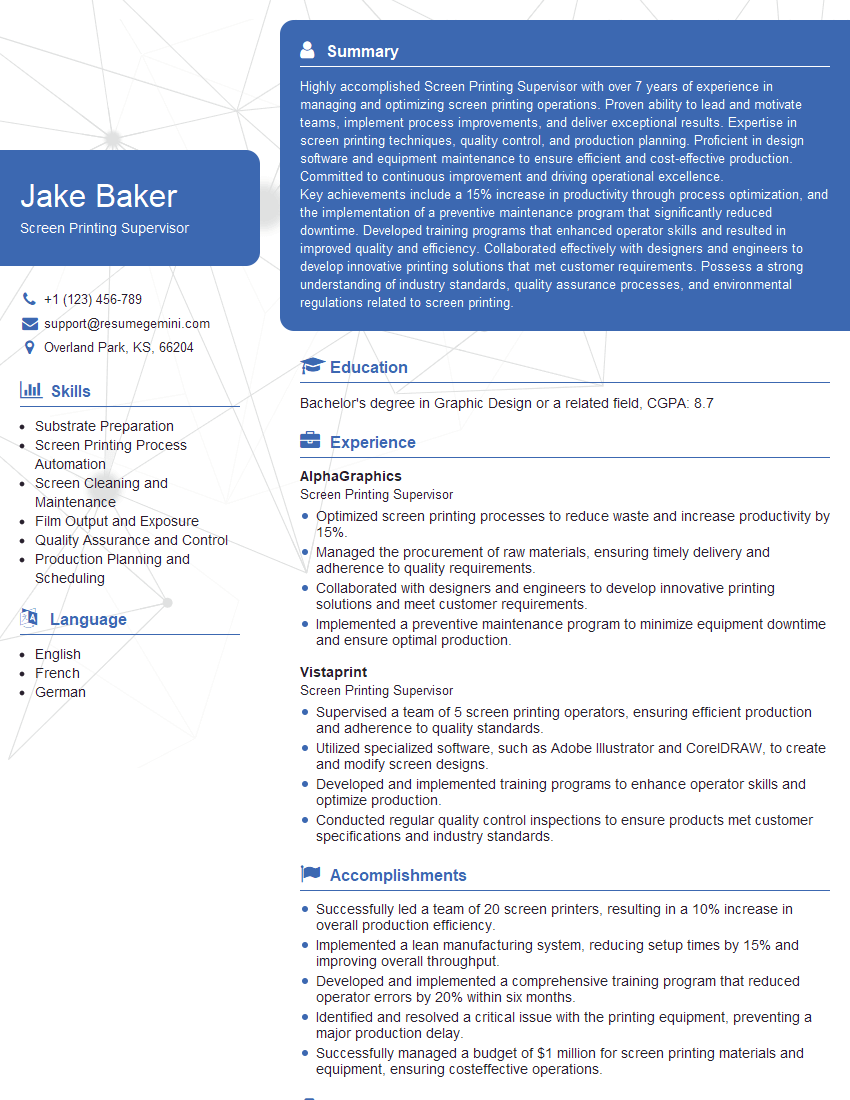
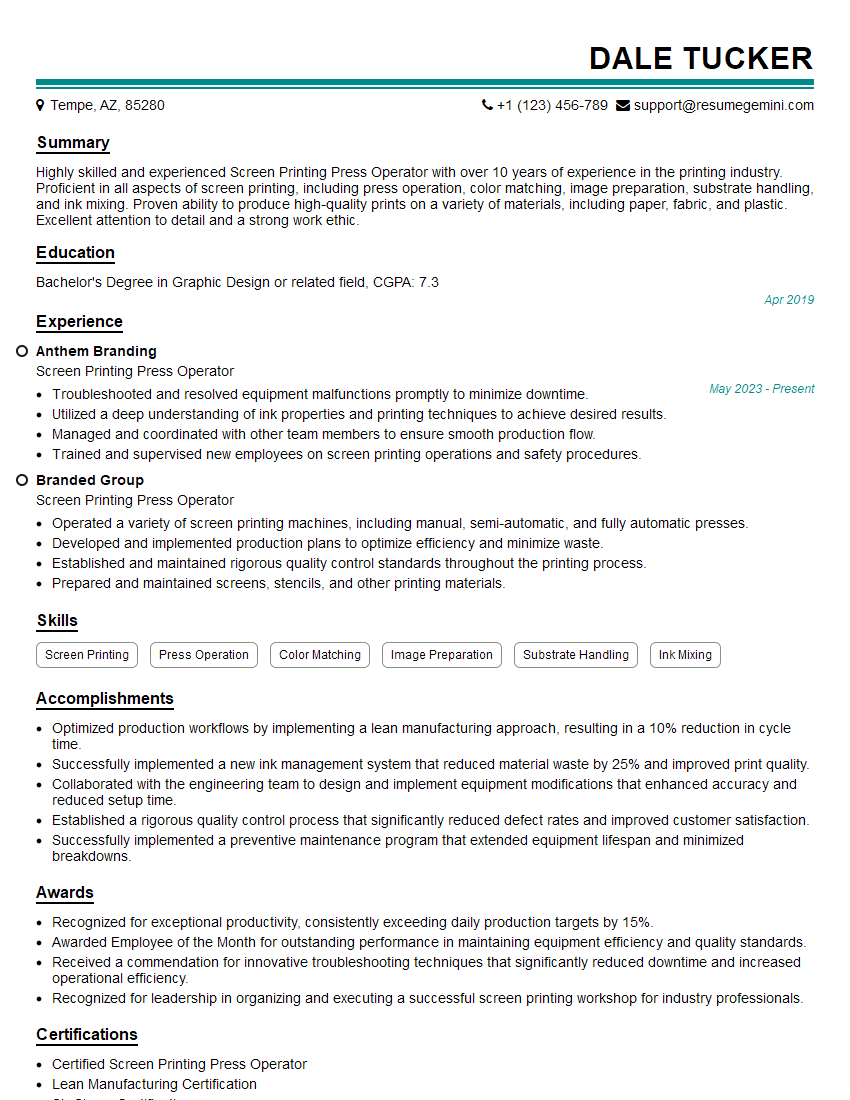
Mastering silkscreening opens doors to exciting career opportunities in various industries, from apparel and graphic design to industrial applications. To maximize your chances of landing your dream job, creating a strong, ATS-friendly resume is crucial. ResumeGemini is a trusted resource to help you build a professional and impactful resume that highlights your skills and experience effectively. They offer examples of resumes tailored specifically to the silkscreening industry to guide you in showcasing your unique qualifications. Take the next step and build a resume that truly represents your potential!

Explore more articles
Users Rating of Our Blogs
Share Your Experience
We value your feedback! Please rate our content and share your thoughts (optional).
What Readers Say About Our Blog
Really detailed insights and content, thank you for writing this detailed article.
IT gave me an insight and words to use and be able to think of examples