Every successful interview starts with knowing what to expect. In this blog, we’ll take you through the top Esri interview questions, breaking them down with expert tips to help you deliver impactful answers. Step into your next interview fully prepared and ready to succeed.
Questions Asked in Esri Interview
Q 1. Explain the difference between a shapefile and a geodatabase.
Shapefiles and geodatabases are both ways to store geographic data in Esri’s ArcGIS system, but they differ significantly in their structure, capabilities, and overall suitability for different projects. Think of a shapefile as a simple, single-table database, while a geodatabase is a sophisticated, multi-table database management system.
Shapefile: A shapefile is a collection of related files (.shp, .shx, .dbf, .prj, etc.) that stores vector data. It’s simple to use and understand, making it suitable for smaller projects or quick data sharing. However, it lacks the advanced features of a geodatabase, including the ability to store multiple feature classes, complex relationships between data, and robust data integrity.
Geodatabase: A geodatabase is a more powerful and versatile data storage system. It allows for multiple feature classes, tables, and subtypes within a single database, enabling complex data modeling and relationships. This makes it ideal for large, complex projects requiring data management and integrity. Geodatabases also support various data types including raster, vector, and attribute data all within a single, well-organized structure. They also offer advanced features such as versioning and spatial indexes for improved performance.
In short: Choose a shapefile for small, simple projects where ease of use is prioritized. Choose a geodatabase for larger, more complex projects requiring robust data management and advanced functionality. For example, a shapefile might be suitable for mapping a small set of points representing locations of trees, while a geodatabase would be better for managing detailed information about a city’s infrastructure, including roads, utilities, and buildings, all interrelated.
Q 2. Describe your experience with ArcGIS Pro’s geoprocessing tools.
I have extensive experience leveraging ArcGIS Pro’s geoprocessing tools for a wide range of tasks. My workflow often involves automating repetitive tasks, performing complex spatial analysis, and preparing data for analysis and visualization. I’m proficient in using both the ModelBuilder graphical interface and Python scripting for more complex automation and customization.
For example, I’ve used geoprocessing tools to:
Automate the conversion of data from various formats into a consistent geodatabase structure. This includes using tools like
FeatureClassToFeatureClassandProjectto ensure consistent projections and data types.Perform spatial analysis such as buffering, overlay analysis (e.g., using
IntersectandUnion), and proximity analysis to answer specific questions about spatial relationships between datasets. This has been critical in projects analyzing accessibility to services, habitat suitability, or identifying areas of conflict.Develop custom geoprocessing tools using Python scripting to perform tasks not readily available in the standard toolset. This has allowed me to create efficient workflows tailored to specific project needs.
My experience includes working with both built-in tools and custom scripts, showcasing adaptability and a deep understanding of ArcGIS Pro’s geoprocessing capabilities. I consider myself adept at troubleshooting and optimizing geoprocessing workflows for efficiency and accuracy.
Q 3. How do you handle spatial data projection and coordinate systems?
Proper handling of spatial data projection and coordinate systems is paramount for accurate spatial analysis and map creation. A mismatch in projections can lead to significant errors in distance calculations, overlay analysis, and other spatial operations. My approach involves careful consideration at each stage of a project.
Data Acquisition: I begin by identifying the coordinate system of each dataset. This information is usually embedded in the data’s metadata (e.g., the .prj file for shapefiles) or provided by the data source. If the projection is undefined, I might try to determine it from available metadata or through visual inspection on the map.
Projection Definition: I ensure all datasets involved in an analysis share a common, appropriate coordinate system. This may involve using the
Projectgeoprocessing tool in ArcGIS Pro to reproject datasets to a suitable projection (e.g., UTM, Web Mercator) for the study area. The choice of projection depends on factors such as the study area’s size and location.On-the-Fly Projection: For visualization purposes, ArcGIS Pro often handles on-the-fly projection, automatically transforming data to the map’s coordinate system. However, this should not be relied upon for analysis; explicit projection before analysis is essential for accuracy.
Coordinate System Documentation: I meticulously document all coordinate systems used in a project to ensure transparency and reproducibility of results.
For example, when working on a project involving national-scale data and local-scale data, I would reproject the national data to match the projection of the local data before conducting any analysis to avoid inaccuracies in overlap areas.
Q 4. What are your preferred methods for data cleaning and validation in ArcGIS?
Data cleaning and validation are crucial steps in any GIS project to ensure data accuracy and reliability. My preferred methods in ArcGIS involve a combination of visual inspection, attribute checks, and spatial validation techniques.
Visual Inspection: This is often the first step. I visually inspect data in ArcGIS Pro using various map symbology and visualizations to identify outliers, errors in geometry (e.g., slivers, self-intersections), and attribute inconsistencies.
Attribute Checks: I use the attribute table to identify and rectify errors such as inconsistent data types, illogical values (e.g., negative population numbers), and missing data. This often involves using query expressions and field calculations to identify and correct these problems.
Spatial Validation: ArcGIS Pro offers powerful tools for spatial validation. I frequently use the
Check Geometrygeoprocessing tool to identify and repair geometric errors. I also utilize spatial queries to identify overlapping features, gaps, or other inconsistencies in spatial relationships.Data Auditing and Documentation: I thoroughly document my data cleaning and validation procedures, including the techniques used and any corrections applied. This is critical for reproducibility and transparency.
For instance, when working with land parcel data, I would use Check Geometry to fix topological errors, then perform attribute checks to ensure all parcels have accurate land use classifications and ownership information.
Q 5. Explain your experience with creating and managing geodatabases in ArcGIS.
My experience with creating and managing geodatabases in ArcGIS encompasses a range of tasks from basic file geodatabase creation to managing complex enterprise geodatabases. I’m familiar with various geodatabase types (file, personal, and enterprise) and understand their respective strengths and limitations.
Geodatabase Design: I employ best practices for geodatabase design, including carefully considering the data model, feature class relationships, and attribute structures to ensure data integrity and efficiency. This includes defining appropriate attribute domains and subtypes to maintain data consistency.
Data Import and Migration: I have considerable experience importing data from various sources into geodatabases, handling different data formats and projections. I use appropriate tools and techniques for data conversion and transformation to maintain data quality.
Versioning and Data Management: I’m familiar with geodatabase versioning for collaborative projects, enabling multiple users to edit data concurrently without conflicts. I have experience managing different versions and reconciling changes in a controlled manner.
Metadata Management: Maintaining accurate and comprehensive metadata is essential. I strive to document all aspects of the geodatabase, including its structure, data sources, and processes used. This ensures long-term data usability and discoverability.
For instance, in one project, I designed and implemented an enterprise geodatabase to manage infrastructure data for a large utility company. This involved careful planning of the data model, creation of feature datasets, implementation of versioning for collaborative editing, and establishment of a rigorous metadata management system.
Q 6. Describe your experience with ArcGIS Online and its various applications.
ArcGIS Online has become an integral part of my workflow, offering collaborative capabilities and web-based mapping services. I utilize its features to share maps, collaborate on projects, and create web-based applications.
Map Sharing and Collaboration: I frequently publish maps and layers to ArcGIS Online to share them with colleagues, clients, or the public. The platform’s collaborative features allow for simultaneous work on projects, streamlining workflows.
Web Map Creation: I build interactive web maps using ArcGIS Online’s intuitive interface, incorporating various data layers and tools to provide visually appealing and informative maps. This often involves customizing the appearance, adding pop-up information, and creating interactive elements.
Web App Development: I’ve developed web applications using ArcGIS Online’s web app builder and other platforms to deliver customized geographic information systems solutions to various stakeholders. These apps often incorporate spatial analysis capabilities, custom widgets, and data visualization tools.
Data Management and Storage: ArcGIS Online provides cloud-based storage for spatial data, providing accessibility and backup options. It simplifies data sharing and collaboration significantly.
For example, I created a web application for a municipality using ArcGIS Online to allow residents to easily search for and access information about their property. This application integrated various layers of geospatial data, including property boundaries, tax information, and zoning regulations.
Q 7. How do you perform spatial analysis using ArcGIS?
Spatial analysis in ArcGIS is a core component of my GIS practice. I employ various techniques to extract meaningful insights from geographic data. My approach is driven by the specific research question or problem being addressed.
Overlay Analysis: I use overlay tools such as
Intersect,Union, andEraseto analyze the spatial relationships between different datasets. For instance, overlaying land use data with soil type data can identify areas suitable for specific agricultural practices.Proximity Analysis: I leverage tools such as
BufferandNearto analyze distances and proximity relationships. This helps determine which areas are within a specific distance of a feature (e.g., identifying homes within a certain radius of a school).Network Analysis: For problems involving networks (roads, utilities, etc.), I use ArcGIS Network Analyst extension to solve route optimization, service area analysis, and other network-based problems.
Geostatistical Analysis: When working with spatially continuous data (e.g., elevation, temperature), I use geostatistical tools to understand spatial autocorrelation, interpolation, and prediction. This includes kriging and other interpolation methods.
Spatial Statistics: I employ spatial statistics tools to analyze patterns and relationships in spatial data, including clustering, spatial autocorrelation, and hot spot analysis. This helps identify significant spatial patterns and trends.
For example, in a project analyzing the spread of an invasive species, I used proximity analysis to understand the spread from initial points, overlay analysis to identify suitable habitats, and spatial statistics to identify clusters of high infestation.
Q 8. What are your preferred methods for data visualization in ArcGIS?
My preferred methods for data visualization in ArcGIS depend heavily on the data and the intended audience, but generally involve a combination of techniques. For exploratory analysis, I often use graduated symbols, proportional symbols, and heatmaps to quickly identify patterns and outliers. These are readily available in ArcMap and ArcGIS Pro. For example, visualizing population density using a heatmap provides an intuitive understanding of population distribution, while graduated symbols can effectively display variations in average income across different regions.
For more complex relationships, I leverage chart symbology and attribute tables to present statistical summaries. I find that charts integrated directly within the map, particularly when they’re dynamically linked to map features, are particularly powerful. This allows a user to click on a feature and immediately see relevant statistical data. Finally, for presentation-ready maps, I often incorporate cartographic elements such as custom labels, legends, and well-chosen color schemes to improve readability and visual appeal. The choice of basemap and color ramps is critical in enhancing the overall clarity and effectiveness of the visualization.
Q 9. How familiar are you with scripting and automation in ArcGIS (Python)?
I have extensive experience with scripting and automation in ArcGIS using Python. My proficiency spans various aspects, from automating geoprocessing tasks to creating custom tools and extending ArcGIS functionality. I’m comfortable using the arcpy site package to manipulate geospatial data, build complex workflows, and integrate with other Python libraries such as NumPy and Pandas for data analysis. I can also create custom geoprocessing tools using ModelBuilder, and convert them to Python scripts for greater flexibility and reusability.
For example, I’ve used Python to automate the nightly batch processing of large datasets, integrating data from various sources, performing spatial analysis, and generating reports. This reduced processing time significantly and improved efficiency compared to manual methods. I’ve also developed custom tools for automating map production, generating dynamic visualizations, and performing complex spatial analyses, saving considerable time and effort.
# Example: simple Python script using arcpy to buffer a feature class
import arcpy
arcpy.env.workspace = "C:/path/to/your/geodatabase"
arcpy.Buffer_analysis("Input_Feature_Class", "Output_Feature_Class", "100 Meters")
Q 10. Explain your experience with different map projections and their suitability.
Understanding map projections is fundamental to GIS work. Different projections distort the Earth’s surface in various ways, so choosing the right one is crucial for accuracy and minimizing distortion. I have experience working with a variety of projections, including projected coordinate systems (like UTM and State Plane) and geographic coordinate systems (like WGS 1984).
Projected coordinate systems are best for area measurements and distance calculations because they minimize distortion within a specific area. UTM zones are particularly useful for large-scale projects, while state plane coordinate systems are ideal for smaller areas such as individual states or provinces. Geographic coordinate systems are suitable for global-scale analysis, but distance and area calculations can be inaccurate due to the Earth’s curvature. The choice depends on the scale and extent of the study area, as well as the type of analysis being performed.
For instance, if I’m mapping a large area, such as the entire United States, I would use a projected coordinate system like Albers Equal Area Conic. However, if I’m working with a global dataset, I might use a geographic coordinate system like WGS 1984, accepting potential distortion for the benefits of a global reference.
Q 11. Describe your workflow for creating a web map using ArcGIS Online.
My workflow for creating a web map in ArcGIS Online typically involves these steps: First, I prepare the data in ArcGIS Pro ensuring data is correctly projected, symbolized, and any necessary spatial analysis is completed. Next, I publish the data to ArcGIS Online as a feature layer or tile layer, depending on the application and data type. For example, I’d publish point data as a feature layer and high-resolution imagery as a tile layer to optimize performance. This process involves selecting the appropriate layer type and defining settings such as pop-up configurations, which can display attribute details, images and links to external resources.
Then, I create a new map in ArcGIS Online, adding the published layers and arranging them appropriately. I refine symbology and labels to ensure optimal map readability and visual appeal. Afterwards, I add a basemap, usually selecting one that complements the data, and enhance the presentation with a title, legend, and potentially a description of the map. Finally, I share the web map with the intended audience, controlling the level of access (e.g., public, organization, specific groups). Depending on the need, I might integrate the web map into a web application using Web AppBuilder or other development tools.
Q 12. How do you manage versioning and concurrency in a geodatabase?
Geodatabase versioning is crucial for managing concurrent edits and maintaining data integrity in collaborative projects. I’m experienced with both traditional versioning and branching versioning, and I choose the method based on the complexity of the project and the number of users involved.
Traditional versioning provides a simple approach for tracking changes. It involves creating versions of the geodatabase, allowing multiple users to edit the data concurrently without interfering with each other. Conflicts are resolved by reconciling and posting edits. Branch versioning provides a more powerful mechanism for managing complex workflows, particularly when teams are working on different aspects of a project. It allows for the creation of independent branches from the default version, enabling parallel development and independent edits without affecting other branches. This approach reduces conflicts and improves team collaboration. I often use a rigorous workflow including clear naming conventions, regular backups, and well-defined versioning strategies to ensure data integrity and avoid conflicts during version reconciliation and posting.
Q 13. What is your experience with raster data processing in ArcGIS?
I have considerable experience processing raster data in ArcGIS, utilizing tools for various tasks such as image classification, change detection, and surface analysis. I’m proficient in using tools like the Spatial Analyst extension for tasks such as reclassification, overlay analysis, and surface analysis. For example, I’ve used raster calculator for applying mathematical operations to raster datasets. I’m also skilled in employing image classification techniques to classify satellite or aerial imagery into different land cover types, including supervised and unsupervised classification methods. This involves preparing the imagery, selecting appropriate algorithms, and evaluating the accuracy of the classification results. Furthermore, I can perform various other raster processing functions such as mosaicking, orthorectification, and data conversion to prepare imagery for analysis.
For instance, in a recent project, I used ArcGIS Pro to process satellite imagery to monitor deforestation. This involved orthorectifying the imagery, performing image classification to identify forest areas, and then using change detection techniques to compare images from different years to measure the rate of deforestation. These analyses help quantify deforestation rates over time, enabling effective environmental management and decision-making.
Q 14. Explain your experience with integrating data from various sources into ArcGIS.
Integrating data from various sources is a common task in GIS. My experience includes integrating data from different formats (shapefiles, geodatabases, CAD files, raster data, etc.) and from diverse sources (databases, spreadsheets, online services). This often involves careful consideration of coordinate systems, data structures, and data quality. I have also used various tools and techniques for this, including using the Append, Merge, and Join tools in ArcMap or ArcGIS Pro for combining datasets. The success of data integration depends heavily on a thorough understanding of the data’s origin, accuracy, and limitations.
For example, in a project involving urban planning, I integrated data from various sources such as cadastral maps, census data, road networks, and utility lines. This required careful data cleaning, projection transformation, and attribute matching to create a consistent and accurate representation of the urban environment. I’ve also integrated data from real-time feeds and APIs to create dynamic maps, reflecting current conditions, like traffic flow or weather patterns. This frequently uses custom Python scripts to automate the data import and integration process.
Q 15. How do you troubleshoot common ArcGIS errors and issues?
Troubleshooting ArcGIS errors involves a systematic approach. First, I carefully examine the error message itself – ArcGIS provides detailed error logs, often pinpointing the problem’s location and cause. This might indicate issues with data integrity (e.g., invalid geometry, missing fields), software configuration (e.g., incorrect licensing, conflicting extensions), or hardware limitations (e.g., insufficient RAM, slow processing).
Next, I’ll check the ArcGIS documentation for the specific error code. The Esri support website is invaluable here, often providing solutions and workarounds. If the error involves geoprocessing, I meticulously review the tool’s parameters to ensure data types, projections, and spatial references are compatible. I’ll also check for any warnings generated during the process.
For more complex issues, I use a process of elimination. If the problem is with a particular dataset, I’ll try a different dataset to isolate the issue. If it’s a geoprocessing tool, I might simplify the model to find the problematic step. I often use the ArcGIS Pro trace capabilities for complex errors. If all else fails, restarting the software or even the machine can resolve temporary glitches. In persistent cases, contacting Esri support directly can be necessary, supplying them with detailed error messages, system information, and reproduction steps.
For example, a common error is ‘invalid geometry.’ I would typically check the dataset for self-intersections or other invalid topological issues using ArcGIS Pro’s built-in tools like the ‘Check Geometry’ tool. I might then use the ‘Repair Geometry’ tool to fix the problem, potentially requiring manual editing if necessary.
Career Expert Tips:
- Ace those interviews! Prepare effectively by reviewing the Top 50 Most Common Interview Questions on ResumeGemini.
- Navigate your job search with confidence! Explore a wide range of Career Tips on ResumeGemini. Learn about common challenges and recommendations to overcome them.
- Craft the perfect resume! Master the Art of Resume Writing with ResumeGemini’s guide. Showcase your unique qualifications and achievements effectively.
- Don’t miss out on holiday savings! Build your dream resume with ResumeGemini’s ATS optimized templates.
Q 16. Describe your experience with creating custom map symbology in ArcGIS.
I have extensive experience creating custom map symbology in ArcGIS, leveraging both the built-in symbology options and advanced techniques for creating visually effective and informative maps. I’m proficient in working with different symbol types, including markers, lines, and polygons, adjusting their size, color, shape, and other properties. I understand the importance of selecting appropriate symbology to effectively communicate geographic information to the target audience.
Beyond basic adjustments, I frequently create custom symbols using external graphics (e.g., .png, .svg files), allowing for highly detailed representations of features. This is particularly useful for creating thematic maps where visual representation is paramount. I also regularly utilize graduated symbols, unique values, and color ramps to effectively represent quantitative and qualitative data.
For example, I once created a custom symbol set for a project mapping various types of infrastructure (roads, pipelines, power lines). Using different colors, line weights, and markers, I created a visually distinct symbology that clearly differentiated infrastructure types on the map. I also used graduated symbols based on pipeline diameter to convey additional information visually.
Additionally, I use data-driven pages to create many maps with slightly different symbology based on the features of that area. It allows me to showcase differences in an easy to navigate and visually appealing way.
Q 17. What is your experience with spatial queries and selection tools in ArcGIS?
Spatial queries and selection tools are fundamental aspects of my GIS workflow. I routinely use these tools to extract specific subsets of data based on spatial relationships or attribute values. In ArcGIS, I’m comfortable using both graphical selection tools (e.g., rectangle, polygon, freehand) and attribute queries (using SQL-like expressions) to select features of interest.
Graphical selection is intuitive for selecting features based on their location on the map. However, attribute queries provide more powerful and precise selection capabilities. I frequently use these queries to select features based on specific criteria (e.g., selecting all parcels with a land value greater than $1 million or selecting points within a specific polygon). I use both the Select by Attributes and Select by Location tools frequently.
For example, I used spatial queries to identify all buildings within a flood plain. This involved selecting building polygons (using a polygon layer representing buildings) located within the flood plain polygon. The result was a new layer showing only the buildings at risk, which I then exported for further analysis or reporting.
Understanding SQL is extremely important for querying, as it is what powers much of the querying tools. Combining spatial and attribute queries makes a very powerful process for refining selection.
Q 18. How do you use ArcGIS to analyze spatial relationships between different datasets?
Analyzing spatial relationships is core to GIS. ArcGIS provides a rich set of tools for this. I utilize spatial joins, overlay analyses (intersect, union, erase, etc.), and proximity analyses (buffers, near) to determine how different datasets relate to each other spatially.
Spatial joins link attributes from one layer to another based on spatial location. For instance, I might join building attributes to census tract attributes to determine building characteristics within each tract. Overlay analysis combines multiple layers, creating new features based on their spatial intersection. I used this to determine which land parcels are within a newly designated park.
Proximity analysis determines the distance between features. I might buffer a river to identify a flood risk zone, or use the ‘Near’ tool to find the nearest fire station to each building. The choice of the analysis tool depends on the specific relationship to be analyzed and the desired output. Each tool brings different information, and often multiple tools are used sequentially to arrive at a final analysis.
For example, in a project involving identifying suitable locations for a new school, I used a series of spatial analyses. I first buffered existing schools to determine areas already adequately served. Then, I intersected this buffer with a layer of residential areas to identify areas where additional schools might be needed. Finally, I used a cost-distance analysis to assess accessibility to different sites.
Q 19. What are your preferred methods for sharing and distributing GIS data?
Sharing and distributing GIS data requires careful consideration of data format, audience, and accessibility. My preferred methods depend on the context and the needs of the recipients.
For internal use, I commonly use ArcGIS Online or ArcGIS Enterprise to share data through web maps and services. This allows users to access and interact with the data through a web browser, without needing to download the data directly. Access control can be effectively managed, ensuring that only authorized personnel have access. For data of higher sensitivity, a secure ArcGIS Enterprise implementation is ideal.
For external collaboration or public dissemination, I use various methods depending on data size and the audience’s technical capabilities. File geodatabases (.gdb) are well-suited for sharing with others who also have ArcGIS. Shapefiles (.shp) provide a more widely compatible format, though they have limitations in terms of data complexity. For very large datasets, cloud storage services such as Amazon S3 or Azure Blob Storage can be suitable, offering scalability and accessibility.
When sharing data externally, I always clearly document the data’s metadata, including projections, coordinate systems, attributes, and any limitations. Proper metadata ensures that users can understand and correctly use the data, minimizing ambiguity and errors.
Q 20. Describe your experience with using ArcGIS for mobile applications.
I have experience developing and deploying ArcGIS mobile applications. This involves leveraging ArcGIS Runtime SDKs (for Android, iOS, and Windows) to build custom applications capable of working offline or online depending on the project needs. My work includes integrating location services (GPS) for data collection in the field and utilizing map services for data visualization and analysis directly on mobile devices.
These applications are often designed for field data collection, where surveyors, inspectors, or other field workers can use a mobile device to collect geographic data and link it to attribute information. I have incorporated functionalities like data synchronization to transfer data collected offline to a central server once network connectivity is available.
For example, I developed a mobile application for a utility company enabling field technicians to easily record and geolocate work orders for the maintenance and repair of power lines. This application provided features like offline map access, improved real-time tracking capabilities, and simplified data upload, optimizing field workflow and efficiency. The application was designed for ease of use, with minimal training required.
In addition to custom development, I am familiar with using pre-built ArcGIS mobile applications for data collection and viewing.
Q 21. How familiar are you with the Esri Arcade scripting language?
I am familiar with Esri Arcade, a lightweight scripting language for creating custom map interactions and visualizations within ArcGIS. I find it a powerful tool for dynamic map creation. I utilize Arcade to customize pop-ups, create labels with dynamic text values, and implement custom symbology based on data-driven expressions.
Arcade’s simplicity makes it ideal for quick prototyping and creating custom solutions. Its integration with ArcGIS makes it straightforward to apply these scripts directly to web maps and applications.
For instance, I used Arcade to create pop-ups that displayed summary statistics (e.g., average income, population density) for polygon features on a web map, calculated on-the-fly based on underlying attribute data. I also used Arcade to create conditional labels, based on attribute values (eg, only showing property addresses if the property is under a certain price).
I find Arcade to be especially helpful for creating interactive map experiences without the need for extensive coding. Its lightweight nature makes it deployable in many different applications where more extensive coding is less desired or impossible.
Q 22. What are your experience with geoprocessing model building in ArcGIS Pro?
Geoprocessing model building in ArcGIS Pro is crucial for automating complex GIS workflows. Think of it like creating a recipe for your GIS tasks – you define the steps, inputs, and outputs, and the model executes them automatically, saving time and ensuring consistency. I’ve extensively used ModelBuilder, the visual programming environment within ArcGIS Pro, to create models for various purposes. For example, I built a model to automate the process of converting raw LiDAR data into a Digital Terrain Model (DTM), involving several steps like filtering, ground classification, and interpolation. This model significantly reduced processing time compared to doing each step manually and eliminated potential human error. Another project involved a model for analyzing suitability of areas for new wind farms. This model incorporated factors like wind speed, land use, and proximity to power lines and automatically generated suitability maps.
My models often incorporate loops, conditional statements, and iterative processes to handle complex scenarios. For instance, in a model designed to analyze land parcel changes over time, I used a loop to iterate through a series of raster images representing land cover changes across different years. The model then calculated the change in area for each land cover type over the entire time period. I also leverage the Python scripting capabilities within ModelBuilder to extend its functionality and handle more advanced tasks. For instance, using custom Python scripts, I can add pre- and post-processing steps to a geoprocessing model to perform specialized analysis.
Q 23. How do you ensure data accuracy and quality in a GIS project?
Data accuracy and quality are paramount in any GIS project; garbage in, garbage out. My approach is multifaceted and begins even before data acquisition. This includes meticulously planning data collection methods, selecting appropriate spatial resolutions, and understanding data limitations. I then leverage ArcGIS Pro’s tools to thoroughly assess the data’s quality. This involves checking for spatial inconsistencies like topology errors (e.g., overlapping polygons, dangling lines), attribute errors (e.g., incorrect data types, missing values), and inconsistencies in coordinate systems.
For example, I once worked on a project mapping infrastructure where the source data contained significant discrepancies. I used ArcGIS Pro’s geoprocessing tools such as the Check Geometry tool to identify and correct geometric errors, and the Feature Verification tool to identify and fix topological errors. Furthermore, I use data validation rules within the geodatabase to ensure data integrity during data entry and editing. Data cleaning also involves managing positional accuracy. Understanding the source data’s accuracy (e.g., GPS accuracy, map scale) is critical. I often apply appropriate error propagation methods to account for this uncertainty during analysis. Ultimately, clear documentation of data sources, processing steps, and quality control procedures is essential for maintaining transparency and allowing others to understand and replicate results.
Q 24. Explain your experience with performing spatial joins and overlay analysis.
Spatial joins and overlay analysis are fundamental GIS operations for integrating and analyzing spatial data. A spatial join links attributes from one feature class to another based on spatial relationships (e.g., intersection, proximity). Overlay analysis combines the geometries and attributes of multiple layers to create a new layer representing the combined information. I’ve extensively used both in various projects. For instance, I used spatial joins to associate census data with polygons representing neighborhoods. This enabled analysis of demographic characteristics within specific geographic areas.
Overlay analysis is equally important. In one project, I used the Intersect tool to overlay land use data with a flood hazard zone map to identify areas with high risk of flooding within specific land use categories (e.g., residential, commercial). The Union tool has been crucial for identifying overlapping features from different datasets – for example combining parcels data with utility line data to identify utility lines lying within a specific property. Choosing the correct overlay method (Intersect, Union, Erase, etc.) depends on the analysis objective and the spatial relationships between the layers. Understanding the implications of these operations on the data is crucial, as they can alter data structures and sometimes lead to data loss. Therefore, careful planning and pre-processing of the input data are essential before undertaking spatial joins and overlay analyses.
Q 25. Describe your experience with using different types of spatial data (vector, raster, etc.).
My experience encompasses all major types of spatial data: vector, raster, and increasingly, point cloud data. Vector data, representing features as points, lines, and polygons, is ideal for discrete objects like buildings or roads. I’ve worked extensively with shapefiles, geodatabases, and other vector formats. Raster data, representing continuous phenomena like elevation or imagery, is often used for surface analysis and remote sensing applications. I’m proficient in processing various raster formats such as GeoTIFF, ERDAS Imagine, and MrSID.
I frequently use ArcGIS Pro’s tools to convert between data types; for instance, converting raster elevation data into a vector contour line dataset. Point cloud data, a massive collection of 3D points, is growing in importance. I’ve used ArcGIS Pro to process point cloud data from LiDAR surveys, performing tasks such as classification, filtering, and generating surface models. Understanding the strengths and limitations of each data type is key. Vector data is efficient for storing discrete objects but might not capture gradual changes. Raster data excels at representing continuous phenomena but can be bulky to process. Point cloud data provides unparalleled detail but requires significant processing power and expertise.
Q 26. How do you evaluate the effectiveness of a GIS solution?
Evaluating the effectiveness of a GIS solution goes beyond simply producing a map. It requires a holistic approach that considers accuracy, usability, timeliness, and cost-effectiveness. My evaluation process begins with defining clear, measurable objectives at the start of a project. These objectives serve as the baseline against which to measure the GIS solution’s success. Following project completion, I then evaluate the solution against these defined objectives.
This involves assessing the accuracy of the results using appropriate methods, such as comparing them with independent data sources or conducting field verification. Usability refers to how easily the solution can be used and understood by its intended audience. This might involve user feedback surveys or user testing. Timeliness refers to whether the solution was delivered within the agreed-upon timeframe, while cost-effectiveness involves evaluating whether the project’s outcome justified the resources invested. I also consider the maintainability and scalability of the GIS solution to determine its long-term value. A well-documented, easily maintainable solution is critical for ensuring continued success. Data quality, data accuracy and proper validation remain crucial components for determining the effectiveness of a solution.
Q 27. What experience do you have with the Esri Portal for ArcGIS?
Esri Portal for ArcGIS is a powerful platform for sharing and managing GIS data and applications. I have experience publishing maps, layers, and web apps to a Portal, configuring user roles and permissions, and managing content using the Portal’s administrative interface. For example, I’ve used the Portal to create a centralized repository for a large dataset used by multiple teams, ensuring consistent access and reducing data redundancy. This setup included configuring access controls to manage who could view and edit data based on their roles within the organization.
I’ve also leveraged the Portal to deploy web apps created using ArcGIS Web AppBuilder or ArcGIS Pro. This made GIS information easily accessible to users who didn’t necessarily need access to the full ArcGIS Pro software. This includes customizing the appearance and functionality of web maps and web applications based on the users’ needs. The use of groups and items within the Portal provides a robust collaborative environment and enables me to efficiently manage and share geospatial content. Effective use of the Portal is pivotal for facilitating collaboration and providing easy access to information for diverse stakeholders.
Q 28. Describe your experience with using ArcGIS Server
ArcGIS Server allows for deployment and sharing of GIS services, making maps, geoprocessing tools, and other capabilities accessible through web applications or other clients. I have experience deploying and configuring ArcGIS Server, publishing various services including map services, geoprocessing services, and image services. This includes setting up the server, configuring security settings, and optimizing performance for various workloads.
For example, I deployed a geoprocessing service on ArcGIS Server that allowed users to access a custom tool for analyzing suitability of land parcels for development, without requiring them to have access to ArcGIS Pro or its associated data. I also configured web map services to be accessible through various platforms, including mobile devices and custom web applications. Understanding how to optimize ArcGIS Server for performance is critical. This involves managing resources, configuring caching strategies, and implementing appropriate security measures to protect sensitive data. Properly configuring ArcGIS Server is fundamental for making GIS capabilities broadly accessible and scalable.
Key Topics to Learn for Your Esri Interview
- GIS Fundamentals: Understand core concepts like spatial data, coordinate systems (geographic and projected), map projections, and geospatial data models (vector, raster).
- ArcGIS Pro: Become familiar with the software’s interface, data management tools, spatial analysis capabilities (e.g., overlay, buffer, proximity analysis), and cartographic functions. Practice creating maps and performing basic analyses.
- Data Management: Learn about geodatabases, feature classes, attribute tables, and data import/export methods. Understand data quality and how to ensure data integrity.
- Spatial Analysis Techniques: Explore various spatial analysis methods relevant to the role you’re applying for. This could include network analysis, suitability analysis, or geostatistics. Be prepared to discuss the application of these techniques to real-world problems.
- Scripting and Automation (Python): Familiarity with Python scripting within the ArcGIS environment is highly advantageous. Be prepared to discuss your experience with automating geoprocessing tasks.
- Cartography and Visualization: Understand map design principles, symbolization, labeling, and the effective communication of spatial information through maps and other visualizations. Showcase your ability to create clear, concise, and informative maps.
- Geospatial Databases (PostgreSQL/PostGIS): Understanding database management within a geospatial context is valuable, especially for roles involving data management or development.
- Problem-Solving Approach: Practice articulating your problem-solving approach, particularly when dealing with complex geospatial challenges. Highlight your ability to analyze data, identify patterns, and draw insightful conclusions.
Next Steps
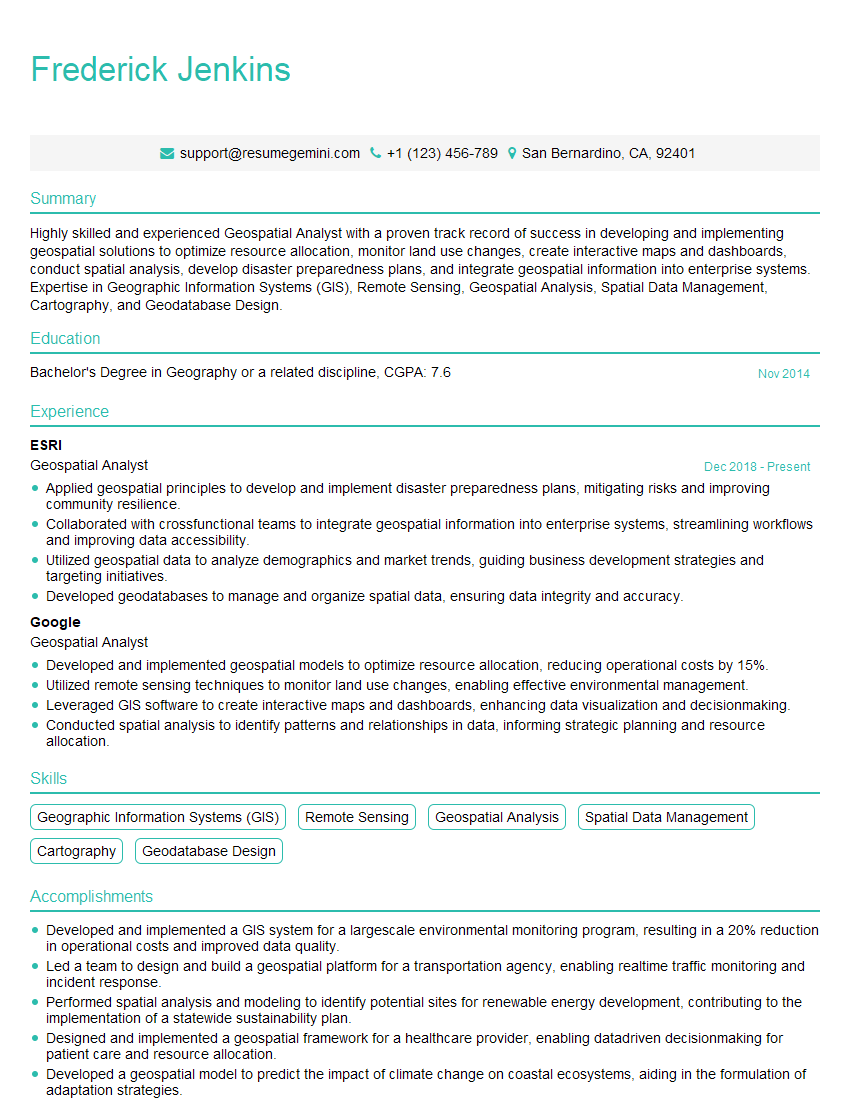
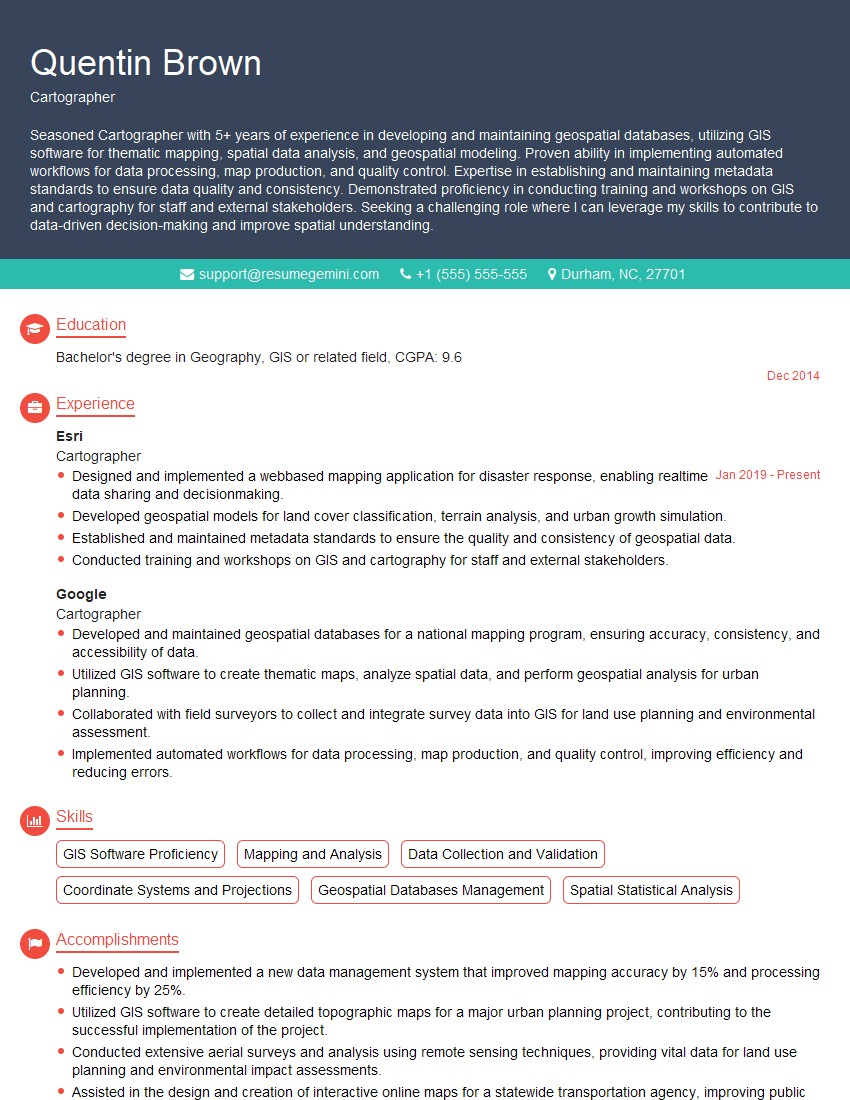
Mastering Esri technologies opens doors to exciting and impactful careers in various fields. To maximize your chances of landing your dream job, creating a strong, ATS-friendly resume is crucial. ResumeGemini is a trusted resource that can help you build a professional and compelling resume tailored to the specific requirements of Esri job postings. We provide examples of resumes optimized for Esri applications to guide you through the process. Invest time in crafting a resume that showcases your skills and experience effectively – it’s your first impression!
Explore more articles
Users Rating of Our Blogs
Share Your Experience
We value your feedback! Please rate our content and share your thoughts (optional).
What Readers Say About Our Blog
Really detailed insights and content, thank you for writing this detailed article.
IT gave me an insight and words to use and be able to think of examples