Feeling uncertain about what to expect in your upcoming interview? We’ve got you covered! This blog highlights the most important Soil Science and Analysis interview questions and provides actionable advice to help you stand out as the ideal candidate. Let’s pave the way for your success.
Questions Asked in Soil Science and Analysis Interview
Q 1. Explain the difference between soil texture and soil structure.
While both soil texture and soil structure describe the physical properties of soil, they refer to different aspects. Soil texture refers to the relative proportions of sand, silt, and clay particles present in the soil. Think of it like a recipe: the ingredients. A sandy soil has a high proportion of sand, while a clay soil has a high proportion of clay. A loamy soil has a balanced mixture of all three. Soil texture is determined by a simple laboratory procedure called the hydrometer method or the textural triangle.
Soil structure, on the other hand, describes how these individual particles are aggregated or clumped together to form larger units called peds. It’s like the way you arrange those ingredients in a dish. Good soil structure is characterized by well-defined peds that allow for good aeration, water infiltration, and root penetration. Poor soil structure might be compacted, platy, or blocky, hindering these important processes. For example, a soil with a sandy texture can still have a good structure if the sand particles are bound together by organic matter, forming stable aggregates. Conversely, a clay soil can have a poor structure if it’s compacted, leading to poor drainage and aeration.
Q 2. Describe the process of soil formation (pedogenesis).
Soil formation, or pedogenesis, is a complex process involving the interaction of five key factors: parent material, climate, biota (living organisms), topography, and time. Imagine it as a recipe for soil, where each ingredient plays a crucial role.
- Parent material provides the initial mineral base. This could be weathered bedrock, glacial deposits, or even volcanic ash.
- Climate influences the rate and type of weathering, as well as the decomposition of organic matter. Hot, humid climates lead to rapid weathering and decomposition, while cold, dry climates slow these processes down.
- Biota, including plants, animals, and microorganisms, are crucial in decomposing organic matter, creating soil structure, and cycling nutrients. Earthworms, for instance, improve soil aeration and drainage.
- Topography affects the amount of water and sunlight a soil receives, influencing weathering rates and organic matter accumulation. Steep slopes often have thin soils, while flat areas tend to have thicker soils.
- Time is essential as it determines the degree of weathering and soil profile development. Older soils generally have better-developed profiles than younger soils.
These five factors interact over time to create distinct soil horizons, forming a soil profile. The process is dynamic and constantly evolving, responding to changes in the environment.
Q 3. What are the major soil horizons and their characteristics?
A typical soil profile consists of several distinct layers called horizons. While variations exist, the most common are:
- O horizon (organic layer): Primarily composed of undecomposed or partially decomposed organic matter, such as leaves, twigs, and other plant debris. This layer is thickest in forests.
- A horizon (topsoil): A dark-colored layer rich in organic matter and minerals. It’s where most biological activity occurs, and it’s crucial for plant growth.
- E horizon (eluviation horizon): A light-colored layer where clay, iron, and aluminum oxides have been leached out (removed) from the topsoil. This horizon is not always present.
- B horizon (subsoil): A layer where materials leached from the A and E horizons accumulate. It often has a higher clay content than the topsoil and may be enriched in iron and aluminum oxides.
- C horizon (parent material): The unconsolidated material from which the soil is formed. This layer is relatively unaltered by soil-forming processes.
- R horizon (bedrock): The underlying consolidated rock layer.
The thickness and characteristics of these horizons vary depending on the soil-forming factors mentioned earlier. Understanding soil horizons is crucial for assessing soil fertility and suitability for various land uses.
Q 4. Explain the concept of cation exchange capacity (CEC) and its importance.
Cation exchange capacity (CEC) is a measure of a soil’s ability to hold onto positively charged ions (cations), such as calcium (Ca2+), magnesium (Mg2+), potassium (K+), and ammonium (NH4+). These cations are essential plant nutrients. The higher the CEC, the more nutrients a soil can retain and make available to plants.
Think of the soil as a sponge, and the clay and organic matter particles within the soil as the sponge’s fibers. These fibers have a negative charge and attract positively charged nutrient ions. CEC is essentially the total amount of these positive charges that the soil can hold. A high CEC means the soil is more fertile and less prone to nutrient leaching.
CEC is influenced by the amount of clay and organic matter in the soil. Clay minerals and organic matter have high CEC, while sandy soils have low CEC. The importance of CEC is that it dictates the soil’s ability to provide plants with essential nutrients, buffer against acidity changes, and retain water. Soils with high CEC are generally more productive and sustainable.
Q 5. How do you determine soil pH and what are its implications for plant growth?
Soil pH is a measure of the soil’s acidity or alkalinity, expressed on a scale of 0 to 14, where 7 is neutral, below 7 is acidic, and above 7 is alkaline. Soil pH is determined using a pH meter or a chemical test kit. A soil sample is mixed with distilled water or a buffer solution, and the pH is measured using a calibrated pH meter or using a colorimetric method with a test kit.
Soil pH significantly affects plant growth because it influences the availability of nutrients. Different plants have different pH preferences. For example, most plants thrive in a slightly acidic to neutral pH range (6.0-7.0). At low pH (acidic conditions), certain nutrients like phosphorus and molybdenum become less available to plants, leading to nutrient deficiencies. Conversely, at high pH (alkaline conditions), micronutrients like iron and manganese may become less soluble and unavailable.
Understanding and managing soil pH is crucial for optimizing plant growth and crop yields. Soil amendments, such as lime (to raise pH) or sulfur (to lower pH), can be used to adjust soil pH to the optimal range for specific crops.
Q 6. Describe different methods for soil sampling and their applications.
Several methods exist for soil sampling, each with specific applications:
- Grid sampling: A systematic approach where samples are collected at regular intervals across a field. This method provides a representative sample of the entire area and is commonly used for large-scale agricultural fields.
- Composite sampling: Combining several individual samples into one composite sample. This is cost-effective and suitable for assessing the general soil fertility of a large area, but it masks variations within the area.
- Targeted sampling: Collecting samples from specific areas of interest, such as areas with different vegetation or drainage patterns. This method is useful for identifying localized problems or variations in soil properties.
- Auger sampling: Using a soil auger to collect samples from different depths. This method is useful for assessing soil profile development and identifying layers with different properties.
- Probe sampling: Using a soil probe to collect small, shallow samples. This method is quick and easy, suitable for rapid assessments or large areas, but less accurate for precise measurements.
The choice of sampling method depends on the objectives of the soil analysis, the size and variability of the area being sampled, and the resources available. Proper sampling is essential to ensure that the results of soil analysis accurately reflect the soil conditions.
Q 7. Explain the role of soil organic matter in soil health.
Soil organic matter (SOM) plays a vital role in maintaining soil health. It’s a complex mixture of partially decomposed plant and animal residues, microbial biomass, and humic substances. Think of SOM as the ‘glue’ that holds soil particles together, creating good soil structure.
SOM enhances soil fertility by providing nutrients for plant growth. As it decomposes, it releases essential nutrients like nitrogen, phosphorus, and potassium. It improves soil water retention capacity, making water available to plants during dry periods. It also improves soil aeration and drainage, allowing roots to access oxygen and preventing waterlogging. Furthermore, SOM acts as a buffer against soil pH changes and helps to reduce erosion.
Healthy soils with high SOM content are more resilient to environmental stressors, such as drought, erosion, and pollution. Managing SOM involves practices such as no-till farming, cover cropping, and adding organic amendments, all aimed at increasing the amount and quality of SOM in the soil.
Q 8. Discuss the impact of soil erosion on soil fertility and land degradation.
Soil erosion, the process of topsoil detachment and transport by water or wind, significantly impacts soil fertility and leads to land degradation. Think of it like slowly peeling away the most nutritious layer of a cake – the top layer contains the most organic matter, nutrients, and beneficial microorganisms crucial for plant growth.
The loss of topsoil reduces the soil’s water holding capacity, making it more susceptible to drought. This loss also diminishes the availability of essential plant nutrients like nitrogen, phosphorus, and potassium, leading to decreased crop yields. Further, erosion exposes less fertile subsoil, which often lacks the structure and organic matter to support healthy plant life. This ultimately results in decreased agricultural productivity and a decline in overall land quality.
For example, a farm experiencing severe sheet erosion (thin, uniform layer of soil removal) will see a gradual decline in crop yields year after year, potentially requiring increasingly higher inputs of fertilizers to compensate for the nutrient loss. In extreme cases, erosion can lead to complete land degradation, rendering the land unsuitable for agriculture or any other productive use, like desertification.
Q 9. What are the common soil-borne diseases and their management strategies?
Many plant diseases originate from pathogens residing in the soil. Common soil-borne diseases include:
- Fusarium wilt: Attacks various plants, causing wilting and vascular discoloration. Management involves crop rotation, using resistant cultivars, and soil solarization (heating the soil to kill pathogens).
- Verticillium wilt: Similar to Fusarium wilt, impacting a wide range of crops. Management strategies are also similar, focusing on disease-resistant varieties and soil sanitation.
- Root rot: Caused by various fungi, leading to root decay and stunted plant growth. Good drainage, proper irrigation, and avoiding excessive soil moisture are crucial. Fungicides can be used as a last resort.
- Potato scab: A bacterial disease affecting potato tubers. Maintaining optimal soil pH and avoiding excessive fertilization can help prevent its spread.
Effective management often involves an integrated approach combining preventative measures like crop rotation, resistant varieties, and proper soil management practices with chemical control only when absolutely necessary to minimize environmental impact and the development of resistant pathogens.
Q 10. Describe different techniques for soil remediation.
Soil remediation aims to clean up contaminated soil. Techniques vary depending on the type and extent of contamination. Common methods include:
- Phytoremediation: Using plants to extract or degrade contaminants. Certain plants have the ability to absorb heavy metals from the soil. This is a cost-effective and environmentally friendly approach.
- Bioremediation: Employing microorganisms (bacteria and fungi) to break down organic contaminants like oil spills. This process relies on the natural ability of microbes to metabolize pollutants.
- Thermal desorption: Heating the soil to volatilize contaminants, which are then collected and treated. This is effective for volatile organic compounds but requires specialized equipment.
- Soil washing: Removing contaminants by leaching with water or chemical solutions. This is useful for removing heavy metals or other inorganic contaminants.
- Excavation and disposal: In cases of severe contamination, the contaminated soil might need to be removed and disposed of in a hazardous waste facility. This is often the most expensive option.
The choice of remediation technique depends on factors like the type of contaminant, concentration, soil properties, and site conditions. A comprehensive site assessment is crucial for selecting the most appropriate and effective remediation strategy.
Q 11. Explain the principles of soil water retention and movement.
Soil water retention and movement are governed by soil physical properties. Water is held in the soil by forces of adhesion (water molecules sticking to soil particles) and cohesion (water molecules sticking to each other).
Retention: The amount of water a soil can hold depends on its texture (sand, silt, clay) and structure (arrangement of soil particles). Clay soils, with their smaller particle sizes and larger surface area, retain more water than sandy soils. Soil organic matter also plays a vital role, increasing water holding capacity by acting like a sponge.
Movement: Water moves through the soil profile primarily by gravity and capillary action. Gravity pulls water downwards, while capillary action allows water to move upwards against gravity in the small pores of the soil. The rate of water movement is influenced by soil texture and structure, with sandy soils allowing for faster infiltration and drainage than clay soils.
Imagine a sponge: a finer sponge (clay) will hold more water, while a coarser sponge (sand) will let water drain faster. The size and connectivity of the pores in the soil determine how easily water can move through it.
Q 12. How do you interpret soil test results?
Interpreting soil test results requires understanding the different parameters measured and their implications for plant growth. Typical tests include:
- pH: Indicates soil acidity or alkalinity. Optimal pH ranges vary for different plants. A pH outside the optimal range can affect nutrient availability.
- Nutrient levels: Measures the concentrations of essential nutrients like nitrogen (N), phosphorus (P), and potassium (K), as well as micronutrients. Low levels indicate the need for fertilization.
- Organic matter content: Indicates the amount of decomposed organic material in the soil. High organic matter improves soil structure, water retention, and nutrient availability.
- Texture: Describes the proportions of sand, silt, and clay. Influences water retention, drainage, and aeration.
Interpreting the results involves comparing the measured values to established optimal ranges for the specific crop being grown and the soil type. For example, a low potassium level suggests the need for potassium fertilizer, while a very high pH might indicate the need for soil amendment to improve nutrient availability. The interpretation should also consider the plant’s nutrient requirements and the soil’s overall physical condition.
Q 13. Discuss the use of GIS in soil science applications.
Geographic Information Systems (GIS) are powerful tools in soil science, enabling the visualization, analysis, and management of spatial soil data. GIS allows us to integrate various soil information layers, such as soil type maps, nutrient levels, erosion risk, and land use, into a single platform.
Applications include:
- Soil mapping and classification: GIS helps create detailed soil maps, classifying different soil types based on their properties and spatial distribution.
- Precision agriculture: GIS supports site-specific management practices by providing detailed information on soil variability across a field. This allows for variable rate fertilization, irrigation, and other management strategies.
- Erosion risk assessment: GIS can integrate topographic data, soil properties, and rainfall patterns to model erosion risk and identify areas needing conservation practices.
- Environmental monitoring: GIS can be used to track changes in soil properties over time, aiding in the monitoring of soil health and pollution.
Essentially, GIS provides a framework for understanding the spatial relationships between different soil properties and environmental factors, enabling more effective and targeted soil management strategies.
Q 14. What are the different types of soil surveys and their uses?
Soil surveys are systematic investigations to characterize and map the soil resources of an area. Different types of surveys exist depending on the scale and objectives:
- Reconnaissance surveys: Large-scale surveys providing a general overview of soil resources. They’re useful for regional planning and identifying areas needing more detailed investigation.
- Detailed surveys: Small-scale, high-resolution surveys providing detailed information about soil properties and their spatial distribution within a specific area. These are used for land-use planning, agricultural management, and engineering purposes.
- Special-purpose surveys: Focused on specific aspects of soil, such as salinity, erosion potential, or suitability for a particular land use. These are customized surveys designed to answer specific questions.
The choice of survey type depends on the specific needs and objectives. For example, a reconnaissance survey might be sufficient for initial land-use planning, while a detailed survey is necessary for precise agricultural management or engineering projects. The outputs of soil surveys, often presented as soil maps and reports, are fundamental for sustainable land management and decision-making.
Q 15. Explain the concept of soil classification systems (e.g., USDA, World Reference Base).
Soil classification systems are frameworks used to organize and understand the vast diversity of soils across the globe. They group soils with similar characteristics, allowing scientists and practitioners to predict their behavior and manage them effectively. Two prominent systems are the USDA (United States Department of Agriculture) system and the World Reference Base (WRB) for Soil Resources.
The USDA system, primarily used in the United States, is hierarchical, categorizing soils into 12 orders based on key properties like soil horizons, climate influence, and parent material. For example, ‘Alfisols’ are mineral soils relatively high in bases and found in humid and subhumid regions, while ‘Aridisols’ are dry soils common in deserts. Each order is further subdivided into suborders, great groups, subgroups, families, and series, providing increasingly specific descriptions.
The World Reference Base (WRB), developed by the FAO (Food and Agriculture Organization of the United Nations), is a more internationally recognized system. It uses a less hierarchical approach, focusing on diagnostic horizons and properties to define 32 soil reference groups. This system aims for greater global consistency in soil classification, making it valuable for international collaborations and global soil assessments. For instance, ‘Vertisols’ are clay-rich soils with high shrink-swell capacity found across many regions, while ‘Cambisols’ are young soils with a slightly developed horizon found in various climates. Both systems rely on field observations, laboratory analysis, and interpretation of soil properties to classify a given soil.
Career Expert Tips:
- Ace those interviews! Prepare effectively by reviewing the Top 50 Most Common Interview Questions on ResumeGemini.
- Navigate your job search with confidence! Explore a wide range of Career Tips on ResumeGemini. Learn about common challenges and recommendations to overcome them.
- Craft the perfect resume! Master the Art of Resume Writing with ResumeGemini’s guide. Showcase your unique qualifications and achievements effectively.
- Don’t miss out on holiday savings! Build your dream resume with ResumeGemini’s ATS optimized templates.
Q 16. Describe the role of soil microorganisms in nutrient cycling.
Soil microorganisms play a crucial role in nutrient cycling, the process by which nutrients are transformed and made available to plants. Think of them as the recycling crew of the soil ecosystem. They break down organic matter – dead plants, animals, and microbes – releasing essential nutrients like nitrogen, phosphorus, and potassium back into the soil. This process involves several key steps:
- Mineralization: Microbes decompose organic matter, converting complex organic forms of nutrients into simpler inorganic forms that plants can absorb. For example, bacteria convert organic nitrogen into ammonium (NH4+), which plants can then utilize.
- Nitrification: Bacteria convert ammonium (NH4+) to nitrite (NO2-) and then nitrate (NO3-), the preferred form of nitrogen for most plants. This process requires oxygen, making soil aeration vital.
- Immobilization: Microbes also temporarily take up nutrients from the soil, incorporating them into their own biomass. This is a natural process, but it can temporarily reduce nutrient availability to plants.
- Nitrogen fixation: Some specialized bacteria, like those associated with legume roots, can convert atmospheric nitrogen (N2) into ammonia (NH3), making it available to plants. This is an incredibly important process because atmospheric nitrogen is inaccessible to most plants.
Understanding the role of soil microorganisms is critical for effective soil management. Practices like cover cropping, adding organic matter, and avoiding excessive tillage can enhance microbial activity and improve nutrient cycling, leading to healthier soils and more productive crops.
Q 17. How do you assess soil fertility?
Assessing soil fertility involves determining the amount and availability of essential nutrients for plant growth. It’s a multi-faceted approach that combines field observations with laboratory analysis.
- Visual Observation: A careful examination of the soil’s color, texture, structure, and presence of organic matter can give initial clues about its fertility. For example, dark-colored soils generally indicate higher organic matter content and potentially better fertility.
- Soil Testing: This is the most crucial aspect. Samples are collected and sent to a laboratory for analysis of essential nutrients like nitrogen (N), phosphorus (P), potassium (K), sulfur (S), calcium (Ca), magnesium (Mg), and micronutrients (e.g., iron, zinc, manganese). These tests reveal the nutrient levels present and can help determine deficiencies or excesses.
- Plant Tissue Analysis: Analyzing the nutrient content of plant leaves or stems provides information on the nutrients the plants are actually able to absorb and utilize. This can identify nutrient deficiencies that may not be apparent from soil tests alone.
- Other Tests: Additional tests may be conducted to assess soil pH, organic matter content, cation exchange capacity (CEC), and other factors influencing nutrient availability. Soil pH, for example, greatly influences the solubility and availability of many nutrients.
The results of these assessments are used to create site-specific nutrient management plans, ensuring that crops receive the appropriate amounts of nutrients without over-fertilizing, which can harm the environment.
Q 18. What are the effects of different land use practices on soil properties?
Different land use practices significantly impact soil properties. The effects can be both positive and negative, depending on the practice and its implementation.
- Agriculture: Intensive farming can lead to soil erosion, compaction, nutrient depletion, and degradation of soil structure. However, sustainable agricultural practices like cover cropping, no-till farming, and crop rotation can help mitigate these negative impacts.
- Forestry: Forests generally protect soil from erosion and maintain soil organic matter. However, intensive logging or deforestation can lead to significant soil erosion and loss of fertility.
- Urbanization: Urban development often results in soil sealing (covering with impervious surfaces), leading to reduced infiltration, increased runoff, and loss of soil functions. Green infrastructure practices can help mitigate this.
- Pastoralism (Grazing): Overgrazing can compact soil, reduce vegetation cover, leading to erosion. Sustainable grazing management practices, such as rotational grazing, can help maintain soil health.
For example, continuous monoculture cropping can deplete specific nutrients while diverse cropping systems can improve soil health. Similarly, no-till farming helps maintain soil structure and reduce erosion compared to conventional tillage.
Q 19. Explain the principles of sustainable soil management.
Sustainable soil management focuses on maintaining and enhancing soil health for long-term productivity and environmental benefits. It integrates multiple principles:
- Minimizing Soil Disturbance: Reducing tillage or adopting no-till practices helps maintain soil structure, reduce erosion, and protect soil organisms.
- Maximizing Soil Cover: Using cover crops, mulches, or other strategies to keep soil covered protects it from erosion, reduces water evaporation, and improves soil organic matter.
- Diversifying Crop Rotation: Rotating crops helps to break pest and disease cycles, improve nutrient cycling, and maintain soil health.
- Optimizing Nutrient Management: Applying nutrients efficiently and in the right amounts, using practices like precision fertilization, ensures optimal plant growth without excess nutrient runoff.
- Integrating Livestock: Properly managed grazing can improve soil health by increasing organic matter and nutrient cycling.
- Maintaining Soil Biodiversity: Promoting a diverse range of soil organisms enhances nutrient cycling and soil resilience.
Sustainable soil management is essential for ensuring food security, protecting biodiversity, and mitigating climate change. It requires a holistic approach that considers the interactions between soil, plants, animals, and the environment.
Q 20. Discuss the impact of climate change on soil resources.
Climate change significantly impacts soil resources. Changes in temperature, precipitation patterns, and extreme weather events affect soil properties and processes:
- Increased Erosion: More intense rainfall events lead to increased soil erosion, causing loss of topsoil and nutrients.
- Changes in Soil Organic Matter: Higher temperatures and altered precipitation can affect the decomposition rate of soil organic matter, influencing nutrient cycling and soil structure.
- Altered Nutrient Availability: Changes in temperature and moisture influence the availability of essential nutrients to plants.
- Desertification: In arid and semi-arid regions, climate change can exacerbate desertification, leading to soil degradation and reduced productivity.
- Increased Soil Salinity: Changes in water tables and evaporation rates can increase soil salinity in many regions, hindering plant growth.
These impacts have significant implications for food security, water resources, and biodiversity. Understanding these impacts is critical for developing adaptation and mitigation strategies for sustainable soil management in a changing climate.
Q 21. What are the challenges and opportunities in soil science research?
Soil science research faces several challenges and opportunities:
- Challenges:
- Data scarcity and limitations: Comprehensive global soil data is still limited, hindering accurate assessments and modeling.
- Complexity of soil systems: Soils are complex systems with numerous interacting factors, making it difficult to fully understand their behavior.
- Climate change impacts: The accelerating impacts of climate change are creating new challenges for soil management and require innovative research solutions.
- Sustainable intensification: Meeting growing food demands while ensuring soil health requires innovative approaches to sustainable agricultural intensification.
- Opportunities:
- Technological advancements: Advances in remote sensing, GIS, and molecular biology provide new tools for studying soils and improving soil management.
- Data sharing and collaboration: Improved data sharing and international collaboration can accelerate research progress and provide more comprehensive understanding of soil systems.
- Developing climate-smart soil management practices: Research into climate-resilient soil management practices is crucial for mitigating the impacts of climate change on soil resources.
- Precision agriculture: Developing site-specific soil management strategies improves nutrient use efficiency and minimizes environmental impacts.
By addressing these challenges and capitalizing on emerging opportunities, soil science research can play a vital role in ensuring food security, environmental sustainability, and a healthy planet.
Q 22. How do you analyze soil for heavy metals?
Analyzing soil for heavy metals involves a multi-step process, starting with sample collection and preparation. We need to ensure representative sampling, avoiding contamination at every stage. After preparing the sample (drying, grinding, sieving), we use various analytical techniques to determine the concentration of metals.
Common methods include:
- Atomic Absorption Spectrometry (AAS): This technique measures the absorption of light by free metal atoms in a flame or graphite furnace. It’s relatively inexpensive and widely used for a range of metals.
- Inductively Coupled Plasma Optical Emission Spectrometry (ICP-OES): ICP-OES uses a plasma to excite the atoms, resulting in higher sensitivity and the ability to analyze multiple metals simultaneously. This is ideal for complex matrices.
- Inductively Coupled Plasma Mass Spectrometry (ICP-MS): This offers even higher sensitivity and is especially useful for detecting trace levels of heavy metals and isotopes. It’s more expensive than AAS or ICP-OES.
The choice of method depends on the specific metals of interest, their expected concentrations, and the available resources. For example, if we suspect high levels of lead and cadmium in soil near a former industrial site, ICP-OES would be a good choice for its speed and ability to analyze both simultaneously. If we’re concerned about extremely low levels of mercury in a pristine environment, ICP-MS would be preferred for its superior sensitivity.
Following analysis, the results are interpreted according to established guidelines and regulatory limits to assess potential environmental risks or human health concerns.
Q 23. Describe different methods for measuring soil porosity and bulk density.
Soil porosity and bulk density are crucial indicators of soil structure and water holding capacity. We can measure them using several methods:
Measuring Soil Porosity:
- Direct Method (using a pycnometer): This involves determining the particle density of the soil using a pycnometer (a device for measuring density) and then using the bulk density to calculate porosity. This is a precise method but is time consuming.
- Indirect Method (using water content and bulk density): This simpler method uses the relationship between bulk density, water content (gravimetrically determined), and particle density (estimated or determined through a pycnometer in a subset of samples). The formula is: Porosity = 1 – (Bulk Density/Particle Density).
Measuring Soil Bulk Density:
- Core Method: This involves using a soil core sampler of known volume to extract an undisturbed soil sample. The sample is weighed, and the bulk density is calculated by dividing the dry weight by the volume.
- Clod Method: This involves carefully removing soil clods of a known volume, weighing them when dry, and then calculating the bulk density. This is less precise than the core method because it is more likely to create compaction or sample damage.
Imagine comparing two soils. One with high porosity will have a lower bulk density and high water retention, ideal for plant growth. A soil with low porosity and high bulk density is compacted, resulting in poor drainage and aeration.
Q 24. What are the limitations of traditional soil testing methods?
Traditional soil testing methods, while valuable, have several limitations:
- Limited information: They typically focus on a few key nutrients (e.g., N, P, K) and ignore other important aspects like soil organic matter quality, microbial activity, and heavy metal content.
- Spatial variability: Soil properties vary significantly across a field. A single composite sample may not accurately represent the entire area, leading to inaccurate fertilizer recommendations.
- Static measurements: Traditional methods provide a snapshot in time, failing to capture the dynamic nature of soil processes. They don’t reveal soil’s response to management changes over time.
- Laboratory errors: Analytical errors can occur during sample preparation and analysis in the lab, affecting the accuracy and precision of the results.
- Interpretation challenges: Interpreting results requires expertise. Recommendations based on a simple test may not be optimally tailored for specific crops or conditions.
For instance, a traditional soil test might indicate sufficient phosphorus levels, but it may not account for the phosphorus’s availability to the plant because of pH or organic matter issues. Thus, although the analysis may be correct, its interpretation might be flawed, leading to improper fertilizer management.
Q 25. Explain the principles of precision agriculture in relation to soil science.
Precision agriculture uses technology to optimize crop production by managing inputs (fertilizers, water, pesticides) based on spatial variability. Soil science plays a critical role:
- Site-specific soil mapping: GPS and GIS are used to create detailed maps of soil properties, such as pH, nutrient levels, and organic matter content, across a field. This allows for variable rate application of inputs.
- Soil sensors and remote sensing: Sensors embedded in the soil or drones equipped with sensors can provide real-time data on soil moisture, temperature, and nutrient levels, guiding irrigation and fertilization decisions.
- Data analysis and modeling: Statistical tools and models are used to analyze soil data and predict crop yields under different management scenarios. This allows for informed decision-making about input management.
For example, a precision agriculture system might use soil maps to apply more fertilizer to areas with low nutrient levels and less to areas with high nutrient levels. This leads to improved crop yields, reduced fertilizer costs, and minimized environmental impact.
Q 26. Describe the role of soil science in environmental protection.
Soil science is fundamental to environmental protection. Soil acts as a vital filter, regulating water quality, storing carbon, and supporting biodiversity. Here’s how soil science contributes:
- Protecting water quality: Understanding soil properties helps us manage runoff and prevent nutrient pollution (e.g., nitrates and phosphates) from entering waterways. Soil scientists help design strategies to reduce erosion and improve water infiltration.
- Climate change mitigation: Soil is a significant carbon sink. Soil science helps develop practices that enhance soil carbon sequestration, mitigating climate change. Managing soil health enhances its carbon holding capacity.
- Biodiversity conservation: Healthy soils support diverse plant and animal communities. Soil science helps maintain soil structure and nutrient cycling which are critical for biodiversity.
- Remediation of contaminated sites: Soil science plays a crucial role in assessing and remediating contaminated soils, restoring them to a safe and productive state. Phytoremediation, using plants to remove pollutants from the soil, is an example of this application.
Consider the example of a contaminated industrial site. Soil scientists would conduct a thorough assessment to determine the extent and nature of the contamination. They would then develop a remediation strategy that might involve excavating and treating the contaminated soil, or using phytoremediation to remove pollutants from the soil in a cost-effective and environmentally friendly manner.
Q 27. How do you manage saline and sodic soils?
Saline and sodic soils present significant challenges for agriculture. Management strategies aim to improve soil conditions and enhance crop productivity:
Saline soils (high salt concentration):
- Improved drainage: Installing drainage systems to leach out excess salts is crucial. This lowers the water table and reduces salt accumulation in the root zone.
- Amendment with gypsum: Gypsum (calcium sulfate) helps replace sodium ions with calcium ions, improving soil structure and permeability.
- Salt-tolerant crops: Selecting and planting salt-tolerant crop varieties is essential for successful cultivation.
Sodic soils (high sodium concentration, high pH):
- Gypsum amendment: This is critical in sodic soils, replacing sodium with calcium and lowering the pH. The calcium helps improve soil structure.
- Acidification: Applying sulfur or acidifying materials lowers the pH, which is crucial for improving nutrient availability and reducing sodium toxicity.
- Organic matter additions: Adding organic matter improves soil structure and water infiltration, mitigating sodicity issues.
Imagine a farmer with a saline field. By installing a drainage system and using salt-tolerant crops, they can successfully reclaim the land and improve its productivity. Without intervention, the high salinity would hinder plant growth and diminish yield.
Q 28. What are the ethical considerations in soil science practice?
Ethical considerations in soil science practice are paramount. They involve:
- Data integrity and transparency: Accurate and reliable data are essential for sound decision-making. We must ensure transparency in methods, data analysis, and reporting to avoid biased outcomes.
- Environmental sustainability: Soil management practices should prioritize long-term soil health and environmental protection. We need to avoid practices that deplete soil resources or cause pollution.
- Social equity and justice: Soil science solutions should be accessible to all, considering the needs of diverse communities and ensuring fair distribution of resources.
- Animal welfare: Where soil health influences animal health, this should be considered in all recommendations.
- Conflict of interest: Avoiding conflicts of interest in research, consulting, and policy recommendations is crucial for maintaining integrity.
For example, a soil scientist advising a farmer on fertilizer use should prioritize environmentally sustainable practices, even if it means recommending less fertilizer than the farmer desires, to prevent nutrient runoff and water pollution.
Key Topics to Learn for Soil Science and Analysis Interview
- Soil Formation and Classification: Understand the factors influencing soil formation (parent material, climate, topography, organisms, time) and be familiar with major soil classification systems (e.g., USDA Soil Taxonomy).
- Soil Physical Properties: Discuss soil texture, structure, density, porosity, water holding capacity, and their impact on plant growth and land management. Be prepared to explain how these properties are measured and interpreted.
- Soil Chemical Properties: Master concepts like soil pH, cation exchange capacity (CEC), nutrient availability, and the role of organic matter. Know how to interpret soil test results and recommend appropriate amendments.
- Soil Biology: Understand the diversity and function of soil organisms, their impact on soil health and nutrient cycling, and the role of soil microorganisms in decomposition and nutrient transformation.
- Soil Erosion and Conservation: Discuss the causes and consequences of soil erosion and the various conservation practices employed to mitigate erosion and maintain soil health.
- Soil Fertility Management: Explain different fertilization strategies, nutrient management practices, and the principles of sustainable soil fertility management. Be prepared to discuss organic vs. inorganic fertilizers.
- Soil Sampling and Analysis Techniques: Describe common soil sampling methods, laboratory analysis techniques (e.g., particle size analysis, chemical analysis), and the interpretation of analytical data. Understand the importance of quality control in soil analysis.
- Soil Contamination and Remediation: Discuss common soil contaminants (heavy metals, pesticides, etc.), their impact on soil health and the environment, and different remediation techniques.
- GIS and Remote Sensing Applications in Soil Science: Understand how Geographic Information Systems (GIS) and remote sensing technologies are used in soil mapping, monitoring, and management.
- Sustainable Soil Management Practices: Be prepared to discuss the principles of sustainable soil management, including no-till farming, cover cropping, crop rotation, and integrated pest management.
Next Steps
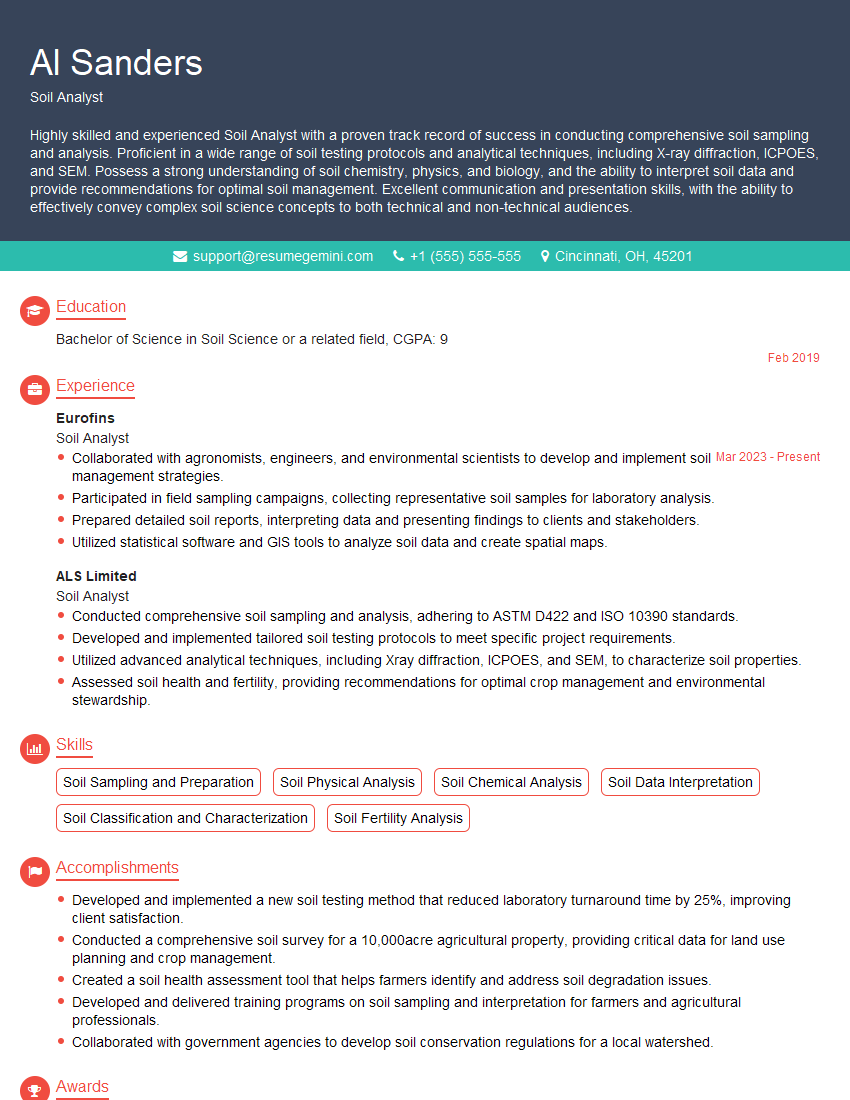
Mastering Soil Science and Analysis opens doors to a rewarding career in agriculture, environmental science, and land management. A strong understanding of these concepts is crucial for success in interviews and throughout your career. To significantly enhance your job prospects, create an ATS-friendly resume that showcases your skills and experience effectively. ResumeGemini is a trusted resource that can help you build a professional and impactful resume. Examples of resumes tailored to Soil Science and Analysis are available to guide you.





Explore more articles
Users Rating of Our Blogs
Share Your Experience
We value your feedback! Please rate our content and share your thoughts (optional).
What Readers Say About Our Blog
Really detailed insights and content, thank you for writing this detailed article.
IT gave me an insight and words to use and be able to think of examples