Unlock your full potential by mastering the most common Hand-Painted Lettering interview questions. This blog offers a deep dive into the critical topics, ensuring you’re not only prepared to answer but to excel. With these insights, you’ll approach your interview with clarity and confidence.
Questions Asked in Hand-Painted Lettering Interview
Q 1. What are the key differences between calligraphy and hand lettering?
While both calligraphy and hand lettering involve creating letters, they differ significantly in their approach and outcome. Calligraphy is a disciplined art form focused on the consistent execution of specific letterforms using traditional tools and techniques. It adheres to established scripts like Copperplate or Spencerian, emphasizing rhythm and flow. Think of it like playing a musical instrument – there are rules and established techniques to follow.
Hand lettering, on the other hand, is more freestyle. It’s about artistic expression and the creative exploration of letterforms. It’s not bound by strict rules, and artists often combine different styles, weights, and flourishes to create unique and personalized designs. It’s closer to painting than playing a pre-composed piece of music – each piece is entirely unique and shaped by the artist’s vision.
Essentially, calligraphy is a method, while hand lettering is a style. You might use calligraphic techniques within a hand lettering piece, but hand lettering isn’t necessarily calligraphic.
Q 2. Describe your preferred hand lettering tools and materials.
My preferred tools depend on the project, but I generally favor a variety of materials to achieve different effects. For example, I love using Higgins Eternal Ink with pointed nib calligraphy pens (like Brause Rose or Leonardt EF) for fine lines and precise details, particularly in more formal projects. For a bolder, more expressive feel, I’ll often opt for brush pens like Tombow Dual Brush Pens or Kuretake Fudegokochi brushes for their versatility and ability to create varied line weights.
I also frequently work with watercolors, specifically those with high pigment concentration, to add depth and color to my lettering. The interplay of the ink and watercolor creates a beautiful texture and unique character that’s difficult to achieve digitally. High-quality watercolor paper, like Arches Cold Press, is a must for avoiding bleed-through and ensuring a smooth surface.
Finally, I always keep a selection of pencil grades (H2, 2B, 4B) on hand for initial sketching and layout. A quality eraser, ruler, and fine-tipped Sharpie pen complete my basic toolkit.
Q 3. Explain your process for creating a hand-lettered logo.
Creating a hand-lettered logo is a multi-stage process requiring careful planning and execution. It begins with a thorough understanding of the client’s brand and target audience. This informs every design decision, from the choice of font style to the overall aesthetic.
- Research & Conceptualization: I start by deeply researching the client’s brand, its values, and its intended audience. This helps to establish a mood board and define the style – modern, vintage, playful, etc.
- Sketching & Refinement: I then create numerous sketches, experimenting with different letterforms, layouts, and stylistic elements. This involves exploring various fonts, weights, and serifs to find the perfect balance.
- Digitalization (Optional): Once I have a few strong sketch candidates, I may scan them and refine them further using vector software like Adobe Illustrator. This allows for precise adjustments and scalability.
- Finalization & Refinement: After selecting the best sketch, I carefully ink the final piece using my chosen tools and materials, paying close attention to detail and consistency.
- Review & Delivery: The finished artwork is reviewed with the client for feedback and adjustments before the final high-resolution files are delivered.
For example, a logo for a children’s bookstore might utilize a playful, rounded font with bright colors and whimsical flourishes, while a logo for a law firm might require a more refined, sophisticated serif font with a classic aesthetic.
Q 4. How do you adapt your lettering style to different projects and clients?
Adaptability is crucial in hand lettering. I approach each project with a fresh perspective, tailoring my style to reflect the client’s brand identity and the project’s purpose. This means understanding the specific needs and limitations of each project.
For instance, a project for a tech startup might call for a minimalist, modern sans-serif typeface, while a project for a coffee shop might necessitate a more rustic, hand-drawn style. I might use bolder strokes and vibrant colors for a children’s book but opt for delicate, refined lines and muted tones for a wedding invitation. The key is to let the project’s needs dictate the style choices, not the other way around.
I achieve this by studying successful examples, experimenting with different techniques, and continuously refining my skillset. Strong communication with the client is also critical to ensuring that the final product meets their expectations.
Q 5. What are some common challenges you face when creating hand-painted lettering, and how do you overcome them?
Hand-painted lettering presents several challenges. One common issue is achieving consistent line weight and spacing, particularly when working with brush pens or watercolors. Slight variations in pressure can drastically alter the appearance of the letters, leading to inconsistencies. I overcome this through consistent practice and by using guidelines to maintain even spacing and letterforms.
Another challenge is managing ink bleeding or color mixing, especially with watercolors. This requires careful planning and the use of high-quality materials. I often test my inks and paints on scrap paper beforehand to understand how they will behave on my chosen paper. Proper layering techniques are also essential to avoid unwanted color mixing.
Finally, maintaining a steady hand over extended periods can be physically demanding. Regular breaks and stretching exercises are crucial to prevent fatigue and ensure the quality of the work doesn’t suffer.
Q 6. What software or digital tools do you use to enhance your hand lettering?
While I prefer the organic nature of hand-painted lettering, I use digital tools to enhance my work. Adobe Photoshop and Adobe Illustrator are indispensable. Photoshop is excellent for retouching, adjusting color balance, and adding subtle textural effects. Illustrator is essential for creating scalable vector graphics, ensuring the logo or artwork remains sharp and crisp at any size.
I also utilize scanning and image editing software to digitize my hand-painted artwork. This allows me to refine details and clean up minor imperfections while preserving the handmade feel. While digital tools are helpful enhancements, they never replace the core process of the hand-painted element.
Q 7. How do you ensure consistency in your lettering across large projects?
Consistency across large projects requires meticulous planning and preparation. I begin by creating a detailed style guide that includes examples of each letterform, along with guidelines for spacing, line weight, and stylistic elements. This serves as a reference point throughout the project.
I also use digital tools to aid consistency. I might create templates in Illustrator to ensure uniformity in size and spacing. Aligning to grids and using consistent brush settings in Photoshop ensures a uniform look throughout the project. However, maintaining this consistency requires practice, patience, and attention to detail, ensuring the style guide remains the guiding principle across the whole project.
Q 8. What are your go-to resources for inspiration and learning new techniques?
Inspiration and learning in hand-painted lettering is a continuous process. My go-to resources are diverse and constantly evolving. I actively engage with online communities like Instagram and Pinterest, searching hashtags like #handlettering, #brushlettering, and #calligraphy to discover emerging artists and techniques. I find immense inspiration in vintage typography books, studying the letterforms and flourishes of past masters. I also delve into historical lettering styles from different cultures, finding unique forms and approaches that spark fresh ideas. Furthermore, I regularly attend workshops and online courses focusing on specific techniques, like copperplate calligraphy or modern brush lettering, to expand my skillset. Participating in lettering challenges also pushes my creative boundaries and exposes me to new styles and approaches.
- Online Communities: Instagram, Pinterest
- Books: Vintage typography books, calligraphy manuals
- Workshops & Courses: Focused on specific techniques
- Challenges: Letterform challenges on social media
Q 9. How do you manage your time when working on multiple lettering projects?
Managing multiple lettering projects requires a structured approach. I use a project management system, often a simple to-do list combined with a calendar, to keep track of deadlines and deliverables. I break down each project into smaller, manageable tasks, prioritizing those with the nearest deadlines. Time blocking is essential; I dedicate specific time slots for each project, focusing intently on one project at a time to maintain concentration and avoid distractions. Batching similar tasks—like sketching for multiple projects or doing all the final inking at once—improves efficiency. Open communication with clients is also crucial; I proactively update them on progress and address any questions or concerns early on, preventing delays.
- Project Management: To-do lists, calendar
- Task Breakdown: Dividing projects into manageable tasks
- Time Blocking: Allocating specific times for each task
- Task Batching: Grouping similar tasks together
- Client Communication: Regular updates and open dialogue
Q 10. Describe your experience with different lettering styles (e.g., serif, sans-serif, script).
My experience spans a range of lettering styles, each possessing its unique character and challenges. Serif typefaces, with their decorative flourishes on the ends of strokes, demand precision and a steady hand for a balanced and elegant result. Sans-serif styles, clean and modern, require a different approach, emphasizing clean lines and consistency in stroke weight. Script lettering, with its flowing and connected letters, presents an opportunity for expressive flourishes and a more personalized touch. Mastering each style requires a different technique—from the precise control needed for copperplate calligraphy (a style of serif lettering) to the loose, expressive brush strokes used in modern script. The choice of style depends greatly on the project’s intended audience and tone.
- Serif: Requires precision and a steady hand; examples include classic book typefaces.
- Sans-serif: Emphasizes clean lines and consistency; examples include Helvetica or Arial.
- Script: Allows for expressive flourishes and personalization; examples include Spencerian or modern brush script.
Q 11. How do you approach color selection and application in your work?
Color selection and application are crucial for creating the desired mood and impact. I begin by considering the overall aesthetic and purpose of the piece. For example, a children’s book might call for bright, playful colors, while a wedding invitation might require more sophisticated, muted tones. I often use color palettes generated by tools like Adobe Color or Coolors.co to ensure harmony and visual appeal. The application process depends on the medium; for watercolor, I use layering and blending techniques to achieve soft transitions, while gouache allows for bold, opaque colors. I may use masking techniques to create sharp edges or gradients. The final color scheme is often refined through several iterations, experimenting with different combinations before settling on the perfect match.
- Color Palette Generation: Adobe Color, Coolors.co
- Medium Considerations: Watercolor layering vs. gouache opacity
- Application Techniques: Masking, blending, layering
- Iteration: Experimenting with different color combinations
Q 12. How do you handle client feedback and revisions?
Handling client feedback and revisions is a collaborative process. I encourage open communication throughout the project, ensuring that the client’s vision is understood from the outset. When revisions are requested, I carefully review the feedback, considering both aesthetic and practical aspects. I often create mock-ups incorporating the suggested changes to visually show the client the impact of the revisions. If the revisions are significant, I may request a revised brief or additional time to accommodate the changes. I strive to make the revision process as smooth and efficient as possible, ultimately aiming for a final product that meets or exceeds the client’s expectations. Maintaining a professional and friendly attitude throughout the entire process is key to building strong client relationships.
Q 13. Describe your understanding of typography principles.
My understanding of typography principles is fundamental to my lettering work. These principles govern the visual arrangement of type and greatly impact readability and aesthetic appeal. Key principles include: Kerning (adjusting the space between individual letters); Tracking (adjusting the overall spacing between all letters in a word or line); Leading (the space between lines of text); Alignment (how text is positioned on the page); and Hierarchy (using size and weight to emphasize certain elements). I also consider concepts like x-height (the height of lowercase letters), ascenders and descenders (the parts of letters that extend above and below the x-height), and the overall weight and style of the lettering to create a balanced and harmonious composition. Understanding these principles allows me to create pieces that are both aesthetically pleasing and functionally effective.
Q 14. Explain your process for creating a hand-lettered piece from initial concept to final product.
My process for creating a hand-lettered piece is iterative and involves several key stages. It starts with the initial concept, understanding the client’s brief and developing a mood board to guide the design. Then comes the sketching phase, where I experiment with different letterforms, layouts, and styles. This is followed by refining the sketch, focusing on proportions, spacing, and overall composition. Next, I begin the ink work, carefully transferring the refined sketch onto the final surface using my chosen medium (e.g., brush pens, dip pens, or even digital tools). After the inking, I’ll proceed with the coloring (if applicable), carefully considering color choices and application methods. Finally, review and adjustments are made before the piece is deemed complete. The entire process is iterative, with frequent self-critique and adjustments along the way. I might even do test runs with different mediums to decide on the best approach for achieving my vision.
- Concept & Mood Board: Defining the overall vision
- Sketching: Experimenting with letterforms and layouts
- Refinement: Focusing on proportion, spacing, and composition
- Inking: Transferring the refined sketch onto the final surface
- Coloring: Applying color and considering application methods
- Review & Adjustments: Making final tweaks and refinements
Q 15. How do you price your hand-lettering services?
Pricing hand-lettering services depends on several factors: project complexity, time investment, materials used, client’s budget, and my own experience and reputation. I typically use a combination of methods. For smaller projects, a flat rate might suffice. For larger, more complex projects, I might charge by the hour, or develop a project-based quote after a detailed consultation. For example, a simple logo design might be priced at a flat rate of $150-$300, while a large mural or a series of illustrations could be quoted at $50-$100 per hour, with a clear breakdown of expected hours provided upfront. This transparent approach builds trust and ensures both parties are on the same page.
I also consider the materials. High-quality inks and papers cost more, and these costs are reflected in the final price. Ultimately, clear communication and a well-defined scope of work are essential for fair and transparent pricing.
Career Expert Tips:
- Ace those interviews! Prepare effectively by reviewing the Top 50 Most Common Interview Questions on ResumeGemini.
- Navigate your job search with confidence! Explore a wide range of Career Tips on ResumeGemini. Learn about common challenges and recommendations to overcome them.
- Craft the perfect resume! Master the Art of Resume Writing with ResumeGemini’s guide. Showcase your unique qualifications and achievements effectively.
- Don’t miss out on holiday savings! Build your dream resume with ResumeGemini’s ATS optimized templates.
Q 16. What are some common mistakes to avoid when hand-lettering?
Common mistakes in hand-lettering often stem from a lack of planning or an insufficient understanding of fundamental principles. One common mistake is inconsistent letter spacing and sizing. Think of it like building with bricks; if the bricks are uneven, the wall looks wobbly. Consistent spacing and sizing create a sense of harmony and readability.
- Ignoring letterforms: Each letter has a unique structure; neglecting its inherent form can result in illegible or visually jarring lettering. Careful study of letterforms is essential.
- Poor pressure control: Uneven pressure on the brush or pen creates inconsistent line weights and detracts from the overall aesthetic appeal.
- Overworking the piece: Trying to ‘fix’ things too much can muddy the artwork and lose the vibrancy of the initial strokes. Knowing when to stop is crucial.
- Lack of planning: Sketching out the lettering beforehand is crucial for ensuring proper composition and flow. Jumping straight into the final piece can lead to corrections and frustration.
Practicing consistently and studying the work of skilled letterers helps greatly in avoiding these common pitfalls.
Q 17. How do you maintain the quality of your work while meeting tight deadlines?
Maintaining quality while meeting tight deadlines requires efficient workflow management and meticulous planning. The key is preparation and prioritisation. I use time-blocking techniques to allocate specific time slots for different project phases, from initial sketching to final touches. This ensures that I am not rushing the work towards the end and ensures the quality remains consistent.
I also employ techniques that help me execute swiftly without compromising quality. For instance, I might use light guiding lines to ensure proper spacing and alignment, and I’ll prioritize the details towards the end after the basic structure is in place.
When faced with extremely short deadlines, I will honestly and professionally communicate with the client. Transparency about constraints and possible adjustments can prevent rushed, poor-quality work.
Q 18. Describe your experience with different brush types and their effects on lettering.
My experience spans a wide range of brush types, each offering unique characteristics and effects. For example, the round brush allows for great versatility; with subtle pressure changes, I can create thick and thin strokes, perfect for adding flair and dynamism to lettering. The flat brush, on the other hand, gives a bold, uniform stroke, suitable for creating strong, geometric styles.
I also utilise pointed nib pens to create more precise, delicate lettering, often used in detailed script or calligraphy styles. Each brush type demands a different approach and technique, requiring experience to handle and master. The right brush choice is crucial for conveying the desired style and mood in the artwork, just as a painter would choose specific brushes for a particular texture or effect.
Q 19. How do you ensure your lettering is legible and aesthetically pleasing?
Ensuring both legibility and aesthetic appeal requires a delicate balance. Legibility is prioritized by focusing on clear letterforms, appropriate spacing (kerning and tracking), and consistent line weight. I always test my designs for readability. Will someone looking at the work from afar still understand it?
Aesthetic appeal is achieved through thoughtful composition, consistent style, and the use of visual elements like flourishes, embellishments, and variations in line weight. Finding that balance – between something that looks stunning and remains easily readable – is a challenge that requires skill and experience. I often solicit feedback to determine if my work is both aesthetically pleasing and easily understood.
Q 20. What is your experience with different paper types and their suitability for hand lettering?
Different paper types significantly impact the final look and feel of hand-lettering. Cold-pressed watercolor paper, for example, offers a textured surface that interacts beautifully with brushstrokes, creating subtle variations in line weight and allowing for expressive blending of colors. However, it can be more challenging for precise fine details.
Smooth papers like Bristol board provide a pristine surface ideal for sharp lines and fine details, perfect for precise script or more illustrative styles. Hot-pressed paper is similarly smooth, but might not offer the same texture and absorption characteristics of cold-pressed paper. Understanding the properties of each type of paper helps in selecting the most suitable option for a particular project and desired aesthetic.
Q 21. How do you handle difficult or complex lettering requests?
Handling complex lettering requests involves a structured approach. Firstly, I’d have a thorough discussion with the client to fully grasp their vision, clarifying any ambiguities and understanding their expectations. I might ask for reference images or examples to get a clearer idea of their desired aesthetic.
Next, I would develop a detailed plan, breaking down the project into smaller, manageable tasks. This allows me to focus on each aspect systematically, preventing feeling overwhelmed by the overall complexity. Frequent communication with the client throughout the process is crucial to ensure we are both on the same page and address any concerns promptly. This collaborative approach guarantees that the final outcome meets the client’s satisfaction and reflects their vision.
Q 22. Describe your workflow for creating custom hand-lettered designs.
My workflow for creating custom hand-lettered designs is a meticulous process that blends creativity with precision. It starts with a deep understanding of the client’s brief – their vision, target audience, and intended use. I then sketch several concepts, exploring different styles, fonts, and layouts. This sketching phase is crucial for brainstorming and refining the overall design.
- Concept Development: I typically create 3-5 initial sketches, playing with different letterforms, compositions, and stylistic choices. For example, a playful design might use rounded letters, while a formal design might opt for sharper serifs.
- Refinement & Selection: I present these sketches to the client, gathering feedback and narrowing down the options. This collaborative phase allows for adjustments based on their preferences.
- Digitalization (Optional): Sometimes, I’ll scan my preferred sketch and refine it digitally using software like Adobe Photoshop or Illustrator. This allows for precision and easier adjustments to spacing, kerning (adjusting the space between letters), and color.
- Final Artwork: Once approved, I create the final hand-lettered piece using my chosen medium – be it gouache, watercolor, or ink – meticulously executing the approved design. I focus on precise strokes and consistent line weight to ensure a polished final product.
- Quality Check: Before delivering the artwork, I conduct a thorough quality check, ensuring everything is flawless and meets the client’s expectations.
For example, for a wedding invitation, the initial sketches might vary from a classic elegant script to a more modern and bold sans-serif font. The client’s feedback guides the final selection and subsequent detailing.
Q 23. What steps do you take to preserve the longevity of your hand-painted pieces?
Preserving the longevity of hand-painted pieces requires careful consideration of materials and handling. Using archival-quality materials is paramount. This includes using acid-free paper or canvas, and paints that are known for their lightfastness and resistance to fading.
- Medium Choice: Gouache, watercolor, and archival inks are generally preferred for their longevity, compared to some acrylics which can fade over time.
- Proper Handling: Avoid direct sunlight and excessive humidity, which can damage the artwork. Store pieces in acid-free folders or archival-quality frames with UV protective glass.
- Surface Preparation: Preparing the surface properly – whether paper or canvas – is essential. Using a high-quality primer or gesso ensures the paint adheres well and reduces the chance of cracking or chipping.
- Professional Mounting & Framing: For high-value pieces, professional mounting and framing are advisable. This protects the artwork from environmental damage and ensures its structural integrity.
- Digital Archiving: Creating a high-resolution digital scan of the finished artwork provides a backup, preserving it for posterity even if the physical piece is damaged.
Think of it like preserving a historical document – careful storage and handling are crucial for ensuring its preservation for generations.
Q 24. How do you balance creative freedom with client expectations?
Balancing creative freedom with client expectations is a delicate act, but essential for successful projects. Open communication is key. I start by actively listening to the client’s needs and vision, but also present my own creative interpretations.
- Collaborative Approach: I encourage a collaborative process where the client is involved throughout the design journey, offering feedback at each stage. This prevents significant deviations from their expectations.
- Mood Boards and Style Guides: Presenting mood boards and style guides early on helps clarify the desired aesthetic. These serve as visual references for both the client and me, ensuring we are on the same page.
- Compromise and Negotiation: There may be times when adjustments are necessary to meet the client’s needs without compromising artistic integrity. Open communication and compromise are crucial in these situations.
- Setting Boundaries: While flexibility is important, establishing clear boundaries and limitations is crucial. If a request is beyond my capabilities or deviates significantly from my style, I communicate this professionally and suggest alternatives.
For instance, if a client wants a logo in a style I don’t usually work with, I might present options demonstrating my style adapted to their needs rather than trying to emulate a completely different aesthetic that might compromise the quality of the final product.
Q 25. Describe your understanding of color theory and its application in hand lettering.
Color theory is fundamental to successful hand lettering. Understanding color relationships—hue, saturation, value—allows me to create visually appealing and impactful designs.
- Hue: This is the pure color – red, blue, green, etc. Choosing the right hue sets the overall mood and tone of the piece.
- Saturation: This refers to the intensity or purity of a color. A highly saturated color is vibrant, while a desaturated color is muted or pastel.
- Value: This is the lightness or darkness of a color. The contrast between light and dark values creates depth and dimension in a design.
- Color Harmonies: I frequently employ color harmonies such as complementary (colors opposite each other on the color wheel), analogous (colors next to each other), and triadic (three colors equally spaced on the wheel) to create visually pleasing combinations. These harmonies create a sense of visual balance and coherence.
- Color Psychology: Understanding the psychological impact of color is also important. For instance, warm colors like red and orange evoke energy and excitement, while cool colors like blue and green convey calmness and tranquility. This informs my color choices based on the intended message or context.
For example, a children’s book might employ vibrant, saturated colors, while a corporate logo might use more subdued, sophisticated hues.
Q 26. What is your process for troubleshooting issues that arise during the lettering process?
Troubleshooting is an integral part of the hand-lettering process. Issues can range from minor imperfections to major design flaws. My approach involves a systematic process.
- Identification: The first step is to pinpoint the exact problem. Is it a shaky line, an uneven spacing issue, a color mismatch, or a composition problem?
- Assessment: Once identified, I assess the severity of the problem. Is it easily fixable, or does it require significant rework?
- Solutions: My approach to fixing the issue depends on its nature. Minor imperfections might be easily corrected with a fine brush or eraser. More significant issues might require repainting sections or even revisiting the design sketch.
- Preventive Measures: After addressing the issue, I reflect on the cause. Was it due to poor brush technique, incorrect mixing of paints, inadequate preparation of the surface? This helps to prevent similar issues in future projects.
- Learning from Mistakes: Every problem is a learning opportunity. I document challenges and solutions in my sketchbook or journal. This builds a repository of knowledge and experience.
For example, if I’m struggling to achieve consistent line weight, I might practice brush strokes on scrap paper, experiment with different brush sizes, or adjust the pressure I’m applying to the brush.
Q 27. How do you stay up-to-date with the latest trends and techniques in hand lettering?
Staying up-to-date in hand lettering requires continuous learning and exploration. I actively engage with the community and explore various avenues for inspiration and skill development.
- Online Communities: I actively participate in online forums, groups, and social media communities dedicated to hand lettering. This provides access to a wealth of knowledge, inspiration, and feedback from fellow artists.
- Workshops and Courses: I regularly attend workshops and online courses to learn new techniques, explore different styles, and expand my skillset. These immersive learning experiences offer invaluable insights.
- Following Influential Artists: I follow prominent hand lettering artists on social media and other platforms. This exposes me to innovative styles, techniques, and tools.
- Experimentation: I dedicate time to experiment with new mediums, tools, and styles, pushing creative boundaries and refining my skills.
- Industry Publications and Blogs: I regularly read industry publications and blogs that feature articles and tutorials on hand lettering trends and techniques.
It’s like a chef constantly experimenting with new ingredients and techniques to refine their culinary skills; this continuous exploration and learning is crucial for growth in this dynamic field.
Q 28. What are your long-term career goals within the field of hand-painted lettering?
My long-term career goals encompass several aspects of growth and contribution within the field of hand-painted lettering.
- Building a Strong Portfolio: My primary goal is to build a diverse and impactful portfolio showcasing my versatility and skill in various styles and mediums. This will attract a wider range of clients and opportunities.
- Expanding My Client Base: I aim to establish myself as a sought-after artist, working with a diverse range of clients, from small businesses to large corporations, and expanding into different creative sectors.
- Teaching and Mentorship: I envision sharing my knowledge and experience with aspiring hand-lettering artists by teaching workshops, creating online courses, or mentoring individuals. This would allow me to contribute to the growth of the community.
- Exploring Collaborative Projects: I’m keen to collaborate with other artists, designers, and brands on exciting projects, pushing the boundaries of hand lettering and exploring new creative possibilities.
- Personal Artistic Exploration: Beyond commercial projects, I plan to dedicate time to personal artistic projects, exploring my creative vision and pushing my boundaries.
Ultimately, my ambition is not just to be successful but also to make a lasting contribution to the world of hand-painted lettering, fostering creativity, and leaving a legacy of beautiful and impactful work.
Key Topics to Learn for Hand-Painted Lettering Interview
- Understanding Different Lettering Styles: Explore various styles like serif, sans-serif, script, and decorative lettering, their historical context, and appropriate applications.
- Mastering Basic Strokes and Techniques: Practice fundamental strokes (upstrokes, downstrokes, connecting strokes), pressure control, and letterforms construction. Understand the impact of different tools (brushes, nibs, pens).
- Color Theory and Palette Selection: Learn about color harmony, contrast, and creating visually appealing palettes for different projects and branding styles.
- Composition and Layout: Develop skills in arranging lettering effectively within a given space, considering balance, hierarchy, and visual flow. Understand the principles of kerning and spacing.
- Practical Application in Various Mediums: Gain experience working with different surfaces (paper, wood, canvas, etc.) and mediums (watercolor, gouache, acrylics, inks).
- Digital Application and Workflow: Familiarize yourself with scanning and editing techniques, and software used for refining hand-lettered work (e.g., Photoshop, Illustrator).
- Troubleshooting and Problem Solving: Develop strategies for addressing common issues like uneven strokes, ink bleeding, and correcting mistakes. Understand how to adapt your approach to different challenges.
- Portfolio Presentation: Learn how to showcase your work effectively, emphasizing your unique style and skill set. Understand the importance of a strong narrative and clear presentation of your process.
Next Steps
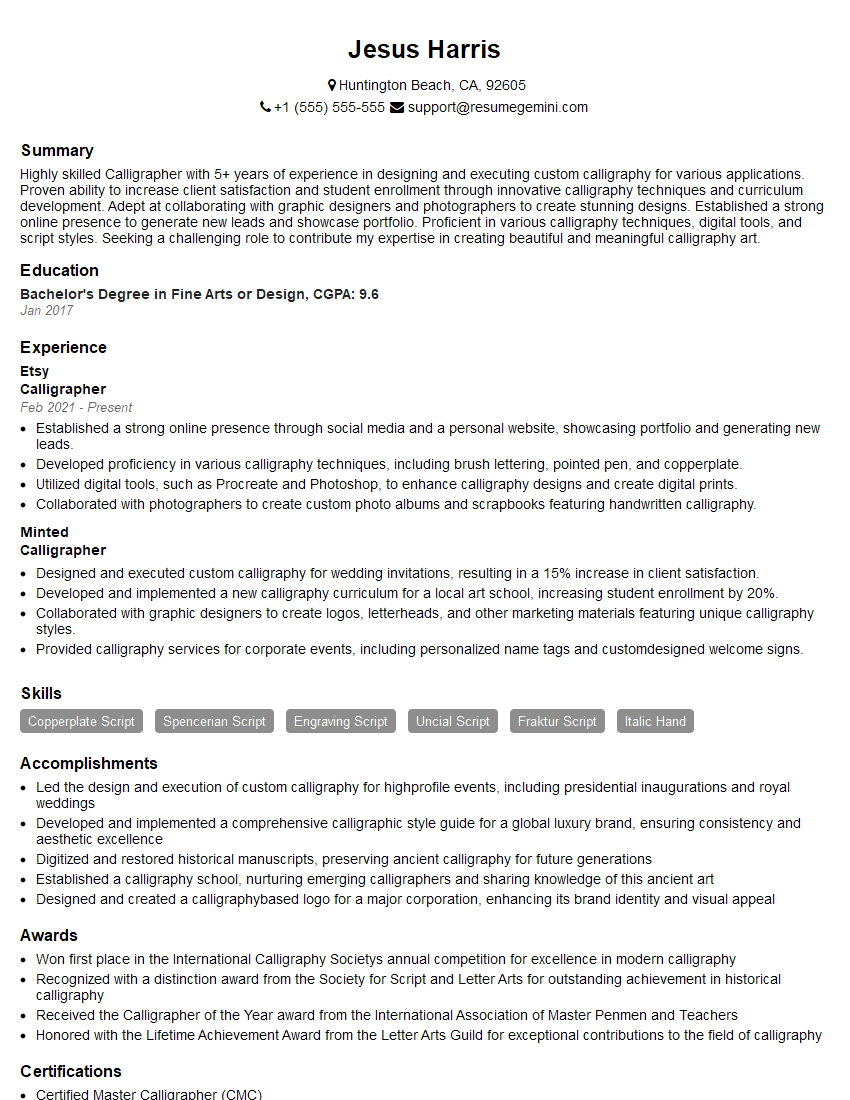
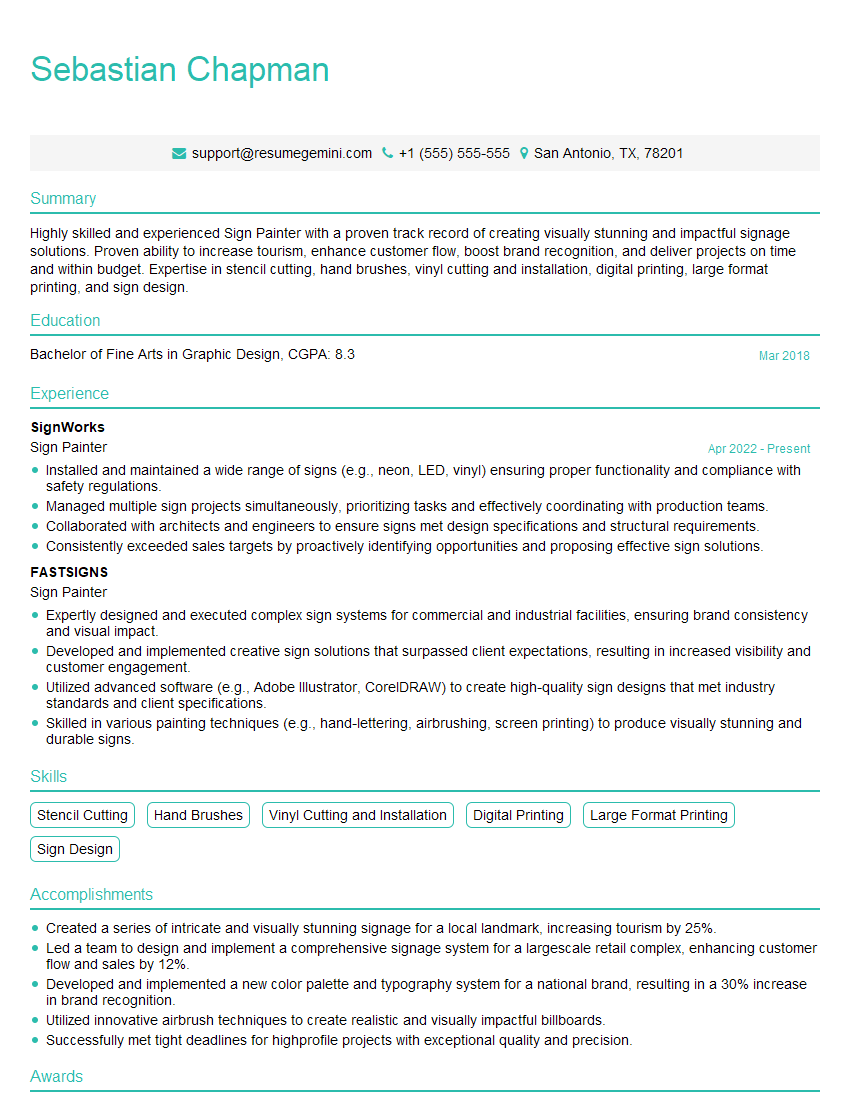
Mastering hand-painted lettering opens doors to exciting creative careers in graphic design, branding, illustration, and calligraphy. To maximize your job prospects, crafting a strong, ATS-friendly resume is crucial. ResumeGemini is a trusted resource that can help you build a professional resume tailored to highlight your skills and experience. Examples of resumes tailored to the Hand-Painted Lettering field are available to guide you. Take advantage of these resources to present yourself effectively and land your dream job.
Explore more articles
Users Rating of Our Blogs
Share Your Experience
We value your feedback! Please rate our content and share your thoughts (optional).
What Readers Say About Our Blog
Really detailed insights and content, thank you for writing this detailed article.
IT gave me an insight and words to use and be able to think of examples