Every successful interview starts with knowing what to expect. In this blog, we’ll take you through the top Handbuilding Techniques interview questions, breaking them down with expert tips to help you deliver impactful answers. Step into your next interview fully prepared and ready to succeed.
Questions Asked in Handbuilding Techniques Interview
Q 1. Describe your experience with pinch pot techniques.
Pinch pot is a fundamental handbuilding technique where a ball of clay is manipulated primarily using your fingers and thumb. Think of it like sculpting with clay – you’re shaping the form directly with your hands. It’s a wonderfully intuitive method, perfect for creating small, organically shaped vessels and figurines.
My experience with pinch pots spans decades, from creating simple bowls in my early days to more complex forms incorporating decorative elements and surface treatments. I’ve used pinch pot as a foundation for larger pieces, building upon the initial pinched form with other techniques like coil building. For example, I once created a series of pinch pot birdhouses, each one uniquely shaped and textured.
The beauty of pinch pot lies in its spontaneity. The process invites experimentation and allows for a unique connection between the artist and the material. However, it can be challenging to create perfectly symmetrical pieces; the inherent organic nature of the technique leads to variations in size and shape. Mastering control and precision takes practice, but the resulting textures and forms are incredibly rewarding.
Q 2. Explain the process of coil building, including key considerations for strength and aesthetics.
Coil building involves creating long, rope-like rolls of clay (the ‘coils’) and layering them to construct a form. Think of it as building a wall, brick by brick, but with clay coils instead of bricks. The strength and aesthetic appeal of a coil-built piece heavily depend on several factors.
Process: First, create uniform coils using a rolling technique to ensure even thickness. Then, carefully place the coils on top of each other, slightly overlapping each coil and ensuring that there’s enough clay for proper joining. Smooth the coil joins thoroughly using a variety of tools such as fingers, wooden tools or sponges. The process requires patience and attention to detail.
Strength Considerations: The strength of a coil-built piece is paramount. Well-joined coils are crucial to prevent cracking or weakness. It’s essential to blend coils thoroughly, ensuring they’re perfectly integrated to avoid visible seams that can become points of stress. Thin coils can result in a piece that cracks during drying or firing. The wall thickness should be consistent, avoiding abrupt changes in thickness.
Aesthetic Considerations: The visual appeal of a coil-built piece can be enhanced by using varying coil sizes and textures, creating patterns or textures with tools like a comb or stamps. A beautifully finished coil-built piece exhibits a harmonious blend of form and texture, often displaying the beauty of the coil structure itself. Careful consideration of the coil placement and arrangement can drastically affect the overall aesthetic.
Q 3. How do you achieve a smooth surface finish on hand-built ceramic pieces?
Achieving a smooth surface finish on hand-built ceramics requires a multi-step approach, beginning even before the piece is completely formed. Properly wedging the clay to remove air bubbles is the first step towards a seamless surface.
Smoothing Techniques: As you’re building, constantly smooth the surfaces with your fingers, tools, or a damp sponge. For coil-built pieces, carefully blend the coils, ensuring no gaps remain. For slab-built pieces, ensure the slabs meet flush and use a rib or other tool to remove excess clay and create seamless joins. After the piece has leather-hard, using a variety of smoothing tools like a rubber rib, metal rib, and chamois can help achieve different textures.
Surface Refinements: Once the piece is leather hard, you can refine the surface further by using finer-grained tools. A damp sponge can be used for very fine smoothing. Finally, once the piece is completely dry, you can lightly sand it to remove any remaining imperfections before bisque firing. This process produces a remarkably smooth surface.
Slip Trailing: For more advanced surface decoration, you can apply slip (a creamy mixture of clay and water) to highlight textures or create patterns.
Q 4. What are the advantages and disadvantages of using different types of clay for handbuilding?
Different clay bodies possess unique properties that significantly influence handbuilding. The choice of clay depends on the intended form, the desired surface finish, and the artist’s personal preference.
Advantages and Disadvantages:
- Earthenware: Low firing temperature, readily available, relatively inexpensive. Can be porous unless glazed properly. Good for beginners.
- Stoneware: Higher firing temperature, durable, and less porous. More challenging to work with due to its stiffness, but results in stronger, more water-resistant pieces.
- Porcelain: High firing temperature, translucent when thin, very fine and delicate. Difficult to handbuild due to its plasticity but produces exquisite results when mastered.
For example, earthenware is ideal for beginners due to its ease of use, while stoneware is preferred for functional pieces requiring durability. Porcelain, with its elegance, is best suited for artists with extensive experience in handbuilding.
Q 5. Explain your understanding of different clay body properties and their impact on handbuilding.
Understanding clay body properties is fundamental to successful handbuilding. Key properties include:
- Plasticity: A clay’s ability to be molded and hold its shape. Highly plastic clays are easier to work with but can be prone to slumping during drying.
- Shrinkage: The reduction in size as the clay dries and fires. High shrinkage can lead to cracking. Knowing your clay’s shrinkage rate is essential for accurate form creation.
- Workability: How easily the clay can be manipulated. This is influenced by moisture content and plasticity.
- Dry Strength: The ability of the clay to resist cracking during drying. Clays with high dry strength are ideal for handbuilding.
For instance, a highly plastic clay will be easy to shape but needs careful drying to avoid cracking, while a less plastic clay might be more difficult to mold but will dry more consistently. Knowledge of these properties allows artists to select and manage clay effectively to minimize issues and maximize success.
Q 6. How do you handle cracking or warping during the drying process?
Cracking and warping during the drying process are common challenges in handbuilding, often stemming from uneven drying. Slow and even drying is crucial to prevent these issues. The rate of drying should be consistent throughout the piece.
Prevention Strategies:
- Slow Drying: Cover the piece with plastic to slow down the surface drying, which can lead to cracking.
- Even Drying: Turn the piece regularly during drying. Avoid direct sunlight or drafts.
- Controlled Environment: Use a humidity-controlled drying room for more delicate pieces.
- Avoid Rapid Temperature Changes: Fluctuations in temperature can exacerbate cracking and warping.
Repairs: If cracking occurs, carefully repair the cracks using slip and gently rejoin the broken pieces. Warping can sometimes be corrected by gently re-shaping the piece while it is still leather hard, but severe warping is difficult to fix.
Q 7. Describe your experience with slab building techniques, including scoring and slipping.
Slab building involves creating flat sheets of clay (the ‘slabs’) and assembling them to create a three-dimensional form. It’s a versatile technique, perfect for creating geometric shapes and structured forms. Scoring and slipping are crucial steps in ensuring strong joins.
Process: Slabs are typically rolled to a consistent thickness using a rolling pin or slab roller. They’re then cut to the desired shape and assembled to create the desired form.
Scoring and Slipping: Scoring involves creating a series of scratches or grooves on the surfaces of the slabs that will be joined. Slipping involves applying a liquid clay suspension (slip) to these scored surfaces. This process provides mechanical and chemical bonding between the slabs, minimizing cracking during drying and firing. The slip acts as a glue, while the scoring increases the surface area for better adhesion. Think of it like creating a key and lock system for your clay components.
My experience with slab building has allowed me to create a diverse range of functional and sculptural pieces. I have made large vessels, boxes with intricate patterns, and even architectural models using this method. The precision required for slab building leads to clean lines and precise forms, which contrasts beautifully with the more organic feel of coil building.
Q 8. How do you create complex shapes and forms using handbuilding methods?
Creating complex shapes in handbuilding relies on mastering fundamental techniques and strategically combining them. Think of it like sculpting with clay – you’re not just adding clay, you’re subtracting, shaping, and assembling. Pinch pots, coils, and slabs are the building blocks, but the real artistry comes in how you manipulate them.
- Pinch pots: While seemingly simple, you can create surprisingly intricate forms by pinching and shaping the clay unevenly, creating organic textures and forms. Think of a vessel with a flared lip and undulating body, all achieved through careful pinching.
- Coiling: Coils allow for the construction of tall, cylindrical, or even sculptural forms. By varying the thickness, length, and placement of the coils, you can achieve subtle curves and dramatic changes in form. For example, a vase with a bulging belly and a slender neck requires strategic coil placement and manipulation.
- Slabs: Slabs offer maximum control. You can create almost any form by cutting, scoring, and joining them. They’re ideal for geometric shapes or for creating complex three-dimensional structures, like architectural models or sculptural pieces. Imagine creating a faceted vase or a complex building by precisely shaping and joining clay slabs.
- Combining Techniques: The real magic happens when you combine these techniques. You might start with a slab base, build up coils for the body, and then pinch and shape the top into a unique form. This allows for limitless possibilities and highly individualized designs.
Q 9. What are your preferred tools for handbuilding, and why?
My tool kit is surprisingly simple but essential. The right tools enhance precision and control, making the difference between a wobbly piece and a beautifully crafted one.
- Wooden Modeling Tools: These are invaluable for smoothing surfaces, shaping coils, and refining details. Their soft touch avoids marring the clay.
- Wire Tools: These are crucial for cutting slabs, trimming edges, and creating clean lines and textures. Different gauge wires offer varied levels of precision.
- Ribs: Metal or wooden ribs help to achieve smooth, even surfaces. The gentle pressure helps compact the clay, and the ribs create unique textures.
- Sponge: A damp sponge is essential for smoothing surfaces and removing excess water. It’s the unsung hero in handbuilding, allowing for seamless transitions between clay sections.
- Needle Tool: A needle tool is surprisingly useful for scoring clay surfaces before joining and for creating fine details and textures.
I avoid using metal tools excessively, as they can often leave undesirable marks on the clay, unless precise cutting or shaping is required. Ultimately, it’s about developing a feel for the clay and choosing the right tool for the job.
Q 10. How do you ensure structural integrity in your hand-built pieces?
Structural integrity in handbuilt ceramics is paramount. It’s all about creating a strong foundation and ensuring all the parts are well-joined. Think of it as building a house – a weak foundation will lead to a collapse!
- Properly Wedged Clay: Using well-wedged clay is the single most important factor. This removes air bubbles, making the clay stronger and less prone to cracking during drying and firing.
- Scoring and Slipping: Always score the surfaces of the clay before joining. This creates mechanical keying. Then, apply a slip (a watery clay mixture) to both surfaces before joining. The slip acts as an adhesive, strengthening the connection.
- Supporting Structures: For large or complex pieces, consider using internal supports, like armatures made from wire or other supportive materials. This is especially crucial for tall or precarious forms.
- Even Drying: Slow and even drying is critical. Rapid drying can lead to cracking. Wrap damp pieces in plastic bags or use a humidity chamber, especially in dry climates.
- Avoid Overworking the Clay: Overworking can weaken the clay. It’s a fine balance between achieving the desired form and avoiding unnecessary manipulation.
Q 11. Explain your knowledge of different firing techniques for hand-built ceramics.
Firing is the transformative stage that takes clay from a workable material to a durable ceramic object. The choice of firing method greatly influences the final properties of the piece.
- Bisque Firing: This low-temperature firing (typically around 1800°F or 980°C) removes all moisture and chemically strengthens the clay body. It’s crucial before glazing.
- Glaze Firing: This is the higher-temperature firing (ranging from 2100°F to 2400°F or 1150°C to 1315°C, depending on the glaze used) that matures the glaze and bonds it to the bisque-fired clay.
- Reduction Firing: This firing method involves controlling the atmosphere in the kiln during the high temperature stage by limiting oxygen supply. This creates unique visual effects in the glaze and clay body. It’s a more complex and specialized technique, requiring careful kiln management.
- Oxidation Firing: This firing method is the most common and occurs with ample oxygen available throughout the firing process. It’s more predictable in terms of glaze results.
The type of firing method chosen will depend on the clay body, the desired aesthetic, and the expertise of the ceramic artist. My preference often leans towards oxidation firing for its consistency, but I experiment with reduction firing to achieve unique effects.
Q 12. Describe your experience with glazing hand-built ceramics, including glaze application methods.
Glazing handbuilt ceramics is a crucial step to enhance aesthetics and durability. It’s an art in itself, requiring careful technique and understanding of glaze properties.
- Glaze Selection: The choice of glaze significantly impacts the final appearance and functionality. Factors such as color, texture, and chemical compatibility with the clay body must be considered.
- Glaze Application Methods: Various methods exist, including dipping, pouring, brushing, spraying, and even sponging. Each method results in a different look and finish. For example, dipping creates a uniform coat, while brushing can add texture and varied coverage. I prefer dipping for even coverage and brushing for finer control and textured effects.
- Multiple Glaze Layers: Many projects often benefit from applying multiple thin coats of glaze, rather than one thick coat, for improved coverage and to reduce the possibility of glaze defects, like crazing or pinholing.
- Glaze Thickness: Consistent glaze thickness is crucial to achieve a uniform finish. Overly thick coats can result in running or bubbling during firing, while thin coats may not provide complete coverage.
Experimentation is key to mastering glaze application. Test tiles are invaluable for testing different glazes and application techniques before applying them to finished pieces.
Q 13. How do you troubleshoot common problems encountered during handbuilding?
Troubleshooting is a part of every ceramic artist’s journey. Knowing the causes of common problems is vital for preventing them in the future.
- Cracking During Drying: This is often caused by uneven drying. Slowing the drying process by wrapping pieces in plastic or using a humidity chamber usually solves the problem.
- Cracking During Firing: This might indicate poor clay preparation, rapid heating or cooling, or insufficient support during firing. Careful attention to the firing schedule is crucial.
- Glaze Defects: Problems like crazing (fine cracks in the glaze), pinholing (tiny holes), or crawling (incomplete glaze coverage) often stem from incorrect glaze application, unsuitable glaze combinations, or improper firing techniques. Consult glaze recipes and test tiles to diagnose these issues.
- Warping: Uneven drying or uneven weight distribution during firing can cause warping. Creating a balanced, well-supported piece is essential.
Careful observation and record-keeping are essential for effective troubleshooting. Documenting clay types, glaze formulas, and firing schedules allows for identifying and correcting recurring issues.
Q 14. What are your strategies for maintaining consistency in your handbuilding work?
Maintaining consistency in handbuilding requires discipline and attention to detail. Consistency isn’t about replicating identical pieces, it’s about controlling the variables that impact the final outcome.
- Consistent Clay Preparation: Always wedge your clay thoroughly and to the same consistency before starting a project. This eliminates variations in the clay’s workability.
- Standardized Techniques: Develop a set of well-defined techniques for each stage of the process, from shaping and joining to drying and firing.
- Careful Measurement: Where appropriate, use consistent measurements to maintain uniformity. For example, keeping consistent coil thicknesses when building a piece will make it structurally sounder and more consistent aesthetically.
- Consistent Workspace: Maintain a clean and organized workspace. This minimizes distractions and reduces the chances of error.
- Regular Practice: Consistent practice is essential to refine skills and develop muscle memory for precise hand movements.
I often work in batches or series to establish a consistent workflow. This ensures that the environment, tools, and materials remain consistent throughout the process.
Q 15. Explain your experience with surface decoration techniques in handbuilding.
Surface decoration is where handbuilding truly shines, allowing for immense creative freedom. My experience encompasses a wide range of techniques, from simple to complex. I frequently use slip trailing, a method of applying colored liquid clay to create intricate designs. This is like using a piping bag for cake frosting, but with clay! I also incorporate incising, carving designs directly into the clay surface, providing texture and depth. For more vibrant results, I employ the use of underglazes and glazes, applied before and after firing, respectively. These add color and enhance the overall aesthetic. I’ve even experimented with adding textures using stamps, stencils, and found objects pressed into the clay before firing. Each technique offers a unique visual effect and allows me to tailor the piece to its intended purpose and aesthetic.
For example, I recently created a series of teacups. One set featured delicate slip-trailed floral patterns, while another boasted bold geometric designs achieved through incising. The contrast highlights how different techniques can create dramatically different looks on otherwise identical forms.
Career Expert Tips:
- Ace those interviews! Prepare effectively by reviewing the Top 50 Most Common Interview Questions on ResumeGemini.
- Navigate your job search with confidence! Explore a wide range of Career Tips on ResumeGemini. Learn about common challenges and recommendations to overcome them.
- Craft the perfect resume! Master the Art of Resume Writing with ResumeGemini’s guide. Showcase your unique qualifications and achievements effectively.
- Don’t miss out on holiday savings! Build your dream resume with ResumeGemini’s ATS optimized templates.
Q 16. How do you adapt your handbuilding techniques to different project requirements?
Adaptability is key in handbuilding. The beauty of the process lies in its flexibility. For instance, if I’m creating a delicate sculptural piece, I might opt for a coil-building technique using thin coils to achieve intricate forms. The coils can be precisely manipulated and shaped, ideal for fine details. However, if I’m making a robust, functional piece like a large planter, I’d likely employ pinch-pot techniques or slab construction for speed and efficiency, building up layers of clay to achieve the desired thickness and strength.
The choice of clay type also influences my technique. A very plastic clay is better suited for intricate coils, while a stiffer clay may be better for slab work, reducing the chance of slumping.
Essentially, the project’s requirements – size, shape, function, and desired aesthetic – dictate my choice of technique. I carefully consider each factor to ensure the final piece is both structurally sound and visually appealing.
Q 17. Describe your process for creating a functional piece (e.g., a bowl or mug) using handbuilding.
Let’s take the creation of a bowl as an example. I typically start with slab construction. I roll out a flat slab of clay using a rolling pin to achieve a consistent thickness. Then, using a template, I cut out a circle – the size determines the final bowl’s diameter. For the sides, I roll out additional slabs, cutting them into strips of the desired height and width. These strips are carefully attached to the circular base, ensuring a consistent join with slip (a liquid clay slurry) acting as an adhesive. I then score and slip the seams, pressing firmly to ensure a strong bond. Once assembled, I use my fingers and various tools to refine the shape, smoothing out any imperfections and creating the desired curve of the bowl. The bowl then undergoes several hours of drying before being bisque fired (a low-temperature firing to harden the clay) and finally glazed and high-fired.
For a mug, I might start with a pinch pot, shaping the base of the mug by pinching and shaping the clay in my hands, then adding a coil for the body. This is a less precise but often faster method for achieving a more organic form. Again, scoring, slipping, and smoothing are key steps.
Q 18. How do you ensure the durability and longevity of your hand-built pieces?
Durability and longevity are achieved through careful attention to detail throughout the entire process. Proper wedging of the clay to eliminate air pockets is crucial to prevent cracking during drying and firing. Ensuring even thickness in the walls prevents stress points. The scoring and slipping techniques mentioned earlier are essential for strong joins. The drying process needs to be slow and controlled to minimize warping and cracking. This might involve using plastic sheeting to reduce moisture loss. Finally, the selection of appropriate glazes plays a vital role. I choose glazes known for their durability and resistance to chipping and cracking. A well-fired piece, combining proper technique with suitable materials, will last for many years.
Q 19. What are the limitations of handbuilding compared to other ceramic techniques?
Handbuilding, while incredibly versatile and rewarding, does have some limitations compared to techniques like wheel throwing or slip casting. Firstly, achieving perfect symmetry and consistent shapes can be challenging. Handbuilt pieces often possess a more organic, handcrafted aesthetic, which is a desirable characteristic for some but not all projects. Secondly, production speed is generally slower. Wheel throwing and slip casting allow for higher volume production, while handbuilding is more labor-intensive. Finally, achieving very thin or extremely large pieces can be difficult, requiring advanced skills and careful planning. However, the limitations are often outweighed by the creative freedom and tactile experience that handbuilding offers.
Q 20. How do you incorporate creativity and innovation into your handbuilding work?
Creativity and innovation are at the heart of my handbuilding practice. I constantly explore new materials and techniques. I’ve experimented with incorporating natural elements like seeds, leaves, and twigs into the clay body, creating unique textures and patterns. I frequently draw inspiration from nature, architecture, and even abstract art, translating these inspirations into three-dimensional forms. I also enjoy experimenting with different clay bodies, from porcelain’s delicate translucency to stoneware’s robust strength. Each material choice influences the final outcome, providing opportunities for novel approaches to form and texture. I see every piece as a chance to experiment, learn, and push the boundaries of what’s possible with handbuilding.
Q 21. Describe your understanding of the history and evolution of handbuilding techniques.
Handbuilding is one of the oldest ceramic techniques, dating back thousands of years. Early examples show the fundamental techniques—pinch pots, coil building, and slab construction—were already being used in ancient civilizations. These methods were essential for creating functional wares and decorative objects. Over time, these techniques evolved, influenced by cultural exchange and technological advancements. The development of different clay bodies and glazes expanded the possibilities. The rise of modern art movements also impacted handbuilding, leading to explorations of more abstract and unconventional forms. Today, handbuilding continues to evolve, with artists experimenting with new materials, tools, and techniques, proving its enduring relevance and enduring appeal.
Q 22. How do you maintain a clean and organized workspace when handbuilding?
Maintaining a clean and organized workspace is paramount in handbuilding. Think of it like a surgeon’s operating room – a clean space minimizes errors and allows for focused work. My approach involves several key strategies. First, I dedicate specific areas for different tasks: a clay preparation zone, a shaping area, a tool storage area, and a drying rack. This spatial division prevents cross-contamination and keeps everything easily accessible. Secondly, I use a variety of containers – from small bowls for slip to larger buckets for water – to keep materials organized. Thirdly, I regularly wipe down surfaces with a damp sponge, removing excess clay immediately to prevent build-up. Finally, I do a thorough cleanup at the end of each session, including scrubbing tools and sweeping the floor. This methodical approach ensures a smooth workflow and prevents frustration.
Q 23. What safety precautions do you observe while using clay and related tools?
Safety is non-negotiable in the ceramics studio. Working with clay, especially when using tools, demands vigilance. I always wear protective gear, which includes a dust mask (especially when working with dry clay or using power tools), safety glasses to protect my eyes from flying debris, and gloves to prevent skin irritation from clay or chemicals. I keep my workspace well-lit to prevent eye strain and accidental cuts. Sharp tools are stored safely and out of reach when not in use. When using power tools like a slab roller or a pottery wheel (even though we are focused on handbuilding), I always ensure they are properly grounded and that I follow the manufacturer’s safety instructions. Furthermore, I emphasize proper lifting techniques when moving heavy clay or finished pieces, to avoid back injuries. Regularly cleaning up spills and ensuring a clutter-free environment also prevents accidents. Finally, I’m always mindful of wet and dry clay’s different properties: wet clay is slippery, and dry clay is dusty.
Q 24. How do you handle large-scale handbuilding projects?
Large-scale handbuilding requires a strategic approach, quite different from smaller projects. I usually start by creating a detailed plan, including scale drawings and construction methods. This detailed plan ensures that all components will fit together properly and that the structural integrity of the final piece is maintained. Instead of constructing the entire piece at once, I break it down into manageable sections, which allows for better control and reduces the risk of structural failure during drying. I might create individual components—like walls, base, or sculptural elements—separately, and then carefully join them with slip and score. Proper support structures—internal armature or external scaffolding—are crucial for stability, especially for very tall pieces. Using different techniques like coil building or slab construction in conjunction, depending on the form’s requirements, is essential. During construction, I frequently check alignment and support points. The drying process also needs special attention, sometimes requiring slower drying times and potentially using fans or humidifiers to prevent cracking.
Q 25. What are your preferred methods for drying and bisque firing hand-built pieces?
The drying and firing process is critical for the longevity and integrity of handbuilt pieces. Slow and even drying is key to preventing cracks. I typically allow the pieces to air dry slowly in a controlled environment, away from direct sunlight and drafts. This can take days or even weeks depending on the size and thickness of the piece. I might use plastic sheeting to cover the pieces and maintain humidity, especially during the initial drying phases. For larger pieces, I might use a slow-drying method to facilitate even moisture loss. Before bisque firing, I carefully examine each piece to check for any cracks or weaknesses. I fire the pieces in a kiln using a slow, gradual firing schedule to minimize thermal shock that might cause cracking. The specific firing schedule depends on the clay body and the kiln’s capabilities. I will usually do a test firing of a small sample first to verify the schedule.
Q 26. How do you manage your time effectively during a handbuilding project?
Effective time management is essential for completing handbuilding projects successfully. I start by breaking down the project into smaller, manageable tasks and create a schedule that outlines when each task should be completed. I try to allocate sufficient time for each stage, allowing for unexpected delays or complexities. This is not just about raw time, but also considering the drying time of different pieces. I also prioritize tasks based on their urgency and dependencies. For example, creating base components should often precede constructing upper parts. I use tools to track progress and manage deadlines such as project management apps, or even a simple checklist. Furthermore, I avoid distractions during work sessions. And finally, regular breaks prevent burnout and maintain focus and motivation, leading to higher-quality work.
Q 27. Describe a time you had to troubleshoot a problem during a handbuilding project. What was the solution?
During a large-scale project, a tall, intricately coiled vase, I encountered a significant structural problem. The upper sections started to sag under their own weight. My initial solution, applying more slip to strengthen the coils, proved insufficient. The problem was a lack of sufficient internal support. The solution was to incorporate a lightweight internal armature of carefully placed wire mesh within the coils before completing the upper parts. This provided the necessary support, preventing further sagging and allowing the vase to dry and fire successfully. This taught me the importance of incorporating internal supports earlier in the design process for tall, complex forms.
Q 28. How do you stay updated on new trends and techniques in handbuilding ceramics?
Staying updated in the ever-evolving world of ceramics is critical. I regularly attend workshops and conferences, both locally and nationally, to learn from renowned ceramic artists and explore new techniques. I actively engage with the ceramic community through online forums, social media groups, and professional organizations, seeking out discussions on latest developments and innovations. I subscribe to ceramic art magazines and journals, which often feature articles about new materials, techniques, and emerging trends. Moreover, I frequently visit museums and galleries to observe the work of contemporary ceramic artists and draw inspiration from their creative approaches. I also dedicate time to self-directed learning, experimenting with new materials and methods in my studio practice.
Key Topics to Learn for Handbuilding Techniques Interview
- Pinch Pots & Coil Building: Understanding the fundamental techniques, variations, and limitations of these methods. Consider the impact of clay type and moisture content on the final product.
- Slab Building: Mastering techniques like joining slabs, creating clean edges, and achieving desired forms. Discuss strategies for avoiding warping and cracking.
- Surface Decoration: Explore various surface treatments like carving, incising, adding textures, and applying slips and glazes. Explain how these choices influence the final aesthetic and functionality of the piece.
- Material Selection & Properties: Demonstrate knowledge of different clay types (e.g., earthenware, stoneware), their properties, and how these influence the handbuilding process. Discuss appropriate drying and firing techniques for each.
- Design & Functionality: Articulate your understanding of design principles as they apply to handbuilt forms. Consider the interplay between form, function, and aesthetics in your work. Discuss problem-solving strategies for achieving desired outcomes.
- Troubleshooting & Problem Solving: Be prepared to discuss common issues encountered in handbuilding (e.g., cracking, warping, uneven drying) and explain how you would troubleshoot and resolve them.
- Tools & Equipment: Demonstrate familiarity with common handbuilding tools and their appropriate use. Discuss safety practices related to handbuilding techniques.
Next Steps
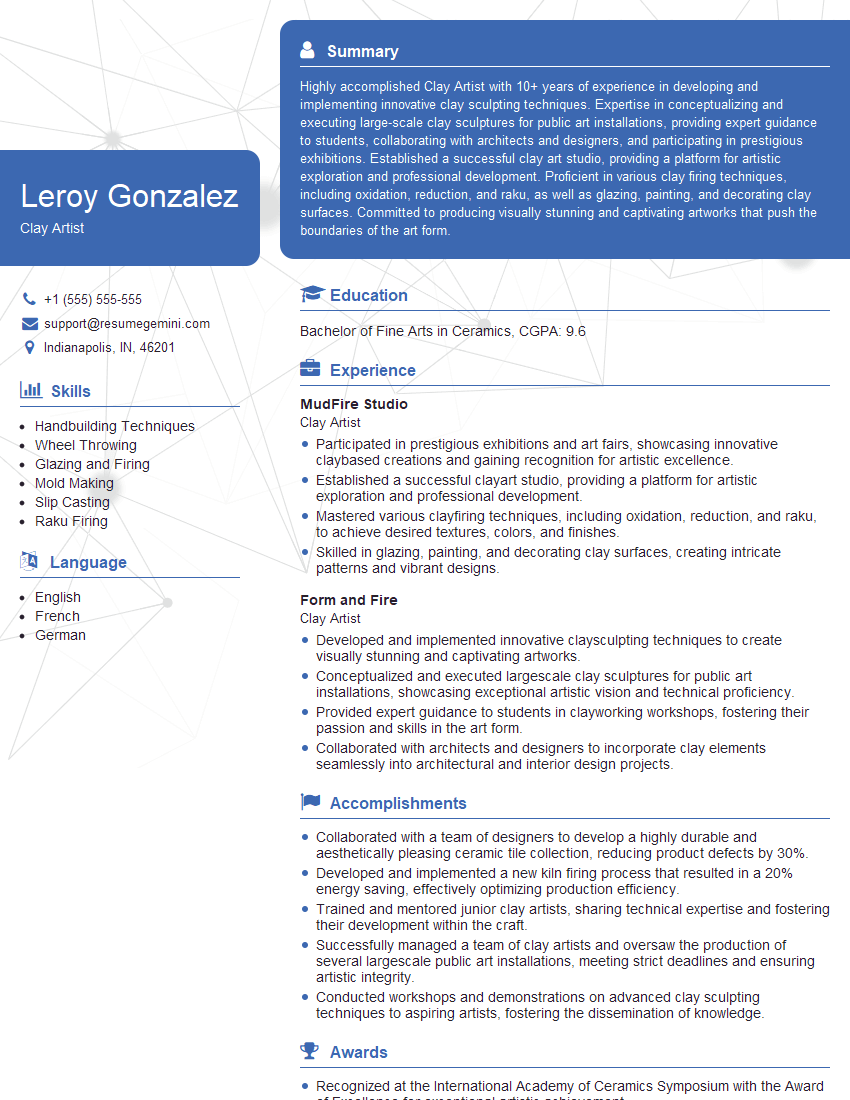
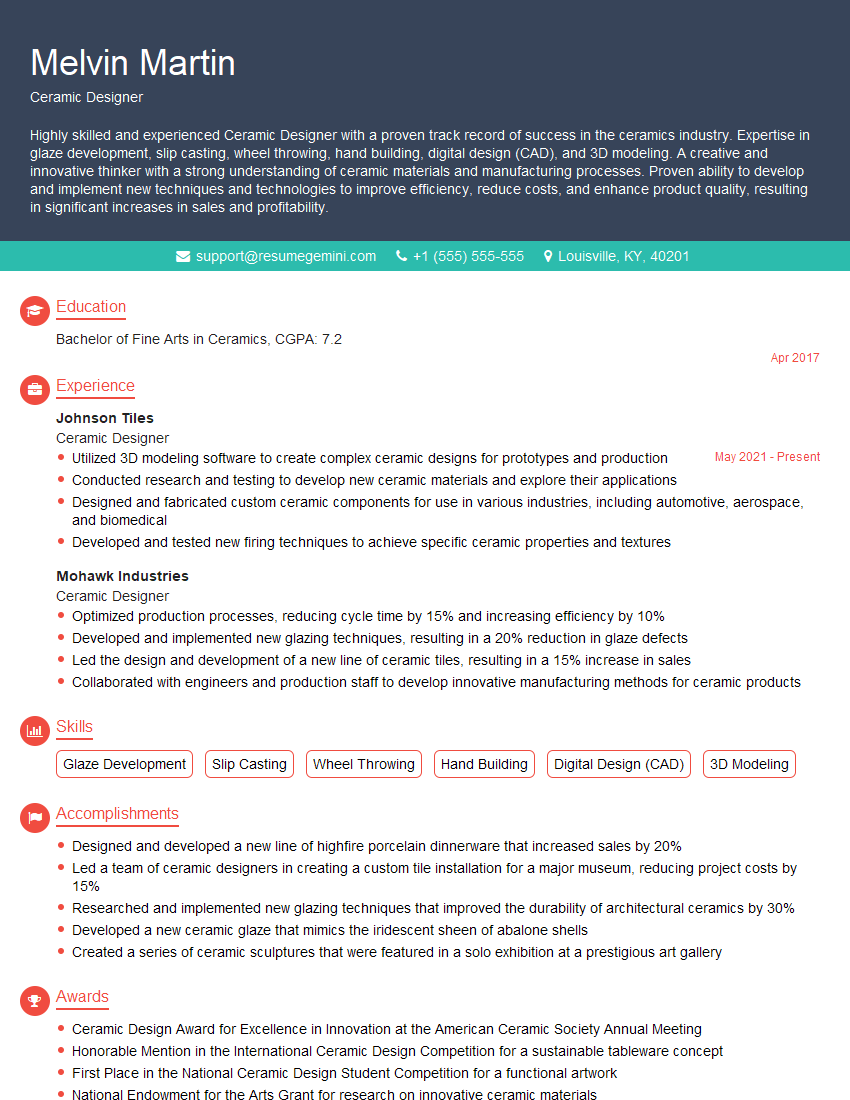
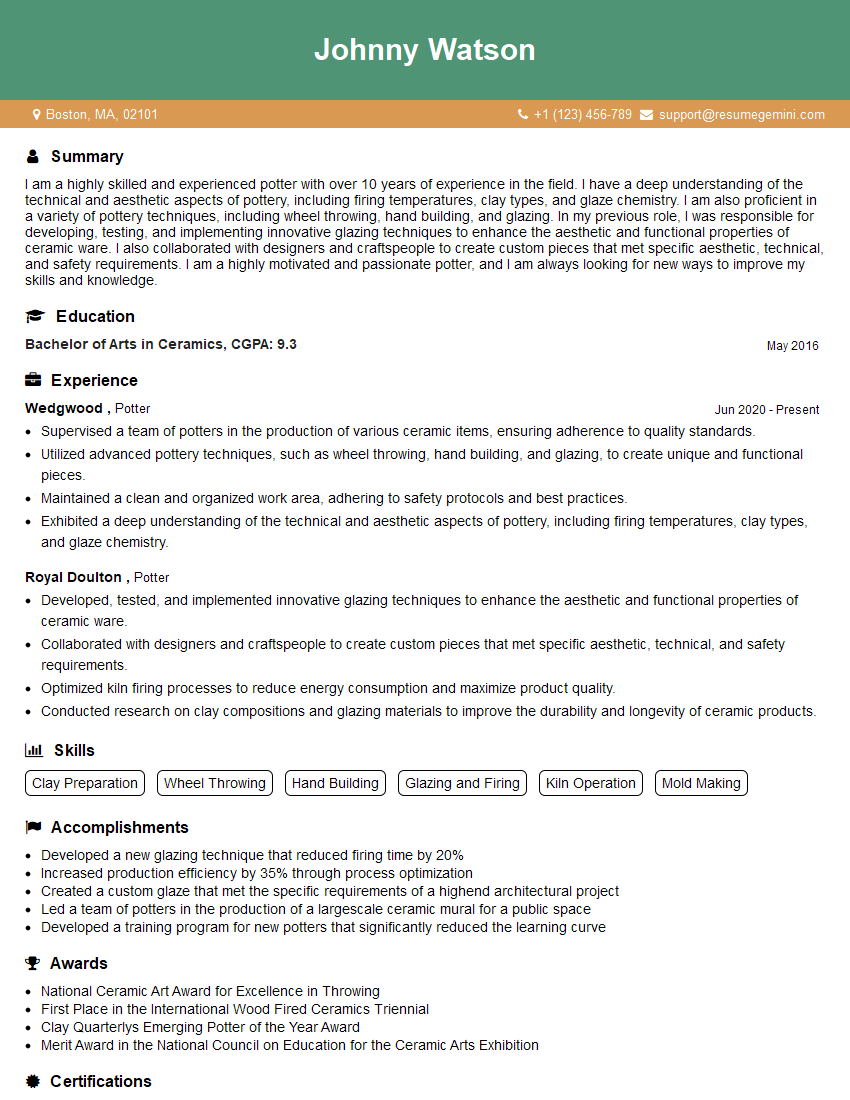
Mastering handbuilding techniques opens doors to exciting career opportunities in ceramics, sculpture, and related fields. A strong understanding of these techniques, combined with a well-crafted resume, significantly increases your chances of landing your dream job. To maximize your job search success, create an ATS-friendly resume that highlights your skills and experience effectively. ResumeGemini is a trusted resource to help you build a professional resume that stands out. Examples of resumes tailored to Handbuilding Techniques are available, providing you with valuable templates and guidance.

Explore more articles
Users Rating of Our Blogs
Share Your Experience
We value your feedback! Please rate our content and share your thoughts (optional).
What Readers Say About Our Blog
Really detailed insights and content, thank you for writing this detailed article.
IT gave me an insight and words to use and be able to think of examples