Are you ready to stand out in your next interview? Understanding and preparing for Color Matching and Formulation interview questions is a game-changer. In this blog, we’ve compiled key questions and expert advice to help you showcase your skills with confidence and precision. Let’s get started on your journey to acing the interview.
Questions Asked in Color Matching and Formulation Interview
Q 1. Explain the difference between additive and subtractive color mixing.
Additive and subtractive color mixing are two fundamentally different approaches to creating colors. Think of it like this: additive is like shining lights together, while subtractive is like mixing paints.
Additive color mixing is used in light-based systems, such as monitors and projectors. It starts with black (absence of light) and adds colors to create others. The primary additive colors are red, green, and blue (RGB). When you combine these at full intensity, you get white light. Imagine shining a red, green, and blue flashlight onto a white surface – where they overlap, you’ll see various colors, eventually white if all three overlap equally.
Subtractive color mixing is used with pigments, dyes, inks, and paints. It starts with white (reflection of all light) and subtracts colors by absorbing certain wavelengths. The primary subtractive colors are cyan, magenta, and yellow (CMY). When you mix these colors, you approach black (theoretically, but practical mixes often result in a muddy brown). Think about mixing paints; red and green paint mixed together doesn’t create yellow but a murky brown.
In short: additive adds light to create color, subtractive absorbs light.
Q 2. Describe the CIE L*a*b* color space and its advantages.
The CIE L*a*b* color space is a device-independent color model that describes colors based on their lightness (L*), red-green opponent channel (a*), and blue-yellow opponent channel (b*). It’s designed to be more perceptually uniform than other color spaces, meaning equal distances in the L*a*b* space represent approximately equal differences in perceived color. This is crucial for accurate color communication and matching.
L* represents lightness, ranging from 0 (black) to 100 (white). a* ranges from negative values (green) to positive values (red), while b* ranges from negative values (blue) to positive values (yellow).
Advantages of CIE L*a*b*:
- Device independence: It’s not tied to a specific device’s characteristics, allowing for consistent color communication across different displays, printers, and other output devices.
- Perceptual uniformity: Differences in L*a*b* values closely correspond to human perception of color differences, making it ideal for color difference calculations and tolerance settings.
- Large gamut: It can represent a wider range of colors compared to other spaces like RGB.
For example, if I need to ensure a specific shade of green is consistently reproduced across different production batches, using L*a*b* coordinates provides a precise and reliable specification regardless of the printer or dye lot.
Q 3. What are metamerism and how does it impact color matching?
Metamerism is a phenomenon where two colors appear identical under one light source but different under another. This happens because the spectral power distributions (the way light reflects at different wavelengths) of the two colors are different, but their perceived color matches under a specific viewing condition.
Impact on color matching: Metamerism makes color matching challenging because a color match achieved under one lighting condition might not hold true under another. For example, two fabrics might appear to match under a fluorescent light but look distinctly different under incandescent light. This is especially relevant in textiles, paints, and printing industries, where consistent color reproduction under various lighting conditions is critical.
To mitigate metamerism issues, color matching is often performed under standardized light sources (like D65, representing average daylight), and metameric indices are calculated to predict how color matches will perform under different lighting conditions. This can also involve using a spectral-matching approach in color formulation where we focus on replicating the spectral reflectance rather than simply matching color appearance under one light source.
Q 4. How do you use a spectrophotometer to measure color?
A spectrophotometer measures the spectral reflectance or transmittance of a sample across the visible spectrum. This means it measures how much light is reflected or transmitted at each wavelength (typically from 400nm to 700nm).
Measurement Process:
- Calibration: The spectrophotometer is calibrated using a white and black standard to ensure accurate measurements.
- Sample Preparation: The sample is properly positioned in the instrument’s measuring port. Surface smoothness and sample size are critical for accurate and repeatable results.
- Measurement: The instrument illuminates the sample with light, and the reflected or transmitted light is captured by a detector that measures the intensity at each wavelength.
- Data Acquisition: The spectrophotometer records the spectral data, often presented as a graph or a set of numerical values.
This spectral data can then be used to calculate various colorimetric values, such as CIE L*a*b*, XYZ, and ΔE (color difference). This is essential for precise color quality control.
For example, in a paint manufacturing environment, a spectrophotometer is used to ensure each batch of paint meets the specified color standards, allowing adjustments to be made in the formulation to maintain consistency. The spectral data not only gives the L*a*b* color values but also provides insight into the underlying components responsible for color.
Q 5. Explain the concept of color tolerance and its importance.
Color tolerance defines the acceptable range of variation in color around a target color. It’s essentially a quantification of how much a color can deviate from the standard before it is considered unacceptable.
Importance: Color tolerance is crucial for maintaining consistency in color reproduction across various production batches and different manufacturing processes. It allows for a degree of variation that is still deemed visually acceptable by the end-user.
Color tolerance is often expressed using the ΔE (delta E) value, which represents the overall difference between two colors in a perceptually uniform color space (like CIE L*a*b*). The allowable ΔE value depends on the application and the sensitivity of the human eye to color differences. A smaller ΔE indicates a tighter tolerance and a higher level of color precision.
For instance, in the automotive industry, the color tolerance for car paint is extremely tight because even minor color variations can be easily noticeable across a large painted surface. But for a textile product, the tolerances might be somewhat more relaxed.
Q 6. What are different color measurement instruments and their applications?
Several color measurement instruments are available, each with specific applications:
- Spectrophotometers: These provide the most comprehensive color information by measuring spectral reflectance or transmittance. They are used in quality control, color formulation, and research. There are various types including 0/45 degree, sphere, and multi-angle spectrophotometers, each having different strengths for different materials and applications.
- Colorimeters: These measure the tristimulus values (X, Y, Z) directly, providing a simpler, faster, and more cost-effective measurement. They are typically used for routine quality control or when high spectral accuracy is not required. They are less versatile than spectrophotometers.
- Densitometers: These measure the density of inks on printed materials. They are commonly used in the printing industry to monitor ink coverage and color consistency. They are useful for process control and quality management during printing.
The choice of instrument depends on factors such as the required accuracy, the type of material being measured, the budget, and the speed of measurement needed.
Q 7. Describe your experience with color management software (e.g., X-Rite i1, Datacolor)
Throughout my career, I’ve extensively utilized color management software such as X-Rite i1 and Datacolor’s solutions for color formulation, quality control, and profile creation. My experience encompasses:
- Color profile creation: Generating ICC profiles for monitors, printers, and scanners, ensuring consistent color reproduction across different devices.
- Color formulation: Using software to predict and adjust color formulations based on spectrophotometer data, saving significant time and materials during the development process.
- Quality control: Analyzing color measurement data to identify deviations from target colors and implementing corrective actions.
- Color communication: Using the software to standardize color communication between different stakeholders, clients, and manufacturing facilities.
I’m proficient in using these tools to efficiently manage color throughout the product development lifecycle, from initial design to final production. For example, I once used X-Rite i1 software to create a color profile for a new digital printing system to ensure accurate color matching with brand standards. This allowed us to drastically reduce the time and material waste during the trial-and-error process of aligning the printer with brand colors.
Q 8. How do you handle color discrepancies between different batches of a product?
Color discrepancies between batches are a common challenge in manufacturing. They stem from variations in raw materials, equipment performance, and even environmental factors like temperature and humidity. Addressing this requires a multi-pronged approach.
Strict Raw Material Control: Implementing rigorous quality control checks on incoming pigments and other ingredients is crucial. This includes verifying their spectral properties and ensuring consistent particle size distribution. Think of it like baking a cake – if your flour or sugar isn’t consistent, your cake won’t be either.
Standardized Production Processes: Precisely controlled mixing, grinding, and application processes are essential. We use calibrated equipment and documented procedures to minimize variability. Each step, from weighing ingredients to the final product inspection, needs careful monitoring and documentation.
Instrumental Color Measurement: Instead of relying solely on visual assessment, which is subjective, we employ spectrophotometers to objectively measure the color of each batch. This provides numerical data (like L*a*b* values) for comparison against the target color and allows for immediate detection of deviations.
Color Adjustment: If discrepancies are detected, we use color formulation software and our understanding of pigment interactions to adjust the recipe for subsequent batches. This might involve tweaking the ratios of different pigments or even substituting specific ingredients.
Statistical Process Control (SPC): We utilize SPC techniques to monitor the production process continuously, identify potential sources of variation, and take proactive measures to prevent discrepancies before they occur. It’s like having a constant eye on the production line to ensure everything is running smoothly.
Q 9. Explain the process of formulating a specific color using different pigment combinations.
Formulating a specific color involves understanding pigment properties and their interactions. It’s like painting a picture – you need the right colors and the right proportions to achieve the desired effect. The process typically involves:
Color Specification: The process begins with a precise color specification, often given in a color space like L*a*b*, XYZ, or sRGB. This could come from a color standard or a client’s sample.
Pigment Selection: Based on the target color and the substrate (material the color is being applied to), we select appropriate pigments. We consider factors like hue, chroma, lightfastness, and cost. For example, a bright red might involve a combination of red and yellow pigments, or even a small amount of blue to modify the hue slightly.
Formulation Software: Sophisticated color formulation software helps predict pigment combinations. These programs use algorithms to calculate the necessary pigment ratios based on the target color and the spectral properties of individual pigments. They can significantly reduce time and material costs involved in the trial-and-error approach.
Trial and Error (Refinement): Even with software, some trial and error is usually required. We make small batches, measure the color using a spectrophotometer, and refine the formulation until we achieve the desired color within an acceptable tolerance.
Quality Control: Once a satisfactory formulation is achieved, we perform rigorous quality control testing to ensure consistency and stability over time. This might include accelerated weathering tests to determine lightfastness and other relevant tests.
Example: Let’s say we want to create a specific shade of green. We might use a combination of phthalocyanine green, yellow pigments, and possibly a touch of blue to adjust the undertone. The exact ratios would be determined through careful experimentation and measurement.
Q 10. How do you account for the effects of different substrates on color appearance?
Different substrates significantly affect color appearance due to their inherent optical properties. A color formulated for a smooth, glossy surface will look different on a rough, matte surface, or a translucent one. This is because the substrate influences light scattering and absorption.
Substrate Characterization: To account for this, we meticulously characterize the substrate’s optical properties. This often involves measuring its gloss, opacity, and texture.
Metamerism: We need to be aware of metamerism, where two colors appear identical under one light source but different under another. This can be particularly problematic when the substrate affects the way light interacts with the color.
Color Compensation: Based on the substrate’s properties, we might need to adjust the color formulation to compensate for the substrate’s influence. For example, a darker color might be needed for a lighter substrate to achieve the same visual effect.
Testing under Different Illuminants: We conduct color measurements under various illuminants (like D65 or A) to assess the color’s appearance under different lighting conditions. This helps us ensure consistent color perception across various environments.
Example: A blue paint formulated for a smooth, white wall might appear duller and less vibrant on a rough, textured wooden surface. To compensate, we might need to increase the concentration of blue pigment or add a small amount of a brighter, more transparent pigment.
Q 11. Describe your experience with various color matching techniques (e.g., visual, instrumental).
I have extensive experience with both visual and instrumental color matching techniques. Visual matching, while subjective, is sometimes necessary for fine-tuning or specialized applications.
Visual Matching: This involves comparing a sample to the target color under standardized lighting conditions using a light booth. It relies on the experience and expertise of the colorist. While quick and sometimes sufficient for simple adjustments, it is prone to human error and inconsistencies.
Instrumental Matching: Instrumental color matching relies on spectrophotometers to measure the spectral reflectance or transmittance of colors. This data is analyzed using color difference formulas (Delta E) to quantify the difference between the target and sample. This is a much more objective and precise method.
Software Assistance: I’m proficient in using color management software, which utilizes instrumental data to simulate pigment mixtures and predict the resulting color, drastically accelerating the formulation process. This reduces the trial-and-error cycles associated with purely visual methods.
I often use a combination of both approaches. Visual evaluation helps with fine-tuning the final color, while instrumental measurements provide objective data for consistency and quality control.
Q 12. Explain the concept of color difference formulas (e.g., Delta E).
Color difference formulas, like Delta E (ΔE), quantify the difference between two colors. ΔE is a single number representing the perceived difference, making it easier to compare various color variations. There are several variations of Delta E (e.g., ΔE76, ΔE94, ΔE00, ΔEab) that each use different weighting schemes, designed to better align with human perception of color difference under specific conditions.
For example, a ΔE of 1 might be barely noticeable, while a ΔE of 5 is readily apparent to the human eye. Different applications may have different acceptance tolerances. A strict tolerance might be ΔE < 1 while a less sensitive one could be ΔE < 3 or even higher.
Understanding which ΔE formula is most appropriate for a given application is crucial, as they vary in how they weight differences in lightness, chroma, and hue. The choice depends on factors like the type of substrate, lighting conditions, and the sensitivity of the application.
Q 13. How do you determine the appropriate color space for a given application?
The choice of color space depends heavily on the application. Different color spaces have different strengths and weaknesses.
L*a*b*: This device-independent color space is excellent for color formulation and quality control because it attempts to represent colors as they are perceived by the human eye, minimizing perceptual differences between colors.
XYZ: Often used as an intermediary, this space is important for calculations and color transformations. It is a standardized and well-defined representation.
sRGB: This is a device-dependent color space ideal for digital displays and web applications, representing colors as they appear on a standard computer monitor.
CMYK: Commonly used in printing, this subtractive color model represents colors using the four process inks – cyan, magenta, yellow, and black. This space is essential when dealing with printed materials and may require consideration for ink limitations and gamut.
Example: For formulating paints, L*a*b* is preferred due to its perceptual uniformity. For designing a website, sRGB is the most appropriate choice. For printing, CMYK is necessary, but its limitations need to be considered during color management.
Q 14. Explain your experience with color quality control and testing procedures.
My experience in color quality control includes implementing and overseeing various procedures, including:
Spectrophotometer Calibration and Maintenance: Regular calibration is crucial to ensure accurate and consistent measurements. This includes using calibration standards and conducting periodic checks to maintain instrument accuracy.
Standard Operating Procedures (SOPs): Detailed SOPs are followed for color measurement, formulation, and batch approval. This ensures consistency and repeatability across production batches.
Metamerism Testing: We frequently conduct metamerism tests under different illuminants to verify color consistency across lighting conditions. This prevents issues where a color appears acceptable under one light but unacceptable under another.
Statistical Process Control (SPC): Using SPC allows us to constantly monitor the production process for potential deviations from the target color and identify sources of variation early, preventing significant batches from failing.
Color Tolerance Setting and Monitoring: Setting acceptable color tolerances (often using Delta E) is vital. This is adjusted according to the application’s sensitivity. It helps define acceptable variation and prevents unnecessary rejections or costly reforms.
We maintain comprehensive records of color measurements, formulations, and quality control tests, allowing for quick identification of potential problems and traceability of any color discrepancies.
Q 15. Describe a challenging color matching problem you’ve solved and your approach.
One of the most challenging color matching projects I undertook involved matching a highly specific, pearlescent automotive paint. The client provided a physical sample, but reproducing its complex iridescence proved difficult. The challenge stemmed from the interplay of multiple pigments – mica, effect pigments – and the influence of different substrate materials and surface textures on the perceived color.
My approach was multifaceted. First, I used a spectrophotometer to capture the spectral data of the sample under various lighting conditions (D65, A, F). This provided a numerical representation of the color, which was crucial. Then, I employed color matching software, incorporating the spectral data to guide the formulation. I meticulously adjusted the pigment concentrations of the mica and effect pigments, carefully controlling the particle size distribution, which greatly impacts the final pearlescence. The iterative process involved numerous adjustments and repeated spectral measurements, refining the formulation until it was visually indistinguishable from the target sample. I even considered the effects of substrate type (i.e. applying the paint to different types of metal panels). This ensured the final color match remained consistent across various manufacturing scenarios.
The success relied not only on sophisticated instrumentation but also on a deep understanding of pigment interaction, particle size effects, and the influence of substrate materials. It highlighted the importance of a systematic approach, combining instrumental measurements with a keen eye for visual assessment.
Career Expert Tips:
- Ace those interviews! Prepare effectively by reviewing the Top 50 Most Common Interview Questions on ResumeGemini.
- Navigate your job search with confidence! Explore a wide range of Career Tips on ResumeGemini. Learn about common challenges and recommendations to overcome them.
- Craft the perfect resume! Master the Art of Resume Writing with ResumeGemini’s guide. Showcase your unique qualifications and achievements effectively.
- Don’t miss out on holiday savings! Build your dream resume with ResumeGemini’s ATS optimized templates.
Q 16. What are some common causes of color inconsistencies in manufacturing?
Color inconsistencies in manufacturing can stem from several sources. Think of it like baking a cake – if you don’t follow the recipe precisely, you won’t get the same result every time.
- Raw Material Variations: Pigments, resins, and solvents can exhibit batch-to-batch variations in their chemical composition and properties. This is a primary cause of color shifts.
- Equipment Calibration: Inconsistent mixing and dispensing of ingredients due to poorly calibrated equipment is a common culprit. Imagine a faulty measuring cup in your kitchen; you won’t have a consistent cake.
- Environmental Factors: Temperature and humidity fluctuations during manufacturing can impact the drying process and the final color appearance. This is especially true for processes requiring precise color control.
- Substrate Differences: The material on which the color is applied can affect its final appearance. The same pigment on different papers will look different.
- Operator Error: Human error, such as incorrect measurements or adjustments, can easily introduce color inconsistencies.
Addressing these issues requires robust quality control measures, precise equipment calibration, strict adherence to standard operating procedures, and effective operator training.
Q 17. How familiar are you with different types of color standards and reference materials?
I’m very familiar with various color standards and reference materials. These are indispensable tools in color matching and formulation, ensuring consistency across different locations and processes. Think of them as the “gold standard” for color.
- Pantone Matching System (PMS): This is a widely used system for spot colors, offering a standardized color library for graphic design and printing.
- RAL Color System: Primarily used in Europe, this system provides a comprehensive range of colors for paints, plastics, and other materials.
- Munsell Color System: This is a more scientifically rigorous system based on perceptual uniformity, helpful for characterizing color differences precisely.
- Color Atlases: Physical color books showing various color standards serve as a tangible visual reference, particularly when dealing with complex color effects.
Choosing the appropriate reference material depends on the application. For instance, PMS is suitable for marketing materials, while RAL is commonly used in architectural projects. Munsell is useful for more detailed scientific evaluations.
Q 18. Describe your understanding of color appearance models.
Color appearance models are mathematical representations that describe how humans perceive color. They’re crucial for predicting how a color will appear under different lighting conditions or on different substrates. Imagine trying to describe a color perfectly to someone across the world. These models bridge the gap.
Some prominent models include:
- CIELAB (L*a*b*): A widely used model that represents color in three dimensions: lightness (L*), red-green opponent channel (a*), and yellow-blue opponent channel (b*). It attempts to be perceptually uniform, meaning that equal distances in the model correspond to roughly equal perceived color differences.
- CIECAM02 and CIECAM16: These are more sophisticated models that incorporate aspects of adaptation and viewing conditions to offer a more accurate prediction of color appearance. They are relevant for different lighting and viewing environments and even individual viewer perception.
Understanding these models is essential for achieving accurate color matches across different viewing conditions and displays, which is especially critical in digital design, manufacturing, and quality control.
Q 19. How do you handle customer feedback regarding color issues?
Handling customer feedback on color issues requires a systematic and empathetic approach. Think of it like a detective work. My process typically involves:
- Gather Detailed Information: Start by carefully reviewing the customer’s feedback, including the nature of the color discrepancy, the specific product, and any relevant images. The more information gathered, the easier it is to solve the problem.
- Reproduce the Issue: Attempt to reproduce the color discrepancy in the lab, using the customer’s description and supplied material. This may involve using different lighting conditions or comparing the customer’s sample to the production batch.
- Instrumental Measurement: Use a spectrophotometer to perform precise measurements of both the customer’s sample and our production batch, allowing a quantitative assessment of the color difference.
- Root Cause Analysis: Once the color difference is established, investigate potential causes – from raw material variations to equipment calibration issues, following the guidelines mentioned earlier.
- Corrective Actions: Implement the necessary corrective actions, adjusting the formulation, recalibrating equipment, or changing raw materials if required. Clear, concise communication with the customer throughout the process is paramount.
- Follow-up: After implementing corrective actions, conduct thorough testing to verify the effectiveness and provide regular follow-up with the customer to maintain a satisfied partnership.
A proactive approach, coupled with excellent communication, fosters trust and strengthens the relationship with the customer.
Q 20. Explain your experience with different pigment types and their properties.
My experience encompasses a wide range of pigment types, each with unique properties and applications. The choice of pigment is crucial for achieving the desired color and performance characteristics. It’s like selecting ingredients for a culinary masterpiece.
- Organic Pigments: These offer a vast range of bright and vibrant colors but can sometimes be less durable or weather-resistant than inorganic pigments.
- Inorganic Pigments: Generally more durable and chemically stable than organic pigments, but the color range might be more limited. Examples include titanium dioxide (white), iron oxides (reds, yellows, browns), and phthalocyanines (blues and greens).
- Effect Pigments: These create special visual effects, such as pearlescence, metallic, or iridescent finishes. Mica-based pigments and interference pigments fall into this category.
- Metallic Pigments: Provide metallic appearances; aluminum, zinc, bronze, and copper powders are commonly used.
Understanding the properties of these different pigments—their color strength, tinting strength, lightfastness, weather resistance, and chemical stability—is crucial for effective formulation. For instance, if I need a weather-resistant color for outdoor applications, I will likely choose inorganic pigments over many organic options.
Q 21. What are the limitations of instrumental color matching?
While instrumental color matching is highly valuable, it does have limitations. It’s important to remember that instruments measure color objectively, while human perception is subjective. This is not to say instruments are inaccurate, but rather that their accuracy is limited by their intended application.
- Metamerism: Two colors that match under one light source may appear different under another. Instruments measure spectral reflectance, while human perception is impacted by light source and observer.
- Instrumental Limitations: Spectrophotometers, while highly precise, may not perfectly capture the full complexity of certain color effects, such as pearlescence or fluorescence.
- Subjective Color Perception: Human perception of color is influenced by individual differences, including age, gender, and even cultural backgrounds, that cannot be fully replicated by instruments.
- Texture and Surface Finish: Instrumental color measurement focuses on spectral reflectance. It doesn’t inherently capture the impact of texture, gloss, or surface roughness on the perceived color. A matte finish will appear different from a glossy finish, even if their measured spectral reflectance values are the same.
Therefore, while instrumental color matching is indispensable, visual assessment by experienced colorists remains crucial for achieving an optimal and commercially viable color match. It’s the interplay between objective instrumental data and subjective visual evaluation that leads to the most accurate and appealing results.
Q 22. How do you address the impact of lighting conditions on color perception?
Lighting significantly impacts color perception because different light sources emit varying spectral power distributions. This means the same object can appear drastically different under incandescent, fluorescent, or daylight conditions. To address this, we use several strategies. First, we specify the light source under which a color should be viewed – often using standardized illuminants like D65 (daylight) or CIE A (incandescent) as defined by the CIE (International Commission on Illumination). We use these standardized illuminants during color measurement to ensure consistency. Second, we utilize spectrophotometers, instruments that measure the spectral reflectance or transmittance of a material, allowing us to obtain objective color data independent of the viewing light source. Third, we employ color management systems (CMS) which profile different lighting conditions to accurately predict and compensate for the shifts in color appearance. For example, in a textile manufacturing setting, we would ensure that the final color evaluation is performed under a D65 light booth to accurately reflect the intended color.
Imagine trying to match a paint color in your living room versus outside on a sunny day – the same paint will appear differently! Utilizing standardized illuminants and spectrophotometers helps prevent such inconsistencies.
Q 23. How do you ensure color consistency across different production processes?
Maintaining color consistency across production processes is paramount. It requires a multi-faceted approach. Firstly, we rely on precise color communication using standardized color systems like Pantone or RAL, which provide universally recognized color references. Secondly, we utilize spectrophotometers throughout the production line for quality control, ensuring that each batch matches the approved standard. Thirdly, we implement strict control over raw materials, ensuring consistency in their color characteristics and avoiding variability. Finally, we regularly calibrate our equipment – be it printing presses, dyeing machines, or mixing systems – to maintain consistent performance. In one instance, I worked with a client experiencing inconsistencies in the production of plastic parts. By implementing rigorous quality control checks using a spectrophotometer at various production stages and calibrating the injection molding machine, we successfully eliminated color variations and achieved consistent product quality.
Think of it like baking a cake – to ensure consistent results, you must use precise measurements, the correct ingredients, and follow the recipe closely.
Q 24. Describe your experience with colorimetric calculations and data analysis.
My expertise in colorimetric calculations involves using the CIE L*a*b* color space and CIECAM02 color appearance model for quantifying and analyzing color differences. I am proficient in using software tools like Color iMatch and Datacolor software for color formulation and analysis. I’ve used these tools extensively to analyze spectral data from spectrophotometers, calculate color differences (ΔE), and perform color transformations. For example, I recently used these methods to troubleshoot a color mismatch between a digital design and the final printed output. By analyzing the spectral data, I was able to pinpoint the source of the error and make adjustments to the printing profile to achieve accurate color reproduction. I also have experience conducting statistical analysis of color data to identify trends and patterns in production runs and to detect potential problems before they impact the final product.
The calculation of ΔE (delta E), a measure of the perceived difference between two colors, is a critical aspect of my daily work, allowing me to quantify color deviations and refine formulations.
Q 25. What is your familiarity with different color standards (e.g., Pantone, RAL)?
I am highly familiar with various color standards, including Pantone, RAL, and others like Munsell and NCS. Pantone is widely used in graphic design and printing, while RAL is common in the coatings and plastics industries. Each system has its strengths and weaknesses, and choosing the right one depends on the application. Pantone offers a wide range of spot colors, ideal for achieving precise and consistent colors across different materials and processes. RAL focuses on a more limited set of colors, primarily for paints and coatings. My experience includes translating between these different color systems using software and colorimetric calculations, ensuring accurate color reproduction regardless of the specified standard. For example, if a client provides a Pantone color reference, I can use colorimetric software to find the closest equivalent in a specific ink or paint system.
Understanding these different standards is like having a multilingual vocabulary for color, allowing for smooth communication and accurate representation across various fields.
Q 26. How do you ensure color accuracy in digital printing?
Achieving color accuracy in digital printing involves a layered approach. First, accurate color profiles for the printer and the specific substrate (paper, fabric, etc.) must be created. This involves using a spectrophotometer to measure the printed color patches and creating a profile that maps the digital color data to the actual printed output. Secondly, color management software (CMS) is crucial to manage the color workflow from design to print, ensuring consistency across different stages. Thirdly, regular calibration and maintenance of the printing equipment are vital. Finally, rigorous quality control checks using a spectrophotometer are necessary to verify color accuracy in each print run. For example, if a digital design calls for a specific Pantone color, I would utilize color management software to ensure that the color output on the digital printer accurately matches the reference. Addressing banding, metamerism issues, and incorrect gamut mapping are addressed using a combination of these techniques.
It’s similar to fine-tuning a musical instrument – regular maintenance and calibration are key to achieving the desired sound (or in this case, color).
Q 27. Explain your understanding of color space transformations.
Color space transformations are essential for converting color data between different systems, such as RGB (used for screens) and CMYK (used for print). This is because different color spaces represent colors differently and have different gamuts (the range of colors they can reproduce). Common transformations include RGB to CMYK conversion, which is necessary when preparing artwork for print, and XYZ to L*a*b* transformation which is commonly used to calculate color differences and perform colorimetric analysis. I am proficient in using color management software to perform these transformations accurately, taking into account the specific characteristics of each color space. For instance, converting an RGB image to CMYK will often result in a loss of color saturation and gamut issues due to the differences in their color gamuts, and a proper transformation accounts for this.
Think of it as translating a document from one language to another – you need to understand the nuances of both languages to achieve an accurate translation.
Q 28. Describe your experience with troubleshooting color formulation issues.
Troubleshooting color formulation issues requires a systematic approach. I typically start by collecting data – this includes spectral data from spectrophotometers, visual assessments, and details about the raw materials and processes used. Then, I analyze the data to identify the source of the problem. This might involve calculating color differences (ΔE) to quantify the deviation, and examining the spectral curves to understand the nature of the color mismatch. Based on the analysis, I formulate solutions that may involve adjustments to the raw materials, the formulation process, or the equipment used. I document all steps and findings, ensuring traceability and repeatability. In one instance, I resolved a color problem in a textile dye formulation by identifying an unexpected interaction between two dyes, leading to a shift in hue. By adjusting the ratio of these dyes and optimizing the dyeing process, we were able to achieve the desired color consistency.
It’s like diagnosing a car problem – you need to systematically test and analyze the various components to find the source of the issue.
Key Topics to Learn for Your Color Matching and Formulation Interview
- Colorimetry and Spectrophotometry: Understanding color spaces (CIE LAB, XYZ), spectrophotometer operation, and data interpretation. Practical application: Analyzing color differences and formulating adjustments.
- Color Matching Systems: Familiarize yourself with various color matching systems and their practical applications (e.g., Munsell, Pantone). Practical application: Selecting appropriate color matching systems for different substrates and applications.
- Formulation Principles: Mastering pigment dispersion, binder selection, and their impact on color accuracy and stability. Practical application: Troubleshooting color inconsistencies in formulations and optimizing for cost-effectiveness.
- Raw Material Knowledge: Understanding the properties of pigments, dyes, resins, and other additives and their influence on color. Practical application: Choosing the right raw materials to achieve specific color effects and performance characteristics.
- Instrumental and Visual Color Measurement: Comparing and contrasting instrumental and visual methods for color evaluation. Practical application: Identifying limitations of each method and choosing the appropriate approach based on the application.
- Color Communication and Data Management: Effectively communicating color specifications and managing color data throughout the production process. Practical application: Using digital color management tools to ensure consistency across different stages of production.
- Troubleshooting and Problem-Solving: Developing strategies to identify and address issues related to color accuracy, consistency, and stability. Practical application: Analyzing color deviations and implementing corrective actions.
- Industry-Specific Applications: Researching the color matching and formulation practices relevant to your target industry (e.g., paints, coatings, plastics, textiles).
Next Steps
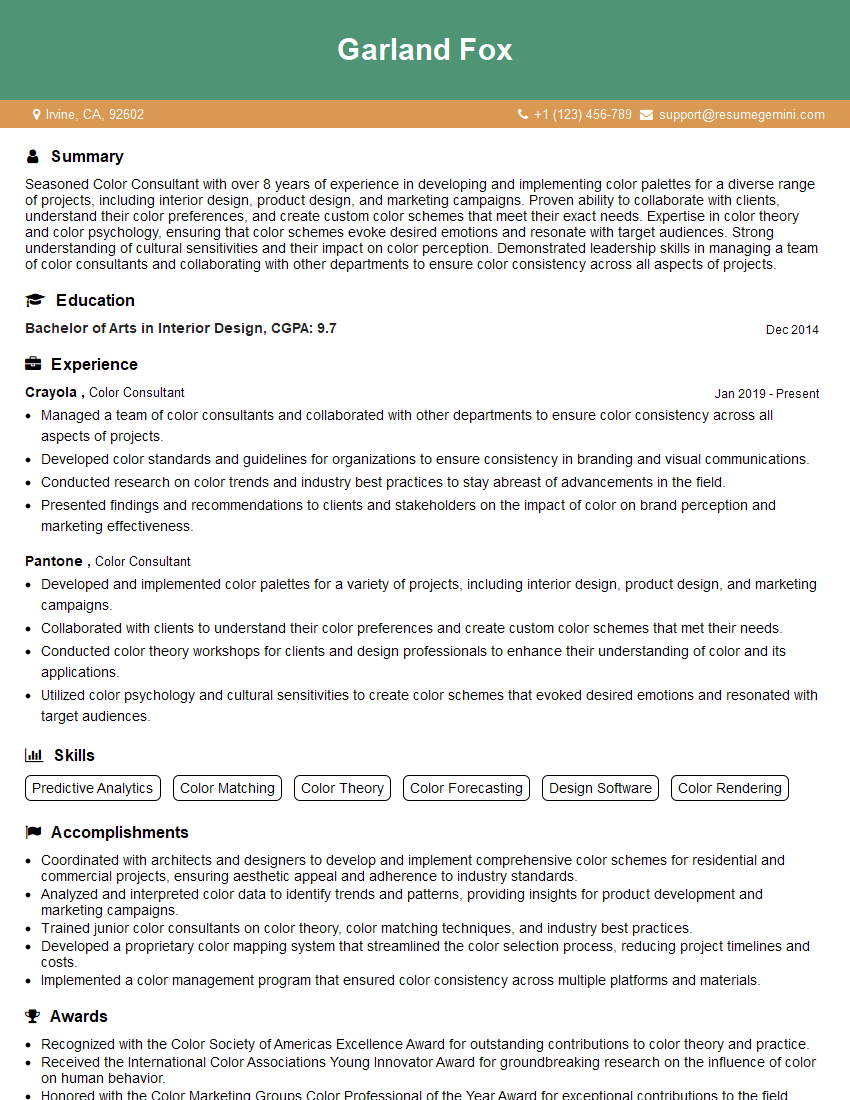
Mastering color matching and formulation is crucial for career advancement in a variety of industries. A strong understanding of these concepts opens doors to specialized roles and increased earning potential. To maximize your job prospects, create an ATS-friendly resume that showcases your skills and experience effectively. ResumeGemini is a trusted resource that can help you build a professional and impactful resume. We provide examples of resumes tailored to the Color Matching and Formulation field to help guide you through the process.
Explore more articles
Users Rating of Our Blogs
Share Your Experience
We value your feedback! Please rate our content and share your thoughts (optional).
What Readers Say About Our Blog
Really detailed insights and content, thank you for writing this detailed article.
IT gave me an insight and words to use and be able to think of examples