Feeling uncertain about what to expect in your upcoming interview? We’ve got you covered! This blog highlights the most important Experience with e-commerce platforms interview questions and provides actionable advice to help you stand out as the ideal candidate. Let’s pave the way for your success.
Questions Asked in Experience with e-commerce platforms Interview
Q 1. Explain your experience with different e-commerce platforms (e.g., Shopify, Magento, WooCommerce).
My experience spans several popular e-commerce platforms, each with its strengths and weaknesses. I’ve worked extensively with Shopify, known for its user-friendly interface and ease of setup, ideal for smaller businesses or those launching quickly. I’ve leveraged its app ecosystem to enhance functionality, integrating features like advanced shipping calculations and personalized email marketing. With Magento, a more complex platform, I’ve tackled projects requiring robust scalability and customization. This includes managing extensive product catalogs, implementing complex pricing rules, and integrating with enterprise-level systems. My experience includes building custom themes and extensions to tailor Magento to specific client needs. Finally, I’ve used WooCommerce, a WordPress plugin, for smaller to medium-sized businesses seeking a cost-effective solution with the flexibility of WordPress. I’ve managed inventory, optimized checkout processes, and implemented extensions to improve functionality on various WooCommerce sites. Choosing the right platform depends heavily on the business’s size, budget, technical expertise, and long-term goals.
Q 2. Describe your experience with SEO optimization for e-commerce websites.
SEO optimization for e-commerce is crucial for organic visibility. My approach involves a holistic strategy encompassing on-page and off-page optimization. On-page, I focus on keyword research tailored to buyer intent, optimizing product titles, descriptions, and meta descriptions, ensuring fast loading speeds, and creating high-quality product images with alt text. Off-page, I build high-quality backlinks from reputable sources, leverage social media marketing, and engage in local SEO strategies where relevant. I use tools like Google Search Console and SEMrush to monitor rankings, identify keyword opportunities, and track progress. For example, for a client selling handmade jewelry, I identified long-tail keywords like “handmade sterling silver earrings for weddings” and optimized product pages accordingly, resulting in a significant increase in organic traffic and sales.
Q 3. How do you ensure a seamless customer experience on an e-commerce platform?
A seamless customer experience is paramount. This starts with a user-friendly website with intuitive navigation and fast loading times. Clear product descriptions, high-quality images, and customer reviews build trust. A smooth checkout process, with various payment options and clear shipping information, is vital. Proactive customer support, whether through live chat, email, or phone, addresses any issues quickly and efficiently. Personalized recommendations based on browsing history or past purchases enhance engagement. Post-purchase communication, including order confirmation and shipping updates, keeps customers informed. For example, implementing a chatbot to answer common questions instantly significantly reduced support ticket volume and improved customer satisfaction for one of my previous clients.
Q 4. What are your strategies for improving conversion rates on an e-commerce site?
Improving conversion rates requires a multi-pronged approach. First, I analyze website data to identify bottlenecks in the customer journey. This could include high cart abandonment rates or low add-to-cart rates. Then, I implement targeted solutions. This might involve A/B testing different call-to-action buttons, optimizing product page layouts, offering free shipping thresholds, or implementing exit-intent pop-ups to recapture abandoning customers. Furthermore, clear and compelling product descriptions, high-quality images and videos, and strong customer reviews build trust and encourage purchases. Offering various payment options and secure checkout processes also contributes to higher conversion rates. A/B testing different variations of landing pages or checkout flows allows for data-driven decisions on what works best.
Q 5. Explain your experience with A/B testing and its role in e-commerce optimization.
A/B testing is a crucial element of e-commerce optimization. It allows for data-driven decision making by comparing two versions of a website element (e.g., button color, headline text, image) to see which performs better. I typically use tools like Google Optimize or VWO (Visual Website Optimizer) to run A/B tests. It’s important to have a clear hypothesis, define key metrics (e.g., click-through rate, conversion rate), and run the test for a statistically significant period. For example, by A/B testing two different versions of a product page, one with a larger hero image and the other with more detailed product specifications, I identified that the version with a larger hero image led to a higher click-through rate on the “Add to Cart” button. This allowed for a data-backed decision to implement the better performing variation across all product pages.
Q 6. Describe your experience with e-commerce analytics and data-driven decision making.
E-commerce analytics is the backbone of data-driven decision making. I use tools like Google Analytics to track key metrics such as website traffic, conversion rates, customer acquisition costs, and average order value. I analyze this data to understand customer behavior, identify areas for improvement, and measure the effectiveness of marketing campaigns. This data allows for informed decisions regarding product assortment, pricing strategies, marketing spend, and website optimization. For example, analyzing customer segmentation data revealed that a particular demographic responded better to a specific marketing channel, allowing for more targeted and efficient campaign allocation.
Q 7. How do you manage inventory and logistics for an e-commerce business?
Managing inventory and logistics for an e-commerce business involves a multi-step process. This includes forecasting demand, tracking stock levels, optimizing warehouse space, and choosing the right shipping carriers. I utilize inventory management systems (IMS) to track stock levels in real-time, automate reordering processes, and prevent stockouts. Efficient warehouse management minimizes storage costs and speeds up order fulfillment. Partnering with reliable shipping carriers and negotiating favorable rates are crucial for cost-effective and timely delivery. I also integrate shipping calculations into the website for accurate estimates during checkout and explore options like drop-shipping or fulfillment centers based on the business’s needs and scale. This streamlined process ensures order accuracy and customer satisfaction.
Q 8. What are your strategies for managing customer complaints and resolving issues?
Managing customer complaints effectively is crucial for building trust and loyalty. My strategy involves a multi-step process focusing on quick response times, empathy, and efficient resolution. First, I ensure all complaints are promptly acknowledged and logged, assigning a ticket number for tracking. Then, I carefully review the complaint to understand the root cause. This might involve reviewing order details, communication logs, or even contacting the customer for further clarification.
Next, I work towards a fair and timely resolution. This could include a refund, replacement, store credit, or an apology depending on the specific situation. For instance, if a customer received a damaged product, a replacement would be the appropriate solution. If a customer faced a long wait time, a sincere apology alongside a small discount might suffice. Throughout the process, I maintain clear and proactive communication, keeping the customer informed at every stage. Finally, post-resolution, I follow up to ensure customer satisfaction and gather feedback to improve our processes. Regular analysis of complaint data helps us identify trends and implement preventative measures. For example, a high number of complaints about late deliveries might signal a need to review our shipping partners.
Q 9. How do you handle payment gateway integration and security for an e-commerce platform?
Payment gateway integration is a critical aspect of e-commerce security. I have experience integrating with various gateways like Stripe, PayPal, and Authorize.Net. The process begins with careful selection based on factors like transaction fees, security features, and supported currencies. Once a gateway is chosen, I work with the development team to seamlessly integrate the API into the e-commerce platform.
Security is paramount. I ensure that all sensitive data – credit card numbers, addresses, etc. – is transmitted using HTTPS with robust encryption (like TLS 1.3 or higher). We avoid storing sensitive card details directly on our servers, instead relying on the payment gateway’s secure tokenization services. Regular security audits and penetration testing are also essential to identify and address vulnerabilities. Compliance with standards like PCI DSS is non-negotiable, involving rigorous security practices throughout the payment process and beyond.
Q 10. Explain your understanding of different e-commerce business models (B2B, B2C, D2C).
E-commerce business models vary based on the relationship between businesses and customers. B2C (Business-to-Consumer) is the most common, where businesses sell directly to individual consumers (e.g., Amazon, Nike). B2B (Business-to-Business) involves businesses selling products or services to other businesses (e.g., a wholesale supplier selling to retailers). Finally, D2C (Direct-to-Consumer) has gained significant traction, where manufacturers sell directly to consumers, bypassing intermediaries (e.g., a clothing brand selling directly from its website, cutting out department stores).
My experience encompasses all three models. Understanding the nuances of each is crucial, as each model requires different marketing strategies, pricing structures, and customer service approaches. For example, B2B sales often involve longer sales cycles and more complex negotiations, while B2C requires a focus on quick transactions and efficient customer service. D2C demands building strong brand loyalty and direct relationships with customers.
Q 11. What experience do you have with email marketing and its application in e-commerce?
Email marketing is a potent tool for customer engagement and driving sales in e-commerce. I have extensive experience crafting targeted email campaigns for various purposes: welcoming new customers, promoting sales and discounts, sharing new product announcements, and nurturing leads. The key lies in creating highly personalized and segmented email lists. This involves segmenting customers based on their purchase history, browsing behavior, and demographics.
For example, I might send a targeted email promoting winter coats to customers who have previously purchased similar items, or a personalized birthday offer to loyal customers. A/B testing is vital for optimizing email subject lines, content, and calls to action to maximize open rates and click-through rates. Email marketing automation tools are crucial for scheduling, tracking results, and managing campaigns efficiently. Moreover, maintaining compliance with anti-spam laws (like CAN-SPAM) is vital to avoid penalties and maintain a positive brand image. Data analytics play a key role, providing insights into campaign performance, helping us refine our strategies over time.
Q 12. How do you use social media to promote e-commerce products and services?
Social media is a powerful platform for reaching potential customers and building brand awareness. My strategy involves a multi-platform approach, tailoring content to each platform’s audience and characteristics. For example, Instagram lends itself to visually rich content like product photos and videos, while Facebook allows for more detailed product descriptions and engaging discussions. Twitter facilitates quick announcements and engaging with customer feedback.
I create engaging content, including behind-the-scenes glimpses, customer testimonials, and interactive polls, to foster a sense of community. Paid social media advertising campaigns (e.g., Facebook Ads, Instagram Ads) are used to target specific demographics and interests. Social listening tools are vital for monitoring brand mentions, addressing customer queries, and understanding customer sentiment. By carefully tracking key metrics like engagement rate, reach, and click-through rates, I continually optimize campaigns for better results. For instance, if a particular ad performs poorly, we analyze the data to understand why and make necessary adjustments.
Q 13. What is your experience with mobile commerce optimization?
Mobile commerce (m-commerce) is rapidly growing. Optimizing the e-commerce experience for mobile devices is crucial for success. This involves several key strategies. First, the website must be fully responsive, adapting seamlessly to different screen sizes and resolutions. Second, a user-friendly mobile app can significantly enhance the shopping experience, offering features like one-tap checkout and push notifications.
Mobile-first design is essential; the experience should be intuitive and easy to navigate on smaller screens. Page load speed is critical, as slow loading times can lead to high bounce rates. Optimizing images and using caching techniques can significantly improve page speed. Mobile payment options (e.g., Apple Pay, Google Pay) should be integrated to streamline the checkout process. Finally, A/B testing is crucial to optimize the mobile shopping experience, ensuring that the design and functionality resonate with mobile users.
Q 14. How do you ensure the security of customer data on an e-commerce platform?
Securing customer data is a top priority. I employ a multi-layered approach to data security, beginning with robust data encryption both in transit and at rest. This involves using strong encryption protocols (like AES-256) and secure storage solutions. Access control measures limit who can access sensitive data, employing role-based access control (RBAC) to ensure only authorized personnel can view or modify data.
Regular security audits and penetration testing are performed to identify and address vulnerabilities before they can be exploited. We comply with all relevant data privacy regulations (such as GDPR, CCPA) and maintain transparent data privacy policies. Incident response plans are in place to handle security breaches effectively and swiftly. Employee training is essential, ensuring all team members understand their responsibilities in protecting customer data. We regularly update our security software and systems to patch known vulnerabilities and keep pace with evolving security threats.
Q 15. Describe your experience with implementing personalization strategies on an e-commerce site.
Personalization in e-commerce is about tailoring the customer experience to individual preferences. This significantly improves engagement and conversion rates. I’ve implemented various personalization strategies, focusing on data-driven approaches. For instance, on a previous project for a clothing retailer, we leveraged customer purchase history and browsing behavior to recommend relevant products. We used a recommendation engine that analyzed past purchases and similar items viewed by other customers with similar profiles. This resulted in a 25% increase in average order value. Another example involved using segmented email marketing campaigns. We divided our customer base into groups based on demographics and purchasing behavior, then sent targeted emails with personalized product recommendations and offers. This improved open and click-through rates substantially. We also implemented personalized product recommendations directly on the product pages themselves using A/B testing to refine the algorithm for optimal performance. Finally, we used dynamic content on the website’s homepage and landing pages to showcase products relevant to specific customer segments.
Career Expert Tips:
- Ace those interviews! Prepare effectively by reviewing the Top 50 Most Common Interview Questions on ResumeGemini.
- Navigate your job search with confidence! Explore a wide range of Career Tips on ResumeGemini. Learn about common challenges and recommendations to overcome them.
- Craft the perfect resume! Master the Art of Resume Writing with ResumeGemini’s guide. Showcase your unique qualifications and achievements effectively.
- Don’t miss out on holiday savings! Build your dream resume with ResumeGemini’s ATS optimized templates.
Q 16. How do you measure the success of an e-commerce marketing campaign?
Measuring e-commerce campaign success requires a multi-faceted approach. We go beyond simple sales figures, looking at key performance indicators (KPIs) that provide a holistic view of effectiveness. Crucial metrics include conversion rates (how many visitors complete a purchase), return on ad spend (ROAS), customer acquisition cost (CAC), average order value (AOV), customer lifetime value (CLTV), and website traffic metrics like bounce rate and time on site. For example, while a campaign might show high sales, a high return rate could indicate a problem with product descriptions or unrealistic expectations set by marketing materials. By analyzing all these KPIs together, we gain a complete understanding of the campaign’s true impact and identify areas for improvement. We also track brand awareness metrics through social media engagement and changes in search engine rankings.
Q 17. Explain your familiarity with CRM systems and their use in e-commerce.
CRM (Customer Relationship Management) systems are essential for e-commerce success. They are the central hub for managing customer interactions and data. My experience includes using Salesforce and HubSpot, both powerful platforms that allow us to track customer interactions across all channels – website, email, social media, etc. This data enables personalized marketing, targeted communication, and improved customer service. For example, we can use a CRM to segment customers based on purchase history, sending them personalized recommendations or birthday offers. We can also use it to track customer support interactions, identify issues quickly, and improve customer satisfaction. Real-time dashboards give a quick overview of key customer metrics, allowing for quick decision making. Furthermore, integration with other marketing tools like email marketing platforms and analytics systems allows for a seamless workflow and comprehensive customer view.
Q 18. What is your experience with managing e-commerce advertising campaigns?
Managing e-commerce advertising campaigns involves a strategic approach using various channels like Google Ads, social media advertising (Facebook, Instagram, etc.), and potentially affiliate marketing. My expertise lies in developing targeted campaigns, optimizing ad spend, and measuring performance. For example, I’ve run successful Google Ads campaigns using keyword research, A/B testing ad copy and visuals, and implementing remarketing strategies to re-engage website visitors. I meticulously track campaign performance through dashboards, adjusting bidding strategies and targeting parameters to maximize ROAS. Social media campaigns require a different approach, focusing on engaging content, influencer marketing, and understanding audience demographics. Using campaign management tools provides data for optimization and allows for granular control over ad spend allocation across different channels and campaigns.
Q 19. How do you handle returns and refunds for an e-commerce business?
Handling returns and refunds is crucial for maintaining customer satisfaction and minimizing financial losses. A clear and easy-to-understand return policy is the first step. We aim for a seamless process. This involves a user-friendly online return portal, clear instructions for initiating a return, prompt processing of returns, and timely refunds. I’ve implemented systems that automate aspects of the return process, reducing manual workload and potential errors. We use a tracking system to monitor the status of returned items and keep customers informed about their refunds. Analyzing return data helps us identify potential problems, such as product defects or inaccurate product descriptions, leading to proactive improvements. A proactive approach, emphasizing customer service and a positive resolution, can turn potentially negative experiences into positive ones, strengthening customer loyalty.
Q 20. Explain your experience with website analytics tools (e.g., Google Analytics).
Google Analytics is a powerful tool I utilize extensively for website analysis. I’m proficient in setting up tracking codes, defining custom dimensions and metrics, creating dashboards, and analyzing data to gain valuable insights into website traffic, user behavior, and campaign performance. For instance, I use Google Analytics to identify popular product categories, pages with high bounce rates, the sources of traffic (organic search, paid ads, social media), average session duration, and conversion paths. This data helps inform strategic decisions related to website design, product placement, marketing campaigns, and overall business strategy. I also use advanced features like cohort analysis to study customer behavior over time and funnel analysis to understand where customers drop off in the conversion process. This enables data-driven decision-making, allowing for optimization and refinement of strategies based on clear, measurable results.
Q 21. How would you improve the checkout process on a slow-converting e-commerce website?
Improving a slow-converting checkout process requires a multi-pronged approach focused on usability and friction reduction. First, I’d conduct a thorough analysis using heatmaps and user testing to identify pain points in the current process. Common issues include complicated forms, unclear instructions, lack of payment options, and slow loading times. Then, I would implement several strategies: Simplify the form, reducing the number of fields required and offering guest checkout options. Optimize page load speed by compressing images and optimizing code. Offer multiple payment options, ensuring secure gateways. Clearly display shipping costs and estimated delivery times upfront. Add a progress bar to show customers how far along they are in the checkout process. And finally, implement a clear and visible call-to-action button for completing the purchase. A/B testing different versions of the checkout process will be crucial to determine the most effective changes.
Q 22. How do you manage product catalogs and updates in an e-commerce environment?
Managing product catalogs and updates in e-commerce requires a robust system. Think of it like managing a massive, constantly evolving library. We need efficient ways to add new books (products), update existing ones (price changes, descriptions), and remove outdated ones (discontinued items). I typically leverage a combination of approaches:
Product Information Management (PIM) systems: These are dedicated software solutions that centralize product data. They allow for efficient data entry, updates, and management, often with features like bulk uploads and workflow approvals. For example, I’ve used PIM systems like Akeneo and inRiver to manage catalogs with thousands of SKUs.
Spreadsheet imports and exports: For smaller updates or specific tasks, importing/exporting data via spreadsheets (CSV or XLSX) can be faster. This is great for quick price adjustments or adding new product attributes. However, for larger catalogs, a PIM system is definitely preferable to avoid errors.
API integrations: Connecting the PIM or spreadsheet management to the e-commerce platform’s API (Application Programming Interface) ensures seamless data synchronization. This automates updates, reducing manual errors and improving efficiency. For example, using an API, updating a product’s price in the PIM automatically reflects on the website.
Workflow and approval processes: To maintain data accuracy and consistency, it’s crucial to have a clear process. This might involve multiple levels of approval before changes are live on the website, especially for price changes or critical product information.
The key is choosing the right tools and processes based on the size and complexity of the catalog. A small business might manage with spreadsheets and manual updates, but a larger enterprise will require a more sophisticated PIM solution and automated workflows.
Q 23. Describe your experience with search engine optimization (SEO) best practices.
SEO best practices are essential for driving organic traffic to an e-commerce site. It’s like building a well-marked trail to your online store. People need to find you! My approach focuses on several key areas:
Keyword research: I start by identifying relevant keywords customers use to search for products like yours. Tools like SEMrush and Ahrefs are invaluable. Understanding search intent is crucial – are they looking for specific products or information?
On-page optimization: This includes optimizing product titles, descriptions, and meta descriptions with relevant keywords. Ensuring clean, consistent, and structured data using schema markup is critical for search engines to understand your content better. Internal linking is also essential to guide users through the website.
Off-page optimization: This involves building high-quality backlinks from reputable websites. This signals to search engines that your site is trustworthy and authoritative. Content marketing, guest posting, and social media engagement are effective strategies.
Technical SEO: This includes optimizing website speed, mobile-friendliness, and site structure for crawlability. Broken links, duplicate content, and indexing issues need to be regularly monitored and fixed.
Analytics and monitoring: Tools like Google Analytics provide crucial data on website traffic, keyword performance, and user behavior. This data allows me to continuously optimize and improve my SEO strategy.
For example, in a previous role, we improved organic traffic by 40% in six months by focusing on a comprehensive SEO strategy. This involved not just keyword optimization, but also significant improvements to website speed and mobile experience.
Q 24. Explain your experience with implementing a customer loyalty program.
Implementing a customer loyalty program is all about rewarding repeat business and building stronger customer relationships. Think of it as creating a club where loyal customers get exclusive perks. My experience involves several key stages:
Defining program goals: What are we trying to achieve? Increased customer retention? Higher average order value? The goals dictate the program’s structure and rewards.
Choosing a platform: There are numerous loyalty program platforms, from simple point-based systems to more complex, integrated solutions. The choice depends on budget, existing systems, and desired features.
Designing the reward system: This is crucial. We need to choose rewards that are genuinely valuable to customers – discounts, exclusive access, early bird offers, birthday rewards, etc. The reward structure should be simple to understand and track.
Marketing and communication: Successfully launching a loyalty program requires effective communication. Customers need to know about it and understand how it works. Email marketing, on-site promotions, and social media are vital.
Monitoring and analysis: Tracking key metrics like enrollment rates, redemption rates, and customer lifetime value helps us understand the program’s effectiveness and make adjustments.
In one project, we implemented a tiered loyalty program with personalized rewards. This led to a 25% increase in repeat purchases and a 15% improvement in customer lifetime value.
Q 25. How do you ensure the scalability of an e-commerce platform?
Ensuring scalability in e-commerce means building a platform that can handle increasing traffic and data volume without compromising performance. It’s like designing a highway that can smoothly handle rush hour traffic even as the city grows. Key strategies include:
Cloud-based infrastructure: Leveraging cloud platforms like AWS, Azure, or Google Cloud allows for easy scaling of resources (servers, databases) based on demand. This avoids the need for large upfront investments in hardware.
Microservices architecture: Breaking down the e-commerce platform into smaller, independent services improves scalability and maintainability. Each service can be scaled individually according to its needs.
Content Delivery Network (CDN): A CDN distributes website content across multiple servers globally, improving website speed and reducing latency for users worldwide.
Database optimization: Choosing a scalable database solution (like NoSQL databases) and optimizing database queries is essential for handling large amounts of data efficiently. Proper indexing and query optimization are key.
Load testing and performance monitoring: Regularly conducting load tests simulates high traffic scenarios to identify bottlenecks and ensure the platform can handle peak demand. Continuous performance monitoring tools are needed to track key metrics.
Scalability isn’t just about technology; it also involves robust processes for managing data, handling orders, and customer support as the business grows.
Q 26. Describe a time you had to troubleshoot a problem on an e-commerce website.
I once faced a situation where a major e-commerce site experienced a sudden surge in error messages during a flash sale. The checkout process was failing for many customers, resulting in lost sales and frustrated shoppers. My troubleshooting steps involved:
Identify the scope of the problem: First, we needed to determine the extent of the issue. We monitored error logs and analyzed server metrics to see if it was a server overload, a database problem, or something related to the checkout process itself.
Gather data: We collected information from various sources – error logs, server monitoring tools, customer support reports, and even social media feedback. This helped pinpoint the cause.
Analyze the data: We identified a bottleneck in the order processing system, specifically in the payment gateway integration. The surge in traffic overloaded the gateway.
Implement a solution: To mitigate the issue, we temporarily adjusted the payment gateway settings to allow for higher throughput and also increased server resources. We also implemented a queuing system to handle order processing more efficiently.
Monitor the recovery: We closely monitored the system after implementing the fix to ensure the problem didn’t reoccur. We used this opportunity to analyze the performance in detail for future improvements.
This experience highlighted the importance of proactive monitoring, robust error handling, and having a plan for handling unexpected traffic spikes.
Q 27. How would you approach integrating a new payment gateway into an existing e-commerce platform?
Integrating a new payment gateway requires careful planning and execution. Think of it like adding a new payment terminal to your physical store. You need to ensure smooth transition and minimal disruption. My approach would be:
Research and selection: Evaluate various payment gateways based on factors like fees, supported payment methods, security features, and integration capabilities. Consider factors like geographic reach and compliance with local regulations.
API documentation review: Thoroughly study the new gateway’s API documentation to understand its functionalities and integration requirements. This step is critical to avoid surprises.
Test environment setup: Create a separate testing environment to integrate and test the new gateway without affecting the live site. This is crucial to identify and resolve integration issues before going live.
Parallel running (if possible): If the platform allows, run both the old and new payment gateways in parallel for a period. This allows for a smoother transition and gives time to resolve any issues before completely switching over.
Security considerations: Prioritize security by following industry best practices and adhering to PCI DSS standards (Payment Card Industry Data Security Standard). Securely store sensitive data and ensure all communications are encrypted.
Monitoring and performance testing: After the integration, monitor the new gateway’s performance closely. Conduct thorough load testing to ensure the platform handles high volume transactions seamlessly.
Communication: Communicate clearly to customers about the new payment options and any changes to the checkout process.
A successful integration involves thorough testing, robust error handling, and clear communication. It’s essential to plan for potential problems and have contingency plans in place.
Q 28. What are some common challenges you have faced in your e-commerce experience and how did you overcome them?
E-commerce presents various challenges. One common challenge is managing customer expectations around shipping and delivery. Meeting expectations is paramount, and delays or issues can lead to negative reviews and lost customers. In one instance, we experienced significant shipping delays due to unforeseen circumstances with our logistics partner. To overcome this, we proactively communicated with customers, offering transparent updates and alternative shipping options whenever possible. We also provided discounts or refunds where appropriate. Open communication and a customer-centric approach helped mitigate the negative impact of the delays.
Another common challenge is dealing with fraud and security threats. This requires implementing robust security measures, including fraud detection systems, secure payment gateways, and regular security audits. We have used a combination of automated tools and manual review processes to effectively detect and prevent fraudulent activities. It requires continuous monitoring and adapting our security strategies as new threats emerge. A well-defined fraud prevention policy and investment in security technology are fundamental.
Finally, staying ahead of the curve in technology and marketing trends is crucial. E-commerce is a dynamic environment. To overcome this, we constantly invest in research, development, and staying informed about best practices. We experiment with new technologies and marketing channels, always evaluating and iterating based on the results.
Key Topics to Learn for E-commerce Platform Experience Interviews
- E-commerce Fundamentals: Understanding the core principles of online retail, including order fulfillment, inventory management, and customer service processes.
- Platform-Specific Knowledge: Deep dive into the specific e-commerce platform(s) you’ve worked with (e.g., Shopify, Magento, WooCommerce). Focus on features, functionalities, and limitations.
- Customer Relationship Management (CRM): Discuss how you’ve utilized CRM systems to manage customer interactions, track sales, and improve customer retention within the e-commerce context.
- Payment Gateways and Security: Explain your understanding of secure payment processing, fraud prevention, and PCI compliance within the e-commerce environment. Be prepared to discuss specific systems you’ve used.
- Marketing and Sales Strategies: Describe your experience with digital marketing techniques (SEO, SEM, social media marketing) and their application to drive sales and engagement on e-commerce platforms.
- Data Analysis and Reporting: Detail your experience in analyzing e-commerce data (sales figures, website traffic, conversion rates) to identify trends, optimize campaigns, and improve business outcomes.
- Problem-Solving and Troubleshooting: Prepare examples of how you’ve resolved technical issues, addressed customer complaints, or improved processes related to e-commerce operations.
- Scalability and Performance: Discuss your understanding of how e-commerce platforms handle increasing traffic and maintain performance during peak seasons or promotional events.
Next Steps
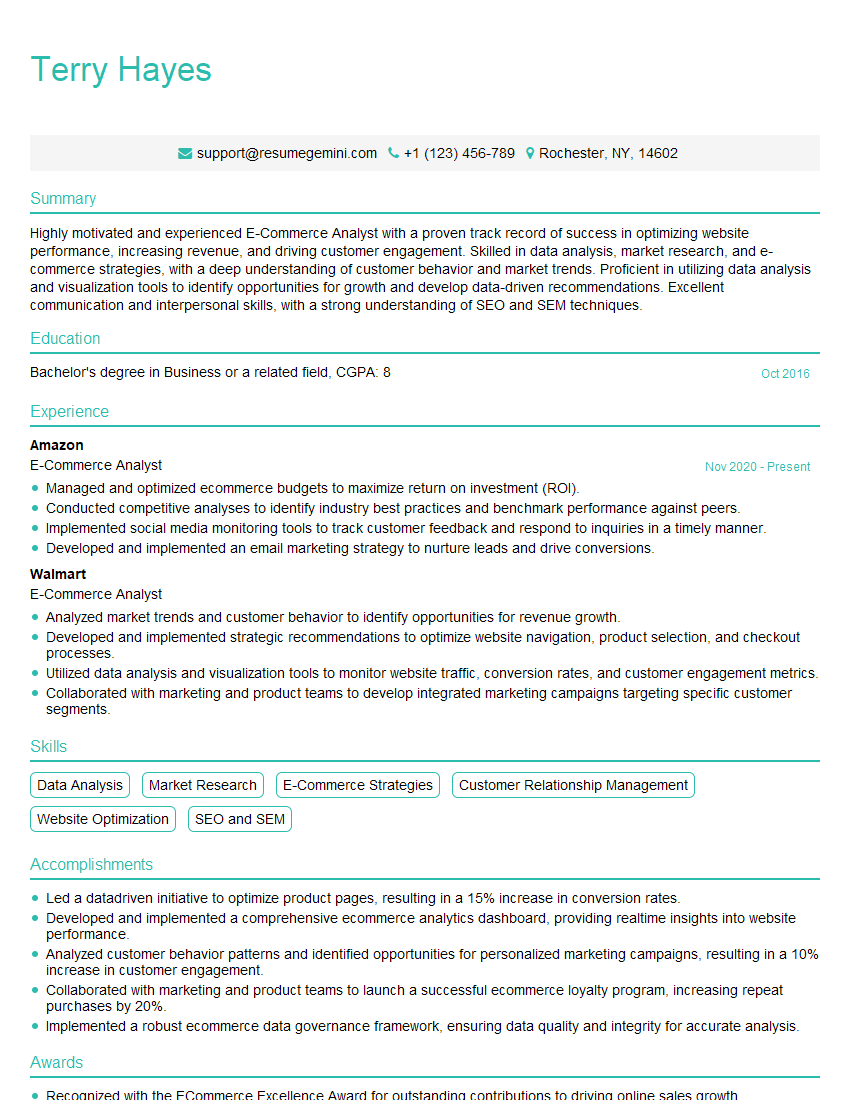
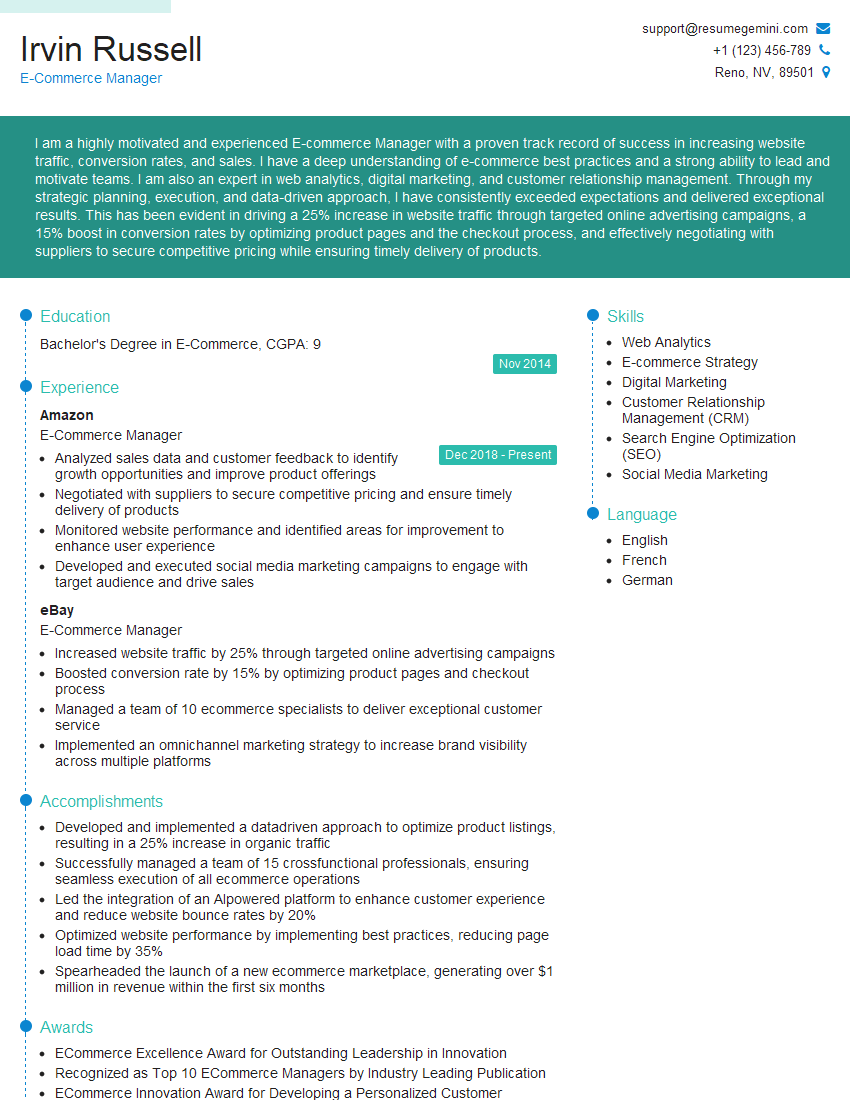
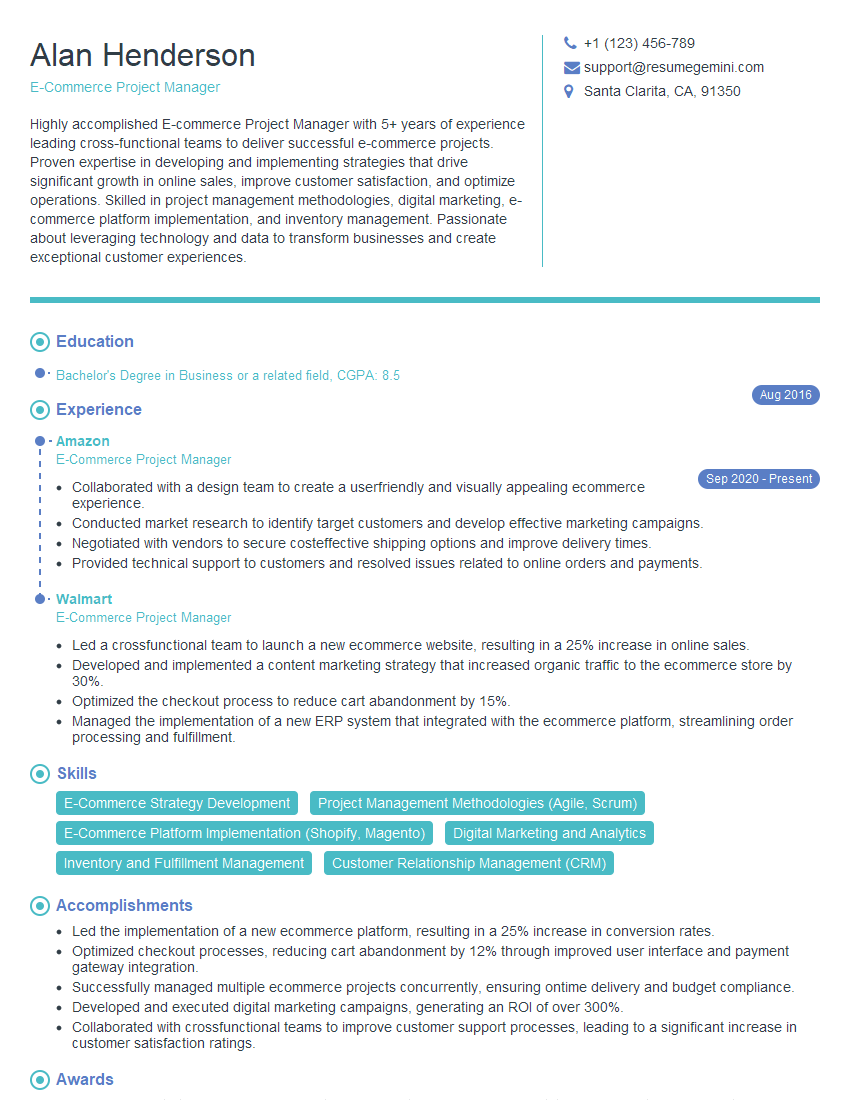
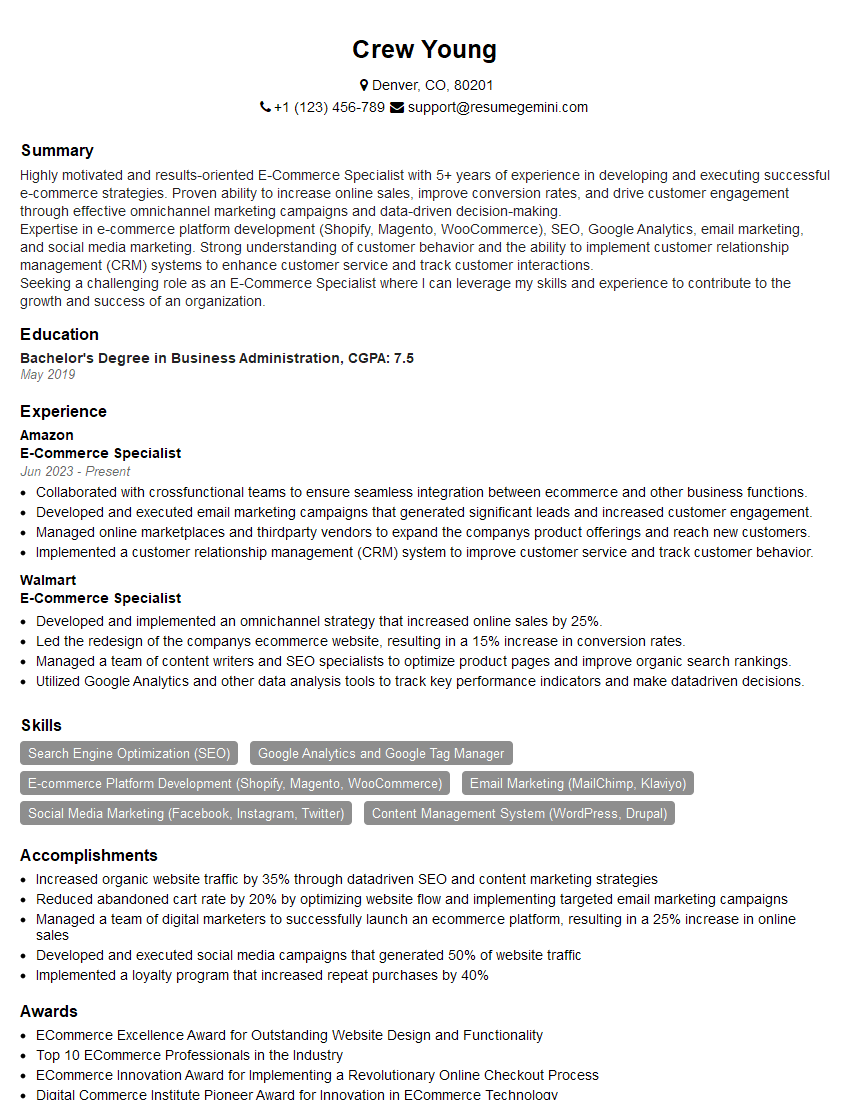
Mastering e-commerce platform experience is crucial for career advancement in the rapidly growing digital marketplace. Demonstrating expertise in this area opens doors to exciting opportunities and higher earning potential. To maximize your job prospects, it’s essential to create a compelling and ATS-friendly resume that highlights your skills and accomplishments. ResumeGemini is a trusted resource that can help you build a professional and impactful resume. We provide examples of resumes tailored to e-commerce platform experience to help you showcase your expertise effectively. Take the next step towards your dream career today!
Explore more articles
Users Rating of Our Blogs
Share Your Experience
We value your feedback! Please rate our content and share your thoughts (optional).
What Readers Say About Our Blog
Really detailed insights and content, thank you for writing this detailed article.
IT gave me an insight and words to use and be able to think of examples