Interviews are more than just a Q&A session—they’re a chance to prove your worth. This blog dives into essential Tree Hazard Assessment interview questions and expert tips to help you align your answers with what hiring managers are looking for. Start preparing to shine!
Questions Asked in Tree Hazard Assessment Interview
Q 1. Explain the difference between visual tree assessment (VTA) and more advanced assessment techniques.
Visual Tree Assessment (VTA) is a fundamental, often initial, step in evaluating tree health and risk. It relies primarily on visual observation by a trained arborist, assessing factors like crown condition, stem integrity, and root flare exposure. Think of it like a quick health check-up for a tree. More advanced techniques, however, incorporate quantitative data to improve accuracy and objectivity. These include:
- Resistograph testing: This uses a small drill to measure wood density, revealing internal decay that’s invisible from the outside. It’s like getting an X-ray for the tree’s heartwood.
- Tomography: Similar to a medical CAT scan, this uses sonic or electrical resistance to create a 3D image of the tree’s internal structure, pinpointing decay and structural weaknesses.
- Soil analysis: Evaluating soil compaction, drainage, and nutrient levels helps determine root health and overall tree stability. A tree struggling in poor soil is more vulnerable.
In essence, VTA provides a preliminary assessment, while advanced techniques offer a more detailed and precise diagnosis when needed, particularly for high-risk trees near infrastructure or in high-traffic areas.
Q 2. Describe the key factors influencing tree stability.
Tree stability is a complex interplay of several key factors:
- Root system: The extent, depth, and health of the root system are paramount. A shallow or damaged root system severely compromises stability, especially in windy conditions or saturated soils. Imagine a tree with a weak foundation—it’s more likely to topple.
- Crown weight and balance: An unbalanced crown, perhaps due to storm damage or improper pruning, can place significant stress on the trunk and branches, increasing the risk of failure. Think of it like a seesaw—if the weight isn’t distributed evenly, it’s prone to tipping.
- Trunk structure and defects: Internal decay, cracks, cavities, and significant leaning all weaken the tree’s structural integrity. A damaged trunk is like a broken column—it can’t support the load effectively.
- Species and age: Some tree species are inherently more prone to certain types of failure. Age also plays a role, as older trees are more susceptible to decay and weakening over time. Each species has its own lifecycle and resilience factors.
- Environmental factors: Extreme weather events (storms, ice, snow), soil conditions (erosion, compaction), and nearby construction can all stress trees and compromise stability.
Q 3. What are the common tree defects that pose significant hazard risks?
Several common tree defects significantly increase hazard risk:
- Decay: Decaying wood loses its structural strength, making branches or the trunk prone to failure. Think of a rotting support beam in a building.
- Cavities: Large cavities weaken the trunk and can create stress concentrations, making the tree susceptible to breakage. They’re like holes in a structural support.
- Cracks: Vertical or horizontal cracks in the trunk or branches indicate structural weaknesses. These cracks compromise the integrity of the wood fibres, weakening the structural support.
- Leaning: Significant leaning increases the risk of uprooting, especially in trees with shallow roots or damaged root systems.
- Broken branches: Broken or weakened branches, especially in the crown, pose a direct hazard to people and property below.
- Co-dominant stems: Trees with two or more main stems growing from the base can be structurally unstable, particularly if the stems are poorly fused.
These defects are often identified during VTA, and more advanced techniques can help assess their severity and extent.
Q 4. How do you assess the risk posed by a tree with decayed wood?
Assessing the risk posed by decayed wood involves a multi-step process:
- Visual inspection: Identify the location, extent, and type of decay (e.g., heart rot, butt rot).
- Advanced techniques: Employ methods like resistograph or tomography to determine the extent of internal decay that may not be visible externally. This gives a more accurate picture than surface examination alone.
- Decay assessment: Evaluate the amount of sound wood remaining. Is the decay concentrated in non-critical areas or compromising the tree’s structural integrity?
- Risk categorization: Based on the location and extent of decay, classify the risk level (low, moderate, high). A small cavity in a branch that is not essential to the tree’s structure may have minimal impact compared to severe decay compromising the base of a large tree.
- Risk mitigation strategies: Develop recommendations to reduce the risk, such as pruning, cabling, or removal.
The process requires experience and judgment, using both qualitative visual assessments and quantitative data to create a comprehensive picture of the risk.
Q 5. Explain the process of creating a tree risk assessment report.
A tree risk assessment report should be clear, concise, and comprehensive. It typically includes:
- Site information: Location, date of assessment, tree species, dimensions, and GPS coordinates.
- Assessment methods: Description of techniques used (VTA, resistograph, tomography, etc.).
- Tree condition: Detailed description of all observed defects (decay, cracks, lean, etc.), including location, extent, and severity.
- Risk analysis: Evaluation of each defect’s potential impact and the overall risk posed by the tree. This section often includes risk matrices that rank tree risk on a numerical or categorical scale (low, moderate, high).
- Recommendations: Specific mitigation strategies to reduce risk, such as pruning, cabling, bracing, or removal. These recommendations often include timelines and specific considerations.
- Photographs and diagrams: Visual aids to supplement the written description.
- Liability considerations: Statement acknowledging inherent limitations in tree assessment. This section addresses the uncertainty involved in predicting tree failure and manages expectations.
The report should be tailored to the audience and intended use (e.g., homeowner, property manager, insurance company).
Q 6. What are the different tree risk assessment methods and when would you use each?
Several tree risk assessment methods exist, each with its strengths and weaknesses:
- Qualitative methods (VTA): Primarily rely on visual inspection and experience. This is fast and inexpensive, ideal for initial screening or assessing many trees. However, its accuracy is limited for detecting internal defects.
- Quantitative methods (e.g., resistograph, tomography): Provide objective data on the extent of internal decay and structural weaknesses. These are more accurate but costly and time-consuming.
- Risk matrix methods: Use predefined risk factors and weighting systems to categorize tree risk. These streamline assessments and improve consistency but can lack nuance in complex cases.
- Decision tree analysis: A systematic approach that uses a branching diagram to guide decision-making. Useful for complicated cases and helps in making logical decisions about mitigation strategies.
The choice of method depends on factors like the tree’s condition, the level of risk, available resources, and the needs of the client. A combination of methods is often ideal, utilizing visual inspection for initial screening and advanced methods for high-risk situations.
Q 7. How do you determine the appropriate mitigation strategies for identified tree hazards?
Determining appropriate mitigation strategies depends on the identified hazards and their risk levels. Common mitigation strategies include:
- Pruning: Removing dead, diseased, or structurally weak branches to reduce crown weight and improve balance.
- Cabling and bracing: Using cables and braces to reinforce weak branches or improve overall tree stability.
- Crown reduction: Reducing the overall size of the crown to lessen wind resistance and stress on the tree. This should be done with care, following proper pruning techniques.
- Root pruning (carefully): In limited situations, root pruning can be considered to reduce root competition or improve access to underground utilities. However, this is an invasive procedure that can stress the tree and should only be done by qualified arborists.
- Tree removal: In cases where the risk is unacceptably high or mitigation strategies are ineffective, tree removal is the safest option.
The best mitigation strategy often involves a combination of approaches. The decision process should consider factors such as cost, effectiveness, time constraints, and the potential for future risks. Always prioritize safety and choose the option that best mitigates the risk without harming the tree unnecessarily.
Q 8. Discuss the role of wind in tree failure.
Wind plays a crucial role in tree failure, acting as a major destabilizing force. The force of the wind on a tree’s crown creates a lever effect, putting stress on the root system and stem. The magnitude of this force depends on several factors, including wind speed, the tree’s height and shape (especially its surface area exposed to the wind), and the density of its crown. Trees with asymmetrical crowns or those with dead or decaying branches are particularly vulnerable. Imagine a sail on a boat – a large, exposed crown acts like a sail, catching the wind and increasing the risk of uprooting or stem failure. We often see this in strong storms where mature, seemingly healthy trees are uprooted because the wind’s force exceeded the anchoring capacity of their root systems.
Furthermore, wind can exacerbate existing weaknesses in a tree. For instance, a tree already suffering from decay or root damage is much more likely to fail in high winds. Assessing wind risk involves understanding local wind patterns, prevalent wind speeds, and the tree’s morphology to predict its susceptibility to failure.
Q 9. How do you assess the impact of soil conditions on tree stability?
Soil conditions are paramount in determining a tree’s stability. Poor soil can significantly reduce the tree’s ability to anchor itself and resist wind forces or other stresses. We assess soil conditions through a combination of methods, including visual inspection, soil probing, and sometimes more advanced techniques like soil sampling and laboratory analysis. Things we look for include:
- Soil type: Clay soils, for example, can become waterlogged, reducing root aeration and strength. Conversely, sandy soils may offer poor anchorage.
- Soil depth: Shallow soils restrict root growth, making trees more susceptible to windthrow. Imagine a tree with roots confined to a thin layer of soil on top of bedrock; it has a much smaller anchor than a tree with deep, extensive root systems.
- Soil compaction: Compacted soil limits root penetration and oxygen availability, reducing the roots’ ability to absorb water and nutrients, thus weakening the tree’s structure. This is often a problem in areas with heavy traffic or construction.
- Drainage: Poor drainage leads to waterlogging, promoting root decay and reducing stability. Conversely, excessively dry soil can weaken trees through dehydration.
By analyzing these factors, we can assess the level of support the soil provides and determine the tree’s overall stability. A tree in poor soil might need remedial work like soil improvement or increased support to enhance its stability.
Q 10. What are the legal and regulatory considerations for tree hazard assessment?
Legal and regulatory considerations for tree hazard assessment vary significantly depending on location. In many jurisdictions, landowners have a legal duty of care to ensure the safety of others on their property. This includes managing tree hazards that could cause damage or injury. Regulations often dictate requirements for inspections, assessments, and mitigation strategies. For example:
- Building codes: Many building codes specify requirements for tree management near structures to prevent damage in the event of a tree failure.
- Occupational Health and Safety (OH&S) regulations: These regulations often mandate risk assessments for trees near workplaces to protect employees.
- Liability laws: Landowners can be held liable for injuries or damages caused by falling trees if they fail to take reasonable steps to mitigate the risk. Thorough documentation of assessments and mitigation measures is crucial in case of legal disputes.
- Local ordinances: Many municipalities have specific regulations regarding tree removal, pruning, and hazard assessment. These can often be quite detailed and include requirements for specific permits, assessments and methods of disposal.
Therefore, a professional tree risk assessment needs to comply with all relevant local, state, and national regulations to ensure legal compliance and to minimise potential liability.
Q 11. Explain the importance of site history in tree risk assessment.
Site history is invaluable in a tree risk assessment, offering crucial context about past events and potential vulnerabilities. Understanding the history helps us predict future risks. This includes considering factors like:
- Past storms or extreme weather events: Previous storm damage can weaken a tree, leaving it susceptible to future failures, even if the visible damage appears to have healed.
- Past maintenance activities: Knowing about previous pruning, cabling, or other treatments provides insight into the tree’s history of management and potential long term impacts.
- Land use changes: Construction, compaction, or changes in drainage patterns near the tree can negatively impact root systems and stability. For example, the construction of a new building may have resulted in root damage.
- Pest and disease history: Information about past infestations or diseases affecting the tree is essential in predicting future health and stability issues.
For example, a tree that survived a severe storm ten years ago but shows signs of slow growth and decay might be at increased risk of failure, even if it appears healthy on the surface. By investigating the site’s history, we can obtain a more comprehensive understanding of a tree’s vulnerabilities and adjust our assessment accordingly.
Q 12. How do you assess the risk to infrastructure from falling trees?
Assessing the risk to infrastructure from falling trees involves identifying potential targets and analyzing the likelihood and consequences of tree failure. We use a combination of techniques including:
- Target identification: This step involves identifying all infrastructure elements at risk, including buildings, power lines, roads, and pipelines. Mapping the location of trees in relation to these elements is crucial.
- Probability analysis: This assesses the likelihood of a tree failing based on factors such as species, health, condition, age, location and surrounding environment.
- Consequence analysis: This assesses the potential severity of damage if a tree were to fail. Factors considered include the size and weight of the tree, the fragility of the infrastructure, and the potential for secondary impacts. For example, a large tree falling on a power line could trigger a widespread power outage.
- Risk matrix: Using the probability and consequence analysis, we can then construct a risk matrix to prioritize mitigation efforts. High-risk scenarios (high probability of failure and high consequences) require immediate attention. For example, a dead tree overhanging a highly trafficked road would be considered a very high risk.
The ultimate goal is to develop a risk management plan to mitigate the risk to infrastructure. This might involve tree removal, pruning, or structural support.
Q 13. Describe different methods for documenting tree assessment findings.
Documentation of tree assessment findings is crucial for legal reasons, for future reference and for effective communication. We employ several methods:
- Written reports: Comprehensive written reports detail the assessment methods used, findings, risk levels, and recommended actions. These typically include photographs, diagrams, and maps.
- Digital photography: High-resolution photographs of the tree, its surroundings, and any visible defects are integral parts of the documentation.
- Tree inventory databases: These databases can store and manage information on large numbers of trees, enabling efficient tracking and analysis of tree health and risk over time.
- GIS mapping: Geographic Information System (GIS) software allows us to map the location of trees and their associated risks, facilitating effective planning and management of tree hazards across larger areas.
- Video recordings: In cases of complex trees or difficult-to-assess situations, video recordings can provide a valuable supplement to the documentation.
The chosen method depends on the scope of the assessment and the requirements of the client. In most cases, a combination of techniques is best to ensure comprehensive and easily understandable documentation.
Q 14. How do you prioritize tree risk management based on risk levels?
Prioritizing tree risk management involves ranking trees based on their level of risk, focusing resources on the most urgent situations. We typically use a risk matrix or similar system that combines the likelihood of failure with the severity of the consequences. This could be a simple numerical rating system or a more complex algorithm. Here’s a typical approach:
- Risk Assessment: Each tree is individually assessed, considering factors such as its species, age, health, location, and proximity to infrastructure. This leads to a probability of failure rating.
- Consequence Assessment: The potential consequences of failure are assessed. A large tree near a school would have significantly higher consequences than a small tree in a remote area. This leads to a severity rating.
- Risk Prioritization: The probability and consequence scores are combined to produce an overall risk score for each tree. Trees with high scores (high probability of failure and severe consequences) are given the highest priority for management.
- Mitigation Planning: Based on the risk ranking, a plan is developed, specifying mitigation strategies for each tree, such as pruning, cabling, removal, or further monitoring.
This ensures efficient and effective resource allocation, focusing efforts on the trees posing the most significant threats. Regular reassessment and monitoring are crucial, as the risk level of a tree can change over time due to factors like growth, decay, and weather events.
Q 15. What are the safety precautions to be taken during tree assessment?
Safety is paramount during any tree assessment. It’s not just about protecting myself; it’s about protecting the property and anyone nearby. My safety protocols begin with a thorough site survey before I even get out of my vehicle. I look for potential hazards like overhead power lines, unstable ground, and the presence of other potential dangers.
- Personal Protective Equipment (PPE): I always wear appropriate PPE, including high-visibility clothing, sturdy boots with steel toes, safety glasses, gloves, and a helmet, especially when working near tree canopies.
- Site Assessment & Hazard Identification: Before approaching a tree, I assess the surrounding area for any potential dangers, such as unstable branches, debris, or uneven terrain. I will also look at weather conditions, as rain and wind can increase risks.
- Communication: If working on a larger property or near roads, I will implement clear communication plans with my team and warn people in the vicinity. This may include putting up signage or having a spotter.
- Distance & Avoidance: I maintain a safe distance from potentially hazardous areas and never attempt to climb a tree unless I’m specifically trained and equipped to do so – and even then, only if all other options are deemed unsuitable.
- Emergency Procedures: I always have a pre-determined communication plan in case of emergency and familiar myself with the location of nearest emergency services.
For instance, during an assessment near a busy road, I would ensure that there’s a clear traffic management plan in place before beginning my work.
Career Expert Tips:
- Ace those interviews! Prepare effectively by reviewing the Top 50 Most Common Interview Questions on ResumeGemini.
- Navigate your job search with confidence! Explore a wide range of Career Tips on ResumeGemini. Learn about common challenges and recommendations to overcome them.
- Craft the perfect resume! Master the Art of Resume Writing with ResumeGemini’s guide. Showcase your unique qualifications and achievements effectively.
- Don’t miss out on holiday savings! Build your dream resume with ResumeGemini’s ATS optimized templates.
Q 16. How do you communicate assessment findings to clients or stakeholders?
Communicating assessment findings effectively is crucial. I tailor my communication style to the audience. With homeowners, I use clear, non-technical language, avoiding jargon. For arborists or engineers, I use more specialized terminology and detailed reports. Regardless of the audience, my communication always includes:
- Clear Summary of Findings: A concise overview of the tree’s condition, highlighting any potential risks.
- Visual Aids: Photographs, diagrams, and even a short video can greatly enhance understanding, particularly when showing areas of concern or decay.
- Specific Recommendations: Detailed recommendations for mitigation, including pruning, cabling, removal, or monitoring schedules – always prioritizing safety.
- Risk Rating Explanation: A clear explanation of the risk rating system used, including its implications and recommendations.
- Written Report: A comprehensive, well-documented report outlining all findings, recommendations, and supporting evidence.
For example, I might explain to a homeowner that a particular branch has a significant risk of failure due to decay, and recommend pruning or removal to mitigate the risk of property damage or injury. The written report would provide detailed photographic and descriptive evidence to support the recommendations.
Q 17. Explain the importance of ongoing tree monitoring and reassessment.
Ongoing monitoring and reassessment are critical for responsible tree management. Trees are living organisms; their condition can change rapidly due to factors like disease, insect infestation, weather events, and growth. Imagine a seemingly healthy tree developing a hidden internal decay – regular monitoring can catch these problems early.
- Early Detection: Regular checks allow for early detection of problems, allowing for timely intervention and preventing minor issues from escalating into major hazards.
- Cost-Effectiveness: Addressing problems early is significantly more cost-effective than dealing with emergencies and extensive repairs down the road.
- Liability Mitigation: Proactive monitoring and reassessment significantly reduce liability concerns for property owners.
- Informed Decision-Making: Ongoing monitoring provides data to inform future decisions related to tree management, including pruning, cabling, or removal.
I typically recommend annual inspections for high-risk trees and less frequent checks for healthy specimens. The frequency of reassessment is adjusted based on the tree’s risk rating, its species, and site conditions.
Q 18. Describe your experience using tree risk assessment software or tools.
I have extensive experience using several tree risk assessment software and tools, including TreeRisk, i-Tree, and Arborist360. These tools are invaluable for streamlining the assessment process and enhancing accuracy.
- Data Collection & Analysis: These programs facilitate the efficient collection and analysis of data points, such as tree dimensions, defects, and environmental factors.
- Risk Calculation: They utilize algorithms to calculate risk ratings, providing a standardized and objective assessment.
- Reporting & Documentation: They generate professional reports that are easy to share with clients and stakeholders, and help maintain a complete record of the assessment.
- Visualization: Many offer 3D modeling or other visualization options, providing a more comprehensive understanding of tree structure and potential failure points.
For example, TreeRisk allows me to input data about a tree’s dimensions and defects, and it automatically calculates a risk score based on established algorithms. This ensures a consistent and scientific approach to the assessment process. The software generates reports which include the calculations, risk ratings and recommendations.
Q 19. How do you handle situations where the landowner disagrees with your assessment?
Disagreements can arise, and handling them professionally is crucial. My approach involves:
- Open Communication: Clearly and calmly explain my assessment findings, using visual aids and non-technical language where appropriate.
- Data Transparency: Share all the data and evidence supporting my assessment, including photographs, measurements, and any relevant literature.
- Alternative Perspectives: Listen to their concerns and perspectives, acknowledging their viewpoints even if I don’t agree.
- Compromise & Negotiation: Explore alternative solutions if possible, such as a second opinion from another qualified arborist.
- Documentation: Meticulously document all communication and agreements, protecting both parties.
In one case, a homeowner disagreed with my recommendation to remove a severely decaying tree. I presented additional evidence and discussed the potential risks of keeping the tree. Ultimately, we agreed on a compromise: a reduced scope of work removing the most hazardous sections and monitoring the remaining portions closely. We established a clear monitoring plan to address any future concerns.
Q 20. What are the ethical considerations involved in tree risk assessment?
Ethical considerations are at the core of tree risk assessment.
- Objectivity & Impartiality: Maintaining objectivity and avoiding conflicts of interest is paramount. I always prioritize the safety of people and property over personal gain.
- Competence & Due Diligence: I only undertake assessments within my area of expertise, using appropriate methodologies and staying up-to-date with the latest research and best practices.
- Transparency & Honesty: Clearly communicate any limitations of my assessment, any uncertainties, or potential biases. This ensures complete transparency.
- Client Confidentiality: Maintaining client confidentiality and protecting sensitive information is of utmost importance.
- Professionalism & Integrity: Adhering to professional codes of conduct, acting with integrity, and maintaining a high level of professionalism in all interactions.
For example, if I’m unsure about a particular aspect of an assessment, I would clearly state this in my report and potentially recommend seeking a second opinion from a specialist. This ensures that clients receive an accurate and responsible assessment.
Q 21. Explain the principles of tree pruning and its role in risk mitigation.
Tree pruning, when performed correctly, is a valuable tool for risk mitigation. It’s not about simply removing branches; it’s about improving the tree’s structure and reducing its susceptibility to damage or failure.
- Crown Reduction: Carefully reducing the overall size of the crown, reducing weight and wind resistance.
- Crown Cleaning: Removing dead, dying, diseased, or weak branches that may pose a hazard.
- Crown Thinning: Removing selected branches to increase light penetration, improving air circulation and reducing density.
- Crown Lifting: Raising the lower branches to provide clearance for pedestrians, vehicles, or buildings.
However, improper pruning can actually increase risk. Poorly executed pruning can damage the tree’s structure and lead to decay or disease. I always follow proper pruning techniques which include using sharp tools, making clean cuts, and avoiding topping or severe reductions.
For example, I would advise against topping a large oak tree as it can cause extensive damage. Instead, I might recommend targeted crown cleaning and thinning to reduce the risk of branch failure.
Q 22. Describe the differences between various tree species and their susceptibility to failure.
Tree species vary significantly in their susceptibility to failure, primarily due to differences in wood properties, branching patterns, and growth habits. For example, brittle wood species like some elms (Ulmus spp.) are more prone to branch failure than more flexible species like oaks (Quercus spp.). Fast-growing species, while often displaying vigorous growth, can develop weaker wood structure compared to slower-growing species. This weakness is often manifested as included bark – a structural defect where bark becomes embedded within the wood during growth.
- Brittle Species: Elms, certain poplars (Populus spp.), and some willows (Salix spp.) often exhibit brittle wood, making them vulnerable to sudden branch failure, especially under stress from wind or ice.
- Decay-Prone Species: Species like beech (Fagus sylvatica) and certain maples (Acer spp.) are susceptible to heart rot, which weakens the internal structure of the tree and drastically increases the likelihood of failure.
- Strong Species: Oaks, certain ashes (Fraxinus spp.), and some hickories (Carya spp.) generally possess stronger wood and more robust branching structures, making them more resistant to failure, although they are still susceptible to disease and decay.
Assessing susceptibility involves a careful consideration of species-specific characteristics alongside other factors like tree age, size, and overall health.
Q 23. How do you consider the impact of pests and diseases on tree stability?
Pests and diseases significantly compromise tree stability by weakening the structural integrity of the wood. Infestations can create numerous entry points for decay fungi, increasing susceptibility to rot. Consider the effects of Dutch elm disease, which systematically attacks the vascular system of elm trees, drastically reducing their strength and potentially leading to catastrophic failure. Similarly, root diseases like Armillaria root rot can cause extensive decay in the root system, dramatically reducing the tree’s anchorage and support.
Assessment involves a thorough visual inspection for signs of infestation (e.g., insect borings, fungal fruiting bodies, wilting foliage) and potentially using tools such as a resistograph to detect internal decay. The severity of the impact is judged based on the extent of infestation or disease, its location within the tree (e.g., heartwood versus sapwood), and the overall health of the tree. A small area of decay in a large, healthy tree might be less concerning than a widespread infestation in a stressed tree.
Q 24. What are the signs of root decay and how do you assess its severity?
Root decay is often difficult to detect directly, as the majority of the root system is hidden underground. However, there are several indicative signs:
- Leaning or tilting of the tree: Significant loss of root support will cause the tree to lean excessively.
- Swollen or cracked base of the tree: Indicates potential internal decay and the presence of fungal activity.
- Exposed roots showing decay: Decayed roots will often exhibit a spongy texture, discoloration, or the presence of fungal fruiting bodies.
- Changes in foliage: Reduced vigor, leaf discoloration, and thinning crown can signify root problems.
- Soil conditions: Waterlogged or compacted soils can contribute to root decay.
Assessing severity often requires more invasive techniques like probing with a specialized tool or using ground penetrating radar to investigate root structure. The extent of decay and its impact on the remaining root system determine its severity. A small area of decay in a relatively healthy root system is less alarming than widespread decay throughout the major roots.
Q 25. How do you incorporate climate change considerations into tree risk assessments?
Climate change introduces several factors that need to be incorporated into tree risk assessments. Increased frequency and intensity of extreme weather events (strong winds, heavy snow, ice storms) place greater stress on trees, increasing the risk of failure. Changes in precipitation patterns, including prolonged droughts or periods of intense rainfall, can weaken trees by causing stress or fostering the development of disease. Rising temperatures can also impact tree physiology, making them more susceptible to pests and diseases.
To account for this, assessments must consider the projected changes in local climate conditions. This may involve using climate models to predict future weather patterns and incorporating the increased risk of extreme events into the overall risk assessment. Assessing species’ resilience to changing conditions and utilizing climate-resilient tree species in urban planning should be considered.
Q 26. What is your experience with different types of tree support systems?
I have experience with a range of tree support systems, from simple cabling techniques to more complex bracing systems.
- Cabling: Used to reinforce weak branch unions or support large, heavy branches. Different cabling materials and techniques are employed depending on the size and condition of the tree.
- Bracing: Involves installing rigid supports, often made of steel or wood, to bolster the tree’s structure, typically supporting a leaning trunk. This technique is usually employed for trees with significant structural defects.
- Dynamic support systems: These systems are designed to allow for tree movement in response to wind or other loads, while still providing additional support.
- Root collars: Supports the root system through soil modification and support structures surrounding the base of the tree.
The choice of support system depends on the specific needs of the tree, the nature of the structural defect, and the long-term goals for the tree’s health and safety.
Q 27. Explain your understanding of tree mechanics and biomechanics.
Tree mechanics and biomechanics are crucial for understanding how trees respond to forces. Tree mechanics applies engineering principles to study the physical forces acting on a tree, such as wind load, snow load, and gravity. This helps to understand how these forces are distributed throughout the tree’s structure and whether it can withstand them. Biomechanics considers the tree’s biological aspects, such as wood strength, branch geometry, and the way a tree grows, to understand how its living structure interacts with the physical forces.
Understanding both is essential for effective risk assessment. For example, knowing the tensile strength of wood allows one to estimate the load a branch can withstand before failure. Understanding a tree’s growth habit lets you predict how its structure might change over time, impacting its long-term stability. A tree with weak branching angles or extensive decay will be considerably more vulnerable to failure than a healthy tree with strong wood and well-formed branches.
Q 28. Describe a challenging tree risk assessment you’ve completed and how you overcame the obstacles.
One challenging assessment involved a large, ancient oak tree in a heavily trafficked area. The tree displayed significant decay in its lower trunk, hidden by a dense covering of ivy. Initial visual inspection was inconclusive, as the decay wasn’t easily visible. The high pedestrian traffic presented safety concerns, and the size and age of the tree made felling a complex and costly option.
To overcome the obstacles, I used a combination of techniques. A resistograph was employed to determine the extent of internal decay. The ivy was carefully removed to gain better visual access. A detailed analysis of the root system was conducted, using ground penetrating radar to assess the health of the underground roots. Based on the findings, we recommended a tailored support system combining steel bracing and cabling to reinforce the weakened trunk and reduce the risk of failure. This approach allowed us to retain the tree while mitigating the risk to public safety and respecting its historical value.
Key Topics to Learn for Tree Hazard Assessment Interview
- Tree Biology and Physiology: Understanding tree growth, structure, and common diseases/weaknesses is fundamental. This includes recognizing stress factors impacting tree health.
- Visual Tree Assessment (VTA): Master the techniques of visual inspection, including identifying decay, structural defects (co-dominant leaders, included bark, etc.), and assessing risk factors based on observation.
- Risk Assessment Methods: Familiarize yourself with various risk assessment methodologies and their application in prioritizing hazard mitigation. Understand the principles behind qualitative and quantitative risk assessment.
- Instrumentation and Technology: Explore the use of tools like resistographs, sonic tomography, and other technologies used in advanced tree assessment. Be prepared to discuss their applications and limitations.
- Safety Regulations and Standards: Demonstrate a thorough understanding of relevant safety regulations and industry best practices for tree hazard assessment and mitigation.
- Report Writing and Communication: Practice clearly communicating assessment findings through detailed and concise reports, suitable for both technical and non-technical audiences.
- Case Studies and Problem Solving: Prepare to discuss real-world scenarios and demonstrate your ability to analyze complex tree situations and propose effective solutions.
Next Steps
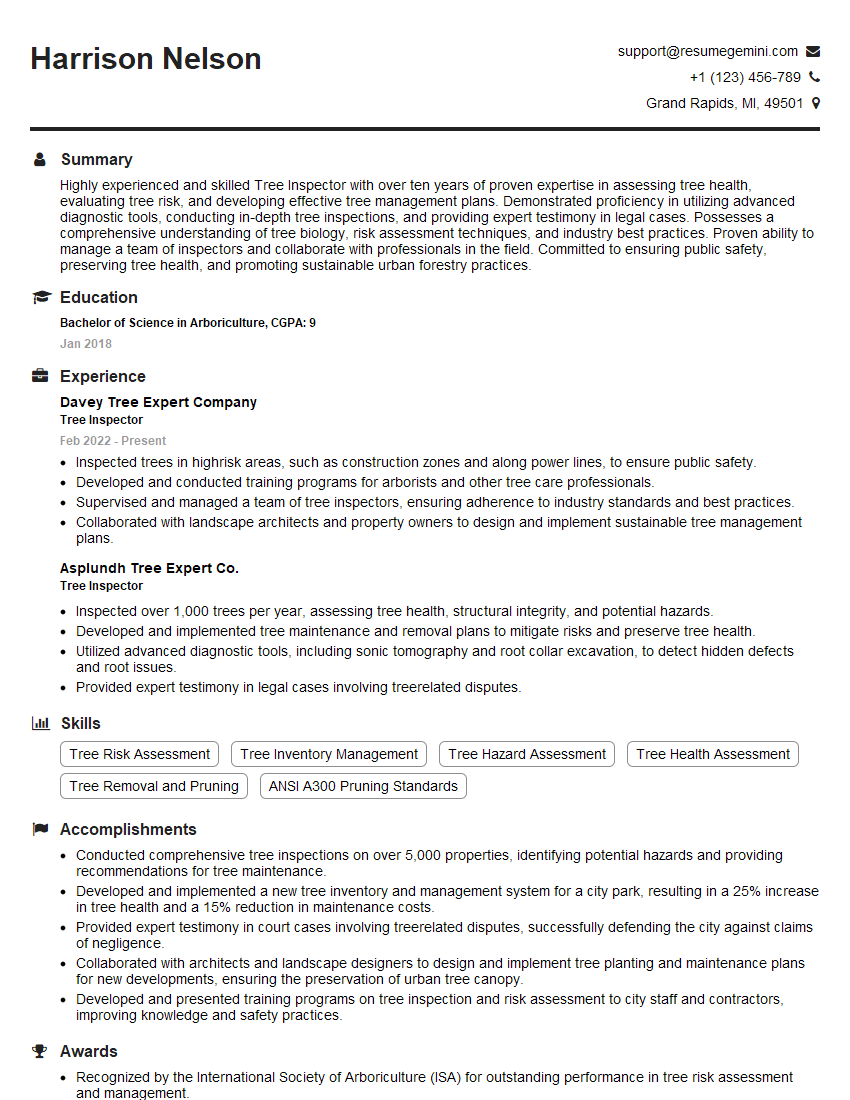
Mastering Tree Hazard Assessment opens doors to rewarding careers in arboriculture, forestry, and related fields, offering opportunities for professional growth and specialization. A strong resume is crucial for showcasing your skills and experience to potential employers. To significantly increase your chances of landing your dream job, focus on creating an ATS-friendly resume that highlights your qualifications effectively. ResumeGemini is a trusted resource to help you build a professional and impactful resume. We provide examples of resumes tailored to Tree Hazard Assessment to guide you in crafting your own compelling application. Take the next step towards your career success today!


Explore more articles
Users Rating of Our Blogs
Share Your Experience
We value your feedback! Please rate our content and share your thoughts (optional).
What Readers Say About Our Blog
Really detailed insights and content, thank you for writing this detailed article.
IT gave me an insight and words to use and be able to think of examples