Every successful interview starts with knowing what to expect. In this blog, we’ll take you through the top Understanding of Comic Book Production interview questions, breaking them down with expert tips to help you deliver impactful answers. Step into your next interview fully prepared and ready to succeed.
Questions Asked in Understanding of Comic Book Production Interview
Q 1. Describe the process of creating a comic book, from initial concept to final printing.
Creating a comic book is a collaborative process spanning several stages. It begins with the initial concept, where the writer develops the story, characters, and plot. This often involves outlining, scripting, and potentially creating a detailed storyboard. Next comes the artist’s phase, where pencils and inks bring the story to life on the page. This may involve multiple iterations and revisions with the writer. Then, the artwork is colored digitally or traditionally, often using specialized software. Lettering is added next, incorporating dialogue, sound effects, and captions. Once the pages are complete, they are assembled into a final layout, taking into account page turns and overall flow. Finally, the completed comic is sent to a printer, who handles the color separation, printing, and binding processes.
Imagine it like baking a cake: the concept is the recipe, pencils are the initial cake shape, inks are the frosting outline, coloring is the frosting itself, lettering is the decorations, and assembly is putting it all together on the plate. The printer is the one who bakes it and presents the final product.
Q 2. What are the different roles involved in comic book production, and how do they interact?
Comic book production involves a diverse team. The writer creates the story and script. The penciller creates the initial artwork, establishing the characters and scenes. The inker adds details, line weight, and texture to the pencils. The colorist applies color digitally or traditionally, enhancing the mood and atmosphere. The letterer adds dialogue, sound effects, and captions to the pages. The editor oversees the entire process, ensuring quality and consistency. A designer often handles the final page layout and design elements, including the cover. Finally, a production manager coordinates the various steps and communicates with the printer.
These roles interact constantly through feedback and revisions. For example, the writer may collaborate with the penciller to ensure the visual representation aligns with the story. The colorist might consult with the editor to maintain color consistency across the series. It’s a highly collaborative process where each role contributes to the final product.
Q 3. Explain the difference between CMYK and RGB color modes in comic book printing.
CMYK (Cyan, Magenta, Yellow, Key [Black]) is the subtractive color model used in printing. It works by layering colored inks on paper to create a final image. The more ink that is layered, the darker the color becomes. RGB (Red, Green, Blue) is the additive color model used in digital displays. It uses light to create colors; mixing all three colors produces white. Because of this fundamental difference, an image made for a screen (RGB) will look different when printed using CMYK. CMYK typically results in slightly duller and less vibrant colors compared to RGB, as it’s inherently limited by the ink used.
Think of it like painting: RGB is like mixing light, while CMYK is like mixing paints. RGB can produce vibrant colors, while CMYK requires careful color adjustments to achieve similar results.
Q 4. What file formats are commonly used in comic book production?
Several file formats are used in comic book production. PDF (Portable Document Format) is commonly used for final layouts and printing due to its high quality and compatibility. TIFF (Tagged Image File Format) is often used for high-resolution artwork, particularly scanned art. JPEG (Joint Photographic Experts Group) is suitable for lower-resolution images and web use, but it’s generally avoided for final art due to compression artifacts. PSD (Photoshop Document) is widely used among artists for manipulating and storing layered artwork. The choice of format often depends on the specific stage of production and the software being used.
For instance, artists might work in PSD for flexibility and layering, then export as a TIFF for the colorist, who might then assemble the pages into a PDF for printing.
Q 5. How do you ensure color consistency across a comic book series?
Maintaining color consistency across a comic book series requires careful planning and execution. Using a consistent color palette throughout the series is crucial. Color profiles should be defined and maintained across all files and stages of production. Working with a single colorist throughout the series is often recommended. Colorists can use color swatches and reference images to maintain consistency from issue to issue. During the editing phase, the editor should carefully review the colors to identify inconsistencies and ensure that the overall aesthetic is unified.
A good analogy is like a painter who uses the same paint brand and mixes from a specific color chart for each piece in a series. Consistency makes the final product appear much more professional and well-made.
Q 6. What are some common challenges faced during comic book production, and how can they be overcome?
Common challenges in comic book production include meeting deadlines, which can be especially difficult when collaborating with multiple artists and writers. Maintaining artistic consistency throughout the series, especially when multiple artists work on a single comic or series, is another challenge. Budget limitations can force compromises on art quality or printing methods. Communication problems between the creative team members can lead to inconsistencies and delays. Finally, unforeseen technical issues, like software crashes or corrupted files, can significantly disrupt the workflow.
These challenges can be overcome through careful project planning, clear communication between team members, establishing realistic deadlines, utilizing robust backup systems, and selecting reliable collaborators.
Q 7. Discuss your experience with different printing methods for comic books.
My experience includes working with both offset printing, which is suitable for large print runs and offers high-quality results, and digital printing, which is more cost-effective for smaller runs and allows for faster turnaround times. Offset printing provides greater color accuracy and consistency, especially important for maintaining consistent color across a series. However, it’s generally more expensive for smaller runs. Digital printing is a better choice for independent publishers or short-run projects, although the print quality can vary depending on the printer and equipment.
Choosing the right method often involves balancing cost, print quality, and the number of copies being printed. For example, a major publisher producing thousands of copies of a popular title would use offset printing, while an independent creator might opt for digital printing for their initial run of a smaller project.
Q 8. How do you manage deadlines and maintain quality in a fast-paced comic book production environment?
Managing deadlines and quality in comic book production requires a meticulous approach. It’s akin to orchestrating a complex symphony – each instrument (artist, writer, letterer, etc.) needs to play their part in perfect harmony and on time. My strategy involves several key steps:
- Detailed Scheduling: I use project management software to break down the entire process into smaller, manageable tasks with clearly defined deadlines for each stage – from scripting and penciling to inking, coloring, lettering, and final proofing. This allows for better tracking and identification of potential delays.
- Regular Communication: Open and frequent communication with the entire team is crucial. Daily check-ins (or more frequent, if needed) ensure everyone is on track and any roadblocks are addressed promptly. This proactive approach prevents minor issues from snowballing into major delays.
- Contingency Planning: Unexpected issues always arise. Having a buffer built into the schedule and identifying alternative solutions beforehand is key. This might involve assigning tasks to backup artists or adjusting the scope of the project slightly if absolutely necessary.
- Quality Control Checks: Regular quality control checks at each stage are vital. This involves peer reviews, self-review, and finally, a thorough final review before sending to print. Catching errors early saves time and significantly improves the final product’s quality.
For example, on a recent project, we faced a delay with the inker. By proactively communicating and reassigning a portion of the inking workload to another artist, we managed to stay on schedule without compromising quality.
Q 9. Describe your experience with digital inking and coloring techniques.
I’m highly proficient in digital inking and coloring, using industry-standard software. My workflow typically involves:
- Inking: I use software like Clip Studio Paint and Adobe Photoshop to create clean, consistent line art. I often experiment with different brush styles to achieve the desired look and feel, whether it’s a sharp, crisp style or a more organic, hand-drawn look. I pay close attention to detail, ensuring line weights are consistent and the art is clear and easily readable.
- Coloring: I use digital painting techniques to add color and depth. This involves selecting a color palette that matches the tone and style of the comic, utilizing layers effectively to manage complexity, and experimenting with different blending modes to create interesting effects. I’m comfortable working with both flat colors and more complex shading techniques.
For instance, in one project requiring a gritty, realistic style, I used a combination of custom brushes and layer masks in Photoshop to achieve a textured, detailed look for both the inking and coloring. In another project with a more stylized aesthetic, I utilized Clip Studio Paint’s built-in features to achieve consistent color flats and gradients for a more vibrant look.
Q 10. Explain your understanding of bleed and trim marks in comic book design.
Understanding bleed and trim marks is fundamental in comic book design. Think of it like baking a cake – you need to account for the pan’s size (trim) and the cake’s potential rise (bleed).
- Bleed: This refers to the area of the artwork that extends beyond the final trim size of the page. It’s crucial because it ensures that there’s no white space along the edges after trimming. Typically, a bleed of 1/8 inch (or 3mm) is used.
- Trim Marks: These are the lines that indicate where the printer should cut the paper to achieve the final page size. They act as guides ensuring consistent dimensions across all pages.
Failure to account for bleed can result in unsightly white borders around the edges of your comic book pages after printing. Likewise, incorrect trim marks can cause pages to be cut inaccurately, ruining the intended layout.
Imagine designing a cover with a character extending to the edge. Without bleed, that character’s hand or foot might be chopped off during the trimming process. Trim marks provide the printer with the precise location to make the cut, ensuring a clean final product.
Q 11. How do you handle revisions and feedback from editors or clients?
Handling revisions and feedback is a collaborative process. It’s not about ego; it’s about crafting the best possible comic. My approach is:
- Active Listening: I carefully consider all feedback, regardless of the source. I try to understand the reasoning behind the suggestions, even if I don’t initially agree.
- Organized Revisions: I track all revisions using a version control system or a clearly labeled file system. This ensures I can easily revert to previous versions if needed.
- Clear Communication: I communicate clearly with editors and clients, asking clarifying questions if something is unclear. I explain my rationale when making changes or offering alternatives.
- Iteration: I understand that revisions are a natural part of the creative process. I embrace them as opportunities to improve the comic, even if it means more work.
For example, if an editor suggests a change to a character’s design, I’ll create several sketches showcasing different options and discuss the pros and cons of each with the editor before implementing the final revision.
Q 12. What software are you proficient in for comic book creation and production?
My proficiency extends across several software applications essential for comic book creation and production:
- Clip Studio Paint: A powerful tool for sketching, inking, coloring, and lettering. Its extensive brush libraries and layer functionality make it ideal for both traditional and digital workflows.
- Adobe Photoshop: Primarily used for image manipulation, color correction, and advanced digital painting techniques, particularly for complex shading and texturing. It offers a broad range of tools and functionalities.
- Adobe Illustrator: Excellent for creating clean vector art, especially for logo design, lettering, and precise line work.
- InDesign: My go-to for page layout and assembly, ensuring a professional and consistent look across the entire comic book.
Q 13. How familiar are you with copyright and licensing issues in the comic book industry?
I have a solid understanding of copyright and licensing in the comic book industry. It’s a complex legal landscape, and ignorance is not an excuse. My knowledge covers:
- Copyright Ownership: I understand the principles of copyright, including the automatic protection afforded to original works and the implications for creators and publishers.
- Character and IP Rights: I’m aware of the necessity to obtain proper licenses when using existing characters or intellectual property. Unauthorized use can result in severe legal consequences.
- Work-for-Hire Agreements: I’m familiar with the implications of work-for-hire agreements, which define ownership of the created work. This is crucial to understanding who owns the rights to the art and the characters created within the comic.
- Fair Use Doctrine: I have a working understanding of the fair use doctrine, allowing limited use of copyrighted material for commentary, criticism, education, etc., although the specifics are complex and require case-by-case analysis.
Before taking on any project involving pre-existing characters or settings, I always ensure the client has the necessary rights to prevent legal issues. I always try to work with legal counsel if there are any gray areas, ensuring all bases are covered.
Q 14. Explain your understanding of different paper stocks and their suitability for comic books.
Different paper stocks significantly impact the final look and feel of a comic book. Choosing the right stock is essential for both aesthetic and practical reasons. Key considerations include:
- Weight (GSM): Grams per square meter (GSM) determines the thickness and weight of the paper. Heavier stock (e.g., 100gsm and above) is more durable and less prone to showing through, ideal for higher-quality comics. Lighter weight paper (e.g., 80gsm) is often used to keep printing costs down, but may show through more prominently, affecting readability.
- Brightness: Measured in CIE brightness, this determines how much light the paper reflects. Higher brightness is preferable for crisper images and brighter colors.
- Finish: Different finishes affect the visual appeal and print quality. Glossy finishes provide vibrant colors and a shiny appearance, while matte finishes produce a softer, less reflective image.
- Type: Common types include newsprint (cheap, low quality, prone to yellowing), offset paper (good all-around choice), and coated paper (best for high-quality printing).
For example, a high-end graphic novel might use a thicker coated paper stock for its durability and vibrant color reproduction, while a more economical comic might opt for a lighter offset paper to manage costs. The choice depends on budget, desired quality, and the overall aesthetic of the comic.
Q 15. Discuss your experience with panel layout and storytelling techniques in sequential art.
Panel layout is the backbone of comic book storytelling. It’s how we guide the reader’s eye and control the pacing of the narrative. Think of each panel as a single shot in a film, and the layout as the overall cinematography. I employ a variety of techniques depending on the story’s needs. For instance, a series of small panels might build suspense, while a large, splash page can emphasize a dramatic moment.
I frequently use techniques like the gutter (the space between panels) to suggest the passage of time or a shift in action. The size and shape of the panels also play a crucial role. A tall, narrow panel might convey a sense of claustrophobia, while a wide, panoramic panel evokes vastness. I’ve found that experimenting with different layouts, like using varied panel shapes or breaking free from a traditional grid, can really enhance the storytelling and keep readers engaged. For example, in one project, I used a sequence of increasingly smaller panels to visually represent a character’s dwindling hope.
Understanding perspective and visual storytelling is essential. I use techniques like leading lines, focal points, and rule of thirds to direct the reader’s gaze and enhance visual impact. Ultimately, the goal is to create a seamless flow that translates the story’s rhythm and emotion effectively through the visual presentation.
Career Expert Tips:
- Ace those interviews! Prepare effectively by reviewing the Top 50 Most Common Interview Questions on ResumeGemini.
- Navigate your job search with confidence! Explore a wide range of Career Tips on ResumeGemini. Learn about common challenges and recommendations to overcome them.
- Craft the perfect resume! Master the Art of Resume Writing with ResumeGemini’s guide. Showcase your unique qualifications and achievements effectively.
- Don’t miss out on holiday savings! Build your dream resume with ResumeGemini’s ATS optimized templates.
Q 16. How do you ensure the readability and clarity of text in comic books?
Readability and clarity of text are paramount. Inconsistent fonts or overly small text can break immersion instantly. I use a clear, easily readable font like Arial or Times New Roman, always ensuring sufficient contrast against the background. The font size is crucial; it needs to be large enough for comfortable reading, but not so large that it overwhelms the artwork.
I meticulously check the kerning (spacing between letters) and leading (spacing between lines) to avoid cramped text blocks. Word balloons should be strategically placed to avoid obstructing important artwork, and I often use different balloon shapes and tails to differentiate between characters’ speech. I also carefully choose the font weight and style to suit the tone of the dialogue. For instance, a bold font might denote shouting or emphasis. For the visually impaired, ensuring appropriate colour contrast between text and background is crucial and often a requirement for accessibility.
Q 17. What are your strategies for maintaining consistency in art style throughout a comic book?
Maintaining artistic consistency is challenging, especially in long-form comics or those with multiple artists. I achieve this through meticulous planning and detailed style guides. Before starting a project, I collaborate with the art team to create a comprehensive style guide that establishes character designs, environment details, and specific artistic elements. This guide includes color palettes, line weights, and detailed examples.
Regular check-ins and feedback sessions throughout the production process are vital. I regularly review the artwork to ensure it adheres to the established style. Digital tools offer a significant advantage; I use color palettes and brush settings, which are saved and shared with the team to maintain uniformity. This collaborative approach allows for corrections and adjustments early in the process, saving time and resources later. Digital painting software also lets me create master brushes and textures to make consistency easier.
Q 18. Describe your experience with working with different printing presses and their limitations.
My experience with different printing presses has been invaluable. Each press has its limitations and nuances. Offset printing, for instance, excels in high-volume printing with superb color reproduction, but it’s more expensive for smaller runs. Digital printing is quicker and more cost-effective for shorter runs, but might have limitations in color accuracy compared to offset.
Understanding color profiles and CMYK color space is vital. Preparing artwork for different presses necessitates careful color management to ensure that the printed result aligns with the digital artwork. I have encountered issues with halftones and screen ruling on older presses, requiring adjustments in the pre-press stage. I’ve learned to work with various paper types and their impact on the final appearance, for example, the absorbency of the paper affecting ink vibrancy. Knowing these limitations and planning accordingly is crucial for a successful print.
Q 19. How do you manage the workflow and communication between different members of the production team?
Efficient workflow and seamless communication are critical. I typically use project management software like Asana or Trello to track progress, assign tasks, and manage deadlines. Regular meetings—both in-person and online—keep everyone informed and on track.
Clear communication channels are essential, ensuring that everyone knows their roles and responsibilities. We use a combination of email, instant messaging, and video conferencing to facilitate quick and easy communication. I always prioritize establishing a collaborative environment where team members feel comfortable raising concerns or requesting clarifications. Version control systems are also integral to prevent conflicts and ensure everyone works on the most up-to-date versions of the files.
Q 20. How familiar are you with industry-standard file transfer protocols?
I am very familiar with industry-standard file transfer protocols such as FTP (File Transfer Protocol), SFTP (Secure File Transfer Protocol), and cloud-based services like Dropbox, Google Drive, and WeTransfer.
Security is a major concern, so I prioritize SFTP for transferring sensitive files. Cloud-based services offer convenience for sharing smaller files and collaborating on projects, but security settings need careful consideration. Understanding the limitations and benefits of each protocol allows me to choose the most appropriate method for any given situation, ensuring both security and efficiency.
Q 21. Explain your understanding of the pre-press process for comic book printing.
The pre-press process is crucial for ensuring a high-quality final product. It involves several stages that prepare the artwork for printing. The process typically begins with preparing high-resolution files, ensuring color accuracy, and checking for any errors.
Next is trapping and imposition. Trapping involves adding extra color to the edges of artwork elements to prevent small gaps from appearing between colors during printing. Imposition is the arrangement of pages to optimize the printing process. Then, color separations are created; this breaks down the artwork’s colors into CMYK (Cyan, Magenta, Yellow, and Key/Black) components for the printing presses. Finally, a proof is created, either a digital soft proof or a physical hard proof, for final approval before sending the files to the printer. Thorough pre-press preparation is vital to avoid costly reprints and delays.
Q 22. Discuss your experience with color separation techniques.
Color separation is a crucial step in comic book production, transforming a full-color artwork into individual plates for printing – typically cyan, magenta, yellow, and black (CMYK). Historically, this involved painstaking manual techniques, but today it’s largely automated using digital tools. My experience spans both traditional methods and current digital workflows.
In the past, I worked with film-based separation, meticulously crafting masks and overlays to isolate color channels. This required a keen eye for detail and a deep understanding of color theory to ensure accurate reproduction. I’ve also extensively used digital color separation software like Photoshop and Illustrator, utilizing features like spot color channels, and the crucial conversion from RGB to CMYK ensuring proper color management across different printing processes.
For example, working on a project featuring a character with vibrant red hair, I’d ensure the red was accurately separated into its CMYK components for crisp, rich reproduction. Mismanaging this step can lead to muddy colors or unexpected shifts in hue during printing.
Q 23. How do you identify and address potential printing problems before they occur?
Identifying potential printing problems before they occur involves a multi-stage process that begins even before the artwork is finalized. It’s proactive, not reactive.
- Pre-press checks: This includes rigorous review of the digital files for resolution, color accuracy (checking for out-of-gamut colors that might print incorrectly), and the presence of any errors such as missing or misplaced elements.
- Proofing: Soft proofs (digital previews) are essential, allowing for quick adjustments. I always recommend generating multiple proofs, such as a CMYK proof to simulate the final printed result, and also a grayscale proof for checking contrast and tonal balance.
- Color calibration: Ensuring all software and hardware used throughout the process are properly calibrated is paramount. Color discrepancies between the artist’s screen and the printer can result in significant errors.
- Communication with the printer: Open communication with the printing company is vital. Sharing the color profiles used and providing them with detailed instructions ensures consistency and reduces unexpected outcomes.
For instance, I once caught a bleed issue (where color extends beyond the trim edge) during pre-press review. A quick correction in the artwork prevented a costly reprint.
Q 24. Describe your approach to quality control in comic book production.
My approach to quality control is systematic and multifaceted, spanning the entire production lifecycle. It begins with establishing clear guidelines and expectations at the outset, working closely with the artist and editor to ensure a shared vision for the final product. I then integrate quality control checkpoints throughout the workflow.
- Artwork review: Thorough assessment of the line art, colors, and lettering to identify and correct any errors or inconsistencies.
- File preparation checks: Verification of file formats, resolutions, color spaces, and bleed settings before sending the files to the printer.
- Proofing and color management: Careful examination of both soft proofs and physical proofs to ensure accuracy in color, registration, and overall print quality.
- Post-print review: Checking the final printed copies for any discrepancies from the proofs, such as color shifts, misalignment, or printing defects.
My approach is to treat each stage as a crucial step towards ensuring a high-quality, consistent, and visually appealing final product.
Q 25. What are some industry trends you are aware of in comic book production?
The comic book industry is constantly evolving, and I’m keenly aware of several key trends:
- Digital First: Many publishers are now releasing comics digitally before print, allowing for earlier reader feedback and better data-driven decisions.
- Independent Creators and Self-Publishing: The rise of digital printing and online platforms has empowered independent creators, fostering greater diversity in storytelling and art styles.
- Hybrid Print/Digital Models: Combining print editions with interactive digital versions enriched with extra content is gaining traction.
- Emphasis on Sustainability: Publishers are increasingly looking for eco-friendly printing options, using recycled paper and sustainable inks.
- Growing use of AI in creation: While not replacing artistic skills, AI is being integrated in areas like inking, coloring assistance, and even script generation.
Q 26. How do you stay up-to-date with the latest technologies and software in comic book production?
Staying current in this fast-paced industry requires ongoing learning and exploration. I actively participate in:
- Industry Conferences and Workshops: Attending events like Comic-Con and industry-specific workshops allows me to network and learn about the latest technologies and best practices.
- Online Courses and Tutorials: Platforms like Skillshare and Udemy offer excellent courses on digital art, color management, and printing technologies.
- Professional Organizations: Membership in relevant professional organizations provides access to resources, publications, and networking opportunities.
- Following Industry Blogs and Publications: I consistently monitor industry blogs, magazines, and websites to stay informed about emerging trends and new software releases.
- Experimentation with new software: I dedicate time to exploring new software and technologies directly to evaluate their potential for improving efficiency and quality.
Q 27. Explain your experience with different types of binding for comic books.
My experience encompasses various comic book binding methods, each with its pros and cons:
- Saddle Stitch: This is the most common method for shorter comics, involving folding pages and securing them with staples down the spine. It’s cost-effective but less durable for thicker books.
- Perfect Binding: The pages are glued together along the spine, then covered with a paper cover. This produces a more durable and professional look, suitable for longer comics or graphic novels.
- Case Binding: The most robust method used for high-quality books, involving stitching pages together into sections, adding a cover board, and then attaching the cover. It’s the most expensive option but offers the greatest durability.
The choice of binding depends greatly on factors such as the comic’s page count, budget, and desired aesthetic. For example, I’d recommend saddle stitch for a 24-page anthology, but perfect binding for a 100-page graphic novel, and case binding for a large-format prestige edition.
Q 28. What are your salary expectations for this position?
My salary expectations are commensurate with my experience and expertise in comic book production, and the specific requirements of this role. Given my background and skillset, I am targeting a salary range of [Insert Salary Range Here]. However, I’m open to discussing this further based on the complete compensation package and the specifics of the position.
Key Topics to Learn for Understanding of Comic Book Production Interview
- Scriptwriting and Storytelling: Understanding narrative structure, pacing, character development, and dialogue in the context of comic book storytelling. Consider how different panel layouts and gutters impact the narrative flow.
- Layout and Design: Practical application of page layouts, panel arrangements, and gutter usage to enhance readability and visual storytelling. Be prepared to discuss the impact of different art styles on the overall narrative.
- Art and Illustration: Familiarity with various art styles and techniques used in comic book production. Discuss the process of character design, environment creation, and the use of visual metaphors.
- Lettering and Typography: Understanding the role of lettering in enhancing readability and visual appeal. Explore different font choices and their impact on the overall tone and mood.
- Coloring and Inking: Knowledge of different coloring techniques (digital and traditional) and inking styles. Discuss how color choices and inking styles contribute to the overall aesthetic and narrative.
- Production Workflow: Understanding the entire production pipeline, from script to print, including collaboration with writers, artists, letterers, and colorists. Be prepared to discuss potential challenges and problem-solving strategies at each stage.
- Software Proficiency: Demonstrate familiarity with industry-standard software used in comic book creation, such as Adobe Photoshop, Illustrator, and Clip Studio Paint. Discuss your experience with digital workflows and traditional methods.
- Industry Trends and Conventions: Stay up-to-date on current trends and conventions in the comic book industry. Be prepared to discuss your understanding of different genres and their visual characteristics.
Next Steps
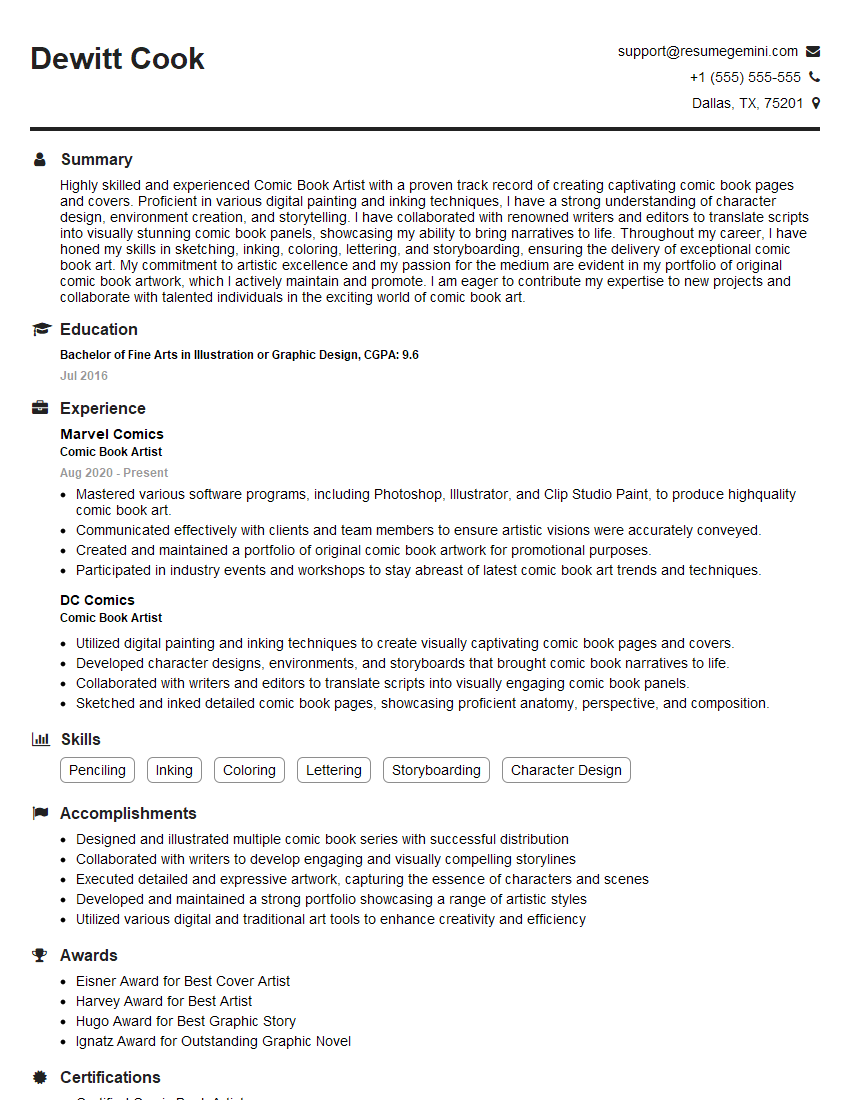
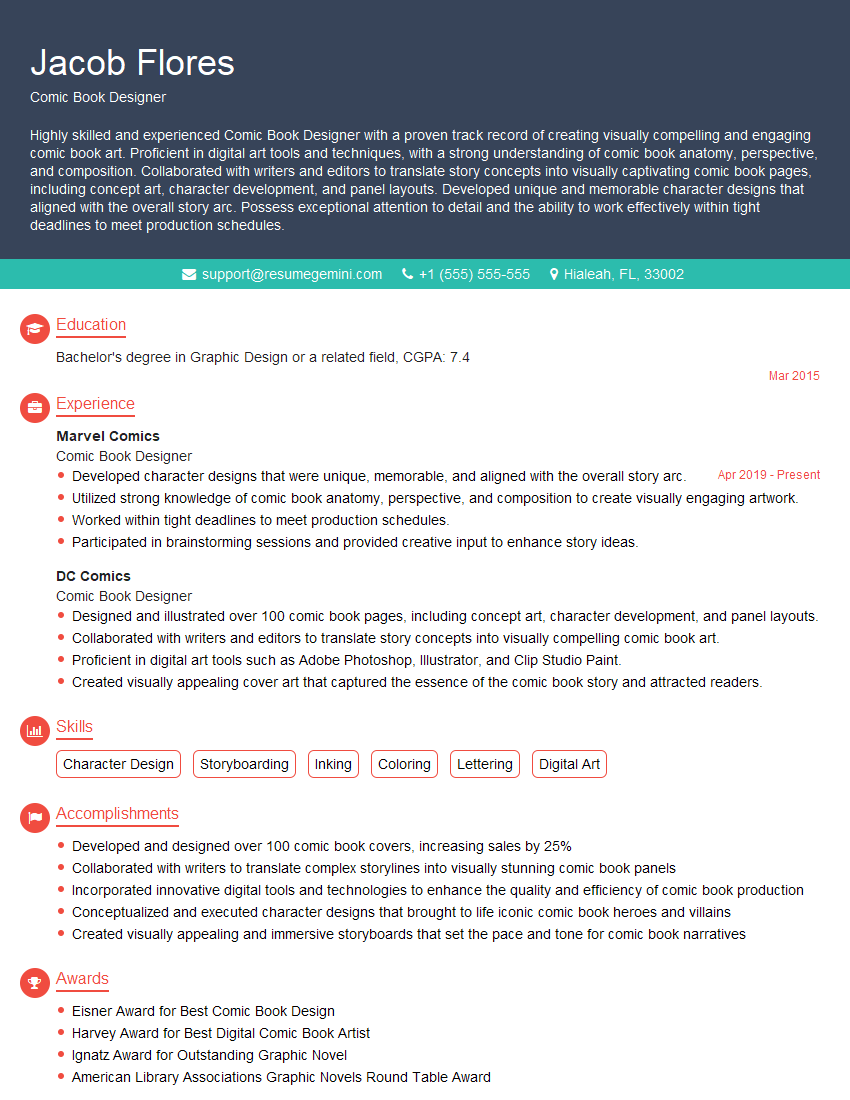
Mastering the intricacies of comic book production significantly enhances your career prospects in this dynamic industry. A strong understanding of these key areas will not only impress potential employers but also allow you to contribute effectively to creative teams. To maximize your job search success, create an ATS-friendly resume that showcases your skills and experience effectively. We highly recommend using ResumeGemini, a trusted resource, to build a professional and impactful resume. ResumeGemini provides examples of resumes tailored to Understanding of Comic Book Production to help guide you.
Explore more articles
Users Rating of Our Blogs
Share Your Experience
We value your feedback! Please rate our content and share your thoughts (optional).
What Readers Say About Our Blog
Really detailed insights and content, thank you for writing this detailed article.
IT gave me an insight and words to use and be able to think of examples