Cracking a skill-specific interview, like one for Storyboarding for Comics, requires understanding the nuances of the role. In this blog, we present the questions you’re most likely to encounter, along with insights into how to answer them effectively. Let’s ensure you’re ready to make a strong impression.
Questions Asked in Storyboarding for Comics Interview
Q 1. Explain your process for translating a script or narrative into a storyboard.
My process for translating a script into a storyboard is a multi-stage approach focusing on visual clarity and narrative flow. First, I thoroughly read and reread the script, identifying key plot points, character interactions, and emotional beats. Then, I create a scene breakdown, outlining each scene with a brief description and noting important actions and dialogue. This allows me to visualize the sequence of events. Next, I start thumbnailing – creating quick, rough sketches to plan panel layouts, character positions, and camera angles. This iterative process involves experimentation; I might try several layouts for a single scene to find the most impactful visual representation. Finally, I refine my thumbnails into polished storyboards, paying close attention to details like character expressions, background elements, and overall composition. Think of it like creating a visual roadmap for the comic, ensuring every panel contributes to the narrative.
For example, a scene with a tense conversation might require close-ups to highlight facial expressions, while an action scene might benefit from wider shots to showcase the scope and movement. The constant interplay between narrative and visual storytelling is key.
Q 2. Describe your experience with different storyboard software (e.g., Storyboard Pro, Toon Boom Harmony).
I’m proficient in both Storyboard Pro and Toon Boom Harmony, each offering distinct advantages. Storyboard Pro excels in its intuitive interface, especially for creating traditional comic-style storyboards. Its features for panel layouts, camera movement, and character animation are excellent for visualizing the dynamic aspects of a comic. I find its ease of use particularly beneficial in quickly iterating through different layout options and making revisions. Toon Boom Harmony, on the other hand, is a more powerful tool with advanced animation capabilities. While it has a steeper learning curve, its strength lies in its potential to create highly detailed storyboards, including sophisticated animation and special effects, if required for the project. I choose the software based on the project’s specific needs and complexity. For a simpler comic, Storyboard Pro’s efficiency is ideal; for complex narratives with extensive visual effects, Toon Boom Harmony’s capabilities are invaluable.
Q 3. How do you manage revisions and feedback on your storyboards?
Managing revisions and feedback is crucial in storyboard creation. My process involves clear communication and iterative revisions. After completing a draft, I present it to the client or team, using cloud-based collaboration tools to facilitate easy sharing and annotation. I usually provide annotated PDFs for direct feedback on specific panels. The feedback is meticulously categorized and addressed systematically, prioritizing essential changes before tackling minor adjustments. I then create a revised version incorporating the feedback, presenting the updated storyboard for another round of review until we reach a final approved version. I maintain detailed records of all revisions, preserving transparency and accountability throughout the process. This iterative approach ensures the final storyboard perfectly aligns with the creative vision.
Q 4. How do you incorporate panel layout and pacing to enhance the narrative?
Panel layout and pacing are essential for controlling the reader’s experience. The size and shape of panels, their arrangement on the page, and the amount of space between them all affect the rhythm and speed of the narrative. Large panels can emphasize important moments, creating a sense of drama, whereas smaller panels can convey rapid action or fleeting thoughts. For instance, a series of small panels might depict a quick chase scene, while a single large panel could highlight an emotional climax. The use of gutters (the spaces between panels) is also crucial; wider gutters can slow down the pace, allowing the reader to absorb information, while narrow gutters create a faster, more frenetic pace. I experiment with different layouts, experimenting to find what best serves the story’s emotional arc and pacing needs. Think of it as composing a musical score, using visual elements to control the tempo and rhythm of the narrative.
Q 5. Explain your understanding of visual storytelling techniques in comics.
Visual storytelling in comics goes beyond simply illustrating the script. It’s about using visuals to communicate emotions, convey subtext, and enhance the narrative’s impact. This includes utilizing techniques like: Composition (using rule of thirds, leading lines, etc. to guide the eye), Character design (communicating personality through visual features), Color palettes (evoking specific moods or emotions), Perspective (establishing scale and spatial relationships), and Symbolism (using visual metaphors to represent abstract concepts). For example, a dark, shadowy setting might indicate danger or mystery, while bright, vibrant colors could represent joy or hope. Mastering these techniques allows me to translate the nuances of the script into a compelling visual experience, enriching the story beyond what words alone could achieve.
Q 6. How do you balance artistic style with the needs of the narrative?
Balancing artistic style with narrative needs is a delicate but essential aspect of comic storyboarding. The chosen style should complement and enhance the story, not detract from it. If the story is gritty and realistic, a detailed, realistic style would be appropriate. Conversely, a whimsical or fantastical story might be better suited to a more cartoonish or stylized approach. I strive to create a visual style that supports the tone and atmosphere of the story. This often involves a collaborative process, working closely with the writer and other creative team members to ensure consistency and effectiveness. For example, if the narrative calls for a sense of unease, I might use darker colors, sharper lines, and more unsettling composition to reflect that tone. The visual style is a tool to serve the narrative, not a separate entity.
Q 7. Describe your experience with different comic book styles (e.g., Manga, Western, Superhero).
I have experience with various comic book styles, including Manga, Western comics, and Superhero comics. Each style has its unique conventions and characteristics. Manga, for example, often features dynamic action sequences, expressive character designs, and specific visual tropes. Western comics frequently emphasize realism, detailed backgrounds, and a more nuanced use of perspective. Superhero comics might incorporate exaggerated proportions, dynamic action poses, and bold, vibrant colors. My approach involves adapting my style to suit the specific genre, while still maintaining a consistent visual vocabulary throughout the project. Understanding the visual language of each style enables me to create storyboards that accurately represent and resonate with the target audience, staying true to genre expectations while pushing creative boundaries.
Q 8. How do you handle complex action sequences in your storyboards?
Handling complex action sequences in storyboarding requires a meticulous approach. Think of it like directing a movie scene – you need to break down the action into smaller, manageable beats. Instead of showing everything at once, I use a combination of techniques:
- Panel Breakdown: I start by dividing the action into individual panels, focusing on key poses and movements. Each panel becomes a snapshot, capturing a crucial moment in the sequence. For example, a character leaping across a chasm might be broken into panels showing: the character’s initial jump, mid-air, approaching the other side, and finally landing safely (or not!).
- Motion Lines and Speed Lines: These visual cues are invaluable for conveying speed and momentum. A flurry of speed lines radiating from a speeding car instantly communicates its velocity. Similarly, carefully placed motion lines show the trajectory of a flying object or a character’s movement.
- Camera Angles and Perspectives: Experimenting with different camera angles helps to enhance the dynamism of the action. A low angle can emphasize a character’s power, while a high angle can show vulnerability. Changing the perspective throughout the sequence keeps the viewer engaged and helps emphasize the progression of the action.
- Staging and Blocking: Careful placement of characters and objects within each panel (staging) and the characters’ positions relative to each other (blocking) ensures the action is clear and understandable. I make sure to clearly show where each character is in relation to each other, and how they move in the scene.
By meticulously planning each panel and utilizing these visual tools, I ensure complex action sequences are clear, engaging, and easy to follow for the artist.
Q 9. How do you create effective character expressions and body language in your panels?
Creating effective character expressions and body language relies on understanding the fundamentals of visual storytelling. I approach it like a sculptor, working with shapes and lines to convey emotion. Here are some key strategies:
- Facial Features: Subtle shifts in eyebrows, eyes, and mouth can drastically alter a character’s expression. For example, slightly raised eyebrows can suggest surprise, while downturned eyes can convey sadness.
- Body Posture: A slumped posture might indicate defeat or sadness, while a straight back suggests confidence. Consider the character’s overall stance and how it reflects their emotional state.
- Gestures: Hand gestures, like a clenched fist or an open palm, can amplify the emotion expressed by the face. A pointing finger might indicate anger or accusation.
- Reference: I often use photographs and videos as references to study human anatomy and expressions. This helps me ensure the expressions are believable and enhance the storytelling.
Essentially, I strive to use the character’s entire body to tell a story. The goal is to make the emotions instantly understandable without relying on excessive dialogue.
Q 10. How do you communicate your storyboards effectively to other team members?
Effective communication is crucial in a collaborative environment. To ensure my storyboards are clear to other team members, I use a multi-faceted approach:
- Clear and Concise Panels: Each panel should convey a distinct moment or piece of information. Avoid overcrowding panels with too much detail; less is often more.
- Annotations and Notes: I add annotations to each panel to clarify character actions, expressions, camera angles, and any special effects required. This leaves no room for interpretation and avoids potential misunderstandings.
- Style Guide Consistency: I maintain a consistent style across the boards, making sure that my character designs, environment details and overall visual language are consistent throughout the project.
- Regular Feedback Sessions: I actively seek feedback from the team, explaining my creative choices and addressing any concerns or questions.
- Digital Tools: Utilizing digital storyboarding software allows for easy sharing, revision, and collaboration with the team. We can leave comments directly on the panels, enabling efficient feedback loops and clarification.
Open communication and a focus on clarity are key to successful collaboration.
Q 11. Describe your process for creating thumbnails and rough layouts.
My process for creating thumbnails and rough layouts involves a series of iterative steps. It’s like sketching out a blueprint before building a house:
- Thumbnails: I start with very small, quick sketches—thumbnails—that capture the essence of each scene or panel. These aren’t detailed; they’re more about composition, flow, and pacing. I might do several versions of a page layout before deciding on the most effective one.
- Rough Layout: Once I have a satisfying thumbnail layout, I expand those sketches into rougher layouts. These layouts are larger, provide more details, and begin to block out the major elements of each panel, including character positions, camera angles, and important elements in the background. This is where I define the panel-to-panel pacing.
- Iteration and Refinement: I constantly revisit and revise my layouts, refining the composition and pacing until I feel the storytelling is as effective as possible. This process often involves multiple revisions and feedback.
- Panel Descriptions: I add brief written descriptions to the layouts, detailing key actions, dialogue, and any important details to guide the artists.
The goal is to create a visual roadmap that’s comprehensive enough for the artists to follow yet flexible enough to allow for creative interpretation.
Q 12. How do you maintain consistency in character design and setting across a series of panels?
Maintaining consistency is paramount in comic book storyboarding. Inconsistent character designs and settings can break the reader’s immersion and create a sense of unprofessionalism. I employ several strategies to ensure visual consistency:
- Character Model Sheets: Creating detailed model sheets for each character is essential. These sheets include multiple views (front, side, back), key expressions, and specific details about clothing and accessories. This serves as a visual bible for the artists.
- Setting Reference Images: Similarly, maintaining reference images of key locations and environments helps maintain consistency. I might even create miniature 3D models of complex settings to provide better clarity and reference.
- Color Palette Reference: This is crucial for maintaining the mood and feel of the comic. A consistent color palette is key to establishing the environment and tone across the series.
- Digital Assets: Using a digital format to create the storyboards makes it easier to maintain consistent color palettes, character designs, and overall style. Digital storyboarding software typically allows for the import and use of existing assets, such as model sheets, color palettes and background elements.
Consistency is not about rigidity. There’s room for subtle variations to add interest, but those variations should be intentional and serve the story.
Q 13. How do you incorporate sound effects and dialogue effectively in your storyboards?
Incorporating sound effects and dialogue effectively enhances the storytelling and adds to the overall experience. I use several approaches:
- Dialogue Placement: I carefully consider the placement of dialogue balloons to avoid overcrowding the panels and ensure readability. I aim for natural speech patterns within the scene and try to prevent overlapping dialogue boxes.
- Sound Effect Integration: Sound effects are represented visually, using words or stylized graphics that evoke the sound (e.g., “BAM!,” “WHOOSH,” “CLANG”). Their placement within the panel should reflect the sound’s origin and intensity.
- Visual Cues: Sometimes, visual cues alone can suggest sounds. For example, a depiction of broken glass might implicitly convey the sound of shattering. I think of the visual representation of sounds as an extension of the visual storytelling.
- Balance: A balance between dialogue, sound effects, and visual narrative is essential. Overusing any one element can clutter the panel and detract from the story.
The goal is to create a harmonious blend of visual and auditory storytelling, where the elements work together to create a rich and immersive experience for the reader.
Q 14. Describe your experience with color scripting or color palettes for comics.
Color scripting, or the creation of a color palette for comics, significantly impacts the mood, atmosphere, and overall visual appeal. My experience involves:
- Mood and Atmosphere: I carefully select colors based on the desired mood for each scene. Warm colors (reds, oranges, yellows) can suggest warmth, energy, or danger, while cool colors (blues, greens, purples) can create a sense of calm, mystery, or sadness. Consider the symbolism of colors as well.
- Character Associations: Color can also be used to associate specific characters with certain colors, reinforcing their personality or role in the story.
- Color Studies: Creating small color studies for key scenes helps me visualize how the color palette will affect the overall feel. This allows me to experiment with different combinations and refine my choices.
- Color Scripting Tools: I often use digital tools to create a color script, which serves as a guide for the colorist. This detailed document includes indications for color gradients, shading, lighting, and saturation for each panel.
- Collaboration with Colorist: Color scripting is a collaborative process. I work closely with the colorist to ensure the final results align with my vision while also leveraging their expertise.
A well-executed color script enhances the visual storytelling and elevates the comic to a new level of artistic expression.
Q 15. How do you adapt your storyboarding style to different genres?
Adapting my storyboarding style to different genres is crucial for effectively conveying the tone and atmosphere of each story. Think of it like choosing the right brush for painting – a delicate watercolor for a romance, bold oil paints for a gritty action story. For example, a horror comic might utilize dark shadows, extreme angles, and unsettling compositions to create suspense, whereas a lighthearted slice-of-life comic would employ brighter palettes, dynamic but less extreme angles, and simpler panel layouts. I adjust panel composition, character design, visual language (e.g., line weight, color palettes), and even the pacing to match the genre’s conventions and emotional impact. A superhero comic might necessitate large, dynamic panels showing epic battles, while a psychological thriller might focus on close-ups and claustrophobic settings to build tension.
Career Expert Tips:
- Ace those interviews! Prepare effectively by reviewing the Top 50 Most Common Interview Questions on ResumeGemini.
- Navigate your job search with confidence! Explore a wide range of Career Tips on ResumeGemini. Learn about common challenges and recommendations to overcome them.
- Craft the perfect resume! Master the Art of Resume Writing with ResumeGemini’s guide. Showcase your unique qualifications and achievements effectively.
- Don’t miss out on holiday savings! Build your dream resume with ResumeGemini’s ATS optimized templates.
Q 16. How do you approach storyboarding for different page sizes and formats?
Storyboarding for different page sizes and formats requires careful consideration of layout and panel design. A smaller format, like a webcomic, necessitates simpler layouts and potentially fewer panels per page to maintain readability. Larger formats, like graphic novels, allow for more elaborate spreads and larger panels, creating opportunities for dramatic visual storytelling. I always start by understanding the final output dimensions and then plan my panel arrangements accordingly. For instance, a standard comic book page might benefit from a grid layout, while a panoramic landscape might call for a single, wide panel. I also adjust the amount of detail in my panels based on the final print resolution and page size. A high-resolution print allows for much finer detail than a smaller digital format.
Q 17. What are some common challenges you face in storyboarding, and how do you overcome them?
One common challenge is balancing visual storytelling with the script’s pacing. Sometimes a scene rich in dialogue needs to be visually engaging without becoming overly cluttered. I overcome this by using visual cues like character expressions, subtle background changes, and creative panel arrangements to convey the emotional rhythm of the scene, even with minimal action. Another challenge is maintaining consistency in character design and visual style across the entire comic. I address this by creating detailed character models and a style guide early in the process, using these as references throughout the storyboarding phase. Finally, unexpected changes in the script can disrupt the flow. My solution is to maintain flexibility, build in buffer time, and communicate regularly with the writer to quickly adapt to any adjustments.
Q 18. How do you use perspective and camera angles to enhance the visual narrative?
Perspective and camera angles are fundamental tools for enhancing narrative. Think of it as directing a movie – a high angle shot can make a character seem vulnerable, while a low angle shot can make them appear powerful. I use wide shots to establish location and context, close-ups to emphasize emotions, and point-of-view shots to place the reader directly into the character’s experience. For example, a low-angle shot during a confrontation scene can heighten the tension and portray the character as dominant, whereas a high-angle shot depicting the same scene might emphasize the character’s vulnerability. Dutch angles (tilted camera perspectives) can convey unease or disorientation. Careful manipulation of these techniques adds depth and sophistication to the visual narrative.
Q 19. Describe your workflow from initial script review to final storyboard.
My workflow begins with a thorough script review. I meticulously analyze the script, noting key plot points, character interactions, and emotional beats. Then, I create a basic thumbnail sketch of each page, focusing on composition and panel arrangement. This initial phase is all about visual planning and blocking out the story’s overall flow. Next, I refine these thumbnails into more detailed pencil sketches, adding character poses, expressions, and background elements. Finally, I ink and color the storyboards, ensuring visual consistency and clarity. Throughout the entire process, I maintain close communication with the writer and art director to ensure alignment and address any revisions. Digital tools greatly assist in this process, allowing for easy revisions and sharing of the storyboard with the team.
Q 20. How do you manage your time effectively when working on a tight deadline?
Managing time effectively under pressure involves meticulous planning and prioritization. I always break down the project into manageable chunks, creating a detailed schedule with deadlines for each stage. This involves time-blocking, prioritizing key scenes, and identifying potential bottlenecks early on. I also leverage efficient workflow techniques, like using digital tools for quick revisions and utilizing templates to streamline repetitive tasks. Communication is also key – proactively informing the team of any potential delays and seeking support when needed. Finally, I build in buffer time to account for unexpected issues or delays. This proactive approach allows me to maintain quality while working within tight deadlines.
Q 21. How familiar are you with industry standard file formats for storyboards?
I am highly familiar with industry-standard file formats for storyboards. This includes common image formats such as JPEG, PNG, and TIFF for high-resolution images and PDFs for presenting the entire storyboard in a cohesive document. I’m also comfortable working with various digital drawing and painting software, exporting files in formats that are easily integrated into production pipelines. Understanding these file types ensures smooth collaboration with artists, editors, and other members of the production team. I can also adapt to specific client requests regarding file formats and resolution requirements.
Q 22. How do you ensure your storyboards are clear and easy to understand for animators or other collaborators?
Clarity is paramount in storyboarding. Animators and collaborators need to instantly grasp the narrative and action. I achieve this through several key strategies:
- Concise Panels: Each panel focuses on a single, impactful moment. I avoid cluttering panels with unnecessary detail. Think of it like writing a screenplay – each panel is a micro-scene.
- Clear Action Lines and Staging: I use clear action lines to indicate movement and character positions. Staging ensures the focal point is unambiguous. For example, a character’s expression or a crucial object will be clearly emphasized.
- Descriptive Captions: While visuals should tell the majority of the story, concise captions provide essential context – dialogue, sound effects, or internal thoughts. These are kept brief and impactful.
- Consistent Style: Maintaining a consistent visual style throughout the storyboard makes it easier to follow the narrative flow. This involves consistent character design, panel layouts, and visual language.
- Annotations: I add notes directly to the storyboard – camera angles, shot types (close-up, long shot, etc.), and important details that might be missed visually.
For example, if I’m storyboarding a fight scene, I’ll use distinct action lines to show the characters’ movements, clearly indicate the impact of blows, and use annotations to specify camera angles and the type of sound effects needed.
Q 23. Describe your experience with creating storyboards for different target audiences.
My experience spans various target audiences, requiring adaptation of style and complexity. For children’s comics, I use simpler layouts, bolder lines, expressive characters, and avoid complex visual metaphors. The narrative is straightforward and focuses on clear actions. Conversely, for mature audiences or graphic novels, I can incorporate more nuanced visuals, complex compositions, and subtle symbolism to enhance the thematic depth. I’ve worked on projects targeting young adults which fell somewhere in between, requiring a balance of visual appeal and narrative sophistication.
For instance, a storyboard for a children’s book about a friendly monster might have large, colourful panels with simple character designs and exaggerated expressions, whereas a graphic novel focusing on a dystopian future would utilize darker tones, more intricate backgrounds, and symbolic imagery to reflect the narrative’s themes of oppression and despair.
Q 24. How do you incorporate symbolism and visual metaphors effectively in your work?
Symbolism and visual metaphors enrich storytelling, adding layers of meaning beyond the literal. I integrate them thoughtfully by:
- Choosing Relevant Symbols: The chosen symbols should directly relate to the narrative’s themes or character arcs. For example, a wilting flower might symbolize fading hope, or a caged bird might represent oppression.
- Subtle Integration: I avoid making the symbolism overly obvious; it should enhance the story without disrupting the flow. A subtle use of color, lighting, or object placement can effectively convey deeper meaning.
- Consistent Application: The symbolism should be consistently used throughout the story to avoid confusion. Repeating a symbol reinforces its meaning and strengthens its impact.
- Contextual Clues: While aiming for subtlety, I provide contextual clues to guide the audience towards understanding the intended meaning. This can be done through character reactions or dialogue.
For example, in a story about overcoming grief, I might repeatedly show a single, bright red poppy amidst a field of wilted flowers, subtly suggesting the persistence of hope even amidst sorrow.
Q 25. What are your preferred methods for presenting your storyboards to clients or directors?
Presentation is key to effective communication. I typically use a combination of methods:
- Digital Presentation: I create a high-resolution digital presentation using software like PowerPoint or Keynote. This allows for easy navigation through the storyboard, showcasing the complete flow of the narrative. I might include voiceovers to add emphasis.
- Physical Storyboard: Depending on the client’s preference, I might also present a physical storyboard printed on boards or individual pages. This allows for a more tactile experience.
- Annotated PDF: I often deliver a high-resolution annotated PDF that includes all the storyboard panels along with notes, revisions, and any necessary technical specifications.
- Walkthrough: I usually lead a walkthrough presentation, explaining the creative choices and addressing any questions or concerns that the client might have.
The goal is to create a clear, visually appealing presentation that facilitates a smooth and collaborative discussion, enabling effective feedback.
Q 26. Explain your understanding of the role of the storyboard in the overall comic production pipeline.
The storyboard is the cornerstone of the comic production pipeline, functioning as a visual blueprint that guides the entire process. It bridges the gap between the initial script and the final product, serving several crucial functions:
- Visualizing the Narrative: It translates the written script into a visual sequence, allowing everyone involved to understand the pacing, shot composition, and overall flow of the story.
- Pre-visualization: Storyboards enable pre-visualization of the final product, allowing for early identification and resolution of potential problems.
- Collaboration and Communication: It serves as a common visual language for collaboration between writers, artists, animators, editors, and directors.
- Planning and Budgeting: The storyboard helps in planning the production schedule, estimating time and resources, and developing the budget.
- Maintaining Consistency: It ensures consistency in the visual style, character design, and overall aesthetic of the comic.
Without a well-defined storyboard, the comic production process would be chaotic and inefficient, leading to potential inconsistencies and delays.
Q 27. Describe a time you had to make significant revisions to your storyboard based on feedback.
During a project involving a historical fantasy setting, my initial storyboard emphasized sweeping landscape shots to showcase the environment. Feedback from the director indicated these shots lacked character focus and slowed the pacing. It was a valuable lesson!
The revision process involved several steps:
- Understanding the Feedback: I carefully reviewed the director’s comments, focusing on the specific concerns regarding pacing and character focus.
- Reworking the Shots: I replaced many of the wide shots with closer shots that highlighted character interactions and emotions. I also adjusted the panel sequencing to create a faster pace.
- Iterative Refinement: I presented revised sections of the storyboard to the director, receiving further feedback and iteratively refining the visuals until the pacing and character focus were appropriately balanced.
- Balancing Aesthetics and Narrative: I found a balance between the visual appeal of the setting and the need to keep the narrative moving forward, resulting in a stronger and more effective storyboard.
This experience reinforced the importance of iterative feedback and the flexibility to adapt and improve one’s work based on constructive criticism.
Q 28. How do you stay current with the latest trends and techniques in comic book storytelling?
Staying current is crucial in the dynamic world of comics. I employ several strategies:
- Reading Comics and Graphic Novels: I actively read a wide range of comics, paying attention to various styles, narrative techniques, and visual storytelling approaches.
- Following Industry Blogs and Publications: I regularly follow industry-specific blogs, online publications, and social media accounts that provide insights into the latest trends and innovations.
- Attending Workshops and Conferences: Participating in workshops, conferences, and online courses helps me learn from other professionals, network, and discover new techniques.
- Experimenting with New Software and Techniques: I actively experiment with new software and digital art tools to enhance my skills and expand my creative toolkit.
- Analyzing Successful Works: I analyze the storyboards and visual styles of successful comics to understand what makes them effective and identify techniques that I can incorporate into my work.
This continuous learning process allows me to refine my skills, stay abreast of emerging trends, and consistently deliver high-quality and engaging storyboards.
Key Topics to Learn for Storyboarding for Comics Interview
- Narrative Structure & Pacing: Understanding how to effectively tell a story visually, controlling the rhythm and flow of the narrative through panel composition and sequencing.
- Character Design & Expression: Developing clear and consistent character designs that effectively convey emotion and personality through posture, facial expressions, and body language within the storyboard panels.
- Panel Composition & Layout: Mastering techniques like the rule of thirds, leading lines, and visual weight distribution to create dynamic and engaging page layouts. Understanding different panel shapes and sizes and their impact on storytelling.
- Camera Angles & Perspectives: Utilizing different camera angles (high, low, over-the-shoulder, etc.) to influence the reader’s emotional response and perspective on the scene.
- Dialogue & Action Integration: Skillfully integrating dialogue and action within the panels to maintain a balance and clarity, ensuring the narrative flows smoothly.
- Style & Genre Conventions: Demonstrating a familiarity with various comic book styles and genre conventions, adapting your storyboarding approach accordingly (e.g., superhero, horror, slice-of-life).
- Software Proficiency: Showcase your skills with industry-standard storyboarding software (mention specific software you are proficient in). Demonstrate your ability to work efficiently and effectively within the chosen program.
- Collaboration & Communication: Highlight your ability to effectively communicate your ideas and collaborate with writers, editors, and artists. Discuss strategies for feedback incorporation and iteration.
- Problem-Solving & Adaptability: Discuss how you approach challenges in storyboarding, such as resolving inconsistencies in the narrative or adapting to changes in the creative direction. Be prepared to discuss creative problem-solving scenarios.
Next Steps
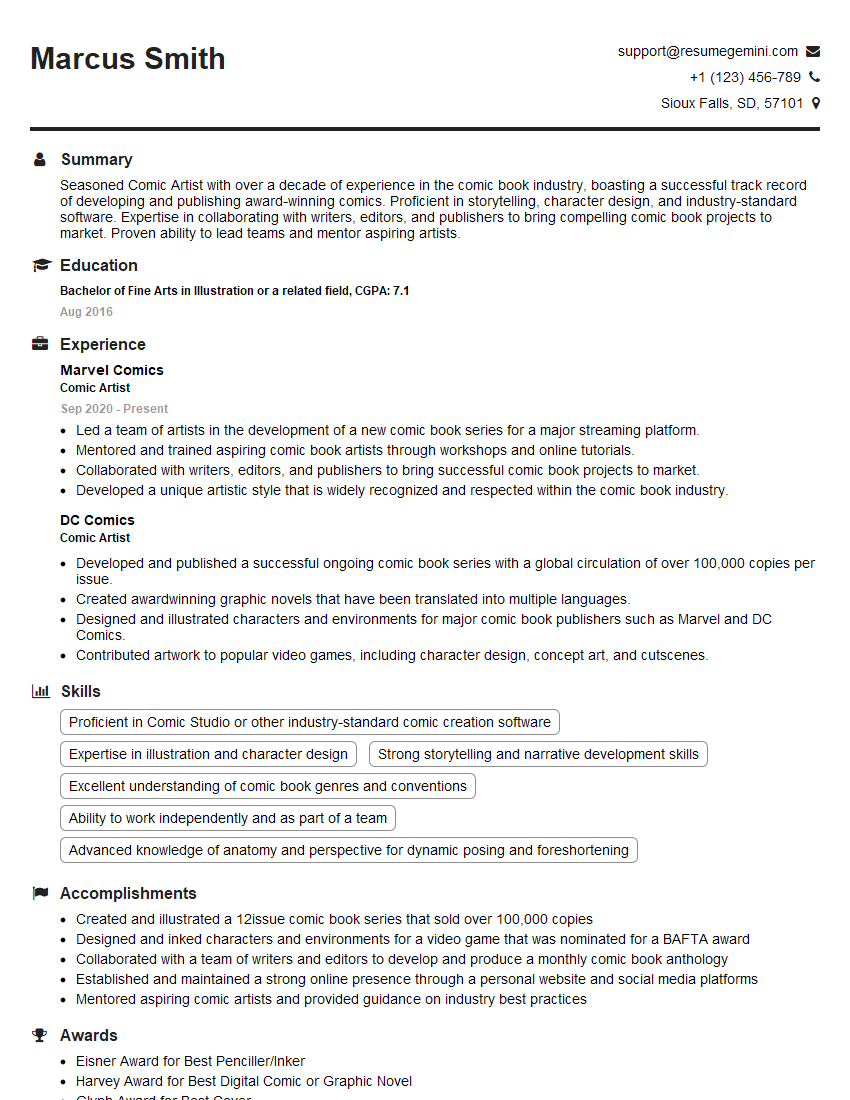
Mastering storyboarding for comics significantly enhances your career prospects in the vibrant world of visual storytelling. It opens doors to various roles, from freelance artist to in-house storyboard artist, offering creative freedom and professional growth. To significantly boost your chances, create a strong, ATS-friendly resume that highlights your skills and experience effectively. ResumeGemini is a trusted resource to help you build a professional resume that stands out. We provide examples of resumes tailored to Storyboarding for Comics to help you create a compelling application.
Explore more articles
Users Rating of Our Blogs
Share Your Experience
We value your feedback! Please rate our content and share your thoughts (optional).
What Readers Say About Our Blog
Really detailed insights and content, thank you for writing this detailed article.
IT gave me an insight and words to use and be able to think of examples