The thought of an interview can be nerve-wracking, but the right preparation can make all the difference. Explore this comprehensive guide to Acoustic Immittance interview questions and gain the confidence you need to showcase your abilities and secure the role.
Questions Asked in Acoustic Immittance Interview
Q 1. Explain the principle of acoustic immittance.
Acoustic immittance measures how easily sound energy can pass through the middle ear. Instead of directly measuring sound transmission, it measures the impedance (resistance to energy flow) or its reciprocal, admittance (ease of energy flow). Think of it like this: imagine trying to push a ball through a pipe. High impedance would be a very narrow, clogged pipe; low impedance would be a wide, open pipe. Acoustic immittance assesses the middle ear’s ‘pipe’ – how effectively sound travels from the eardrum to the inner ear.
This is crucial because middle ear problems, such as fluid buildup or ossicular chain disruptions, significantly affect this energy flow. By measuring immittance, we can indirectly assess the health and functionality of the middle ear system.
Q 2. Describe the different types of immittance measurements.
Acoustic immittance encompasses several measurements, primarily:
- Tympanometry: Measures middle ear pressure and compliance (how easily the eardrum moves).
- Static Acoustic Compliance: Measures the compliance of the middle ear system at a single, typically 200 Hz, frequency. This is often part of the tympanometry procedure.
- Acoustic Reflex Thresholds (ART): Measure the lowest intensity sound that elicits a contraction of the middle ear muscles, reflecting the integrity of the reflex pathway.
These measurements are all interconnected. For instance, abnormal tympanometry often leads to an investigation of acoustic reflexes to pinpoint the cause of the middle ear dysfunction.
Q 3. What is tympanometry and how is it performed?
Tympanometry is a crucial test that assesses the function of the middle ear. It measures the mobility of the eardrum (tympanic membrane) and the middle ear system in response to varying air pressure. The procedure is straightforward and non-invasive.
A small probe is placed gently in the ear canal. This probe delivers sound and measures changes in compliance (movement of the eardrum) across a range of air pressures. The instrument creates a graph called a tympanogram, which displays pressure versus compliance.
The procedure is typically quick, painless, and well-tolerated by patients of all ages, from infants to adults.
Q 4. Interpret a tympanogram: Type A, As, Ad, B, and C.
Tympanograms are categorized into different types, each representing a specific middle ear condition:
- Type A: Normal. Shows a peak compliance at or near atmospheric pressure, indicating a healthy middle ear. The eardrum moves normally in response to pressure changes.
- Type As: Shallow. Peak compliance is present but lower than normal, suggesting stiffness of the middle ear system. This might be due to otosclerosis (bony growth on the ossicles) or tympanosclerosis (scarring of the eardrum).
- Type Ad: Deep. Peak compliance is higher than normal, indicative of a hypermobile eardrum (excessive movement), often seen in cases of ossicular discontinuity or a flaccid eardrum.
- Type B: Flat. No peak is visible, indicating that the middle ear is filled with fluid or another significant obstruction. This commonly occurs with otitis media (middle ear infection).
- Type C: Negative pressure. Peak compliance is present but at a negative pressure, suggesting Eustachian tube dysfunction (the tube connecting the middle ear to the nasopharynx is blocked or not functioning correctly).
Each type provides a clue to the underlying condition. It is important to remember that tympanometry alone is not diagnostic and should be interpreted in conjunction with other clinical findings.
Q 5. Explain the significance of the peak pressure in tympanometry.
The peak pressure in a tympanogram represents the point of maximum eardrum mobility, which is usually at or near atmospheric pressure (0 daPa). The significance lies in its deviation from this normal value. A negative peak pressure indicates negative middle ear pressure, often a sign of Eustachian tube dysfunction. This is because a blocked or poorly functioning Eustachian tube cannot equalize middle ear pressure with atmospheric pressure, leading to a vacuum effect.
Conversely, a positive peak pressure may suggest middle ear effusion (fluid buildup), although this is less common than negative pressure. The peak pressure therefore provides valuable insight into the status of the Eustachian tube and overall middle ear pressure equilibrium.
Q 6. What are acoustic reflexes and how are they measured?
Acoustic reflexes are involuntary contractions of the middle ear muscles (tensor tympani and stapedius) in response to intense sounds. These contractions stiffen the ossicular chain, reducing sound transmission to the inner ear. This protective mechanism prevents damage to the delicate inner ear structures from loud noises.
Acoustic reflex thresholds (ARTs) are measured using an immittance instrument. A tone is presented to the ear, and the instrument monitors changes in middle ear impedance. As the intensity of the tone increases, a point is reached where the muscles contract, causing a measurable change in impedance. This intensity level is the ART. The presence and thresholds of acoustic reflexes are important indicators of the integrity of the auditory pathway.
Q 7. Describe the different components of the acoustic reflex pathway.
The acoustic reflex pathway is a complex neural circuit involving several components:
- Inner hair cells of the cochlea: These cells initially transduce the acoustic energy into neural signals.
- Cochlear nerve: These signals travel along the cochlear nerve.
- Cochlear nucleus: The nerve fibers synapse in the cochlear nucleus in the brainstem.
- Superior olivary complex: Signals are further processed in the superior olivary complex, which is crucial for bilateral reflex pathways.
- Facial nerve: The signals are then transmitted via the facial nerve.
- Stapedius muscle: The facial nerve stimulates the stapedius muscle, causing it to contract. The tensor tympani is often involved but is less easily measured clinically.
Damage at any point along this pathway can affect the acoustic reflex, making its measurement a powerful tool in localizing the site of a hearing problem. For example, an absent reflex could indicate a problem with the inner ear, nerve, brainstem, or facial nerve.
Q 8. Interpret acoustic reflex results: present, absent, elevated threshold.
Acoustic reflexes are involuntary contractions of the middle ear muscles in response to loud sounds. Interpreting the results involves assessing the presence or absence of the reflex, and if present, the intensity level (threshold) at which it occurs.
- Present: This indicates normal function of the middle ear muscles and pathways. The stapedius muscle contracts, reducing the sound’s transmission to the inner ear. This is a positive finding and suggests no significant pathology in the middle ear or brainstem pathway.
- Absent: An absent reflex suggests a problem somewhere along the pathway. This could be due to middle ear disease (e.g., otitis media, ossicular discontinuity), a lesion involving the facial nerve (which innervates the stapedius muscle), or a brainstem lesion.
- Elevated Threshold: This signifies that a louder-than-normal sound is required to elicit the reflex. This can be indicative of middle ear pathology (like otosclerosis, which stiffens the ossicles), or a milder involvement of the auditory pathway compared to an absent reflex. The degree of elevation helps pinpoint the severity.
Think of it like this: your knee-jerk reflex. If it’s present, your nervous system is working as expected. If absent or sluggish, there might be a neurological issue. Similarly, the acoustic reflex gives us a window into the integrity of the auditory pathway.
Q 9. What are the clinical applications of tympanometry?
Tympanometry measures the middle ear’s pressure and compliance (how easily it moves). This helps diagnose conditions affecting the middle ear space.
- Identifying Middle Ear Effusions: Tympanometry is excellent at detecting fluid in the middle ear (otitis media with effusion), showing a characteristic flat or B-type curve. This is because fluid reduces the mobility of the tympanic membrane.
- Assessing Eustachian Tube Function: By measuring middle ear pressure, we assess the Eustachian tube’s ability to equalize pressure between the middle ear and the atmosphere. Repeated tests can track changes in function over time.
- Detecting Tympanic Membrane Perforations: A perforated eardrum usually results in a type ‘C’ curve with very high compliance. This is because there is no longer a sealed system in the middle ear.
- Monitoring Middle Ear Status after Surgery: Tympanometry is crucial for post-surgical monitoring following procedures like myringotomy (incision of the eardrum to drain fluid) or tympanoplasty (middle ear reconstructive surgery). It tracks healing and the restoration of normal middle ear function.
- Differentiating Types of Hearing Loss: While not definitive on its own, tympanometry helps distinguish conductive hearing loss (problems in the outer or middle ear) from sensorineural hearing loss (problems in the inner ear or auditory nerve).
Imagine the middle ear as a balloon. Tympanometry tells us if the balloon is inflated correctly, if there’s a leak, or if it’s filled with something other than air.
Q 10. What are the clinical applications of acoustic reflex testing?
Acoustic reflex testing assesses the integrity of the auditory pathway from the cochlea to the brainstem. It’s a valuable tool in diagnosing various conditions.
- Identifying Brainstem Lesions: Absent or abnormal reflexes can indicate lesions along the brainstem auditory pathways, often associated with conditions like multiple sclerosis or acoustic neuroma.
- Differentiating Conductive and Sensorineural Hearing Loss: While it doesn’t provide the complete picture, acoustic reflexes can help differentiate between the two. A conductive hearing loss usually causes an absent reflex, whereas a sensorineural loss might result in a normal or elevated threshold.
- Assessing the Function of the Facial Nerve: Since the stapedius muscle is innervated by the facial nerve, an absent reflex may suggest facial nerve damage.
- Monitoring the Progress of Middle Ear Disease: Tracking the presence or threshold of the reflex can assess the effectiveness of treatment for middle ear conditions.
- Detecting Pseudohypoacusis (malingering): In some cases, individuals may feign hearing loss. Normal acoustic reflexes in such cases can help detect this.
This test acts like an electrical circuit test for your hearing system, identifying disruptions along the auditory pathway.
Q 11. How do you interpret combined tympanometry and acoustic reflex results?
Combining tympanometry and acoustic reflex testing provides a more comprehensive evaluation of the middle ear and auditory system. They complement each other, offering a more detailed picture than either test alone.
For example, a Type B tympanogram (flat curve) indicating middle ear effusion combined with an absent ipsilateral acoustic reflex strongly suggests the presence of fluid in the middle ear. Conversely, a normal tympanogram with an absent reflex might point towards a neurological issue rather than a middle ear problem.
The interpretation involves a careful assessment of both results and their correlation. A systematic approach helps in arriving at a diagnosis. This approach involves considering various scenarios based on the type of tympanogram, the presence or absence of the acoustic reflexes, and the patient’s clinical presentation.
Q 12. What are the limitations of acoustic immittance testing?
Acoustic immittance testing, while valuable, has limitations:
- Patient Cooperation: Young children or individuals with cognitive impairments may find it difficult to remain still and compliant during testing, affecting the accuracy of the results.
- Cerumen (Earwax): Excessive earwax can obstruct sound transmission and compromise test results, requiring removal before testing.
- Collapsing Ear Canals: Narrow or collapsible ear canals may lead to inaccurate measurements, particularly during tympanometry. These conditions affect the seal of the probe tip.
- Otitis Externa (Outer Ear Infection): Inflammation or infection in the outer ear canal can interfere with test performance.
- Limited Specificity: While immittance measures provide strong clues, they are not always definitive in pinpointing specific pathologies. Further tests may be necessary for confirmation.
Think of it like trying to examine a complex machine with limited tools. While these tools provide valuable information, they can’t reveal every detail.
Q 13. How do middle ear pathologies affect tympanometry results?
Middle ear pathologies significantly alter tympanometry results. The type of curve obtained reflects the condition’s nature and severity.
- Otitis Media with Effusion (OME): Characterized by fluid in the middle ear, resulting in a flat tympanogram (Type B). The compliance is reduced because the fluid restricts the movement of the tympanic membrane.
- Eustachian Tube Dysfunction: Leads to negative middle ear pressure, often showing a Type C tympanogram (low pressure). This is because the Eustachian tube is unable to equalize the pressure in the middle ear with atmospheric pressure.
- Otosclerosis: A disease causing abnormal bone growth in the middle ear, stiffening the ossicular chain and reducing compliance. This often results in a Type As tympanogram (reduced compliance).
- Ossicular Discontinuity: A break in the ossicular chain results in abnormally high compliance, often manifesting as a Type Ad tympanogram (increased compliance). This indicates a lack of the normal impedance of the middle ear chain.
- Tympanic Membrane Perforation: A hole in the eardrum leads to a Type C tympanogram showing very high compliance or even an inability to obtain a measurable curve because the probe cannot get a good seal. This is because the middle ear is no longer a closed system.
The changes in tympanometry reflect the physical alterations in the middle ear’s structure and function caused by these pathologies.
Q 14. How do different types of hearing loss affect immittance results?
Different types of hearing loss manifest differently in immittance results:
- Conductive Hearing Loss: This type, stemming from problems in the outer or middle ear, typically presents with abnormal tympanometry (e.g., Type B, C, or As) and an absent or elevated threshold acoustic reflex. The middle ear isn’t conducting sound properly.
- Sensorineural Hearing Loss: Originating in the inner ear or auditory nerve, this type often shows normal tympanometry but may exhibit normal or elevated acoustic reflex thresholds (depending on the degree and location of the damage). The problem isn’t in the transmission, but the reception and processing of the sound in the inner ear or brain.
- Mixed Hearing Loss: A combination of conductive and sensorineural loss. This shows a mixture of the features of both types; the tympanogram may be abnormal, and the reflex may be absent or elevated, reflecting a problem in both the sound conduction mechanism and inner ear/nerve transduction.
Therefore, integrating immittance findings with other audiological measures provides a complete picture of the hearing status and helps differentiate among various types of hearing loss.
Q 15. What are the normal values for tympanometric parameters in adults and children?
Normal tympanometric values vary slightly depending on the specific instrument used and the age of the patient. However, we generally look for specific patterns. For adults, we expect a peak pressure (static compliance) within the range of -100 to +100 daPa (decaPascals), indicating normal middle ear pressure. The peak admittance (compliance) usually falls between 0.3 and 1.7 cubic centimeters (cc). Equivalent ear volume (EeV) typically measures between 0.6 and 2.0 cc, reflecting the volume of the external ear canal. In children, the values shift somewhat. The peak pressure remains similar, but the compliance tends to be higher, reflecting the smaller and more compliant middle ear structures in younger patients. The equivalent ear volume will also generally be smaller in children. Precise ranges for children vary with age, making age-specific normative data essential for interpretation.
Example: A 30-year-old adult with a tympanogram showing a peak pressure of 50 daPa, peak admittance of 0.9 cc, and equivalent ear volume of 1.2 cc would be considered to have normal middle ear function. A 2-year-old child’s values might show higher compliance and a smaller EeV, still falling within normal ranges for that age group. It is crucial to always consult age-appropriate normative data when interpreting results.
Career Expert Tips:
- Ace those interviews! Prepare effectively by reviewing the Top 50 Most Common Interview Questions on ResumeGemini.
- Navigate your job search with confidence! Explore a wide range of Career Tips on ResumeGemini. Learn about common challenges and recommendations to overcome them.
- Craft the perfect resume! Master the Art of Resume Writing with ResumeGemini’s guide. Showcase your unique qualifications and achievements effectively.
- Don’t miss out on holiday savings! Build your dream resume with ResumeGemini’s ATS optimized templates.
Q 16. Discuss the equipment used in acoustic immittance testing.
Acoustic immittance testing utilizes specialized equipment called an impedance bridge or immittance meter. These devices are sophisticated instruments capable of delivering precisely controlled sound stimuli to the ear and measuring the resulting impedance and admittance. Key components include:
- Sound source: Generates pure-tone signals, typically at 226 Hz, though some may offer different frequencies.
- Probe: A small probe tip containing a miniature loudspeaker (for sound delivery) and a microphone (for measuring sound reflections). It’s usually placed snugly in the ear canal.
- Air pressure pump: Allows for the controlled variation of air pressure within the ear canal, crucial for obtaining tympanometric measurements.
- Processing unit: Processes the signals, calculates the impedance/admittance, and displays the results graphically (tympanogram) and numerically.
- Computer and software: Modern instruments often integrate with computers for data storage, analysis, and report generation. They often allow for automatic interpretation features, but should not replace the clinician’s expertise.
The design ensures precise control and measurement of the acoustic signals, enabling accurate assessment of middle ear function.
Q 17. Explain the procedure for performing immittance testing on a patient.
Immittance testing is a relatively straightforward procedure. First, the patient’s history is reviewed. Then, a visual inspection of the external ear canal is performed to ensure there’s no visible obstruction like cerumen (earwax) that could affect the test. Next, the probe tip is gently inserted into the ear canal, taking care to avoid discomfort. The instrument then automatically changes the air pressure within the ear canal while measuring sound reflections. This process generates a tympanogram, a graph depicting the relationship between air pressure and middle ear admittance. Along with the tympanogram, other measures such as static compliance and equivalent ear volume are obtained. Finally, acoustic reflexes are often tested by presenting a loud sound to one ear and observing the changes in immittance in the other ear. The whole procedure takes only a few minutes per ear.
Example: Before beginning, it’s crucial to ensure the probe is clean and a proper seal is achieved in the ear canal. Slight adjustments to probe position may be necessary for optimal results. Post-procedure, the ear canal and probe should be cleaned to maintain hygiene.
Q 18. How do you troubleshoot common problems encountered during immittance testing?
Several issues can arise during immittance testing. Troubleshooting involves systematic checks:
- Poor probe seal: This is the most common problem. Ensure the probe is inserted properly and fits snugly in the ear canal. Cerumen (earwax) needs to be removed. In cases of unusual ear canal anatomy, adjustments may be necessary. A poor seal will result in inaccurate EeV measurements and distorted tympanograms.
- Equipment malfunction: Check the instrument’s calibration, power supply, and connections. A malfunctioning component might produce erratic readings or no readings at all. Regular maintenance and calibration are crucial.
- Patient movement: Patient movement during the test can introduce artifacts in the data. Instructions to remain still and avoid talking are essential. Consider retesting if substantial movement is observed.
- Otitis externa (Swimmer’s ear): Inflammation or infection in the ear canal can interfere with the test. Treatment of the infection may be necessary before retesting.
- Excessive cerumen: Presence of excessive ear wax blocks sound from reaching the middle ear and prevents accurate measurements. Thorough cleaning of the ear canal is necessary before testing.
Addressing these issues systematically will improve the accuracy and reliability of immittance testing.
Q 19. Describe the role of immittance testing in diagnosing middle ear disorders.
Immittance testing plays a vital role in diagnosing various middle ear disorders. It’s a non-invasive and quick method to evaluate the condition of the middle ear structures and assess their function. By measuring the middle ear’s ability to transmit sound, we can identify problems such as:
- Otitis media (middle ear infection): Often presents with reduced compliance and a flat or abnormal tympanogram.
- Otosclerosis (abnormal bone growth in the middle ear): Usually associated with reduced compliance.
- Tympanic membrane perforation (hole in the eardrum): Results in increased equivalent ear volume and an abnormal tympanogram.
- Eustachian tube dysfunction: Characterized by negative middle ear pressure.
- Cholesteatoma (skin growth in the middle ear): Can cause varied results, often including reduced compliance and abnormal tympanograms.
The information gathered helps clinicians differentiate between various conditions and guide further investigation or treatment plans.
Q 20. How do you differentiate between conductive, sensorineural, and mixed hearing loss using immittance measures?
Immittance testing alone cannot definitively diagnose the type of hearing loss (conductive, sensorineural, or mixed). It primarily assesses middle ear function. However, it provides valuable clues to differentiate between these types:
- Conductive hearing loss: This is caused by problems in the outer or middle ear that impair sound transmission to the inner ear. Immittance testing shows abnormal findings like reduced compliance, abnormal tympanograms, and potentially absent acoustic reflexes. The inner ear is typically unaffected.
- Sensorineural hearing loss: This arises from damage to the inner ear or auditory nerve. Immittance measures are usually normal because the middle ear is functioning correctly; the problem lies in the inner ear’s ability to process sound.
- Mixed hearing loss: This combines elements of both conductive and sensorineural hearing loss. Immittance testing might show abnormal findings indicative of conductive loss (e.g., reduced compliance, abnormal tympanogram), but pure-tone audiometry will be needed to confirm the sensorineural component because the pure-tone testing assesses the whole hearing pathway.
Pure-tone audiometry is essential to confirm the diagnosis and establish the degree of hearing loss. Immittance testing complements this by providing valuable information about the middle ear’s contribution to the overall hearing impairment.
Q 21. What is the difference between static compliance and equivalent ear volume?
Static compliance and equivalent ear volume are two distinct but related parameters obtained during immittance testing:
- Static compliance (or admittance): This measures the mobility of the tympanic membrane and the ossicular chain (the tiny bones of the middle ear) at a given middle ear pressure. It reflects the ease with which the middle ear system vibrates in response to sound. A low static compliance suggests stiffness in the middle ear system, while high compliance suggests excessive mobility or looseness.
- Equivalent ear volume (EeV): This represents the volume of the external ear canal and any air space behind a perforated tympanic membrane. It’s a measure of the air space in the ear canal and middle ear. An abnormally high EeV suggests a perforation in the tympanic membrane or patent ventilation tube. A low EeV may indicate an obstruction in the ear canal.
Example: Imagine a balloon. Static compliance is analogous to how easily the balloon expands when you blow into it. A stiff balloon would have low compliance, while a loose balloon would have high compliance. EeV is like the volume of air the balloon can hold. A punctured balloon would have a larger volume, while a normally inflated balloon would have its typical volume.
Q 22. How does Eustachian tube dysfunction affect tympanometry?
Eustachian tube dysfunction significantly impacts tympanometry. The Eustachian tube connects the middle ear to the nasopharynx, equalizing pressure. When it’s blocked or malfunctioning, pressure in the middle ear can’t equalize with atmospheric pressure. This results in a characteristic tympanogram. Instead of a typical Type A curve (normal middle ear pressure), you’ll see a Type B (flat curve) indicating a significant pressure difference, or a Type C curve (negative middle ear pressure) suggesting retraction of the tympanic membrane. Think of it like a balloon: if the air valve is stuck, you can’t inflate or deflate it properly. Similarly, a dysfunctional Eustachian tube prevents normal middle ear pressure equalization, resulting in an abnormal tympanogram.
For example, a patient with a cold or allergies might present with a Type B tympanogram due to Eustachian tube blockage from inflammation. Successfully treating the underlying cause often leads to normalization of the tympanogram, showing a Type A curve after the Eustachian tube function improves.
Q 23. Describe the impact of otitis media on tympanometric findings.
Otitis media, or middle ear infection, drastically alters tympanometric findings. The presence of fluid in the middle ear space, whether serous (clear) or purulent (pus), significantly reduces the mobility of the tympanic membrane. This leads to a Type B tympanogram, a flat line showing no significant compliance changes with pressure variation. The fluid acts as a barrier, damping the vibrations of the membrane. Imagine trying to bounce a ball on a water-filled surface versus a hard surface; the water significantly diminishes the bounce.
Sometimes, you might observe a Type C tympanogram, indicating negative middle ear pressure alongside fluid. This suggests that the Eustachian tube is dysfunctional, contributing to the fluid accumulation. Resolution of the infection and drainage of the fluid usually lead to the restoration of a normal Type A curve.
Q 24. Explain the role of immittance testing in monitoring the effectiveness of treatment for middle ear disorders.
Immittance testing is crucial for monitoring the effectiveness of treatment for middle ear disorders. Serial tympanograms provide objective evidence of healing and improvement. For example, a patient with otitis media treated with antibiotics will ideally show a gradual shift from a Type B to a Type A tympanogram as the infection resolves and middle ear pressure normalizes. This indicates that the treatment is working and the fluid is clearing.
Similarly, in cases of Eustachian tube dysfunction, the improvement in tube function can be monitored through changes in the tympanogram from Type B or C to Type A. This allows clinicians to assess the response to treatment, such as decongestants or surgical intervention. Acoustic reflex testing can also provide complementary information about the integrity of the middle ear structures and the function of the stapedius muscle.
Q 25. What are the safety precautions for performing acoustic immittance testing?
Safety is paramount during acoustic immittance testing. The most important precaution is to ensure the probe tip is clean and disinfected between patients to prevent cross-contamination. Always use appropriate probe covers and follow infection control protocols. The probe tip should be positioned gently and correctly in the ear canal to avoid injury. It’s crucial to explain the procedure to the patient to minimize discomfort or anxiety and get their informed consent.
For patients with perforated eardrums or drainage from the ear, immittance testing is contraindicated to avoid introducing infection. Always check for the presence of cerumen (earwax), which can interfere with test results and should be carefully removed if necessary, using appropriate techniques.
Q 26. How do you explain the results of immittance testing to a patient?
Explaining immittance test results to a patient requires clear and simple language, avoiding technical jargon. I usually begin by explaining that the test measures the middle ear’s ability to move and how well the eardrum is functioning. I describe the different types of tympanograms in simple terms. For instance, a Type A curve means the middle ear is working normally, while a Type B suggests fluid or other issues.
I then correlate the findings with the patient’s symptoms and explain the implications. If a problem is found, I describe the necessary next steps, such as further investigation or treatment. I make sure the patient understands the importance of follow-up testing to monitor the condition and the response to treatment. Using analogies, such as comparing the eardrum to a balloon, helps them easily visualize the concept.
Q 27. Discuss the importance of proper patient positioning during immittance testing.
Proper patient positioning is essential for accurate immittance testing. The patient’s head should be held steady to minimize movement artifacts that could distort the results. The ear canal needs to be free from obstructions, and the probe tip must be properly sealed to the ear canal to ensure an airtight seal. The patient must remain still during the test; any movement can affect the pressure readings and make the test results unreliable.
In infants, securing the head gently but firmly might involve parental assistance. For children, engaging them in a quiet activity or game can help them remain still. In adults, clear instructions about the importance of remaining still are crucial. Incorrect positioning can result in artifacts and inaccurate interpretations, leading to misdiagnosis or inappropriate treatment decisions.
Q 28. Compare and contrast tympanometry and acoustic reflex testing.
Tympanometry and acoustic reflex testing are both immittance tests but measure different aspects of middle ear function. Tympanometry measures the compliance (or flexibility) of the middle ear system by assessing changes in pressure in the ear canal and the eardrum’s response. The test shows a graph (tympanogram) representing the relationship between air pressure in the ear canal and the movement of the eardrum.
Acoustic reflex testing assesses the contraction of the stapedius muscle in response to intense sounds. This muscle’s contraction is a reflex action, indicating the integrity of the auditory pathway. While tympanometry primarily focuses on the middle ear mechanics, acoustic reflex testing assesses the neural pathways involved in the auditory reflex. Both tests, when performed together, provide a more comprehensive picture of middle ear function.
Key Topics to Learn for Acoustic Immittance Interview
- Basic Principles: Understanding impedance, admittance, and their relationship to middle ear function. This includes knowing the definitions and how they relate to sound transmission.
- Tympanometry: Mastering the interpretation of tympanograms, including different types (A, As, Ad, B, C) and their clinical significance. Practice analyzing graphs and relating them to middle ear pathologies.
- Acoustic Reflexes: Thoroughly understanding the physiology of the acoustic reflex, its measurement techniques, and the interpretation of reflex thresholds and decay. Consider the implications of absent or abnormal reflexes.
- Equipment and Procedures: Familiarity with different immittance instruments and their operation. Knowing the proper procedures for conducting immittance testing and ensuring patient comfort and accurate results.
- Clinical Applications: Understanding how acoustic immittance testing is used to diagnose middle ear pathologies such as otitis media, otosclerosis, and Eustachian tube dysfunction. Be ready to discuss differential diagnoses based on test results.
- Data Interpretation & Problem Solving: Practice interpreting complex immittance results, identifying potential artifacts, and formulating appropriate clinical recommendations. Be prepared to explain your reasoning in a clear and concise manner.
- Limitations & Contraindications: Knowing the limitations of acoustic immittance testing and understanding when it might not be appropriate. Be able to discuss these scenarios and alternative testing methods.
Next Steps
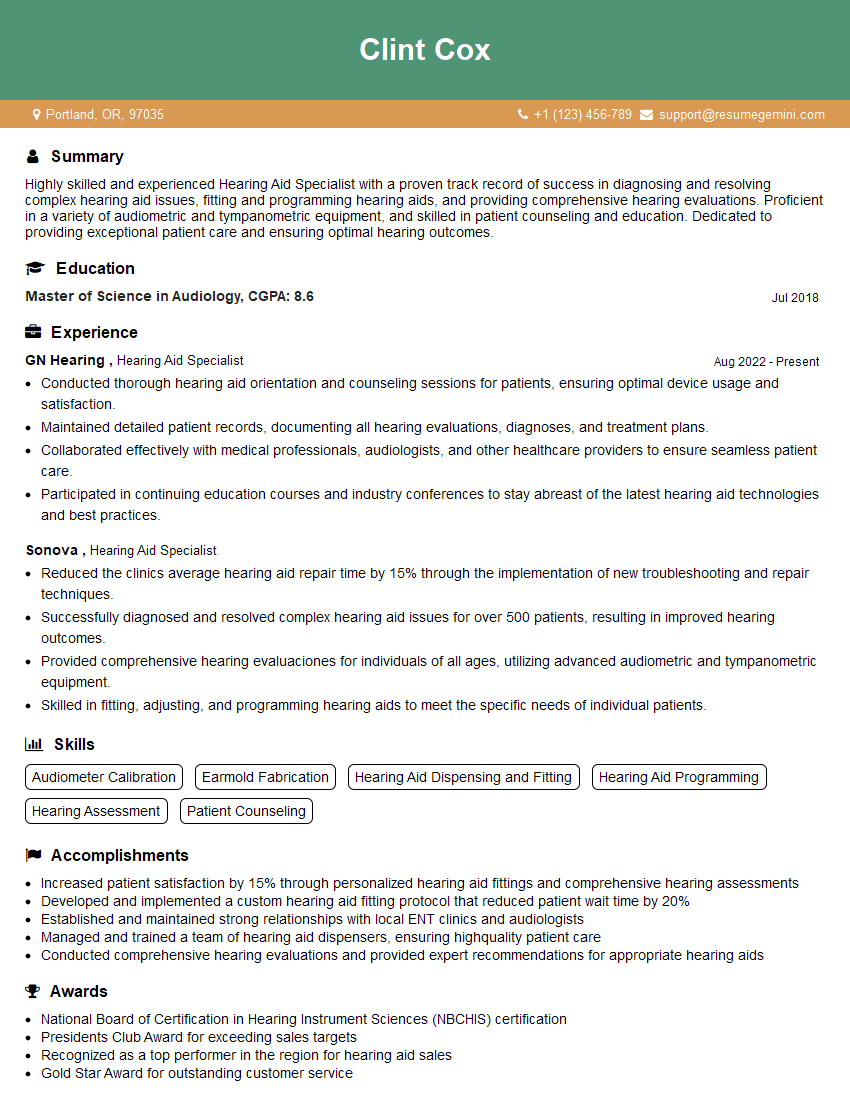
Mastering acoustic immittance opens doors to exciting career opportunities in audiology and related fields. A strong understanding of this crucial diagnostic tool is highly valued by employers. To maximize your job prospects, crafting an ATS-friendly resume is critical. ResumeGemini can help you build a professional and impactful resume that highlights your skills and experience effectively. We provide examples of resumes tailored specifically to the field of Acoustic Immittance to give you a head start. Invest the time to create a compelling resume – it’s your first impression and a key to unlocking your career potential.





Explore more articles
Users Rating of Our Blogs
Share Your Experience
We value your feedback! Please rate our content and share your thoughts (optional).
What Readers Say About Our Blog
I Redesigned Spongebob Squarepants and his main characters of my artwork.
https://www.deviantart.com/reimaginesponge/art/Redesigned-Spongebob-characters-1223583608
IT gave me an insight and words to use and be able to think of examples
Hi, I’m Jay, we have a few potential clients that are interested in your services, thought you might be a good fit. I’d love to talk about the details, when do you have time to talk?
Best,
Jay
Founder | CEO