Cracking a skill-specific interview, like one for Antenna and Transmission Line Installation, requires understanding the nuances of the role. In this blog, we present the questions you’re most likely to encounter, along with insights into how to answer them effectively. Let’s ensure you’re ready to make a strong impression.
Questions Asked in Antenna and Transmission Line Installation Interview
Q 1. Explain the difference between impedance matching and SWR.
Impedance matching and SWR (Standing Wave Ratio) are closely related concepts crucial for efficient power transfer in antenna systems. Imagine trying to pour water from a wide jug into a narrow bottle – if the sizes don’t match, you’ll get spillage and inefficiency. Similarly, if the impedance of your transmission line doesn’t match the antenna’s impedance, power reflects back, causing losses.
Impedance matching is the process of ensuring the impedance of the transmission line is equal to the impedance of the antenna. This allows maximum power transfer from the transmitter to the antenna. A perfect match is when the impedances are equal (typically 50 ohms in many systems).
SWR, on the other hand, is a measure of how well the impedance is matched. It’s the ratio of the maximum voltage to the minimum voltage along the transmission line. A perfect match (1:1 SWR) indicates no reflections, and all power is transferred. A higher SWR (e.g., 2:1 or higher) indicates significant impedance mismatch, resulting in power loss and potentially damaging the transmitter.
In essence, impedance matching is the goal, and SWR is the metric used to assess how well that goal has been achieved.
Q 2. Describe the types of antennas and their applications.
Antennas come in various types, each suited for different applications. The choice depends on factors like frequency, desired radiation pattern, gain, size constraints, and the environment.
- Dipole Antenna: A simple, half-wavelength antenna commonly used in radio broadcasting and amateur radio. It’s relatively inexpensive and easy to build but has a relatively low gain.
- Yagi-Uda Antenna: A directional antenna consisting of a driven element and parasitic elements (directors and reflectors). It provides high gain and directivity, making it suitable for long-distance communication and satellite TV reception.
- Patch Antenna: A compact, planar antenna widely used in mobile devices and satellite communications. They are relatively easy to integrate into different structures.
- Horn Antenna: A high-gain antenna used in microwave applications and satellite communications, offering good directivity and wide bandwidth.
- Microstrip Antenna: Another planar antenna often used in wireless applications because of its small size and ease of integration with printed circuit boards.
For instance, a Yagi-Uda antenna might be chosen for a long-range Wi-Fi connection, while a patch antenna might be preferred for a cell phone due to its small size.
Q 3. What are the common causes of signal loss in transmission lines?
Signal loss in transmission lines can be attributed to several factors:
- Ohmic Losses (Conductor Losses): Resistance in the conductors causes power to be dissipated as heat. This is more significant at higher frequencies.
- Dielectric Losses: The insulating material (dielectric) between the conductors also absorbs some energy, especially at higher frequencies.
- Radiation Losses: At higher frequencies, some of the signal energy can radiate away from the transmission line, particularly if the line isn’t properly shielded or terminated.
- Skin Effect: At higher frequencies, the current tends to flow mostly on the surface of the conductor (skin effect), increasing effective resistance and causing more losses.
- Reflections: Impedance mismatches at connectors or the antenna itself cause signal reflections, reducing the power delivered to the antenna. This is related to SWR.
Minimizing these losses requires careful selection of transmission line type and materials, proper impedance matching, and using quality connectors.
Q 4. How do you measure and calculate Return Loss?
Return Loss is a measure of the power reflected back from a transmission line or antenna due to impedance mismatch. It’s expressed in decibels (dB).
Measurement: Return loss is typically measured using a vector network analyzer (VNA). The VNA sends a signal down the transmission line and measures the reflected signal. The ratio of the incident power to the reflected power is then calculated in dB.
Calculation: Return loss (RL) can be calculated using the formula:
RL (dB) = -20 * log10(Γ)
where Γ (Gamma) is the reflection coefficient, which is the ratio of the reflected voltage to the incident voltage. The reflection coefficient can be derived from the measured SWR:
Γ = (SWR - 1) / (SWR + 1)
For example, if the SWR is 2:1, the reflection coefficient is (2-1)/(2+1) = 0.333, and the return loss is approximately -9.5 dB. A higher (less negative) return loss indicates more reflection and a poorer impedance match.
Q 5. Explain the concept of antenna gain and directivity.
Antenna Gain is a measure of how effectively an antenna focuses its radiated power in a specific direction. It compares the power density radiated by the antenna in a specific direction to the power density radiated by an isotropic radiator (a theoretical antenna that radiates equally in all directions). Gain is usually expressed in dBi (decibels relative to an isotropic radiator).
Antenna Directivity is a measure of an antenna’s ability to concentrate radiation in a particular direction. It’s similar to gain but doesn’t consider losses in the antenna. Directivity is also expressed in dBi.
Think of a flashlight. A highly directional flashlight (high directivity and gain) focuses its light in a narrow beam, while a standard flashlight spreads its light more broadly (lower directivity and gain). An antenna with high gain will transmit and receive signals more effectively in its preferred direction compared to an antenna with lower gain.
Q 6. How do you troubleshoot a faulty antenna installation?
Troubleshooting a faulty antenna installation involves a systematic approach:
- Visual Inspection: Start with a thorough visual check of the antenna, cables, and connectors. Look for any physical damage, loose connections, or corrosion.
- SWR Measurement: Use an SWR meter to check the standing wave ratio. A high SWR indicates an impedance mismatch, which could be due to a faulty cable, connector, or antenna.
- Signal Strength Measurement: Measure the signal strength at the antenna and compare it to expected levels. Weak signal could indicate cabling issues, antenna misalignment, or environmental interference.
- Cable Continuity Test: Use a cable tester or ohmmeter to check the continuity of the transmission line and connectors. Open or short circuits can significantly impact signal quality.
- Antenna Alignment: If using a directional antenna, verify that it’s correctly aimed towards the intended signal source.
- Environmental Factors: Consider the environmental factors such as obstructions, interference, and weather conditions that might be affecting signal strength.
By systematically investigating these areas, you can usually pinpoint the cause of the problem and implement appropriate corrective actions.
Q 7. Describe different transmission line types (coaxial, waveguide, etc.) and their properties.
Various transmission line types exist, each with its strengths and weaknesses:
- Coaxial Cable (Coax): Consists of a central conductor surrounded by a dielectric insulator, a conductive shield, and an outer jacket. It’s widely used due to its good shielding, low losses at lower frequencies, and ease of use. RG-58, RG-59, and LMR-400 are common examples.
- Waveguide: A hollow metallic pipe used at microwave frequencies. It provides excellent shielding and low loss but is bulky, inflexible, and more expensive. Rectangular and circular waveguides are common types.
- Microstrip Line: A planar transmission line consisting of a metallic strip separated from a ground plane by a dielectric substrate. It’s widely used in printed circuit board (PCB) designs for its compactness and ease of integration.
- Twin-Lead: Consists of two parallel conductors separated by a dielectric spacer. It’s relatively inexpensive but offers less shielding compared to coax, making it more susceptible to interference.
The choice of transmission line depends on the frequency, power level, required shielding, and physical constraints. For example, coax is commonly used in cable television, while waveguides are often found in radar and satellite communication systems. Microstrip lines are ubiquitous in modern electronic devices.
Q 8. What safety precautions should be taken when working at heights on antenna towers?
Working at heights on antenna towers presents significant risks. Safety is paramount, and a comprehensive approach is crucial. This involves meticulous planning, adherence to strict safety protocols, and utilization of appropriate safety equipment.
- Fall Protection: This is the most critical aspect. Harness systems, anchored securely to the tower structure, are mandatory. A full-body harness is essential, and it should be inspected regularly for wear and tear. Regular training in proper harness use and rescue techniques is a non-negotiable requirement. Consider using a safety net or other fall arrest systems, where feasible.
- Proper Training and Certification: All personnel should have adequate training and appropriate certifications for working at heights. This includes understanding rescue procedures and the proper use of all safety equipment.
- Communication: Clear and constant communication between team members is vital. Two-way radios are typically utilized to ensure coordination and immediate response to emergencies.
- Weather Conditions: Work should be halted in adverse weather conditions, such as high winds, lightning, ice, or heavy rain. The risks associated with poor weather greatly increase the chances of accidents.
- Equipment Inspection: Regular inspection of all equipment is crucial. This includes the antenna tower itself, all safety equipment (harnesses, ropes, anchors), and any tools that will be utilized on the tower. Faulty or damaged equipment must be promptly replaced.
- Emergency Procedures: Emergency plans must be developed and understood by all team members. This should include procedures for evacuation in case of accidents or emergencies.
Imagine a scenario where a technician is working on a high tower and a sudden gust of wind causes them to lose their footing. Proper fall protection would prevent a potentially fatal fall. This highlights the importance of adherence to the strictest safety standards when working at heights.
Q 9. Explain the importance of grounding in antenna systems.
Grounding in antenna systems is crucial for safety and performance. It provides a path for lightning strikes and static electricity to safely dissipate into the earth, preventing damage to equipment and ensuring personnel safety. Improper grounding can lead to equipment failure, signal degradation, and even serious injury or death.
- Lightning Protection: A properly grounded antenna system acts as a lightning rod, diverting the energy from a lightning strike safely into the ground. This prevents damage to the antenna, transmission lines, and associated electronics.
- Static Discharge: Static electricity buildup can damage sensitive equipment. Grounding provides a path for this charge to dissipate, preventing electrical surges and component failure. Think of it like a pressure relief valve for electrical charges.
- Signal Integrity: Grounding minimizes interference and noise in the signal path, leading to improved signal quality and reduced errors.
- Safety: Grounding protects personnel by preventing electrical shocks from stray currents or lightning strikes. It’s a fundamental safety measure for protecting lives and preventing accidents.
For example, consider a radio tower struck by lightning. Without proper grounding, the powerful electrical surge could destroy the antenna, transmission line, and even the supporting structure, potentially causing significant damage and injury. A well-implemented grounding system would divert the surge harmlessly into the earth.
Q 10. How do you calculate the length of a transmission line for a specific frequency?
Calculating transmission line length is essential to optimize performance at a specific frequency. The goal is to ensure the line is an integer multiple of a quarter-wavelength (λ/4), creating a resonant match with minimal reflections. This is particularly important for maximizing power transfer and minimizing signal loss.
The formula for calculating the wavelength (λ) is:
λ = c / fWhere:
λis the wavelength in meterscis the speed of light (approximately 3 x 10⁸ m/s)fis the frequency in Hertz (Hz)
Once you’ve calculated the wavelength, you can determine the length of a quarter-wavelength transmission line:
Length = λ / 4It’s important to consider the velocity factor (VF) of the transmission line material, which accounts for the fact that the signal propagates slower in the cable than in free space. The adjusted formula is:
Length = (λ / 4) * VFWhere VF is a decimal value (e.g., 0.66 for RG-58 coaxial cable).
Example: Let’s say we need a transmission line for a frequency of 100 MHz. First calculate the wavelength:
λ = (3 x 10⁸ m/s) / (100 x 106 Hz) = 3 metersThen, using a VF of 0.66 for RG-58:
Length = (3 meters / 4) * 0.66 ≈ 0.495 metersTherefore, the required length of the RG-58 transmission line would be approximately 0.495 meters (or 49.5 centimeters).
Q 11. What are the effects of environmental factors (weather, terrain) on antenna performance?
Environmental factors significantly impact antenna performance. Weather conditions and terrain can affect signal propagation, gain, and overall system efficiency.
- Weather: Rain, snow, ice, and fog attenuate radio waves, causing signal loss. High winds can cause physical damage to antennas and even cause them to become misaligned. Lightning can cause catastrophic damage to both the antenna and associated equipment.
- Terrain: Hills, mountains, and buildings can cause signal blockage, reflection, diffraction, and scattering. These phenomena can lead to signal fading, multipath interference, and reduced coverage area. The presence of trees and vegetation can also absorb radio waves and affect signal propagation.
- Temperature: Extreme temperatures can affect the performance of certain antenna materials, leading to changes in impedance and signal characteristics. This is particularly relevant in areas with significant temperature swings.
For instance, heavy rainfall can significantly reduce the effective range of a wireless communication system. Similarly, a mountain range can completely block the signal between two communication points, requiring the use of repeater stations or alternative strategies to overcome the obstacle.
Q 12. Describe different antenna polarization types and their applications.
Antenna polarization refers to the orientation of the electric field vector of a radio wave. Different polarization types have specific applications depending on the propagation characteristics and system requirements.
- Linear Polarization: The electric field vector remains in a fixed plane. This can be either vertical or horizontal. Vertical polarization is commonly used in VHF and UHF television broadcasting, while horizontal polarization is often used in terrestrial microwave links.
- Circular Polarization: The electric field vector rotates continuously as the wave propagates. This can be either right-hand circular polarization (RHCP) or left-hand circular polarization (LHCP). Circular polarization is less sensitive to polarization mismatch and is often used in satellite communications, where the antenna orientation might change during transmission.
- Elliptical Polarization: This is a combination of linear and circular polarization, where the electric field vector traces an ellipse as the wave propagates. It’s often used in applications where a compromise between the benefits of linear and circular polarization is desirable.
The choice of polarization depends on factors such as the environment, the type of communication system, and the desired signal quality. For example, in satellite communications, circular polarization is frequently chosen to mitigate the effects of Faraday rotation, a phenomenon that causes the polarization of a linearly polarized wave to rotate as it travels through the ionosphere.
Q 13. How do you perform an antenna alignment and optimization?
Antenna alignment and optimization are crucial for maximizing signal strength, minimizing interference, and achieving the desired coverage area. This process involves careful adjustment and fine-tuning of the antenna’s position and orientation.
- Site Survey: Begin with a thorough site survey to identify potential obstacles and interference sources. This includes identifying potential reflection points and areas of signal blockage.
- Antenna Positioning: Position the antenna based on the desired coverage pattern and direction. Accurate positioning is crucial, even small deviations can result in significant performance differences.
- Signal Measurement: Utilize appropriate signal measurement equipment (e.g., spectrum analyzer, signal generator) to determine the signal strength and quality at various locations. This data is used to assess antenna performance and identify areas for improvement.
- Adjustment and Fine-tuning: Make adjustments to the antenna’s azimuth (horizontal) and elevation (vertical) angles, based on signal measurements. This iterative process involves adjusting the antenna, taking measurements, and repeating until optimal performance is achieved.
- SWR Measurement: Measure the standing wave ratio (SWR) to verify a proper impedance match between the antenna and transmission line. A high SWR indicates impedance mismatch, causing signal loss and potentially damaging the transmitter.
Imagine trying to communicate with a distant radio station. If your receiving antenna isn’t correctly aligned, you’ll receive a weak and distorted signal. Careful alignment and optimization are key to ensuring the best possible signal reception.
Q 14. Explain the concept of antenna pattern and beamwidth.
An antenna pattern visually represents the antenna’s radiation characteristics in three-dimensional space. It shows the relative signal strength (or power density) at different angles from the antenna. The beamwidth is a key parameter within the antenna pattern.
- Antenna Pattern: This pattern illustrates how the antenna radiates power in different directions. Some antennas have highly directional patterns (focused beam), while others radiate power more uniformly in all directions (omnidirectional pattern).
- Beamwidth: This is the angular width of the main lobe (the region of strongest radiation) of the antenna’s pattern, usually measured at the half-power points (3 dB points). A narrower beamwidth indicates a more directional antenna, while a wider beamwidth indicates a less directional antenna.
The antenna pattern and beamwidth determine the coverage area and the antenna’s ability to focus the signal in a specific direction. A highly directional antenna, with a narrow beamwidth, is suitable for point-to-point communication over long distances, while an omnidirectional antenna is ideal for broadcasting to a wide area.
For example, a parabolic dish antenna has a very narrow beamwidth, focusing the signal in a specific direction for satellite communication. In contrast, a dipole antenna has a wider beamwidth, broadcasting in a wider pattern, making it suitable for applications such as AM radio broadcasting.
Q 15. What are the different types of connectors used in transmission lines?
Transmission lines utilize various connectors to ensure a secure and efficient signal transfer. The choice of connector depends heavily on the frequency, power level, and environmental conditions. Some common types include:
N-Type: A robust, threaded connector suitable for high-power applications and a wide range of frequencies. Think of it as the workhorse – reliable and durable.
SMA (SubMiniature version A): A smaller, less robust connector often used in lower-power applications and higher frequencies. It’s more compact and easier to work with in tight spaces.
BNC (Bayonet Neill-Concelman): A quick-connect/disconnect bayonet-style connector, generally used in lower power, lower frequency applications. It’s convenient for frequent connections and disconnections.
TNC (Threaded Neill-Concelman): A threaded version of the BNC, offering better environmental sealing and improved reliability in harsh conditions. It’s essentially a BNC with improved weatherproofing.
Type F: Commonly used in coaxial cable systems for television and cable internet. It’s designed for ease of use and widespread compatibility in consumer applications.
Choosing the right connector is crucial. A poorly chosen connector can lead to signal loss, impedance mismatches, and even system failure. For instance, using an SMA connector on a high-power system could lead to arcing and damage.
Career Expert Tips:
- Ace those interviews! Prepare effectively by reviewing the Top 50 Most Common Interview Questions on ResumeGemini.
- Navigate your job search with confidence! Explore a wide range of Career Tips on ResumeGemini. Learn about common challenges and recommendations to overcome them.
- Craft the perfect resume! Master the Art of Resume Writing with ResumeGemini’s guide. Showcase your unique qualifications and achievements effectively.
- Don’t miss out on holiday savings! Build your dream resume with ResumeGemini’s ATS optimized templates.
Q 16. How do you interpret a site survey report for antenna installation?
Interpreting a site survey report for antenna installation is critical for a successful deployment. The report should detail several key aspects, including:
Location details: Precise coordinates, surrounding structures (buildings, trees, terrain), and potential obstructions that may impact signal propagation. This helps determine the optimal antenna placement.
RF environment: Information on existing RF sources (other antennas, Wi-Fi networks, etc.) that could cause interference. Identifying these sources is vital for planning mitigation strategies.
Path profile: A visual representation of the signal path between the transmitting and receiving antennas. This often includes Fresnel zone clearance calculations, which are essential to avoid signal blockage and diffraction losses.
Signal strength predictions: The report should provide estimations of signal strength at the intended receiver, considering factors like antenna gain, path loss, and atmospheric conditions. This helps determine the feasibility of the system and the needed hardware.
Regulatory compliance: The report must ensure the proposed antenna installation complies with all relevant local and national regulations regarding height restrictions, emissions, and safety.
Imagine you are planning a microwave link across a valley. The site survey must reveal the terrain profile, identify any potential obstructions (hills, buildings) which would block the signal path, and suggest appropriate antenna height and positioning for optimal performance. A thorough review of the site survey ensures a robust and efficient antenna installation.
Q 17. Describe the process of installing a microwave antenna system.
Installing a microwave antenna system involves a detailed, multi-stage process. Here’s a breakdown:
Site preparation: This involves preparing the mounting location, ensuring structural integrity and compliance with regulations. This could include erecting a tower, reinforcing an existing structure, or obtaining necessary permits.
Antenna mounting: The antenna is securely mounted onto the chosen structure using appropriate brackets and hardware. Proper grounding is crucial to protect against lightning strikes.
Transmission line installation: The coaxial cable connecting the antenna to the radio equipment is carefully routed and secured, minimizing bends and ensuring proper grounding. This often involves using cable trays, conduits or other protection methods.
Radio equipment installation: The radio equipment (transmitter/receiver) is installed in a suitable environment, providing adequate ventilation and protection from the elements.
Alignment and testing: Precise alignment of the transmitting and receiving antennas is crucial. This often involves using specialized equipment to ensure optimal signal strength and minimize signal loss. Thorough testing verifies the system’s performance and compliance with specifications.
Documentation: A comprehensive record of the installation, including equipment specifications, alignment details, and test results should be maintained for future reference and troubleshooting.
For example, installing a microwave link between two buildings requires careful planning of the cable route to avoid interference from other metallic structures and ensuring proper grounding to avoid electrical surges.
Q 18. Explain the principles of RF propagation.
RF (Radio Frequency) propagation refers to how radio waves travel through space. Several factors influence this:
Frequency: Higher frequencies experience greater attenuation (signal loss) and are more susceptible to atmospheric effects. Lower frequencies can travel farther with less loss.
Path loss: Signal strength decreases with distance. This loss is influenced by the environment (obstacles, terrain).
Reflection: Radio waves bounce off surfaces like buildings and the ground. This can cause constructive or destructive interference, altering signal strength.
Diffraction: Waves bend around obstacles, allowing signals to reach locations that wouldn’t otherwise be directly visible. However, the signal strength will be reduced.
Refraction: Changes in atmospheric conditions (temperature, humidity) can cause the waves to bend, affecting signal path and strength.
Absorption: Some materials (water, trees) absorb radio waves, leading to signal attenuation.
Imagine throwing a stone across a lake. The distance it travels depends on the stone’s initial force (signal strength), the size and shape of the lake (terrain), and any obstacles it encounters (buildings, trees). RF propagation shares this principle; understanding these factors is key to designing effective communication systems.
Q 19. How do you identify and resolve signal interference issues?
Identifying and resolving signal interference issues requires a systematic approach:
Identify the symptoms: Determine the nature of the interference (e.g., intermittent signal loss, noise, distortion).
Analyze the RF environment: Use spectrum analyzers to identify the frequency and source of interfering signals. This could involve scanning the spectrum for nearby transmitters or other sources of electromagnetic noise.
Investigate potential sources: Consider sources like other antennas, electrical equipment, or even natural phenomena.
Implement mitigation techniques: Based on the identified source, strategies could include:
Shielding: Use metallic enclosures or conductive coatings to reduce interference.
Filtering: Use filters to block specific frequencies causing the interference.
Antenna relocation/orientation: Changing the antenna’s position or direction can help minimize interference.
Changing frequencies: If possible, shifting the operating frequency to one less congested can drastically improve performance.
Retest and verify: After implementing solutions, retest the system to ensure the interference is resolved and performance is optimized.
For example, if a wireless network experiences interference from a nearby microwave oven, solutions could involve changing the Wi-Fi channel, shielding the network’s cabling, or relocating the router farther from the microwave.
Q 20. What are the common troubleshooting techniques for transmission line problems?
Troubleshooting transmission line problems often involves a combination of techniques:
Visual inspection: Check for physical damage to the cable (cuts, kinks, water ingress). This is often the first and simplest step.
Impedance measurements: Use a time-domain reflectometer (TDR) to identify impedance mismatches or discontinuities along the cable. A mismatch can indicate a connector issue or cable damage.
Signal level measurements: Use a signal level meter to measure signal strength at various points along the transmission line. Significant signal loss can pinpoint the location of the problem.
Connector checks: Inspect connectors for damage, corrosion, or loose connections. A loose connector is a frequent cause of signal degradation.
Grounding verification: Ensure proper grounding of the transmission line to protect against lightning strikes and reduce noise.
Imagine a sudden drop in signal strength on a long cable run. A TDR will help identify if there’s a break in the cable or a faulty connector. Systematic testing helps quickly isolate and resolve such problems.
Q 21. Describe different methods for antenna mounting and securing.
Antenna mounting and securing methods vary depending on the antenna size, weight, and environmental conditions. Common methods include:
Rooftop mounts: Antennas are mounted on rooftops using brackets, masts, or towers. Roof penetration must be properly sealed to prevent water ingress.
Tower mounts: Larger antennas are often mounted on towers, providing height and visibility. This requires robust structural considerations and may need specialized rigging and climbing equipment.
Wall mounts: Antennas can be mounted directly to walls using brackets. Appropriate anchoring is critical to ensure stability and prevent damage.
Pole mounts: Antennas are attached to poles, typically used for smaller antennas in outdoor applications.
Ground mounts: Antennas are mounted directly on the ground, often using a concrete base for stability. This is suitable for low-profile antennas.
Securing the antenna is crucial. For example, a rooftop antenna must withstand wind loads and other environmental stresses. Improper securing can lead to antenna failure, signal disruptions, and potential damage to property.
Q 22. What are the safety regulations and standards related to antenna installation?
Antenna installation is governed by stringent safety regulations to protect workers and the public from potential hazards like RF exposure, falls from heights, and electrical shocks. Key standards include OSHA (Occupational Safety and Health Administration) regulations in the US, and similar national and international standards like those from IEC (International Electrotechnical Commission).
- RF Exposure Limits: These regulations set limits on the amount of RF radiation a person can be exposed to, depending on the frequency and power level. We always use appropriate RF safety meters to ensure we remain within these limits during installation and operation.
- Fall Protection: Antenna installations often involve working at heights, necessitating the use of harnesses, safety lines, and other fall protection equipment. Rigorous safety training is mandatory for all personnel involved.
- Electrical Safety: Antennas frequently connect to high-powered transmission lines. Lockout/Tagout procedures are crucial to prevent accidental energization during installation or maintenance. We use insulated tools and follow strict grounding procedures.
- Weather Conditions: Working in inclement weather presents additional risks, and work should be suspended if conditions become unsafe. Lightning protection is also a critical consideration.
- Proper Grounding: Effective grounding minimizes the risk of lightning strikes and prevents the buildup of static electricity, ensuring both personnel and equipment safety.
Compliance with these regulations is non-negotiable, and regular safety audits are conducted to maintain the highest safety standards. For example, during a recent installation on a tall building, we implemented a full fall-arrest system and used a cherry picker to minimize the height risk. We also conducted daily safety briefings with the team to highlight potential hazards and safe practices.
Q 23. How do you use RF test equipment (spectrum analyzer, power meter, etc.)?
RF test equipment is essential for verifying the performance of an antenna installation. A spectrum analyzer measures the frequency and power of RF signals, helping us identify interference and verify signal strength. A power meter measures the power level of the transmitted signal, ensuring it’s within the safe and specified operating parameters. Other common tools include an antenna analyzer to measure impedance and SWR (Standing Wave Ratio) and signal generators to create test signals.
Example: To test an antenna installation, I would first use a signal generator to transmit a known signal at the desired frequency. I’d then use the spectrum analyzer to check the signal’s frequency and power at the receiving end, ensuring there is no signal degradation or interference. The power meter would then verify the transmitted power is as expected. An antenna analyzer is used to ensure proper impedance matching between the antenna and the transmission line, minimizing signal loss and reflections (represented by SWR). A low SWR is desirable (ideally close to 1:1) showing efficient power transfer. Finally, I would observe the antenna pattern to confirm the radiation characteristics of the antenna are as intended.
Example of using a spectrum analyzer: Set the center frequency to the operating frequency of the antenna, use a suitable span, and observe the signal level and any potential interference.Q 24. Explain the concept of Fresnel zone clearance.
The Fresnel zone is the elliptical volume of space around the line-of-sight path between two antennas where the RF signal propagates. Fresnel zone clearance refers to the requirement that there should be minimal obstructions within this zone to minimize signal attenuation and multipath interference. Obstructions reduce the signal strength and can cause fading or signal degradation.
Think of it like throwing a ball: If there’s something in the way (a tree, building, etc.), the ball’s trajectory is affected. Similarly, obstacles in the Fresnel zone can disrupt the RF signal, affecting the quality of the communication link. The size of the Fresnel zone varies depending on the frequency and distance between the antennas.
Practical Application: Before installing an antenna link, we carefully map the Fresnel zone. Using software tools and surveying techniques, we identify and evaluate potential obstacles. This can influence the antenna placement and type selection, as the required clearance can vary depending on the link characteristics (frequency and length). For example, a microwave link operating at a higher frequency needs stricter Fresnel zone clearance than a lower-frequency link. If obstructions can’t be avoided, adjustments to the antenna height or other mitigations such as using higher gain antennas might be needed.
Q 25. How do you calculate the path loss between two antennas?
Path loss is the reduction in signal power as it travels from one antenna to another. It’s influenced by several factors, including distance, frequency, antenna gains, and atmospheric conditions. The Friis transmission equation is commonly used to estimate path loss:
Path Loss (dB) = 32.45 + 20log10(f) + 20log10(d) - Gt - GrWhere:
fis the frequency in MHzdis the distance in kilometersGtis the gain of the transmitting antenna in dBiGris the gain of the receiving antenna in dBi
Example: Let’s say we have two antennas operating at 2.4 GHz (f = 2400 MHz), separated by 5 km (d = 5). Both antennas have a gain of 10 dBi (Gt = Gr = 10). Plugging these values into the equation, we get:
Path Loss (dB) = 32.45 + 20log10(2400) + 20log10(5) - 10 - 10 ≈ 92 dBThis means the signal strength decreases by approximately 92 dB over the 5 km distance. Remember this calculation provides an estimate. Actual path loss can be affected by factors not accounted for in this simplified model.
Q 26. What are the challenges of installing antennas in dense urban environments?
Installing antennas in dense urban environments presents several unique challenges:
- Line of Sight Obstructions: Tall buildings and other structures significantly obstruct the line of sight, making it difficult to achieve optimal signal strength and reliability. Careful site surveys and planning are crucial to identify the best antenna locations and possibly need for higher gain antennas or repeater systems.
- Multipath Propagation: RF signals can reflect off buildings and other surfaces, creating multiple signal paths that interfere with each other and causing signal degradation, fading, and instability. Advanced antenna techniques, such as using directional antennas or employing diversity reception techniques, help mitigate this.
- Permitting and Regulations: Obtaining necessary permits and approvals from local authorities can be complex and time-consuming, as regulations are designed to protect public safety, historical sites, and visual aesthetics.
- Access and Safety: Accessing rooftops and other high locations in crowded urban environments can be challenging and requires strict adherence to safety protocols and use of appropriate equipment.
- Interference: The high density of RF sources such as Wi-Fi networks, mobile base stations, and other communication systems can cause interference, affecting the performance of the installed antenna. Carefully choosing the operating frequency and using appropriate filtering techniques can help minimize interference.
For example, I once faced this when installing a microwave link between two buildings in a downtown area. We utilized a sophisticated site survey to account for building reflections, and had to obtain several permits from the city council before starting the installation. Furthermore, we used high-gain directional antennas to minimize the effects of multipath interference, and installed advanced filtering on the receiving end to reduce the impact of nearby sources.
Q 27. Describe your experience with different types of antenna systems (e.g., Yagi, parabolic, horn).
Throughout my career, I’ve worked extensively with various antenna systems. My experience encompasses the design, installation, and testing of Yagi antennas, parabolic antennas, and horn antennas, each with its own unique characteristics and applications:
- Yagi Antennas: These directional antennas are cost-effective and suitable for point-to-point communication links, offering high gain and directivity. I’ve used them extensively in applications ranging from amateur radio to wireless broadband networks. Their directional nature helps eliminate some interference. However, precise alignment is critical for optimal performance.
- Parabolic Antennas (Dish Antennas): These high-gain antennas are ideal for long-distance communication links requiring significant signal strength, such as satellite communication and microwave links. I’ve installed them on rooftops and towers, paying close attention to alignment and focusing to maximize signal reception. Accurate aiming and surface integrity are crucial for performance.
- Horn Antennas: These wideband antennas are particularly useful where precise pattern control is needed. They offer a good compromise between gain and beamwidth, making them suitable for a variety of applications. They are robust and require less precise alignment than parabolic antennas but typically have lower gain.
Each antenna type demands specific installation techniques. For example, Yagi antennas require precise alignment for optimal performance, while parabolic antennas require careful consideration of surface accuracy and wind loading. My experience allows me to effectively assess the requirements of a given application and select the most suitable antenna system.
Key Topics to Learn for Antenna and Transmission Line Installation Interview
- Antenna Fundamentals: Understanding antenna types (e.g., dipole, Yagi-Uda, parabolic), radiation patterns, gain, bandwidth, and impedance matching. Consider practical examples of choosing the right antenna for specific applications.
- Transmission Line Theory: Mastering concepts like characteristic impedance, SWR (Standing Wave Ratio), losses, and different transmission line types (coaxial, waveguide, twin-lead). Be prepared to discuss troubleshooting techniques for impedance mismatches.
- Installation Techniques: Familiarize yourself with safety procedures, grounding techniques, proper cable routing and termination, and the use of specialized tools and equipment. Think about real-world scenarios involving tower climbing or working at heights.
- RF Safety: Understand the potential hazards associated with working with RF signals and the necessary safety precautions to mitigate risks. This is crucial for demonstrating responsibility and professionalism.
- Testing and Measurement: Knowing how to use test equipment like SWR meters, spectrum analyzers, and signal generators to verify proper installation and performance is essential. Be ready to describe practical testing procedures.
- Troubleshooting and Problem Solving: Develop your ability to diagnose and solve problems related to signal strength, noise, interference, and faulty connections. Practice explaining your troubleshooting methodology.
- Regulatory Compliance: Understand relevant regulations and standards related to antenna and transmission line installations (e.g., FCC regulations). This showcases awareness of industry best practices.
Next Steps
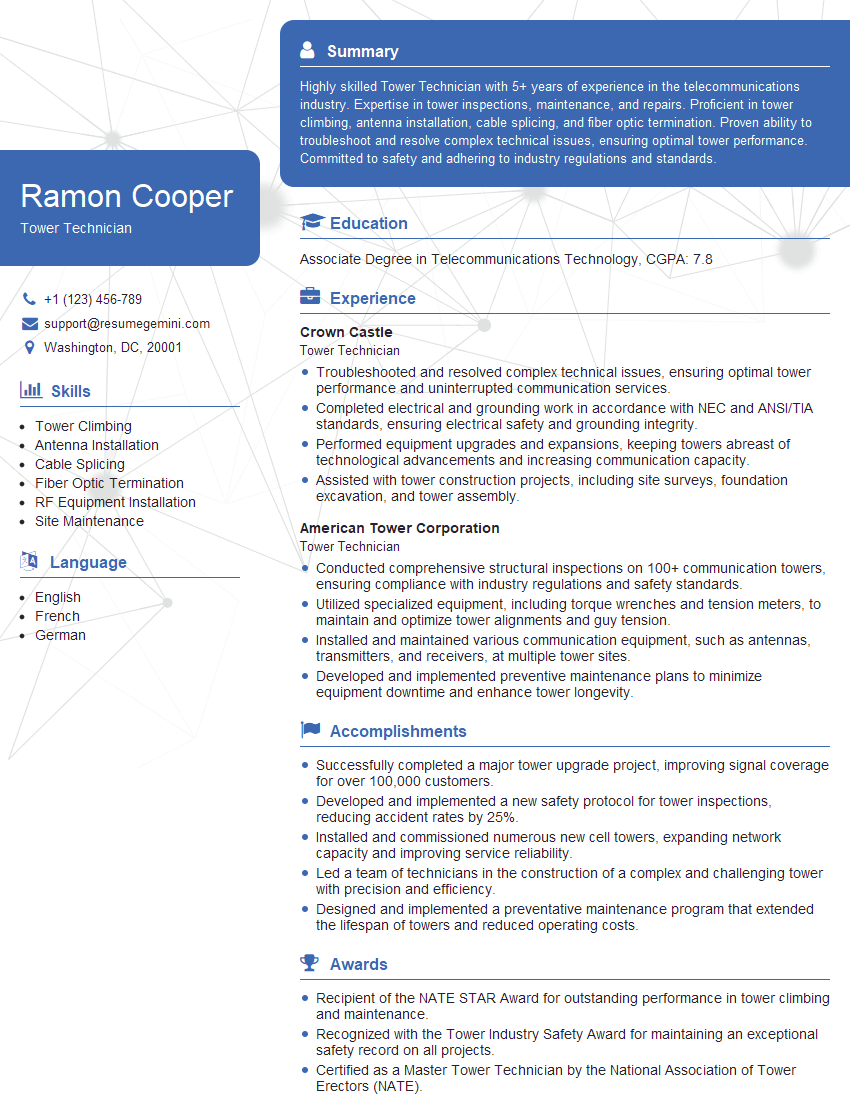
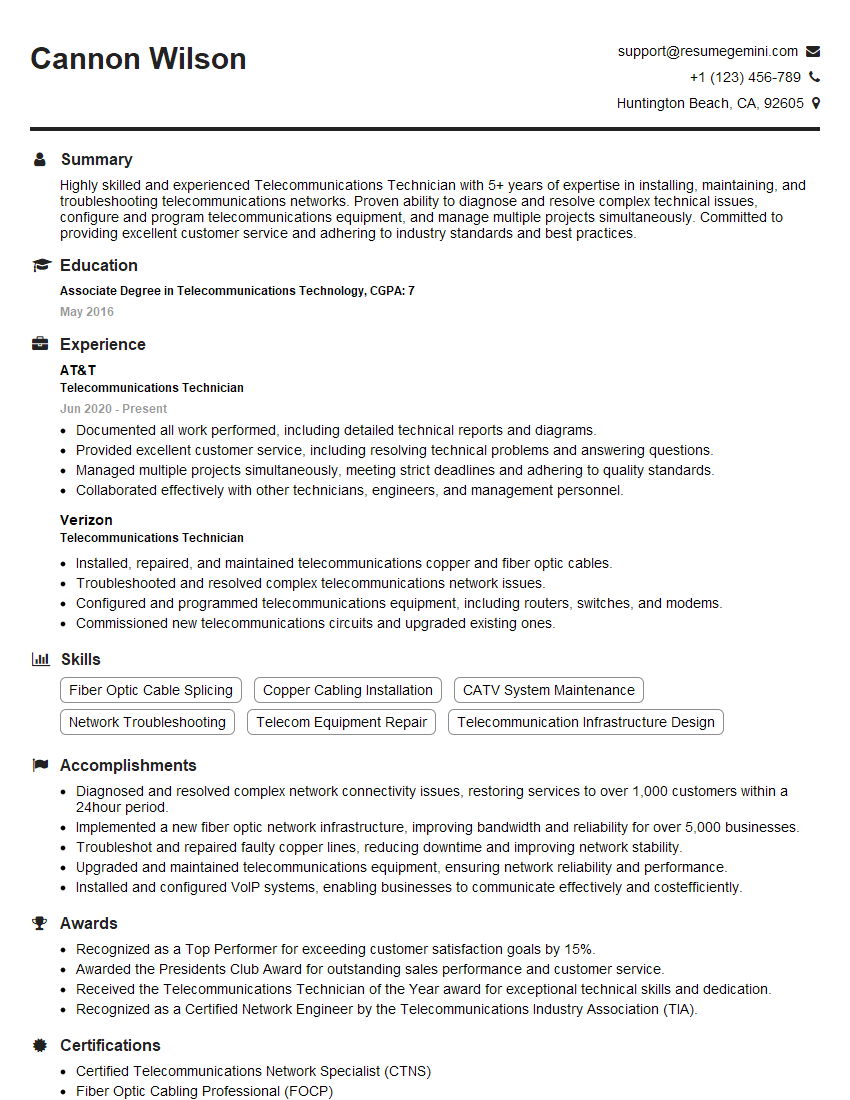
Mastering Antenna and Transmission Line Installation opens doors to exciting career opportunities in telecommunications, broadcasting, and aerospace. A strong understanding of these principles significantly enhances your value to potential employers. To maximize your job prospects, crafting a compelling and ATS-friendly resume is paramount. ResumeGemini is a trusted resource that can help you build a professional resume that highlights your skills and experience effectively. Examples of resumes tailored to Antenna and Transmission Line Installation are available to help guide your resume creation process. Take the next step in your career journey by investing time in crafting a high-impact resume that showcases your expertise.

Explore more articles
Users Rating of Our Blogs
Share Your Experience
We value your feedback! Please rate our content and share your thoughts (optional).
What Readers Say About Our Blog
I Redesigned Spongebob Squarepants and his main characters of my artwork.
https://www.deviantart.com/reimaginesponge/art/Redesigned-Spongebob-characters-1223583608
IT gave me an insight and words to use and be able to think of examples
Hi, I’m Jay, we have a few potential clients that are interested in your services, thought you might be a good fit. I’d love to talk about the details, when do you have time to talk?
Best,
Jay
Founder | CEO