Interviews are opportunities to demonstrate your expertise, and this guide is here to help you shine. Explore the essential Applied Theatre interview questions that employers frequently ask, paired with strategies for crafting responses that set you apart from the competition.
Questions Asked in Applied Theatre Interview
Q 1. Explain the core principles of Applied Theatre.
Applied Theatre uses theatrical techniques not for entertainment alone, but as a tool for social change, education, and community development. Its core principles revolve around participation, collaboration, and reflection.
- Participation: Audience members are not passive spectators; they actively participate in the process, shaping the narrative and contributing their experiences.
- Collaboration: Applied Theatre projects are typically collaborative, involving diverse stakeholders – facilitators, participants, and the wider community – in the creative process.
- Reflection: The process encourages critical reflection on personal experiences, social issues, and potential solutions. Theatre becomes a platform for dialogue and understanding.
For example, a workshop addressing bullying might involve participants role-playing different scenarios, exploring the perspectives of bullies, victims, and bystanders, ultimately aiming for behavioral change through shared experience and critical analysis.
Q 2. Describe your experience using a specific Applied Theatre technique (e.g., Forum Theatre, Playback Theatre).
I have extensive experience using Forum Theatre. In one project, I worked with a group of young people struggling with gang violence in an urban area. We used Forum Theatre to explore the dynamics of conflict and decision-making within gang life.
The process began with a short scene depicting a typical conflict scenario, showing how escalating tensions could lead to violence. After the initial performance, I, as the facilitator, invited audience members to ‘jump in’ and replace actors, offering alternative actions to the characters on stage. This allowed them to explore different solutions and witness the immediate consequences of their choices.
The discussions that followed each ‘intervention’ were incredibly insightful. Participants explored the root causes of violence, the impact of social pressures, and the potential for positive change within their community. The experience allowed them to experiment with conflict resolution strategies in a safe and supportive environment, leading to meaningful personal reflections and shifts in perspective.
Q 3. How do you adapt Applied Theatre techniques to different demographics and contexts?
Adapting Applied Theatre to different demographics and contexts requires sensitivity and flexibility. The key is to understand the specific needs, experiences, and communication styles of the target group.
- Language and Communication: Adapt the language, tone, and storytelling style to be appropriate and accessible. For example, working with young children might require simpler language and more playful interactions, while working with adults might involve more complex narratives and abstract themes.
- Cultural Sensitivity: Be mindful of cultural norms, values, and beliefs. Respectful representation and avoidance of stereotypes are crucial. Involving community members in the design and implementation phases can significantly improve cultural relevance.
- Accessibility: Ensure accessibility for individuals with disabilities by adapting the physical space, materials, and methods. Consider providing alternative formats such as sign language interpretation or audio descriptions.
For instance, a project addressing domestic violence with refugee women requires a careful approach, considering language barriers, trauma sensitivity, and potentially limited access to resources. The focus would be on creating a safe and empowering environment, adapting theatrical techniques to facilitate emotional expression and collaborative problem-solving.
Q 4. What ethical considerations are crucial in Applied Theatre practice?
Ethical considerations are paramount in Applied Theatre. The wellbeing and rights of participants are always prioritized.
- Informed Consent: Participants must be fully informed about the nature of the project, their rights, and the potential risks and benefits. Their consent must be freely given and can be withdrawn at any time.
- Confidentiality and Anonymity: Maintain the confidentiality of participants’ personal information and experiences shared during the process. Anonymisation techniques should be employed where appropriate.
- Power Dynamics: Be mindful of power imbalances and ensure equitable participation among all stakeholders. Facilitators should be aware of their own biases and strive to create a safe and inclusive environment for everyone.
- Harm Reduction: Implement strategies to minimize the risk of psychological distress or emotional harm. Provide appropriate support mechanisms, such as debriefing sessions or access to counselling, as needed.
For example, if exploring sensitive topics like trauma or abuse, providing clear exit strategies and access to mental health support is crucial. Debriefing sessions offer a safe space for participants to process their experiences and discuss any emotional responses.
Q 5. Explain your understanding of audience participation in Applied Theatre.
Audience participation is fundamental to Applied Theatre. It’s not just about watching a performance; it’s about active engagement, shaping the narrative, and collectively creating meaning.
The level of participation can vary depending on the technique used. In some methods, such as Forum Theatre, audience members directly participate by taking on roles and influencing the narrative. In others, such as Playback Theatre, the audience shares their stories which are then spontaneously performed and explored through improvised theatre. Even in more structured performances, the audience’s reactions and reflections are crucial to the process and interpretation.
Audience participation allows for greater understanding, empathy, and ownership of the subject matter. It fosters dialogue, challenges assumptions, and enables collective learning and problem-solving. It’s the active involvement that transforms a passive audience into an engaged community of participants.
Q 6. How do you assess the impact and effectiveness of your Applied Theatre work?
Assessing the impact of Applied Theatre is crucial. It requires a multifaceted approach, combining quantitative and qualitative methods.
- Qualitative Data: This includes gathering feedback through focus groups, individual interviews, participant observations, and analyzing the discussions and interactions that occur during the sessions. These data provide rich insights into participants’ experiences, reflections, and changes in perspective.
- Quantitative Data: Pre- and post-intervention surveys or questionnaires can measure changes in attitudes, knowledge, skills, or behaviors. This provides a more structured way to measure the impact and quantify changes.
- Observation and Documentation: Careful observation of participant behavior, interactions, and engagement during the sessions provides valuable insights into the effectiveness of the intervention.
The most effective approach involves a combination of these methods, allowing for a more comprehensive understanding of the impact. It’s important to remember that the effects of Applied Theatre can be subtle and long-term, requiring ongoing monitoring and evaluation.
Q 7. Describe your experience facilitating participatory theatre processes.
Facilitating participatory theatre processes requires strong interpersonal skills, improvisation skills, and a deep understanding of group dynamics. My approach emphasizes creating a safe, inclusive, and empowering environment where all participants feel comfortable contributing.
I start by building rapport with participants, establishing clear guidelines and expectations, and actively listening to their ideas and contributions. I use a variety of techniques to encourage engagement, from icebreakers and warm-up exercises to improvisational games and role-playing activities. I guide the process, offering support and structure while allowing space for creativity and spontaneity. I strive to create a collaborative space where participants feel ownership of the process and the outcomes.
For example, in a community-based project focused on environmental sustainability, I facilitated a process where residents collaboratively created a theatrical performance showcasing their concerns and solutions related to local environmental issues. This involved guiding them through storytelling, improvisation, and scene-building, resulting in a powerful and engaging performance that fostered community dialogue and action.
Q 8. How do you handle conflict or resistance during an Applied Theatre session?
Conflict and resistance are inevitable in Applied Theatre, as it often tackles sensitive or challenging issues. My approach focuses on viewing these as opportunities for deeper learning and engagement, rather than roadblocks. I handle conflict by first creating a safe and respectful environment where participants feel comfortable expressing themselves. This involves clearly establishing ground rules at the beginning of the session, emphasizing active listening, and fostering empathy.
If conflict arises, I facilitate a structured discussion, encouraging participants to articulate their perspectives without judgment. I may use techniques like role-playing or improvisation to help participants understand different viewpoints and explore potential solutions collaboratively. For instance, if a disagreement emerges during a forum theatre session (a key technique in Theatre of the Oppressed), I might invite other participants to suggest alternative actions the protagonist could take to resolve the conflict within the scenario. The goal is always to transform conflict into a constructive learning experience.
Resistance, on the other hand, can stem from various factors such as discomfort with vulnerability or a lack of trust. I address resistance by acknowledging participants’ feelings and validating their concerns. I might offer alternative activities or modify the session’s structure to accommodate their needs while still working toward the overall objectives. Sometimes, simply adjusting the pace or providing more individual support can significantly reduce resistance.
Q 9. What are the key differences between Applied Theatre and traditional theatre?
While both Applied Theatre and traditional theatre use dramatic techniques like acting, scriptwriting, and directing, their fundamental goals differ significantly. Traditional theatre primarily aims to entertain, offering an aesthetic experience to an audience. The focus is on the performance itself—the artistry, the spectacle, the storytelling through a pre-determined narrative.
Applied Theatre, conversely, prioritizes social change and personal transformation. The performance, though potentially powerful, is a tool for achieving a specific outcome, such as fostering dialogue, raising awareness about social issues, or promoting skills development. For example, a traditional theatre production might explore themes of social injustice through a fictional story; an Applied Theatre project would actively engage participants in exploring those themes, potentially even creating solutions or strategies through the process.
Another key difference lies in the audience/participants. In traditional theatre, the audience is largely passive, observing the performance. In Applied Theatre, participants are actively involved, often co-creating the performance and directly applying the learning to their own lives or communities. The outcome is often a tangible shift in understanding, attitudes, or behaviours, rather than just a shared aesthetic experience.
Q 10. Discuss the role of improvisation in Applied Theatre.
Improvisation is the backbone of many Applied Theatre techniques. It fosters creativity, spontaneity, and active participation. Because Applied Theatre often deals with unpredictable situations and sensitive topics, improvisation allows for flexibility and adaptation. It encourages participants to think on their feet, respond to each other’s ideas, and develop solutions collaboratively. This process allows for a deeper exploration of the issues at hand, moving beyond theoretical discussions into experiential learning.
For example, in a workshop addressing conflict resolution, improvisation exercises can simulate real-life conflict scenarios, allowing participants to practice different communication strategies and conflict resolution techniques in a safe and controlled environment. Similarly, in community development projects, improvisation can help participants creatively envision alternative futures and collaboratively design solutions to community problems.
Improvisation also helps to break down barriers and foster trust among participants. The playful nature of improvisation can create a relaxed atmosphere, encouraging risk-taking and vulnerability, which are essential for meaningful engagement in Applied Theatre.
Q 11. How do you incorporate storytelling in your Applied Theatre practice?
Storytelling is an integral part of Applied Theatre, serving as a powerful tool for sharing experiences, exploring complex issues, and promoting empathy. I incorporate storytelling in several ways. One approach involves using personal narratives or community stories as the starting point for discussions and creative activities. Participants might share their own experiences, which can then be used as the basis for improvisations, role-playing, or forum theatre exercises. This participatory storytelling can be profoundly empowering, allowing individuals to find voice and connect with others through shared experiences.
Another approach involves using fictional narratives or case studies to explore challenging themes. These stories can provide a safe space to examine difficult social issues without directly confronting personal trauma. For instance, a fictional story about domestic violence might be used to initiate a discussion about the dynamics of abusive relationships and the resources available to victims. The story becomes a springboard for further exploration and action planning.
In addition, I use storytelling to structure workshops. A compelling narrative arc can provide a framework for the session, guiding participants through a series of activities and reflecting upon their learning.
Q 12. Explain your understanding of Augusto Boal’s Theatre of the Oppressed.
Augusto Boal’s Theatre of the Oppressed is a powerful participatory theatre form that uses dramatic techniques to facilitate social change and empower marginalized communities. It fundamentally challenges the traditional passive role of the audience, transforming them into active agents of change. Boal’s work is based on the premise that theatre can be a tool for liberation and social transformation, helping people to understand and challenge oppressive structures and power dynamics.
Key techniques in Theatre of the Oppressed include Forum Theatre, where the audience can interrupt the performance to suggest alternative actions, and Image Theatre, which uses non-verbal techniques to explore complex social issues. Spect-actors (audience members) can intervene in the performance and experiment with alternative scenarios, empowering them to see themselves as agents of change. These techniques create a space for collective reflection, analysis, and problem-solving, allowing participants to develop strategies for addressing real-world issues. The goal isn’t just to critique the status quo, but also to envision and build a better future.
Q 13. Describe your experience working with diverse populations in an Applied Theatre setting.
Working with diverse populations is central to my Applied Theatre practice. I’ve had the opportunity to work with diverse age groups, ethnicities, cultural backgrounds, and socio-economic status, each bringing unique perspectives and experiences. My approach emphasizes cultural sensitivity and inclusivity. Prior to any session, I thoroughly research the community and tailor my approach to the specific needs and context. This often involves consultation with community leaders and key informants.
For instance, in a project with refugee youth, I carefully considered their trauma and cultural backgrounds while choosing appropriate activities. I prioritized non-verbal communication techniques initially and built trust gradually, allowing them to express themselves at their own pace. In another project with elderly people in a nursing home, I adapted activities to suit their physical limitations and engaged with their life stories to promote reminiscence therapy. Successful engagement requires careful consideration of language barriers, cultural nuances, and individual needs, focusing on collaborative storytelling, mutual respect, and adaptive facilitation.
Q 14. How do you ensure safety and inclusion in your Applied Theatre workshops?
Ensuring safety and inclusion in Applied Theatre workshops is paramount. I establish clear ground rules at the beginning of each session, emphasizing respect, confidentiality, and consent. These rules are co-created with participants whenever possible to foster a sense of ownership and shared responsibility. Participants are explicitly informed that they have the right to opt out of any activity at any time without explanation.
I prioritize creating a psychologically safe space where participants feel comfortable expressing themselves and taking risks without fear of judgment or ridicule. This includes building trust through open communication, active listening, and demonstrating empathy. I’m also mindful of potential power dynamics within the group and work to address any imbalances. Techniques like role-reversal exercises can help participants understand perspectives different from their own. If sensitive or emotionally charged topics are addressed, I ensure access to appropriate support services, such as mental health professionals.
Furthermore, I use inclusive language and avoid making assumptions about participants’ backgrounds or experiences. I actively seek feedback throughout the session, ensuring that the process remains comfortable and relevant for everyone. Adapting the activities to ensure accessibility for those with disabilities is another critical aspect of inclusive practice.
Q 15. What are your strengths and weaknesses as an Applied Theatre practitioner?
My greatest strength as an Applied Theatre practitioner lies in my ability to build rapport and trust with diverse participants. I create safe and inclusive spaces where individuals feel empowered to explore complex issues through creative expression. This involves careful listening, empathy, and adapting my approach to suit individual needs and learning styles. For example, in a project with at-risk youth, I found that incorporating elements of improvisation and storytelling helped them to overcome their initial hesitancy and engage more deeply with the themes we were exploring. A weakness I am actively working on is delegating tasks effectively. While I have a strong vision and enjoy being actively involved in every aspect of a project, I recognize that effective delegation enhances efficiency and allows for a broader range of perspectives to be incorporated. I’m currently attending workshops focused on leadership and team management to address this.
Career Expert Tips:
- Ace those interviews! Prepare effectively by reviewing the Top 50 Most Common Interview Questions on ResumeGemini.
- Navigate your job search with confidence! Explore a wide range of Career Tips on ResumeGemini. Learn about common challenges and recommendations to overcome them.
- Craft the perfect resume! Master the Art of Resume Writing with ResumeGemini’s guide. Showcase your unique qualifications and achievements effectively.
- Don’t miss out on holiday savings! Build your dream resume with ResumeGemini’s ATS optimized templates.
Q 16. How do you maintain professional boundaries in Applied Theatre?
Maintaining professional boundaries in Applied Theatre is crucial, particularly when working with vulnerable populations. It involves establishing clear roles and expectations from the outset. This includes outlining the project’s scope, the facilitator’s role, participants’ rights, and confidentiality protocols. I always ensure informed consent is obtained, and I’m careful to avoid any form of dual relationships (e.g., becoming a participant’s friend outside the project). Regular supervision and reflection on my practice are essential for maintaining ethical conduct and recognizing potential boundary crossings. For instance, if a participant shares personal information outside the scope of the project, I would gently guide them back to the project’s focus while ensuring they feel heard and supported. Documenting all sessions and interactions also provides a valuable record for accountability and professional reflection.
Q 17. Describe a challenging situation you faced in an Applied Theatre project and how you overcame it.
In a project with refugees, language barriers presented a significant challenge. While some participants spoke English, others spoke different languages, hindering group participation and effective communication. To overcome this, I incorporated visual aids, like images and drawings, to facilitate understanding and expression. I also collaborated with bilingual volunteers to ensure accurate translation and interpretation during discussions and activities. We adapted exercises to be less language-dependent, focusing on nonverbal communication and shared experiences through movement and collaborative storytelling. This collaborative problem-solving not only addressed the immediate challenge but also enhanced the project’s inclusivity and fostered a sense of mutual support among participants.
Q 18. What are your preferred methods for evaluating the outcomes of an Applied Theatre project?
Evaluating Applied Theatre projects requires a multifaceted approach that moves beyond simple quantitative metrics. I employ a mixed-methods approach, combining qualitative and quantitative data. Qualitative data collection might involve participant feedback through interviews, focus groups, or reflective journals. These provide rich insights into the participants’ experiences and understanding of the themes explored. Quantitative data, such as pre- and post-project questionnaires measuring changes in attitudes or behaviors, offer a broader perspective on the project’s impact. I also analyze observations from sessions, paying attention to group dynamics, participant engagement, and the evolution of their creative work. Triangulating these various data sources provides a more comprehensive and nuanced understanding of the project’s outcomes.
Q 19. How do you integrate feedback into your Applied Theatre practice?
Feedback is integral to my professional development and the continuous improvement of my Applied Theatre practice. I actively solicit feedback from participants, collaborators, and supervisors. I utilize various methods, including formal evaluations, informal discussions, and observation notes. I view criticism not as a personal attack but as an opportunity for growth. I analyze feedback to identify areas where I can strengthen my facilitation skills, adapt my methods, or improve the overall project design. For instance, if feedback reveals a lack of clarity in instructions, I’ll revise my approach to ensure better understanding in future projects. This iterative process of feedback and refinement enhances both the quality of my work and the impact of my Applied Theatre interventions.
Q 20. Discuss your experience with developing original Applied Theatre projects.
Developing original Applied Theatre projects involves a rigorous process of research, design, and collaboration. I begin by identifying a specific social or community issue that needs addressing. This might involve conducting needs assessments, interviewing key stakeholders, and reviewing relevant literature. Then, I conceptualize a project that aligns with the identified needs and the principles of Applied Theatre. This often involves brainstorming creative strategies and adapting existing theatre techniques to the specific context. For example, I developed a project addressing youth homelessness that involved devising a series of theatrical scenes based on interviews with young people experiencing homelessness. The scenes were then performed and discussed in a facilitated forum, sparking dialogue and empathy among audience members. Throughout the development process, I regularly seek feedback from collaborators and potential participants to ensure the project’s relevance, accessibility, and effectiveness.
Q 21. How do you manage time effectively during an Applied Theatre project?
Effective time management in Applied Theatre projects requires meticulous planning and organization. I begin by creating a detailed project timeline, outlining key milestones, deadlines, and responsibilities. This involves breaking down the project into smaller, manageable tasks, which improves efficiency and reduces feelings of being overwhelmed. I utilize project management tools like Gantt charts or digital calendars to monitor progress and track deadlines. Prioritizing tasks based on urgency and importance helps me allocate time effectively. Regular meetings with collaborators are essential for keeping everyone on track and addressing any potential challenges promptly. Finally, I build in buffer time to accommodate unexpected delays or unforeseen circumstances. This proactive approach allows for flexibility and minimizes the risk of project delays.
Q 22. What resources do you typically use in your Applied Theatre work?
My Applied Theatre work relies on a diverse range of resources, tailored to the specific project and community. These can be broadly categorized as:
- Human Resources: This includes the participants themselves, who are the most crucial resource. Their lived experiences, perspectives, and stories form the bedrock of our work. I also collaborate with community leaders, social workers, educators, and other professionals, bringing diverse expertise to the table.
- Material Resources: These range from simple props and costumes to more sophisticated audio-visual equipment. For example, in a project addressing environmental issues, we might use recycled materials for props, emphasizing the project’s themes. Sometimes, the natural environment itself becomes the performance space.
- Theoretical Resources: I draw on a range of theoretical frameworks, including Augusto Boal’s Theatre of the Oppressed, Playback Theatre, Forum Theatre, and applied improvisation techniques. These provide guiding principles for structuring workshops, facilitating dialogue, and fostering creative expression.
- Community Resources: This is crucial. Access to community centers, schools, libraries, and other spaces greatly impacts the feasibility and reach of our projects. Understanding the community’s infrastructure and resources helps me to design accessible and impactful interventions.
The choice and utilization of resources are always driven by the project’s goals and the needs of the participants, emphasizing ethical and collaborative practices.
Q 23. How do you adapt your approach based on the specific needs of a community or group?
Adaptability is paramount in Applied Theatre. My approach is highly contextual; it’s not a ‘one-size-fits-all’ model. I begin by engaging in deep listening and participatory research. This involves spending time with the community, observing their dynamics, and understanding their specific challenges and aspirations.
For instance, when working with marginalized youth, I might prioritize activities focused on building trust and fostering a safe space for self-expression. Techniques like Forum Theatre, which allows participants to intervene in and reshape the narrative, are particularly effective in this context. Conversely, when working with professionals in a corporate setting, I might focus on developing communication skills and conflict resolution through improvisation exercises. The key is to ensure the methods are relevant, respectful, and genuinely address the community’s needs.
This process involves careful consideration of:
- Cultural nuances: I am sensitive to cultural values and traditions, making sure the activities are appropriate and respectful.
- Language and communication styles: I adjust my language and communication style to suit the audience, employing visual aids or storytelling techniques where appropriate.
- Accessibility: I strive to make the work accessible to all participants, regardless of their abilities or backgrounds. This might involve adapting activities or providing assistive technologies.
Q 24. Describe your experience working collaboratively with other professionals in Applied Theatre projects.
Collaboration is fundamental to effective Applied Theatre. I’ve had the privilege of working with diverse professionals, including social workers, educators, community organizers, artists, and therapists. In a recent project addressing domestic violence, I collaborated closely with a social worker who provided essential expertise on the issue, and with a therapist who helped ensure that the participants’ experiences were handled with sensitivity and care. This collaborative process enriches the project in multiple ways:
- Enhanced understanding: Diverse perspectives contribute to a more nuanced understanding of the issues at hand.
- Improved design: Collaborative input ensures that the interventions are relevant and effective for the community.
- Sustainable impact: By working with local stakeholders, we ensure that the project’s impact is sustainable and integrated into the community’s ongoing work.
- Increased resources: Collaborations can open doors to resources that might not be accessible otherwise.
Effective communication, clear roles, and shared goals are critical for successful collaborative projects. I always strive for a participatory model, valuing every member’s contribution and ensuring everyone feels heard and empowered.
Q 25. What are some of the potential limitations of Applied Theatre?
While Applied Theatre offers powerful tools for social change, it’s essential to acknowledge its limitations. These include:
- Power dynamics: Despite aiming for inclusivity, power imbalances can still exist between facilitators and participants, potentially hindering genuine dialogue and empowerment.
- Risk of superficiality: If not carefully designed and implemented, Applied Theatre interventions can lack depth and fail to address the root causes of social issues. It’s not a quick fix.
- Ethical considerations: Issues such as participant confidentiality, informed consent, and potential emotional distress require careful attention.
- Resource constraints: Time, funding, and access to appropriate spaces and materials can limit the scope and impact of projects.
- Sustainability: Sustaining the positive changes achieved through Applied Theatre interventions can be challenging, requiring ongoing support and engagement.
Addressing these limitations requires thoughtful planning, ethical reflection, and a commitment to continuous learning and improvement.
Q 26. How do you address these limitations in your practice?
I address these limitations through several strategies:
- Reflexivity: I regularly reflect on my own biases and power dynamics within the project, actively seeking feedback from participants.
- Participatory design: I involve participants in all stages of the project, ensuring their voices shape the interventions.
- Ethical frameworks: I adhere to strict ethical guidelines related to confidentiality, informed consent, and emotional wellbeing, often consulting with ethics boards or relevant professionals.
- Community partnerships: I build strong partnerships with local organizations and community members to ensure long-term support and sustainability.
- Evaluation and feedback mechanisms: Rigorous evaluation methods are used to measure the impact and effectiveness of interventions and identify areas for improvement. Post-project feedback from participants is invaluable.
By proactively addressing these limitations, I aim to create ethical, meaningful, and impactful Applied Theatre experiences.
Q 27. What are your professional development goals in the field of Applied Theatre?
My professional development goals center around expanding my expertise in specific areas of Applied Theatre, particularly in:
- Trauma-informed practice: Deepening my understanding of trauma and developing techniques to work effectively and sensitively with individuals who have experienced trauma.
- Digital storytelling and applied theatre: Integrating digital media into my practice to enhance communication and reach a wider audience.
- Community-based participatory research: Enhancing my skills in conducting robust participatory research to inform the design and evaluation of projects.
- Intergenerational applied theatre: Exploring opportunities to use theatre to bridge divides and build connections between different age groups.
I aim to achieve these goals through continued professional development workshops, peer learning, research, and engagement with leading practitioners in the field.
Q 28. Describe your vision for the future of Applied Theatre.
My vision for the future of Applied Theatre is one of greater accessibility, inclusivity, and impact. I envision a world where Applied Theatre is widely recognized and utilized as a powerful tool for:
- Promoting social justice: Addressing systemic inequalities and empowering marginalized communities through creative expression and participatory action.
- Fostering intercultural dialogue: Bridging cultural divides and promoting understanding through collaborative theatrical experiences.
- Strengthening community resilience: Building communities’ capacity to cope with challenges and build positive social change.
- Enhancing mental health and wellbeing: Utilizing the therapeutic potential of theatre to promote mental wellbeing and support personal growth.
- Integrating Applied Theatre into formal education: Making Applied Theatre a standard part of education to equip young people with critical thinking, creative problem-solving, and collaborative skills.
This requires continued collaboration, innovation, and a commitment to ensuring ethical and impactful practice. I believe Applied Theatre has the power to transform lives and communities, and I am excited to contribute to its growth and evolution.
Key Topics to Learn for Your Applied Theatre Interview
- Theatre of the Oppressed: Understand its principles, methodologies (e.g., forum theatre, image theatre), and applications in community development and social justice.
- Applied Drama Techniques: Explore various techniques like role-playing, improvisation, storytelling, and their use in education, healthcare, and corporate settings. Be ready to discuss specific examples of how you’ve used these techniques.
- Community-Based Theatre: Discuss the collaborative process, audience engagement, and ethical considerations involved in creating theatre with and for specific communities.
- Dramaturgy and Script Analysis in Applied Contexts: Explain how you adapt and analyze scripts to suit the specific needs of applied theatre projects.
- Assessment and Evaluation in Applied Theatre: Discuss methods for measuring the impact and effectiveness of applied theatre interventions.
- Ethical Considerations in Applied Theatre: Be prepared to discuss issues of power dynamics, participant vulnerability, and responsible practice.
- Research Methods in Applied Theatre: Familiarize yourself with qualitative research methods used to evaluate the impact of applied theatre projects.
- Specific Applied Theatre Fields: Research areas like Arts in Healthcare, Educational Drama, or Corporate Training and be able to articulate your knowledge and interest in a specific area.
Next Steps
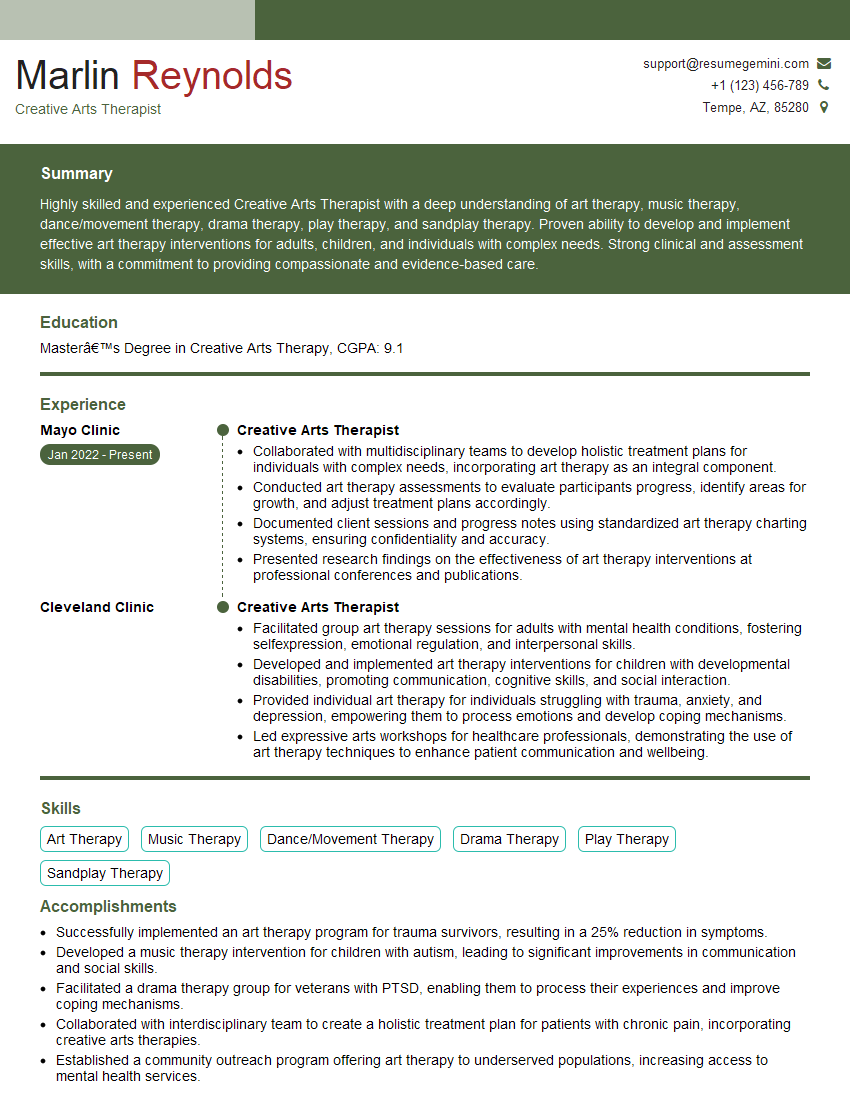
Mastering Applied Theatre opens doors to diverse and fulfilling careers, impacting lives through creative engagement and social change. To maximize your job prospects, create a compelling and ATS-friendly resume that showcases your skills and experience effectively. ResumeGemini is a trusted resource to help you build a professional resume that stands out. We offer examples of resumes tailored to Applied Theatre professionals to guide you in crafting your own impactful application materials.
Explore more articles
Users Rating of Our Blogs
Share Your Experience
We value your feedback! Please rate our content and share your thoughts (optional).
What Readers Say About Our Blog
I Redesigned Spongebob Squarepants and his main characters of my artwork.
https://www.deviantart.com/reimaginesponge/art/Redesigned-Spongebob-characters-1223583608
IT gave me an insight and words to use and be able to think of examples
Hi, I’m Jay, we have a few potential clients that are interested in your services, thought you might be a good fit. I’d love to talk about the details, when do you have time to talk?
Best,
Jay
Founder | CEO