Unlock your full potential by mastering the most common Aviation Regulations and Standards Knowledge interview questions. This blog offers a deep dive into the critical topics, ensuring you’re not only prepared to answer but to excel. With these insights, you’ll approach your interview with clarity and confidence.
Questions Asked in Aviation Regulations and Standards Knowledge Interview
Q 1. Explain the difference between FAR Part 23 and FAR Part 25 aircraft certification.
FAR Part 23 and FAR Part 25 are both sets of regulations from the Federal Aviation Administration (FAA) governing the certification of aircraft, but they apply to different categories of airplanes. Think of it like this: Part 23 is for smaller, simpler airplanes, while Part 25 is for larger, more complex ones, often involving higher passenger capacities and more sophisticated systems.
FAR Part 23: This part covers the certification of normal, utility, acrobatic, and commuter category airplanes. These are generally smaller aircraft, often single-engine or with a maximum certificated takeoff weight below 12,500 lbs. The certification standards emphasize airworthiness and safety, but with a less stringent design and testing process than Part 25. A good example is a Cessna 172.
FAR Part 25: This part applies to transport category airplanes, which are larger, more complex airplanes designed for carrying passengers or cargo on a commercial basis. Think Boeing 737 or Airbus A320. Part 25 standards are far more rigorous, encompassing extensive design analyses, extensive testing procedures (including flight testing), and meticulous documentation to ensure the highest level of safety and reliability. The certification process is significantly more complex and time-consuming.
The key difference boils down to the level of complexity and safety requirements. Part 25 aircraft undergo much more stringent scrutiny due to the increased risks associated with their size, passenger capacity, and operational complexity.
Q 2. Describe the process for obtaining an Airworthiness Certificate.
Obtaining an Airworthiness Certificate is a crucial step in ensuring an aircraft is safe for flight. The process involves a thorough inspection and verification of the aircraft’s airworthiness against established regulations. It’s like getting a health check-up for your airplane!
Pre-Application Phase: This involves preparing all necessary documentation, including the aircraft’s registration, maintenance records, and any modifications performed. A detailed inspection is also carried out by a qualified mechanic.
Application Submission: The completed application and supporting documents are submitted to the relevant aviation authority (e.g., FAA in the United States).
Inspection and Verification: An aviation inspector will conduct a thorough inspection of the aircraft to ensure it meets all airworthiness requirements. This includes checking the aircraft’s structure, systems, and documentation.
Issuance of Certificate: If the aircraft passes the inspection, the aviation authority will issue an Airworthiness Certificate, validating that the aircraft is safe for flight. This certificate has to be renewed periodically as per regulatory requirements.
The specific requirements and process can vary depending on the country and the type of aircraft. But the fundamental principle remains the same: to ensure safety before an aircraft takes to the skies.
Q 3. What are the key elements of a Safety Management System (SMS)?
A Safety Management System (SMS) is a proactive approach to managing safety risks within an aviation organization. It’s not just about reacting to accidents, but about actively identifying, assessing, and mitigating hazards before they cause incidents. Think of it as preventative medicine for an airline or airport.
Safety Policy: A formal statement of the organization’s commitment to safety, setting the tone and direction for the SMS.
Safety Risk Management: A systematic process of identifying hazards, analyzing risks, and implementing control measures to reduce their likelihood or impact.
Safety Assurance: Monitoring the effectiveness of the SMS through audits, inspections, and performance indicators. It’s about checking if the preventive measures are working.
Safety Promotion: Encouraging a safety-conscious culture through training, communication, and reporting mechanisms. Creating a culture of open communication and feedback is vital.
A successful SMS requires commitment from all levels of the organization, from management to front-line personnel. Regular reviews and updates are essential to adapt to changing circumstances and evolving risks within the industry.
Q 4. How do you ensure compliance with ICAO Annex 6?
ICAO Annex 6, Operations of Aircraft, outlines international standards and recommended practices for the safe operation of aircraft. Compliance is crucial for ensuring global interoperability and safety in aviation. It’s a global rulebook!
Ensuring compliance involves a multi-faceted approach:
Implementation of Regulations: National aviation authorities must adopt and implement the relevant parts of Annex 6 into their national regulations. They must align their standards with those defined by ICAO.
Operational Procedures: Airlines and other aviation operators must develop and implement operational procedures that adhere to the standards laid out in Annex 6. This includes flight planning, crew resource management, and aircraft maintenance.
Training and Certification: Personnel involved in aircraft operations must undergo appropriate training and certification to ensure they are competent to perform their duties according to Annex 6 standards. Pilots, air traffic controllers, maintenance engineers all fall under this requirement.
Audits and Inspections: Regular audits and inspections are conducted to verify ongoing compliance with Annex 6 requirements. This acts as a check-up to ensure no deviation is happening.
Continuous Improvement: A commitment to continuous improvement is essential, involving regular review and updates of procedures and training based on operational experience and safety data analysis. Safety is a constant, iterative process.
Non-compliance can result in serious consequences, including operational restrictions, grounding of aircraft, and even international sanctions.
Q 5. Explain the role of a Designated Engineering Representative (DER).
A Designated Engineering Representative (DER) acts as an authorized agent of the FAA (or equivalent authority in other countries), specializing in a particular area of aircraft design or maintenance. They are highly skilled engineers with extensive experience in aviation. Think of them as expert consultants working within the regulatory framework.
Their roles include:
Reviewing Design Changes: DERs evaluate proposed design modifications to aircraft or components, ensuring they meet airworthiness standards.
Approving Maintenance Practices: They can approve innovative maintenance procedures or techniques, provided they maintain airworthiness.
Providing Technical Expertise: DERs offer their expertise to the aviation authority during investigations or certification processes, providing technical insights to ensure efficient and informed decision-making.
Issuing Authorizations: In some cases, they may issue specific authorizations, allowing for deviations from standard practices while maintaining safety. This is done judiciously and requires sufficient justification.
Essentially, DERs provide a bridge between the aviation industry’s need for innovation and the regulatory framework, ensuring that technical advancements are implemented safely and in accordance with established standards.
Q 6. Describe the different classes of airspace and their associated regulations.
Airspace is categorized into different classes to manage air traffic safely and efficiently, based on factors like the density of traffic, terrain complexity, and the presence of obstacles. It’s like zoning for the sky.
Class A: This is the highest altitude airspace, typically above 18,000 feet in the United States. Instrument flight rules (IFR) are mandatory, with precise air traffic control separation standards. It’s where most long-haul flights operate.
Class B: This airspace surrounds major airports, characterized by high traffic density and complex operations. IFR is normally required and there is close air traffic control guidance.
Class C: Similar to Class B, but usually with lower traffic volume, and reduced control requirements. IFR is required in some cases.
Class D: Surrounds smaller airports with operational control towers, usually having less traffic compared to Class B and C. Flight rules depend on the conditions.
Class E: This airspace extends from the surface up to 14,500 feet in non-controlled areas. Flight rules are generally dependent upon the aircraft’s instrumentation and the weather conditions.
Class G: Uncontrolled airspace, below 1,200 feet above ground level. Visual flight rules (VFR) are typically used but instrument flight may also be conducted.
Each class has specific regulations related to flight visibility, cloud clearance, communication requirements, and aircraft separation. Pilots must be familiar with the regulations for each airspace class they are operating in. Failure to adhere to these regulations can have serious safety implications.
Q 7. What are the requirements for maintaining an aircraft’s flight log?
Maintaining accurate and up-to-date flight logs is vital for ensuring aircraft safety and regulatory compliance. It provides a comprehensive record of an aircraft’s operational history, including maintenance and flight time. This is the airplane’s personal journal!
Key requirements typically include:
Date and Time: Precise start and end times of each flight.
Aircraft Identification: Registration number of the aircraft.
Departure and Arrival Airports: Precise identification of locations.
Flight Time: Total flight time, including flight legs.
Pilot-in-Command: Identification of the pilot in charge.
Number of Passengers and Cargo: A record of what was carried on-board.
Fuel Used: Record of fuel consumption for each leg.
Maintenance Entries: Any maintenance actions must also be recorded in the flight log, this can include pre-flight checks or other required checks.
Flight logs must be meticulously maintained, signed by appropriate personnel, and stored securely. Incomplete or inaccurate records can result in penalties and affect the validity of the aircraft’s Airworthiness Certificate.
Q 8. Explain the process for reporting a maintenance discrepancy.
Reporting a maintenance discrepancy is crucial for ensuring aircraft airworthiness and safety. The process typically involves several steps, starting with the discovery of the issue. This could be anything from a malfunctioning light to a more serious mechanical problem. Once identified, the discrepancy is documented using a standardized form, often called a maintenance discrepancy report (MDR) or a similar type of logbook entry. This report will detail the nature of the problem, its location, and the severity (e.g., AOG – Aircraft on Ground, delaying, or deferred).
Next, the MDR is submitted to the appropriate maintenance personnel. The urgency of the report dictates how quickly it needs to be addressed. A critical discrepancy (like a failed engine component) requires immediate action, while a less urgent issue (e.g., a minor cosmetic defect) can be scheduled for later maintenance. The maintenance team then investigates, repairs, or replaces the faulty component. Once the work is completed, it’s documented in the aircraft logbook, and the MDR is closed out. A copy is generally retained by the maintenance department as a permanent record.
For example, imagine a pilot noticing an unusual vibration during flight. They’d immediately report this as a discrepancy, noting the time, flight conditions, and any other relevant information. The maintenance crew would then thoroughly inspect the aircraft, potentially uncovering a loose part or imbalance in the rotor system (for a helicopter) or a problem with an engine component (for a fixed-wing aircraft).
Q 9. What are the limitations of a pilot’s medical certificate?
A pilot’s medical certificate has limitations that depend on the class of certificate (e.g., First-Class, Second-Class, Third-Class) and any specific limitations imposed by the issuing authority. These certificates are not indefinite; they have an expiry date and require regular medical examinations to ensure the pilot’s fitness for flying. The limitations often relate to specific medical conditions that might impair a pilot’s ability to perform their duties safely.
For instance, a pilot with a history of heart problems might have limitations on the type of flying they can do, or they might require more frequent medical checks. Similarly, vision limitations can restrict a pilot to flying only with corrective lenses or might prohibit night flying altogether. Use of medication, even over-the-counter drugs, can also result in limitations or restrictions on a pilot’s ability to fly. Any condition affecting cognitive function or physical coordination is carefully reviewed to determine suitability for flight.
A pilot must adhere to these limitations strictly. Operating an aircraft outside the bounds of their medical certificate is a serious violation of aviation regulations and can lead to severe penalties, including suspension or revocation of their license.
Q 10. Describe the procedures for handling an in-flight emergency.
In-flight emergencies require immediate, decisive action based on the specific situation. The procedure generally follows a structured approach, prioritizing safety and minimizing risk. It starts with identifying the emergency and its severity. This might be an engine failure, a fire, a loss of cabin pressure, or a medical emergency on board.
Next, the pilot will follow emergency checklists specific to the type of aircraft and the nature of the problem. These checklists provide step-by-step instructions for dealing with the emergency. Simultaneously, the pilot will contact air traffic control (ATC) to declare an emergency, providing information about the situation and requesting assistance.
Depending on the situation, the pilot might attempt to rectify the problem, divert to the nearest suitable airport, or initiate emergency procedures like deploying life rafts or emergency oxygen masks. Maintaining communication with ATC and following their instructions is critical throughout the process. After a safe landing, a thorough investigation is usually conducted to determine the cause of the emergency and to implement preventative measures to avoid similar incidents in the future. Effective communication with the crew and passengers is essential, reassuring them and conveying clear instructions on how to respond.
Q 11. Explain the concept of ‘risk mitigation’ in aviation.
Risk mitigation in aviation focuses on identifying potential hazards and implementing strategies to reduce the likelihood or severity of accidents and incidents. It’s a proactive approach rather than reactive. It involves several key steps:
- Hazard Identification: Identifying potential hazards, both operational (e.g., weather, mechanical failure) and human factors (e.g., fatigue, stress).
- Risk Assessment: Analyzing the likelihood and severity of each identified hazard, leading to a risk rating.
- Risk Control: Implementing measures to reduce the risk, such as procedural changes, technological advancements, or training programs. This might involve eliminating the hazard, reducing its likelihood, or mitigating its consequences.
- Monitoring and Review: Continuously monitoring the effectiveness of risk control measures and making adjustments as needed.
For example, if a particular runway approach is identified as having a higher-than-average accident rate due to challenging terrain, risk mitigation might involve implementing new navigational aids, improving pilot training for that specific approach, or even modifying the approach procedure itself.
Q 12. How do you interpret and apply the principles of human factors in aviation safety?
Human factors in aviation encompass the psychological, physiological, and organizational influences on pilot and aircrew performance. Applying these principles means understanding how human limitations and capabilities affect safety. It involves recognizing that humans are fallible and prone to errors. We must design systems and procedures that accommodate those limitations and minimize the potential for errors to lead to accidents.
Examples include designing cockpits with intuitive controls, providing clear and concise information displays, implementing effective crew resource management (CRM) training, and understanding how factors like fatigue, stress, and workload can impact decision-making. CRM training emphasizes teamwork, communication, and leadership to ensure a safe and efficient operation. Fatigue management focuses on ensuring adequate rest for flight crews, while workload management involves designing procedures to keep the crew’s cognitive load at a manageable level. The goal is to create a safer operating environment by anticipating human error and designing systems to mitigate its effects.
Q 13. What are the key elements of an effective aviation safety investigation?
An effective aviation safety investigation aims to determine the cause of an accident or incident, to prevent similar events in the future. Key elements include:
- Gathering Evidence: This involves meticulously collecting data from various sources—the aircraft’s flight recorders (FDR and CVR), witness statements, air traffic control recordings, maintenance records, and weather data.
- Analyzing Data: The collected data is analyzed to identify contributing factors and to establish a timeline of events. This often involves using sophisticated analytical techniques and specialized software.
- Determining Cause: The investigation team carefully determines the root cause(s) of the accident or incident, going beyond the immediate factors to identify underlying issues.
- Safety Recommendations: Based on the findings, the investigation team provides specific safety recommendations to prevent future occurrences. These may involve changes to regulations, procedures, training programs, or aircraft design.
- Transparency and Objectivity: The investigation should be conducted impartially and transparently, with findings and recommendations made public to promote learning and improvement within the aviation industry.
A thorough investigation considers not only human factors but also technical, environmental, and organizational factors. The goal isn’t to assign blame but to understand how the accident happened and to prevent it from happening again.
Q 14. Explain the role of the flight data recorder (FDR) and cockpit voice recorder (CVR).
The Flight Data Recorder (FDR) and Cockpit Voice Recorder (CVR) are crucial safety devices mandated on most commercial aircraft. They provide invaluable information during accident investigations.
The FDR records a vast amount of data about the aircraft’s flight, including airspeed, altitude, heading, engine parameters, control surface positions, and more. This data is essential in reconstructing the flight path and identifying any anomalies that may have contributed to the accident. The CVR records the conversations between pilots, the cockpit environment sounds (including alarms), and the radio communications with air traffic control. It offers insights into crew actions, decisions, and communications during critical phases of flight.
Together, the FDR and CVR provide a comprehensive record of the events leading up to and during an accident, offering crucial evidence for investigators to understand the sequence of events, identify contributing factors, and make recommendations to improve aviation safety. They are often considered the ‘black boxes’ of an aircraft, although they are typically orange to aid in their location after a crash.
Q 15. What is the difference between a major and minor repair on an aircraft?
The distinction between major and minor repairs on an aircraft hinges on the impact on its airworthiness. A major repair is defined as any repair that affects the structural integrity, performance, or flight characteristics of the aircraft in a significant way. It often requires specialized tools, expertise, and meticulous documentation, often necessitating approval from the relevant aviation authority. Think of it as a surgery – a substantial intervention requiring a high degree of skill. A minor repair, on the other hand, is a less significant alteration, typically involving cosmetic fixes or simple component replacements that don’t compromise the aircraft’s overall safety or operational capabilities. An analogy might be patching a small hole versus replacing a damaged wing. Examples of major repairs could include replacing a section of a wing spar or performing an overhaul on a critical engine component. Minor repairs would include patching a small dent in the fuselage or replacing a faulty light bulb.
- Major Repair Examples: Overhaul of an engine, replacement of a major structural component (e.g., wing spar), significant fuselage repair.
- Minor Repair Examples: Replacing a small section of damaged skin, repairing a minor dent, replacing a light or a small electrical component.
Career Expert Tips:
- Ace those interviews! Prepare effectively by reviewing the Top 50 Most Common Interview Questions on ResumeGemini.
- Navigate your job search with confidence! Explore a wide range of Career Tips on ResumeGemini. Learn about common challenges and recommendations to overcome them.
- Craft the perfect resume! Master the Art of Resume Writing with ResumeGemini’s guide. Showcase your unique qualifications and achievements effectively.
- Don’t miss out on holiday savings! Build your dream resume with ResumeGemini’s ATS optimized templates.
Q 16. Describe your understanding of weight and balance calculations.
Weight and balance calculations are crucial for safe and efficient flight. They ensure the aircraft’s center of gravity (CG) remains within the approved limits specified by the manufacturer. An aircraft that’s too nose-heavy or tail-heavy can be difficult to control, potentially leading to stalls, loss of control, or even a crash. The process involves carefully calculating the weight of the aircraft, including fuel, passengers, cargo, and the aircraft itself. This is then used to determine the CG location. This calculation is usually done using a weight and balance form, which accounts for the weight and arm (distance from the datum) of each item. The datum is a reference point on the aircraft usually located on the fuselage. The process must be meticulously followed. In simpler terms, imagine balancing a seesaw. If you place too much weight on one side, it tips. Similarly, an aircraft needs its weight distributed correctly to maintain stability and control. Incorrect weight and balance can lead to significant performance issues, reduced fuel efficiency, and safety hazards. Airlines use specialized software for these computations, but the fundamental principles remain the same.
Q 17. Explain the significance of aircraft performance charts.
Aircraft performance charts are essential tools providing critical data on an aircraft’s capabilities under various conditions. These charts graphically display the relationship between factors like altitude, airspeed, temperature, weight, and runway length. They help pilots determine things such as safe takeoff and landing speeds, climb performance, fuel consumption, and the best flight profiles to maintain efficiency and safety. For example, a pilot needs to know the minimum takeoff speed for a given weight and runway length to avoid a situation where they can’t reach the required lift-off speed before running out of runway. These charts are not just for planning; they are also used during flight to ensure the aircraft is operated within its limitations, and hence, safely and effectively. These charts are specific to each aircraft model, and their accurate use requires training and experience.
Q 18. How do you ensure compliance with environmental regulations in aviation?
Compliance with environmental regulations in aviation involves minimizing the impact of aircraft operations on the environment. This includes reducing noise pollution, managing emissions (CO2, NOx, etc.), and preventing the discharge of pollutants. Specific measures include adherence to noise abatement procedures during takeoff and landing, using quieter aircraft, and implementing fuel-efficient flight strategies. Airlines continuously monitor emissions and implement technologies designed to reduce their environmental footprint. International organizations like ICAO (International Civil Aviation Organization) set standards and guidelines to promote environmentally responsible aviation practices. This extends to waste management, including the proper disposal of hazardous materials. Failure to comply can lead to substantial fines and operational restrictions.
Q 19. What is the role of the airport authority in ensuring safety and security?
Airport authorities play a vital role in ensuring safety and security through various measures. They are responsible for maintaining the infrastructure (runways, taxiways, terminals), implementing and enforcing safety regulations, providing air traffic control services, managing emergency response capabilities, and overseeing security protocols to prevent unauthorized access and terrorist acts. This includes screening passengers and baggage, deploying security personnel, and coordinating with law enforcement agencies. Airport authorities also work closely with airlines and other stakeholders to ensure compliance with safety and security standards. Regular inspections, training programs, and emergency drills are also vital elements of their function. Ultimately, their goal is to create a safe and secure environment for all airport users.
Q 20. Describe your experience with aircraft maintenance manuals and documentation.
Aircraft maintenance manuals (AMMs) and other documentation are the cornerstones of safe and compliant aircraft maintenance. AMMs are highly detailed technical documents providing step-by-step instructions for all aspects of aircraft maintenance, from routine inspections to complex repairs. They contain schematics, diagrams, and parts lists, ensuring technicians perform maintenance correctly. Throughout my career, I have extensively used AMMs to troubleshoot malfunctions, plan maintenance tasks, and ensure adherence to regulatory standards. Proper documentation is equally crucial, recording all maintenance actions, parts used, and inspection results. This documentation is essential for tracking aircraft history, proving compliance with regulations, and facilitating efficient maintenance planning. The accuracy and completeness of this documentation are paramount for maintaining the airworthiness of the aircraft and ensuring that the maintenance history can be easily tracked and verified. My experience includes utilizing both printed and digital AMMs and maintaining meticulous records.
Q 21. What is your understanding of aviation security regulations?
Aviation security regulations are designed to prevent acts of unlawful interference against civil aviation. These regulations cover a wide range of areas, including passenger and baggage screening, cargo security, access control to airside areas, and the protection of aircraft from sabotage. These regulations are largely based on international standards set by the ICAO and implemented nationally through legislation and regulations. They include detailed procedures for security checks, the use of advanced technologies (such as X-ray machines and explosive detection systems), and the training of security personnel. Compliance with these regulations is strictly enforced through audits and inspections, and non-compliance can lead to severe penalties. The aim is to mitigate risks from various threats to the safety and security of air travel.
Q 22. Explain the concept of ‘sterile cockpit’ and its importance.
The ‘sterile cockpit’ rule mandates that flight crew members refrain from non-essential activities during critical phases of flight, such as takeoff and landing, and during other specified periods. Think of it like this: a surgeon wouldn’t answer their phone during a critical operation; similarly, pilots need to maintain complete focus during these demanding times.
Its importance lies in enhancing safety by minimizing distractions. During critical phases, even seemingly minor distractions like casual conversation or adjusting the radio can impair the pilot’s ability to react to unexpected events. The rule reduces the risk of human error, a major contributor to aviation accidents.
For example, a conversation about weekend plans might seem inconsequential, but it could cause a pilot to miss a crucial warning or delay their reaction to a sudden change in weather conditions. The sterile cockpit rule helps create a focused environment where pilots can effectively manage the complex demands of flight.
Q 23. Describe different types of aviation accidents and their causes.
Aviation accidents are broadly classified into several types, often with overlapping causes. These include:
- Controlled Flight Into Terrain (CFIT): This occurs when an airworthy aircraft is flown unintentionally into terrain, water, or an obstacle. Poor situational awareness, inadequate navigation, or pilot fatigue are common causes.
- Loss of Control In-Flight (LOC-I): This involves an accident resulting from the inability of the flight crew to maintain control of the aircraft. This can stem from mechanical failure, adverse weather conditions, or pilot error.
- Mid-air collisions: These occur when two or more aircraft collide in flight. Traffic management failures, inadequate pilot awareness, or communication breakdowns are contributing factors.
- Runway excursions: This involves an aircraft leaving the runway during takeoff or landing. Issues such as poor visibility, runway contamination, mechanical malfunctions, or pilot error are typical causes.
Ultimately, most aviation accidents are attributed to a combination of factors rather than a single cause. A thorough investigation, using tools like the ‘Swiss Cheese Model’, which identifies latent failures in the system that allowed the accident to occur, is crucial to understanding the complex interplay of contributing factors.
Q 24. How do you apply principles of aviation meteorology in decision-making?
Aviation meteorology plays a vital role in flight safety and operational efficiency. Pilots and flight dispatchers use meteorological information to make informed decisions about flight planning, routing, and execution. Understanding weather patterns is crucial.
For example, before a flight, I would consult weather forecasts and charts to assess potential hazards like thunderstorms, icing conditions, and strong winds. This informs decisions on:
- Route selection: Choosing a route that avoids severe weather or optimizes fuel efficiency based on wind conditions.
- Altitude selection: Selecting an altitude to minimize turbulence or icing.
- Departure and arrival times: Adjusting flight schedules to avoid peak weather activity.
- Go/No-Go decision: Determining whether a flight should proceed based on the overall weather assessment.
Real-time weather updates during flight also play a crucial role in in-flight decision-making, potentially requiring route alterations or diversions to ensure passenger and crew safety.
Q 25. Explain your understanding of aviation fuel regulations and handling.
Aviation fuel regulations are stringent to ensure safety and prevent hazards. These regulations cover various aspects, from fuel quality and storage to handling and dispensing. Fuel must meet strict specifications to ensure proper combustion and prevent engine damage.
Fuel storage requires appropriate facilities to prevent contamination and spills. Strict procedures govern fuel handling, including the use of specialized equipment and trained personnel. Improper handling can lead to contamination with water or other substances, causing engine malfunctions.
For example, a common regulation is the requirement for fuel testing before use to ensure it meets quality standards. Furthermore, detailed procedures prevent mixing different grades of fuel, which could damage the engine.
Compliance with these regulations is monitored through audits and inspections to ensure ongoing safety and operational reliability.
Q 26. Describe the process for obtaining an operational flight permit.
Obtaining an operational flight permit (OFP) is a complex process that varies depending on the aircraft type, intended operation, and the regulatory authority. Generally, it involves:
- Application submission: Submitting a comprehensive application to the relevant aviation authority, including detailed information about the aircraft, its maintenance records, the intended operation, and the operational personnel.
- Aircraft inspection: A thorough inspection of the aircraft to ensure it meets airworthiness standards and is equipped with the necessary operational systems.
- Operational evaluation: An assessment of the operator’s organizational structure, safety management system, and operational procedures.
- Personnel qualification: Verification of the qualifications and training of flight crew and maintenance personnel.
- Permit issuance: Upon successful completion of all the steps, the aviation authority issues the operational flight permit.
Throughout this process, adherence to all applicable regulations and standards is mandatory. Failure to meet these requirements can lead to delays or refusal of the permit.
Q 27. How would you handle a situation involving a conflict between regulations and operational needs?
Conflicts between regulations and operational needs can arise, demanding careful consideration and a structured approach. My priority is always safety, but I must also consider the practicalities.
My approach would involve:
- Thorough assessment: Carefully examine the regulatory requirements and the operational necessities to fully understand the conflict.
- Risk analysis: Evaluate the potential risks associated with both complying with the regulation and deviating from it. This includes considering the likelihood and severity of potential consequences.
- Documentation: Meticulously document the situation, including the conflict, the risk assessment, and the proposed solution.
- Communication: Engage in clear and transparent communication with the relevant authorities to discuss the conflict and seek guidance or approval for any necessary deviations from the regulations. This is crucial; trying to find workarounds without the proper channels creates massive safety risks.
- Mitigation strategies: Develop and implement mitigation strategies to minimize any risks associated with the chosen course of action. This might involve alternative procedures or additional safety measures.
Ultimately, the goal is to find a solution that ensures safety without compromising operational viability. In most cases, this involves proactive communication and a commitment to adhering to the spirit of regulations while handling exceptions with transparency and appropriate justification.
Key Topics to Learn for Aviation Regulations and Standards Knowledge Interview
- Airworthiness Directives (ADs): Understanding the process of issuing, complying with, and interpreting ADs, including their impact on maintenance and flight operations. Consider practical scenarios involving AD compliance and potential consequences of non-compliance.
- Flight Operations Regulations: Familiarize yourself with regulations governing various aspects of flight operations, such as flight planning, dispatch, and crew resource management (CRM). Practice applying these regulations to hypothetical flight scenarios to solidify your understanding.
- Safety Management Systems (SMS): Grasp the principles and practical application of SMS in aviation, including hazard identification, risk assessment, and mitigation strategies. Explore case studies demonstrating successful SMS implementation.
- International Civil Aviation Organization (ICAO) Standards and Recommended Practices (SARPs): Develop a comprehensive understanding of key ICAO SARPs and their relevance to national regulations. Consider how these international standards influence operational procedures.
- Regulatory Compliance and Auditing: Learn about the processes involved in ensuring regulatory compliance and conducting internal and external audits. Understand the role of documentation and record-keeping in maintaining compliance.
- Accident Investigation and Reporting: Familiarize yourself with accident investigation methodologies and reporting requirements. Explore the role of human factors in aviation accidents and incidents.
- Specific Regulatory Bodies and their functions (e.g., FAA, EASA, CASA): Understand the roles and responsibilities of major aviation regulatory bodies and how their regulations differ.
Next Steps
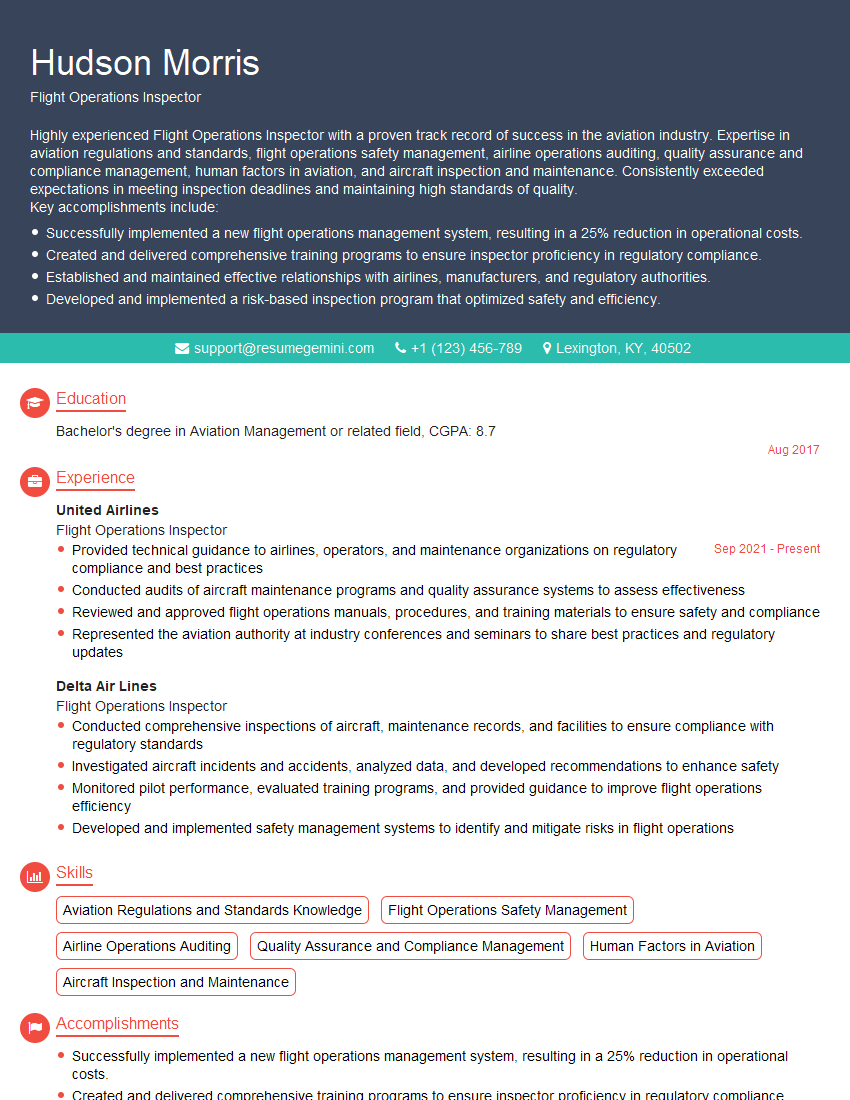
Mastering Aviation Regulations and Standards Knowledge is crucial for career advancement in the aviation industry. A strong understanding of these regulations demonstrates your commitment to safety and compliance, opening doors to higher-level positions and greater responsibilities. To maximize your job prospects, creating an ATS-friendly resume is paramount. ResumeGemini can significantly enhance your resume-building experience by providing tools and resources to create a professional and impactful document that highlights your skills and experience effectively. ResumeGemini offers examples of resumes tailored specifically to Aviation Regulations and Standards Knowledge, ensuring your application stands out from the competition. Take the next step in your career journey – build a winning resume with ResumeGemini.
Explore more articles
Users Rating of Our Blogs
Share Your Experience
We value your feedback! Please rate our content and share your thoughts (optional).
What Readers Say About Our Blog
I Redesigned Spongebob Squarepants and his main characters of my artwork.
https://www.deviantart.com/reimaginesponge/art/Redesigned-Spongebob-characters-1223583608
IT gave me an insight and words to use and be able to think of examples
Hi, I’m Jay, we have a few potential clients that are interested in your services, thought you might be a good fit. I’d love to talk about the details, when do you have time to talk?
Best,
Jay
Founder | CEO