Feeling uncertain about what to expect in your upcoming interview? We’ve got you covered! This blog highlights the most important Basic knowledge of marine electrical systems interview questions and provides actionable advice to help you stand out as the ideal candidate. Let’s pave the way for your success.
Questions Asked in Basic knowledge of marine electrical systems Interview
Q 1. What are the main components of a marine electrical system?
A marine electrical system, much like a house’s electrical system, requires several key components to function safely and effectively. Think of it as a network delivering power to various devices on board.
- Power Source: This is typically the main battery bank (often 12V DC or 24V DC), providing the primary power for the vessel. Larger boats may also have AC generators for shore power or additional power demands.
- Battery Charger: This component converts AC power (from shore power or a generator) to DC power to recharge the batteries.
- Distribution Panel: This acts as the central hub, distributing power to different circuits throughout the boat via circuit breakers or fuses.
- Wiring: Marine-grade wiring, carefully routed and secured, connects all components and appliances. This is critical for safety and longevity.
- Circuit Breakers & Fuses: These safety devices protect the wiring and appliances from overloads and short circuits. They act like tiny safety valves in the system.
- Loads: These are the devices that consume power, such as lights, bilge pumps, navigation equipment, and appliances.
- Grounding System: Essential for safety, this system provides a return path for electricity to the source, preventing stray currents and shocks.
Imagine a simple scenario: you turn on your navigation lights. The power flows from the battery, through the distribution panel, along the wiring to the lights, and then back to the battery via the grounding system.
Q 2. Explain the difference between AC and DC power in marine applications.
Marine systems use both AC (Alternating Current) and DC (Direct Current) power, each with its distinct advantages and applications. Think of it like having two different types of plumbing in your boat.
- DC Power: This is typically used for smaller appliances and systems that directly draw power from the batteries. It’s what powers your lights, bilge pumps, and electronic devices. DC is generally lower voltage (12V or 24V) and safer for direct use on board. It’s like using low-pressure water pipes.
- AC Power: This is often obtained from shore power (when plugged into a dock) or a generator. It’s used to power larger appliances like air conditioners, microwaves, and some entertainment systems. It’s generally higher voltage (120V or 240V), so it needs to be converted to DC for most onboard uses (using an inverter for example). It’s like using higher-pressure water pipes in other sections of the system.
The difference lies in the direction of electron flow: DC flows in one direction, while AC alternates its direction periodically. Most modern boats utilize a combination of both for efficient power distribution.
Q 3. Describe the function of a marine battery charger.
A marine battery charger’s primary function is to convert AC power from shore power or a generator into DC power to safely charge the boat’s batteries. Imagine it as a specialized ‘power-refueling’ station for your boat’s power supply. It’s critical for maintaining the battery’s health and ensuring you have sufficient power for all onboard systems.
These chargers typically include features like voltage regulation, to prevent overcharging that damages batteries; and current limiting, to protect against short circuits. Some advanced models have several charging stages to optimize the charging process, for instance, a bulk charging phase followed by a float charging phase to maximize battery lifespan.
Q 4. How do you troubleshoot a faulty circuit breaker?
Troubleshooting a faulty circuit breaker involves a systematic approach. Think of it as diagnosing a problem in your home’s electrical system. Here’s a step-by-step guide:
- Safety First: Turn off the main power source to the affected circuit before any inspection or repair work.
- Visual Inspection: Examine the circuit breaker. Look for any obvious signs of damage, such as burning, melting, or discoloration.
- Check the Breaker Position: Is the breaker completely tripped (in the “off” position)? If so, carefully reset it.
- Test the Circuit: If the breaker trips again immediately, there’s a problem with the circuit itself—likely a short circuit or an overload. Do not repeatedly reset the breaker.
- Isolate the Problem: Unplug or switch off every device connected to that circuit one by one. If the breaker stays on after disconnecting a device, you’ve found the faulty appliance.
- Inspect Wiring: If no single appliance is causing the problem, you may need to inspect the wiring for damage such as loose connections, chafing, or rodent damage.
- Professional Help: If you are unsure about any step, or if you can’t find the fault, contact a qualified marine electrician. Attempting repairs without the necessary knowledge can be dangerous.
Q 5. What are the safety precautions when working with marine electrical systems?
Working with marine electrical systems requires strict adherence to safety protocols. Think of it as handling high-voltage power, potentially in a wet or corrosive environment—safety is paramount.
- Disconnect Power: Always disconnect the power source before working on any component. This can be achieved by switching off the relevant breakers or disconnecting the battery terminals.
- Wear Appropriate PPE: Use insulated tools, safety glasses, and rubber gloves to protect yourself from electric shocks.
- Avoid Moisture: Ensure your workspace is dry and that you avoid contact with water or moisture.
- Ventilation: Work in well-ventilated spaces to avoid exposure to potentially harmful fumes from batteries or wiring insulation.
- Use Proper Tools: Employ only tools suitable for electrical work, and ensure they are properly insulated.
- Know Your Limits: If you are not confident in your skills or knowledge, consult a qualified marine electrician. Safety should never be compromised.
Q 6. Explain the importance of grounding and bonding in marine electrical systems.
Grounding and bonding are crucial for safety and the proper functioning of a marine electrical system. Think of grounding as the electrical ‘earth’ connection, providing a safe return path for electricity, while bonding connects metallic parts to create a single electrical potential to prevent corrosion and galvanic reactions.
- Grounding: This provides a path for fault currents to flow back to the source, preventing dangerous stray voltages and electric shocks. A properly grounded system ensures that if a fault occurs, the current is safely directed to the earth, not through you or equipment.
- Bonding: This connects various metallic parts of the boat, such as engine components, fuel tanks, and hull fittings, to a common electrical potential. It prevents voltage differences between these parts, which can cause corrosion or galvanic action (electrochemical corrosion). A good bonding system creates a unified electrical environment, reducing the likelihood of stray currents causing galvanic corrosion issues.
Without proper grounding and bonding, there is a substantial risk of electric shocks, fire hazards, and corrosion that will shorten the life and safety of your vessel.
Q 7. What is the purpose of a voltage regulator?
A voltage regulator’s main job is to maintain a consistent and stable DC voltage output from a power source, usually a generator or alternator. Think of it as a pressure regulator for your boat’s electrical system. Without it, voltage fluctuations can damage sensitive electronics and shorten battery life.
Voltage regulators prevent overcharging of batteries by limiting the output voltage from the generator or alternator to a safe level. They ensure that the batteries are charged efficiently and without damage. In essence, it acts as a safeguard, preventing the system from either over-volting or under-volting, ensuring the longevity of equipment and safety.
Q 8. How do you test the voltage and amperage of a circuit?
Testing voltage and amperage is fundamental to marine electrical system maintenance. Voltage measures the electrical potential difference, while amperage measures the rate of electrical current flow. We use a multimeter for both.
To measure voltage, select the DC voltage setting on your multimeter (most marine systems are DC). Carefully connect the probes – usually red to positive (+) and black to negative (-) – across the terminals of the component you’re testing. The reading displays the voltage. For example, a car battery should read around 12.6V when fully charged.
Measuring amperage requires a bit more care. You need to place the multimeter in series with the circuit, meaning you interrupt the circuit to insert the meter. This is often done with an inline ammeter. Never attempt to measure amperage without disconnecting the load, unless you are using a clamp meter capable of measuring current in-line without breaking the circuit. Ensure your multimeter is set to the appropriate DC amperage range. Start with a higher range and decrease if necessary to get a precise reading. Incorrect range selection can damage the meter.
Always remember safety! Disconnect the power before working with any electrical components and follow appropriate precautions to avoid electrical shock.
Q 9. Describe different types of marine wire and cable.
Marine wire and cable must withstand harsh conditions like saltwater, UV exposure, and vibration. Several types exist, each with specific characteristics:
- Tinned copper wire: Offers good conductivity and corrosion resistance, often used for smaller circuits.
- Tinned copper stranded wire: More flexible than solid wire, ideal for applications requiring movement. This is common in wiring harnesses.
- Antifungal wire: Designed to resist fungal growth, crucial in humid marine environments.
- Ultra-violet (UV) resistant wire: Protects against sun damage, vital for exposed wiring runs on deck.
- Tinned copper multi-strand cable: Larger-gauge cables, used for higher current applications like the engine’s starting system.
- Marine-grade power cables: These are usually thicker and more heavily insulated to handle high amperage. They’re often color-coded by voltage rating.
The choice of wire depends on factors like amperage, voltage, and the installation environment. Undersized wire can overheat and create a fire hazard. Always consult wiring diagrams and use the correct gauge.
Q 10. What are the common causes of electrical fires on boats?
Electrical fires on boats are serious and can quickly escalate due to confined spaces. Common causes include:
- Overloaded circuits: Drawing too much current from a circuit exceeds its capacity, leading to overheating and fire.
- Loose connections: Poor connections create resistance, generating heat and potentially sparking a fire.
- Damaged insulation: Chafing, rodent damage, or deterioration exposes wires, allowing shorts and potentially fires.
- Improper wiring: Incorrectly sized wires, improper termination, and poor installation practices can result in overheating.
- Faulty electrical components: Malfunctioning switches, breakers, or other components may malfunction and cause overheating.
- Corrosion: Saltwater corrosion can compromise the integrity of wiring, leading to shorts and fires.
Regular maintenance, proper sizing of wires, appropriate circuit protection, and the use of high-quality components and materials are crucial for preventing electrical fires. A well-maintained electrical system is paramount to boat safety.
Q 11. Explain the function of a marine bilge pump.
A marine bilge pump is an essential safety device that removes water from the bilge – the lowest point in a boat’s hull. Water can accumulate due to rain, leaks, or condensation. The pump typically runs automatically when the water level reaches a certain point, using a float switch. Some have manual overrides.
Bilge pumps are categorized as electric or manual. Electric pumps are powered by the boat’s DC system and are more common due to their efficiency. Manual pumps require hand cranking, offering a backup in case of electrical failure. They are less common due to time and effort required during emergencies. The key functionality is removing water and preventing flooding, maintaining the boat’s stability and preventing damage.
Q 12. How do you troubleshoot a malfunctioning navigation light?
Troubleshooting a malfunctioning navigation light involves a systematic approach:
- Check the bulb: The simplest cause. Replace it with a known good bulb of the correct type and wattage.
- Inspect the wiring: Look for any broken, frayed, or corroded wires. Pay attention to the connections at the light and the switch.
- Test the switch: Ensure the switch is operating correctly. If necessary, bypass the switch temporarily to confirm whether the issue lies in the switch or elsewhere.
- Check the circuit breaker or fuse: A blown fuse or tripped breaker indicates a short circuit or overload. Replace the fuse with the correct rating (do not use a higher rating as it might increase the risk of fire!) or reset the breaker, then inspect for underlying problems.
- Measure the voltage at the light: Use a multimeter to check if voltage is reaching the light. If not, trace the wiring back to the source to pinpoint the fault.
- Examine the ground connection: A poor ground connection can cause malfunctioning lights. Ensure a clean and secure ground connection.
If the problem persists after these steps, you may need professional assistance from a qualified marine electrician.
Q 13. What is the purpose of a marine alternator?
A marine alternator is a vital component that generates electrical power to recharge the boat’s batteries. Unlike a standard car alternator, marine alternators are often designed to handle vibration and corrosion common in the marine environment and typically regulated to prevent overcharging. They’re typically belt-driven by the engine.
The alternator converts mechanical energy from the engine into electrical energy. This energy is then regulated and used to power onboard systems and recharge the batteries, ensuring a reliable power supply while underway. When the engine is off, systems run from the battery’s stored energy.
Q 14. Explain how to select the appropriate size of wire for a given circuit.
Selecting the appropriate wire size is crucial for safety and performance. Undersized wire can overheat and cause fires, while oversized wire is wasteful and unnecessary. The American Wire Gauge (AWG) system is used. A lower AWG number indicates a larger wire diameter and higher current carrying capacity.
To determine the correct wire size, you need to know the amperage of the circuit and the length of the wire run. Consult an ampacity chart which shows the maximum current a wire of a given gauge can safely handle at a given temperature. Always add a safety factor to account for voltage drop along the wire length. There are many online calculators available to assist in this process. Choosing a correctly sized wire ensures your electrical system is both safe and efficient. Using an ampacity chart ensures the wire can handle the current flow without overheating.
Q 15. What are the different types of marine switches?
Marine switches, like their land-based counterparts, control the flow of electricity. However, the marine environment demands robust and reliable switches designed to withstand harsh conditions like moisture, salt spray, and vibration. Common types include:
- Toggle Switches: Simple on/off switches, often used for lights, pumps, and other smaller loads. Think of the classic light switch in your home, but built tougher.
- Rocker Switches: Similar to toggle switches but with a rocker-type action. These are often found in more modern installations and offer a more streamlined aesthetic.
- Push-button Switches: Momentary or maintained contact switches activated by a push. Momentary switches, like those activating a horn, only operate while pressed. Maintained switches, on the other hand, stay engaged until released.
- Rotary Switches: These switches offer multiple positions, allowing for various settings or functions (e.g., controlling different speeds of a blower). Imagine the selector switch on a washing machine, but again, marine-grade.
- Circuit Breakers: While also functioning as switches, circuit breakers serve the critical role of overcurrent protection, automatically disconnecting the circuit in case of a fault. More on these below.
The choice of switch depends on the application’s specific requirements, including the load’s power draw and the desired level of user control.
Career Expert Tips:
- Ace those interviews! Prepare effectively by reviewing the Top 50 Most Common Interview Questions on ResumeGemini.
- Navigate your job search with confidence! Explore a wide range of Career Tips on ResumeGemini. Learn about common challenges and recommendations to overcome them.
- Craft the perfect resume! Master the Art of Resume Writing with ResumeGemini’s guide. Showcase your unique qualifications and achievements effectively.
- Don’t miss out on holiday savings! Build your dream resume with ResumeGemini’s ATS optimized templates.
Q 16. Describe the function of a circuit breaker versus a fuse.
Both circuit breakers and fuses protect electrical circuits from overcurrents, preventing damage to equipment and reducing fire hazards. However, they achieve this in different ways:
- Fuse: A fuse contains a thin wire that melts and breaks the circuit when excessive current flows. Once blown, it needs to be replaced with a new fuse of the same rating. Think of it as a one-time sacrificial device. They are relatively inexpensive but require manual replacement after a fault.
- Circuit Breaker: A circuit breaker uses an electromagnet or thermal element to trip a switch mechanism that interrupts the current. Once the fault is cleared, the breaker can be reset and reused. This is much more convenient than replacing a fuse, particularly in hard-to-reach locations on a boat.
In short, fuses are simpler and cheaper, while circuit breakers are more convenient and reusable. Many modern marine systems utilize circuit breakers for their convenience, especially in larger vessels.
Q 17. How do you interpret marine electrical schematics?
Marine electrical schematics use standard electrical symbols, but with some additions specific to the marine environment. Understanding the symbols is crucial for troubleshooting. Here’s a breakdown:
- Symbols: Familiarize yourself with standard symbols for components like batteries, switches, lights, motors, and fuses. Numerous resources, including online guides and textbooks, provide detailed symbol lists.
- Wiring Diagrams: The diagram will show how these components are interconnected, usually with lines representing wires and their colors (color-coding is essential for identification). Follow the lines to trace the path of electricity.
- Bus Bars: These are depicted as heavy lines or bars and represent centralized distribution points for power.
- Grounding: Proper grounding symbols are critical in marine systems to ensure safety and prevent corrosion. Look for symbols indicating connections to the boat’s ground system.
- Protection Devices: Fuses and circuit breakers will be clearly identified, including their ratings.
Reading schematics is like following a map – practice makes perfect. Start by tracing the path of a particular circuit, such as the one powering the navigation lights, to understand its components and how they interact.
Q 18. What are the safety considerations for working in confined spaces with marine electrical systems?
Working in confined spaces with marine electrical systems presents significant safety risks. Here are key considerations:
- Ventilation: Ensure adequate ventilation to prevent the buildup of potentially explosive gases, especially in bilges or battery compartments. Poor ventilation can lead to asphyxiation or explosions.
- Permit-to-Work Systems: Follow strict permit-to-work procedures, isolating power before starting any work. This ensures that the system is completely de-energized and prevents accidental shocks.
- Personal Protective Equipment (PPE): Use appropriate PPE, including insulated gloves, eye protection, and non-conductive footwear. This is critical to minimize risks of electrical shock or injury.
- Gas Testing: Check for flammable and explosive gases before entering confined spaces using appropriate detection equipment. These checks should happen before and during the work.
- Emergency Procedures: Make sure emergency procedures are readily available and that personnel are trained on emergency response protocols for electrical incidents.
Always remember, safety is paramount. Neglecting these precautions can have serious, even fatal consequences.
Q 19. Explain the proper use of electrical testing equipment (multimeter, etc.).
A multimeter is an essential tool for diagnosing electrical problems. It measures voltage, current, and resistance. Here’s how to use it safely and effectively:
- Voltage Measurement: Set the multimeter to the appropriate voltage range (AC or DC) before connecting the probes. Always start with a higher range and then decrease it until you get a stable reading. Incorrectly selecting the voltage range can damage the meter.
- Current Measurement: Measuring current requires inserting the multimeter in series with the circuit. This involves breaking the circuit and connecting the probes in the break. Always ensure the multimeter is set to the correct current range; improper range selection can damage the meter. Current measurement is especially dangerous and should be done only by experienced technicians.
- Resistance Measurement: Ensure the circuit is completely de-energized before measuring resistance. The multimeter’s probes are connected across the component to measure its resistance. This allows identifying a broken wire or a faulty component.
- Safety: Always follow the manufacturer’s instructions. Use insulated probes and be aware of potential hazards like live circuits. Avoid touching the probes while the meter is connected to a live circuit.
Regular calibration of your multimeter is crucial to ensure accurate readings. Always treat your multimeter with care and store it properly to extend its lifespan and ensure reliable measurements.
Q 20. How do you identify and rectify common problems with marine wiring?
Troubleshooting marine wiring requires a systematic approach:
- Visual Inspection: Start with a thorough visual inspection for damaged insulation, loose connections, corrosion, or signs of overheating. This is often the easiest way to spot problems.
- Continuity Testing: Use a multimeter to check the continuity of wires. This helps identify broken wires or poor connections, indicating high resistance.
- Voltage Testing: Measure the voltage at different points in the circuit to identify where the voltage drops or is absent, thereby pinpointing the fault location.
- Current Measurement: In some cases, measuring current can help to identify overloads or shorts. This should only be done by experienced professionals with proper training.
- Tracing the Circuit: Carefully follow the circuit diagram to trace the path of the electricity. This helps ensure no other parts of the system are impacted.
Once the problem is identified, repairs should be made using appropriate marine-grade materials and techniques. Remember to always follow safe working practices, de-energizing the circuit before performing any repairs.
Q 21. What are the regulations and standards governing marine electrical installations?
Marine electrical installations are governed by a range of regulations and standards to ensure safety and reliability. These vary depending on the vessel’s size, type, and intended use but typically involve:
- ABYC (American Boat and Yacht Council): ABYC standards are widely recognized and adopted in North America. They cover various aspects of marine electrical systems, including wiring, grounding, and protection devices.
- IEC (International Electrotechnical Commission): IEC standards provide international guidelines and are often referenced in marine regulations. These are becoming more important for international vessels and commercial shipping.
- National and Regional Regulations: Many countries have their own specific regulations for marine electrical installations, which may supplement or modify international standards. It’s essential to research and comply with the applicable local regulations.
- Classification Societies: Classification societies, such as ABS (American Bureau of Shipping), DNV (Det Norske Veritas), and Lloyd’s Register, also issue regulations and guidelines that affect marine electrical installations, particularly for larger commercial vessels.
Failure to comply with these regulations can lead to legal repercussions and, more importantly, compromise the safety and reliability of the electrical system. Always consult the relevant standards and regulations for your specific vessel and location.
Q 22. Describe the different types of marine batteries and their applications.
Marine batteries are the heart of any boat’s electrical system, powering everything from navigation lights to engines. The most common types are flooded lead-acid, AGM (Absorbent Glass Mat), and gel cell batteries. Each has its strengths and weaknesses.
- Flooded Lead-Acid (FLA): These are the most traditional and often the least expensive. They require regular maintenance, including checking the electrolyte level and adding distilled water as needed. They’re generally suitable for less demanding applications where cost is a primary concern.
- Absorbent Glass Mat (AGM): AGM batteries use a fiberglass mat to absorb the electrolyte, eliminating the need for topping off with water. They are spill-proof, more resistant to vibration, and can handle deeper discharges than FLA batteries. They’re a popular choice for boats with moderate power demands.
- Gel Cell Batteries: Similar to AGM, gel cell batteries use a gelled electrolyte. They are even more vibration-resistant and spill-proof than AGM batteries, making them ideal for applications where shock and vibration are significant concerns, such as boats with rough seas.
Applications: FLA batteries might be found in older vessels or those with less demanding electrical needs. AGM batteries are a good all-around choice for most boats. Gel cell batteries are preferred in applications requiring high vibration resistance, such as trolling motors or windlass operation.
Q 23. Explain the process of installing a new marine electrical outlet.
Installing a marine electrical outlet requires careful planning and adherence to safety regulations. It’s crucial to use marine-grade components designed to withstand the harsh marine environment. Here’s a step-by-step process:
- Plan the location: Choose a location convenient for use and easily accessible, but also protected from water spray.
- Run the wiring: Use appropriately sized marine-grade wire, routing it carefully to avoid sharp edges and chafing. Secure the wiring with appropriate clamps and ties.
- Install the back box: Use a waterproof marine-grade back box and mount it securely to the surface.
- Wire the outlet: Connect the wires to the outlet according to the manufacturer’s instructions and wiring diagram. Ensure proper polarity (+ and -).
- Test the installation: Before sealing the outlet, test the circuit with a multimeter to ensure proper voltage and grounding.
- Seal the outlet: Use waterproof sealant around the outlet to prevent water ingress. This is critical in marine environments.
- Turn on the power: Finally, connect the power and verify that the outlet is functioning correctly.
Important: Always disconnect the power before working on any electrical system. Consult a qualified marine electrician if you’re unsure about any part of the process.
Q 24. How do you ensure proper ventilation in marine electrical compartments?
Proper ventilation in marine electrical compartments is critical to prevent overheating and the build-up of flammable gases from batteries. Inadequate ventilation can lead to fires and other serious hazards. Here’s how to ensure proper ventilation:
- Venting to the outside: Compartments should have vents that directly exhaust to the outside, preferably high and low to create natural convection. Avoid venting into enclosed spaces.
- Exhaust fans: For larger compartments or those with significant heat generation, exhaust fans can supplement natural ventilation. These should be explosion-proof and appropriately sized for the compartment’s volume.
- Regular inspection: Regularly check vents and fans to ensure they are clear and functioning correctly. Blocked vents can severely impair ventilation.
- Material selection: Use non-combustible materials for the construction of electrical compartments.
Think of it like a house—you need good air circulation to prevent dampness and mold. Similarly, marine electrical compartments need ventilation to prevent dangerous conditions.
Q 25. How do you troubleshoot intermittent electrical problems?
Troubleshooting intermittent electrical problems can be challenging. It requires a systematic approach to identify the root cause. Start by:
- Identify the affected circuit: Pinpoint the specific area experiencing the intermittent problem (e.g., lights, bilge pump, etc.).
- Check connections: Inspect all wiring connections in the affected circuit, looking for loose terminals, corrosion, or broken wires. A common culprit is corrosion on battery terminals.
- Test switches and breakers: Ensure that all switches and circuit breakers are functioning correctly. A faulty switch or breaker can cause intermittent power issues.
- Use a multimeter: Measure voltage and current at various points in the circuit to identify voltage drops or shorts. This helps isolate the problem area.
- Look for damaged wiring: Check the wiring for any signs of damage, such as chafing or fraying. This is particularly common in areas with movement or vibration.
Sometimes, the problem might be subtle. For example, a loose connection might only make intermittent contact. If the problem persists, it’s best to consult a qualified marine electrician.
Q 26. What are the typical voltage levels used in marine electrical systems?
Marine electrical systems typically operate at 12 volts (DC) for smaller vessels and 24 volts (DC) or even 48 volts (DC) for larger ones. Some systems also incorporate 120 volts (AC) for shore power or generators. This AC power is often used for household-type appliances onboard.
The choice of voltage depends on factors like the size of the vessel and the power requirements of the onboard systems. Lower voltages are generally safer, while higher voltages are more efficient for transmitting large amounts of power over longer distances.
Q 27. Describe the different types of marine lighting and their applications.
Marine lighting encompasses a wide range of options, each tailored to specific needs. Common types include:
- Navigation lights: These are crucial for safety and are governed by international regulations. They include red, green, and white lights to indicate the vessel’s course and position.
- Interior lighting: This can range from basic incandescent bulbs to more energy-efficient LED lights. LED lights are increasingly common due to their longer lifespan and lower power consumption.
- Floodlights: Used for illuminating decks or work areas at night, these are usually powerful and weather-resistant.
- Underwater lights: These add an aesthetic touch and can be used for night fishing or attracting marine life. They are usually designed for submersion.
The selection of lighting depends on the application. For instance, navigation lights must meet strict specifications, while interior lighting choices are primarily based on aesthetics, energy efficiency, and durability. LEDs are a popular choice for many applications due to their efficiency and long lifespan.
Q 28. How do you maintain and inspect marine electrical systems?
Regular maintenance and inspection of marine electrical systems are vital for safety and reliability. This should include:
- Visual inspection: Regularly check wiring for damage, loose connections, and corrosion. Look for any signs of overheating or water intrusion.
- Battery checks: Monitor battery voltage and electrolyte levels (for FLA batteries). Clean battery terminals regularly to prevent corrosion.
- Circuit breaker checks: Ensure circuit breakers are functioning correctly and trip when overloaded.
- Grounding checks: Verify proper grounding to prevent electrical shock hazards. Use a multimeter to measure resistance to ground.
- Switch and outlet checks: Periodically test all switches and outlets to ensure proper functioning.
- Documentation: Keep detailed records of maintenance performed and any issues encountered.
Think of it like a car—regular maintenance prevents bigger problems down the line. The same applies to marine electrical systems. Proactive maintenance can prevent costly repairs and potentially dangerous situations.
Key Topics to Learn for Basic knowledge of marine electrical systems Interview
- DC Electrical Systems: Understanding voltage, current, and power in marine DC systems. This includes the role of batteries, battery chargers, and voltage regulators.
- AC Electrical Systems: Knowledge of AC power generation (alternators), distribution, and its use in marine environments. Consider the differences between AC and DC and their applications.
- Wiring and Cabling: Familiarize yourself with proper marine wiring practices, including cable sizing, color-coding, and safety regulations. Understand the importance of grounding and bonding.
- Electrical Safety: Thorough understanding of marine electrical safety procedures, including isolation, lockout/tagout, and arc flash protection.
- Common Marine Electrical Components: Become familiar with the function and operation of essential components like switches, circuit breakers, fuses, and electrical distribution panels.
- Troubleshooting Techniques: Develop your ability to diagnose and troubleshoot common electrical problems in marine systems, using multimeters and other diagnostic tools.
- Navigation Lights and Instrumentation: Understand the electrical systems powering navigation lights, GPS, depth sounders, and other essential onboard instruments.
- Specialized Marine Equipment: Gain familiarity with the electrical requirements and operation of specific marine systems like thrusters, winches, and bilge pumps.
- Battery Banks and Charging Systems: Deep understanding of different battery types (flooded, AGM, lithium), their charging characteristics, and the function of battery management systems (BMS).
Next Steps
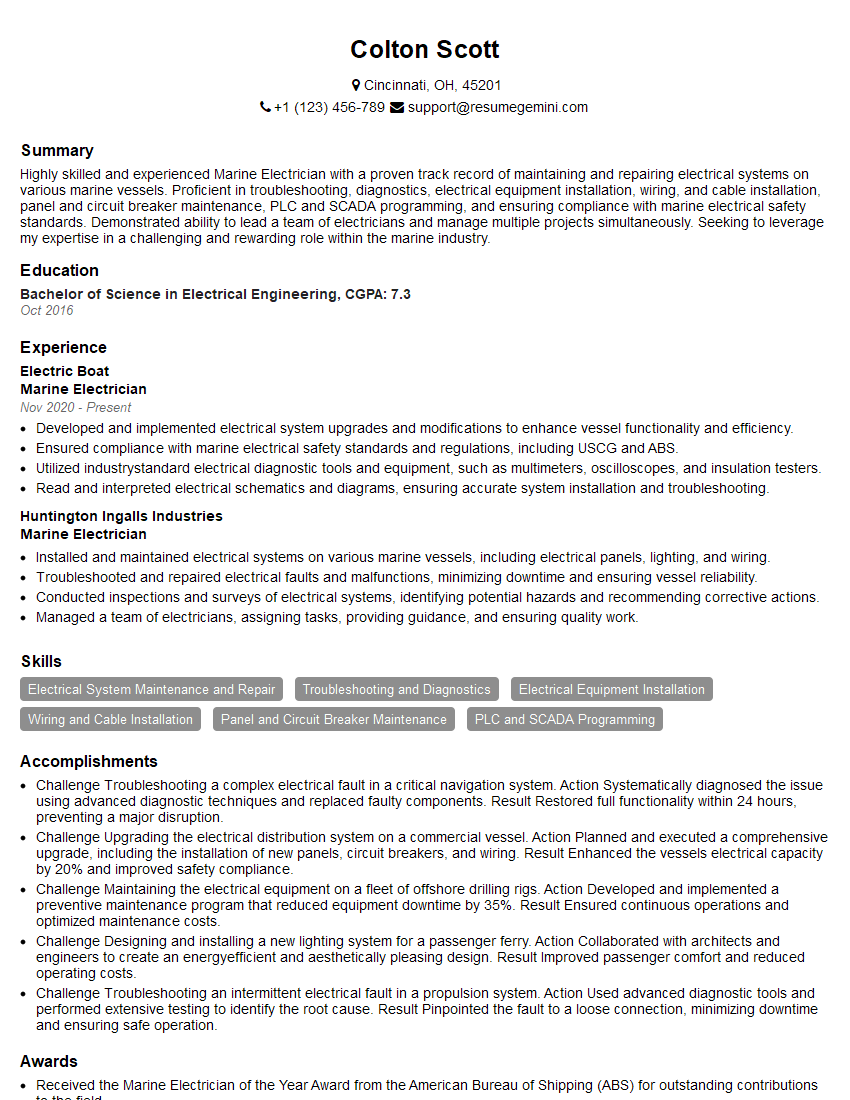
Mastering the basics of marine electrical systems is crucial for career advancement in the marine industry, opening doors to more specialized roles and higher earning potential. A well-crafted resume is your key to unlocking these opportunities. Creating an ATS-friendly resume ensures your application gets noticed by recruiters. ResumeGemini is a trusted resource to help you build a professional and effective resume that highlights your skills and experience. ResumeGemini provides examples of resumes tailored to showcasing expertise in Basic knowledge of marine electrical systems, ensuring your application stands out from the competition.
Explore more articles
Users Rating of Our Blogs
Share Your Experience
We value your feedback! Please rate our content and share your thoughts (optional).
What Readers Say About Our Blog
I Redesigned Spongebob Squarepants and his main characters of my artwork.
https://www.deviantart.com/reimaginesponge/art/Redesigned-Spongebob-characters-1223583608
IT gave me an insight and words to use and be able to think of examples
Hi, I’m Jay, we have a few potential clients that are interested in your services, thought you might be a good fit. I’d love to talk about the details, when do you have time to talk?
Best,
Jay
Founder | CEO