Interviews are more than just a Q&A session—they’re a chance to prove your worth. This blog dives into essential Blade Element Theory interview questions and expert tips to help you align your answers with what hiring managers are looking for. Start preparing to shine!
Questions Asked in Blade Element Theory Interview
Q 1. Explain the fundamental principles of Blade Element Theory (BET).
Blade Element Theory (BET) is a fundamental method for analyzing the aerodynamic performance of wind turbine rotors and propellers. It works by breaking down the rotor blade into a series of small, independent blade elements, each acting like a miniature airfoil. By analyzing the forces on each element and summing them up, we can predict the overall performance of the entire rotor.
Imagine a helicopter’s rotor: BET allows us to treat each small section of each blade as a tiny wing, individually calculating lift and drag. Adding up all these individual contributions provides a total picture of how much thrust and torque the entire rotor is producing.
Q 2. What are the assumptions made in BET, and what are their limitations?
BET relies on several key assumptions:
- Each blade element acts independently: We ignore the influence of neighboring elements. This works well for many situations, but becomes less accurate at high solidity (when blades are close together).
- Two-dimensional airfoil theory applies: We use 2D airfoil data to estimate lift and drag. This is a simplification; in reality, the flow is three-dimensional and more complex.
- Uniform inflow: The air approaches each blade element with a uniform velocity. In reality, the flow is perturbed by the rotor itself.
- No wake interaction: We neglect the influence of the wake (the swirling air behind the rotor) on subsequent blade elements. Wake interaction is significant, especially at higher speeds.
These limitations mean that BET’s accuracy is greatest for rotors with relatively low solidity and low tip speed ratios. For more accurate predictions, more complex methods like Computational Fluid Dynamics (CFD) are often needed.
Q 3. Describe the process of calculating the lift and drag forces on a blade element.
Calculating lift and drag on a blade element involves these steps:
- Determine the local relative velocity: This is the velocity of the air as seen by the blade element. It’s a vector sum of the freestream velocity and the induced velocities (axial and tangential, explained later).
- Calculate the angle of attack (AoA): This is the angle between the relative velocity vector and the chord line of the blade element. It’s crucial for determining lift and drag.
- Obtain lift and drag coefficients: Using the AoA and airfoil data (e.g., from wind tunnel testing), find the lift coefficient (CL) and drag coefficient (CD).
- Compute lift and drag forces: The lift (L) and drag (D) forces are calculated using these formulas:
L = 0.5 * ρ * V_r^2 * c * C_LandD = 0.5 * ρ * V_r^2 * c * C_D, where ρ is air density, Vr is the relative velocity, and c is the chord length of the element.
These forces are then resolved into axial (thrust) and tangential (torque) components.
Q 4. How do you account for tip losses in BET calculations?
Tip losses are a significant effect in BET, stemming from the fact that the simplified assumptions break down near the blade tips. The flow becomes highly three-dimensional and complex. To account for tip losses, empirical corrections are often applied. One popular method is the Prandtl tip loss correction, which utilizes a tip loss factor that reduces the lift and drag contributions of the blade elements near the tip. This factor depends on the tip speed ratio and the number of blades.
The Prandtl correction effectively reduces the effective span of the blade, representing the reduced lift generation due to the tip vortex.
Q 5. Explain the concept of axial and tangential induction factors.
Axial and tangential induction factors represent the changes in air velocity due to the rotor’s action. Imagine a windmill: the rotating blades induce a flow in two directions.
- Axial induction factor (a): This describes the reduction in axial velocity (the velocity along the rotor axis) due to the rotor’s thrust. A value of ‘a’ = 0.5 indicates the axial velocity is halved by the rotor’s action.
- Tangential induction factor (a’): This describes the change in tangential velocity (the velocity around the rotor axis) caused by the rotor’s torque. It’s related to the swirl induced by the rotating blades.
These factors are crucial because they modify the relative velocity experienced by each blade element, directly impacting lift and drag calculations.
Q 6. How are these induction factors determined?
Induction factors (a and a’) are not directly measured but rather determined iteratively. We start with an initial guess, then calculate the lift and drag on each element, ultimately leading to new values of axial and tangential momentum. This process is repeated until the calculated induction factors converge to a solution. This iterative process usually employs the momentum theory in conjunction with the blade element theory, balancing the forces exerted by the rotor on the air with the changes in momentum of the airflow.
Several numerical techniques like the Newton-Raphson method can be used to efficiently solve these coupled equations. Software tools and algorithms are commonly used to perform these iterative calculations.
Q 7. Describe the influence of blade angle and pitch on performance.
Blade angle and pitch significantly influence rotor performance.
- Blade angle: This is the angle between the chord line of the blade element and the plane of rotation. It directly affects the angle of attack.
- Pitch: This refers to the collective angle of the entire blade (or a section of it). Changing the pitch alters the blade angle at each radius.
A higher pitch angle typically leads to higher lift but also higher drag. Optimizing the blade angle and pitch distribution along the blade radius is crucial for maximizing rotor efficiency and achieving desired performance characteristics, such as high thrust or high speed.
Consider a propeller: adjusting the pitch changes the thrust and the rotational speed. A smaller pitch results in a faster rotation at lower thrust, while a higher pitch generates more thrust with slower rotation.
Q 8. How does BET account for the effect of wind shear?
Blade Element Theory (BET) doesn’t inherently account for wind shear directly in its simplest form. Wind shear, the variation of wind speed with height, significantly impacts the performance of a wind turbine. However, we can incorporate its effects. Instead of using a single wind speed for the entire rotor, we model the wind speed at each blade element along the radial span using a wind shear profile. This profile could be a power law profile, a logarithmic profile, or even a measured wind shear profile specific to the location. The wind speed at each element is then used in the BET calculations, resulting in a more accurate prediction of the overall rotor performance.
For example, imagine a wind turbine operating in a situation where the wind speed at hub height is 10 m/s, but it’s only 8 m/s at the blade root and 12 m/s at the blade tip. A simple BET calculation using only the hub height wind speed would be inaccurate. Incorporating a wind shear profile allows us to use the appropriate wind speed for each element’s calculations, giving a more realistic performance prediction.
Q 9. Explain the differences between BET and Blade Element Momentum Theory (BEMT).
Both BET and Blade Element Momentum Theory (BEMT) are used to predict the performance of wind turbines. However, they differ in their underlying assumptions and approach. BET considers each blade section as an airfoil and sums up the forces on each element to determine the overall performance. It’s more of a quasi-3D model. BEMT incorporates the momentum theory to account for the induced velocities caused by the rotor’s action on the air. It’s more holistic, considering the interaction of the rotor with the surrounding flow field.
The key difference lies in how they treat the induced velocities. BET often uses empirical relationships or simpler models to estimate induced velocities, whereas BEMT attempts to explicitly solve for them using momentum conservation equations. BEMT, therefore, tends to be more computationally intensive but can be more accurate in predicting performance, especially for turbines operating at higher tip speed ratios.
Think of it like this: BET is like calculating the individual contributions of many small gears in a clock to understand how the clock moves, while BEMT tries to understand the clock’s motion by considering the overall mechanism of how the gears interact with each other and the external force (wind).
Q 10. How is BET used in the design of wind turbine blades?
BET is a crucial tool in wind turbine blade design. It provides a relatively simple and efficient method for predicting blade performance across a range of operating conditions. During the design process, engineers iterate with BET, adjusting blade parameters such as chord length, twist, and airfoil shape at various radial stations to optimize performance metrics. For instance, they might use BET to investigate the impact of a change in airfoil on the lift and drag characteristics, ultimately determining the overall power output. By iteratively using BET with different designs and then comparing the results, they can pinpoint the optimal blade geometry. This minimizes the reliance on expensive and time-consuming wind tunnel testing.
By varying the blade parameters using BET and calculating the performance, we can optimize the blades for maximum power output at optimal wind speeds, minimizing fatigue loads, and improving the overall efficiency of the wind turbine.
Q 11. How do you validate BET predictions?
Validation of BET predictions is crucial. This is typically done by comparing the predicted performance with experimental data. This data might come from wind tunnel testing of individual airfoil sections, or more comprehensively from field tests of complete wind turbine prototypes. Several methods exist for this comparison. We can analyze the power curves (power output vs. wind speed), thrust curves (thrust vs. wind speed), or even detailed blade load measurements. Discrepancies between the predicted and measured data can highlight areas where BET might need refinements or where additional factors need to be included in the model (such as tower shadow effects, unsteady aerodynamics or tip losses).
A common approach is to create a model error and uncertainty analysis by quantifying the deviation between the measured and predicted values. This helps improve the BET model by identifying model limitations and allowing us to calibrate the model for better accuracy.
Q 12. What are the limitations of BET in predicting actual wind turbine performance?
BET, while valuable, has several limitations. It relies on several simplifying assumptions. These include: treating the flow as steady and incompressible, neglecting wake rotation and three-dimensional effects (tip losses and root effects), and assuming the airfoil sections behave independently. In reality, wind turbine flows are inherently unsteady and highly three-dimensional, particularly near the blade tips and the root. These simplifying assumptions can lead to inaccuracies in performance predictions, especially at high tip speed ratios or under complex flow conditions. Furthermore, it relies heavily on the accuracy of the airfoil data used in the calculations, making proper airfoil selection critical to the accuracy of the model.
For example, BET might underestimate the power output at high wind speeds due to its simplified treatment of wake rotation and tip losses, which become more significant at these conditions.
Q 13. How does airfoil selection impact the performance predictions from BET?
Airfoil selection significantly impacts BET predictions. The lift and drag characteristics of the airfoil, as functions of the angle of attack, directly influence the aerodynamic forces calculated by BET. Different airfoils have different performance curves (lift coefficient Cl vs angle of attack α, and drag coefficient Cd vs α). An airfoil optimized for high lift at low Reynolds numbers (closer to the blade root) will perform differently compared to one designed for high lift at high Reynolds numbers (near the blade tip). Using inappropriate airfoils in the BET model will lead to inaccurate predictions of power, thrust, and bending moments. The selection of airfoil also affects the performance across different operating conditions (wind speeds and angles of attack). Thus, accurate airfoil data and suitable selection based on the specific operating conditions at different spanwise locations are essential for accurate BET predictions.
Selecting a high-lift airfoil may increase power production at optimal wind speeds but could increase the drag and the loading on the structure at higher wind speeds.
Q 14. Discuss the role of Reynolds number in BET calculations.
The Reynolds number (Re) is a dimensionless quantity that represents the ratio of inertial forces to viscous forces in a fluid flow. It significantly influences the airfoil’s performance characteristics (Cl and Cd). In BET calculations, the Reynolds number varies along the blade span because the freestream velocity and chord length change. This variability necessitates careful consideration during airfoil selection and validation. Airfoil data for the appropriate Reynolds number regime must be employed in the BET calculation. Using inappropriate airfoil data can cause significant errors in the prediction of the blade performance.
For example, an airfoil might exhibit different lift and drag coefficients at low Reynolds numbers (typical of the blade root at low wind speeds) compared to high Reynolds numbers (typical of the blade tip at high wind speeds). This variation must be considered in the BET calculations to achieve accurate results.
Q 15. How do you account for the effects of yaw error in BET?
Yaw error, the angle between the wind direction and the rotor plane, significantly impacts wind turbine performance. In Blade Element Theory (BET), we account for this by modifying the effective wind speed experienced by each blade element. Imagine a perfectly aligned turbine; the wind hits each blade element head-on. Now, introduce yaw. The wind’s velocity vector is no longer perpendicular to the blade. We decompose the wind speed into two components: one parallel to the blade (which contributes to drag) and one perpendicular (contributing to lift). The perpendicular component is reduced by a factor of cos(yaw_angle). This reduction directly affects the lift and, consequently, the thrust and torque generated by the element. Sophisticated BET models often incorporate iterative procedures to solve for the induced velocity distribution under yawed conditions, accurately predicting the resultant power loss.
For example, a 10-degree yaw error can lead to a considerable decrease in power output, highlighting the importance of accurate yaw control in real-world wind turbine operation.
Career Expert Tips:
- Ace those interviews! Prepare effectively by reviewing the Top 50 Most Common Interview Questions on ResumeGemini.
- Navigate your job search with confidence! Explore a wide range of Career Tips on ResumeGemini. Learn about common challenges and recommendations to overcome them.
- Craft the perfect resume! Master the Art of Resume Writing with ResumeGemini’s guide. Showcase your unique qualifications and achievements effectively.
- Don’t miss out on holiday savings! Build your dream resume with ResumeGemini’s ATS optimized templates.
Q 16. What software tools are commonly used for BET analysis?
Several software tools are widely used for BET analysis, ranging from simple spreadsheets to advanced computational fluid dynamics (CFD) packages. Spreadsheets like Excel can be used for basic BET calculations, particularly for educational purposes or initial design explorations. However, for detailed analysis and optimization, more powerful tools are needed.
- MATLAB: Offers excellent scripting capabilities for automating BET calculations and analyzing results.
- Python with libraries like NumPy and SciPy: Provides flexibility and open-source tools for developing custom BET models.
- Specialized CFD software (e.g., ANSYS Fluent, OpenFOAM): These packages are capable of solving the Navier-Stokes equations and provide significantly more accurate results but demand high computational resources.
- Commercial wind turbine design software: Many companies offer proprietary software that integrates BET with other advanced models for comprehensive turbine design and analysis. These typically have user-friendly interfaces tailored to wind energy engineers.
The choice of software depends heavily on the complexity of the analysis, available resources, and desired accuracy. For instance, a preliminary design might benefit from a spreadsheet-based approach, whereas a final design would require the precision of CFD or dedicated wind turbine design software.
Q 17. How is BET used in the design optimization of wind turbine blades?
BET plays a crucial role in wind turbine blade design optimization by enabling engineers to iteratively refine the blade geometry to maximize power output and efficiency. The process typically involves defining design variables such as chord length, twist angle, and airfoil shape along the blade’s span. BET is then used to predict the aerodynamic performance for each set of variables. Optimization algorithms (e.g., genetic algorithms, gradient-based methods) are employed to systematically explore the design space, searching for optimal combinations that maximize the power coefficient (Cp) or other performance metrics while considering constraints like material strength and manufacturing limitations.
For instance, an engineer might use BET coupled with an optimization algorithm to find the optimal twist distribution along the blade to minimize tip losses and maximize the overall power capture. This iterative process leads to a blade design that is tailored to specific wind conditions and operational requirements.
Q 18. Describe the impact of turbulence on BET predictions.
Turbulence significantly impacts the accuracy of BET predictions. The inherent assumption of uniform and steady wind flow in BET is violated in real-world scenarios where turbulent fluctuations are present. These fluctuations affect the local wind speed and direction experienced by each blade element, leading to variations in lift and drag forces. The resulting power output will fluctuate, and the mean power generated will likely be lower than the predictions from a steady-state BET analysis. Advanced BET models attempt to account for this by incorporating turbulence models which estimate the effect of turbulent eddies on the mean flow conditions. These models often utilize parameters that characterize the turbulent intensity and length scales. However, fully capturing the complex interaction between turbulence and the blade remains a significant challenge.
Imagine trying to calculate the trajectory of a ball thrown in a strong wind: a simple calculation neglecting wind will be far from accurate. Similarly, neglecting turbulence in BET simplifies the problem but leads to less accurate and reliable predictions.
Q 19. Explain how to calculate the power coefficient using BET.
The power coefficient (Cp) is a dimensionless quantity that represents the efficiency of a wind turbine in converting wind energy into mechanical power. In BET, it’s calculated by summing the contributions of all blade elements. The power generated by each element is calculated using the local lift and drag forces, together with the rotational speed. This elemental power is then integrated along the blade span to obtain the total power. The power coefficient is then calculated by dividing the total power by the power available in the wind.
The formula is not simple and involves several iterations to account for induced velocities and the influence of neighboring blade elements. A simplified representation (ignoring many factors, including tip losses, yaw errors, and wake interactions) might show the relationship as: Cp = P / (0.5 * ρ * A * V3), where P is the total power, ρ is air density, A is the rotor swept area, and V is the wind speed. However, a true BET calculation involves iterative solvers and more sophisticated formulations to achieve reasonable accuracy.
Q 20. How does the blade twist affect the performance predictions?
Blade twist, the variation of the angle of attack along the blade span, significantly affects performance predictions in BET. Twisting the blade allows for optimization of the angle of attack across the radius, maximizing lift and minimizing drag at each radial station. Without twist, the angle of attack might be optimal at one radius but far from optimal at others. For instance, the blade tip experiences higher wind speeds than the root, so it needs a lower angle of attack to avoid excessive drag and stall. Therefore, the blade is often twisted such that the angle of attack decreases towards the tip. Accurate modelling of this twist is crucial for predicting the overall performance of the turbine.
Improper twist design can lead to reduced power output, increased drag, and even structural damage due to uneven load distribution.
Q 21. What is the influence of the number of blades on the overall performance?
The number of blades in a wind turbine influences its overall performance in several ways, primarily affecting the tip speed ratio (TSR) and the wake interaction. The TSR is the ratio of the blade tip speed to the wind speed; it influences the lift and drag characteristics. A higher number of blades typically leads to a lower optimal TSR for maximum power extraction. This is due to stronger wake interaction between blades, which reduces the effective wind speed experienced by downwind blades. The increased number of blades distributes the load more evenly, but the cumulative drag from a greater number of blades can offset these advantages. Additionally, increasing the number of blades often involves compromises in blade size and design, which could affect manufacturing cost and material constraints.
Three-bladed turbines are currently prevalent due to their balance between power capture efficiency and other factors. However, the optimal number of blades is design-specific and depends heavily on the turbine’s size, operational conditions, and the design goals.
Q 22. How can BET be used to predict the noise generated by a wind turbine?
Blade Element Momentum Theory (BEMT), a close cousin of Blade Element Theory (BET), can be adapted to predict wind turbine noise. While BET primarily focuses on aerodynamic forces and power, the noise generation is linked to the unsteady aerodynamic forces acting on the blades. These forces, calculated through BET, can then be used as input to acoustic models. This process usually involves breaking down the blade into elements and calculating the fluctuating lift and drag on each element. These fluctuating forces are the primary source of aerodynamic noise. The acoustic model then uses this data to predict the sound pressure levels at various distances and frequencies. The accuracy depends heavily on the sophistication of both the aerodynamic and acoustic models used. Think of it like this: BET provides the ‘ingredients’ (forces), and the acoustic model is the ‘recipe’ that turns those ingredients into a prediction of the ‘noise cake.’ It is crucial to remember that this is a complex process and that factors such as blade geometry, turbulence intensity, and atmospheric conditions also greatly influence the final noise prediction.
Q 23. Discuss the importance of considering 3D effects in the design process
Considering 3D effects in wind turbine design is crucial for accurate performance prediction and optimization, especially for large turbines. BET, in its simplest form, is a 2D model that assumes the flow around each blade element is independent and two-dimensional. However, in reality, the flow is three-dimensional, with significant interactions between blade elements, the tip vortices, and the wake. These 3D effects manifest in several ways: tip losses (reduced lift near the blade tips), rotational effects (affecting lift and drag distributions), and wake interference (changing the inflow conditions for downstream blade sections). Neglecting these factors leads to underestimation of power production and inaccuracies in the prediction of loads. Advanced BET models incorporate 3D effects through various techniques, such as using corrections for tip losses and considering the influence of the helical wake. For instance, Prandtl’s tip loss factor accounts for the reduced circulation at the blade tips due to tip vortex formation. Ignoring 3D effects would be akin to designing a bridge only considering its load in one direction, ignoring the effects of wind and other forces from multiple directions. The results can be catastrophic.
Q 24. How do you apply BET in unsteady flow conditions?
Applying BET to unsteady flow conditions requires extending the basic framework. In steady flow, the angle of attack at each blade element remains constant. However, under unsteady conditions (e.g., turbulent wind, gusty conditions, or dynamic stall), the angle of attack changes constantly. To handle this, the unsteady aerodynamic forces need to be calculated. This often involves incorporating unsteady airfoil characteristics such as unsteady lift and drag coefficients obtained from experiments or computational fluid dynamics (CFD) simulations. Time-domain simulations are then used to track the changes in angle of attack and calculate the resulting forces. Methods like dynamic stall models are incorporated to account for the complex flow separation and reattachment phenomena observed during unsteady maneuvers. Think of it like this: in steady flow, you’re driving at a constant speed, while in unsteady flow, you’re navigating through traffic – a much more complex situation requiring a more nuanced approach.
Q 25. What is the significance of the wake model in BET?
The wake model is an integral part of BET, particularly when considering the interaction between blades in a multi-blade rotor. The wake generated by upstream blades alters the flow conditions experienced by downstream blades. An accurate wake model accounts for the axial induction factor and the tangential induction factor. These factors represent the change in axial and tangential velocities induced by the wake. Different wake models exist, ranging from simple models that assume uniform axial induction to more complex models that consider the effects of blade rotation and tip vortices. A simple analogy is cars on a highway. The wake behind a car slows down the cars following it. A good wake model accurately accounts for this slowdown, providing a more realistic prediction of the conditions for each car (blade element) on the highway.
Q 26. How do you handle blade root and tip effects within the BET framework?
Handling blade root and tip effects requires modifying the standard BET approach. At the blade root, constraints from the hub and centrifugal forces influence the aerodynamic performance. These effects often result in reduced aerodynamic efficiency at the root. Tip effects, as discussed earlier, involve tip losses due to the three-dimensionality of the flow and the formation of tip vortices. To account for these, various correction factors are used. Tip loss corrections, often based on Prandtl’s tip-loss factor, are used to adjust lift and drag calculations near the blade tip. Similarly, root effects may be incorporated using empirically derived corrections or more complex models that incorporate the structural and aerodynamic constraints. These corrections are crucial for achieving accurate predictions and are analogous to adjusting a recipe based on the specific properties of your ingredients.
Q 27. Describe a scenario where BET is not suitable, and explain why.
BET is not suitable for scenarios involving highly complex flow phenomena, such as those near stall or under extreme turbulence. BET’s reliance on simplified assumptions about the flow around blade elements breaks down in these situations. For example, BET struggles to accurately predict performance during stall, where flow separation becomes significant and the assumption of attached flow is no longer valid. Similarly, in highly turbulent inflow conditions, the simple momentum models of BET may not capture the complex interactions between the turbulence and the blade. In such cases, more sophisticated techniques like Computational Fluid Dynamics (CFD) are necessary, which solves the full Navier-Stokes equations to account for viscous effects and complex flow patterns. Imagine trying to model the chaotic flow of a river during a flood using a simple ruler and measuring tape. BET works well for relatively smooth streams but is outmatched in high-turbulence situations.
Q 28. Compare and contrast the use of BEMT and CFD in wind turbine design
Both BEMT (Blade Element Momentum Theory) and CFD are used in wind turbine design, but they differ significantly in their approach and capabilities. BEMT, a simplified version of BET, is a semi-empirical method that uses relatively simple equations to predict the aerodynamic forces on the blades. It is computationally efficient, providing quick results, suitable for preliminary design and optimization studies. However, it relies on several assumptions, including 2D flow and the use of airfoil data obtained from experiments or simpler models. CFD, on the other hand, is a computational method that solves the Navier-Stokes equations to model the flow around the turbine. It provides a highly detailed and accurate prediction of the flow field, forces, and moments acting on the rotor. However, it’s computationally expensive, requiring significant computing resources and time. BEMT is akin to using a blueprint to estimate the size and weight of a building, while CFD is like creating a detailed, 3D model of the building including every structural detail. Each method has its strengths and weaknesses; BEMT is faster but less accurate while CFD is slower but far more accurate.
Key Topics to Learn for Blade Element Theory Interview
- Fundamental Principles: Understanding the underlying assumptions and limitations of Blade Element Momentum Theory (BEMT).
- Aerodynamic Forces: Analyzing lift and drag forces acting on individual blade elements, including the influence of angle of attack and airfoil characteristics.
- Induced Velocity: Calculating induced velocities and their impact on the overall performance of the rotor.
- Momentum Theory Integration: Combining BEMT with actuator disk theory to obtain a comprehensive understanding of rotor performance.
- Blade Geometry and Design: Exploring the relationship between blade geometry (twist, chord, airfoil selection) and rotor performance predictions.
- Tip Losses and Corrections: Accounting for tip losses and implementing appropriate corrections in BEMT calculations.
- Computational Implementation: Understanding numerical methods and software tools used for BEMT analysis (e.g., iterative solution techniques).
- Practical Applications: Applying BEMT to design and analyze various rotor systems, such as wind turbines, helicopters, and propellers.
- Performance Prediction and Optimization: Utilizing BEMT to predict rotor performance characteristics (e.g., power, thrust, torque) and optimize design parameters.
- Advanced Topics: Exploring more complex aspects like unsteady aerodynamics, dynamic stall, and the influence of inflow conditions.
Next Steps
Mastering Blade Element Theory is crucial for career advancement in the aerospace, renewable energy, and related fields. A strong understanding of BEMT demonstrates a sophisticated grasp of fundamental aerodynamic principles and opens doors to exciting roles in design, analysis, and research. To maximize your job prospects, create an ATS-friendly resume that highlights your skills and experience effectively. ResumeGemini is a trusted resource that can help you build a professional and impactful resume. We provide examples of resumes tailored to Blade Element Theory to guide you through the process, ensuring your qualifications shine through to potential employers.

Engineering Manager Resume Sample

Principal Engineer Resume Sample

Project Engineer Resume Sample

Applications Engineer Resume Sample

Research Scientist Resume Sample

Test Engineer Resume Sample
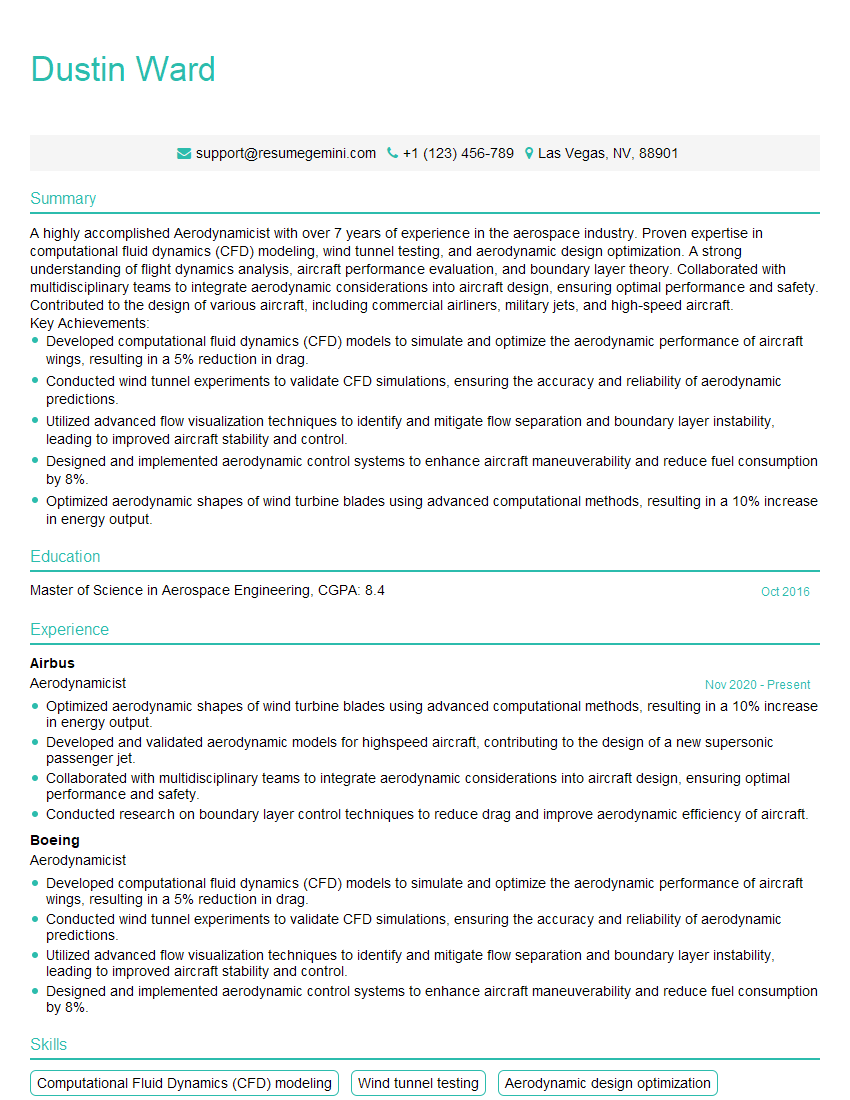
Aerodynamicist Resume Sample

Aerospace Engineer Resume Sample
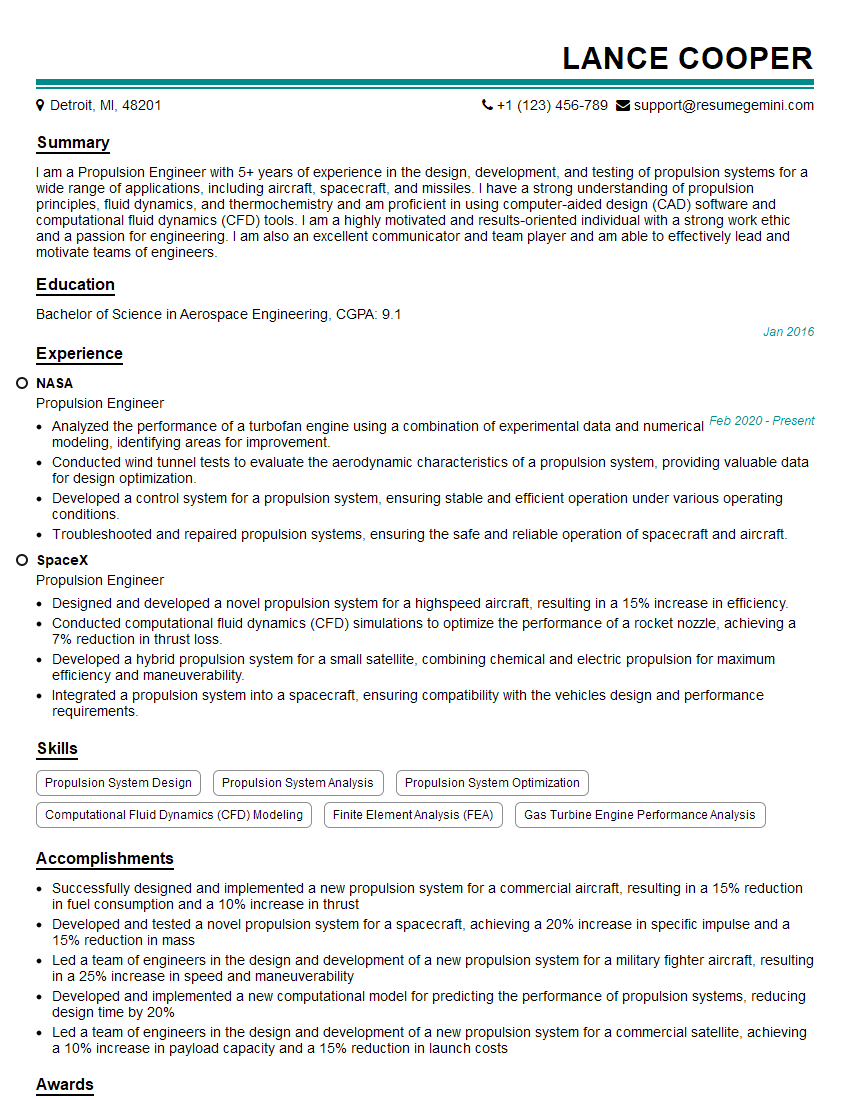
Propulsion Engineer Resume Sample
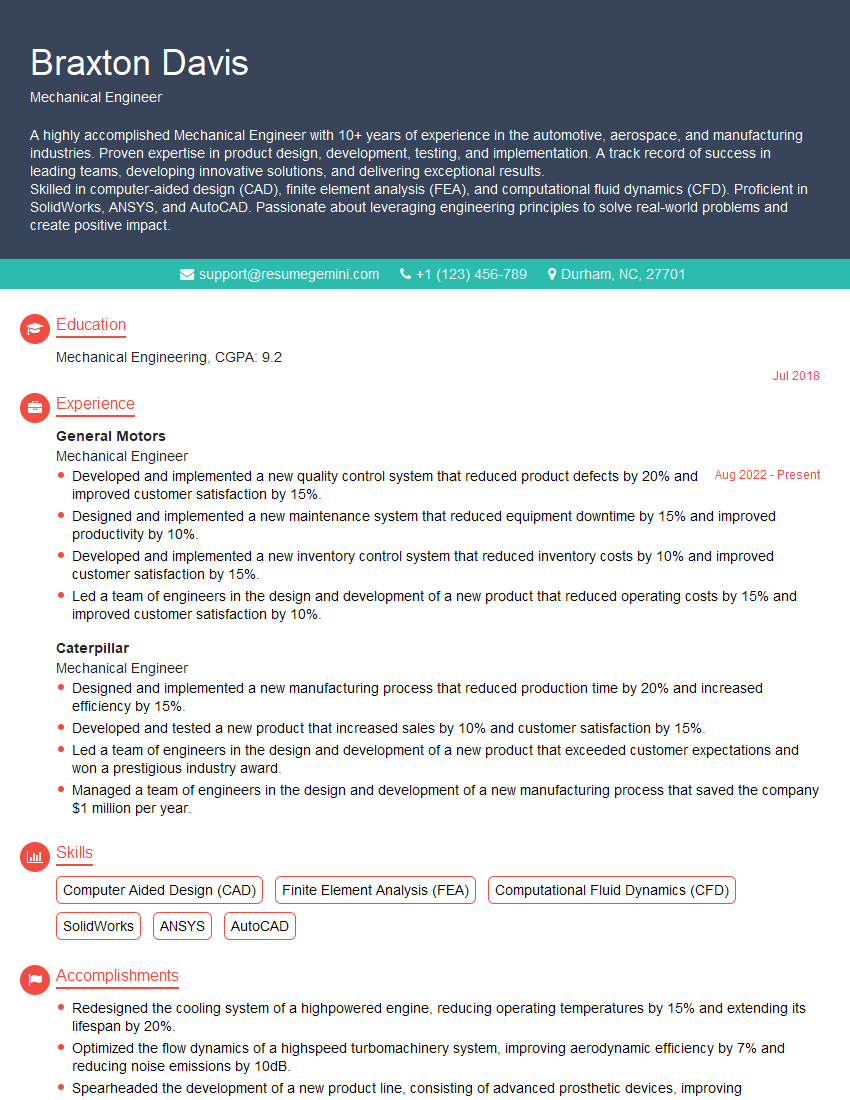
Mechanical Engineer Resume Sample

Renewable Energy Engineer Resume Sample

Wind Turbine Engineer Resume Sample
Explore more articles
Users Rating of Our Blogs
Share Your Experience
We value your feedback! Please rate our content and share your thoughts (optional).
What Readers Say About Our Blog
Really detailed insights and content, thank you for writing this detailed article.
IT gave me an insight and words to use and be able to think of examples