Are you ready to stand out in your next interview? Understanding and preparing for Boat Electrical System Maintenance interview questions is a game-changer. In this blog, we’ve compiled key questions and expert advice to help you showcase your skills with confidence and precision. Let’s get started on your journey to acing the interview.
Questions Asked in Boat Electrical System Maintenance Interview
Q 1. Explain the difference between AC and DC electrical systems in boats.
Boat electrical systems primarily use either Alternating Current (AC) or Direct Current (DC), each with distinct characteristics. DC systems are the most common in boats, powering most onboard devices directly from the battery bank. Think of it like a river flowing in one direction – consistently providing power. This is ideal for devices like lights, pumps, and electronics that require a constant voltage. AC, on the other hand, is like a wave, reversing its direction periodically. While less common as the primary power source in smaller boats, AC is often used for shore power connections, supplying power from a marina’s electrical grid. AC is typically converted to DC for use by most onboard appliances using an inverter. Larger vessels might have dedicated AC circuits for high-power appliances like air conditioners. The choice depends on the boat’s size and the power requirements of its systems. For instance, a small sailboat might rely entirely on a 12V DC system, while a large motor yacht will likely have both AC and DC systems integrated.
Q 2. Describe the function of a battery charger in a marine electrical system.
A battery charger’s role is crucial in maintaining a boat’s battery bank’s health. Its main function is to convert AC power (from shore power or a generator) into DC power to replenish the batteries after they’ve been discharged by onboard systems. Imagine it as a ‘watering hole’ for your boat’s electrical system. Without a properly functioning charger, your batteries will constantly drain, potentially leaving you stranded. Modern chargers often include features like automatic voltage regulation, temperature compensation, and multiple charging stages (bulk, absorption, float) to maximize battery life and prevent overcharging, which can damage the battery.
Q 3. How do you troubleshoot a faulty bilge pump?
Troubleshooting a faulty bilge pump requires a systematic approach. First, verify the problem: Is there water in the bilge? Is the float switch activated? Then, check the power supply: Is the breaker tripped? Are the fuses blown? If the power is okay, inspect the wiring: Look for loose connections, corrosion, or broken wires. Next, test the pump itself: Can you power it directly with a temporary connection bypassing the switch and wiring? If the pump still doesn’t work, the pump itself is likely faulty. If the pump runs directly but not through the normal circuit, the issue is likely with the float switch, wiring, or circuit breaker. Remember to always disconnect the power before working on any electrical components.
- Check the power supply to the pump.
- Inspect the wiring for damage or loose connections.
- Test the float switch to ensure it is triggering correctly.
- Test the pump motor directly using a temporary power supply.
- If all else fails, replace the pump.
Q 4. What are the safety precautions when working with boat electrical systems?
Working with boat electrical systems demands stringent safety precautions due to the presence of water and potentially explosive environments. Always remember to disconnect the power source before any work begins, either by turning off the battery switch or unplugging the shore power. Wear appropriate personal protective equipment (PPE), including safety glasses and insulated gloves. Be mindful of wet conditions – never work on electrical components while it is raining or near water. Use insulated tools and ensure you are working in a well-ventilated space to prevent the build-up of dangerous gases from battery fumes. If unsure about any procedure, consult a qualified marine electrician. Safety should always be your top priority.
Q 5. Explain the purpose of a marine electrical distribution panel.
A marine electrical distribution panel acts as the central hub for the boat’s electrical system. Think of it as a miniature power grid within the boat. It houses circuit breakers or fuses, protecting individual circuits from overloads and short circuits. This prevents potential fires and damage to other electrical components. The panel allows for organized switching and monitoring of various circuits – each switch controlling a specific appliance or group of appliances. The panel’s clear layout allows for easy identification and troubleshooting of any issues. A properly organized distribution panel ensures the safe and efficient delivery of power throughout the boat. In case of a short circuit, the circuit breaker will trip, safely isolating the faulty circuit.
Q 6. How do you test a marine battery for capacity and charge?
Testing a marine battery involves assessing both its capacity (how much charge it can hold) and its current charge level. A voltmeter is used to check the voltage. A fully charged 12V battery typically reads around 12.6-12.7V. A lower voltage indicates a lower charge level. However, voltage alone isn’t sufficient to determine overall battery health. A load tester applies a load to the battery and measures the voltage drop under that load; a significant drop signifies a weakened battery. For more accurate assessment of the battery’s capacity, a battery capacity tester can be used. This equipment provides a detailed assessment of the battery’s ability to hold charge. This will help to determine if the battery should be replaced or charged.
Q 7. What are the common causes of overheating in marine electrical wiring?
Overheating in marine electrical wiring is a serious safety concern. Several factors can contribute: Overcurrent, exceeding the wire’s ampacity (maximum current carrying capacity) due to too many devices on a single circuit, often caused by improperly sized wiring. Poor connections, such as loose terminals or corroded connections, generate heat due to increased resistance. Oversized fuses or breakers, providing inadequate protection; they might allow excessive current to flow until the wire overheats. Insulation damage, allowing wires to short circuit or touch metal parts, resulting in heat generation and potential fires. Confinement, lacking sufficient airflow around the wiring, trapping heat and causing overheating. Ensuring proper ventilation and using appropriately sized wiring based on the load requirements are critical to preventing overheating problems.
Q 8. Describe the process of installing a new marine electrical circuit.
Installing a new marine electrical circuit requires careful planning and adherence to safety regulations. Think of it like building a highway for electricity – you need a clear path, proper signage (labeling), and robust infrastructure.
- Planning: First, determine the circuit’s purpose (e.g., navigation lights, bilge pump, stereo). This dictates the amperage and wire gauge needed. A higher amperage device needs thicker wire to handle the current.
- Selecting Wire and Breakers: Choose marine-grade wire rated for the appropriate amperage and voltage. Never use automotive wire; it’s not designed for the harsh marine environment. Install a correctly sized circuit breaker or fuse to protect the circuit from overloads.
- Routing the Wire: Route the wire along designated pathways, securing it with appropriate clips and fasteners. Avoid sharp bends or kinks, which can damage the wire. Keep wiring away from moving parts and hot surfaces. Consider using conduit for extra protection in areas prone to abrasion.
- Connections: Use marine-grade connectors designed for the wire size and environment. Crimp connectors securely using the correct crimping tool. Poor connections are a major cause of electrical problems.
- Testing: After installation, test the circuit using a multimeter to ensure proper voltage and continuity. Always disconnect power before working on any electrical system.
- Grounding: Properly ground the circuit to the boat’s grounding system. This ensures a safe and reliable return path for the electricity. A poor ground can lead to voltage drops and equipment malfunction.
Example: Installing a new circuit for an electric anchor windlass might require a heavy-gauge wire (e.g., 8 AWG) and a high-amperage breaker (e.g., 50A) due to the windlass’s high current draw.
Q 9. How do you diagnose a problem with a boat’s navigation lights?
Troubleshooting navigation lights involves systematic checking to pinpoint the fault. Start with the simplest checks and proceed to more complex ones. Think of it as a detective investigation.
- Visual Inspection: Check the bulbs. A burnt-out bulb is the most common cause. Replace any damaged bulbs.
- Power Supply Check: Test the voltage at the light’s connection point with a multimeter. If no voltage is present, trace the wiring back to the switch and the power source (battery). You may find a blown fuse or a faulty switch.
- Switch Operation: Verify that the navigation light switch is functioning correctly. A faulty switch can interrupt power to the lights. Test the switch continuity using the multimeter.
- Wiring Check: If there’s voltage at the switch but not at the light, inspect the wiring for breaks, corrosion, or poor connections. A multimeter can help you find a break in the circuit.
- Ground Connection: A poor ground connection is another frequent culprit. Check the ground wire for corrosion or looseness.
Example: If you have no port side navigation light, first check the bulb. If the bulb is okay, check the voltage at the light socket. If no voltage is present there, work your way back to the switch and battery, checking for power at each point.
Q 10. Explain the function of a voltage regulator in a boat’s electrical system.
A voltage regulator is essential in a boat’s electrical system; it acts as a buffer, maintaining a stable voltage output from the alternator to the battery. Think of it as a pressure regulator for your boat’s electrical system.
The alternator generates electricity to charge the battery. Without a regulator, the alternator would overcharge the battery, leading to damage or even explosion. The regulator monitors the battery voltage and adjusts the alternator’s output accordingly, preventing overcharging and ensuring the battery is charged optimally. If the battery voltage is low, the regulator will allow the alternator to provide maximum charging current, while preventing overcharging when the battery is full.
Q 11. What are the different types of marine wire and connectors?
Marine wire and connectors must withstand the harsh conditions found on boats – exposure to salt water, sunlight, and vibration. Choosing the wrong type can lead to corrosion, failure, and even fire.
- Wire: Tinned copper wire is standard, providing excellent conductivity and resistance to corrosion. Different gauges (AWG numbers) indicate different current-carrying capacities. Larger gauges (smaller numbers) are needed for higher current applications.
- Connectors: Marine-grade connectors are essential. These connectors are sealed, corrosion-resistant, and often color-coded for easy identification. Examples include butt connectors, ring terminals, and spade terminals. Crimping is necessary for a secure and reliable connection.
Example: A smaller gauge wire like 18 AWG might be suitable for low-current applications like lighting, while a larger gauge like 6 AWG is needed for high-current components such as a windlass or trolling motor.
Q 12. How do you identify and repair a short circuit in a boat’s wiring?
Identifying and repairing a short circuit requires patience and methodical troubleshooting. A short circuit is an unintended low-resistance path for electricity, causing excessive current draw and potential damage. Think of it as a shortcut in your electrical highway, potentially causing a traffic jam (overheating) or a collision (fire).
- Identify the Problem: Check the boat’s electrical system for blown fuses or tripped circuit breakers. A significant increase in current draw may indicate a short.
- Visual Inspection: Carefully inspect the wiring for any signs of damage, chafing, or bare wires. Look for wires touching metal parts of the boat.
- Multimeter Test: Use a multimeter to test for continuity between wires and the boat’s hull or grounded metal parts. A low resistance reading indicates a short.
- Isolate the Short: Once the location of the short circuit is identified, disconnect the affected circuit from the power supply.
- Repair: Repair the damaged wiring by replacing the affected section of wire. Ensure all connections are properly insulated.
Example: If a short circuit causes the main battery switch to trip, start by checking the main power cables for damage and chafing. Use a multimeter to check for continuity between the positive and negative cables.
Q 13. Describe the process of grounding a boat’s electrical system.
Grounding a boat’s electrical system is crucial for safety and proper operation. A proper ground provides a low-resistance path for electricity to return to the battery. Think of it as the return road on your electrical highway.
The boat’s grounding system typically consists of a network of heavy-gauge wires connecting various parts of the boat to the engine block or a dedicated ground bus. The ground bus should be connected to the boat’s hull (through a well-grounded metal point) and the negative battery terminal.
Grounding involves connecting all negative wires to this common ground point. This ensures a complete circuit and prevents stray currents from causing corrosion or electrical problems. Poor grounding can lead to voltage drops, poor performance of equipment and safety hazards.
Q 14. What are the common causes of corrosion in marine electrical systems?
Corrosion is a major problem in marine electrical systems due to the salty, damp environment. Think of it as rust eating away at your boat’s electrical system.
- Saltwater: Saltwater is highly corrosive and readily attacks bare wires, terminals, and connectors. It promotes electrolysis, accelerating the deterioration process.
- Moisture: Moisture provides a conductive path, allowing corrosion to occur more easily.
- Dissimilar Metals: When dissimilar metals are in contact in the presence of moisture, galvanic corrosion can occur. This happens when one metal corrodes faster than the other due to an electrochemical reaction.
- Poor Connections: Loose or improperly made connections generate heat, further accelerating corrosion.
Example: Aluminum and stainless steel are often used together on boats, and their contact in a moist environment can lead to corrosion. Proper insulation and use of corrosion-resistant connectors are crucial in preventing this.
Q 15. How do you prevent corrosion in marine electrical systems?
Corrosion is the silent killer of marine electrical systems. Saltwater is incredibly corrosive, and it loves to attack exposed metal, leading to poor connections, voltage drops, and even fires. Preventing it requires a multi-pronged approach.
- Proper Installation: Use high-quality marine-grade components designed to withstand saltwater exposure. These components often feature protective coatings or are made from corrosion-resistant materials like stainless steel.
- Regular Cleaning: Clean your terminals and connections regularly. A simple wire brush and a degreaser can make a huge difference. Pay special attention to areas prone to water accumulation.
- Protective Coatings: Apply dielectric grease to all connections. This prevents moisture from reaching the metal and forming a conductive path for corrosion. Think of it as sunscreen for your electrical system.
- Proper Ventilation: Ensure good airflow around electrical components to prevent moisture buildup. A damp environment accelerates corrosion.
- Grounding: A properly grounded system is crucial. A good ground provides a path for stray currents to flow to earth instead of causing corrosion in other components.
- Anodes (Sacrificial Anodes): These are strategically placed pieces of metal that corrode preferentially to protect other, more important parts of the boat. They’re a vital component in corrosion protection for the entire boat, not just the electrical system.
For example, I once worked on a boat where the owner neglected to clean the battery terminals. The resulting corrosion caused a significant voltage drop, resulting in erratic performance of the navigation lights, almost leading to a dangerous situation.
Career Expert Tips:
- Ace those interviews! Prepare effectively by reviewing the Top 50 Most Common Interview Questions on ResumeGemini.
- Navigate your job search with confidence! Explore a wide range of Career Tips on ResumeGemini. Learn about common challenges and recommendations to overcome them.
- Craft the perfect resume! Master the Art of Resume Writing with ResumeGemini’s guide. Showcase your unique qualifications and achievements effectively.
- Don’t miss out on holiday savings! Build your dream resume with ResumeGemini’s ATS optimized templates.
Q 16. Explain the function of a circuit breaker in a boat’s electrical system.
A circuit breaker is a safety device that automatically interrupts the flow of electricity in a circuit when the current exceeds a predetermined level. Unlike a fuse, which is a one-time use device, a circuit breaker can be reset after it trips. This protects the wiring and components from overheating and potential damage, and ultimately prevents fires.
Imagine a circuit breaker as a smart switch. It continuously monitors the electrical current. If something goes wrong, like a short circuit or an overloaded circuit, it instantly cuts the power, preventing further damage. It then needs to be manually reset once the problem is identified and fixed.
Q 17. How do you test a circuit breaker?
Testing a circuit breaker is a straightforward process. First, ensure the power is OFF to the circuit you’re testing. Then:
- Visual Inspection: Check for any signs of damage, such as burn marks or loose connections.
- Manual Test (if applicable): Some circuit breakers have a test button. Pressing this button should trip the breaker. If it doesn’t, the breaker might be faulty and needs replacing.
- Ohmmeter Test (for more thorough testing): With the breaker OFF, use an ohmmeter to check for continuity across the breaker terminals. A low resistance reading indicates a good connection. A high resistance or open circuit indicates a faulty breaker.
Remember, safety is paramount. Always disconnect the power before attempting any testing or repairs.
Q 18. What are the different types of fuses used in marine electrical systems?
Marine electrical systems use several types of fuses, each designed for specific applications. The most common are:
- Blade Fuses: These are widely used because of their compact size and ease of replacement.
- Cartridge Fuses: These fuses have a glass or ceramic body containing a wire that melts when overloaded. They offer better protection against vibration and shock compared to blade fuses.
- Glass Fuses: Similar to cartridge fuses, they are readily available and easy to check for blown status.
It’s crucial to use fuses that are specifically rated for marine use. These fuses are often designed to withstand harsh marine environments and vibration.
Q 19. How do you select the correct fuse for a particular circuit?
Selecting the correct fuse is critical for the safety of your boat’s electrical system. The fuse’s amperage rating must match or slightly exceed the maximum current draw of the circuit it protects, but not by too much. A fuse that’s rated too high could fail to protect the circuit from overload.
For example, if a circuit has a maximum current draw of 15 amps, you would choose a 15-amp fuse or, at most, a 20-amp fuse. Never use a fuse with a higher rating than what’s specified for the circuit. Consult your boat’s wiring diagram or owner’s manual to determine the correct amperage rating for each circuit.
Q 20. Describe the process of replacing a fuse.
Replacing a fuse is a relatively simple process, but safety is key. Always turn off the power to the circuit before attempting any replacement.
- Identify the Blown Fuse: Visually inspect the fuse for a broken filament (in glass or cartridge fuses) or a blown element (indicated by a broken link in blade fuses).
- Turn Off the Power: This is the most important step. Always switch off the relevant circuit breaker or battery switch.
- Remove the Blown Fuse: Use the appropriate fuse puller or pliers to carefully remove the old fuse.
- Install the Replacement Fuse: Ensure you use a fuse of the correct amperage rating. Insert the new fuse firmly into its holder.
- Turn On the Power: After verifying that the replacement fuse is correctly installed, switch the power back on.
If the replacement fuse blows immediately, there’s a problem in the circuit that needs to be investigated and fixed before replacing the fuse again. This could indicate a short circuit or another fault in the wiring or equipment.
Q 21. What are the common causes of blown fuses?
Blown fuses are a common occurrence in marine electrical systems, often indicating a problem that needs attention. Common causes include:
- Short Circuits: This is the most frequent cause. A short circuit occurs when the positive and negative wires touch, creating a direct path for electricity with extremely high current flow.
- Overloaded Circuits: Connecting too many devices to a single circuit, exceeding its current capacity, will cause the fuse to blow.
- Faulty Wiring: Damaged or corroded wiring can create a high resistance, leading to excessive heat and eventually blowing the fuse.
- Faulty Appliances: A malfunctioning appliance can draw excessive current and trip the fuse.
Never simply replace a blown fuse without investigating the underlying cause. Ignoring the problem could lead to more serious damage, including fire.
Q 22. Explain the function of an inverter in a boat’s electrical system.
An inverter in a boat’s electrical system is essentially a power converter. It takes the direct current (DC) electricity produced by your boat’s batteries and transforms it into alternating current (AC) electricity, which is what most household appliances require. Think of it as a translator between your boat’s battery system and your land-based electronics. Without an inverter, you wouldn’t be able to use many common devices like laptops, hair dryers, or coffee makers onboard.
For example, if you have a 12-volt DC battery system, a 1000-watt inverter can convert that DC power into 120-volt AC power suitable for your shore power-dependent appliances. The inverter’s power rating is crucial; you need to ensure it’s powerful enough to handle the combined wattage of all the devices you intend to run simultaneously.
Q 23. How do you troubleshoot a faulty inverter?
Troubleshooting a faulty inverter requires a systematic approach. First, check the obvious: Are the batteries fully charged and connected correctly? Is the inverter’s circuit breaker tripped? A simple reset might solve the problem. If not, move on to more in-depth checks.
- Check the AC output: Use a multimeter to test the AC output voltage. It should match the rated voltage (120V or 230V, depending on your system). A low or absent voltage indicates a problem within the inverter itself.
- Inspect the DC input: Similarly, check the DC input voltage from your batteries using a multimeter. Make sure the voltage is within the specified range for your inverter.
- Examine the cooling system: Inverters generate heat. Check for adequate ventilation and ensure the cooling fan is working properly. Overheating can cause the inverter to shut down.
- Look for error codes: Many inverters display error codes that can pinpoint the issue. Consult your inverter’s manual to decipher these codes.
- Check the overload protection: If you’re trying to run too many appliances simultaneously, it might overload the inverter. Reduce the load and try again.
If you’ve exhausted these checks and the problem persists, it’s time to call a qualified marine electrician. Attempting repairs yourself without the proper knowledge and tools can be dangerous.
Q 24. Describe the different types of marine batteries.
Marine batteries are designed to withstand the harsh conditions of a boat environment, including vibration, temperature fluctuations, and potential exposure to salt water. Several types are commonly used:
- Flooded Lead-Acid (FLA): These are the most traditional and affordable type. They require regular maintenance, including checking the electrolyte levels and adding distilled water as needed.
- Gel Cell Batteries: These are sealed and maintenance-free, making them a popular choice. They offer good performance and are less susceptible to spills compared to FLA batteries.
- AGM (Absorbent Glass Mat) Batteries: Similar to gel cells, these are sealed and maintenance-free. They generally offer higher performance and are more resistant to vibration than FLA batteries. They are a strong contender for general boat use.
- Lithium-ion Batteries: These are the newest technology, offering high power density, longer lifespan, and lighter weight compared to lead-acid batteries. However, they are significantly more expensive.
Q 25. What are the advantages and disadvantages of each type of marine battery?
The choice of battery depends on your needs and budget. Here’s a comparison:
| Battery Type | Advantages | Disadvantages |
|---|---|---|
| Flooded Lead-Acid | Low cost, readily available | Requires maintenance, heavy, shorter lifespan |
| Gel Cell | Sealed, maintenance-free, good performance | Higher cost than FLA, less tolerant of deep discharges |
| AGM | Sealed, maintenance-free, high performance, vibration-resistant | Higher cost than FLA and Gel Cell, less tolerant of deep discharges |
| Lithium-ion | High power density, long lifespan, lightweight | Very high cost, requires specialized charging systems, potential safety concerns if mishandled |
For example, a budget-conscious boater might opt for FLA batteries, while someone prioritizing convenience and longer lifespan might choose AGM or Lithium-ion.
Q 26. How do you maintain marine batteries?
Proper marine battery maintenance is crucial for extending their lifespan and ensuring reliable performance. This includes:
- Regular Cleaning: Keep the battery terminals clean and free of corrosion using a wire brush and baking soda solution. Apply a corrosion inhibitor after cleaning.
- Electrolyte Level Check (FLA only): For flooded lead-acid batteries, check the electrolyte level regularly and add distilled water if needed. Never use tap water!
- Charging: Use a marine-specific charger to avoid overcharging or undercharging. Follow the manufacturer’s recommendations for charging cycles.
- Storage: When storing batteries for extended periods, keep them charged at around 80% capacity in a cool, dry place. Always disconnect them from the boat’s electrical system during storage.
- Periodic Testing: Have your batteries tested periodically by a marine professional to assess their health and identify potential problems early on.
Q 27. Explain the importance of bonding in a boat’s electrical system.
Bonding in a boat’s electrical system is essential for safety and corrosion prevention. It involves connecting all metallic parts of the boat to a common ground point. This creates a low-resistance path for stray electrical currents, preventing corrosion and minimizing the risk of electric shock. Think of it as a unified electrical safety net.
Imagine a scenario where a stray current from a faulty wire touches a metal fitting on your boat. Without bonding, that current could wander, potentially causing corrosion and even causing a shock if you touch that fitting. But with a properly bonded system, the current takes the path of least resistance through the bonding system and safely to the ground.
A properly installed bonding system significantly reduces the risk of galvanic corrosion (corrosion caused by dissimilar metals in contact with seawater) and ensures your boat’s safety.
Q 28. How do you troubleshoot a problem with a boat’s lighting system?
Troubleshooting a boat’s lighting system involves a methodical approach. The first step is to identify the problem: Is it a single light, or are multiple lights affected?
- Check the fuses/circuit breakers: Start by checking the fuses or circuit breakers associated with the affected lights. A blown fuse or tripped breaker is often the simplest solution.
- Inspect the wiring: Look for any loose connections, broken wires, or corrosion in the wiring leading to the lights. Carefully inspect the wiring harness and connectors.
- Test the bulbs: Replace the bulb with a known good one. This simple check can quickly rule out a faulty bulb as the cause.
- Verify power supply: Use a multimeter to check the voltage at the light fixture. If there’s no voltage, the problem is further up the circuit. You’ll need to trace the wiring back towards the power source.
- Check the switches: Ensure the switches controlling the lights are functioning correctly. A faulty switch can prevent the lights from turning on.
If the problem persists after these checks, it may indicate a more serious electrical issue requiring the expertise of a marine electrician. Remember to always disconnect the power supply before working on the electrical system.
Key Topics to Learn for Boat Electrical System Maintenance Interview
- DC Electrical Systems: Understanding the principles of direct current (DC) electricity in marine environments, including voltage drops, current flow, and circuit protection.
- Battery Systems: Knowledge of various battery types (flooded lead-acid, AGM, lithium-ion), their maintenance, charging systems (alternators, solar panels), and troubleshooting common battery issues (e.g., low voltage, sulfation).
- Wiring and Cabling: Familiarity with marine-grade wiring, cable sizing calculations based on amperage and voltage, proper wire termination techniques, and troubleshooting short circuits and open circuits.
- Electrical Components: Understanding the function and maintenance of common boat electrical components, such as switches, circuit breakers, fuses, relays, and lighting systems.
- Troubleshooting Techniques: Developing systematic approaches to diagnose and resolve electrical problems using multimeters, diagnostic tools, and schematic diagrams. This includes understanding the use of continuity testing, voltage measurements, and current checks.
- Safety Procedures: Understanding and applying safe working practices when dealing with boat electrical systems, including lockout/tagout procedures, personal protective equipment (PPE) usage, and awareness of potential hazards (e.g., shock, fire).
- Navigation and Communication Systems: Basic understanding of the electrical systems powering navigation lights, GPS, VHF radios, and other onboard communication equipment, including their maintenance and troubleshooting.
- AC Electrical Systems (if applicable): For larger vessels, familiarity with alternating current (AC) systems, inverters, and shore power connections.
- Preventative Maintenance: Developing a routine maintenance schedule for boat electrical systems, including regular inspections, cleaning, and component testing to prevent failures and extend lifespan.
Next Steps
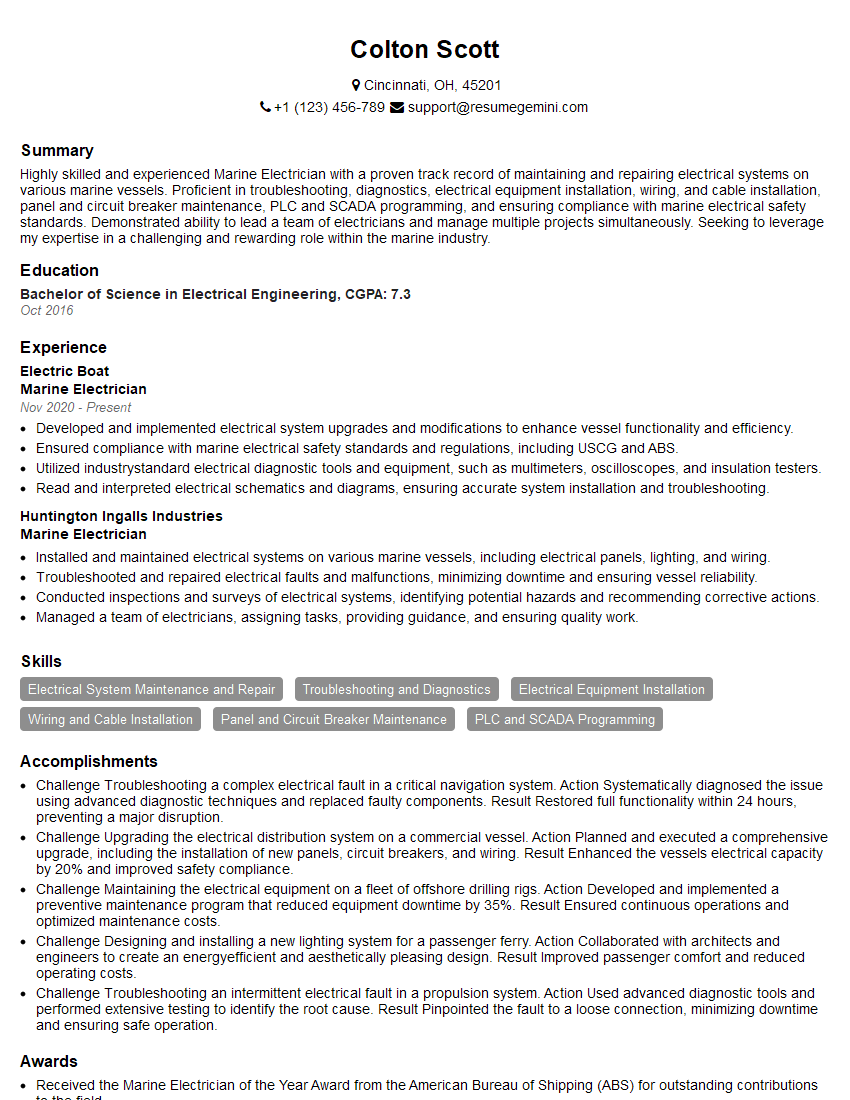
Mastering boat electrical system maintenance opens doors to exciting career opportunities within the marine industry, offering diverse roles and excellent growth potential. To stand out from the competition, a well-crafted, ATS-friendly resume is crucial. ResumeGemini is a trusted resource to help you build a professional resume that highlights your skills and experience effectively. They provide examples of resumes tailored specifically to Boat Electrical System Maintenance, ensuring your application makes a lasting impression. Invest time in crafting a compelling resume – it’s your first step towards securing your dream job.
Explore more articles
Users Rating of Our Blogs
Share Your Experience
We value your feedback! Please rate our content and share your thoughts (optional).
What Readers Say About Our Blog
I Redesigned Spongebob Squarepants and his main characters of my artwork.
https://www.deviantart.com/reimaginesponge/art/Redesigned-Spongebob-characters-1223583608
IT gave me an insight and words to use and be able to think of examples
Hi, I’m Jay, we have a few potential clients that are interested in your services, thought you might be a good fit. I’d love to talk about the details, when do you have time to talk?
Best,
Jay
Founder | CEO