Cracking a skill-specific interview, like one for Chemical Information Retrieval Services (SciFinder, Reaxys), requires understanding the nuances of the role. In this blog, we present the questions you’re most likely to encounter, along with insights into how to answer them effectively. Let’s ensure you’re ready to make a strong impression.
Questions Asked in Chemical Information Retrieval Services (SciFinder, Reaxys) Interview
Q 1. Describe your experience using SciFinder and Reaxys.
I have extensive experience using both SciFinder and Reaxys, two leading chemical information retrieval services. My experience spans several years and encompasses a wide range of applications, from simple compound searches to complex reaction pathway analyses and patent searches. I’m proficient in leveraging the advanced search features of both platforms to efficiently retrieve relevant and reliable data. For example, I’ve used SciFinder extensively for literature searches related to organic synthesis, while I’ve found Reaxys particularly useful for detailed reaction optimization and property prediction. My familiarity extends beyond basic searching to encompass data analysis and interpretation, ensuring the information I retrieve is appropriately contextualized and applied.
Q 2. How would you search for a specific compound in SciFinder?
Searching for a specific compound in SciFinder is straightforward but requires understanding its various search capabilities. The most common approach is using the structure search. You can draw the structure directly using the sketching tool or input the CAS Registry Number (CAS RN) if known. Alternatively, you can use the name search, but be aware that different names might exist for the same compound (e.g., IUPAC name, common name, trivial name). If you’re unsure of the exact structure or name, you can use substructure searching (finding compounds containing a specific structural fragment). It’s crucial to meticulously check the results, as variations in nomenclature might lead to missed results. For example, if searching for ibuprofen, using the CAS RN is the most reliable method. If you use a name search, you should consider synonyms or related terms and possibly combine it with a structure search.
Q 3. Explain the difference between a substructure search and an exact search in Reaxys.
In Reaxys, an exact search finds only compounds that exactly match the specified structure or name. Think of it like finding an identical twin – only the perfect match will do. A substructure search, however, is much more flexible. It finds compounds that contain the specified structure as a part of their overall structure. This is akin to finding someone who shares a specific facial feature – you’ll find a larger group of people because only a portion of their overall structure needs to match. For example, an exact search for benzene will only return results for benzene itself. A substructure search using a benzene ring will return benzene, but also toluene, chlorobenzene, and countless other compounds containing a benzene ring.
Q 4. How do you handle false positives or negatives in your searches?
False positives and negatives are inherent challenges in any information retrieval system. To minimize false positives (irrelevant results), I refine my search strategy by using multiple search terms, Boolean operators (AND, OR, NOT), and applying appropriate filters such as reaction type, year of publication, or specific property ranges. To address false negatives (missing relevant results), I explore alternative search terms and consider using broader search options, like substructure searches in place of exact searches. If a search yields too few results, I evaluate whether my search terms are too specific. Conversely, if it yields too many results, I try to increase specificity by adding more terms or using narrower filters. A multi-faceted approach and careful evaluation are crucial.
Q 5. Describe a complex search you performed using either SciFinder or Reaxys.
One complex search I performed involved identifying all palladium-catalyzed cross-coupling reactions reported since 2015 that utilized an aryl halide containing a specific functional group (a tertiary amine) and produced a biaryl product with a defined steric profile. This involved combining several search criteria in Reaxys, using a combination of substructure and keyword searching. I employed substructure searching to define the aryl halide and the biaryl product, keyword searching to identify the palladium catalyst and reaction type, and applied a date filter to limit results to papers published since 2015. I further refined results by filtering based on reaction yields and adding property constraints related to the steric profile. This multi-step process allowed me to effectively narrow down a vast dataset to a concise and highly relevant subset, which proved essential for my research.
Q 6. What are the limitations of SciFinder and Reaxys?
While incredibly powerful, both SciFinder and Reaxys have limitations. One significant limitation is the inherent time lag between publication of research and its inclusion in the databases. This means that very recent publications might be absent. Both databases also rely on indexed information; therefore, the quality and completeness of the data depend on the accuracy of the original publications and the indexing process. Another limitation lies in the cost; access often requires institutional subscriptions, limiting individual use. Finally, the sheer volume of data can be overwhelming and necessitate well-defined search strategies to avoid being swamped with irrelevant information. The databases might also miss niche publications or research from lesser-known journals.
Q 7. How do you determine the relevance of search results?
Determining the relevance of search results is a crucial step. I evaluate relevance based on multiple factors: the title and abstract, the keywords used by the authors, the journal’s impact factor (as an indicator of quality and visibility), and the overall alignment of the findings with my specific research questions. I usually start with a thorough review of the abstracts to eliminate irrelevant results. I then carefully examine the full text of the most promising papers to verify the relevance of the data to my specific needs. For example, if I’m looking for a specific synthetic procedure, I check if the paper provides sufficient details on reagents, reaction conditions and yields. This iterative process of filtering and refinement is essential to maximize the value of my search efforts.
Q 8. How do you manage and organize large datasets retrieved from chemical databases?
Managing large datasets from chemical databases requires a systematic approach. Think of it like organizing a massive library – you can’t just throw everything on the shelves haphazardly. My strategy involves a multi-step process:
Filtering and Refining: Initially, I carefully refine my search queries to retrieve only the most relevant data. This significantly reduces the initial dataset size. I leverage advanced search functionalities like substructure searching and property filtering to narrow down the results.
Exporting and Formatting: I export the data in a structured format, usually CSV or SDF (Structure Data File), which allows easy import into spreadsheet software or cheminformatics tools. This step allows for further manipulation and analysis.
Database Management: For extremely large datasets, I utilize database management systems (DBMS) like SQLite or MySQL. These allow for efficient searching, sorting, and filtering within the retrieved data.
Data Visualization: To gain insights quickly, I leverage data visualization tools to represent the data graphically. This might involve creating charts or graphs to identify trends or patterns.
Keyword tagging and organization: I utilize keywords and tags to organize data within my personal files or databases, making it easy to locate specific information at a later date. This is especially useful when dealing with multiple projects simultaneously.
For example, while researching novel catalysts, I once retrieved over 10,000 articles from SciFinder. By employing these techniques, I was able to efficiently analyze only the most relevant 200 publications.
Q 9. Explain your experience with different search operators (e.g., Boolean operators).
Boolean operators (AND, OR, NOT) are fundamental to efficient searching in chemical databases. They’re like the building blocks of a precise query, allowing you to combine search terms to narrow or broaden your results.
AND: This operator ensures that all search terms must be present in the result. For example,'benzene' AND 'oxidation'would return only results mentioning both benzene and oxidation.OR: This operator returns results containing at least one of the specified search terms.'benzene' OR 'toluene'would retrieve documents mentioning either benzene or toluene or both.NOT: This operator excludes results containing a specific term.'aspirin' NOT 'synthesis'would exclude any documents detailing the synthesis of aspirin, focusing on other aspects instead.
Beyond Boolean operators, SciFinder and Reaxys offer advanced search features such as substructure searching (finding molecules with specific structural features), exact-match searching for CAS Registry Numbers, and property-based filtering (for example, finding compounds with a specific melting point range).
My experience encompasses utilizing these operators and advanced features to formulate highly specific search strategies, crucial for efficiently locating relevant information amid millions of entries.
Q 10. How do you cite information retrieved from SciFinder and Reaxys?
Proper citation of information is crucial for maintaining academic integrity and giving credit to original sources. SciFinder and Reaxys provide tools to facilitate this process. Typically, the citation style is consistent with ACS (American Chemical Society) or other established styles.
The citation usually includes the database name (SciFinder or Reaxys), the accessed date, and ideally a unique identifier like the CAS Registry Number or document ID. For example:
SciFinder: [Author(s)]. Title of Article. Journal Name Year, Volume(Issue), Pages. Retrieved from SciFinder on [Date].
Reaxys: [Author(s)]. Title of Article. Journal Name Year, Volume(Issue), Pages. Retrieved from Reaxys on [Date].
It’s important to note that the specific formatting might vary slightly depending on the specific article or patent and the chosen citation style guide. Always check the database’s help section or the relevant citation style guide for precise instructions.
Q 11. How familiar are you with CAS Registry Numbers?
I am very familiar with CAS Registry Numbers (CAS RNs). They are unique numerical identifiers assigned by the Chemical Abstracts Service to every chemical substance described in the scientific literature. They are crucial for unambiguous identification of chemicals, avoiding confusion due to different names or synonyms. CAS RNs are essential when searching chemical databases like SciFinder and Reaxys because they guarantee the retrieval of the correct information for a specific compound, regardless of its name or structural representation.
Think of CAS RNs as the social security numbers of chemical compounds—a unique identifier that ensures that we’re always talking about the same molecule.
Q 12. How would you use SciFinder to identify potential synthetic routes for a molecule?
SciFinder offers powerful tools to identify potential synthetic routes for a given molecule. The process typically involves:
Drawing the Target Molecule: I start by drawing the target molecule using SciFinder’s chemical drawing tool.
Searching for Synthesis Reactions: SciFinder allows searching for reactions leading to the target molecule or its precursors. This might involve using substructure searching to find reactions featuring key functional groups present in the target molecule.
Reaction Navigator: This tool within SciFinder is extremely useful for exploring and visualizing potential synthetic pathways. I can work backwards from the target molecule, identifying precursors and exploring different synthetic approaches.
Analyzing Reaction Conditions and Yields: Once potential routes are identified, I analyze the reported reaction conditions (temperature, pressure, reagents, catalysts) and yields to evaluate the feasibility and efficiency of each synthetic route.
Considering Reagent Availability and Cost: The accessibility and cost of the required reagents are also important factors that I evaluate when choosing a synthetic route.
By combining these steps, I can develop a comprehensive understanding of potential synthetic routes and choose the most efficient and practical strategy for the target molecule. This is a crucial aspect of medicinal chemistry, process chemistry, and material science research.
Q 13. Explain your experience using Reaxys to analyze reaction conditions and yields.
Reaxys is a powerful tool for analyzing reaction conditions and yields. It allows a detailed examination of millions of reactions from the literature. My experience includes:
Reaction Search: I can search for reactions based on reactants, products, catalysts, and reaction conditions (temperature, pressure, solvent).
Data Analysis: Reaxys allows me to analyze reaction data statistically and visually. I can create graphs showing the relationship between reaction conditions and yields, helping to optimize reaction parameters.
Predictive Modeling: With Reaxys, it’s possible to build quantitative structure-activity relationship (QSAR) models and reaction outcome prediction models to anticipate the yield and selectivity of different reaction conditions.
Retrosynthetic Analysis: Reaxys can assist with retrosynthetic analysis, proposing plausible routes to synthesize a target compound by identifying appropriate reactions and reagents.
For example, when working on a project requiring the synthesis of a specific compound, I used Reaxys to search for similar reactions. By analyzing the yields and conditions reported in the literature, I was able to optimize the synthesis, achieving significantly higher yield than previously reported.
Q 14. How do you evaluate the reliability of information found in chemical databases?
Evaluating the reliability of information found in chemical databases is critical. It’s not a simple yes or no answer; it requires a critical and nuanced approach.
Source Evaluation: I carefully assess the source of the information. Peer-reviewed journal articles are generally more reliable than patents or less reputable sources. I also check the journal’s impact factor and reputation.
Data Consistency: I look for consistency in the data across multiple sources. If multiple independent studies report similar findings, it increases confidence in the reliability of the information.
Experimental Details: I examine the level of detail provided in the experimental section of an article or patent. Detailed and reproducible experimental procedures improve the reliability of the results.
Author Expertise: The reputation and expertise of the authors are relevant indicators of the reliability of their work.
Date of Publication: More recent publications might reflect advancements in techniques and knowledge, leading to more reliable results than older studies.
A multi-faceted approach is key. I don’t rely on a single factor to judge reliability; instead, I consider a combination of factors to form a well-informed opinion on the trustworthiness of the data.
Q 15. How would you use SciFinder to track the progress of a specific research area?
Tracking the progress of a specific research area in SciFinder involves a multi-faceted approach leveraging its powerful search capabilities. Think of it like following a research ‘thread’ through time.
First, I’d start by identifying key keywords and concepts related to the area. For example, if I wanted to track progress in ‘Lithium-ion battery cathode materials’, I’d use these terms as my initial search strings. SciFinder’s advanced search options allow for combining terms using Boolean operators (AND, OR, NOT) to refine results. I might search for publications containing ‘Lithium-ion’ AND ‘cathode’ AND (‘nickel’ OR ‘manganese’ OR ‘cobalt’) to focus on specific material compositions.
Next, I’d utilize SciFinder’s citation searching capabilities. By identifying seminal papers in the field, I can then follow their citation links to see which later publications built upon that research. This helps uncover a chronological progression of ideas and advancements. SciFinder’s visualization tools allow you to map these citations and view the research ‘tree’ that develops from a starting point.
Finally, I would employ the ‘Alerts’ feature to receive updates on new publications that match my specified search criteria. This ensures I remain abreast of the latest developments without constantly manually searching. This automated notification system is crucial for continuous monitoring of a dynamic research area.
Career Expert Tips:
- Ace those interviews! Prepare effectively by reviewing the Top 50 Most Common Interview Questions on ResumeGemini.
- Navigate your job search with confidence! Explore a wide range of Career Tips on ResumeGemini. Learn about common challenges and recommendations to overcome them.
- Craft the perfect resume! Master the Art of Resume Writing with ResumeGemini’s guide. Showcase your unique qualifications and achievements effectively.
- Don’t miss out on holiday savings! Build your dream resume with ResumeGemini’s ATS optimized templates.
Q 16. Describe your experience using analytical tools within SciFinder or Reaxys.
My experience with SciFinder’s analytical tools is extensive. I regularly use its substructure searching capabilities to identify compounds with specific functionalities or structural motifs. For instance, I’ve used it to find all compounds containing a specific heterocyclic ring system within a larger molecule, something vital for medicinal chemistry projects. This surpasses simple keyword searching, allowing you to focus on structural similarity.
Beyond substructure searching, I frequently utilize reaction searching. Given a specific reaction, SciFinder can retrieve many examples of that transformation, helping me understand reaction scope, yields, and relevant conditions. This is particularly useful when optimizing synthetic routes or exploring new reaction pathways.
Furthermore, SciFinder’s analytical features allow me to analyze reaction yields, assess the frequency of certain chemical transformations and identify trends within research literature based on reaction conditions, catalysts, or other parameters. This allows you to gather quantitative insights that a simple literature review may miss.
Reaxys offers similar analytical capabilities with a stronger focus on properties and synthesis planning. Reaxys’ predictive tools based on reaction and substance properties assist in finding optimal synthetic routes and assessing the feasibility of specific transformations. These tools allow for a more data-driven approach to research.
Q 17. How do you handle ambiguous search terms or chemical names?
Ambiguous search terms are a common challenge in chemical information retrieval. Imagine trying to search for ‘methyl benzene’ – many databases will also return results for toluene, because they are the same compound, simply with different names. My approach is multi-pronged.
First, I utilize SciFinder’s and Reaxys’ synonym and structural searching capabilities. Instead of just typing a name, I can draw the chemical structure directly, eliminating ambiguity caused by different names or synonyms. This is especially helpful for complex molecules where naming conventions vary across publications.
Secondly, I expand my search terms using related synonyms and keywords. For example, if a search for a specific chemical name yields limited results, I’ll incorporate synonyms, related chemical classes, or structural fragments into my search strategy. Using ‘OR’ boolean operators will allow me to capture all results that contain any of the listed terms.
Finally, I carefully examine the search results and refine my search strategy iteratively. The initial search may generate too many or too few hits; I will adjust my terms or strategies accordingly. This iterative process is key to effectively managing ambiguity. If a chemical name is particularly ambiguous I may use specialized nomenclature or CAS registry numbers to assure clarity.
Q 18. How familiar are you with the different file formats used in chemical databases?
Familiarity with various file formats is essential for effective use of chemical databases. SciFinder and Reaxys primarily export data in formats like .csv (comma-separated values) for tabular data, enabling easy import into spreadsheets and databases. This format is the most common for handling large datasets of chemical properties, reaction data, or bibliographic information.
Another crucial format is .sdf (Structure Data File), a standard for representing chemical structures and associated information. This allows you to transfer structural data between programs and databases, or utilize this format for molecular modeling and simulation tools. These formats preserve the molecular structure while permitting attachment of other information like names, chemical properties, and references.
Additionally, I’m proficient in handling .mol (MDL Molfile) format, another widely used standard for chemical structures, which is similar to .sdf files. These files can be imported into numerous computational chemistry software packages for visualization, modelling, and calculations.
Finally, exporting in citation management software formats like .ris (Research Information Systems) or .bib (BibTeX) is important for seamless integration with reference management tools. This enables streamlined organization and tracking of literature references uncovered during searches.
Q 19. Explain your experience using chemical drawing tools within SciFinder or Reaxys.
Both SciFinder and Reaxys incorporate powerful chemical drawing tools that are indispensable for efficient searching and data analysis. These tools allow for far more precise searches compared to simple text-based searches.
I frequently use the chemical drawing tools to create substructures for searching. For example, if I’m interested in finding compounds containing a specific pharmacophore, I can draw that pharmacophore directly and use it as the search query. This allows for a much more targeted search compared to relying on keywords or incomplete chemical names.
Furthermore, these tools are vital for constructing and analyzing reaction schemes. I can draw reactants and products and use these drawings as input to find similar reactions reported in the literature, helping me optimize synthetic strategies or assess reaction feasibility. The ability to visually manipulate and compare structures accelerates this process.
Beyond searching, the chemical drawing tools are also useful for creating and exporting figures for reports and presentations. I can use these tools to generate publication-quality images of chemical structures and reaction schemes, avoiding the need for external software, improving efficiency and consistency.
Q 20. How would you train a junior colleague on using SciFinder or Reaxys?
Training a junior colleague on SciFinder or Reaxys involves a structured, hands-on approach. I would start with the basics, demonstrating how to perform simple keyword searches and navigate the interface. I would then progress to more advanced techniques like substructure searching, reaction searching, and the use of Boolean operators. The training wouldn’t just be lectures; instead I’d provide opportunities to practice.
I’d use practical examples relevant to their research interests. For example, if they were working on drug discovery, I would show them how to search for compounds with specific properties or biological activities, and how to trace their synthesis pathways from published procedures. If they worked with materials science, I would show them how to search for materials with specific characteristics and their applications.
I would emphasize the importance of carefully defining search terms, using Boolean operators effectively, and interpreting results critically. I’d also teach them how to utilize the citation mapping tools and alert features to monitor the progress of specific research areas. Finally, I would encourage them to experiment and explore the many features of these powerful databases. Regular check-ins and providing opportunities for applying the knowledge in their research will reinforce the learning process. This creates a positive and productive learning environment.
Q 21. What are the ethical considerations when using chemical information databases?
Ethical considerations when using chemical information databases are paramount. The primary concern revolves around intellectual property and data integrity. It is crucial to respect copyright and licensing agreements associated with the databases and any data obtained from them. This means using the data only for legitimate research and educational purposes, and properly citing any information used in publications or presentations.
Data integrity involves ensuring the accuracy and reliability of the information accessed. It’s essential to carefully evaluate the source and quality of data before using it for any conclusions. The data is not necessarily perfect and may contain errors or omissions. It’s important to be mindful of any potential bias inherent in the data sets used. We must be critical of published information, not accepting everything at face value.
Another critical ethical consideration is the responsible use of data and avoiding plagiarism. All data retrieved must be properly cited and attributed. This includes not just published literature but also any data extracted from the databases themselves. Maintaining transparency regarding data sources and methodology is essential for ensuring the integrity of research findings. This establishes trust within the scientific community.
Q 22. How do you stay up-to-date with the latest developments in chemical information retrieval?
Staying current in chemical information retrieval requires a multi-pronged approach. It’s not just about using the databases; it’s about understanding their evolution.
- Regularly attend webinars and online training sessions: Both SciFinder and Reaxys offer numerous training opportunities that cover new features, search strategies, and updates to their indexing methodologies. These are invaluable for learning best practices.
- Network with other professionals: Attending conferences, joining online communities (like those related to chemistry or cheminformatics), and engaging with colleagues allows you to learn about effective search techniques and troubleshooting strategies others have discovered.
- Read relevant publications: Stay abreast of new database features and advancements through articles in journals like Journal of Chemical Information and Modeling or news and blog posts from the database providers themselves.
- Experiment with new features: Don’t be afraid to test out new search capabilities or indexing approaches. Practice makes perfect, and you’ll become more adept at uncovering information as you explore.
- Utilize the help resources: Both SciFinder and Reaxys have comprehensive help sections and documentation. These are invaluable for understanding search operators and advanced functionalities.
Think of it like learning a language – consistent practice and exposure are key to fluency in chemical information retrieval. By actively seeking out these avenues, you ensure you remain a highly effective researcher.
Q 23. Describe a time you had to troubleshoot a problem with a chemical database search.
During a project investigating novel catalysts for CO2 reduction, I encountered a frustrating problem. I was searching for publications related to specific metal-organic frameworks (MOFs) using a combination of keywords and substructure searching in SciFinder. My initial searches yielded few relevant results despite knowing numerous publications existed.
My troubleshooting involved a systematic approach:
- Reviewed my search strategy: I meticulously checked my keyword selection and substructure queries, ensuring accuracy and completeness. I discovered I’d unintentionally excluded some important keywords due to a typo.
- Expanded search terms: I broadened my search terms, employing synonyms and related chemical concepts. For example, instead of focusing solely on ‘CO2 reduction’, I included terms like ‘carbon capture’ and ‘electrocatalysis’.
- Explored advanced search operators: SciFinder’s Boolean operators and proximity operators were crucial. I refined my search using parentheses and proximity operators to target publications where my chosen keywords appeared closely together.
- Tested different search fields: I experimented with searching across different fields within SciFinder, such as titles, abstracts, and index terms, to capture publications that might not have used the exact keywords I initially selected.
By systematically addressing potential issues, I significantly improved my results. The key takeaway was the importance of carefully crafting search strategies and employing a methodical approach to troubleshooting when unexpected results occur. Thinking like a detective is key when you hit roadblocks in database searching.
Q 24. What are the key differences between SciFinder and Reaxys?
SciFinder and Reaxys are both powerful chemical databases, but they have distinct strengths and weaknesses:
| Feature | SciFinder | Reaxys |
|---|---|---|
| Content Focus | Strong emphasis on chemical substances, reactions, patents, and journal articles, with a particularly strong US patent coverage. | Strong in chemistry and materials science, with a broader focus on patents (including European, and other international patents), including comprehensive substance data. |
| Reaction Searching | Excellent reaction searching capabilities including retrosynthetic analysis tools. | Powerful reaction searching capabilities, including reaction prediction and planning. |
| Substance Information | Comprehensive substance information including physical properties, spectral data, and references. | Comprehensive substance information, covering a wider range of properties and including experimental procedures. |
| Patent Searching | Extensive US patent coverage. | Broader international patent coverage |
| Interface | Intuitive and user-friendly interface. | More complex interface requiring greater familiarity. |
| Pricing | Typically more accessible to individual researchers through institutional subscriptions. | Usually more expensive, often requiring institutional subscriptions. |
The best choice depends on specific needs. SciFinder excels at finding US patents and has a user-friendly interface; Reaxys provides broader international patent coverage and more comprehensive substance data but has a steeper learning curve.
Q 25. Which database would you choose for patent searching, and why?
For patent searching, I would primarily choose Reaxys. While SciFinder has strong US patent coverage, Reaxys offers a more comprehensive collection of international patents, particularly from European patent offices. This broader scope is crucial for gaining a global perspective on a technology or invention.
Furthermore, Reaxys’ advanced search capabilities and filters specifically tailored for patent searches, such as classification codes and applicant information, enable more efficient retrieval of relevant documents.
However, for purely US patent searches focusing only on that specific jurisdiction, SciFinder’s strong US patent coverage and possibly simpler interface could make it a practical choice.
Q 26. Which database would you use for reaction synthesis planning, and why?
For reaction synthesis planning, I would choose Reaxys. Its reaction prediction and planning capabilities, coupled with its extensive reaction dataset, significantly aid in designing synthetic routes. The software allows for retrosynthetic analysis, visualizing potential pathways, and assessing the feasibility of various synthetic strategies. While SciFinder offers excellent reaction searching, Reaxys provides the more advanced tools directly geared toward planning a synthesis.
Reaxys’ detailed substance information, including experimental procedures from literature, is also invaluable in refining synthetic plans and estimating yields. It helps bridge the gap between theory and practical execution.
Q 27. How would you approach finding information on a newly discovered compound?
Discovering information on a newly discovered compound requires a multi-faceted approach using both databases and other resources:
- Start with the name and structure: Begin by inputting the compound’s name or structure (if known) into both SciFinder and Reaxys. These databases use sophisticated algorithms to identify compounds based on various identifiers including CAS Registry Numbers, IUPAC names, and InChIKeys.
- Expand the search: If initial searches don’t produce results, try searching for related compounds. This may involve identifying structural analogs or compounds with similar functionalities.
- Explore chemical databases beyond SciFinder and Reaxys: Consider databases like PubChem which may provide information not indexed in SciFinder or Reaxys, especially if the compound is very new.
- Search scientific literature directly: Use search engines like Google Scholar to look for publications mentioning the compound. Often, papers announcing new compounds contain comprehensive characterization data.
- Consult specialized databases: Depending on the compound’s class, specialized databases focusing on specific areas like pharmaceuticals or polymers might contain relevant information.
Remember to cross-reference results from different sources to verify the accuracy and completeness of the information. Think of it as triangulation – using multiple sources to confirm your findings.
Q 28. Describe your experience with exporting and importing data from SciFinder and Reaxys.
Both SciFinder and Reaxys offer robust data export and import functionalities. The specific features and formats may differ slightly, but the core principles are similar.
SciFinder: Exporting data is straightforward using options to download results in formats like CSV, TXT, or SDF (Structure Data File) for chemical structures. The exported data can be readily imported into spreadsheet software (like Excel) or specialized chemical drawing and analysis programs (like ChemDraw).
Reaxys: Reaxys offers similar export options, including various chemical file formats for structures and data tables for properties and bibliographic information. Again, importing this data into other software applications is generally straightforward.
Challenges: Occasional challenges include data formatting issues when importing large datasets. Data cleansing might be necessary depending on the target application, ensuring consistency in formatting. Sometimes, you might need to manually adjust the data to suit a particular program’s requirements.
Overall, both platforms provide effective methods for managing and sharing information, facilitating collaborative research and data analysis. Understanding the various export/import formats and the nuances of the software you are using is key to a smooth workflow.
Key Topics to Learn for Chemical Information Retrieval Services (SciFinder, Reaxys) Interview
- Database Navigation & Search Strategies: Mastering Boolean operators, substructure searching, and reaction searching in both SciFinder and Reaxys. Understanding the strengths and weaknesses of each platform’s search capabilities.
- Structure Drawing & Representation: Proficiency in drawing chemical structures and utilizing various naming conventions (IUPAC, SMILES, InChI). Understanding how these representations function within the databases.
- Data Interpretation & Analysis: Extracting relevant information from search results, critically evaluating the quality and reliability of data, and summarizing findings effectively.
- Property Prediction & Calculation: Utilizing tools within SciFinder and Reaxys to predict chemical properties (e.g., logP, boiling point) and understanding the limitations of these predictions.
- Patent & Literature Searching: Efficiently identifying relevant patents and literature citations related to specific chemical compounds or reactions. Understanding the differences in patent and journal article information retrieval.
- Reaction Searching & Retrosynthesis: Performing complex reaction searches to identify synthetic routes and exploring retrosynthetic analysis capabilities within the platforms.
- Data Export & Citation Management: Exporting data in various formats (e.g., CSV, SDF) and integrating this information into other software or citation management tools.
- Comparative Analysis of SciFinder & Reaxys: Understanding the unique features and capabilities of each database and choosing the most appropriate platform for specific research questions.
- Troubleshooting & Problem-Solving: Developing strategies for effectively troubleshooting common search issues and navigating database limitations.
Next Steps
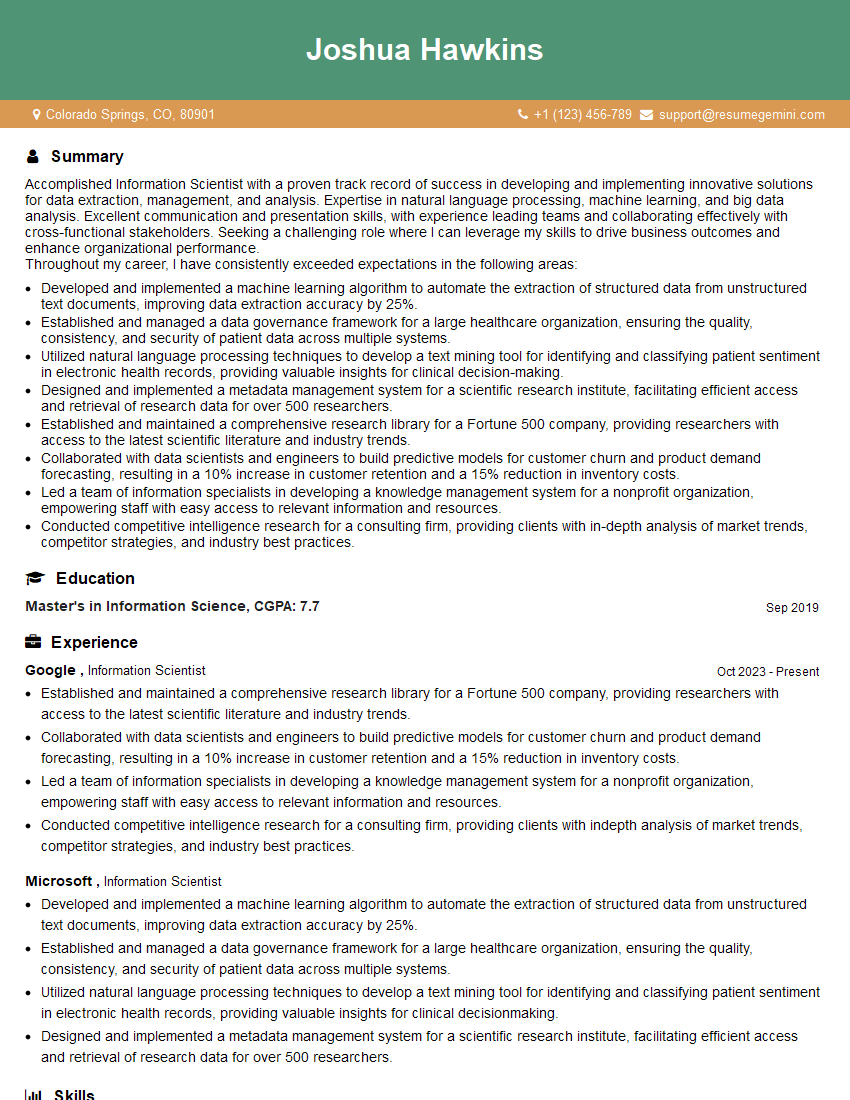
Mastering chemical information retrieval services like SciFinder and Reaxys is crucial for success in many chemistry-related roles, opening doors to exciting research opportunities and career advancement. A strong understanding of these tools demonstrates valuable research skills and efficiency. To maximize your job prospects, invest time in crafting an ATS-friendly resume that highlights your expertise. ResumeGemini is a trusted resource to help you build a professional and impactful resume, showcasing your skills effectively. Examples of resumes tailored to Chemical Information Retrieval Services (SciFinder, Reaxys) are available to help guide you.
Explore more articles
Users Rating of Our Blogs
Share Your Experience
We value your feedback! Please rate our content and share your thoughts (optional).
What Readers Say About Our Blog
I Redesigned Spongebob Squarepants and his main characters of my artwork.
https://www.deviantart.com/reimaginesponge/art/Redesigned-Spongebob-characters-1223583608
IT gave me an insight and words to use and be able to think of examples
Hi, I’m Jay, we have a few potential clients that are interested in your services, thought you might be a good fit. I’d love to talk about the details, when do you have time to talk?
Best,
Jay
Founder | CEO