Every successful interview starts with knowing what to expect. In this blog, we’ll take you through the top Electronic Prepress interview questions, breaking them down with expert tips to help you deliver impactful answers. Step into your next interview fully prepared and ready to succeed.
Questions Asked in Electronic Prepress Interview
Q 1. Explain the process of trapping in prepress.
Trapping in prepress is a crucial technique used to prevent unwanted gaps between colors or inks during the printing process. Think of it like creating a slight overlap between adjacent color areas to ensure clean, sharp edges, even when the printing plates aren’t perfectly aligned. This is especially important when printing with multiple colors, as minor misregistrations (errors in alignment) are almost inevitable.
There are two main types of trapping: spread trapping, where the lighter color is spread slightly into the darker color, and choke trapping, where the darker color is choked slightly, meaning it encroaches slightly onto the lighter color. The choice between them depends on the specific colors and the printing method. For instance, spread trapping is often preferred for light colors on dark backgrounds, preventing white gaps, while choke trapping is useful for dark colors on light backgrounds to prevent dark outlines looking fuzzy.
For example, imagine printing a logo with a red circle next to a blue square. Without trapping, there might be a tiny white gap between the red and blue, especially if the press misregisters slightly. With trapping, a thin sliver of the red would extend into the blue area, or vice versa, seamlessly filling that gap.
Q 2. What are the different color spaces used in electronic prepress, and when would you use each one?
Several color spaces are vital in electronic prepress, each serving a different purpose. The most common are:
- CMYK (Cyan, Magenta, Yellow, Key [Black]): This is the subtractive color model used for most printing processes. It’s based on the mixing of colored inks to create a wide range of colors. It’s the workhorse of print production, but its limitations include a smaller color gamut than RGB.
- RGB (Red, Green, Blue): This is the additive color model used for displays like monitors and screens. It’s perfect for designing and viewing on-screen, but it can’t directly represent the range of colors achievable in print.
- Pantone (PMS): This is a spot color system using pre-mixed inks with specific formulations for precise color matching. It’s invaluable for branding, where consistent color across various print runs and materials is paramount. Imagine a company logo—Pantone ensures the logo’s color remains consistent even if different printers or papers are used.
- Lab (CIE L*a*b*): This is a device-independent color space, meaning it represents colors in a way that’s less dependent on the specific output device. It’s useful for color management and ensuring accuracy across different devices and color profiles.
In practice, you’d typically work in RGB for on-screen design, convert to CMYK for print preparation, and sometimes use Pantone for brand colors. Lab is used behind the scenes for accurate color conversions and proofing.
Q 3. Describe your experience with color management and profiling.
My experience with color management and profiling is extensive. I’ve worked with various color management systems (CMS) to create and utilize ICC profiles. These profiles characterize a specific device’s color reproduction capabilities, ensuring color consistency across different stages of the prepress workflow. I’ve handled situations requiring the creation of custom profiles for unusual substrates or printing processes. This is critical for accurately predicting the final printed output based on the digital design. For example, I once had to create a custom profile for a client who was using a unique type of textured paper which significantly impacted ink absorption, leading to different color representation compared to standard papers. Without a custom profile, color matching would have been practically impossible.
I’m proficient in using software tools like Adobe Acrobat, which allow me to manage color spaces, apply profiles, and perform color conversions for various output devices with a high degree of accuracy. I understand soft proofing, which involves simulating how the design will look in print on a calibrated monitor, minimizing surprises when the final printed output is received.
Q 4. How do you ensure color consistency across different printing methods?
Maintaining color consistency across different printing methods—offset, digital, large format, etc.—requires a meticulous approach. It starts with using a color management system, which enables you to control and manage color reproduction across different stages of the printing process, from creation to output. Crucially, it also involves understanding the limitations of each print method. Offset printing, for instance, has a wider color gamut than many digital printers.
Color proofing is vital. Soft proofing, using calibrated monitors, helps visualise the final output, while hard proofing, using a proof printer that closely simulates the final print process, provides a physical representation. Choosing the right substrates (paper) and ensuring consistent ink formulations across different print jobs are also crucial elements.
Furthermore, establishing communication and a shared understanding with printers is key. Working closely with them to establish color standards and conduct color tests before the actual production run helps to identify and rectify any inconsistencies early on.
Q 5. What is the importance of image resolution in prepress?
Image resolution is paramount in prepress. It determines the sharpness and detail of the final printed output. Low resolution images will appear blurry and pixelated, especially when enlarged. The resolution, measured in dots per inch (dpi), needs to be appropriate for the intended printing method and final output size. Offset printing typically requires higher resolutions (300 dpi or more) than digital printing (which might be fine at 150 dpi for certain applications).
Using images with insufficient resolution is a common prepress problem. Imagine a website banner designed at 72 dpi being printed as a large billboard – it would look disastrously blurry! Therefore, selecting high-resolution source images or upscaling with care using advanced software techniques is crucial.
The resolution needs to align with the printing process, screen ruling (the number of lines per inch in a halftone screen), and the paper quality to achieve the desired outcome. Selecting appropriate resolution is a critical step for achieving high quality print and ensures that the details are accurately represented.
Q 6. Explain the concept of imposition and its importance in printing.
Imposition is the arrangement of pages on a printing sheet before printing. Imagine you’re printing a booklet—imposition dictates how the printed sheets need to be folded and assembled to form the final product in the correct page order. It’s like creating a puzzle where the pieces must fit together precisely to yield a perfect end result. Without correct imposition, the booklet’s pages would be out of order, resulting in a completely unusable product.
The importance of accurate imposition is paramount. It ensures the pages are arranged correctly for efficient printing, and most importantly, correct binding and finishing. Incorrect imposition will lead to wasted resources and reprints, significantly impacting costs and time. Dedicated software facilitates this process by automatically arranging pages based on the printing press and binding method. For instance, a different imposition setup would be required for a saddle-stitched booklet compared to a perfect-bound book.
Q 7. What software are you proficient in (Adobe InDesign, Illustrator, Photoshop, Acrobat, etc.)?
I’m highly proficient in the Adobe Creative Suite, including:
- Adobe InDesign: For page layout and design of complex documents, brochures, and books.
- Adobe Illustrator: For creating and manipulating vector graphics, logos, and illustrations.
- Adobe Photoshop: For image editing and retouching.
- Adobe Acrobat: For PDF creation, editing, and preflighting for print, including color management.
Beyond Adobe, I also have experience with other industry-standard software like prepress workflow automation systems and RIP software, depending on the client’s specific needs and production pipeline.
Q 8. Describe your experience with PDF workflows and preflighting.
PDF workflows are the backbone of modern electronic prepress. My experience encompasses the entire process, from creating press-ready PDFs to preflighting them for potential issues. I’m proficient in using various PDF creation tools like Adobe Acrobat Pro, ensuring the final PDF is optimized for the chosen printing method. Preflighting, a crucial step, involves using software like PitStop Pro to automatically check for potential printing problems such as missing fonts, low-resolution images, color profile inconsistencies, and overset text. Think of preflighting as a thorough quality check before sending the file to print – it’s like proofreading a document before handing it in. For example, I recently identified a missing font in a client’s PDF, preventing a costly reprint by catching it during the preflight stage.
My workflow often involves creating a custom preflight profile tailored to the specific client’s requirements and printing method. This ensures consistency and efficiency, preventing common errors early on in the process.
Q 9. How do you handle problematic files or images?
Handling problematic files and images requires a systematic approach. I start by identifying the nature of the problem. For instance, a low-resolution image might appear blurry, while a missing font might result in the wrong text or character appearing, or even missing entirely. Using image editing software like Adobe Photoshop, I can upsample images to improve resolution, ensuring they meet the required print standards, or at the very least, flag images with poor resolution to the client. For fonts, I’ll work to find the necessary font or replace it with an appropriate alternative that will render as expected.
I also regularly deal with color profile issues. Inconsistent or missing color profiles can lead to inaccurate color reproduction. My solution usually involves embedding the correct ICC profile into the PDF and converting color spaces to ensure consistent color across different devices and printing processes. If necessary, I’ll communicate with the client, providing solutions and ensuring the final product meets their expectations.
In the event of a corrupt file, I have strategies for recovery, attempting various techniques to repair the file or obtaining a backup from the client. A methodical approach and clear communication are critical in resolving file-related problems.
Q 10. What are the common file formats used in electronic prepress?
The electronic prepress world relies on several key file formats. PDF (Portable Document Format) is the industry standard for print-ready files due to its ability to preserve fonts and images across different platforms. TIFF (Tagged Image File Format) is commonly used for high-resolution images, often with lossless compression to retain image quality. JPEG (Joint Photographic Experts Group) is used where some image compression is acceptable, typically for web images and lower-resolution print applications. EPS (Encapsulated PostScript), while less common now, is still used for vector graphics, especially those created in Adobe Illustrator.
Beyond these, other formats like AI (Adobe Illustrator) and InDesign (Adobe InDesign) native files might appear in the workflow, but they are typically converted to PDFs before preflighting and sending to print. Choosing the right format is essential to ensuring print quality and efficiency, and understanding the limitations of each format is crucial to avoiding costly mistakes.
Q 11. Explain your experience with different printing processes (offset, digital, etc.).
I have extensive experience with both offset and digital printing processes. Offset printing, a high-volume process involving plates, is ideal for large print runs, offering superior quality and cost-effectiveness for large quantities. I understand the importance of color management, ensuring consistent color reproduction across different offset printing presses. My knowledge extends to various offset techniques, including perfecting (printing on both sides of the sheet simultaneously).
Digital printing, on the other hand, is perfect for short to medium print runs, providing flexibility and speed. It requires different considerations, such as understanding the printer’s capabilities and limitations, and choosing appropriate paper stocks. I am skilled in preparing files for various digital printing presses and understanding the color profiles and resolutions required for optimal output. I’ve worked with many digital print technologies such as toner-based and inkjet-based systems, tailoring my approach to specific machine characteristics.
My experience encompasses optimizing files for both processes, knowing when to use one over the other based on project requirements, budget, and desired quality.
Q 12. How do you manage and organize large quantities of files?
Managing large quantities of files requires a robust organizational system. I leverage a combination of strategies. First, a clear and consistent file-naming convention is essential for quick retrieval. I typically use a system that includes the client name, project name, file type, and version number (e.g., ClientName_ProjectName_v01.pdf). This makes finding specific files much faster.
Secondly, I use a hierarchical folder structure within a shared network drive. Folders are organized by client and project, making navigation intuitive. I also employ version control systems, ensuring that older versions of files are archived and accessible while maintaining a clear track of the latest version. For backup purposes I ensure all data is regularly backed up to the cloud or an offsite server. Finally, metadata tagging within files and folders further improves searchability and organization.
Q 13. What is your experience with CIP3/CIP4 workflows?
CIP3 and CIP4 are standards for automating the workflow between prepress, printing, and other related processes. CIP3 focused primarily on color management and image data transfer. CIP4 builds on this, providing more comprehensive automation and job tracking capabilities, particularly via JDF (Job Definition Format). While CIP3 is largely legacy technology, understanding its foundations is essential for comprehending the advancements that CIP4 represents. My experience with these workflows includes integrating prepress software with printing systems via JDF, enabling automated job submission, color management, and status updates. This reduces manual intervention, enhances efficiency, and minimizes errors during the production workflow.
For example, I’ve worked on projects where automated job tickets, including all relevant prepress settings and color profiles, were transferred from the prepress system to the press, reducing manual intervention and improving accuracy.
Q 14. How do you ensure the accuracy of print-ready files?
Ensuring the accuracy of print-ready files involves a multi-layered approach. Firstly, thorough preflighting as discussed previously is crucial. This automated check catches many potential issues. Secondly, a careful manual review of the files, paying attention to details like color accuracy, image resolution, text placement, and overall composition, helps catch errors that automated processes might miss. It is like carefully proofing a manuscript before publication.
Soft proofing, simulating the final print output on screen, is another important step. This allows for visual verification of color and image quality before the actual printing process. Finally, a hard proof—a physical printout of the file on the same type of paper that will be used for the final print—is the ultimate check to ensure everything looks as expected. This step is especially important for critical projects. By combining these methods, I significantly increase the chance of obtaining accurate and flawless print results.
Q 15. Describe your experience with proofing methods (soft proof, hard proof).
Proofing is a crucial step in prepress, ensuring the final printed product matches the client’s expectations. Soft proofing uses digital methods, while hard proofing involves a physical print sample.
My experience encompasses both. Soft proofing typically involves using a calibrated monitor and specialized software (like Adobe Acrobat Pro with a color profile matching the intended printing press) to view a digital representation of the final product. This allows for quick iterations and corrections before committing to expensive printing. I regularly use soft proofs to check for color accuracy, image resolution, and text clarity, often employing tools to simulate different paper stocks and printing processes. For example, I once caught a subtle color shift in a Pantone color during a soft proof that would have been costly to correct after printing.
Hard proofing, while more costly and time-consuming, provides a tangible representation, crucial for critical jobs requiring precise color reproduction or unique substrates. I’ve worked with various hard proof methods, from high-resolution inkjet proofs on coated paper to chromalin proofs for exacting color matching. For instance, a recent project involved a high-end packaging job where a hard proof was essential to ensure the embossed logo and foil stamping appeared as intended before proceeding to the final print run.
Career Expert Tips:
- Ace those interviews! Prepare effectively by reviewing the Top 50 Most Common Interview Questions on ResumeGemini.
- Navigate your job search with confidence! Explore a wide range of Career Tips on ResumeGemini. Learn about common challenges and recommendations to overcome them.
- Craft the perfect resume! Master the Art of Resume Writing with ResumeGemini’s guide. Showcase your unique qualifications and achievements effectively.
- Don’t miss out on holiday savings! Build your dream resume with ResumeGemini’s ATS optimized templates.
Q 16. How do you troubleshoot common prepress problems?
Troubleshooting in prepress requires a systematic approach. I start by identifying the type of problem: is it a color issue, a trapping problem, a font rendering error, or a file corruption issue?
- Color Issues: I check the color profiles, color spaces (CMYK, RGB, etc.), and look for potential color management conflicts. I might also investigate the print settings and paper stock. For example, if the blues are too light, I check if the printer profile matches the press profile accurately, looking for any mismatches in the color space or possible ICC profile issues.
- Trapping Issues: This usually involves insufficient or incorrect overprinting of colors to avoid gaps between adjacent colors. I examine the trapping settings in the imposition software and possibly adjust them for optimal results. I use my experience to decide whether to implement spread or choke trapping strategies.
- Font Rendering Problems: Issues like missing fonts or incorrect font embedding can lead to unexpected rendering issues. I meticulously check that all fonts used are correctly embedded in the PDF and that the correct versions are present on the RIP.
- File Corruption: Corrupted files can manifest in different ways, often leading to unexpected artifacts or rendering problems. I use file repair tools and verify file integrity to resolve this. Sometimes, obtaining the original source files from the client is necessary.
My approach is always to systematically eliminate possible causes until the root problem is identified and solved. Thorough documentation is vital for traceability and preventing similar problems in the future.
Q 17. What are your methods for quality control in prepress?
Quality control (QC) in prepress is paramount. My process involves multiple checks at different stages.
- File Check: I rigorously examine all incoming files for completeness, proper resolution, color mode, and the absence of any errors. This includes verifying the client’s specifications and checking for any missing fonts or images.
- Pre-flight Check: I use automated preflight tools to catch potential problems early. This process identifies issues like missing fonts, color space inconsistencies, incorrect bleed settings, and other potential pitfalls before proceeding to the next step. Adobe Acrobat Pro’s preflight feature is a key component of my workflow.
- Soft Proofing: A detailed soft proof checks for accurate color reproduction, correct text and image placement, and overall visual quality. Client approvals at this stage prevent unnecessary reprints.
- Hard Proofing (When Necessary): A hard proof is generated for jobs requiring precise color matching or specific substrate considerations. This usually precedes the final print run.
- Final PDF Review: I perform a final inspection of the imposition, checking for correct page order, bleeds, and margins before sending it for printing.
By implementing a layered QC process, I minimize errors and ensure high-quality output. This approach has proven to significantly reduce issues and rework in post-production, saving both time and resources.
Q 18. Explain your experience with variable data printing.
Variable data printing (VDP) allows for personalized printing of mass mailings, marketing materials, and other documents by changing the content dynamically. My experience includes working with various VDP software and workflows.
I’ve used VDP to personalize direct mail campaigns by incorporating recipient-specific information like names, addresses, and personalized messages. I’m proficient in integrating databases with VDP software to manage the personalization process. For instance, I recently managed a project involving over 10,000 personalized postcards, each featuring a unique image and address. This required careful data management and precise integration with the printing process. The challenge involved ensuring data integrity and accuracy across a large dataset, requiring meticulous error-checking.
My skills include creating and manipulating VDP templates, managing data sources, and troubleshooting issues arising from data inconsistencies or software glitches. I’m comfortable working with different file formats, including data feeds in CSV or XML formats.
Q 19. How do you handle client revisions and feedback?
Handling client revisions and feedback efficiently is critical. My process involves careful documentation, clear communication, and a structured approach.
- Detailed Tracking: I maintain a record of all revisions, including the date, the changes requested, and the status of the implementation.
- Clear Communication: I promptly acknowledge client feedback and communicate the timeline for implementing the revisions. I avoid technical jargon and strive for clarity.
- Version Control: I keep meticulously tracked versions of the design files, making it simple to revert to previous states if required.
- Proofing Revisions: Before finalizing any changes, I provide a new proof to the client for their approval, thus avoiding misinterpretations and costly reprints.
This methodical approach ensures client satisfaction and prevents misunderstandings. I emphasize proactive communication; addressing potential concerns early can prevent delays and additional revision requests.
Q 20. What are your skills in using RIP software?
RIP software (Raster Image Processor) is essential for converting vector-based files to raster images suitable for printing. My expertise extends to various RIP software, including those from manufacturers like EFI, Kodak, and others.
My skills include configuring color profiles, adjusting image processing parameters (resolution, sharpening, screening), and troubleshooting RIP-related errors. I’m familiar with different RIP features, such as spot color management, trapping, and pre-press quality checks. For example, I often use the built-in color management tools of the RIP to fine-tune the color output, ensuring optimal results for different printing presses and substrates.
I regularly use RIP software to manage color profiles, optimize image settings, and create high-quality print-ready files. I understand the importance of calibrating the RIP to match the printer profile for achieving consistent and accurate color reproduction.
Q 21. Describe your experience with imposition software.
Imposition software arranges pages of a document for efficient printing on a press sheet. My experience involves using various imposition software, such as imposition tools integrated within Adobe Acrobat Pro, dedicated imposition packages like Impose, and other specialized software.
My skills include creating imposition schemes, setting up bleeds and margins, and optimizing for different sheet sizes and press configurations. I understand different imposition techniques, including signatures, gang printing, and booklet making. For example, I recently worked on a project where I needed to create a 64-page booklet with a specific spine width and fold pattern. This involved using imposition software to arrange the pages and generate a print-ready file suitable for the press.
My proficiency extends to optimizing imposition for minimizing paper waste and maximizing printing efficiency while maintaining accurate page order and alignment. I always check the generated imposition for potential errors before sending it to the RIP.
Q 22. How familiar are you with different paper stocks and their printing properties?
Understanding paper stocks and their printing properties is crucial in electronic prepress. Different papers have vastly different characteristics that impact the final printed piece. These characteristics influence everything from ink absorption and color reproduction to the overall feel and durability of the product.
- Coated Papers: These have a smooth, glossy surface, ideal for sharp images and vibrant colors. They’re often used for magazines, brochures, and high-quality marketing materials. However, they can be more expensive and less environmentally friendly than uncoated papers.
- Uncoated Papers: These have a more textured surface, often resulting in a more natural look and feel. They’re suitable for books, stationery, and business cards where a less glossy finish is desired. They generally absorb ink more readily, which can affect color vibrancy.
- Specialty Papers: This broad category includes papers with unique characteristics, such as recycled content, textured finishes (e.g., linen), or colored stocks. Choosing the right specialty paper can significantly enhance the design and brand identity of the printed material. Examples include metallic papers or papers with watermarking.
For example, if I were preparing a design for a high-end fashion magazine, I’d likely choose a glossy coated paper to showcase the vibrant colors of the photography. Conversely, for a rustic wedding invitation, an uncoated or textured paper would be more appropriate to complement the style.
Q 23. What is your experience with managing and archiving prepress files?
Managing and archiving prepress files is critical for maintaining project integrity and ensuring efficient workflow. I’ve extensively used various methods for both short-term project management and long-term archival.
For short-term projects, I leverage cloud-based collaborative platforms like Dropbox or Google Drive, which allow for easy sharing and version control. This minimizes confusion and ensures everyone works with the most up-to-date files. For each project, I maintain a meticulously organized folder structure, ensuring all related files (design files, fonts, color profiles, etc.) are readily accessible.
Long-term archiving is handled through a combination of methods, depending on the client’s needs and the file types involved. This often includes using a secure network-attached storage (NAS) solution with redundant backups, as well as utilizing a cloud storage service with version history and disaster recovery capabilities. Metadata is meticulously tagged to ensure searchability and efficient retrieval years down the line. For example, I always include details like client name, project name, date, file format, and color space.
Q 24. Explain your understanding of print finishing processes.
Print finishing processes are crucial for enhancing the aesthetic appeal, durability, and functionality of a printed piece. They transform a basic printed sheet into a finished product ready for distribution. These processes usually take place after the printing is complete.
- Cutting and Trimming: This involves precisely cutting the printed sheets to the desired size and shape.
- Folding and Binding: This process assembles pages into booklets, brochures, or books using various methods like saddle-stitch, perfect binding, or wire-o binding.
- Lamination: Applying a protective plastic film to enhance durability and provide a glossy or matte finish.
- Die-Cutting: Creating custom shapes and designs using a die-cutting machine, often used for creating unique business cards or invitations.
- Embossing and Debossing: Creating raised or indented designs to add texture and visual interest.
For instance, I recently worked on a project where a client required a luxurious feel for their corporate brochure. We chose to use thick paper stock, perfect binding, and a matte lamination to achieve the desired high-quality look and feel.
Q 25. How do you handle high-pressure situations and tight deadlines?
High-pressure situations and tight deadlines are common in electronic prepress. My approach involves a combination of proactive planning, efficient workflow, and clear communication.
I prioritize tasks based on urgency and dependencies, using project management tools to track progress and identify potential bottlenecks. Open communication with clients and team members is key to managing expectations and quickly addressing any issues that arise. I’m adept at delegating tasks appropriately and readily seek help when needed to avoid delays.
For example, once a client requested significant revisions to a project just days before its due date. By prioritizing the critical changes and working closely with the design team and the printer, we were able to meet the deadline without sacrificing quality. My methodical approach and proactive communication helped mitigate the stress and ensure a successful outcome.
Q 26. Describe your experience with digital asset management systems.
I have significant experience working with digital asset management (DAM) systems. These systems are crucial for organizing, storing, and retrieving digital files, especially within collaborative environments. A well-implemented DAM system significantly streamlines the prepress workflow.
My experience includes using both proprietary and open-source DAM solutions. These systems provide features like metadata tagging, version control, search functionality, and access control. This ensures efficient retrieval of files, prevents version conflicts, and simplifies collaboration between team members and clients. I understand the importance of choosing a system that aligns with the specific needs of a project or organization, considering factors like scalability, security, and integration with other software.
For example, in a previous role, implementing a cloud-based DAM system reduced our file search time by 75% and significantly minimized the risk of using outdated files, which led to improved efficiency and reduced project errors.
Q 27. What is your experience with color separations?
Color separation is a fundamental aspect of electronic prepress, particularly for offset printing. It’s the process of dividing a full-color image into its four primary color components (cyan, magenta, yellow, and black – CMYK).
Each color component is then printed as a separate plate, ensuring that when the plates are printed sequentially, the colors blend together to create the original image. Accurate color separation is essential for achieving consistent color reproduction across all printed materials. I am proficient in using software such as Adobe Illustrator and Photoshop to create and manage color separations, including the management of spot colors and ensuring appropriate color profiles are used throughout the process to maintain color accuracy.
For instance, I’ve worked with intricate designs requiring precise control over spot colors for corporate branding. I’ve applied my knowledge of color theory and color management systems to ensure that the colors appeared accurately in both the digital proof and the final print product.
Q 28. How do you stay up-to-date with the latest trends and technologies in electronic prepress?
Staying current in electronic prepress requires continuous learning. The industry is constantly evolving with new technologies and best practices.
I actively participate in industry conferences and workshops to learn about new software and techniques. I regularly read trade publications and online resources, and I follow key influencers and experts on social media. I also actively seek out training opportunities and certifications to enhance my skills and stay abreast of changes in industry standards and best practices.
Moreover, I am involved in online professional communities, where I can interact with other professionals, share best practices, and learn from their experiences. A hands-on approach is vital; I experiment with new software and techniques on personal projects to solidify my understanding and broaden my skillset.
Key Topics to Learn for Electronic Prepress Interview
- Color Management: Understanding color spaces (CMYK, RGB, etc.), color profiles, and color conversion processes. Practical application: Troubleshooting color discrepancies between digital and printed outputs.
- Image Editing and Retouching: Mastering software like Adobe Photoshop for image optimization, retouching, and preparing images for print. Practical application: Correcting image flaws, resizing images for different print formats, and ensuring optimal image resolution.
- Pre-flighting and Quality Control: Utilizing pre-flight tools and techniques to identify and resolve potential printing errors before production. Practical application: Checking for missing fonts, low-resolution images, and color inconsistencies.
- File Formats and Conversions: Understanding the strengths and weaknesses of different file formats (PDF, TIFF, JPEG, etc.) and performing accurate conversions between them. Practical application: Choosing the appropriate file format for specific printing requirements and avoiding data loss during conversion.
- Imposition and Finishing: Knowledge of imposition software and techniques for arranging pages for printing and understanding various finishing options (binding, cutting, folding). Practical application: Creating imposition layouts for different booklet or book formats.
- Proofing and Output: Understanding different proofing methods (soft proof, hard proof) and the role of output devices (printers, CTP) in the printing process. Practical application: Assessing the accuracy of proofs and identifying discrepancies between the digital and printed output.
- Workflow and Automation: Familiarity with automated workflows and prepress production systems. Practical application: Streamlining the prepress process to improve efficiency and reduce errors.
Next Steps
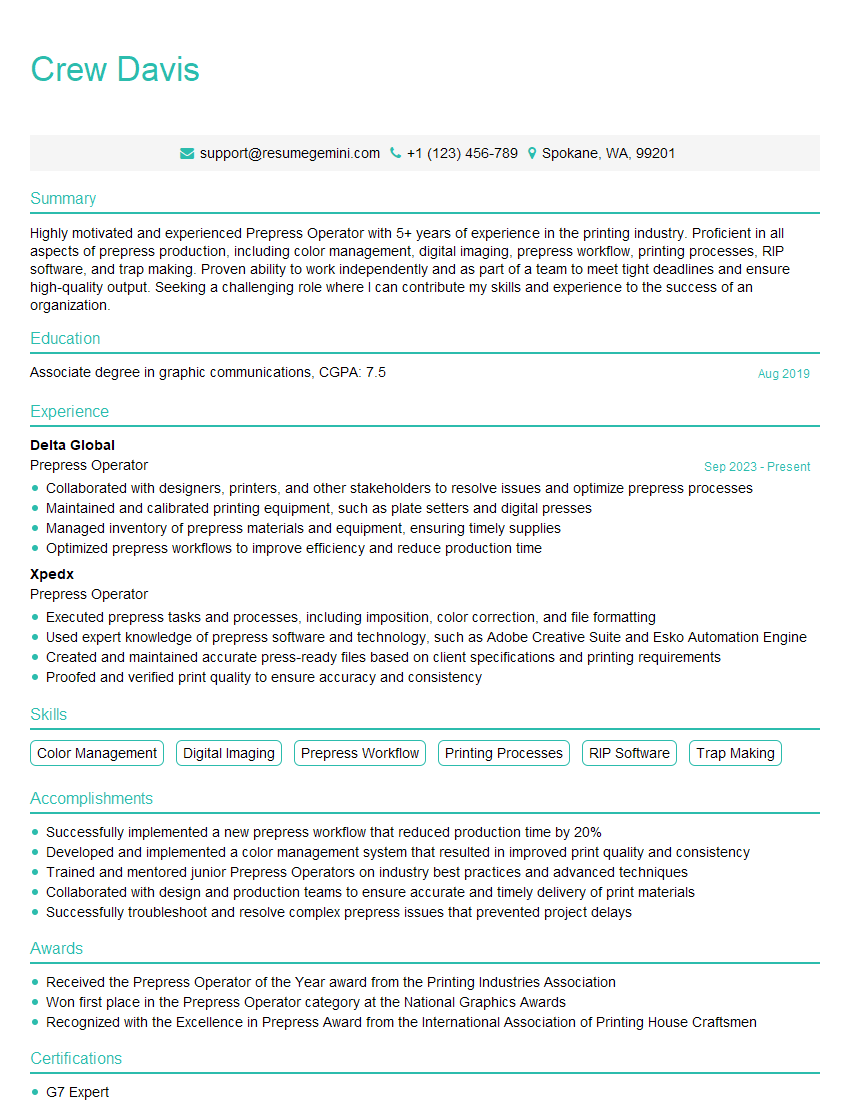
Mastering Electronic Prepress opens doors to exciting career opportunities in the printing and publishing industries, offering a blend of technical expertise and creative problem-solving. To maximize your job prospects, creating a strong, ATS-friendly resume is crucial. ResumeGemini is a trusted resource to help you build a professional resume that showcases your skills and experience effectively. ResumeGemini provides examples of resumes tailored specifically to Electronic Prepress roles, guiding you towards creating a compelling application.

Explore more articles
Users Rating of Our Blogs
Share Your Experience
We value your feedback! Please rate our content and share your thoughts (optional).
What Readers Say About Our Blog
I Redesigned Spongebob Squarepants and his main characters of my artwork.
https://www.deviantart.com/reimaginesponge/art/Redesigned-Spongebob-characters-1223583608
IT gave me an insight and words to use and be able to think of examples
Hi, I’m Jay, we have a few potential clients that are interested in your services, thought you might be a good fit. I’d love to talk about the details, when do you have time to talk?
Best,
Jay
Founder | CEO