The thought of an interview can be nerve-wracking, but the right preparation can make all the difference. Explore this comprehensive guide to Experience with Agile and Scrum methodologies interview questions and gain the confidence you need to showcase your abilities and secure the role.
Questions Asked in Experience with Agile and Scrum methodologies Interview
Q 1. Explain the Scrum framework and its key roles.
Scrum is a lightweight, iterative framework for managing and completing complex projects. It’s based on empirical process control—transparency, inspection, and adaptation—and relies heavily on teamwork and self-organization. At its core, Scrum emphasizes delivering value incrementally through short iterations called sprints.
- Product Owner: Defines and prioritizes the product backlog (a prioritized list of features and requirements). They are the voice of the customer.
- Scrum Master: Serves as a facilitator and removes impediments for the team. They ensure the Scrum process is followed correctly and the team is functioning effectively.
- Development Team: A self-organizing, cross-functional team responsible for designing, developing, testing, and delivering the product increment.
For example, imagine building a mobile app. The Product Owner might be the marketing team who determines which features are most important. The Development Team comprises programmers, designers, and testers. The Scrum Master ensures the team has what it needs to successfully complete sprints.
Q 2. What are the Scrum events (ceremonies) and their purpose?
Scrum events are short, time-boxed meetings designed to foster communication, collaboration, and transparency. They are:
- Sprint Planning: The team plans the work for the upcoming sprint, selecting items from the product backlog and creating a sprint backlog.
- Daily Scrum: A short daily meeting (typically 15 minutes) where the team synchronizes their work, identifies impediments, and plans for the day. It’s not a status meeting; it’s about problem-solving.
- Sprint Review: A meeting held at the end of the sprint to demonstrate the completed work to stakeholders and gather feedback.
- Sprint Retrospective: A meeting held at the end of the sprint where the team reflects on the past sprint and identifies areas for improvement in the process.
Think of the daily Scrum as a quick check-in—a huddle—to make sure everyone is on the same page. The Sprint Review is like a show-and-tell, showcasing the value delivered. The Retrospective is crucial for continuous improvement—learning from successes and failures.
Q 3. Describe the Agile Manifesto and its principles.
The Agile Manifesto is a set of values and principles that guide Agile software development. It prioritizes:
- Individuals and interactions over processes and tools
- Working software over comprehensive documentation
- Customer collaboration over contract negotiation
- Responding to change over following a plan
It emphasizes adaptability and collaboration, recognizing that the best way to build software is through close collaboration with customers and a flexible approach to development. It’s not about abandoning plans entirely, but about being ready to adjust based on new information and feedback.
For example, imagine a project where customer requirements shift mid-development. An Agile team can adapt quickly, incorporating the changes into the next sprint, while a traditional waterfall team might encounter significant delays and rework.
Q 4. How do you handle conflicting priorities in a Scrum project?
Conflicting priorities are common in Scrum. The best way to handle them is through transparent prioritization by the Product Owner. This usually involves:
- Prioritization Techniques: Using methods like MoSCoW (Must have, Should have, Could have, Won’t have) or value vs. effort matrices to rank backlog items.
- Open Discussion: Facilitating a discussion between the Product Owner, Development Team, and stakeholders to understand the reasoning behind competing priorities and find the best compromise.
- Data-Driven Decisions: Using data from market research, user feedback, and analytics to inform prioritization decisions.
- Negotiation and Compromise: Sometimes, certain features might need to be deferred to later sprints.
For example, if the team has limited time in a sprint and faces competing priorities, they might use a MoSCoW analysis to identify the must-have features and postpone the others to the next sprint.
Q 5. What is sprint backlog grooming and why is it important?
Sprint backlog grooming is a continuous process of reviewing, refining, and prioritizing the items in the sprint backlog. This ensures that the team has a clear understanding of the work to be done in the upcoming sprint and that the items are ready for development.
It includes:
- Breaking down large tasks: Decomposing complex user stories into smaller, more manageable tasks.
- Estimating tasks: Using techniques like story points or relative estimation to determine the effort required for each task.
- Clarifying ambiguities: Ensuring that everyone understands the requirements and acceptance criteria for each task.
- Re-prioritization: Adjusting the order of the items based on new information or changing priorities.
It’s vital for efficient sprint execution and helps prevent unexpected issues during the sprint. Imagine trying to build a house without a detailed blueprint—that’s what happens without proper backlog grooming.
Q 6. Explain the difference between a sprint and a release.
A sprint and a release are distinct concepts in Scrum:
- Sprint: A short, time-boxed iteration (typically 2-4 weeks) during which a potentially shippable product increment is created. Sprints are the building blocks of the project.
- Release: The deployment of a potentially shippable product increment to the customer or end-users. A release might comprise several sprints’ worth of work.
Think of sprints as individual bricks and the release as a completed wall. Multiple sprints contribute to a single release, but each sprint delivers a functioning piece.
Q 7. How do you manage impediments in a Scrum team?
Impediments are anything that blocks the team’s progress. Managing them effectively is critical for successful Scrum implementation. This involves:
- Identifying Impediments: Through daily Scrums, sprint reviews, retrospectives, and open communication.
- Escalating Impediments: The Scrum Master plays a crucial role in identifying and escalating impediments to the appropriate parties (e.g., management, other teams).
- Removing Impediments: Actively working to resolve the impediments, often collaborating with other teams or departments.
- Tracking Impediments: Maintaining a log of impediments to track progress and identify recurring issues.
For example, if a team is blocked by a dependency on another team, the Scrum Master might facilitate a meeting to resolve the dependency. If there’s a lack of resources, they might advocate for additional support.
Q 8. What are the different Agile methodologies (e.g., Kanban, XP)?
Agile methodologies are iterative approaches to software development and project management that emphasize flexibility, collaboration, and customer satisfaction. Several popular methodologies exist, each with its own strengths and weaknesses. Here are a few examples:
- Scrum: A framework focused on iterative development using short sprints (typically 2-4 weeks) with daily stand-up meetings, sprint reviews, and retrospectives. It’s highly structured and well-suited for complex projects.
- Kanban: A visual system for managing workflow. It emphasizes visualizing work, limiting work in progress (WIP), and continuous improvement. It’s more flexible than Scrum and works well for projects with evolving requirements.
- Extreme Programming (XP): Focuses on engineering practices like test-driven development (TDD), pair programming, and continuous integration. It prioritizes high-quality code and rapid feedback loops. It’s best suited for projects requiring high technical expertise.
- Lean Software Development: Emphasizes eliminating waste and maximizing value for the customer. It borrows principles from Lean manufacturing and focuses on continuous delivery.
- Crystal: A family of methodologies that adapts to the specific characteristics of a project and team. Different Crystal methods are tailored to the size, criticality, and priorities of each project.
The choice of methodology depends heavily on the project’s context, team size, and the nature of the product being developed. For instance, a small team with a simple project might find Kanban sufficient, while a larger team working on a complex system might benefit from the structure of Scrum.
Q 9. Describe your experience with Agile estimation techniques (e.g., story points).
Agile estimation techniques help teams predict the effort required to complete tasks. Story points are a relative estimation method, focusing on the complexity and effort of a user story rather than time. In my experience, we typically use Fibonacci sequence (1, 2, 3, 5, 8, 13, etc.) to represent story points. A story assigned a ‘5’ is roughly twice as complex as a ‘3’.
My experience includes facilitating planning poker sessions where team members independently estimate stories, then discuss their estimates to reach a consensus. This collaborative approach ensures that everyone understands the tasks and their relative difficulty. We then use historical data (velocity, discussed below) to project sprint capacity and plan accordingly. Other techniques I’ve used include T-Shirt sizing (XS, S, M, L, XL) for quick estimations when high precision isn’t critical.
For example, in one project, we initially underestimated the complexity of integrating a third-party API. The team assigned it lower points than it actually deserved, impacting the sprint capacity. This taught us the importance of thorough discussion and careful consideration of dependencies when estimating.
Q 10. How do you measure the success of an Agile project?
Measuring the success of an Agile project goes beyond simply delivering software on time and within budget. We measure success across several key areas:
- Customer Satisfaction: Regular feedback sessions, surveys, and demonstration of working software ensure we’re meeting the customer’s needs and expectations.
- Product Quality: Metrics like code coverage, bug rates, and technical debt provide insights into the quality of the delivered product. Continuous integration and automated testing are crucial here.
- Team Performance: Tracking velocity, sprint completion rates, and team morale helps assess the team’s effectiveness and identify areas for improvement. Regular retrospectives are invaluable in this regard.
- Value Delivered: Did the project deliver the intended business value? Did it achieve its goals? This often involves measuring key performance indicators (KPIs) related to the project’s objectives.
- Adaptability and Responsiveness: How effectively did the team respond to changes in requirements or unforeseen challenges? Agility is about adapting to the inevitable changes, and successful projects demonstrate this capability.
These metrics, combined with qualitative feedback, provide a holistic view of project success. A simple delivery of working software isn’t enough; the software must meet customer needs, be of high quality, and be delivered in a sustainable manner.
Q 11. What are the benefits of using Agile methodologies?
Agile methodologies offer numerous benefits, leading to improved project outcomes and enhanced team dynamics. Some key advantages include:
- Increased Flexibility and Adaptability: Agile’s iterative nature allows for changes in requirements throughout the project lifecycle, resulting in a more responsive approach to evolving customer needs.
- Improved Collaboration and Communication: Daily stand-up meetings, sprint reviews, and retrospectives facilitate constant communication and collaboration among team members, stakeholders, and customers.
- Enhanced Customer Satisfaction: Frequent feedback loops and working software demonstrations ensure customer involvement and satisfaction throughout the process.
- Reduced Risks and Costs: Identifying and addressing issues early in the development cycle minimizes risks and reduces costly rework later on.
- Faster Time to Market: Iterative development and continuous integration allow for quicker delivery of working software, leading to a faster time to market.
- Higher Quality Product: Continuous testing and feedback loops lead to higher quality code and a better overall product.
- Increased Team Morale and Productivity: The collaborative and empowering nature of Agile improves team morale and productivity.
In my experience, projects using Agile methodologies have consistently shown greater efficiency, better product quality, and higher customer satisfaction compared to traditional waterfall approaches.
Q 12. Explain the concept of velocity in Scrum.
In Scrum, velocity is a measure of the amount of work a team completes during a sprint. It’s typically expressed in story points. A team’s velocity is calculated by summing the story points of all completed items in a sprint. For example, if a team completes 20 story points worth of work in a sprint, their velocity is 20 story points.
Velocity is not a fixed number; it can vary from sprint to sprint based on various factors, such as team size, complexity of tasks, availability of resources, and unforeseen interruptions. Tracking velocity over multiple sprints provides insights into the team’s productivity and helps in more accurate sprint planning and forecasting. This historical data allows for more reliable estimates of the work that can be accomplished in future sprints.
It’s crucial to remember that velocity is a team metric, not an individual one. Focusing on improving the team’s overall velocity rather than individual performance encourages collaboration and mutual support.
Q 13. How do you facilitate effective daily stand-up meetings?
Effective daily stand-up meetings are crucial for Scrum’s success. They should be short, focused, and action-oriented, typically lasting no more than 15 minutes. To facilitate this, I follow these guidelines:
- Set a clear agenda: The purpose is to discuss progress, identify roadblocks, and plan for the day. Stick to this agenda.
- Timeboxing: Enforce the time limit strictly to keep the meeting concise.
- Rotate the facilitator role: This ensures participation and prevents the meeting from being dominated by one person.
- Encourage brief answers: Ask team members to provide concise updates on their progress, obstacles, and plans for the day.
- Focus on action items: The meeting should conclude with clear action items for each team member.
- Use a visual aid: A Kanban board or Scrum board can provide a visual overview of the current sprint progress.
- Stand up (if possible): Standing encourages brevity and prevents the meeting from dragging on.
I’ve found that consistent application of these practices leads to productive and efficient daily stand-up meetings, enabling the team to remain synchronized and address challenges promptly.
Q 14. What is your experience with Agile tools (e.g., Jira, Trello)?
I have extensive experience with several Agile tools, including Jira and Trello. Jira is a powerful project management tool particularly well-suited for larger, more complex projects. Its features like issue tracking, sprint management, and reporting provide comprehensive project oversight. I’ve utilized Jira’s Kanban boards, Scrum boards, and various reporting features to monitor progress, identify bottlenecks, and track team velocity.
Trello, on the other hand, offers a more visual and less complex approach to project management. Its ease of use makes it ideal for smaller teams or projects that require simpler workflow management. I’ve used Trello for smaller projects and personal task management, leveraging its flexibility and visual representation of tasks and progress.
My experience extends to configuring and customizing these tools to suit specific project needs. For instance, I’ve configured Jira workflows to automate various processes and created custom dashboards to provide stakeholders with relevant and timely information. The choice of tool depends on the project’s complexity, team size, and the preferred working style. Knowing the strengths and limitations of each tool is essential to make an informed decision.
Q 15. Describe your experience with different Agile scaling frameworks (e.g., SAFe, LeSS).
My experience encompasses several Agile scaling frameworks, primarily Scaled Agile Framework (SAFe) and Large-Scale Scrum (LeSS). SAFe, a more structured approach, is ideal for large organizations with complex projects, providing a defined hierarchy and roles like Release Train Engineer (RTE) and System Architect. I’ve worked on several large-scale projects using SAFe, coordinating multiple Agile Release Trains (ARTs) and ensuring alignment across teams. This involved meticulous program increment (PI) planning, regular synchronization meetings, and a strong focus on system-level architecture and integration. In contrast, LeSS, with its emphasis on simplicity and decentralization, is better suited for smaller organizations or projects requiring more autonomy. My experience with LeSS has involved working with multiple Scrum teams coordinating through a common product backlog, leveraging less formal structures and more collaborative decision-making. The choice between these frameworks depends heavily on the organizational context and project complexity; understanding the strengths and limitations of each is crucial for successful implementation. For example, while SAFe provides strong governance, its extensive framework might be overkill for smaller, less complex projects, where LeSS’s leaner approach would be more effective.
Career Expert Tips:
- Ace those interviews! Prepare effectively by reviewing the Top 50 Most Common Interview Questions on ResumeGemini.
- Navigate your job search with confidence! Explore a wide range of Career Tips on ResumeGemini. Learn about common challenges and recommendations to overcome them.
- Craft the perfect resume! Master the Art of Resume Writing with ResumeGemini’s guide. Showcase your unique qualifications and achievements effectively.
- Don’t miss out on holiday savings! Build your dream resume with ResumeGemini’s ATS optimized templates.
Q 16. How do you handle stakeholder management in an Agile environment?
Effective stakeholder management in Agile is crucial. I approach this through a combination of proactive communication, transparency, and active engagement. This includes regularly scheduled meetings, demos, and progress reports tailored to different stakeholder groups. For example, I’ve used Kanban boards to provide a visual representation of progress for less technical stakeholders, while presenting detailed burn-down charts to the engineering leadership. Early and often feedback mechanisms – via surveys, focus groups, or one-on-one meetings – are critical to understanding stakeholder needs and expectations. Building a strong rapport based on trust and open communication is paramount. Addressing concerns promptly and transparently, especially when facing challenges, fosters collaboration and mutual understanding. Stakeholder management isn’t a one-size-fits-all approach; it requires adaptability and sensitivity to the specific requirements of each stakeholder group.
Q 17. Explain the concept of continuous integration and continuous delivery (CI/CD).
Continuous Integration and Continuous Delivery (CI/CD) is a set of practices that automates the process of building, testing, and deploying software. CI emphasizes frequent integration of code changes into a shared repository, followed by automated builds and tests to detect integration issues early. This is typically achieved using tools like Jenkins, GitLab CI, or Azure DevOps. CD extends CI by automating the deployment of the code to various environments (development, testing, production). A CI/CD pipeline might look like this: Developers commit code to a shared repository → Automated build is triggered → Automated tests are run (unit, integration, etc.) → Successful builds are deployed to a staging environment → Manual or automated acceptance testing → Deployment to production. The goal is to reduce the lead time for delivering new features and improving the reliability and speed of releases. For example, in a previous project, we implemented a CI/CD pipeline that reduced our deployment time from days to hours, allowing for quicker feedback and faster delivery of value.
Q 18. How do you ensure quality in an Agile project?
Ensuring quality in an Agile project requires a multifaceted approach that integrates quality practices throughout the development lifecycle, not just at the end. This begins with defining clear acceptance criteria and a comprehensive Definition of Done (DoD) to ensure everyone understands what constitutes a “finished” product. Automated testing – unit, integration, and system tests – is critical for detecting defects early. Test-driven development (TDD) can further enhance quality by guiding development based on pre-defined tests. Regular code reviews and pair programming promote knowledge sharing and help catch errors before they become larger problems. Continuous integration and continuous delivery also play a crucial role by automating the build and deployment processes, reducing the risk of errors during these stages. Finally, effective communication and collaboration within the team, and with stakeholders, helps to ensure alignment on quality goals and expectations. For instance, in a past project, we implemented a combination of TDD and automated UI testing, reducing our defect rate by 40%.
Q 19. What is your experience with Agile retrospectives?
Agile retrospectives are crucial for continuous improvement. I have extensive experience facilitating retrospectives using various techniques, adapting the approach to the specific needs of the team. We typically use a structured approach that includes a review of the sprint, identifying what went well, what could be improved, and formulating action items. I encourage open and honest feedback, creating a safe environment where team members feel comfortable sharing their perspectives, even if they are negative. Techniques like the “Start, Stop, Continue” framework or the “Four Ls” (Liked, Learned, Lacked, Longed for) are often helpful. Following the retrospective, I ensure that action items are assigned and tracked. Importantly, retrospectives should focus on actionable improvements, avoiding blame and focusing on collective learning. The effectiveness of a retrospective depends greatly on its facilitation; creating a positive and encouraging environment is essential. In past experiences, well-facilitated retrospectives led to significant improvements in team dynamics and productivity.
Q 20. How do you deal with team conflicts in an Agile setting?
Team conflicts are inevitable in any team environment. In an Agile setting, I address them proactively and constructively, focusing on problem-solving and finding win-win solutions. My approach is centered around open communication and active listening. I start by creating a safe space where team members can express their concerns and perspectives without feeling judged. I might facilitate a structured discussion using techniques such as conflict resolution models (e.g., the Thomas-Kilmann Conflict Mode Instrument) or simply guide a respectful conversation focusing on understanding the root cause of the conflict. Mediation, if needed, is employed to help the parties find common ground. The key is to focus on the issue, not the personality. Documentation of the conflict, proposed solutions and agreed upon actions is crucial. For example, In one situation, a conflict arose due to differing opinions on technical approaches. By facilitating a collaborative session where team members presented their ideas and weighed the pros and cons of each approach, we reached a consensus on a solution that leveraged the strengths of each approach.
Q 21. Explain the concept of Definition of Done (DoD).
The Definition of Done (DoD) is a checklist of criteria that must be met for a product increment (user story, task, etc.) to be considered complete. It explicitly defines what constitutes a “finished” item, ensuring consistency and quality. This might include aspects like code reviews, unit tests, integration tests, automated deployment, and documentation. For example, a DoD might include: ‘Code is reviewed by a peer’, ‘Unit tests have 90% coverage’, ‘All acceptance criteria are met’, ‘Code is deployed to the staging environment’, ‘Documentation is updated.’ A well-defined DoD minimizes ambiguity, reduces rework, and improves overall team productivity. A clear DoD aligns the entire team on the standards of quality and completion, and prevents the delivery of incomplete or substandard work. By regularly reviewing and updating the DoD, the team can continuously adapt to changing needs and improve its processes.
Q 22. How do you handle scope creep in an Agile project?
Scope creep, the uncontrolled expansion of project requirements, is a common Agile challenge. Preventing it requires proactive measures and a strong commitment to the defined scope within each sprint.
- Clearly Defined User Stories: Ensure user stories are detailed, well-defined, and accepted by the stakeholders before the sprint begins. Use acceptance criteria to clarify what constitutes “done.”
- Regular Stakeholder Communication: Frequent communication with stakeholders through sprint reviews and daily stand-ups allows for early detection of potential scope creep. This keeps everyone aligned and addresses any emerging needs promptly.
- Prioritization & Backlog Management: The product backlog should be a living document, regularly prioritized based on value and feasibility. New requests should be evaluated against existing priorities; if truly valuable, they are added to the backlog, but their impact on sprint goals is discussed. This often leads to trade-offs or pushing less-critical items into future sprints.
- Change Management Process: Establish a formal process for managing changes. This might involve a change request form, impact assessment, and approval from relevant stakeholders. This formalizes the process, making it transparent and helping avoid uncontrolled additions.
- Timeboxing: Dedicate specific time within each sprint for addressing potential changes or new requests. This prevents unplanned work from overwhelming the sprint goals.
For example, if a client requests a significant new feature mid-sprint, we would evaluate its impact on the sprint goal. If it’s critical, we’d discuss with the client potential trade-offs (e.g., delaying other features) or adjusting the sprint backlog. If it’s not critical, we’d add it to the product backlog for future consideration.
Q 23. What is your experience with Agile risk management?
Agile risk management focuses on continuous identification, assessment, and mitigation of risks throughout the project lifecycle. It’s iterative and integrated into the sprint process, unlike traditional waterfall approaches which often address risks only upfront.
- Risk Identification: Regularly identify potential risks through brainstorming sessions (e.g., during sprint planning or retrospectives), stakeholder interviews, and reviewing user stories for potential issues.
- Risk Assessment: Analyze the likelihood and impact of each identified risk. This helps prioritize which risks require immediate attention.
- Risk Mitigation: Develop strategies to reduce the likelihood or impact of high-priority risks. This can involve creating contingency plans, assigning ownership for risk mitigation, or adjusting the sprint backlog to address vulnerabilities.
- Risk Monitoring: Continuously monitor identified risks throughout the project. Track progress on mitigation strategies and identify any new risks emerging.
- Risk Response: Adapt the project plan as needed based on the changing risk landscape. This ensures agility in responding to unforeseen challenges.
In a past project, we identified the risk of a third-party API becoming unavailable. We mitigated this by developing a fallback mechanism and building in redundancy. This proactive approach prevented project delays when the API unexpectedly went down.
Q 24. How do you prioritize user stories in a product backlog?
Prioritizing user stories in the product backlog is crucial for maximizing value delivery. Several methods can be employed, often in combination.
- MoSCoW Method: Categorizes stories into Must have, Should have, Could have, and Won’t have. This provides a clear prioritization based on necessity and business value.
- Value vs. Effort Matrix: Plots stories based on their business value and the effort required to implement them. High-value, low-effort stories are prioritized.
- Story Points: Assigns relative effort estimates to stories (e.g., using Fibonacci sequence). This aids in sprint planning and capacity estimation.
- Business Value: Assigning a numerical value to each story based on its contribution to the overall business goals. This helps determine which stories provide the greatest return on investment.
- Risk Reduction: Prioritizing stories that mitigate high-risk areas.
- Dependency Analysis: Identifying and addressing dependencies between stories. Some stories might need to be completed before others can be started.
For instance, in a recent project, we used a combination of the MoSCoW method and a value vs. effort matrix. This allowed us to clearly prioritize ‘must-have’ features that also had a low implementation effort, ensuring rapid delivery of critical functionality.
Q 25. What are the characteristics of a high-performing Agile team?
A high-performing Agile team exhibits several key characteristics:
- Self-Organization: The team takes ownership of its work and collaboratively makes decisions regarding task assignment and approach.
- Cross-Functionality: Team members possess a diverse skill set, enabling them to handle various aspects of the project independently.
- Collaboration & Communication: Open and effective communication is prioritized, fostering a collaborative environment where everyone feels comfortable sharing ideas and concerns.
- Continuous Improvement: Regular retrospectives and continuous learning foster a culture of improvement, identifying areas for refinement.
- Shared Understanding: All team members have a clear understanding of the project goals, sprint goals, and individual responsibilities.
- Trust & Respect: Team members trust each other’s abilities and show mutual respect, fostering a positive and productive environment.
- Focus & Discipline: The team remains focused on delivering high-quality work within the sprint timeframe, adhering to agreed-upon processes and standards.
In my experience, the key to a high-performing team is building strong relationships and fostering a culture of trust and respect. Open communication and shared responsibility are vital for success.
Q 26. Explain your understanding of technical debt and how it’s managed in Agile.
Technical debt refers to the implied cost of rework caused by choosing an easy (limited) solution now instead of using a better approach that would take longer. In Agile, we actively acknowledge and manage technical debt to avoid accumulating it to an unmanageable level.
- Identification: Regularly identify technical debt during sprint reviews, retrospectives, and code reviews. This involves documenting areas where shortcuts were taken or suboptimal solutions were implemented.
- Prioritization: Prioritize addressing technical debt based on its impact. High-impact debts that pose significant risks or hinder future development should be prioritized.
- Planning: Allocate specific time within sprints (or dedicated sprints) to address technical debt. This ensures it’s not neglected and allows for proactive resolution.
- Refactoring: Regularly refactor code to improve its quality, readability, and maintainability. This helps reduce technical debt and prevents it from accumulating.
- Automation: Automate testing and deployment processes to ensure that changes introduced to address technical debt don’t introduce new bugs or regressions.
For instance, if we used a quick-and-dirty solution for a feature during a sprint to meet a tight deadline, we’d add a user story to the backlog to refactor that code in a later sprint. This approach ensures we deliver value quickly while planning for future improvements.
Q 27. Describe a time you had to adapt an Agile process to a specific project context.
On a project involving the development of a mobile application with a tight deadline, we initially planned to follow a Scrum framework strictly. However, we encountered significant challenges with client feedback integration due to their limited availability for frequent sprint reviews.
To adapt, we implemented a Kanban approach for a portion of the development process, focusing on a continuous flow of work. We created a Kanban board visualizing the development stages and allowed for flexible task prioritization based on client feedback. This allowed us to respond more quickly to changes and ensure we were building the most valuable features first. Regular daily stand-ups, while still following the Scrum philosophy, replaced the less effective sprint review cycles in the context of the dynamic client involvement. By combining elements of both methodologies, we successfully delivered the application on time while effectively incorporating client feedback.
Key Topics to Learn for Agile and Scrum Methodologies Interviews
- Agile Principles: Understand the core values and principles behind the Agile Manifesto. Be prepared to discuss how these principles guide your work and decision-making.
- Scrum Framework: Master the roles (Product Owner, Scrum Master, Development Team), events (Sprint Planning, Daily Scrum, Sprint Review, Sprint Retrospective), and artifacts (Product Backlog, Sprint Backlog, Increment) of the Scrum framework. Practice explaining them clearly and concisely.
- Sprint Planning & Execution: Describe your experience with sprint planning, task estimation (e.g., story points), and daily task management within a sprint. Highlight your contribution to effective sprint execution.
- Sprint Review & Retrospective: Explain how you participate in sprint reviews (demonstrating completed work) and retrospectives (identifying areas for improvement). Showcase your ability to provide constructive feedback and collaborate on process enhancements.
- Agile Estimation Techniques: Discuss your familiarity with different estimation techniques (e.g., story points, planning poker) and how you’ve used them to manage project timelines and resources effectively.
- Agile Tools & Technologies: Mention any experience with Agile project management tools (e.g., Jira, Trello, Asana) and how they have helped streamline your workflow.
- Problem-Solving in Agile Environments: Be ready to discuss how you’ve addressed challenges such as scope creep, conflicting priorities, or team conflicts within an Agile framework. Highlight your problem-solving skills and collaborative approach.
- Scaling Agile: If applicable, discuss your experience with scaling Agile frameworks (e.g., Scrum of Scrums, LeSS) and the challenges and benefits of working in larger, more complex Agile environments.
Next Steps
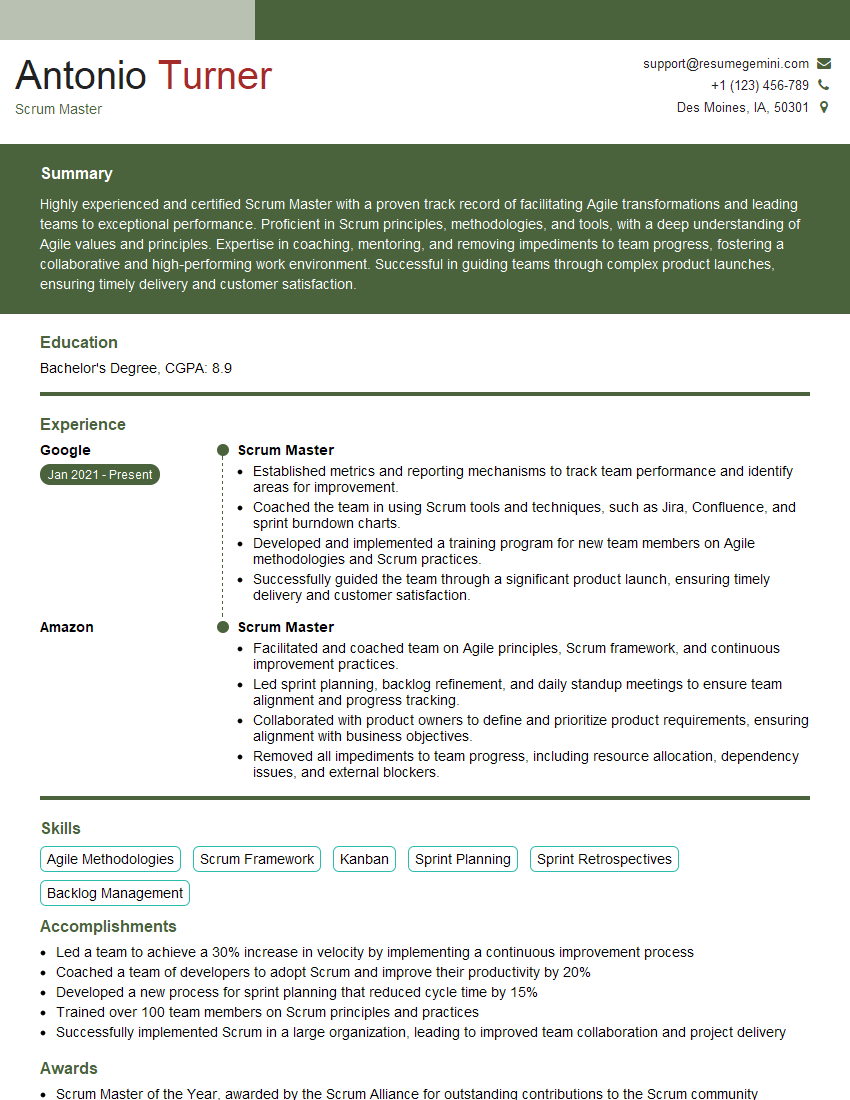
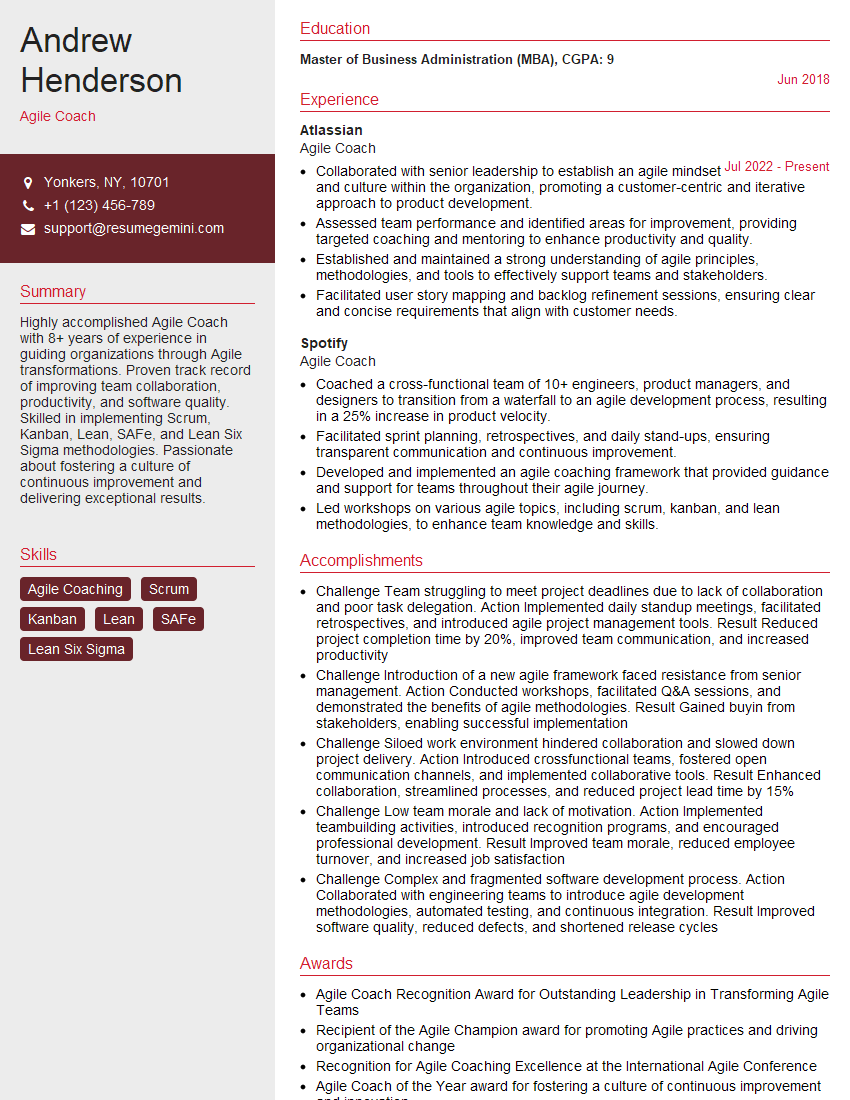
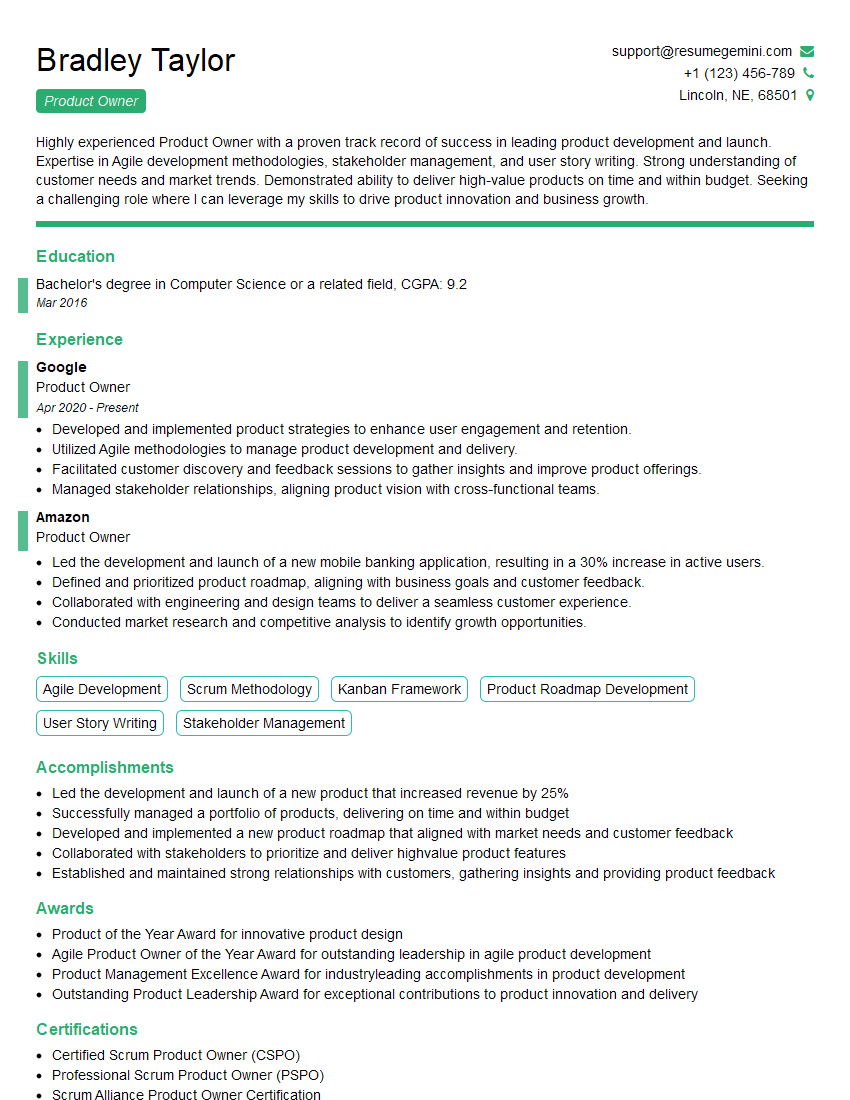
Mastering Agile and Scrum methodologies is crucial for career advancement in today’s dynamic tech landscape. Demonstrating a strong understanding of these frameworks will significantly improve your job prospects. Creating an ATS-friendly resume is key to getting your application noticed. ResumeGemini is a trusted resource to help you build a professional and effective resume that highlights your Agile and Scrum expertise. Examples of resumes tailored to Agile and Scrum methodologies are available to help guide your creation. Invest the time to craft a compelling resume – it’s your first impression with potential employers.
Explore more articles
Users Rating of Our Blogs
Share Your Experience
We value your feedback! Please rate our content and share your thoughts (optional).
What Readers Say About Our Blog
I Redesigned Spongebob Squarepants and his main characters of my artwork.
https://www.deviantart.com/reimaginesponge/art/Redesigned-Spongebob-characters-1223583608
IT gave me an insight and words to use and be able to think of examples
Hi, I’m Jay, we have a few potential clients that are interested in your services, thought you might be a good fit. I’d love to talk about the details, when do you have time to talk?
Best,
Jay
Founder | CEO