Feeling uncertain about what to expect in your upcoming interview? We’ve got you covered! This blog highlights the most important Experience with automation systems interview questions and provides actionable advice to help you stand out as the ideal candidate. Let’s pave the way for your success.
Questions Asked in Experience with automation systems Interview
Q 1. Explain the difference between Robotic Process Automation (RPA) and Business Process Automation (BPA).
Robotic Process Automation (RPA) and Business Process Automation (BPA) are both aimed at improving efficiency, but they differ significantly in their approach. Think of RPA as a ‘digital worker’ mimicking human actions on a computer, while BPA encompasses a broader, more strategic overhaul of entire business processes.
- RPA focuses on automating repetitive, rule-based tasks within existing systems. It’s like having a virtual assistant handle data entry, invoice processing, or form filling. It interacts with applications through their user interfaces, just like a human would.
- BPA takes a holistic view, analyzing and optimizing entire workflows. It might involve redesigning processes, implementing new software, or changing organizational structures. RPA can be *part* of a BPA strategy, automating specific tasks within the redesigned process.
For example, imagine a process for processing customer orders. RPA might automate the data entry of order details from an email into a CRM system. BPA, on the other hand, might involve implementing a new order management system that integrates with the email system, eliminating the manual data entry entirely.
Q 2. Describe your experience with different automation frameworks (e.g., Selenium, Cypress, Robot Framework).
I’ve worked extensively with several automation frameworks, each with its strengths and weaknesses. My experience includes:
- Selenium: A widely used framework for web UI automation. I’ve used it extensively for testing web applications, automating browser interactions, and verifying functionality across different browsers and devices. For example, I used Selenium to create a suite of automated tests that verified the functionality of an e-commerce website’s checkout process, ensuring a seamless user experience.
- Cypress: A modern JavaScript-based framework that excels in its speed and ease of debugging. I prefer Cypress for its developer-friendly features and its ability to handle asynchronous operations effectively. I’ve used Cypress to build end-to-end tests for a single-page application, enabling faster feedback during development.
- Robot Framework: A generic test automation framework that’s well-suited for larger, more complex projects. I used Robot Framework to automate a series of integrations between multiple internal systems, ensuring data consistency across platforms. Its keyword-driven approach made the scripts easy to maintain and understand by both technical and non-technical team members.
Q 3. How do you handle errors and exceptions in automation scripts?
Robust error handling is crucial for reliable automation scripts. My approach involves a multi-layered strategy:
- Try-Except Blocks: I utilize try-except blocks to gracefully handle predictable exceptions. This allows the script to continue execution even if an error occurs, logging the error details for later investigation.
try: # Code that might raise an exception # ... except ExceptionType as e: # Handle specific exception types print(f'An error occurred: {e}') # Log the error # ... - Assertions: For testing purposes, assertions are vital. They verify that the script behaves as expected at various points. Failing an assertion will immediately halt the script, drawing attention to the issue.
assert condition, 'Error message' - Logging: Comprehensive logging is essential for debugging and monitoring. I log both successes and failures, including timestamps and relevant context, making it easier to track down the root cause of problems.
- Retry Mechanisms: For transient errors (e.g., network issues), I implement retry mechanisms. The script will automatically attempt the failed operation a certain number of times before giving up.
Furthermore, a centralized error reporting system, integrated with monitoring tools, provides real-time alerts on critical failures.
Q 4. What are some common challenges you’ve faced in implementing automation solutions?
Implementing automation solutions presents several challenges:
- Maintaining Up-to-Date Scripts: Applications and systems frequently update, requiring constant maintenance of automation scripts to prevent them from breaking. This involves regular testing and updates of scripts to accommodate changes.
- Data Integrity and Security: Ensuring data integrity and security when automating processes that handle sensitive information is paramount. Strict access controls and secure data handling practices are crucial.
- Dealing with Unexpected Changes: Automation scripts are susceptible to unexpected changes in the applications they interact with. Robust error handling and self-healing mechanisms are necessary to address these issues.
- Lack of Skilled Resources: The demand for automation experts often exceeds the supply, creating challenges in finding and retaining skilled personnel.
One particular challenge I faced involved automating a legacy system with poorly documented APIs. This required reverse engineering parts of the system and implementing significant error handling to manage the unreliable nature of the existing infrastructure. We ultimately mitigated this by prioritizing the most critical processes and gradually expanding automation coverage as the system was modernized.
Q 5. Explain your experience with CI/CD pipelines and their role in automation.
CI/CD pipelines are indispensable for automating the deployment and testing of automation scripts. They allow for continuous integration, where changes are frequently merged into a central repository, and continuous delivery/deployment, where tested changes are automatically deployed. This eliminates manual steps and speeds up the delivery of updates, enabling rapid iteration and improved quality.
In a typical setup, the CI/CD pipeline would trigger tests upon code commits, deploy updated scripts to a staging environment for further testing, and finally deploy to production after successful validation. This streamlined approach minimizes errors and improves the overall reliability of the automation system.
For example, I implemented a CI/CD pipeline using Jenkins that automated the building, testing, and deployment of our Selenium test scripts. This ensured that any code changes were rigorously tested before being deployed to our production environment, reducing the risk of introducing bugs.
Q 6. How do you ensure the scalability and maintainability of your automation scripts?
Scalability and maintainability are paramount for long-term success. My strategies include:
- Modular Design: Breaking down scripts into smaller, reusable modules improves readability, simplifies maintenance, and allows for easier scaling. Changes in one module don’t necessitate extensive modifications elsewhere.
- Version Control: Using a version control system like Git tracks changes, allowing for easy rollback to previous versions if necessary, and facilitates collaboration among team members.
- Proper Documentation: Clear, concise documentation makes the scripts easy to understand and maintain for current and future developers. This minimizes the learning curve for new team members.
- Parameterization: Using parameters allows scripts to be adaptable to different environments and inputs, reducing the need for significant code changes when requirements evolve.
Employing these practices enhances both the maintainability and scalability of my automation scripts, ensuring they can adapt to future needs and evolving environments.
Q 7. Describe your experience with version control systems (e.g., Git) in an automation context.
Version control, primarily using Git, is fundamental in my automation workflow. It’s more than just storing code; it’s a collaborative tool that ensures traceability and enables efficient teamwork.
- Branching Strategy: I use a branching strategy (e.g., Gitflow) to manage different versions of scripts and features, allowing for parallel development and controlled merging of changes.
- Commit Messages: Descriptive commit messages clearly outline the purpose and scope of each change, improving traceability and facilitating understanding of the script’s evolution.
- Code Reviews: Code reviews are a critical part of the process, ensuring code quality and detecting potential issues before they reach production.
- Collaboration: Git’s collaboration features streamline teamwork, allowing multiple developers to work on the same scripts concurrently without conflicts.
In one project, Git’s branching capabilities were vital in managing parallel development of different test suites for a large e-commerce platform. Each team worked on a separate branch, and the merging process was carefully managed to prevent conflicts and ensure a seamless integration of changes.
Q 8. How do you approach testing automation scripts?
Testing automation scripts is crucial for ensuring reliability and preventing errors. My approach is multifaceted and follows a structured methodology. It begins with unit testing, where individual components of the script are verified. This is followed by integration testing, checking the interaction between different parts. Finally, I conduct system testing, assessing the entire script’s functionality within the overall system.
I utilize a combination of techniques including:
- Test-Driven Development (TDD): Writing tests *before* the code ensures the script meets requirements from the outset.
- Behavior-Driven Development (BDD): Using a shared language (like Gherkin) between developers and stakeholders clarifies expected behavior and makes testing more collaborative.
- Automated Test Frameworks: Employing frameworks like pytest (Python) or JUnit (Java) provides structure, reporting, and efficient test execution.
For example, if I’m automating a deployment script, unit tests would verify individual commands (e.g., file transfers), integration tests would check the sequence of commands, and system tests would validate the successful deployment in a test environment.
Regular regression testing after code changes is paramount, ensuring new features don’t break existing functionality. I also employ various testing types, including positive and negative testing to cover all possible scenarios.
Q 9. What metrics do you use to measure the success of an automation project?
Measuring the success of an automation project goes beyond simply completing the scripts. Key metrics include:
- Reduction in manual effort: Quantify the time saved through automation (e.g., hours/week, percentage reduction).
- Improved accuracy: Track the decrease in human errors – this can be challenging to quantify precisely, but comparing error rates before and after automation is a good start.
- Increased efficiency: Measure the speed of processes – how much faster is task completion with automation?
- Return on Investment (ROI): Calculate the cost savings compared to the investment in developing and maintaining the automation.
- Defect detection rate: Monitor the number of bugs found during automated testing versus manual testing.
- Test coverage: Assess how much of the system or application is covered by automated tests.
For example, if an automation project reduced manual testing time by 50% and prevented 20% of previous human errors, it would be considered very successful. Monitoring these metrics throughout the project’s lifecycle allows for course correction and ensures the project remains aligned with its objectives.
Q 10. Explain your experience with different scripting languages (e.g., Python, Java, JavaScript) for automation.
I have extensive experience with Python, Java, and JavaScript for automation. The choice of language depends heavily on the project’s requirements and the existing infrastructure.
- Python: My go-to for many automation tasks due to its readability, extensive libraries (like `requests`, `selenium`, `paramiko`), and robust ecosystem for testing. It excels in tasks involving scripting, web scraping, and system administration.
- Java: A powerful choice for large-scale, enterprise-level automation projects requiring scalability and robustness. Its strong typing and mature ecosystem make it ideal for complex systems and applications.
- JavaScript: Particularly useful for web automation using tools like Selenium and Puppeteer. Its ability to interact directly with browser DOM makes it efficient for testing web applications and automating browser-based tasks.
# Python example (using requests):import requestsresponse = requests.get('https://www.example.com')print(response.status_code)
The key is selecting the language that best aligns with the project’s needs and the team’s expertise. A well-structured and documented script, regardless of the language, is essential for maintainability.
Q 11. How do you prioritize automation tasks in a project?
Prioritizing automation tasks involves a careful evaluation of several factors. My approach typically involves:
- Business Value: Prioritize tasks that deliver the most significant impact on business goals. Tasks that automate critical processes or improve efficiency drastically should take precedence.
- Risk Reduction: Automate tasks prone to human error or those posing significant risk (e.g., security vulnerabilities).
- Feasibility: Consider the technical feasibility and complexity of each task. Start with simpler tasks to build momentum and gain experience.
- Return on Investment (ROI): Estimate the cost savings and benefits of each automation task to determine its overall value.
- Dependencies: Identify interdependencies between tasks and prioritize those that enable or unlock others.
I often use a prioritization matrix (like a MoSCoW method – Must have, Should have, Could have, Won’t have) to visualize and communicate priorities to the team. This approach ensures that the most valuable and feasible tasks are tackled first, maximizing the impact of the automation project.
Q 12. Describe your experience with different automation tools (e.g., Ansible, Puppet, Chef).
My experience spans various automation tools, each with its strengths and weaknesses:
- Ansible: An agentless tool utilizing SSH for configuration management and application deployment. Excellent for its simplicity, speed, and ease of use, particularly in managing Linux systems. I’ve used it extensively for automating server provisioning, application deployments, and infrastructure-as-code.
- Puppet: A powerful configuration management tool using a declarative approach. Well-suited for managing large-scale infrastructure and enforcing consistency across environments. It offers robust reporting and auditing capabilities. I’ve employed it in projects requiring strict adherence to configuration standards.
- Chef: Another popular configuration management tool emphasizing infrastructure as code. It utilizes a Ruby-based DSL (Domain-Specific Language) and is known for its flexibility and extensibility. I’ve worked with Chef in complex projects where infrastructure management and automation required a powerful and versatile solution.
The choice of tool depends on the project’s complexity, scale, and the existing infrastructure. For example, Ansible might be preferred for smaller projects or rapid prototyping, while Puppet or Chef could be better suited for large-scale, enterprise deployments requiring advanced features.
Q 13. How do you handle security concerns in automated systems?
Security is paramount in automated systems. My approach involves:
- Least Privilege: Granting automation scripts only the necessary permissions to perform their tasks. Avoid running scripts with excessive privileges.
- Secure Storage of Credentials: Never hardcode sensitive information directly into scripts. Utilize secure methods like environment variables, dedicated secret management tools (like HashiCorp Vault), or encrypted configuration files.
- Input Validation: Sanitize and validate all inputs to prevent injection attacks (e.g., SQL injection, command injection).
- Regular Security Audits: Conduct periodic security assessments of the automation scripts and infrastructure to identify and address potential vulnerabilities.
- Monitoring and Logging: Implement comprehensive logging and monitoring to detect unusual activity or potential security breaches.
- Use of Secure Protocols: Always use secure protocols like HTTPS for communication between different components of the automated system.
For instance, I would never directly embed database passwords in an automation script; instead, I’d use a secure method like environment variables or a dedicated secret management system to store and retrieve credentials securely.
Q 14. Explain your understanding of different automation patterns (e.g., Command, Strategy, Template).
Automation patterns provide reusable solutions for common automation challenges. Here are some examples:
- Command Pattern: Encapsulates a request as an object, thereby letting you parameterize clients with different requests, queue or log requests, and support undoable operations. Think of it like creating reusable commands that can be executed in different contexts.
- Strategy Pattern: Defines a family of algorithms, encapsulates each one, and makes them interchangeable. This is helpful when you have multiple ways to achieve the same task (e.g., different deployment strategies). You can select the appropriate strategy at runtime.
- Template Pattern: Defines the skeleton of an algorithm in an operation, deferring some steps to subclasses. Useful when you have a common structure but need variations in specific steps (e.g., a template for generating reports with customizable sections).
For example, in a deployment automation system, the Command pattern might be used to encapsulate individual deployment steps (e.g., stop service, update code, start service). The Strategy pattern can be employed to support different deployment methods (e.g., blue-green deployment, rolling deployment). Finally, the Template pattern can structure the overall deployment process, allowing variations in certain steps depending on the environment (development, testing, production).
Q 15. How do you ensure the reliability of automated systems?
Ensuring the reliability of automated systems is paramount. It’s not just about the system working, but working consistently and predictably under various conditions. This involves a multi-faceted approach encompassing robust design, rigorous testing, and proactive monitoring.
- Redundancy and Failover Mechanisms: Implementing backup systems and failover mechanisms is crucial. Imagine a critical automated process like order fulfillment – a single point of failure could cripple the entire operation. Redundant servers, databases, and network connections ensure that if one component fails, another seamlessly takes over.
- Error Handling and Exception Management: Automated systems should gracefully handle unexpected errors. Instead of crashing, they should log the error, attempt recovery, and perhaps notify relevant personnel. Think of a web scraper encountering a temporary network outage – robust error handling would allow it to retry the request after a short delay instead of stopping completely.
- Continuous Monitoring and Alerting: Real-time monitoring with appropriate alerting is essential. Tools like Nagios or Prometheus can track key performance indicators (KPIs) and trigger alerts if thresholds are breached. This allows for prompt intervention before minor issues escalate into major problems. For instance, monitoring CPU usage on a server running automation scripts can prevent performance degradation.
- Regular Testing and Updates: Regular testing, including unit, integration, and system tests, is critical. This helps catch bugs and vulnerabilities early, before they impact production. Regular software updates patch security holes and improve system stability.
By combining these strategies, we can build highly reliable automated systems capable of consistently delivering on their intended function.
Career Expert Tips:
- Ace those interviews! Prepare effectively by reviewing the Top 50 Most Common Interview Questions on ResumeGemini.
- Navigate your job search with confidence! Explore a wide range of Career Tips on ResumeGemini. Learn about common challenges and recommendations to overcome them.
- Craft the perfect resume! Master the Art of Resume Writing with ResumeGemini’s guide. Showcase your unique qualifications and achievements effectively.
- Don’t miss out on holiday savings! Build your dream resume with ResumeGemini’s ATS optimized templates.
Q 16. Describe your experience with integrating automation with other systems.
My experience with integrating automation with other systems spans various technologies and architectures. I’ve worked extensively with APIs (Application Programming Interfaces) to connect automation workflows with different applications, databases, and cloud services. A common scenario is integrating a robotic process automation (RPA) tool with an enterprise resource planning (ERP) system to automate invoice processing.
For example, in a previous role, we integrated an automated testing framework with our Continuous Integration/Continuous Deployment (CI/CD) pipeline. This involved using APIs to trigger test runs upon code commits, automatically reporting results back into the pipeline, and initiating deployment upon successful test completion. The integration involved careful consideration of data formats, authentication mechanisms, and error handling.
Another example involves connecting a data warehousing system with an ETL (Extract, Transform, Load) process for automated data migration. This needed careful coordination of data transformations and error handling to ensure data integrity.
Successful integration requires a deep understanding of each system’s architecture, data formats, and communication protocols. It also demands careful planning, thorough testing, and meticulous documentation to ensure seamless operation and maintainability.
Q 17. How do you debug complex automation issues?
Debugging complex automation issues requires a systematic and methodical approach. I typically start with a thorough understanding of the system’s architecture and the flow of data. Then, I use a combination of techniques to pinpoint the root cause.
- Logging and Monitoring: Comprehensive logging is crucial. Detailed logs provide a trail of events, enabling me to trace the execution path and identify where the error occurred. Monitoring tools give real-time insights into system performance and resource utilization, often revealing performance bottlenecks or anomalies that might be causing the issue.
- Reproducing the Error: I work to reproduce the issue consistently. This might involve setting up a test environment mirroring the production setup. Consistent reproduction helps rule out environmental factors and isolate the problem.
- Step-by-Step Analysis: I often use a step-by-step approach to isolate the problem. This could involve examining each component of the automation workflow individually, checking for errors at each stage.
- Code Inspection and Review: A careful review of the code is crucial. Using a debugger allows for stepping through the code line by line to understand the program’s execution flow and identify areas that may contain errors. Code style conventions and peer code reviews helps prevent issues before they arise.
- External Resource Checks: Sometimes the issue may not be within the automation system itself, but rather in an external system it interacts with. I might need to consult logs from external services or databases to pinpoint the source of the problem.
Debugging is often an iterative process, requiring a blend of technical skills and problem-solving abilities. It requires patience and a persistent approach.
Q 18. What are the benefits and drawbacks of using automation in your field?
Automation offers numerous benefits but also has potential drawbacks. Let’s examine both:
- Benefits:
- Increased Efficiency and Productivity: Automation significantly reduces manual effort, freeing up human resources for more strategic tasks. Think of data entry – automation can handle this tedious task much faster and more accurately than humans.
- Improved Accuracy and Consistency: Automated systems perform tasks consistently without human error, leading to higher accuracy and improved quality of output.
- Reduced Costs: By automating tasks, organizations can reduce labor costs and improve operational efficiency.
- Enhanced Scalability: Automation systems can easily scale to handle increasing workloads without requiring a proportional increase in human resources.
- Drawbacks:
- Initial Investment Costs: Implementing automation systems requires upfront investment in software, hardware, and training.
- Maintenance and Support: Automated systems require ongoing maintenance, support, and updates. This can involve substantial costs.
- Job Displacement: Automation can potentially displace workers who previously performed the automated tasks. However, this displacement can lead to opportunities for upskilling into more strategic roles.
- Complexity and Integration Challenges: Integrating automation systems with existing systems can be complex and challenging, requiring specialized skills and expertise.
The decision to automate should involve a careful cost-benefit analysis, considering both the potential advantages and drawbacks.
Q 19. Explain your experience with monitoring and logging in automated systems.
Monitoring and logging are critical aspects of managing automated systems. They provide insights into system health, performance, and potential issues. Effective monitoring allows for proactive identification and resolution of problems before they impact users or operations. Logging provides a historical record of system activity, which is crucial for troubleshooting and auditing.
In my experience, I’ve used various tools for monitoring and logging. These include centralized logging systems like ELK stack (Elasticsearch, Logstash, Kibana) for aggregating and analyzing logs from various sources. Monitoring dashboards provide at-a-glance views of system performance, alerting administrators to potential issues.
For example, we might monitor CPU utilization, memory usage, network traffic, and error rates. Alerts are configured to notify administrators of significant deviations from expected performance. Logs provide detailed information about each transaction, including timestamps, error codes, and data processed. This allows us to analyze trends and identify patterns. Detailed logging and robust monitoring are integral to reliable and maintainable automated systems.
Q 20. How do you manage changes and updates in automated systems?
Managing changes and updates in automated systems requires a structured approach to ensure system stability and prevent disruptions. This is typically done using a version control system like Git and a carefully planned deployment process.
- Version Control: Using Git allows for tracking changes to the automation scripts and configurations. This enables easy rollback to previous versions if issues arise after an update.
- Testing: Before deploying any changes, thorough testing is essential, often involving automated testing suites to validate the functionality and stability of the updated system.
- Staging Environment: Deploying updates to a staging environment that mirrors the production environment allows for testing the changes in a controlled environment before releasing them to production.
- Rollback Plan: Having a plan to quickly revert to the previous stable version is crucial to minimize the impact of any unforeseen issues.
- Change Management Process: A formal change management process ensures that all changes are properly documented, reviewed, and approved before deployment. This process often involves documenting the changes, obtaining approvals, and scheduling downtime for the update.
By using a combination of these techniques, we can manage changes and updates effectively, ensuring the stability and reliability of our automated systems. This approach minimizes disruption and improves the overall operational efficiency.
Q 21. Describe your experience with different types of automation testing (e.g., unit, integration, system).
My experience with automation testing encompasses various levels: unit, integration, and system testing.
- Unit Testing: This involves testing individual components or modules of the automation system in isolation. For instance, if we have a function that parses data from an API response, unit tests would verify that the function correctly parses different data formats and handles errors appropriately. We frequently use unit testing frameworks like JUnit or pytest.
- Integration Testing: This focuses on verifying the interaction between different components of the system. It ensures that these components work together as expected. For example, integrating a script that sends emails with a script that retrieves data from a database would be tested as part of the integration testing phase.
- System Testing: This involves testing the entire automation system as a whole, simulating real-world scenarios. This verifies that the system functions correctly end-to-end. This might involve running the entire automation workflow, from start to finish, to validate the overall process. System tests are vital to ensure the system meets all requirements.
A combination of these testing levels ensures comprehensive testing coverage, improving the overall quality and reliability of the automated system. The selection of testing techniques often depends on the nature and complexity of the automation system.
Q 22. How do you collaborate with other team members in an automation project?
Collaboration is paramount in automation projects. I believe in a proactive, communicative approach, leveraging various tools and techniques. Firstly, I establish clear roles and responsibilities from the outset, ensuring everyone understands their contribution to the project’s success. We utilize project management tools like Jira or Asana to track tasks, deadlines, and progress transparently. Regular stand-up meetings allow for quick updates and the identification of potential roadblocks early on. For complex tasks, we employ pair programming or code reviews to ensure quality and share knowledge. For example, in a recent RPA project, I paired with a junior developer to build a bot for invoice processing. This allowed me to mentor them while ensuring the code met our quality standards. Beyond technical collaboration, I actively foster a positive and supportive team environment, encouraging open communication and constructive feedback.
Q 23. Explain your experience with agile methodologies and their role in automation.
Agile methodologies are fundamental to successful automation projects. Their iterative nature allows for flexibility and adaptation to changing requirements. I’ve extensively used Scrum and Kanban. In Scrum, we break down automation tasks into manageable sprints, with daily stand-ups to monitor progress and address issues. The iterative approach lets us demonstrate working prototypes frequently, gathering valuable feedback early. Kanban’s visual workflow helps prioritize tasks and manage the flow of automation work efficiently. For instance, in a recent project automating data migration, we used Kanban to visually track the progress of individual tasks from analysis to testing and deployment. The agile approach ensured we could adapt to unexpected challenges and deliver value incrementally.
Q 24. How do you assess the feasibility of automating a particular process?
Assessing feasibility involves a multi-faceted approach. First, I analyze the process to be automated, identifying its complexity, data sources, and potential risks. I use a cost-benefit analysis to weigh the investment in automation against its potential return. I look at factors like the process’s frequency, error rate, and the availability of the necessary technology and resources. If the process involves interacting with legacy systems or has highly variable data, it may be challenging to automate fully. For example, I recently evaluated automating a manual data entry process. After analysis, we found that while automating 80% was feasible, the remaining 20% requiring human intervention due to unpredictable data variations. We decided to proceed with a hybrid solution, maximizing automation where possible.
Q 25. How do you handle unexpected events or disruptions in automated systems?
Handling unexpected events requires a robust error handling strategy and proactive monitoring. My approach involves implementing comprehensive logging and exception handling in the automation scripts. I set up monitoring systems to alert me of anomalies or failures. This could involve using tools like Nagios or Prometheus. For example, if a web service becomes unavailable, the automation script should gracefully handle the error, perhaps by retrying the request or sending an alert. I also establish recovery mechanisms, such as automated rollback procedures, to minimize downtime and data loss. Furthermore, I encourage continuous testing and improvement to proactively identify and address potential vulnerabilities before they impact operations. We maintain detailed documentation of the error handling logic, facilitating faster problem resolution.
Q 26. Describe your approach to documenting automation processes and scripts.
Comprehensive documentation is essential for maintainability and collaboration. I use a combination of techniques, including detailed comments within the scripts themselves, flowcharts to illustrate the process logic, and user manuals explaining the automation’s operation. For complex systems, I leverage version control systems like Git to track changes and ensure traceability. I adhere to a consistent naming convention and code formatting standards for clarity. I also document the assumptions, limitations, and dependencies of the automation process, enabling other developers to understand and maintain the code effectively. For example, if a script relies on a specific API, I document the API endpoint, authentication methods, and any rate limits, ensuring future developers can easily integrate the script into the broader system.
Q 27. What are some best practices for designing and implementing automation solutions?
Best practices for automation involve following a structured approach. This starts with thorough requirements gathering and process analysis. Employing modular design principles allows for reusability and maintainability. Prioritizing security best practices, such as input validation and access control, is crucial. Rigorous testing is fundamental, encompassing unit tests, integration tests, and user acceptance testing. Implementing robust error handling and logging mechanisms ensures resilience and quick troubleshooting. Continuous integration and continuous deployment (CI/CD) pipelines streamline the deployment process, minimizing manual intervention and risk. Finally, regular monitoring and performance analysis ensure the automation solution continues to perform optimally.
Q 28. How do you stay up-to-date with the latest trends and technologies in automation?
Staying updated is critical in the rapidly evolving automation field. I actively participate in online communities, such as forums and professional organizations, engaging with peers and experts. I subscribe to industry newsletters and follow key influencers on social media platforms like LinkedIn and Twitter. I dedicate time to reading industry publications and attending webinars and conferences to stay abreast of the latest advancements. I also actively experiment with new technologies and frameworks in personal projects to gain hands-on experience. For example, recently I explored the capabilities of serverless computing and its application in automation workflows. Continuous learning ensures I can leverage the most effective tools and technologies to deliver innovative and efficient automation solutions.
Key Topics to Learn for Experience with automation systems Interview
- Automation Frameworks: Understanding popular frameworks like Selenium, Robot Framework, Cypress, or UiPath. Explore their strengths, weaknesses, and appropriate use cases.
- Test Automation Principles: Grasping core concepts like test-driven development (TDD), behavior-driven development (BDD), and the importance of creating maintainable and scalable automated tests.
- Scripting and Programming Languages: Demonstrating proficiency in languages commonly used in automation, such as Python, Java, JavaScript, or C#. Practice writing clean and efficient code.
- Continuous Integration/Continuous Deployment (CI/CD): Familiarizing yourself with CI/CD pipelines and how automation integrates within these processes. Understand tools like Jenkins, GitLab CI, or Azure DevOps.
- API Automation: Experience with testing and automating APIs using tools like Postman or REST-assured. Understand the importance of API testing in a broader automation strategy.
- Data-Driven Testing: Learn how to effectively use data-driven approaches to enhance test coverage and efficiency. Explore techniques for managing and utilizing test data.
- Troubleshooting and Debugging: Develop strong debugging skills to effectively identify and resolve issues within automated systems. Be prepared to discuss your problem-solving approach.
- Cloud-Based Automation: Understanding how automation integrates with cloud platforms like AWS, Azure, or GCP. Explore cloud-based automation tools and services.
- Security Considerations in Automation: Discuss the importance of security best practices within automation processes, including secure coding and access controls.
- Performance Testing and Optimization: Understand how to measure and improve the performance of automated systems.
Next Steps
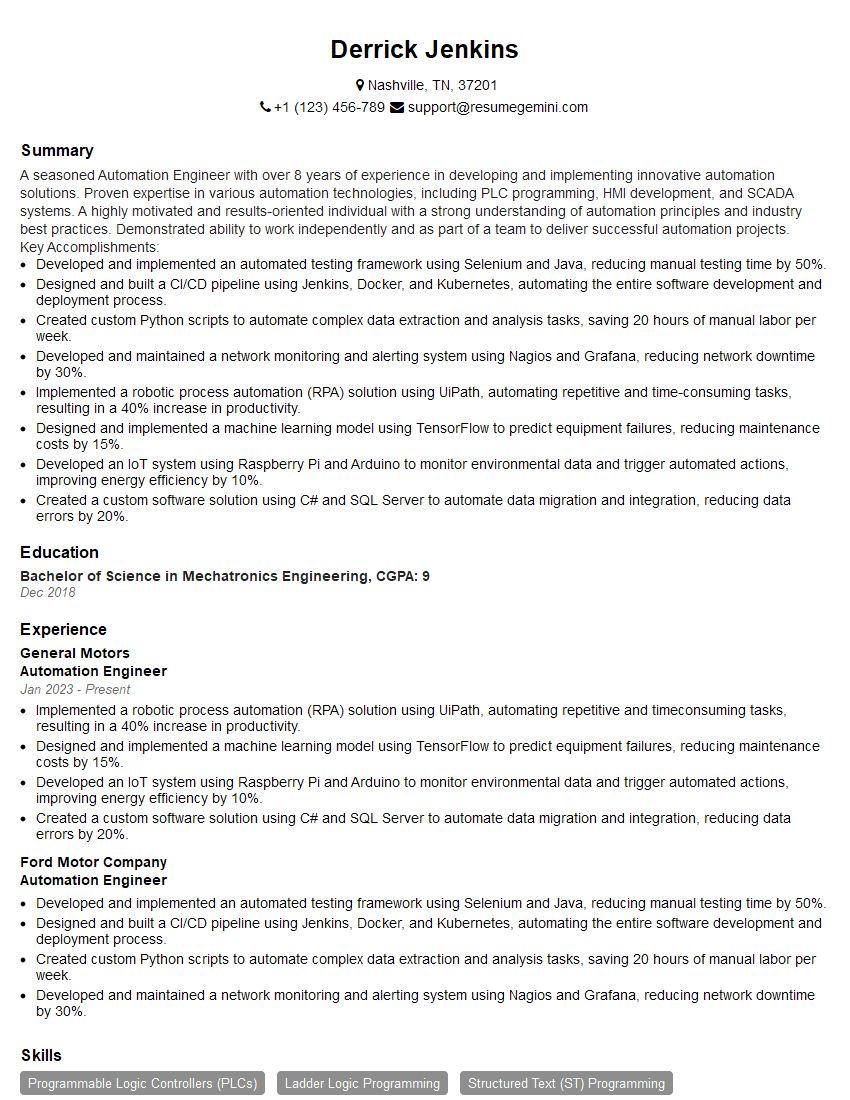
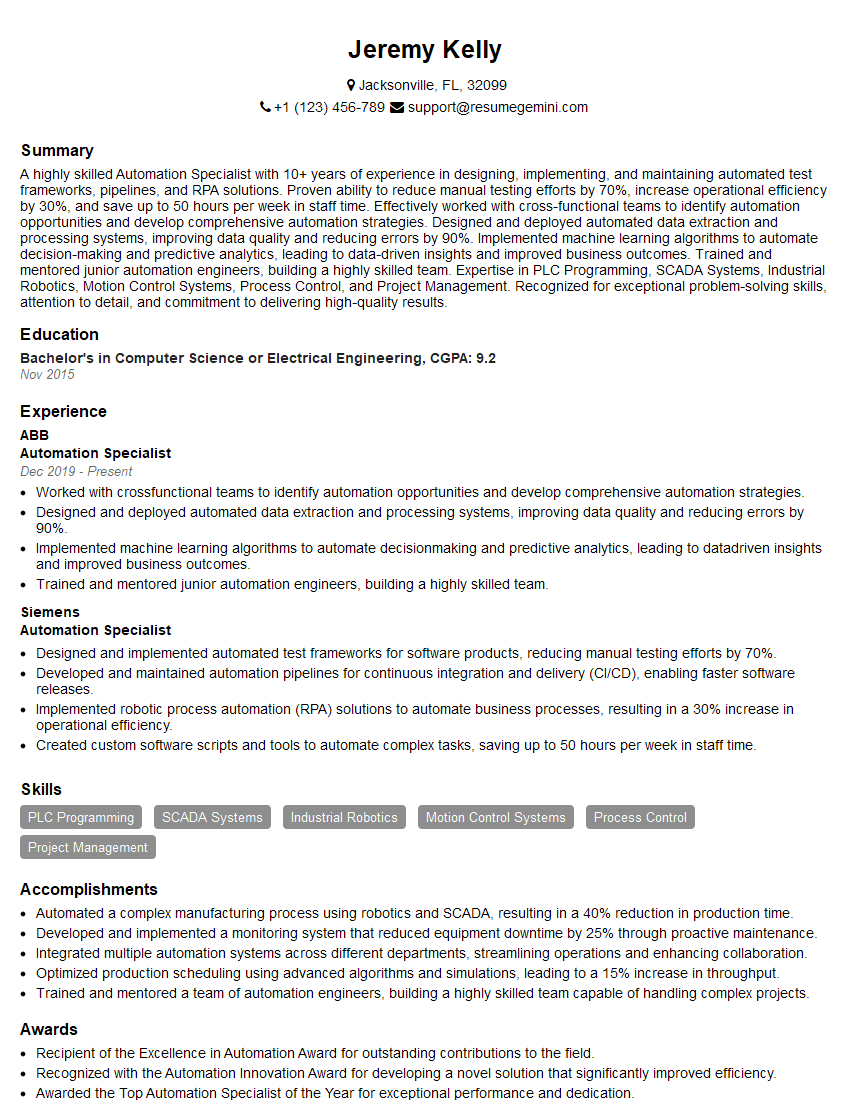
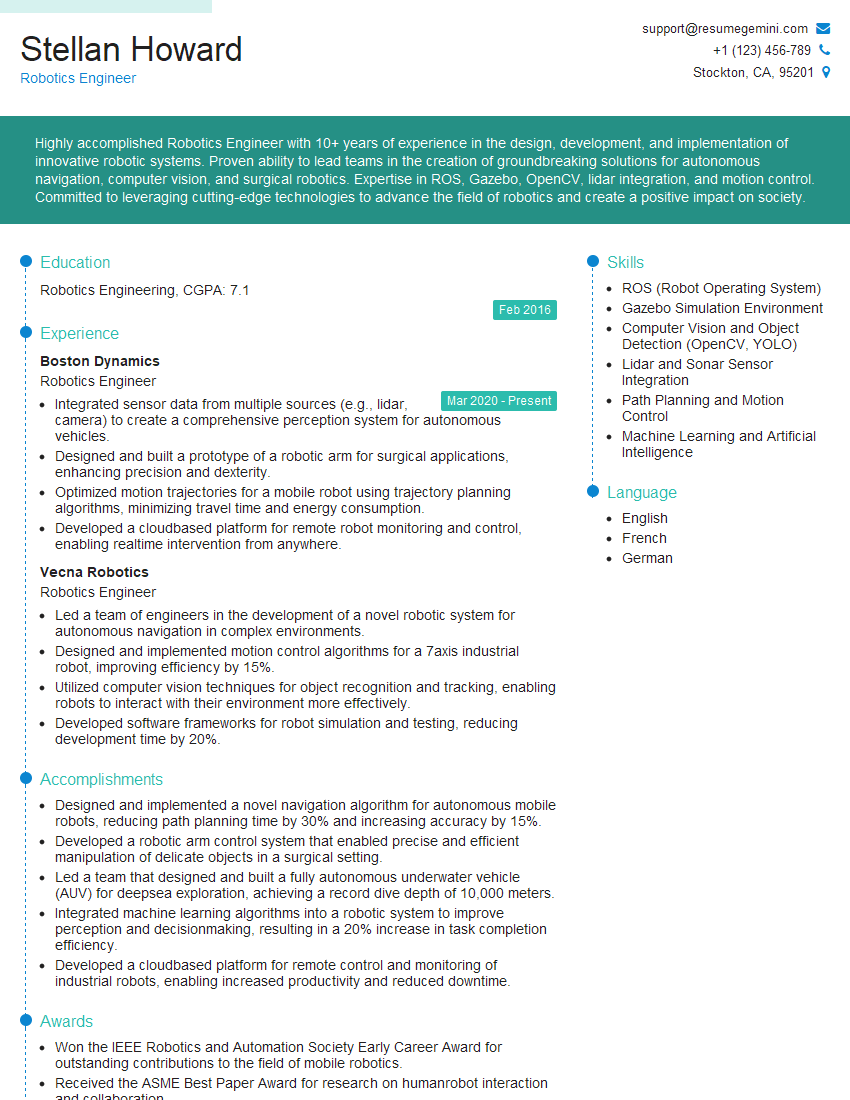
Mastering experience with automation systems is crucial for career advancement in today’s tech landscape. It opens doors to high-demand roles and allows you to contribute significantly to efficient and reliable software development. To maximize your job prospects, focus on creating a strong, ATS-friendly resume that highlights your skills and experience effectively. ResumeGemini can be a valuable resource in this process, helping you craft a professional and impactful resume that showcases your abilities. Examples of resumes tailored to highlight experience with automation systems are available to guide you.
Explore more articles
Users Rating of Our Blogs
Share Your Experience
We value your feedback! Please rate our content and share your thoughts (optional).
What Readers Say About Our Blog
I Redesigned Spongebob Squarepants and his main characters of my artwork.
https://www.deviantart.com/reimaginesponge/art/Redesigned-Spongebob-characters-1223583608
IT gave me an insight and words to use and be able to think of examples
Hi, I’m Jay, we have a few potential clients that are interested in your services, thought you might be a good fit. I’d love to talk about the details, when do you have time to talk?
Best,
Jay
Founder | CEO